Toll-Like Receptor Gene Polymorphisms and their Relationship with Performance and Immune Response in Sheep: A Systematic Review
· · ·
Affiliations & Notes ⌄
1Department of Agriculture and Animal Health, University of South Africa, Florida, 1709, Gauteng, South Africa. *Correspondence | Nkululeko Nyangiwe, Department of Agriculture and Animal Health, University of South Africa, Florida, 1709, Gauteng, South Africa
The results of this systematic review indicated that out of the 14 included studies, there were 79 different Single Nucleotide Polymorphisms (SNPs) found with the Exon 3 Being the most targeted genomic region.
Based on our knowledge, this is the first systematic review reporting on the association between SNPs of the TLRs in sheep and immune response or production in sheep.
The TRLs influence the immune response and production in sheep and as such, there were identified SNPs of TLR1, TLR2, TLR4, TLR5, TLR7 and TLR9.
The SNPs of the TLR9 improvement would improve the resistance of sheep to SRLVs infections and might be used as potentially viable genetic indicators for the betterment of immune response and c.1710C>A SNPs of TLR4 might be used for the betterment of milk production in sheep during breeding programs.
Selected from the article's own text.
Abstract
The discovery of Toll-like receptors (TLRs) opened the door to a better understanding of the organism’s defence mechanisms against infections. TLR family encodes several ancient immune receptors that recognize microbial conserved structural motifs termed as pathogen-associated molecular pattern (PAMPs). Studies that looked into genetic polymorphisms of TLR gene in sheep and their relationship with immune response have been conducted. Therefore, the objective of this systematic review was to systematically review the single nucleotide polymorphisms (SNPs) of the TLRs and their association with performance and immune response. Preferred Reporting Items for Systematic Reviews and Meta-Analysis (PRISMA) were used for the identification, screening, eligibility and inclusion and 14 studies were found to be eligible. The systematic review used four search engines (Pubmed, Science direct, google scholar and web of science) and components of the research question identification of the Population, Exposure and Outcomes (PEO) to gather eligible studies. The results indicated that nucleotide sequences of 6 different TLRs were identified in the included articles. The results demonstrated that the identified TLRs (4 and 9) had a relationship with milk traits, flystrike response, susceptibility/resistance to Small Ruminant Lentivirus infections (SRLVs), pathogen detection, incidence of mastitis pathogens and immune response to pathogens. The TLRs influence the immune response of sheep, as such (1, 2, 4, 5, 7 & 9) TLRs have the potential to be useful genetic markers for improving performance and disease susceptibility in sheep during breeding programmes. Further research must investigate associations of the polymorphisms and plant-derived agonists that can activate the TLRs.
Keywords | Innate immunity, Polymorphism, Candidate gene, Pathogens, Sheep, Association
Introduction
One of the most important processes in species evolution is host-pathogen competition . Recent research in the field of natural resistance of animals and humans has increased the chances of controlling the pathogenic, metabolic and hereditary disease . Sheep breeds and individuals exhibit genetic variation in their susceptibility to infections, which may present a chance for genetic selection for resistance to infectious diseases by identifying the genes responsible and investigating host-resistance mechanisms . The discovery of Toll-like receptors (TLRs) opened the door to a better understanding of the organism’s defence mechanisms against infections .
Toll-like receptor (TLR) family encodes several ancient immune receptors that recognize microbial conserved structural motifs termed as pathogen-associated molecular pattern (PAMPs) . Liu et al. (2021) reported that TLRs are a family of proteins that are involved in the innate immune response and each TLR is able to identify patterns of molecules associated with pathogens, which can then trigger an innate immune response. TLR, a member of the interleukin-1 (IL-1) receptor superfamily, stimulates the immune system when microorganisms are present and enhances the immune system cells’ ability to present antigens and kill microorganisms . Additionally, they are divided into two subfamilies, the cell-surface TLRs and the intracellular TLRs, according to where they are located on or within the cell . Among the TLRs, ten different types of TLRs are present in sheep . TLRs 1, 2, 4–6, and 10, which are found on the cell surface, identify components of bacterial and other microbial cell walls, whereas TLRs 3, 7, 8, and 9, which are found intracellularly, particularly in endosomes, identify the nucleotide components of viruses and bacteria .
Studies have shown that TLRs, which are a component of innate immunity, play a crucial role in host-pathogen interaction ; ; ; . Several studies, Zhou and Hickford (2008), Smith et al. (2012), Yang et al. (2018), Yaman (2020), Arcangeli et al. (2021) and Liu et al. (2021) have investigated the genetic polymorphisms of TLR gene in sheep and their relationship with immune response. Although some research has examined the connection between TLR genes and immune response, there is no conclusive data to draw firm conclusions about how TRL genes affect immune response and production in sheep. As a result, a systematic review of the research findings will advance our understanding of TRLs as significant candidate genes for immune response and productive traits in sheep. Thus, this study will add knowledge on the use of TRLs as one of the candidate genes for performance traits and immune response in sheep.
Materials and Methods
Eligibility criteria
Prior to conducting the systematic review, the Population, Exposure, and Outcomes (PEO) components of the research question were identified as described by Bettany-Saltikov (2010). The population was described as “Sheep”, which was exposed to “Polymorphisms” and outcomes of “Immune responses/adaptive immunity”. Prior to the decision to conduct the systematic review, a preliminary search of the PEO components was conducted on the PubMed database.
Literature search
The two authors (Thabang Sako and Nkululeko Nyangiwe) used the databases of Google Scholar, PubMed, Science Direct, and Web of Science to search for research publications up until July 16, 2025, using the following keywords: ‘Toll-like receptors’, ‘polymorphisms/genetic variations’, ‘Immune response/adaptive immunity’, and ‘sheep’.
Inclusion criteria
All the obtained articles were deemed eligible if they met the following criteria: (1) the Toll-like receptor gene was being studied; (2) the polymorphisms of the Toll-like receptor gene were included; and (3) sheep were the species of interest.
Exclusion criteria
The criteria for exclusion involved: (1) duplicated records; (2) lacking the association of TLRs polymorphisms to immune response/adaptive immunity; (3) and studies that inferred association without association analysis with immune response/adaptive immunity.
Data extraction
The content that was extracted was done independently by the two authors (Thabang Sako and Nkululeko Nyangiwe). The contents extracted from the articles include the name of the 1st author, the year the article was published, country, breed, population size, Toll-like receptor gene number and observed genotypes.
Results
Search results
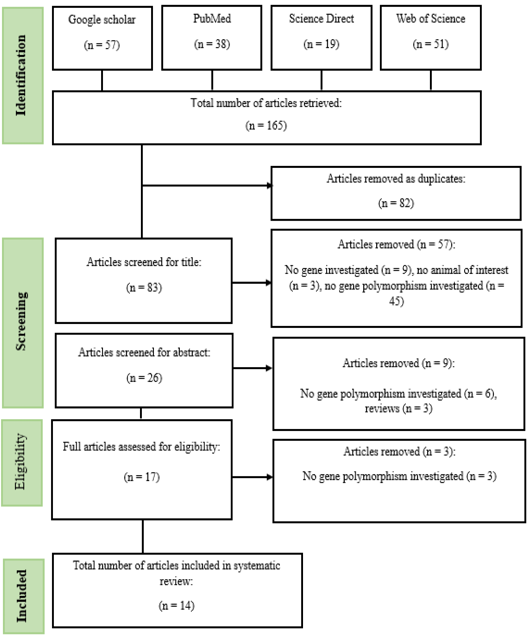
A total of 165 articles were retrieved for the systematic review from the following databases: Google Scholar (n = 57), PubMed (n = 38), Science Direct (n = 19), and Web of Science (n = 51). After removing the duplicates (n = 82) that appeared between the search databases, the remaining articles underwent additional analysis for inclusion and exclusion criteria. The remaining articles (n = 83) were screened for their title, and 57 (n = 57) were eliminated. Next, the abstract was screened, and nine (n = 9) were eliminated. Three (n = 3) articles were eliminated from the entire article search, leaving a total of eighteen (n = 14) articles to be included in the systematic review.
Characteristics of included studies
A total number of fourteen articles (n = 14) of the hundred and sixty-five analysed were kept and incorporated in the systematic review as shown in Table 1. Each author had one (n= 1) each of the 14 included articles except for Smith , 2014) Yaman ; and Zhou ; who had two (n= 2) articles each in the 14 included articles. The used articles ranged from 2006 to 2024. The articles were from nine differing countries. The sample size of sheep utilised ranged from 50-1 750, with 28.57%, (n= 4) of the studies ranging from 50-150 sheep used. The included studies investigate the toll-like receptors (TLRs) and their association with traits in sheep with the Merino sheep probing most, being investigated in (n= 4) studies which is 28.57% of included articles. The included studies investigated six different TLRs (1, 2, 4, 5, 7 and 9), with TRL4, 50%, being the most investigate TLR. Polymerase chain reaction- single strand conformation polymorphism (PCR-SSCP) was the most used genotyping method, with 50% of the 14 articles that were included.
Table 1: General characteristics of studies included in the review.
Author
Year
Country
Breed
N
Sex
Gene
Trait
Genotypic method
Arcangeli et al.,
2021
Italy
Italian sheep
493
N/A
TLR 9
SRLV infection
PCR qPCR
Byun et al.,
2009
New Zealand
N/A
1 670
N/A
TLR 4
Immune response, Disease susceptibility
PCR-SSCP
Liu et al.,
2021
New Zealand
Merino, Corriedale, Perendale, Romney, Lincoln, Coopworh, Poll Dorset, Texel, Finn, Dorset Down, Suffolk, South Suffolk, Shropshire, and various crossbred sheep and composites)
212
N/A
TLR 9
Flystrike susceptibility
PCR-SSCP
Sallam,
2021
Egypt
Barki
311
Females
TLR 4
Milk traits
PCR-SSCP
Sarafidou et al.,
2013
Greece
Boutsko-breed (n=56), Friesarta-breed (n=27) and Comisana breed (n=32)
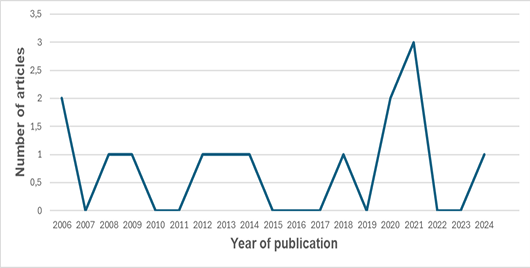
The 14 included studies’ publication years are shown in Figure 2. The results demonstrate that the included studies came from 2006-2024. Out of 14 articles, the majority were published in 2021 with three articles out of 14 ; ; 2 years (2006 and 2020) included two studies each and seven years (2008, 2009, 2012, 2013, 2014, 2018, and 2024) included one study each out of 14.
Publication by country
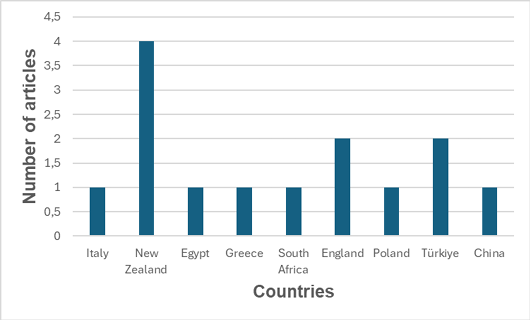
The included studies’ country of publication is shown in Figure 3. The findings indicate that the fourteen included studies were carried out in nine differing countries. There were four articles in New Zealand ; ; ; , 2 countries (England and Türkiye) had two articles each and 6 countries (Italy, Egypt, Greece, South Africa, Poland and China) had one study each.
Distribution by journal
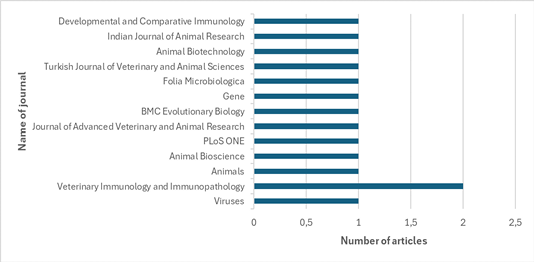
The distribution of included studies by journal is shown in Figure 4. The results showed that they were published in thirteen different international journals including viruses, veterinary immunology and immunopathology, animals, animal bioscience, plos one, journal of advanced veterinary and animal research, BMC evolutionary biology, gene, folia microbiologica, Turkish journal of veterinary and animal sciences, animal biotechnology, Indian journal of animal research, and developmental and comparative immunology. Veterinary immunology and immunopathology contributed three journals ; , while the rest of the journals contributed each on the other 14 included articles.
Identified single nucleotide polymorphisms (SNPs) and targeted genomic region
Table 2 displays the identified SNPs along with the genomic regions of the TLRs under investigation. Nine of the fourteen included articles identified the SNPs and their targeted regions, according to the findings. The findings identified a total of 18 SNPs for TLR2, 23 SNPs for TLR4, 25 SNPs for TLR5, 5 SNPs for TLR7 and 8 SNPs for TLR9. The results indicated that the TLR4 SNPs were found on exon 2 and 3 while TLR9 SNPs were found on exon 2. 8 articles (57.14%) out of the 14 includes articles indicated the genomic regions of the identified SNPs.
Genotypic frequencies
The reported genotypic frequencies of the include studies are shown in Table 3. A total of 21 discovered genotypes were reported throughout the study. The results indicated that the TLR4 reported in the two studies showed 2 and 3 genotypes, respectively. TLR9 reported 3 genotypes while TLR7 reported 3 genotypes and 2 genotypes. Yang et al. (2018) reported the highest genotypic frequency (0.942) and the lowest genotypic frequency (0.058).
Allelic frequencies
The allelic frequencies of the included studies are presented in Table 4. A total of 50 discovered alleles were reported throughout the study. The results showed that 6 out of 14 included articles were clear about the allelic frequencies, while 8 were not. The reported alleles for TLR1, TLR2, TLR4 and TLR9 were 4, 10, 30 and 6, respectively. The highest (0.973) and lowest (0.023) allelic frequencies were reported by Świderek et al. (2006).
Single nucleotide polymorphisms and their associations with sheep production traits
The SNPs and their associations with production traits and immune response are shown in Table 5. The results showed that the 14 included studies studied immune responses to various infections and milk production traits and their associations with the genotypes of identified SNPs of the TLRs. The results indicated a significant relationship between the genotypes of TLR9 SNPs and the small ruminant lentiviruses infection. No significant relationship we indicated between the infections of m. avium subsp. Paratuberculosis and C. abortus and genotypes of TLR9 SNPs. The genotypes of the SNPs of TLR4 showed a significant relationship with 2 milk traits (fat percentage and protein percentage) and non-significant relationship with 2 milk traits (total solids percentage and daily milk yield).
Discussion
Infectious diseases have a negative impact on sheep health and productivity . In addition to triggering the adaptive immune response, innate immune mechanisms offer a first line of defense against infection by
Table 5: Single nucleotide polymorphisms and their associations with immune response and sheep production traits as reported by original studies.
Author
Breed
TLR
Traits
Genotypes
Significance
Arcangeli et al.,2021
Italian sheep
TLR9
SRLVs Infection
QQ RQ RR
*
AA AS SS
*
RR GR GG
*
Sallam et al., 2021
Barki
TLR4
DMY
TT GT GG
ns
FP
TT GT GG
*
PP
TT GT GG
*
LP
TT GT GG
ns
TSP
TT GT GG
ns
Sarafidou et al., 2013
Boutsko-breed, Friesarta-breed and Comisana breed
TLR9
SRLV
RR GG GR
*
CA
RR GG GR
ns
MAP
RR GG GR
ns
Yaman et al., 2020
Karacabey merino, Kivircik, Imroz, Chios, Cine capari and Karakacan
TRL4
Eimeria spp.
N/A
*
N/A
ns
TLR4: toll-like receptor 4; TLR9: toll-like receptor 9; SRLVs: small ruminant lentiviruses; DMY: daily milk yield (g/d); FP: fat percentage; PP: protein percentage; LP: lactose percentage; TSP: total solids percentage; CA: C. abortus; MAP: m. avium subsp. Paratuberculosis; * Significance estimated at p<0.05; ns: non-significant p>0.05; N/A; not available.
identifying and eliminating pathogens . According to Liu et al. (2021), a family of proteins known as toll-like receptors (TLRs) is involved in the innate immune response. This systematic review was conducted to establish the impact of TLRs on the performance and immune response in sheep.
The results of this systematic review indicated that out of the 14 included studies, there were 79 different Single Nucleotide Polymorphisms (SNPs) found with the Exon 3 Being the most targeted genomic region. Arcangeli et al. (2021) investigated the TLR4 in Italian sheep and identified three SNPs (R447Q, A462S and G520R) that had a relationship with the small ruminant lentiviruses. Byun et al. (2009) investigated the TLR4 in sheep and identified 12 SNPs (T955C, T1013C, G1032C, A1045G, G1052A, T1066C, A1088G, T1091C, C1097G, C1132T, G1166C and G1183T) at exon 4. Sallam (2021) investigated TLR4 and discovered a c.1710C>A SNP an association between the TLR4 and fat percentage or protein percentage, while there was no association between the TLR and daily milk yield or total solids percentage reported in Barki ewes. Sarafidou et al. (2013) reported associations between the G520C SNP and small ruminant lentiviruses while there were no associations between the SNP and M. avium subsp. Paratuberculosis or C. abortus in the three breeds (Friesarta-breed, Boutsko-breed and Comisana breed) that were investigated.
Study by Selala et al. (2024) on TLR4 in Dorper sheep identified a SNP (T2249) at Exon 2. Smith et al. (2012) investigated the evolution of TLR5 in domestic animals and detected twenty-five SNPs (G33G, C46A, G210G, C275C, G339G, C360C, T396T, A731A, T906T, C1200C, A1474G, C1531A, A1536A, G1698G, T1887T, A1953A, A1976A, A1977A, A2016A, A2047G, T2157T, A2276A, G2353C, T2394T and A2418A) in Blackface, Texel, Blueface, Dorper, Djallonke, Dorset, Red Maasai, Latxa, Suffolk, Soay sheep. The study of Smith et al. (2014) investigating the novel ovine polymorphisms and adaptive evolution in mammalian TLR2 suggest existence of multiple pathogen binding regions identified 18 SNPs (C615C, G674G, C943C, G1162T, A1401A, C1688C, G1731G, C1737C, T1749T, C1949C, T2008C, T2037T, A2055A, C2089T, C2168C, G2232G, G2235G and C2238C) spread across the Blackface, Blueface, Djallonke, Dorper, Dorset, Latxa, Red Maasai, Suffolk, Texel and Soay sheep breeds. Świderek et al. (2006) investigated TLRs and their associations with the natural bacterial infections of the mammary gland and somatic cell concentrations in sheep and detected two alleles of TLR1, six alleles of TLR2 and nine alleles of TLR4 in the Polish Heath sheep ewes and detected two alleles of TRL1, four alleles of TLR2 and six alleles of TLR4 in Polish Lowland sheep ewes. Yaman (2020) investigated TLR4 in three Türkish native (Kıvırcık, Karacabey merinosu and İmroz) and 4 composite (Ramlıç, Bandırma, Hampshire crossbred and Black head mutton merino crossbred-SBA) and identified 15 SNPs (G688A, A857G, G873A, G881A, A883G, T892C, C897T, G1032C, G1052A, T1066C, A1088G, T1091C, C1097G, C1132T and G1183T) on exon 3 and reported that there were no associations detected between the investigated TLR4 and paratuberculosis in composite sheep and Türkish native sheep. The study by [] investigated TLR4 in six indigenous Turkish sheep breeds (Kivircik, Karacabey merino, Chios (Sakiz), Imroz (Gokceada), Cine capari and Karakacan) and identified 14 SNPs A857G, G873A, G881A, A883G, T892C, C897T, T1066C, A1088G, T1091C, C1097G, C1132T, G1183T, G1540A and G2037A) of Exon 3 and a relationship between SNP T1066C and Eimeria spp. infection (coccidiosis) was detected.
Yang et al. (2018) examined the polymorphisms of TLR7 in Suffolk and Kazak sheep and identified three SNPs (A343G, A350G and G864A) in Kazak sheep and five SNPs (A343G, A350G, G864A, T1185C and A1244G) in Suffolk sheep. Therefore, two SNPs (T1185C and A1244G) were identified in Suffolk and not found in Kazak sheep. Zhou and Hickford (2008) investigated the variation of the TLR9 gene in sheep and identified four SNPs (C1323T, G1340A, G1384T and G1452A) in the New Zealand Romney sheep. Zhou et al. (2006) investigated the allelic variation of the TRL4 gene in sheep and identified fourteen SNPs (A857G, G873A, G881A, A883G, T892C, C897T, G1032C, G1052A, T1066C, A1088G, T1091C, C1097G, C1132T and G1183T) in the five sheep breeds (Merino, Romney, Corriedale, NZ cross-bred sheep and Poll Dorset).
The contribution of this systematic review to the body of knowledge is that there were eighteen (C615C, G674G, C943C, G1162T, A1401A, C1688C, G1731G, C1737C, T1749T, C1949C, T2008C, T2037T, A2055A, C2089T, C2168C, G2232G, G2235G and C2238C) identified SNPs for TLR2, twenty-three (G688A, A857G, G873A, G881A, A883G, T892C, C897T, T955C, T1013C, G1032C, A1045G, G1052A, T1066C, A1088G, T1091C, C1097G, C1132T, G1166C, G1183T, G1540A, c.1710C>A, G2037A and T2249C) Identified SNPs for TLR4, twenty-five (G33G, C46A, G210G, C275C, G339G, C360C, T396T, A731A, T906T, C1200C, A1474G, C1531A, A1536A, G1698G, T1887T, A1953A, A1976A, A1977A, A2016A, A2047G, T2157T, A2276A, G2353C, T2394T and A2418A) identified SNPs for TRL5, five (A343G, A350G, G864A, T1185C and A1244G) identified SNPs for TLR7 and eight (C1323T, G1340A, C.1384G/T (p.Ala462Ser), G1452A, G1557C, c.1558C/G (p.Arg520Gly), T1571C and c.1572C/T) identified SNPs for TLR9. TLR4 SNPs were found on exon 3 and TLR9 SNPs were found on exon 2. Based on our knowledge, this is the first systematic review reporting on the association between SNPs of the TLRs in sheep and immune response or production in sheep. Therefore, there were no comparisons of the other systematic review in this field. The limitations of this systematic review are that (a) some articles identified SNPs and their relationship with immune response was not disclosed and (b) identified SNPs were not similar in the included studies which make is not feasible to conduct a meta-analysis.
Conclusions and Recommendations
The TRLs influence the immune response and production in sheep and as such, there were identified SNPs of TLR1, TLR2, TLR4, TLR5, TLR7 and TLR9. The SNPs of the TLR9 improvement would improve the resistance of sheep to SRLVs infections and might be used as potentially viable genetic indicators for the betterment of immune response and c.1710C>A SNPs of TLR4 might be used for the betterment of milk production in sheep during breeding programs.
Acknowledgements
This work was supported by the University of South Africa through their Post-Doctoral fellowship grants.
Novelty statement
This study offers valuable information on how TLRs can be used as candidate genes for production traits and immune response in sheep. The findings provide important insights on sheep selection and breeding for improved performance and immune response.
Author’s contribution
This manuscript was written with input from all authors. Thabang Sako wrote the manuscript’s initial draft. Mpho Tawana, Nkululeko Nyangiwe, and Ntombikhona Koza then made revisions to the manuscript. Every author reviewed and approved the final manuscript.
Ethical considerations
All authors took into account ethical concerns such as plagiarism, misconduct, informed consent, fabrication, and data falsification.
Generative AI and AI-assisted technology statement
The authors declare that this manuscript was prepared without the use of Generative AI.
Conflict of interest
The authors have declared no conflict of interest.
Figures
Figure 1:.
Study selection flow diagram.
Figure 2:.
Publication by year.
Figure 3:.
Distribution by country.
Figure 4:.
Publication by journal.
References
Alan A, Alan E, Arslan K, Daldaban F, Aksel EG, Çınar MU, Akyüz B (2022). LPS-and LTA-induced expression of TLR4, MyD88, and TNF-α in lymph nodes of the Akkaraman and Romanov lambs. Microsc. Microanal., 28(6): 2078-2092. https://doi.org/10.1017/S1431927622012314[CrossRef]
Arcangeli C, Lucarelli D, Torricelli M, Sebastiani C, Ciullo M, Pellegrini C, Felici A, Costarelli S, Giammarioli M, Feliziani F, Passamonti F (2021). First survey of SNPs in TMEM154, TLR9, MYD88 and CCR5 genes in sheep reared in Italy and their association with resistance to SRLVs infection. Viruses, 13(7): 1290. https://doi.org/10.3390/v13071290[CrossRef]
Bettany-Saltikov J (2010). Learning how to undertake a systematic review: Part 1. Nurs. Stand., 24(50): 47-55. https://doi.org/10.7748/ns2010.08.24.50.47.c7939[CrossRef]
Byun SO, Zhou H, Hickford JGH (2009). Development of a simple typing method for the ovine Toll-like receptor 4 gene. Vet. Immunol. Immunopathol., 130(3-4): 272-274. https://doi.org/10.1016/j.vetimm.2008.12.025[CrossRef]
Chang J-S, Russell GC, Jann O, Glass EJ, Werling D, Haig DM (2009). Molecular cloning and characterization of toll-like receptors 1-10 in sheep. Vet. Immunol. Immunopathol., 127: 94–105. https://doi.org/10.1016/j.vetimm.2008.09.026[CrossRef]
Liu X, Zhou H, Gong H, Liu W, Fang Q, Luo Y, Wang J, Li S, Hu J, Hickford JGH (2021). Ovine toll-like receptor 9 (TLR9) gene variation and its association with flystrike susceptibility. Animals, 11: 3549. https://doi.org/10.3390/ani11123549[CrossRef]
Sallam AM (2021). A missense mutation in the coding region of the toll-like receptor 4 gene affects milk traits in Barki sheep. Anim. Biosci., 34(4): 489-498. https://doi.org/10.5713/ajas.19.0989[CrossRef]
Sarafidou T, Stamatis C, Kalozoumi G, Spyrou V, Fthenakis GC, Billinis C, Mamuris Z (2013). Toll like receptor 9 (TLR9) polymorphism G520R in sheep is associated with seropositivity for small ruminant lentivirus. PLoS One, 8(5): e63901. https://doi.org/10.1371/journal.pone.0063901[CrossRef]
Selala LJ, Chitura TL, Mbazima V, Tyasi TL (2024). Genetic variations of Toll-like receptor 4 gene in exon 2 of South African Dorper sheep. J. Adv. Vet. Anim. Res., 11(2): 302–305. https://doi.org/10.5455/javar.2024.k777[CrossRef]
Smith SA, Haig D, Emes RD (2014). Novel ovine polymorphisms and adaptive evolution in mammalian TLR2 suggest existence of multiple pathogen binding regions. Gene, 540(2): 217-225. https://doi.org/10.1016/j.gene.2014.02.032[CrossRef]
Smith SA, Jann OC, Haig D, Russell GC, Werling D, Glass EJ, Emes RD (2012). Adaptive evolution of Toll-like receptor 5 in domesticated mammals. BMC Evol. Biol., 12(1): 122-131. http://www.biomedcentral.com/1471-2148/12/122
Świderek WP, Bhide MR, Gruszczyńska J, Soltis K, Witkowska D, Mikula I (2006). Toll-like receptor gene polymorphism and its relationship with somatic cell concentration and natural bacterial infections of the mammary gland in sheep. Folia Microbiol., 51(6): 647-652. https://doi.org/10.1007/BF02931633[CrossRef]
Yaman Y (2020). Association of toll-like receptor 4 (TLR 4) gene exon 3 variants with serostatus of theovine Johne’s disease (paratuberculosis) in Turkish sheep. Turk. J. Vet. Anim. Sci., 44(3): 542-547. https://doi.org/10.3906/vet-1909-98[CrossRef]
Yaman Y, Aymaz R, Keleş M, Bay V, Özüiçli M, Şenlik B (2021). Association between ovine toll-like receptor 4 (TLR4) gene coding variants and presence of Eimeria spp. in naturally infected adult Turkish native sheep. Anim. Biotechnol., 32(3): 375-380. https://doi.org/10.1080/10495398.2020.1824921[CrossRef]
Yang X, Liang T, Zhang X, Yang SF, Wu P, Xiao YY, Chen XK, Song JW, Yan GQ, Sheng JL (2018). Examination of polymorphisms in the sequence encoding the extracellular domain of Suffolk and Kazak sheep’s Toll-like receptor 7. Indian J. Anim. Res., 52(7): 968-973.
Zhou H, Hickford JG (2008). Polymorphism of Toll-like receptor 9 (TLR9) gene in sheep. Vet. Immunol. Immunopathol., 121(1-2): 140-143. https://doi.org/10.1016/j.vetimm.2007.07.001[CrossRef]
Zhou H, Hickford JG, Fang Q, Lin YS (2006). Allelic variation of the ovine Toll-like receptor 4 gene. Dev. Compar. Immunol., 31(2): 105-108. https://doi.org/10.1016/j.dci.2006.05.006[CrossRef]