
Antibiotic drug resistance in E. coli is a worldwide health problem. Particularly, increasingly reported carbapenem resistance due to carbapenemases is highly worrisome. Literature regarding incidence of class B metallo-β-lactamases (MBLs) - producing E. coli has not yet judiciously been addressed. In this study, we investigated the occurrence of carbapenemase- and MBLs-producers among a collection of 100 carbapenem resistant E. coli obtained from a tertiary hospital at Lahore Pakistan. All carbapenemase producers were further investigated to identify frequency of blaIMP and blaVIM encoding genes. Results of modified hodge test identified 81% carbapenemase producers, while combined disc diffusion test identified 28 isolates as MBL producers among them. Of all carbapenemase producers, 25 isolates (30.8%) of carbapenemase-producing E. coli were found to harbor bla-VIM gene, while 13 isolates (16.04%) were found to carry blaIMP gene. We report on high incidence rate of carbapenemase producers among carbapenem resistant E. coli isolates.
Short Communication · Volume 51, Issue 5, 5 August 2019 · Open Access
Incidence of blaIMP and blaVIM Genes among Carbapenemase Producing Escherichia coli in Lahore, Pakistan
· · · ·
Affiliations & Notes ⌄
- 1Department of Pathology, Microbiology Section, Continental Medical College, Lahore, Pakistan 2Department of Immunology, University of Health Sciences, Lahore, Pakistan 3School of Biomedical Sciences and Astbury Centre for Structural Molecular Biology, University of Leeds, Leeds, UK 4Institute of Basic Medical Sciences, Khyber Medical University, Peshawar, Pakistan 5College of Veterinary Sciences and Animal Husbandry, Abdul Wali Khan University, Mardan, Pakistan
Article Info ⌄
- Journal:
- Pakistan Journal of Zoology
- Published:
- 5 August 2019

From the article
- Results showed that all of these 100 isolates of E. coli were carbapenem non-susceptible, all being resistant to imipenem (100%) and meropenem (100%).
- Out of these 100 isolates, 81 were found positive for carbapenemase production based on Modified Hodge Test, whilst only 28 isolates were phenotypically positive for MBL production.
- It is concluded that E. coli isolated from different patients at a tertiary care hospital at Lahore indicate high prevalence of carbapenemase production stains comprising MBL.
- This suggests to restrict the use of carbapenem drugs in order to restrict further dissemination of resistance.
Selected from the article's own text.
Abstract
Materials and methods
This study was conducted between Sept 2017 and April 2018. A total of one hundred non duplicate E. coli isolates, which were found resistant to at least one carbapenem drug were obtained from collection of a tertiary care hospital at Lahore, Punjab Pakistan.. E. coli was reconfirmed on the basis of colonial characteristics and morphology and biochemically using an API 20E Test System for Enterobacteriaceae (bioMérieux, France). Antimicrobial susceptibility of isolates was tested by the Kirby-Bauer disc diffusion method using mueller-hinton agar (Oxoid, UK), according to Clinical Laboratory Standards Institute (CLSI). The antibiotic discs contained imipenem (10 µg) and meropenem (10 µg). Carbapenemase-producing E. coli were identified by the modified hodge test and phenotypic detection of MBL was done by a combined disc diffusion method as per guidelines of Clinical laboratory Standard Institute . In the combined disc test, if the increase in inhibition zone and imipenem-EDTA disc was ≥7 mm than the imipenem alone, the test was considered as MBL-positive.
Isolates found positive for carbapenemase production were subjected to PCR based identification for blaIMP and blaVIM using primers described in Table I. Plasmid DNA was extracted through plasmid isoaltion kit (TIANGEN Biotech Beijing, Co., Ltd.). The quality and quantity of extracted DNA was determined through nanodrop as well gel electrophoresis. Primers for PCR were synthesized by GeneLink, while master mix was purchased from Thermo Scientific. PCR reaction was performed in a total of 25µl reaction mixture. PCR was performed at a range of temperatures of 50-56°C and the optimum temperature was identified as 55°C.
Results and discussion
All E. coli isolates were picked up from carbapenem-resistant culture collection and were tested again against meropenem and imipenem antibiotics to ensure its resistance pattern against carbapenem drugs. Results showed that all of these 100 isolates of E. coli were carbapenem non-susceptible, all being resistant to imipenem (100%) and meropenem (100%). Out of these 100 isolates, 81 were found positive for carbapenemase production based on Modified Hodge Test, whilst only 28 isolates were phenotypically positive for MBL production. Our current observed incidence rate of carbapenemase production among imipenem-resistant E. coli is higher as compared to previous report of 37.1% from Lahore in 2015 . Furthermore, in the same study, Ain et al. (2018) observed an overall 63.38% frequency of occurrence of MBL among all clinical isolates as compared to 28% observed in our study . This suggests that in the current study, MBL incidence rate was found much lower as compared to previous study. This could be the strain difference, as we have only focused on E. coli while, Ain et al. (2018) studied overall prevalence among different strains including E. coli. Our results showed that 25 isolates (30.8%) of
Table I.- Primers used for PCR amplification of blaIMP and blaVIM genes.
| Target gene | Primer | Primer sequence (5′- 3′) | Amplicon size (bp) | Reference |
| blaIMP | IMP-F | CTACCGCAGCAGAGTCTTTG | 587 bp | Senda et al. (1996) |
| IMP-R | AACCAGTTTTGCCTTACCAT | |||
| blaVIM | VIM-F | AGTGGTGAGTATCCGACAG | 261 bp | Mavroidi et al. (2000) |
| VIM-R | ATGAAAGTGCGTGGAGAC |
carbapenemase-producing E. coli were found to harbor bla-VIM gene, while 13 isolates (16.04%) were found to carry blaIMP gene (Fig. 1). All PCR amplicon of the targeted genes were sequenced and confirmed through BLAST. A recent study from district Lahore concluded that of 100 carbapenem resistant isolates, 93 and 89 isolates were positive for carbapenemase and β-lactamase production, respectively, while, 3.3% of these isolates were found positive for bla-IMP and 32.5% were found positive for bla-VIM . Our results are corroborates with the result of studies reported in India, Madagascar and Brazil where 94.4%, 89.8% and 88.2% carbapenemase positivity was described among gram-negative bacteria, respectively ; ; . Other studies suggest widespread presence of carbapenemase encoding genes in other parts of Paksitan suggesting to initiate steps to discourage dissemination of these features. This suggest that incidence of carbapenemase producers are quite high with considerably proportion of strains carrying bla-IMP gene. The higher incidence rate of MBL and subsequent higher occurrence of bla-IMP and bla-VIM genes in our clinical isolates is possibly due to the ability of E. coli to capture novel resistance genes through horizontal recombination located on the conjugative plasmids. The absence of bla-IMP and bla-VIM genes in the rest of carbapenem resistant strains does reflect that other types of carbapenemase encoding genes may also be present in the vicinity. It is speculated that other types of carbapenemase encoding genes such blaNDM-1, blaOXA-48 etc. may also be widespread in the area and should be investigated. In conclusion, the results describe here indicate high prevalence of carbapenemase-producing E. coli which, if not properly managed, will present a devastating challenge for the health care system of Pakistan.
Conclusion
It is concluded that E. coli isolated from different patients at a tertiary care hospital at Lahore indicate high prevalence of carbapenemase production stains comprising MBL. Majority of these isolates were encoding bla-IMP and bla-VIM genes, however, possibility of existence of other genes cannot be rule out. Notably, bla-VIM gene was found more prevalent (30.8%) than the bla-IMP gene (16.04%). This suggests to restrict the use of carbapenem drugs in order to restrict further dissemination of resistance.
Acknowledgements
There was no funding available for the work.
Statement of conflict of interest
The authors have no conflicts of interest to report.
Figures
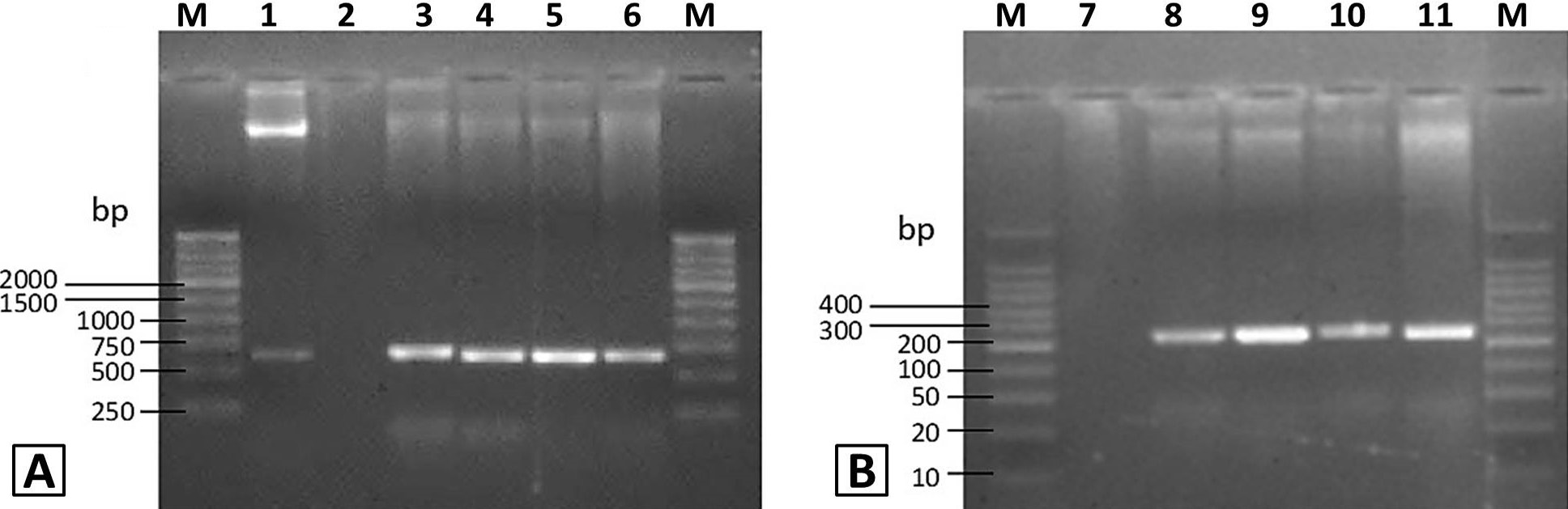
PCR amplification of blaIMP and blaVIM genes from E. coli isolates. Ethidium bromide stained agarose gel demonstrating PCR amplification of the blaIMP gene (A) and the blaVIM gene (B) from E. coli isolates. Lane M, base pair size markers; Lane 1, positive control; Lane 2 and 7, negative control; Lanes 3 to 6, blaIMP gene positive samples; Lanes 8 to 11, blaVIM gene positive samples.
References
- Adnan, M., Khan, H., Kashif, J., Ahmad, S., Gohar, A., Ali, A., Khan, M.A., Shah, S.S.A., Hassan, M.F. and Irshad, M., 2017. Pakistan Vet. J., 37: 230-232.
- Ain, N.U., Iftikhar, A., Bukhari, S.S., Abrar, S., Hussain, S., Haider, M.H., Rasheed, F. and Riaz, S., 2018. Antimicrob. Resist. Infect. Contr., 7: 128. https://doi.org/10.1186/s13756-018-0417-y[CrossRef]
- Akhtar, J., Saleem, S., Shahzad, N., Waheed, A., Jameel, I., Rasheed, F. and Jahan, S., 2018. Pakistan J. Zool., 50: 2343-2349. https://doi.org/10.17582/journal.pjz/2018.50.6.2343.2349[Full text][CrossRef]
- Ali, T., Rahman, S., Zhang, L., Shahid, M., Zhang, S., Liu, G., Gao, J. and Han, B., 2016. Front. Microbiol., 7: 1931. https://doi.org/10.3389/fmicb.2016.01931[CrossRef]
- Ali, T., Rahman, S., Zhang, L., Shahid, M., Han, D., Gao, J., Zhang, S., Ruegg, P.L., Saddique, U. and Han, B., 2017. Oncotarget, 8: 90144. https://doi.org/10.18632/oncotarget.21496[CrossRef]
- Amin, A., Khan, M.A., Azam, S.M.F. and Haroon, U., 2011. J. Ayub med. Coll. Abbottabad, 23: 19-22.
- Amudhan, M.S., Sekar, U., Kamalanathan, A. and Balaraman, S., 2012. J. Infect. Devel. Count., 6: 757-762.
- Andriamanantena, T.S., Ratsima, E., Rakotonirina, H.C., Randrianirina, F., Ramparany, L., Carod, J.F., Richard, V. and Talarmin, A., 2010. Annls. clin. Microbiol. Antimicrob., 9: 17. https://doi.org/10.1186/1476-0711-9-17[CrossRef]
- Aqib, A.I., Nighat, S., Ahmed, R., Sana, S., Jamal, M.A., Kulyar, M.F.A., Khan, N.U., Sarwar, M.S., Hussain, M.A., Asadullah, Rahman, A. and Rahman, S., 2019. Pakistan J. Zool., 51: 307-315. http://dx.doi.org/10.17582/journal.pjz/2019.51.1.307.315[Full text][CrossRef]
- Bahar, M.A., Jamali, S. and Samadikuchaksaraei, A., 2010. Burns, 36: 826-830. https://doi.org/10.1016/j.burns.2009.10.011[CrossRef]
- Butt, T., Usman, M., Ahmad, R.N. and Saif, I., 2005. J. Pakistan med. Assoc., 55: 302-304.
- CLSI., 2016. Performance standards for antimicrobial susceptibility testing. Clinical and Laboratory Standard Institute, CLSI document, Wayne, PA. pp. M100–S124.
- Franco, M.R.G., Caiaffa-Filho, H.H., Burattini, M.N. and Rossi, F., 2010. Clinics, 65: 825-829. https://doi.org/10.1590/S1807-59322010000900002[CrossRef]
- Genc, O., Aksu, E. and Gulcan, A., 2016. J. Microbiol. Meth., 125: 8-11. https://doi.org/10.1016/j.mimet.2016.03.010[CrossRef]
- Griffin, P.M. and Tauxe, R.V., 1991. Epidemiol. Rev., 13: 60-98. https://doi.org/10.1093/oxfordjournals.epirev.a036079[CrossRef]
- Hasan, B., Perveen, K., Olsen, B. and Zahra, R., 2014. J. med. Microbiol., 63: 50-55. https://doi.org/10.1099/jmm.0.063925-0[CrossRef]
- Khattak, I., Mushtaq, M.H., Ayaz, S., Ali, S., Sheed, A., Muhammad, J., Sohail, M.L., Amanullah, H., Ahmad, I. and Rahman, S., 2018. Adv. exp. Med. Biol., 1057: 111-126. https://doi.org/10.1007/5584_2018_170[CrossRef]
- Lim, H., Pene, J. and Shaw, R., 1988. J. Bact., 170: 2873-2878. https://doi.org/10.1128/jb.170.6.2873-2878.1988[CrossRef]
- Mavroidi, A., Tsakris, A., Tzelepi, E., Pournaras, S., Loukova, V. and Tzouvelekis, L.S., 2000. J. Antimicrob. Chemother., 46: 1041-1043. https://doi.org/10.1093/jac/46.6.1041[CrossRef]
- Meletis, G., 2016. Therap. Adv. Infect. Dis., 3: 15-21. https://doi.org/10.1177/2049936115621709[CrossRef]
- Nordmann, P., Naas, T. and Poirel, L., 2011. Emerg. Infect. Dis., 17: 1791. https://doi.org/10.3201/eid1710.110655[CrossRef]
- Nordmann, P., Dortet, L. and Poirel, L., 2012. Trends mol. Med., 18: 263-272. https://doi.org/10.1016/j.molmed.2012.03.003[CrossRef]
- Rahman, S., Ali, T., Ali, I., Khan, N.A., Han, B. and Gao, J., 2018a. Biomed Res. Int., 2018: 9519718. https://doi.org/10.1155/2018/9519718[CrossRef]
- Rahman, S., Ali, T., Muhammad, N., Umer, T., Ahmad, S., Ayaz, S. and Han, B., 2018b. In: 2018 15th International Bhurban Conference on Applied Sciences and Technology (IBCAST). IEEE, pp. 203-214. https://doi.org/10.1109/IBCAST.2018.8312224[CrossRef]
- Rahman, S., Ahmad, S., Khan, I. and Pakistan, P., 2018c. Pak. Vet. J., 39: 116-120. https://doi.org/10.29261/pakvetj/2018.091[CrossRef]
- Sartor, A.L., Raza, M.W., Abbasi, S.A., Day, K.M., Perry, J.D., Paterson, D.L. and Sidjabat, H.E., 2014. Antimicrob. Agents Chemother., 58: 5589-5593. https://doi.org/10.1128/AAC.02425-14[CrossRef]
- Senda, K., Arakawa, Y., Ichiyama, S., Nakashima, K., Ito, H., Ohsuka, S., Shimokata, K., Kato, N. and Ohta, M., 1996. J. clin. Microbiol., 34: 2909-2913.
- Shah, M.K., Saddique, U., Ahmad, S., Hayat, Y., Rahman, S., Hassan, M.F. and Ali, T., 2017. Small Rumin. Res., 153: 118-122. https://doi.org/10.1016/j.smallrumres.2017.06.002[CrossRef]
- Toleman, M.A., Biedenbach, D., Bennett, D.M., Jones, R.N. and Walsh, T.R., 2005. J. Antimicrob. Chemother., 55: 61-70. https://doi.org/10.1093/jac/dkh512[CrossRef]
Services
Article usage statistics
Loading…