
Sagitta otoliths of five species Scomberoides commersonnianus (414), S. lysan (15), S. tala (8), S. tol (344) and Megalaspis cordyla (277) were collected from the commercial catches from July 2013 to March 2015. Fish length and otolith length for five species recorded as S. commersonnianus TLcm = 16.3−88.4, OLcm = 0.3−0.9; S. lysan TL=23.2−73, OL = 0.2−0.7; S. tala TL = 48.5−55.5, OL = 0.6-0.9; S. tol TL =18.9−68, OL =0.3− M. cordyla TL= 18.4−47, OL = 0.3−0.9. The otolith dimensions such as length, height, weight were plotted against fish body parameters length and weights. The regression models estimate for otolith dimensions and fish body parameters estimates can be useful for studies on population structure of five important carangids species.
Short Communication · Volume 51, Issue 5, 5 August 2019 · Open Access
Otolith Dimensions versus Fish Lengths Estimated for Five Carangids (Pisces) in Pakistan
·
Affiliations & Notes ⌄
- 1Center of Excellence in Marine Biology, University of Karachi, Karachi 75270 , * Corresponding author: dr.naziaedu@yahoo.com
Article Info ⌄
- Journal:
- Pakistan Journal of Zoology
- Published:
- 5 August 2019

From the article
- The otolith shape parameters for five carangids showed considerable variations within the inter-intra species.
- The parameters of fish (length and weight) and otolith (length and weight) for four queen fishes and one horse mackerel are summarized in Table I. Regression model on TL~OL, TL~OW, OL~OW was applied separately for all five species (Fig. 1).
- We found strong correlation between otolith weight (OW)/otolith length and total length (TL) in S. tala (R2=1).
- Supplementary Figure S2 shows a very week relation between otolith length and otolith weight of S. commersonnianus (OL~OW, R2= 0.53) (Fig. 1).
Selected from the article's own text.
Abstract
Material and methods
A total of 773 individuals of five species of Scomberoides and Megalaspis was collected from commercial catches from the Karachi fish harbor from July 2013 to March 2015. Species were identified using FAO species catalogs . Standard morphometric parameters such as total length, standard length, fork length, girth measured in (cm) and body weight in (grams). The sagitta otolith (pair) were extracted out and measured to (mm) and weighed at 0.0001-gram precision using digital balance (Diamond MCT500, Ohaus, USA). No significant difference in right and left otolith were tested (t test, P>0.05). However, right otoliths were used for each calculation and damaged otoliths were separated and did not use. Regression model were applied on total length-verses otolith length, otolith weight, and otolith length (OL) verses otolith weight (OW). Otolith length and width description presented in Supplementary Figure S1.
Results
The otolith shape parameters for five carangids showed considerable variations within the inter-intra species. Of all five species otolith have sulcus with heterosulcoid in shape and ostium is funnel-like while cauda tubular (Supplementary Table I). The parameters of fish (length and weight) and otolith (length and weight) for four queen fishes and one horse mackerel are summarized in Table I.
Regression model on TL~OL, TL~OW, OL~OW was applied separately for all five species (Fig. 1). We found strong correlation between otolith weight (OW)/otolith length and total length (TL) in S. tala (R2=1).
Table I.- Fish and otolith lengths and weights (total fish length TL, Otolith length OL, Otolith height OH), Otolith weight OW for five carangid species.
| Species name | n | TL (cm) Min-Max | OL (cm) Min-Max | OH (cm) Min-Max | OW (g) Min-Max |
| Scomberoides commersonnianus(Lacepède, 1801) | 414 | 16.3−88.4 | 0.3−0.9 | 0.2−0.5 | 0.0006−0.00162 |
| S. lysan (Forsskål, 1775) | 15 | 23.2−73 | 0.2−0.7 | 0.15−0.35 | 0.0012−0.0078 |
| S. tala (Cuvier, 1832) | 8 | 48.5−55.5 | 0.6-0.9 | 0.3−0.35 | 0.00098−0.0105 |
| S. tol (Cuvier, 1832) | 344 | 18.9−68 | 0.3−1.1 | 0.15−0.5 | 0.0007−0.0155 |
| M. cordyla (Linnaeus, 1758) | 277 | 18.4−47 | 0.3−0.9 | 0.15−0.3 | 0.0008−0.024 |
Supplementary Figure S2 shows a very week relation between otolith length and otolith weight of S. commersonnianus (OL~OW, R2= 0.53) (Fig. 1). The regression between TL~OL and OL~OW was estimated to be R2= 0.74 and 0.53, respectively for S. commersonnianus. For S. lysan, relationship between OL~OW and OL~TL was R2= 0.92 and 0.91, respectively. R2 in S. tala for TL~OL was 1 and for OL~OW was 0.82. For S. tol this relationship between TL~OW and OL~TL was 0.81 and 0.77, respectively. In M. cordyla R2 for TL~OL was R2=0.74 and for OL~OW it was 0.53 (Fig. 1).
Discussion
The morphometry is widely used to evaluate fish population variations, monitor fish stocks and paleontological studies. Use of sulcus inscription structure in otoliths is rational method for distinguishing species in most of carangid species. The fast and slow swimming, nature can also be detected from the otolith shape in carangids, slow moving fishes have a larger otolith as compared to the fast swimming fishes. The sulcus shape correlates with the special nature of diet of S. commersonnianus, S. tol and M. cordyla (Qamar et al., 2015, 2016b). Somatic growth depends on availability of food, whereas temperature influences both metabolism and somatic growth. Larger otolith can be a result of slower somatic growth, whereas fast growth may produce elongated otolith. The rounded otolith may be the result of reduced growth. This study showed that the elongated otolith is because of slow growth rate. Qamar et al. (2016a) and Panhwar et al. (2014) have reported slow growth rate of M. cordyla (K=0.73), S. commersonnianus (K=0.25) and S. tol (K= 0.37). Previous studies revealed that all these species are slow growing. Regression estimates showed positive correlation between otolith growth and fish length, whereas weak relationship was estimated in the otolith dimensions versus total length of S. tala. Otolith length increases till the fish attains its maximum length, the otolith continue to grow in thickness . However, in three species (S. commersonnianus, S. tala and M. cordyla) otolith length is the best predictor of fish length and in S. tol and S. lysan, otolith weight was supposed to be forecaster of fish length.
Supplementary material
There is supplementary material associated with this article. Access the material online at: http://dx.doi.org/10.17582/journal.pjz/2019.51.5.sc2
Statement of conflict of interest
Authors have declared no conflict of interest.
Figures
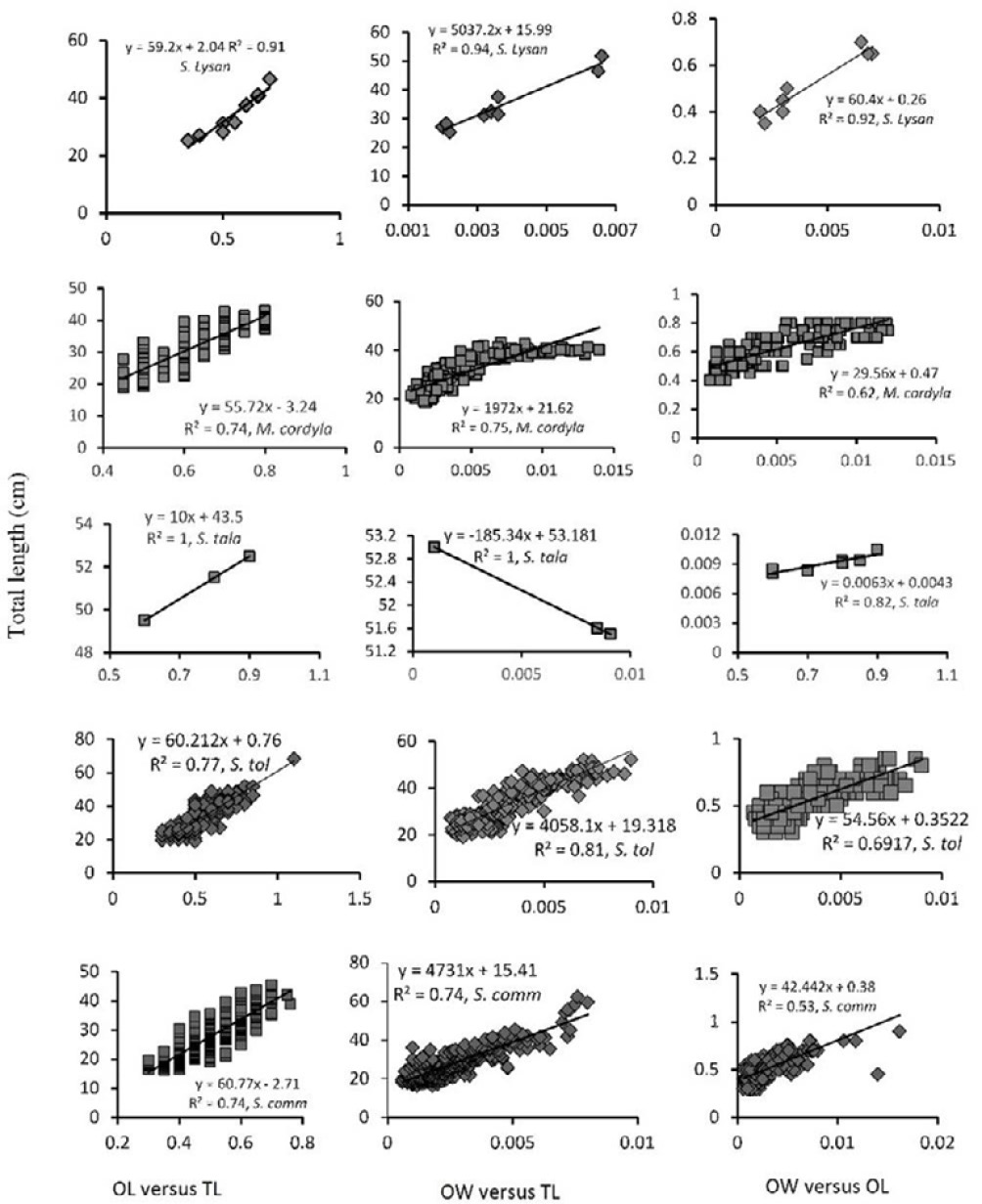
Regression estimation of S. commersonnianus, S. lysan, S. tala, S. tol and M. cordyla collected from northern Arabian Sea.
References
- Blacker, R.W., 1974. In: Sea fisheries research (ed. F.R. Harden-Jones). John Wiley and Sons, pp. 67-90.
- Bianchi, G., 1985. Filed guide commercial marine and brackish water: FAO identification sheets for fishery purpose. UNDP/ FAO/PAK/77/033
- FAO, 2012. Word fisheries production, FAO official publication, Rome, Italy
- Harvey, J., Loughlin, T., Perez, M. and Oxman, D., 2000. Relationship between fish size and otolith length for 63 species of fishes from Eastern North Pacific Ocean. NOAA Technical Report, 150.
- Handbook, 2012. Fisheries statistics of Pakistan, Marine Fisheries Department, Karachi, Pakistan.
- Panhwar, S.K., Qamar, N. and Jahangir, S., 2014. Pakistan J. Agric. Sci., 51: 1111-1116.
- Parafkandeh-Haghighi, F., 2008. Age determination in aquatic animals. Fisheries Research Organization Publications, Tehran, pp. 139.
- Qamar, N., 2015a. Population characteristics, reproductive seasonality, spawning, feeding habits and stock assessment of selected species of the family Carangidae (Pisces) in Pakistan. Ph.D thesis, Center of Excellence in Marine Biology, University of Karachi, pp. 250.
- Qamar, N., Panhwar, S.K. and Jahangir, S., 2015b. Pakistan J. Zool., 47: 1171-1179.
- Qamar, N., Panhwar, S.K. and Brower, S., 2016a. Pakistan J. Zool., 48: 869-874.
- Qamar, N., Panhwar, S.K. and Siddiqui, G., 2016b. In: Fisheries and aquaculture in the modern world (ed. H. Mikkola). InTech Open, ISBN: 978-953-51-4732-9, pp. 169-201. https://doi.org/10.5772/62627[CrossRef]
Supplementary material
Services
Article usage statistics
Loading…