
Calcium nitrate is a common fertilizer in agriculture, however, the toxic effects limit its uses. This study, therefore, aimed to evaluate the harmful impact of calcium nitrate on oxidative stress markers of liver and kidney function in rats. Twenty-eight male Wistar albino rats were divided into a control group that received distilled water, and three treated groups received 200, 400, or 800 mg/kg body weight of calcium nitrate for 30 days. Liver and kidney specimens were obtained from rats of different groups immediately after sacrifice, stored at -20°C in the freezer for the subsequent preparation of the homogenate which was used for determination of oxidative stress parameters. Results revealed a significant dose-dependent increase in malondialdehyde content, a decrease in glutathione content, enzymatic activity of catalase activity, and glutathione peroxidase in liver and kidney homogenates. Conclusively, calcium nitrate caused the induction of liver and kidney oxidative injury in a dose-dependent manner, where the higher effects were noticed with the highest doses.
Research Article · Volume 58, Issue 4, 4 May 2026 · Open Access
In Vivo Experimental Study on Calcium Nitrate-Induced Oxidative Liver and Kidney Damage in Wistar Albinos Rats
· ·
Affiliations & Notes ⌄
- 1Laboratory of Sciences and Technology of Water and Environment, Mohamed-Cherif Messaadia University, BP 1553, Souk Ahras 41000, Algeria 2Department of Biology, Faculty of Natural and Life Sciences, Mohamed-Cherif Messaadia University, BP 1553, Souk Ahras 41000, Algeria * Corresponding author: s.araar@univ-soukahras.dz
Article Info ⌄
- Journal:
- Pakistan Journal of Zoology
- Published:
- 4 May 2026

From the article
- This study demonstrated that the treatment of rats with calcium nitrate induced a significant increase in body weight.
- In this study, MDA content in the liver and kidney tissues was increased significantly in calcium nitrate-treated rats as compared with controls.
- In this regard, the obtained results revealed a significant decrease in CAT activity in the liver and kidney tissues of calcium-nitrated exposed rats.
- This study reported the dose-dependent toxic effect of calcium nitrate on liver and kidney function and consequently led to explore the dangers of excessive and uncontrolled use of chemical fertilizers on mammalian and human health.
Selected from the article's own text.
Abstract
Introduction
Synthetic fertilizers are widely used in agriculture as a rapid and inexpensive source of nutrients for plants, leading to a significant increase in crop productivity (Ahmad et al., 2017). Nitrogen fertilizer application is one of the most important land management practices for improving crop and pasture productivity . Calcium nitrate, as a nitrogen source , is considered the best form of nitrogen fertilizer due to its effective synergy with K, Mg, and Ca, explained by a concomitant uptake of cations and anions without antagonism, in addition to its beneficial effect in the plant rhizosphere . Moreover, only one-third to one-half of the minerals applied as fertilizers are effectively absorbed by plants, but half or two-thirds of the remaining parts result in soil, water, and air pollution, causing considerable environmental and human health concerns ; ; . Additionally, studies investigating the toxic effects of repeated-low doses of inorganic fertilizers contaminated drinking water on albino rats have reported induction of serious health conditions, including anemia, leukocytosis, and liver and kidney impairments ; 2023), leukopenia, and reproductive alteration (Ihedioha and Idika, 2007a, b). Nitrates, the end product of nitrogen fertilization, can cause considerable water contamination when it is not promptly absorbed by plant roots. Leafy green vegetables, such as lettuce, exhibit the highest nitrate levels . Nitrates serve as precursors to nitric oxide (NO), a molecule involved in various physiological functions, including neurotransmission , immune regulation , smooth muscle vascular relaxation , and inhibition of platelet aggregation . However, nitrates can also impact mitochondrial functionality, increasing the production of reactive oxygen species (ROS) by mitochondrial complex III and other reactive molecules, such as superoxide anion (O²•-), hydrogen peroxide (H2O2), hydroxyl radical (OH•), and singlet oxygen (1O²) . As a result, cells possess an antioxidant defense system that can effectively alleviate oxidative stress leading to lipid peroxidation, protein carbonylation, amino acid modification, DNA damage, and protein S-nitrosylation (Kurutas, 2016). As reported, ROS can induce an antioxidant response as a defense mechanism, including increased glutathione (GSH) levels and overexpression of detoxification enzymes, such as superoxide dismutase (SOD) isoforms, catalase, thioredoxin, glutathione peroxidase, and glutathione transferase . Also, ROS can damage hepatocytes by inducing inflammation, fibrosis, necrosis, apoptosis, or even malignant transformation . Furthermore, Nitric oxide (NO), a signaling molecule with diverse physiological functions, can also pose health risks under certain conditions. NO can react with oxyhemoglobin (HbO2) to form methemoglobin (metHb), a form of hemoglobin that cannot transport oxygen effectively. Also, NO can react with secondary amines to produce N-nitroso compounds, some of which are known carcinogens . These N-nitroso compounds can also be hepatotoxic, causing liver fibrosis and tumors . Thus, exposure to environmental pollutants can increase the risk of kidney disease , through the accumulation of toxins in the renal tubules, resulting subsequently in the dysfunction or failure of the kidney . In this regard, the present study aimed to investigate the impact of various doses of a commercial calcium nitrate named “CALNISOL®” on renal and hepatic oxidative stress markers in albino rats over a 30 days exposure period.
Materials and methods
Chemical materials
Calcium nitrate (Ca (NO3)2·4H2O) commercialized under the name Calnisol® (CAS No.: 10124-37-5) was purchased from Profert company, a fertilizer company in Bejaia, Algeria.
Animals
Twenty-eight male Wistar rats weighing 240±20 g, and obtained from the Pasteur Institute, Algiers, Algeria were housed in the animal house of our institution under standard laboratory conditions (T° 25±2°C, humidity 50±10%, and 12h/12h light/dark), and had free access to food and water before and during the experiment.
Experimental procedures
After three weeks of acclimatization, rats were divided into four groups of seven rats each. The first group was the control group received water as a vehicle, and the second, third, and fourth groups received, respectively via oral gavage 200, 400, and 800 mg of calcium nitrate/kg body weight for 30 days . At the end of the experimental period, the animals were fasted overnight and sacrificed by cervical decapitation. The liver and kidneys were removed and stored at -20°C for subsequent determination of oxidative stress parameters.
Determination of oxidative stress markers
For assessment of oxidative stress parameters one gram of liver and kidney tissues of control and treated rats were homogenized in 10 ml of phosphate-buffered saline (PBS: Tris 50 mM, NaCl 150 mM, pH 7.4), centrifuged at 9000 g, 4°C for 15 min, and the supernatant was aliquoted into Eppendorf tubes and stored at -20°C until use.
Malondialdehyde (MDA), a lipid peroxidation marker, reduced glutathione (GSH) content, and protein concentration were determined by spectrophotometry using the methods of Esterbauer et al. (1992) and Bradford (1976), respectively. Catalase (CAT) activity was estimated by the method of Aebi (1984), while glutathione peroxidase (GPx) activity was determined by the method of Flohé and Günzler (1984).
Statistical analysis
The results are provided as mean ± standard deviation (mean ± SD). Comparisons between groups were performed using one-way analysis of variance (ANOVA), using SPSS software (version 25).
Results
Table I shows calcium nitrate-induced body weight changes. The final body weight and the body weight gain significantly (p<0,01) increased in calcium nitrate at 800 mg /kg bwt treated rats as compared to the control group.
Figure 1 shows calcium nitrate-induced changes in oxidative markers. Calcium nitrate at a dose of 800mg/kg significantly decreased the hepatic and renal GSH content, but not significantly at doses of 200 and 400 mg/kg as compared to the control group (Fig. 1A). Further, the MDA level in kidney and liver tissues increased significantly (p<0.05), highly significantly (p<0.01), and non-significantly respectively in treatment with calcium nitrate at doses of 400, 800, and 200 mg/kg compared to the control group (Fig. 1B). Treatment of rats with calcium nitrate at a dose of 800 mg/kg significantly decreased GPx activity in the liver and kidneys compared to control rats (Fig. 1C). Similarly, Figure 1D showed that the catalase activity decreased highly significantly (p < 0.01) in the liver tissue of rats treated with calcium nitrate at 800mg/kg bwt (G4), significantly (p < 0.05) in the kidney tissue, and non-significantly in rats treated with calcium nitrate at 200 mg/kg.
Table I. Changes in body weight of control, and treated animals with calcium nitrate at doses of 200, 400 and 800 mg/kg for 30 days.
| Parameters | Treatments | |||
| Control | 200 mg/kg | 400 mg/kg | 800 mg/kg | |
| Initial body weight (g) | 256.14±6.28 | 257.14±4.52 | 257.29±3.95 | 256.86±5.55 |
| Final body weight (g) | 289.43±6.24 | 389.29±3.35 | 291.86±5.58 | 300.14±3.67 |
| Weight gain (%) | 33.29±10.06 | 32.14±5.34 | 34.57±3.50 | 43.29±6.73 |
Discussion
The organism possesses a potential antioxidant defense, including enzymatic (e.g CAT, SOD, GPx, and GST), and non-enzymatic like GSH molecules acting effectively against the oxidative stress-mediated production of ROS ; . This study demonstrated that the treatment of rats with calcium nitrate induced a significant increase in body weight. This result contradicts the findings of Rouag et al. (2020), who reported a decrease in body weight following exposure of rats to sodium nitrate. In contrast, the work of Messaadia et al. (2013) showed no significant changes in the physiological growth of rats treated with ammonium nitrate compared to the control group. Similarly, Gueroui and Kechrid (2016) reported no significant change in body weight in rats exposed to silver nitrate-contaminated drinking water at a concentration of 20 mg/L for 3 months. This is likely due to the accumulation of this pollutant in the adipose tissues, leading consequently to increased protein catabolism to ensure sufficient energy during the detoxification process ; . Our results revealed a significant increase in MDA along with a significant decrease in GSH content, and the enzymatic activity of catalase, GPx, and GST in the liver and kidneys of rats treated with calcium nitrate at 200, 400, and 800 mg/kg for 30 days. GSH is an important element that plays a crucial role in cell protection. It possesses a thiol group (SH) able to bind with the toxic metabolites. Also, it acts in synergy with other antioxidant enzymes such as GPx, CAT, and SOD to exert antioxidant effects . This decrease in GSH content is possibly due to its involvement in the detoxification reactions with free radicals . These results are similar to those obtained in a study conducted on rats treated with sodium nitrate at a dose of 400 mg/kg for 50 days , and those reported in female rats exposed to 500 mg/L NaNO3 for 28 days . In this study, MDA content in the liver and kidney tissues was increased significantly in calcium nitrate-treated rats as compared with controls. This result is in line with that reported in a study investigating the effect of ammonium nitrate at different doses of 8, 24, and 40 mg/kg in rats , and that conducted on sodium nitrate-exposed rats, showing an increased MDA level, and a decreased GSH content . The increased level of tissue MDA is strongly referred to as the increased oxidative damage associated with increased free radicals leading to increased lipid peroxidation (breakdown of the cell polyunsaturated fatty acids) . In fact, increased lipid peroxidation weakens the cell membrane function by losing its fluidity and the activity of membrane and cytoplasmic enzymes . In addition, catalase, GPx, and GST are considered the main enzymatic defense systems in the cell, whose activity variations indicate the extent of cytotoxic damage occurring in various tissues . Our findings revealed a clear reduction in the activity of these enzymes in the liver and kidneys of calcium nitrate-treated rats compared to controls. GPx is a unique selenoenzyme in mammalian cells, and its molecule has four selenium atoms in the active center making a form of selenocysteine . It breaks down H2O2 into water and lipid peroxides, primarily in the mitochondria and sometimes in the cytosol ; . Moreover, GPx activity was significantly decreased in the liver and kidneys of calcium nitrate-exposed rats, and this result is similar to that found in the previous study of Rouag et al. (2020). The decreased activity of GSH-Px could be explained by an overproduction of H2O2 and depletion of selenium and glutathione ; known as the substrate and cofactor of GSH-Px . On the other hand, hyperglycemia can produce ROS, and inhibit the active sites of the antioxidant enzymes such as SOD, CAT, and GSH-Px . On top of that, CAT, a major component of the antioxidant enzyme system, utilizes iron or manganese as a cofactor and catalyzes in association with the degradation or reduction of water and molecular oxygen . In this regard, the obtained results revealed a significant decrease in CAT activity in the liver and kidney tissues of calcium-nitrated exposed rats. This finding is in line with that reported in the study by Dar et al. (2019) conducted on ammonium nitrate-exposed rats, proving that the excessive production of H2O2 can reduce CAT activity.
Conclusion
This study reported the dose-dependent toxic effect of calcium nitrate on liver and kidney function and consequently led to explore the dangers of excessive and uncontrolled use of chemical fertilizers on mammalian and human health.
Declarations
Acknowledgments
The results were obtained within the project ATRP/ code N°: D01N01UN410120180001andquot; Origin and diversification of pollution (water, air and soil) by heavy metals of some biotopes by the use of bio-indicator models and quot; funded by Directorate General for Scientific Research and Technological Development (DGRSDT).
Funding
The study did not receive any external funding.
Ethical statement
The experimental procedures were conducted in accordance with the National Institutes of Health guidelines for animal care and were approved by the ethics committee of our institution.
Generative AI and AI-assisted technology statement
The authors have declared that no generative AI or AI-assisted technologies were used to create this manuscript.
Statement of conflict of interest
The authors have declared no conflict of interest.
Figures
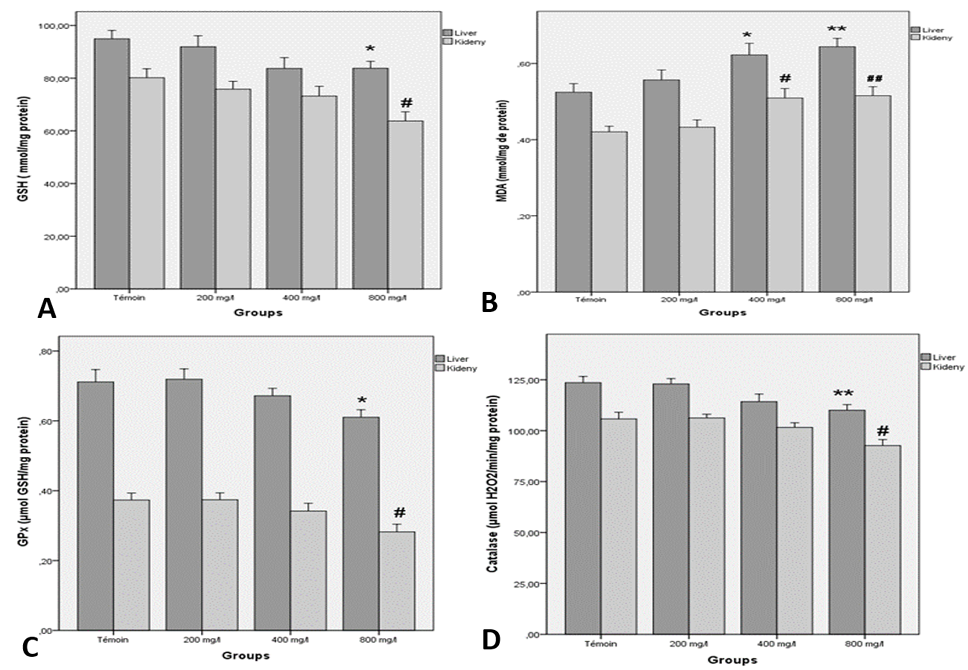
Changes in hepatic and renal glutathione content (A), malondialdehyde content (B), glutathione peroxidase activity (C) and catalase activity (D) in control and rats treated with calcium nitrate at doses of 200, 400 and 800 mg/kg for 30 days.
References
- Aebi, H., 1984. Catalase in vitro. Meth. Enzymol., 105: 121-126. https://doi.org/10.1016/S0076-6879(84)05016-3[CrossRef]
- Ahmed, M., Rauf, M., Mukhtar, Z. and Saeed, N.A., 2017. Excessive use of nitrogenous fertilizers: An unawareness causing serious threats to environment and human health. Environ. Sci. Pollut. Res., 24: 26983-26987. https://doi.org/10.1007/s11356-017-0589-7[CrossRef]
- Akopova, O., Kotsiuruba, A., Korkach, Y., Kolchinskaya, L., Nosar, V., Gavenauskas, B.,Serebrovska, Z., Mankovska, I. and Sagach, V., 2016. The effect of NO donor on calcium uptake and reactive nitrogen species production in mitochondria. Cell. Physiol. Biochem., 9: 193-204. https://doi.org/10.1159/000445616[CrossRef]
- Al-Attar, A.M., Elnaggar, M.H.R. and Almalki, E.A., 2017. Protective effect of some plant oils on diazinon induced hepatorenal toxicity in male rats. Saudi J. biol. Sci., 24(6): 1162–1171. https://doi.org/10.1016/j.sjbs.2016.10.013[CrossRef]
- Al-Ayed, M.I., 2000. Toxicity of drinking water with different nitrate levels. J. Egypt. German Soc. Zool., 31: 197-210.
- Anwar, M.M. and Mohamed, N.E., 2015. Amelioration of liver and kidney functions disorders induced by sodium nitrate in rats using wheat germ oil. J. Radiat. Res. appl. Sci., 8: 77-83. https://doi.org/10.1016/j.jrras.2014.11.004[CrossRef]
- Aposhian, H.V., 1999. How is inorganic arsenic detoxified. In: Arsenic exposure and health effects, III Elsevier Science Ltd, pp. 289-297. https://doi.org/10.1016/B978-008043648-7/50033-9[CrossRef]
- Banerjee, B.D., Seth, V. and Ahmed, R.S., 2001. Pesticide-induced oxidative stress: Perspective and trends. Rev. environ. Hlth., 16: 1-40. https://doi.org/10.1515/REVEH.2001.16.1.1[CrossRef]
- Ben-Saad, H., Kammoun, I., Boudawara, T., Zeghal, K.M., Hakim, A. and Amara, I.B., 2017. Effects of selenium on tebuconazole-induced hepatotoxicity in adult rats. Res. Rev. Biosci., 12: 117.
- Bouaziz-Ketata, H., Salah, G.B., Salah, H.B., Marrekchi, R., Jamoussi, K., Boudawara, T., Boudawara, T., Fakhfekh, F. and Zeghal, N., 2014. Nitrate-induced biochemical and histopathological changes in the liver of rats: Ameliorative effect of Hyparrhenia hirta. Biomed. environ. Sci., 27: 695-706.
- Bradford, M.M., 1976. A rapid and sensitive method for the quantitation of microgram quantities of protein utilizing the principle of protein-dye binding. Anal. Biochem., 72: 248-254. https://doi.org/10.1006/abio.1976.9999[CrossRef]
- Calvert, G.M., 2016. Agricultural pesticide exposure and chronic kidney disease: New findings and more questions. Occup. environ. Med., 73: 1–2. https://doi.org/10.1136/oemed-2015-103132[CrossRef]
- Chelikani, P., Fita, I. and Loewen, P.C., 2004. Diversity of structures and properties among catalases. Cell. Mol. Life Sci., 61: 192-208. https://doi.org/10.1007/s00018-003-3206-5[CrossRef]
- Dar, M.A., Sultana, M., Mir, A.H., Bader, M.A., Raina, R. and Prawez, S., 2019. Effect of repeated oral administration of Roundup® and ammonium nitrate on liver of Wistar rats. Proc. natl. Acad. Sci., 89: 505-510.
- Single and interactive toxic potential of Roundup® and ammonium nitrate on haemato-biochemical parameters in Wistar rats. J. Cell Tissue Res., 15: 5295-5299.
- Dogbatse, J.A., Awudzi, G.K., Arthur, A., Owusu-Ansah, F., Amoako-Attah, I. and Quaye, A.K., 2024. Assessment of calcium nitrate fertilizer as a suitable nitrogen source for cacao (Theobroma cacao L.) cultivation in Ghana. Int. J. Agron., 1: 5578534. https://doi.org/10.1155/2024/5578534[CrossRef]
- Elahi, E., Weijun, C., Zhang, H. and Nazeer, M., 2019. Agricultural intensification and damages to human health in relation to agrochemicals: Application of artificial intelligence. Land Use Policy, 83: 461-474. https://doi.org/10.1016/j.landusepol.2019.02.023[CrossRef]
- Erkekoglu, P. and Baydar, T., 2010. Evaluation of the protective effect of ascorbic acid on nitrite-and nitrosamine-induced cytotoxicity and genotoxicity in human hepatoma line. Toxicol. Mechan. Methods, 20: 45-52. https://doi.org/10.3109/15376510903583711[CrossRef]
- Esterbauer, H., Gebicki, J., Puhl, H. and Jürgens, G., 1992. The role of lipid peroxidation and antioxidants in oxidative modification of LDL. Free Radic. Biol. Med., 13: 341-390. https://doi.org/10.1016/0891-5849(92)90181-F[CrossRef]
- Flohé, L. and Günzler, W.A., 1984. Assays of glutathione peroxidase. Meth. Enzymol., 105: 114-120. https://doi.org/10.1016/S0076-6879(84)05015-1[CrossRef]
- Garthwaite, J., 1991. Glutamate, nitric oxide and cell-cell signalling in the nervous system. Trends Neurosci., 14: 60-67. https://doi.org/10.1016/0166-2236(91)90022-M[CrossRef]
- Góth, L., Rass, P. and Páy, A., 2004. Catalase enzyme mutations and their association with diseases. Mol. Diagn., 8: 141-149. https://doi.org/10.1007/BF03260057[CrossRef]
- Goyal, M.R., 2012. Management of drip/trickle or micro irrigation. CRC Press. https://doi.org/10.1201/b13110[CrossRef]
- Gueroui, M. and Kechrid, Z., 2016. Evaluation of some biochemical parameters and brain oxidative stress in experimental rats exposed chronically to silver nitrate and the protective role of vitamin E and selenium. Toxicol. Res., 32: 301-309. https://doi.org/10.5487/TR.2016.32.4.301[CrossRef]
- Halliwell, B., 1994. Free radicals and antioxidants: A personal view. Nutr. Rev., 52: 253-265. https://doi.org/10.1111/j.1753-4887.1994.tb01453.x[CrossRef]
- He, L., He, T., Farrar, S., Ji, L., Liu, T. and Ma, X., 2017. Antioxidants maintain cellular redox homeostasis by elimination of reactive oxygen species. Cell. Physiol. Biochem., 44: 532-553. https://doi.org/10.1159/000485089[CrossRef]
- Hibbs, Jr. J.B., 1991. Synthesis of nitric oxide from L-arginine: A recently discovered pathway induced by cytokines with antitumour and antimicrobial activity. Res. Immunol., 142: 565-569. https://doi.org/10.1016/0923-2494(91)90103-P[CrossRef]
- Ighodaro, O.M. and Akinloye, O.A., 2018. First line defence antioxidants-superoxide dismutase (SOD), catalase (CAT) and glutathione peroxidase (GPX): Their fundamental role in the entire antioxidant defence grid. Alex. J. Med., 54: 287-293. https://doi.org/10.1016/j.ajme.2017.09.001[CrossRef]
- Ihedioha, J.I. and Idika, I.K., 2007a. Haematological abnormalities associated with contamination of drinking water with low sub-lethal concentrations of inorganic fertilizers. Proc. 32nd Ann. Conf. Nig. Soc., Anim. Prod., 32: 27-30.
- Ihedioha, J.I. and Idika, I.K., 2007b. Contamination of drinking water with low sub-lethal levels of inorganic fertilizers: effects on body weight gain feed and water consumption and relative organ weight percentages. Anim. Prod., 32: 31-35.
- Kebièche, M., Lakroun, Z., Mraïhi, Z. and Soulimani, R., 2011. Effet antidiabétogène et cytoprotecteur de l’extrait butanolique de Ranunculus repens L. et de la quercétine sur un modèle expérimental de diabète alloxanique. Phytothérapie, 9: 274-282. https://doi.org/10.1007/s10298-011-0651-4[CrossRef]
- Kurutas, E.B., 2015. The importance of antioxidants, which play the role in cellular response against oxidative/nitrosative stress: Current state. Nutr. J., 15: 1-22. https://doi.org/10.1186/s12937-016-0186-5[CrossRef]
- Li, M., Wiedmann, T. and Hadjikakou, M., 2019. Towards meaningful consumption-based planetary boundary indicators: The phosphorus exceedance footprint. Glob. Environ. Change, 54: 227-238. https://doi.org/10.1016/j.gloenvcha.2018.12.005[CrossRef]
- Liu, C.W., Sung, Y., Chen, B.C. and Lai, H.Y., 2014. Effects of nitrogen fertilizers on the growth and nitrate content of lettuce (Lactuca sativa L.). Int. J. environ. Res. Publ. Hlth., 11: 4427–4440. https://doi.org/10.3390/ijerph110404427[CrossRef]
- Mazzetto, A.M., Styles, D., Gibbons, J., Arndt, C., Misselbrook, T. and Chadwick, D., 2020. Region-specific emission factors for Brazil increase the estimate of nitrous oxide emissions from nitrogen fertiliser application by 21%. Atmospheric Environ., 230: 117506. https://doi.org/10.1016/j.atmosenv.2020.117506[CrossRef]
- Messaadia, A., Saka, S., Krim, M., Maidi, I., Aouacheri, O. and Djafer, R., 2013. Ginger- supplemented diet ameliorates ammonium nitrate-induced oxidative stress in rats. Afr. J. Biotechnol., 12: 40. https://doi.org/10.5897/AJB2013.13118[CrossRef]
- Moncada, S., Palmer, R.M. and Gryglewski, R.J., 1986. Mechanism of action of some inhibitors of endothelium-derived relaxing factor. Proc. natl. Acad. Sci., 83: 9164-9168. https://doi.org/10.1073/pnas.83.23.9164[CrossRef]
- Muntané, J., Angel, J., Marín, L.M. and Padillo, F.J., 2013. Nitric oxide and cell death in liver cancer cells. Mitochondrion, 13: 257-262. https://doi.org/10.1016/j.mito.2012.09.004[CrossRef]
- Nujić, M. and Habuda-Stanić, M., 2017. Nitrates and nitrites, metabolism and toxicity. Fd. Hlth. Dis., 6: 63-73.
- Radomski, M.W., Palmer, R.M. and Moncada, S., 1987. The anti-aggregating properties of vascular endothelium: Interactions between prostacyclin and nitric oxide. Br. J. Pharmacol., 92: 639. https://doi.org/10.1111/j.1476-5381.1987.tb11367.x[CrossRef]
- Ramachandran, V. and Saravanan, R., 2013. Asiatic acid prevents lipid peroxidation and improves antioxidant status in rats with streptozotocin-induced diabetes. J. Funct. Fds., 5: 1077-1087. https://doi.org/10.1016/j.jff.2013.03.003[CrossRef]
- Rouag, M., Berrouague, S., Djaber, N., Khaldi, T., Boumendjel, M. and Taibi, F., 2020. Pumpkin seed oil alleviates oxidative stress and liver damage induced by sodium nitrate in adult rats: Biochemical and histological approach. Afr. Hlth. Sci., 20: 413-425. https://doi.org/10.4314/ahs.v20i1.48[CrossRef]
- Saka, S., Bahi, A. and Aouacheri, W., 2011. The effect of oxidative stress induced by lead acetate on the glutathione enzymatic system in rats. Ann. Toxicol. Anal., 23: 139-145. https://doi.org/10.1051/ata/2011123[CrossRef]
- Samia, A., Fadila, K., Sarra, S., Sakina, C. and Abdelhak, G., 2022. Toxicological evaluation of a monoammonium phosphate fertilizer in rats following 30 days of repeated oral exposure. Fresenius Environ. Bull., 31: 7861-7868.
- Samia, A., Fadila, K., Sarra, S., Sakina, C. and Abdelhak, G., 2023. Calcium nitrate toxicity on rat liver and kidney functions: A biochemical and histopathological evaluation. Jordan J. biol. Sci., 16. https://doi.org/10.54319/jjbs/160106[CrossRef]
- Sheahan, M., Barrett, C.B. and Goldvale, C., 2017. Human health and pesticide use in sub-Saharan Africa. Agric. Econ., 48(S1): 27-41. https://doi.org/10.1111/agec.12384[CrossRef]
- Shila, S., Kokilavani, V., Subathra, M. and Panneerselvam, C., 2005. Brain regional responses in antioxidant system to α-lipoic acid in arsenic intoxicated rat. Toxicology, 210: 25-36. https://doi.org/10.1016/j.tox.2005.01.003[CrossRef]
- Sies, H., 1993. Strategies of antioxidant defense. Euro. J. Biochem., 215: 213-219. https://doi.org/10.1111/j.1432-1033.1993.tb18025.x[CrossRef]
- Sindhu, R.K., Koo, J.R., Roberts, C.K. and Vaziri, N.D., 2004. Dysregulation of hepatic superoxide dismutase, catalase and glutathione peroxidase in diabetes: Response to insulin and antioxidant therapies. Clin. exp. Hyperten., 26: 43-53. https://doi.org/10.1081/CEH-120027330[CrossRef]
- Volkmer, B.G., Ernst, B., Simon, J., Kuefer, R., Bartsch Jr, G., Bach, D. and Gschwend, J.E., 2005. Influence of nitrate levels in drinking water on urological malignancies: A community-based cohort study. BJU Int., 95: 972-976. https://doi.org/10.1111/j.1464-410X.2005.05450.x[CrossRef]
- Walczak, R., Westhof, E., Carbon, P. and Krol, A., 1996. A novel RNA structural motif in the selenocysteine insertion element of eukaryotic selenoprotein mRNAs. Rna, 2: 367-379.
Services
Article usage statistics
Loading…