Besides, in the current study, ivy gourd supplementation significantly improved percentage of CH₄ of net gas production but directly failed to mitigate ruminal CH₄ production.
Lemongrass, sage, and ivy gourd showed distinct nutrient profiles, with lemongrass rich in dry matter and organic matter (OM), sage high in nitrogen-free extract and low in fibre, and ivy gourd highest in ash and ether extract.
Among these PDs, sage demonstrated a notable reduction in CH₄ production, whereas lemongrass achieved a modest reduction, which hold practical significance when considering cost-effectiveness and better performance in cattle.
The percentage of CH₄ relative to net gas volume was significantly reduced across all PDs, with the sage diet exhibiting the most substantial mitigation effect.
Selected from the article's own text.
Abstract
This in vitro study investigated the effects of three phytogenic supplements (PSs)—sage (Salvia officinalis), ivy gourd (Coccinia grandis), and lemongrass (Cymbopogon citratus)—on rumen fermentation kinetics and methane (CHâ‚„) production. The basal diet (60% roughage and 40% concentrate) without PSs served as the control diet, while phytogenic diets (PDs) included 1% dry matter (DM) of each PS and designed as sage, ivy gourd, or lemongrass diets, respectively. Data obtained from the in vitro trial were analyzed via one-way analysis of variance. Results indicated that PDs showed the tendency of better rumen fermentation kinetics, i.e., improved organic matter degradability, microbial protein synthesis, energy yield, short-chain fatty acids, and net gas production, compared to the control (P=0.063), while there was no significant differences among all PDs. Sage and lemongrass diets significantly reduced CHâ‚„ production (by 18% and 5%, respectively), while ivy gourd had a minimal impact. Additionally, the CHâ‚„ percentage of net gas and per mg neutral detergent fibre reduced by 16–30% in all PDs, with sage demonstrating the most pronounced reduction (P<0.01). Therefore, supplementation of individual PSs like sage, ivy gourd, or lemongrass at 1% DM of basal diet enhanced rumen fermentation kinetics, whereas both sage and lemongrass effectively reduced CHâ‚„ production.
Globally, ruminants generally consume grasses; however, in the Indian subcontinent, especially in Bangladesh, they are commonly given a combination of grasses, inferior rice straw, and concentrates a). The inclusion of rice straw or grass as primary components in diets often leads to poor nutrient utilization and contribute to greater environmental pollution . This pollution is primarily caused by methane (CH₄), which is the second most abundant greenhouse gas produced in the rumen by methanogenic archaea . A cow daily emits around 132–414 g of enteric CH₄, with a potential for global warming which is 28 times greater than CO2 over a century . Additionally, CH₄ production leads to a 10% energy loss from feed, reducing nutrient efficiency and causing a loss of 16–26 g/kg of feed consumed .
To mitigate CH₄ emissions and improve nutrient utilization, researchers are investigating phytogenic supplements (PSs) as natural and sustainable solutions . Sage (Salvia officinalis), a PS, exhibits varying effects on methanogenesis, ruminal fermentation, and nutrient degradation, depending on various doses like 0.5, 1.0, 1.5, and 2.0% dry matter (DM) of diet . Among these doses, supplementation at 1% DM with basal diet enhance ruminal fermentation, nutrient degradability, and reduces CH₄ emissions, likely due to its phytochemicals, such as tannins, camphor, saponins, rosmarinic acid, and carnosol .
Similarly, ivy gourd (Coccinia grandis) and lemongrass (Cymbopogon citratus), as promising PSs, have been used in egg production in laying hens and functional milk production in cows b), respectively, due to their rich content of flavonoids, phenolics, tannins, and saponins. Tannins and saponins present in ivy gourd and lemongrass may reduce protozoa, methanogens, and fungal species by forming sterol complexes in their cell membranes, potentially decreasing enteric CH₄ emissions ; . However, to our knowledge, the anti-methanogenic potential of ivy gourd as a PS remains unexplored. On the contrary, it was reported that lemongrass, when included at 1% along with mangosteen peel (1%) or separately at 2% of the substrate level, significantly improves total gas production, nutrient degradability, and propionic acid production, while reducing CH₄ concentration and methanogens ; . Additionally, daily supplementation of lemongrass as a PS (100 g/cattle) has been reported to improve nutrient digestibility, milk yield, antioxidant status, and concentrations of desirable fatty acids b). It also stimulates microbial protein synthesis and enhances the populations of cellulolytic and amylolytic bacteria in beef cattle .
In addition, the composition of basal diets along with PSs namely sage, ivy gourd, and lemongrass—particularly their crude protein levels and fibre fractions—are closely associated with CH₄ emissions . When these PSs, particularly sage and lemongrass, are included at low levels (typically 1% of DM), their effectiveness is mainly attributed to secondary metabolites rather than primary nutrients ; . Moreover, the chemical composition of these PSs is influenced by various factors such as plant variety, region, soil type, and cultivation practices, which may influence rumen fermentation patterns and CH₄ production . Among various varieties, lemongrass (Cymbopogon flexuosus) exhibited variable fibre fractions, with cellulose, hemicellulose, and lignin contents approximately 39.5%, 22.6%, and 28.5%, respectively . However, to the best of our knowledge, the nutrient composition—particularly the fibre fractions and the anti-methanogenic properties of these PSs have not been studied in this subcontinent. Consequently, this study (in vitro) was designed to evaluate the composition of shrub (sage) and herbs (ivy gourd and lemongrass) and their effects on rumen organic matter degradability, microbial protein synthesis, digestible energy, metabolizable energy, short-chain fatty acids, net gas, and CH₄ production.
MATERIALS AND METHODS
Phytogenic Supplements Preparation
The experiment was under taken in the Department of Animal Nutrition at Bangladesh Agricultural University (BAU), Mymensingh, Bangladesh. Phytogenic supplements (PSs), including sage (Salvia officinalis), ivy gourd (Coccinia grandis), and lemongrass (Cymbopogon citratus DC. staf.), were cultivated and harvested at 65 days post-planting ; b) from the Shahjalal Animal Nutrition Field Laboratory (SANFL) at BAU. The harvested PSs were oven-dried at 60°C and subsequently ground using a locally manufactured grinder equipped with a 1 mm sieve. Then, each PS was placed in a zipper-sealed bag and stored in a desiccator with silica gel at room temperature to maintain its stability and prevent moisture absorption.
Experimental Diets and Design For In Vitro Study
Green roughage namely Napier grass (Pennisetum purpureum) and dried rice straw were collected from the SANFL, BAU. Concentrate items, including corn, mustard oil cake, soybean meal, and wheat bran, were procured from the local market. These ingredients were oven-dried at 60°C and ground to a particle size of 1 mm using a locally made grinder. Then, the concentrate mixture was prepared on a dry matter (DM) basis by combining corn, mustard oil cake, soybean meal, wheat bran, di-calcium phosphate, and salt at 15.72, 9.60, 4.96, 8.00, 0.50, and 1.00%, respectively. The basal diet was formulated considering the roughages and concentrate mixture ratio at 60: 40 and designed as the control diet without PS (Table 1). The phytogenic diets (PDs) included the basal diet supplemented with 1% DM of sage, ivy gourd, or lemongrass and considered as sage, ivy gourd, or lemongrass diet, respectively. The control diet and three PDs were arranged in a completely randomized design.
Chemical Analysis
The proximate components namely DM, ash, crude protein (CP), crude fibre (CF), and ether extract (EE) of the basal diet, Napier grass, rice straw, concentrate mixture, and PSs including sage, ivy gourd, and lemongrass powder were determined in accordance with the AOAC, (2005). The fibre components of these samples, including neutral detergent fibre (NDF), acid detergent fibre (ADF), and acid detergent lignin (ADL), were determined following the procedures described by Goering and Van Soest, (1970). Then, hemicellulose was calculated by subtracting the ADF from the NDF; whereas cellulose was quantified by subtracting the ADL from the ADF. Besides, non-structural carbohydrate (NSC) were calculated using the following formula, NSC (%) = 100 – % of (CP + ash + NDF + EE). The chemical composition of the basal diet, Napier grass, rice straw, and concentrate mixture are presented in Table 1.
Table 1: Ingredients and nutrient composition of the basal diet and nutrient composition of grass, straw, and concentrate mixture.
Ingredients
g/kg dry matter
Napier grass
498.3
Rice straw
103.9
Corn
157.2
Mustard oil cake
96.0
Soybean meal
49.6
Wheat bran
80.0
Di-calcium phosphate
5.0
Salt
10.0
Chemical constituents
% on dry matter
Basal diet
Napier grass
Rice straw
Concentrate mixture
Organic matter
89.18
88.87
83.02
92.67
Crude protein
13.45
7.91
5.31
21.30
Crude fibre
25.07
37.44
40.00
5.48
Ether extract
3.32
4.97
3.34
4.82
Ash
10.82
12.13
16.98
7.85
Nitrogen free extract
47.33
38.55
34.36
61.07
Neutral detergent fibre
54.01
79.19
79.52
21.20
Acid detergent fibre
34.66
46.37
47.82
8.00
Nonstructural carbohydrate
18.40
Acid detergent lignin
6.12
-
-
-
Cellulose
28.54
-
-
-
Hemicellulose
19.35
32.82
31.70
13.20
Ethical Approval and Rumen Liquor Collection
The rearing of cannulated beef cattle and the rumen liquor collection system were approved by the Animal Welfare and Experimentation Ethics Committee (AWEEC/BAU/2025 (2) /15(b)). The in vitro study was conducted in two phases. In the first phase, rumen liquor was collected from two Holstein crossbred beef cattle (390 ± 30 kg) at a local slaughterhouse using a pre-warmed conical flask filled with CO₂. The flask was placed in a thermo flask with hot water (39°C) to maintain temperature during collection and transportation. The rumen liquor was then homogenized and filtered through a two-layer cheesecloth into a CO₂-filled warm flask. In the second phase, rumen liquor was collected from one Holstein crossbred cattle (350 kg) and one cannulated Indigenous Zebu beef cattle (198.5 kg) following the same procedure. The cannulated animal, housed at SANFL, BAU, was maintained on a 52: 48 roughage-to-concentrate diet. Cattle was supplied a daily ration of around 12 kg German grass and 2.20 kg of a concentrate mixture (66.4% corn, 16.3% wheat bran, 15.4% mustard oil cake, 0.9% di-calcium phosphate, and 1.0% salt), with ad libitum water access. To accurately represent diet digestibility across both genetic types and avoiding variability from slaughterhouse sampling, rumen liquor was collected from a cannulated Indigenous Zebu cattle under controlled conditions and from slaughterhouse-sourced Holstein crossbred cattle.
In vitro Rumen Fermentation Kinetics
For both phases, in vitro gas production was measured described by Menke et al. (1979). For each phase, after measuring the basal diet (200 ± 10 mg) without PSs (control diet) or with PSs at 1.0% of DM (PDs: sage, ivy gourd, or lemongrass), fourteen piston syringes (2 per diet, 2 blanks, 2 hay and 2 concentrate standards) fitted with piston and long needle attached to silicon rubber tube was incubated at 39°C from the afternoon. The following day, one part of filtered liquor was mixed with two parts of an incubation medium saturated with CO₂ and stirred using a magnetic stirrer in a 39°C water bath to prepare the liquor-incubation medium. Subsequently, 30 mL of the rumen liquor-incubation medium was dispensed into each pre-warmed (39°C) piston syringe using an automatic pipette. After eliminating gas bubbles, the plastic clip on the silicon tube was secured, and the initial piston position was recorded. The syringes were then placed in an incubation apparatus set to rotate at a rate of one rotation per minute for 24 hours. The first reading was taken after 8 hours, followed by gas elimination, and the second reading was recorded at 24 hours.
Considering both hours reading of the gas for each diet, blank, hay, and concentrate standards, the net gas production (mL per 200 mg of DM) was determined for each diet . Then, using net gas production, CP, and EE of each diet, digestible energy (DE), metabolizable energy (ME), and organic matter (OM) degradability were calculated according to Menke et al. (1979). Short-chain fatty acids (SCFAs) were estimated using the formula of Njidda (2010), while microbial protein (MP) synthesis was calculated as 19.3 g microbial nitrogen per kg OM degradability, following Khattab et al. (2016).
Methane and pH Measurement
After 24 hours reading, the silicon tube was inserted into the nozzle of a syringe containing 2 mL of 10 M NaOH solution. After securing the setup, the tube’s clip was loosened, allowing gas to flow from the piston syringe into the NaOH solution. The displacement of NaOH in syringe indicated CH₄ volume, as CO₂ dissolves in the solution . CH₄ generation per mL of NaOH was calculated based on the total gas volume injected and the corresponding NaOH displacement. The CH₄ percentage in the total gas was determined from the CH₄-to-CO₂ ratio, while CH₄ production per mg of NDF per hour was calculated using the NDF content of the diets. Immediately after gas collection, rumen fluid pH was measured using a pH meter (Hanna, China).
Statistical Analysis
All samples were analyzed in triplicate. Differences among the control diet and PDs were assessed using one-way ANOVA in SPSS 22. Tukey’s post-hoc test was applied to compare means among diets, with significance declared at P≤0.05 and tendency toward significance at P≤0.10. Then, data were presented as mean ± standard deviation.
Table 2: Nutrient profiles of phytogenic supplements used in the in vitro study.
Proximate components
Sage
Ivy gourd
Lemongrass
% DM on fresh basis
13.76
14.21
25.91
% components on DM basis
Organic matter
87.30
84.26
91.32
Crude protein
6.78
14.25
5.04
Crude fibre
18.79
20.08
25.11
Ether extract
3.76
6.60
5.35
Ash
13.75
14.48
8.68
Nitrogen free extract
56.92
44.59
55.82
Neutral detergent fibre
33.81
35.93
67.86
Acid detergent fibre
16.54
13.59
39.47
Nonstructural carbohydrate
27.90
28.74
13.07
#TPC (mg GAE/g dry sample)
85.1
4.17
19.83
#TFC (mg QE/g dry sample)
9.07
6.27
10.51
% DM: Percentage dry matter; #Reference value: Rahman et al., 2021; Rahman et al., 2024b; TPC: Total phenolic contents; GAE: Gallic acid equivalent; TFC: Total flavonoid contents; QE: Quercetin equivalent.
RESULTS
Nutrient Profiles of PSs
Lemongrass showed higher DM (25.91%) content, followed by ivy gourd (14.21%) and sage (13.76%; Table 2) on fresh basis. On a DM basis, OM was higher in lemongrass, followed by sage and ivy gourd. CP content was 14.25% in ivy gourd and 6.78% in sage, with lemongrass showed the lowest (5.04%) value. Lemongrass also had the highest CF (25.11%), followed by ivy gourd (20.08%) and sage (18.79%). Then, EE (6.60%) and ash (14.48%) contents were highest in ivy gourd among three PSs. Lemongrass had higher level of nitrogen free extract (NFE), NDF, and ADF, followed by sage and ivy gourd, while NSC was highest in ivy gourd (28.74%) and lowest in lemongrass (13.07%).
Fibre Fractions of PSs
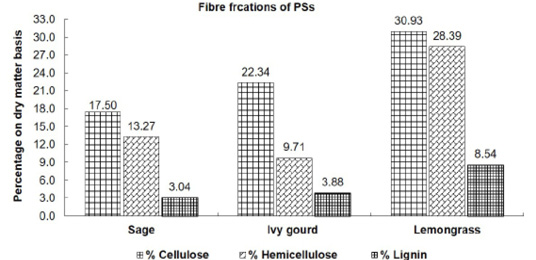
The cellulose content was highest in lemongrass (30.93%), followed closely by ivy gourd (22.34%), while sage had the lowest cellulose content (17.50%; Figure 1). Besides, the hemicellulose content was highest in lemongrass compared to ivy gourd and sage. The lignin content was highest in lemongrass (8.54%), followed by ivy gourd (3.88%) and sage (3.04%).
In vitro Fermentation Kinetics
pH of rumen fluid exhibited no significant variation across all phytogenic diets (PDs; Table 3). The PDs (sage, ivy gourd, or lemongrass) showed a tendency for higher OM degradability, DE, ME, SCFAs, and MP synthesis compared to the control diet (P=0.063). However, there was no significant differences among the PDs for these parameters (P>0.05). Compared to the control diet, the PDs demonstrated a 7–8% increase in OM degradability, a 7% enhancement in MP synthesis, an 8% improvement in DE, a 10–11% increase in ME, and a 14–17% higher production of SCFAs.
In vitro Gas Production
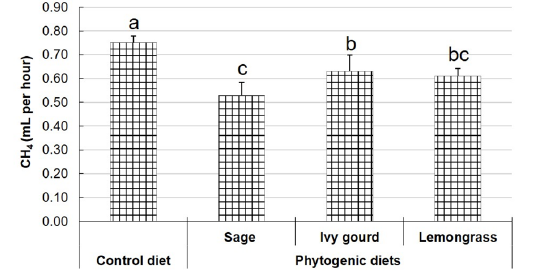
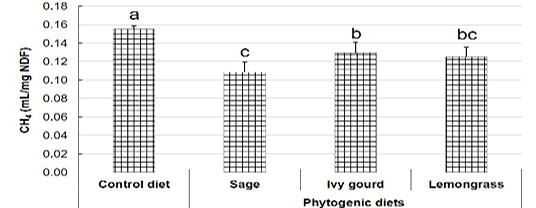
Compared to the control diet, the PDs namely sage, ivy gourd, or lemongrass showed a propensity of 17–18% higher net gas production in 24 hours or each hour (P=0.06), while there was no variation among all PDs (P>0.05; Table 4). The sage-based PD significantly reduced CH₄ production over 24 hours (Table 4) and on an hourly basis (Figure 2) compared to the control and ivy gourd diet (P<0.05), and no significant difference was observed between the lemongrass and sage diets (P>0.05). Additionally, CH₄ as a percentage of net gas production was 16–30% lower in PDs than in the control, with the lowest value recorded for the sage diet (P<0.01). Similarly, CH₄ production per mg of NDF was decreased by 16–30% in all PDs compared to the control (P<0.01), with sage exhibiting the greatest reduction (Figure 3).
Table 3: Effects of phytogenic supplements on in vitro rumen fermentation kinetics.
Variables
Control diet
Phytogenic diets
SEM
P-value
Sage
Ivy gourd
Lemongrass
pH
6.29±0.07
6.31±0.06
6.30±0.05
6.35±0.08
0.02
0.44
OMD (%)
57.33b±0.89
61.58a±2.53
61.91a±3.00
61.87a±2.98
0.75
0.063
DE (MJ/kg DM)
9.93b±0.16
10.70a±0.46
10.76a±0.55
10.75a±0.54
0.14
0.063
ME (MJ/kg DM)
7.80b±0.17
8.61a±0.49
8.68a±0.57
8.67a±0.57
0.14
0.063
SCFAs (mmoL)
0.76b±0.03
0.88a±0.07
0.89a±0.09
0.89a±0.09
0.02
0.063
MP (g/kg DM) synthesis
1.11b±0.02
1.19a±0.05
1.19a±0.06
1.19a±0.06
0.01
0.063
DE: Digestible energy; MJ/kg DM: Mega joule per kilogram dry matter; ME: Metabolizable energy; OMD: Organic matter digestibility; %: Percentage; SCFAs: Short-chain fatty acids; mmoL: Milli moles; MP: Microbial protein; g/kg DM: Gram per kilogram dry matter.
Table 4: Effects of phytogenic supplements on in vitro gas production.
Variables
Control diet
Phytogenic diets
SEM
P-value
Sage
Ivy gourd
Lemongrass
Gas production (mL) in 24 hours
Net gas (mL/200 mg DM)
34.38b±1.17
39.98a±3.33
40.41a±3.95
40.37a±3.92
0.99
0.06
CH₄ (mL/200 mg DM)
6.21a±0.18
5.08b±0.74
6.10a±0.53
5.93ab±0.79
0.18
0.08
% CH₄ of net gas
18.08a±0.73
12.66c±0.85
15.15b±1.32
14.73b±1.64
0.57
0.01
Gas production per hour
Net gas (mL/200 mg DM)
1.43b±0.05
1.67a±0.14
1.69a±0.16
1.68a±0.17
0.04
0.06
% CH₄ of net gas
0.75a±0.03
0.53c±0.03
0.63b±0.05
0.62b±0.07
0.02
0.01
mL: Milliliter; mg DM: Milligram dry matter.
DISCUSSIONS
Sage shrub was reported to contain 82.1% OM, 5.6% CP, 9.4% EE, 36.5% NDF, 17.7% ADF, and 30.6% NSC in Egypt . However, the present study displayed different findings, with higher OM and CP contents but lower EE and ash values compared to previous finding. These variations are likely due to differences in geographical location, climatic conditions, and cultivation practices between Bangladesh and Ethiopia. Bangladesh is characterized by fertile alluvial soils and a humid monsoon climate, whereas Ethiopia features diverse volcanic soils and a climate ranging from arid to temperate. These environmental factors significantly contribute to nutritional differences in shrub . On the contrary, the chemical composition of lemongrass in the present study nearly aligns with previous finding , particularly in terms of DM, OM, CF, EE, NFE, ADF, and NSC. This similarity can be attributed to the fact that lemongrass in both studies was cultivated under identical regional conditions, on the same land, and following the same cultivation practices . However, higher NDF and ADL levels were observed in the current study, which could be attributed to delayed harvesting, leading to increased lignification. Furthermore, the nutritional profile of ivy gourd analyzed in this study exhibited notable differences from the findings of Rahman et al. (2021), who assessed only the proximate composition of the leaves. The variations in DM, CF, EE, and NFE contents-except for CP and ash-may be due to differences in fibre fractions, particularly cellulose, hemicellulose, and lignin, which are present in variable concentrations across different plant parts. In addition, data on the cellulose, hemicellulose, and lignin content of sage and ivy gourd specific to this subcontinent were not available. However, their composition may vary depending on land type, cultivation practices, and harvesting processes. Besides, the total phenolic and flavonoid contents in these PSs are relatively high, as reported by Rahman et al. (2021, 2024b).
These primary nutrients and secondary metabolites especially phenolic and flavonoids, significantly influence rumen fermentation kinetics, nutrient utilization, gas production, and particularly CH₄ emissions in both in vivo and in vitro studies . However, these effects are dose-dependent like more than 1% sage supplements reduce the nutrient degradability . Consistent with the present findings, supplementation of 1% sage , or 1% lemongrass combined with mangosteen peel (1%; , or 2% individually , improved gas production, nutrient degradability, and rumen fermentation while reducing CH₄ emissions. These current effects may be attributed to the enhancement of beneficial rumen microbes by secondary metabolites, contributing to improved OM degradability, energy yield (DE and ME), MP synthesis, SCFAs, and overall fermentation efficiency ; . These PSs enhance the activity and population of cellulolytic and amylolytic bacteria ; , thereby improving feed degradability which may lead to increased OM degradability, energy yield (DE and ME), SCFAs, and net gas production. In addition, these PSs contain phenolic, flavonoids, tannin, saponin, and terpenoids which are responsible for inhibiting hyper-ammonia-producing bacteria, thus conserving nitrogen for microbial growth and improve the MP synthesis in the current study ; ; .
Additionally, the secondary metabolites present in sage (1,8-cineole, thujone, camphor, and other terpenoids) or lemongrass (citral, limonene, and myrcene) were proven to reduce protozoal populations and shift rumen fermentation patterns, leading to increased propionate production ; . This greater availability of propionate helps to utilize hydrogen, which would otherwise be used to produce CH₄, thereby contributing to a reduction in CH₄ production by 18% with sage and 5% with lemongrass in the current study. Previous studies indicated that supplementation with 1% sage and 0.50–0.75 mg/L sage essential oil has been shown to reduce CH₄ production by approximately 10.34% and 9–13%, respectively. Likewise, the inclusion of 1–2% lemongrass individually or 1% lemongrass with mangosteen peel resulted in a 2–5% and 21.0% reduction in CH₄ production under in vitro conditions ; which aligns with the current study. Although the present study observed a relatively modest (5%) CH₄ reduction, this outcome is significant given the practical advantages of lemongrass, such as its lower cost, higher biomass yield, and greater DM content compared to sage and ivy gourd b). Additionally, low-dose inclusion of lemongrass has been reported to improve dairy cow productivity, immunity, and milk desirable fatty acids, and zinc content b, 2024c). In contrast to the findings of the present study, Glorio Patrucco et al. (2025) reported that lemongrass supplementation at 0.07% did not significantly reduce in vitro CH₄ production, which may be attributed to the relatively low doses of lemongrass essential oil used . Supplementation with either sage or lemongrass at a 1% inclusion level has been shown to reduce the abundance of methanogens ; . This effect is primarily attributed to key secondary metabolites: citral in lemongrass , and thujone and 1,8-cineole in sage , which are known to disrupt the integrity of methanogenic cell membranes, thereby contributing to decreased ruminal CH₄ production in the existing study. Moreover, additional in vivo studies are necessary to validate their applicability and confirm their effectiveness under practical feeding conditions. Besides, in the current study, ivy gourd supplementation significantly improved percentage of CH₄ of net gas production but directly failed to mitigate ruminal CH₄ production. This outcome may be attributed to suboptimal concentrations (on DM basis) of anti-methanogenic secondary metabolites, such as tannins (1.2–3.5%) and saponins (0.8–2.2%), present in ivy gourd . Notably, previous study has reported that dietary inclusion of tannins at 2.5% and saponins at 0.75% can exert significant anti-methanogenic effects in ruminants.
CONCLUSIONS AND RECOMMENDATIONS
Lemongrass, sage, and ivy gourd showed distinct nutrient profiles, with lemongrass rich in dry matter and organic matter (OM), sage high in nitrogen-free extract and low in fibre, and ivy gourd highest in ash and ether extract. In an in vitro study, supplementation of phytogenic diets (PDs) with sage, ivy gourd, or lemongrass at 1% inclusion level exhibited a suggestive trend (P=0.063) toward enhancing OM degradability, microbial protein synthesis, feed energy values, short-chain fatty acids, and net gas production compared to the control diet. Among these PDs, sage demonstrated a notable reduction in CH₄ production, whereas lemongrass achieved a modest reduction, which hold practical significance when considering cost-effectiveness and better performance in cattle. The percentage of CH₄ relative to net gas volume was significantly reduced across all PDs, with the sage diet exhibiting the most substantial mitigation effect.
ACKNOWLEDGEMENTS
The authors gratefully acknowledge the financial support provided by the Ministry of Science and Technology (MoST), Government of the People’s Republic of Bangladesh, under the Research and Development (R and D) program (Project ID: 2023/07/MoST (R and D)). The authors also extend their sincere appreciation to the Department of Animal Nutrition, Bangladesh Agricultural University, and Bangladesh Agricultural University Research System for their technical support and valuable contributions throughout the research.
NOVELTY STATEMENTS
This study provides a comprehensive analysis of the fibre composition including cellulose, hemicellulose, and lignin content of sage, ivy gourd, and lemongrass cultivated in Bangladesh. Notably, it is the first to investigate the methane mitigation potential of ivy gourd as a phytogenic supplement using an in vitro rumen fermentation system. In contrast, the inclusion of either sage or lemongrass at the same inclusion level with the basal diet resulted in significant improvements in rumen fermentation kinetics, along with notable reductions in methane production.
AUTHOR’S CONTRIBUTIONS
Md. Aliar Rahman: Conceptualization, Methodology, Data Collection and Analysis, Writing Original Draft and Editing.
Rakhi Chowdhury: Supervision, Editing and Review.
Conflict of Interest
The authors have declared no conflict of interest.
Figures
Figure 1:.
Crude fibre fractions of phytogenic supplements used in In vitro study.
Figure 2:.
Effects of phytogenic supplements on methane production in in vitro system.
Figure 3:.
Effects of phytogenic supplements on methane production (mL) per mg NDF in in vitro.
References
AOAC (2005). Official Methods of Analysis (18th edition), Association of Official Analytical Chemist. Arlington, VA, USA.
Bashar MK, Haese E, Sultana N, Rodehutscord M (2024). In vitro ruminal fermentation, methane emissions, and nutritional value of different tropical feedstuffs for ruminants. J. Adv. Vet. Anim. Res., 11(4): 924-935. https://doi.org/10.5455/javar.2024.k842[CrossRef]
Benchaar C, Calsamiglia S, Chaves AV, Fraser GR, Colombatto D, McAllister TA, Beauchemin KA (2008). A review of plant-derived essential oils in ruminant nutrition and production. Anim. Feed Sci. Technol., 145(1-4): 209–228. https://doi.org/10.1016/j.anifeedsci.2007.04.014[CrossRef]
Bodas R, Prieto N, García-González R, Andrés S, Giráldez FJ, López S (2012). Manipulation of rumen fermentation and methane production with plant secondary metabolites. Anim. Feed Sci. Technol., 176(1–4): 78–93. https://doi.org/10.1016/j.anifeedsci.2012.07.010[CrossRef]
Cieslak A, Szumacher-Strabel M, Stochmal A, Oleszek W (2013). Plant components with specific activities against rumen methanogens. Animals, 7(s2): 253–265. https://doi.org/10.1017/S1751731113000852[CrossRef]
Fidriyanto R, Priadi G, Paradisa YB, Astuti WD, Ridwan R, Rohmatussolihat R, Sarwono KA, Whatman M, Widyastuti Y (2021). The use of lemongrass waste as elephant grass substitute in high forage feed on in vitro rumen fermentation: Methane production and digestibility. Agriculture, 33(2): 103–114. https://doi.org/10.24246/agric.2021.v33.i2.p103-114[CrossRef]
Fievez V, Babayemi OJ, Demeyer D (2005). Estimation of direct and indirect gas production in syringes: A tool to estimate short chain fatty acid production that requires minimal laboratory facilities. Anim. Feed Sci. Technol., 123: 197–210. https://doi.org/10.1016/j.anifeedsci.2005.05.001[CrossRef]
Glorio Patrucco S, Lotto A, Dorigo M, Fornaciari R, Sagliano A, Martinelli N, Cosani A, Abid K, Barbera S, Kaihara H, Tassone S (2025). Influence of lemongrass and oregano essential oils and their combination on in vitro ruminal fermentation and greenhouse gas emissions in total mixed ration for dairy cows. Ital. J. Anim. Sci., 24(1): 266–280. https://doi.org/10.1080/1828051X.2025.2450509[CrossRef]
Goel G, Makkar HP (2012). Methane mitigation from ruminants using tannins and saponins. Trop. Anim. Health Prod., 44(4): 729–739. https://doi.org/10.1007/s11250-011-9966-2[CrossRef]
Goering HK, Van Soest PJ (1970). Forage fiber analyses (apparatus, reagents, procedures, and some applications). US Agricultural Research Service.
Hristov AN, Oh J, Firkins JL, Dijkstra J, Kebreab E, Waghorn G, Makkar HP, Adesogan AT, Yang W, Lee C, Gerber PJ (2013). Special topics—Mitigation of methane and nitrous oxide emissions from animal operations: I. A review of enteric methane mitigation options. J. Anim. Sci., 91(11): 5045–5069. https://doi.org/10.2527/jas.2013-6583[CrossRef]
Kahvand M, Malecky M (2018). Dose-response effects of sage (Salvia officinalis) and yarrow (Achillea millefolium) essential oils on rumen fermentation in vitro. Ann. Anim. Sci., 18(1): 125–142. https://dx.doi.org/10.1515/aoas-2017-0024[CrossRef]
Khattab MS, Ebeid HM, Abd El Tawab AM, El-Nor SA, Aboamer AA (2016). Effect of supplementing diet with herbal plants on ruminal fiber digestibility and gas production. Res. J. Pharm., Biol. Chem. Sci., 7(6): 1093–1097.
Kholif AE, Rahman MA, Abo El-Nor SA, Morsy TA, Gouda GA, Fahmy M, Chahine M (2024). Efficacy of Salvia officinalis shrub as a sustainable feed additive for reducing ruminal methane production and enhancing fermentation in ruminants. Animals, 14(11): 1648. https://doi.org/10.3390/ani14111648[CrossRef]
Khonkhaeng B, Cherdthong A, Chantaprasarn N, Harvatine KJ, Foiklang S, Chanjula P, Wanapat M, So S, Polyorach S (2021). Comparative effect of Volvariella volvacea-treated rice straw and purple corn stover fed at different levels on predicted methane production and milk fatty acid profiles in tropical dairy cows. Livest. Sci., 251: 104626. https://doi.org/10.1016/j.livsci.2021.104626[CrossRef]
Lee MA, Todd A, Sutton MA, Chagunda MG, Roberts DJ, Rees RM (2017). A time-series of methane and carbon dioxide production from dairy cows during a period of dietary transition. Cogent Environ. Sci., 3(1): 1385693. https://doi.org/10.1080/23311843.2017.1385693[CrossRef]
Madhu P, Stephen Livingston T, Manickam IN (2017). Fixed bed pyrolysis of lemongrass (Cymbopogon flexuosus): Bio-oil production and characterization. Energy Sources, Part A: Recovery, Utilization, and Environmental Effects, 39(13): 1359–1368. https://doi.org/10.1080/15567036.2017.1328623[CrossRef]
Martínez-Fernández G, Abecia L, Martín-García AI, Ramos-Morales E, Hervás G, Molina-Alcaide E, Yáñez-Ruiz DR (2013). In vitro–in vivo study on the effects of plant compounds on rumen fermentation, microbial abundances and methane emissions in goats. Animal, 7(12): 1925–1934. https://doi.org/10.1017/S1751731113001699[CrossRef]
Menke KH, Raab L, Salewski A, Steingass H, Fritz D, Schneider W (1979). The estimation of the digestibility and metabolizable energy content of ruminant feedingstuffs from the gas production when they are incubated with rumen liquor in vitro. J. Agric. Sci., 93(1): 217–222. https://doi.org/10.1017/S0021859600086305[CrossRef]
Njidda AA (2010). Stoichiometric relationship between short chain fatty acid and in vitro gas production of semi-arid browses of North-eastern Nigeria. Pakistan J. Nutri., 9(7): 637–642. https://dx.doi.org/10.3923/pjn.2010.637.642[CrossRef]
Oskoueian E, Abdullah N, Oskoueian A (2013). Effects of flavonoids on rumen fermentation activity, methane production, and microbial population. Biomed Res. Int., 2013(1): 349129. https://doi.org/10.1155/2013/349129[CrossRef]
Patra AK, Yu Z (2015). Effects of essential oils on methane production and fermentation by, and abundance and diversity of, rumen microbial populations. Appl. Environ. Microbiol., 81(8): 2899–2907. https://doi.org/10.1128/AEM.03672-14[CrossRef]
Prachumchai R, Suriyapha C, Dagaew G, Sommai S, Matra M, Phupaboon S, Phasuk Y, Wanapat M (2024). Microencapsulation of lemongrass and mangosteen peel as phytogenic compounds to gas kinetics, fermentation, degradability, methane production, and microbial population using in vitro gas technique. PLoS One, 19(6): e0304282. https://doi.org/10.1371/journal.pone.0304282[CrossRef]
Rahman MA, Chowdhury R, Islam KMS (2024a). Performance and nutritional status of Holstein crossbred cows in a selected area of Bangladesh under the existing farming system. J. Adv. Vet. Anim. Res., 11(3): 686–692. https://doi.org/10.5455/javar.2024.k818[CrossRef]
Rahman MA, Ray D, Redoy MRA, Al-Mamun M (2021). Dose titration of herbs mixture powder supplementation on laying performance and egg quality in commercial layer chicken. Livest. Res. Rural Dev., 33:1.
Rahman MA, Redoy MRA, Chowdhury R, Al-Mamun M (2024c). Effect of dietary supplementation of plantain herb, lemongrass and their combination on milk yield, immunity, liver enzymes, serum, and milk mineral status in dairy cows. J. Adv. Vet. Anim. Res., 11(1): 185–193. https://doi.org/10.5455/javar.2024.k764[CrossRef]
Rahman MA, Redoy MRA, Shuvo AAS, Chowdhury R, Hossain E, Sayem SM, Rashid MH, Al-Mamun M (2024b). Influence of herbal supplementation on nutrient digestibility, blood biomarkers, milk yield, and quality in tropical crossbred cows. PLoS One, 19(11): e0313419. https://doi.org/10.1371/journal.pone.0313419[CrossRef]
Rahman MA, Sultana S, Redoy MRA, Debi MR, Chowdhury R, Al-Mamun M (2022). Combined impact of lemongrass and spearmint herbs on performance, serum metabolites, liver enzymes, and meat quality of broiler. J. Adv. Vet. Anim. Res., 9(4): 712–719. https://doi.org/10.5455/javar.2022.i640[CrossRef]
Totakul P, Matra M, Sommai S, Viennasay B, Wanapat M (2024). Combination effects of phytonutrient pellet and lemongrass (Cymbopogon citratus) powder on rumen fermentation efficiency and nutrient degradability using in vitro technique. Trop. Anim. Health Prod., 56(2): 97. https://doi.org/10.1007/s11250-024-03936-w[CrossRef]
Vargas-Ortiz L, Chavez-Garcia D, Barros-Rodríguez M, Andrade-Yucailla V, Lima-Orozco R, Macías-Rodríguez E, Guishca-Cunuhay C, Zeidan Mohamed Salem A (2022). Rumen function and in vitro gas production of diets influenced by two levels of tannin-rich forage. Fermentation, 8(11): 607. https://doi.org/10.3390/fermentation8110607[CrossRef]
Wanapat M, Cherdthong A, Pakdee P, Wanapat S (2008). Manipulation of rumen ecology by dietary lemongrass (Cymbopogon citratus Stapf.) powder supplementation. J. Anim. Sci., 86(12): 3497–3503. https://doi.org/10.2527/jas.2008-0885[CrossRef]
Yalew S, Asmare B, Mekuriaw Y (2020). Effects of fertilizer type and harvesting age on species composition, yield, and chemical composition of natural pasture in the highlands of Ethiopia. Biodiversitas J. Biolog. Biodiv., 21(11): 4999–5007. https://doi.org/10.13057/biodiv/d211103[CrossRef]