Research Article · Volume 12, Issue 10, 31 August 2024 · Open Access
The Balance of Rumen Degradable Protein with Non-Fiber Carbohydrate in Cattle Rations and its Effect on Total Gas Production, Gas Kinetics and Methane Gas Production
· ·
Affiliations & Notes ⌄
1Student at the Faculty of Animal Husbandry, Department of Animal Nutrition and Feed Technology, Padjadjaran University, Jl. Raya Bandung-Sumedang Km.21 Jatinangor, 45363, Sumedang, Indonesia
2Department of Animal Nutrition and Feed Technology, Faculty of Animal Husbandry, Padjadjaran University, Jl. Raya Bandung-Sumedang Km.21 Jatinangor, Sumedang, Indonesia. *Correspondence | Ujang Hidayat Tanuwiria, Department of Animal Nutrition and Feed Technology, Padjadjaran University, Jl. Raya Bandung-Sumedang Km. 21 Jatinangor, Sumedang, Indonesia
The results showed that after the incubation process for 24 hours the total gas production ranged from 161.74 – 182.20 mL/g DMs and methane gas production ranged from 16.03 – 16.92 mM/g DMs.
The treatment did not significantly affect the kinetic gas for constant a+b or maximum gas production which ranged from 168.89 – 184.77 mL/g DMs.
The use of various ratios of Rumen Degradable Protein (RDP) with Non-Fiber Carbohydrate (NFC) in rations did not affect total gas production, maximum gas production (a+b), and methane gas production in vitro.
In addition, the methane gas production was not significantly different from each treatment, indicating that the lower and upper limits for the ratios that can produce the lowest and highest methane cannot yet be concluded.
Selected from the article's own text.
Abstract
The rumen of cattle is inhabited by complex microbiota that play an important role in facilitating the feed fermentation process. Therefore, its nutrient requirements must also be taken into consideration. Nutrient requirements for rumen microbes can be met from rumen degradable protein (RDP) and non-fiber carbohydrate (NFC). Nutrients that are easily degraded in the rumen can be seen from their metabolite products such as total gas production, gas kinetics, and methane gas production. This study aims to determine the effect of the balance of rumen degradable protein (RDP) with non-fiber carbohydrate (NFC) in cattle rations on total gas production, gas kinetics and methane gas production in vitro. The study used an experimental method with a completely randomized design (CRD). There were six treatments of RDP balance with NFC, namely R1 (1.7), R2 (1.5), R3 (1.8), R4 (1.6), R5 (1.4), and R6 (1.3) with five replications. Research data were processed by analysis of variance and Duncan’s multiple range test. The results showed that the balance of RDP:NFC in the ration gave no significant effect (P>0.05) on total gas production, maximum gas production, and methane gas production. However, it had a significant effect (P<0.05) on the cumulative gas production rate. The conclusion of this study is that the balance of RDP:NFC in cattle ration is a more important factor in feed formulation.
Keywords | Rumen degradable protein, Non-fiber carbohydrate, Total gas production, Gas kinetics, Methane gas
INTRODUCTION
Feed is one of the factors that determine the level of livestock productivity . Based on economic as well as production perspectives, feed contributes 60-70% in livestock farming activities . The calculation of animal feed needs is still considered not optimal because it is still based on the calculation of the needs of the host alone. The rumen of cattle is inhabited by complex microbiota that play an important role in facilitating the fermentation process of feed that cannot be digested by the host animal and is responsible for providing up to 70% of the animal’s energy needs . In addition, rumen microbes are the largest contributor to protein for cattle through microbial protein production . Around 80-90% of ruminants’ amino acid needs are met by microbial proteins (National Research Council, 2001). The rumen microbes require protein nitrogen to multiply and synthesize their body proteins . Therefore, cattle feed formulation must also take into account the nutrient requirements for rumen microbes because feed is a determining factor for the variety, number, composition and characteristics of these microbes, especially protein and energy intake , another factor reported as the impact of extra herbs , b).
Rumen Degradable Protein (RDP) is the fraction of protein that is degraded in the rumen by rumen microbes to produce microbial protein . Microbial protein is influenced by the availability of energy derived from carbohydrate fermentation in the rumen and nitrogen (N) in the form of NH3 . The availability of these elements in the rumen must be in the right proportion in order to increase the efficiency of microbial protein synthesis ; , b). Non-Fiber Carbohydrate (NFC) provides carbohydrates that are easily fermented. Non-Fiber Carbohydrates (NFC) consist of sugars, starch, fructans, pectin, galactans and B-glucans . Increasing the availability of energy derived from fermented carbohydrates and nitrogen in the form of NH3 in the rumen will affect microbial protein synthesis (National Research Council, 2001).
Research on the effect of RDP and NFC synchronization was carried out by measuring the metabolite products produced, namely total gas production, gas kinetics, and methane gas production produced through in vitro techniques. Gas production can indicate fermented and unfermented, soluble and insoluble nutrients . Gas kinetics are required to estimate the kinetics of the fermentation process. Gas kinetics are measured to determine the rate of gas formation reactions and the rate of feed fermentation in the rumen . Methane is a fermentation product produced through the process of methanogenesis. Methane emissions represent a significant loss of feed energy, ranging from 2% to 12% of gross feed energy ; ; Kharzi et al., 2022). Several studies have examined the interaction effect of RDP and NFC in several concentrations in the diet on microbial protein synthesis (MPS) and digestibility, but did not measure the resulting gas production potential and kinetic gas ; . Considering the fact that RDP provides available (N) for rumen microbes and NFC is rapidly fermented in the rumen, we hypothesized that total gas production, kinetic gas, and methane gas production are affected by the size of RDP and NFC in the feed including their synchronization. Therefore, this study aimed to determine the effect of various RDP and NFC balances in cattle rations on total gas production, gas kinetics, and methane gas production. This research is also expected to produce new feed formulation standards in the future that not only take into the animal’s needs but also the needs of rumen microbes in it. In addition, the results obtained, especially methane gas data, can be an initial mitigation of methane gas that will be generated if in the future RDP: NFC is used as a standard in feed formulations.
MATERIALS AND METHODS
Eksperimental Design
In vitro research was conducted at the Laboratory of Ruminant Nutrition and Feed Chemistry, Faculty of Animal Husbandry, Padjadjaran University. The ration used is a mixture of several types of feed such as fiber sources, energy sources, protein sources, and mineral sources. The feed ingredients were cut and dried at 60°C for 24 hours. After that, the material was ground to a size of 1 mm using a hammermill, then each feed was tested for dry matter, ash, crude protein, BETN by the method AOAC (2007), and RDP content by the Tilley and Terry method (1969). Information on the nutrient content of each feed ingredient used in this study can be seen in Table 1. The study used a completely randomized design (CRD) with six rations formulated based on the ratio of RDP:NFC (1.7; 1.5; 1.8; 1.6; 1.4; 1.3) for each treatment (R1, R2, R3, R4, R5, R6). The balances was obtained from the ratio of RDP and NFC (60:35, 60:40, 65:35, 65:40, 55:39, 55:41) respectively (Table 2) with the nutrient content of each treatment shown in Table 3. The selection of RDP concentrations that are higher than the NFC is expected to optimize microbial protein synthesis while producing digestive enzymes in the rumen so that the process of feed degradation into simpler
components occurs faster.
The sample incubation procedure for in vitro refers to Theodorou et al. (1994) and the preparation procedure performed by Yanza et al. (2018) with modifications where gas production data collection uses a syringe directly in units
of mL. Around 500 mg of feed sample and 50 mL of rumen fluid mixture with buffer were mixed and placed into a 100 mL bottle. In addition, 2 bottles containing 50 mL of buffered rumen fluid without feed samples were prepared as blanks. The research was conducted with an experimental method using a completely randomized design (CRD) with a total of 30 experimental units (6 treatments and 5 replicates).
Table 2: Composition of diets treatment.
Feed source
Treatment
R1
R2
R3
R4
R5
R6
Percentage
Rice straw
8,69
14,19
8,62
8,18
6,36
6,68
Corn husks
5,00
0,00
0,00
0,00
13,22
12,44
Elephant grass
5,00
0,00
33,00
29,89
13,54
12,00
Corn stalks
24,34
20,75
0,00
0,00
13,22
12,44
Grounded corn
23,64
16,90
35,00
28,51
11,86
11,30
Cassava
0
1,77
0,00
0,00
10,36
12,00
Coconut meal
12,13
17,36
3,53
3,73
15,63
14,96
Palm meal
0,00
0,00
0,00
5,00
1,50
2,99
Indigofera
15,00
14,00
18,53
13,00
2,60
2,37
Soybean meal
4,37
6,75
0,00
0,00
8,26
8,29
Tofu dregs
0,83
7,29
0,00
10,69
2,44
3,36
Mineral
1,00
1,00
1,00
1,00
1,00
1,00
Preparation of Inoculum and Incubation
Cattle rumen fluid was taken from two cows A and B at Ciroyom Slaughterhouse located at Jl. Arjuna No. 45, Husen Sastranegara, Cicendo District, Bandung City. The rumen fluid was filtered using four layers of muslin cloth into two different flasks stored at 39°C under anaerobic conditions and immediately transported to the laboratory. Two hundred milliliters of rumen fluid from each flask was mixed with 1600 mL of buffer liquid (9.8 g NaHCO3, 4.65 g Na2HPO4.2H2O, 0.57 g KCl, 0.47 g NaCl, 0.12 g MgSO4.7H2O, and 0.04 g CaCl2 per liter buffer) in 2-Liter beaker glass. The mixture of rumen fluid and buffer was continuously supplied with CO2 gas before 50 mL of rumen fluid and buffer were put into 100 mL bottles that had been filled with feed samples from each treatment. Afterward, the bottles were incubated in a waterbath for 24 hours at 39°C.
Total Gas Production, Gas Kinetics, and Methane Analysis
Total gas production data was collected every two hours during the incubation process for 24 hours using 20 mL syringe with a 0.1 mm needle that was inserted into the bottle cap that had been opened in the center. The fermentation process is characterized by the syringe being pushed by the pressure of the gas formed during incubation. The gas taken is then collected into a 100 mL bottle that has been vacuumed beforehand. After the incubation process is complete, the data is summed for the total gas production parameter. Meanwhile, the kinetic gas is estimated by the exponential equation proposed by Ørskov and McDonald (1979) is p=a+b(1-e-ct), where p represents cumulative gas production at time t hours, a represents gas production from the soluble fraction, b: represents gas production from the insoluble but fermentable fraction, c: represents the rate of gas formation reaction, t represents fermentation time at a given time (hours). All data were analyzed using SPSS (v.29). The previously collected gas was taken as much as about 10 mL using a 10 mL syringe and put into a 10 mL vacutainer for methane gas concentration analysis. Methane analysis
Table 4: Gas Production, Gas Kinetic, and Methane Production after 24h rumen fermentation in vitro.
Observed Parameters
R1
R2
R3
R4
R5
R6
P value
TGP (mL/ g DMs)
169,78
161,74
171,43
178,47
175,73
182,20
0,510
a+b (mL/ g DMs)
176,56
168,89
180,26
181,26
181,02
184,77
0,849
c (mL/h)
0,018a
0,035bc
0,017a
0,023ab
0,041c
0,040c
0,000
CH4 (mM/g DMs)
16,70
16,06
16,03
16,13
16,46
16,92
0,967
TGP: Total Gas Production; CH4: Methane production; a+b: Potential extent of gas production; c: Constant rate of gas production; abc: Means with different superscript letter in the same column showed statistically different at p<0.05.
are using Shimadzu 8A GC with FID (Flame Ionization Detector) based on procedures .
Statistical Analysis
The study used a completely randomized design (CRD) with six RDP:NFC treatment rations (1.7; 1.5; 1.8; 1.6; 1.4; 1.3). The mathematical model used is as follows:
Yij = µ + τi + εij
where;
Yij: observed response due to i-th treatment and j-th replication.
µ: general mean.
τi: effect of i-th treatment.
εij: effect of error from i-th treatment and j-th replication.
All data were analyzed using one-way ANOVA using SPSS (v.29) with RDP:NFC ratio as the independent variable and total gas production, kinetic gas, and methane gas production as the dependent variable. The treatment was said to have a significant effect if p<0.05. Duncan’s Multiple Range Test was used to determine the real difference between treatments. Statistical significance between treatments was said to be significantly different if p<0.05.
Table 3: Nutrient composition of dietary treatment.
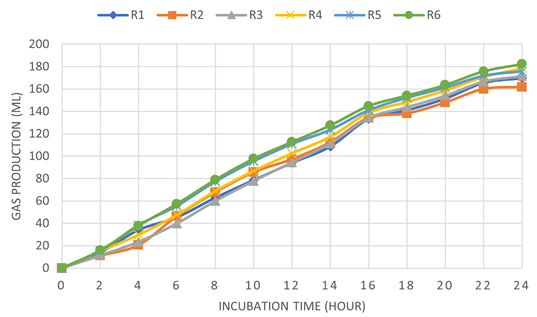
This study aimed to determine the effects of various RDP and NFC balances on total gas production taken every two hours for 24 hours of incubation time, kinetic gas, and methane gas production (Table 4). The results showed that after the incubation process for 24 hours the total gas production ranged from 161.74 – 182.20 mL/g DMs and methane gas production ranged from 16.03 – 16.92 mM/g DMs. The methane gas production produced in this study is higher than the research of ; . The high production of methane produced can have a greater impact on the environment. These results open up opportunities for further research in the future, namely RDP and NFC synchronization research with the addition of antimethanogenic materials such as syntetic halogenated compounds to reduce the production of methane produced . Statistically, the treatments had no significant effect (P=0.01; P=0.97 respectively) on total gas production and methane gas production. The treatment did not significantly affect the kinetic gas for constant a+b or maximum gas production which ranged from 168.89 – 184.77 mL/g DMs. The non-significant difference in total gas production is thought to occur because the difference in balance values between treatments is not too significant, resulting in substrates that are broken down and fermented by rumen microbes not much different between treatments. However, for the cumulative gas production rate (constant c), the treatments had a significant effect (P=0.00). The resulting gas production rate ranged from 0.017 – 0.041 mL/hour. Treatments R5 and R6 have the highest cumulative gas production rate (c). While the lowest cumulative gas production rate (c) was produced by treatments R3 and R1.
Total Gas Production
The results of this study indicate that the high and low content of RDP and NFC in the ration can be the cause of high and low gas production. Gas production indicates the fermentation process of feed by rumen microbes . The higher carbohydrate content in the feed, the higher the gas produced from the feed fermentation process . Gas production is basically the result of carbohydrate fermentation by rumen microbes, converting polysaccharides into acetate, propionate, short fatty acids, CO2, and CH4 .
The ration of treatments R5 and R6 had similar graphical patterns of total gas production (Figure 1). However, at the end of the incubation period, the total gas production of R6 was higher, and the total gas production of treatment R5 was lower than treatment R4. Although it has a high NFC content when compared to treatment R1 (NFC 35%), treatment R2 (NFC 40%) has the lowest gas production graph at the end of the incubation period. These results show that the high content of NFC in the ration is not always a determining factor for high total gas production. The balance between the RDP and NFC content of the ration plays a more important role in supporting rumen microbial activity to digest feed. This occurs because gas production is related to the availability of carbohydrates in the feed, which the higher levels will increase protein degradation by rumen microbes which will then be utilized by microbes for growth, where increased microbial growth is characterized by increased gas production .
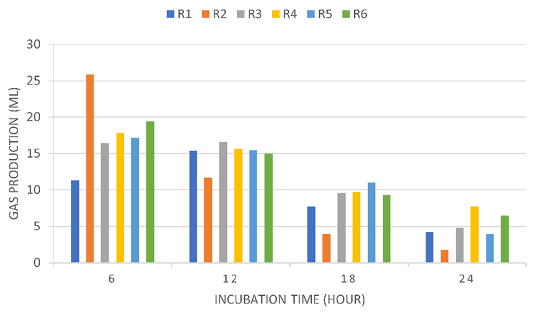
Based on Figure 2, the highest total gas production occurs at different times. This is related to the high and low content of NFC in the ration. Non-Fiber Carbohydrate content determines how quickly the rations are degraded in the rumen due to its fermentable nature. In addition, differences in the speed of adaptation of rumen microbes to new conditions and feed can also affect how quickly the rations are degraded. Any changes in rumen microbes can produce important effects on animal physiology, one of which affects feed conversion efficiency in ruminants (Hasan et al., 2020). However, in general, the increase in total gas production occurred at a relatively similar time at the beginning of the incubation period. The rate of gas production in each treatment decreased after 18 hours of incubation. This occurs because, as the incubation time increases, the substrate that can be fermented also decreases in number .
Gas Kinetics
Gas kinetics are measured to determine the rate of gas formation reactions and the rate of feed fermentation in the rumen . Gas kinetics depend on the proportion of soluble, insoluble but degradable, and non-degradable feed fractions . Gas kinetics values were estimated using the exponential equation proposed by Ørskov and Mcdonald (1979). The constant a+b (maximum gas production) is related to the total gas production, where the total gas production formed during 24 hours of incubation produced more than 90% of the maximum gas production in all treatments. Similar to total gas production, the high and low content of NFC in the ration can cause differences in the amount of gas produced. The higher the carbohydrate content in the feed, the higher the gas produced from the feed fermentation process in the rumen . In addition, differences in maximum gas production (a+b) can also be caused by changing rumen microbial populations and activities. Changes in rumen microbial activity cause changes in the digestibility value of various soluble fractions in feed .
The kinetic gas was also used to estimate the cumulative gas production rate (constant c) of each treatment ration. Treatment R5 has the highest cumulative gas product rate (c) of 0.041 mL/hour. While R3 is the treatment that has the lowest cumulative gas production rate (c). The high or low value of the constant c indicates how quickly the treatment ration is fermented by rumen microbes. The constant c value is related to the maximum gas production (a+b). Ration R5 is very rapidly fermented, but has a low maximum gas production. This result is inversely proportional to the treatment ration which is fermented not so fast (low c constant), but produces a fairly high maximum gas production. These results are in accordance with research , which reported that treatments with high constant c values had low maximum gas production (a+b). These results show that NFC actually provides carbohydrates that are easily fermented and digested, resulting in a high cumulative gas production rate (c). Higher NFC and lower NDF concentrations promote faster and higher gas production rates . Soluble carbohydrates will be quickly converted to gas and increase total gas production and block tannins in methanogenesis . In addition, this difference can also be caused by changes in rumen microbial population and activity. However, the availability of an appropriate amount of RDP is also a factor in how quickly or slowly a ration can be fermented by rumen microbes. The balance between RDP and NFC content of the ration is an important factor in supporting rumen microbial activity to digest feed. The addition of carbohydrates in feed can increase protein degradation by microbes so that it can be used for microbial growth .
Methane Emissions
Methane is a product of the biological activity of methanogenic bacteria in the rumen produced through the process of methanogenesis. The concentration of methane gas (CH4) formed during the incubation process can be an indicator of the quality of feed that is environmentally friendly because the contribution of methane gas released into the atmosphere as a greenhouse gas causes global warming. Methane production in this study is included in the high category when compared to the research of Sirohi et al. (2012). Methane gas comes from fiber degradation that produces H2 which will be utilized by methanogenic microbes to be converted into CH4 through the process of methanogenesis. Methanogenic microbes in the rumen obtain substrates for methanogenesis from microbial fermentation products. Ciliated protozoa are prominent producers of H2 and carry out hydrogen transfer with methanogenic achae for later conversion to CH4 . Methane gas production is closely related to fiber content, especially the NDF (Neutral Detergent Fiber) fraction in the diet. Methane content increases with increasing NDF and hemicellulose content because it will change the proportion of acetic acid that produces hydrogen gas (H2) as a substrate in the methanogenesis reaction . In this study, the proportion of NDF ranged from 59% to 65%, which is quite high in the ration.
The NDF fractions are mostly composed of polysaccharides that have longer chemical bonds than the NFC fractions, which are mostly included in the NDS (Neutral Detergent Soluble). The longer the polysaccharide bonds, the more carbon (C) and hydrogen (H2) produced from the fermentation process. But actually, the role of fibrolytic bacteria and methanogen bacteria in the fermentation process is the main factor in the formation of methane gas in the rumen. Fibrolytic bacteria and ciliated protozoa act as the first working unit that converts feed cell wall polysaccharides into VFA, CO2 and H2, where some of these substrates, especially hydrogen and acetate, will be used by methanogenic bacteria to produce methane gas (CH4) through the hydrogenotrophic pathway ; Hasan et al., 2020). This high availability of hydrogen then makes methanogenic bacteria use the substrate to produce high amounts of methane gas (CH4). Recently, several plant extracts such as saponins, tannins and essential oils (EO) have been investigated to assess their ability to manipulate rumen physiology and antimicrobial activities and the results showed a significant effect on methanogens, feed degradation and fermentation parameters (Hasan et al., 2020). The use of plant secondary metabolites together with RDP- and NFC-based feeds could be an interesting research topic in the future.
CONCLUSIONS AND RECOMMENDATIONS
In conclusion, this study aimed to determine the effect of various ratios of RDP and NFC in cattle rations on total gas production, gas kinetics, and methane gas production through in vitro tests. The use of various ratios of Rumen Degradable Protein (RDP) with Non-Fiber Carbohydrate (NFC) in rations did not affect total gas production, maximum gas production (a+b), and methane gas production in vitro. However, it affected the cumulative gas production rate (c). Ration treatments R5 (1.4) and R6 (1.3) produced the highest cumulative gas production rate. These results will serve as an early illustration of how much gas is produced and a predictor of the amount of feed degradation in the rumen if the ration formulation is based on the ratio of RDP and NFC. In addition, the methane gas production was not significantly different from each treatment, indicating that the lower and upper limits for the ratios that can produce the lowest and highest methane cannot yet be concluded. The addition of antimethanogenic substrates in feed with the ratio of RDP and NFC is one of the interesting topics for future research.
ACKNOWLEDGMENTS
This research is part of the “Riset Kolaborasi Indonesia (RKI) 2023” research and we would like to thank the “Research Collaboration Indonesia (RKI)” research scheme for supporting this research.
NOVELTY STATEMENT
The novelty of this study lies in its focus on the specific balance between rumen degradable protein (RDP) and non-fiber carbohydrates (NFC) in cattle rations and its effects on total gas production, gas kinetics, and methane gas production. Unlike previous research, which primarily examined microbial protein synthesis and digestibility without considering gas production potential, this study uniquely integrates the measurement of gas kinetics and methane production in vitro. Notably, there are no previous publications that specifically report the RDP:NFC ratio, making this study a pioneering effort in understanding the implications of this ratio on rumen fermentation and methane emissions. This approach not only provides insights into the efficiency of microbial protein synthesis but also offers a potential avenue for methane mitigation strategies in cattle nutrition.
AUTHOR’S CONTRIBUTIONS
Muhammad Ariana Setiawan: Students, play a role in carrying out research in the field and data processing.
Ujang Hidayat Tanuwiria and Andi Mushawwir: Research conceptualization, Methodology and carrying out research in the field.
Conflict of Interest
The author declares that there is no conflict of interest regarding the publication of this article
Figures
Figure 1:.
Total Gas Production Pattern.
Figure 2:.
Total Gas Production in Unit Time.
References
Abrar A, Fariani A (2018). The Effect of Tannin Extracted from Sorghum Grain to Gas and Methane Production In Vitro. Jurnal Peternakan Sriwijaya, 7(1): 40–52.
Alfiansyah AH, Hartutik H (2021). Tren Produksi Gas, Produksi Gas Total dan Degradasi Secara In Vitro Dengan Penambahan Aditif Dengan Level Berbeda Pada Silase Tebon Jagung (Zea Mays L). Jurnal Nutrisi Ternak Tropis., 4(2): 77–87. https://doi.org/10.21776/ub.jnt.2021.004.02.2[CrossRef]
Anas MA, Muhlisin, Bachruddin Z, Yusiati LM (2020). In vitro gas production kinetics as influenced by combination of Acacia magium, Swietenia mahagoni and Artocarpus heterophyllus as tannin source. IOP Conference Series: Earth Environ. Sci., 465(1): 1-5. https://doi.org/10.1088/1755-1315/465/1/012036[CrossRef]
AOAC (2007). Official methods of analysis (18th ed.)., Association of Official Analytical Chemists. Arlington, VA.
Cieslak A, Zmora P, Matkowski A, Nawrot-Hadzik I, Pers-Kamczyc E, El-Sherbiny M, Bryszak M, Szumacher-Strabel M (2016). Tannins from sanguisorba officinalis affect in vitro rumen methane production and fermentation. The J. Anim. Plant Sci., 26(1): 54–62.
Fahmi T, Tedi S, Sujitno E. (2015). Petunjuk Teknis Manajemen Pemeliharaan Ternak Domba. Balai Pengkajian Teknologi Pertanian Jawa Barat. Bandung.
Fregulia P, Dias RJP, Campos MM, Tomich TR, Riberio Pereira LG, Alves Neves AL (2024). Composition of the rumen microbiome and its association with methane yield in dairy cattle raised in tropical conditions. Mol. Biol. Rep., 51: 447. https://doi.org/10.1007/s11033-024-09381-0[CrossRef]
Getachew G, Blummel M, Makkar HPS, Becker K (1998). In vitro gas measuring techniques for assessment of nutritional quality of feeds: a review. Anim. Feed Sci. Technol., 72: 261–281.
Getachew G, DePeters EJ, Robinson PH (2004). In Vitro Gas Production Provides Effective Method for Assessing Ruminant Feeds. Calif. Agric., 58(1): 54–58. https://doi.org/10.3733/ca.v058n01p54[CrossRef]
Haryati RP, Jayanegara A, Laconi EB, Ridla M, Suptijah P (2019). Evaluation of chitin and chitosan from insect as feed additives to mitigate ruminal methane emission. AIP Conf. Proc. 3 July 2019; 2120 (1): 040008., https://doi.org/10.1063/1.5115646[CrossRef]
Hassan F, Arshad MA, Ebeid HM, Rehman MS, Khan MS, Shahid S and Yang C (2020). Phytogenic Additives Can Modulate Rumen Microbiome to Mediate Fermentation Kinetics and Methanogenesis Through Exploiting Diet–Microbe Interaction. Front. Vet. Sci., 7: 575801. https://doi: 10.3389/fvets.2020.575801[CrossRef]
Hermon, Suryahadi, Wiryawan KG, Hardjosoewignjo S (2008). Nisbah Sinkronisasi Suplai N-Protein dan Energi dalam Rumen Sebagai Basis Formulasi Ransum Ternak Ruminansia. Media Peternakan., 31(3): 186–194.
Jayanegara A (2008). Methane Reduction Effect of Polyphenol Containing Plants, Simple Phenols and Purified Tannins in In Vitro Rumen Fermentation System (Master Thesis). University of Hohenheim.
Jayanegara A, Makkar HPS, Becker K (2009). Emisi metana dan fermentasi rumen in vitro ransum hay mengandung tannin murni pada konsentrasi rendah. Media Peternakan., 20(2):185–195.
Jayanegara A, Sofyan A (2008). Penentuan aktivitas biologis tanin beberapa hijauan secara in vitro menggunakan “Hohenheim Gas Test” dengan polietilen glikol sebagai determinan. Media Peternakan., 31(1):44–52.
Kharazi AY, Latipudin D, Suwarno N, Puspitasari T, Nuryanthi N, Mushawwir A (2022). Lipogenesis in Sentul chickens of starter phase inhibited by irradiated chitosan. IOP Conference Series: Earth Environ. Sci., 1001: 1–6. https://doi.org/10.1088/1755-1315/1001/1/012021[CrossRef]
Kurniawati A (2004). Pertumbuhan Mikroba Rumen dan Efisiensi Pemanfaatan Nitrogen pada Silase Red Clover (Trifolium Pratense cv Sabtron). Risalah Seminar Ilmiah Penelitian Dan Pengembangan Aplikasi Isotop Dan Radiasi., 17:168–171.
Martin C, Morgavi DP, Doreau M (2010). Methane mitigation in ruminants: from microbe to the farm scale. Animal., 4(3): 351–365. https://doi.org/10.1017/S1751731109990620[CrossRef]
Morgavi DP, Forano E, Martin C, Newbold CJ (2010). Microbial Ecosystem and Methanogenesis in Ruminants. Animal., 4(7):1024–1036. https://doi.org/10.1017/S1751731110000546[CrossRef]
Mushawwir A, Permana R, Latipudin D, Suwarno N (2021a). Organic Diallyl-n-Sulfide (Dn-S) inhibited the glycogenolysis pathway and heart failure of heat-stressed laying hens. IOP Conference Series: Earth Environ. Sci., 788: 1-7. https://doi.org/10.1088/1755-1315/788/1/012091[CrossRef]
Mushawwir A, Permana R, Darwin D, Puspitasari T, Pangerteni D S, Nuryanthi N, Suwarno N (2021b). Enhancement of the liver histologic of broiler induced by irradiated chitosan (IC). IAP Conf. Proc. 2381: 0200461-0200467. https://DOI.org/10.1063/5.0066271[CrossRef]
National Research Council (2001). Nutrient Requirements of Dairy Cattle (7th ed.). National Academy Press. Washington DC.
Ørskov ER, Mcdonald I (1979). The Estimation of Protein Degradability in the Rumen from Incubation Measurements Weighted According to Rate of Passage. J. Agric. Sci., 92(2): 499–503. https://doi.org/10.1017/S0021859600063048[CrossRef]
Rivero MJ, Keim JP, Balocchi OA, Lee MRF (2020). In Vitro Fermentation Patterns and Methane Output of Perennial Ryegrass Differing in Water-Soluble Carbohydrate and Nitrogen Concentrations. Animals, 10(6):1076. https://doi.org/10.3390/ani10061076[CrossRef]
Rosmalia A, Permana IG, Despal D (2022). Synchronization of Rumen Degradable Protein with Non-Fiber Carbohydrate on Microbial Protein Synthesis and Dairy Ration Digestibility. Vet. World., 15(2): 252–261. https://doi.org/10.14202/vetworld.2022.252-261[CrossRef]
Romero P, Ungerfeld EM, Popova M, Morgavi DP, Yáñez-Ruiz DR, Belanche A (2024). Exploring the combination of Asparagopsis taxiformis and phloroglucinol to decrease rumen methanogenesis and redirect hydrogen production in goats. Anim. Feed Sci. Technol., 316: (116060). https://doi.org/10.1016/j.anifeedsci.2024.116060[CrossRef]
Putri EM, Zain M, Warly L, Hermon (2019). In Vitro Evaluation of Ruminant Feed from West Sumatera Based on Chemical Composition and Content of Rumen Degradable and Rumen Undegradable Proteins. Vet. World., 12(9): 1478–1483. https://doi.org/10.14202/vetworld.2019.1478-1483[CrossRef]
Rahmania H, Permana R, Latipudin D, Suwarno N, Puspitasari T, Nuryanthi N, Mushawwir A (2022). Enhancement of the liver status of Sentul chickens from the starter phase induced by irradiated chitosan. IAP Conf. Proc., 1001: 1-7. https://doi.10.1088/1755-1315/1001/1/012007
Rosmalia A, Permana IG, Despal D (2022). Synchronization of Rumen Degradable Protein with Non-Fiber Carbohydrate on Microbial Protein Synthesis and Dairy Ration Digestibility. Vet. World., 15(2): 252–261. https://doi.org/10.14202/vetworld.2022.252-261[CrossRef]
Sirohi SK, Goel N, Pandey P (2012). Efficacy of different methanolic plant extracts on anti-methanogenesis, rumen fermentation and gas production kinetics in vitro. Open Vet. J., 2: 2226–4485.
Soeharsono, Andriani L, Hernawan E, Kamil KA, Mushawwir A (2011). Fisiologi ternak : Fenomena dan Nomena Dasar, Fungsi, dan Interaksi Organ pada Hewan (Soeharsono, Ed.). Widya Padjadjaran. Bandung.
Tanuwiria UH, Susilawati I, Tasrifin DS, Salman LB, Mushawwir A (2022a). Behavioral, physiological, and blood biochemistry of Friesian Holstein dairy cattle at different altitudes in West Java, Indonesia. Biodiversitas, 23(1): 533-539. https://doi.10.13057/biodiv/d230157
Tanuwiria UH, Susilawati I, Tasrifin DS, Salman LB, Mushawwir A (2022b). Evaluation of Cardiovascular Biomarkers and Lipid Regulation in Lactation Friesian Holstein at Different Altitude in West Java, Hayati J. Biosci., 29 (4): 428-434. https://doi.10.4308/hjb.29.4.428-434
Theodorou MK, Williams BA, Dhanoa MS, McAllan AB, France J (1994). A Simple Gas Production Method Using a Pressure Transducer to Determine the Fermentation Kinetics of Ruminant Feeds. Anim. Feed Sci. Technol., 48: 185–197.
Tilley JM, Terry RA (1969). A two-stage technique for in vitro digestion of forage crops. J. Br. Grassland Soc., 18(2): 104–111.
Villalba JJ, Ates S, MacAdam JW (2021). Non-fiber Carbohydrates in Forages and Their Influence on Beef Production Systems. Front. Sustainable Food Syst., https://doi.org/10.3389/fsufs.2021.566338[CrossRef]
Yanza YR, Szumacher-Strabel M, Bryszak M, Gao M, Kolodziejski P, Stochmal A, Slusarczyk S, Patra AK, Cieslak A (2018). Coleus amboinicus (Lour.) leaves as a modulator of ruminal methanogenesis and biohydrogenation in vitro. J. Anim. Sci., https://doi.org/10.1093/jas/sky321[CrossRef]
Zhao X, Gong JM, Zhou S, Fu CB, Liu C, Xu L, Pan K, Qu M (2015). Effects of Degradable Protein and Non-Fibre Carbohydrates on Microbial Growth and Fermentation in the Rumen Simulating Fermenter (Rusitec). Ital. J. Anim. Sci., 14: 220–225. https://doi.org/10.4081/ijas.2015.377[CrossRef]
The Balance of Rumen Degradable Protein with Non-Fiber Carbohydrate in Cattle Rations and its Effect on Total Gas Production, Gas Kinetics and Methane Gas Production · ResearchersLinks