Research Article · Volume 13, Issue 5, 13 April 2025 · Open Access
Impact of Multinutrient Block Supplementation on Semen Quality in Etawah Crossbred Goats
· · · · ·
Affiliations & Notes ⌄
1Department of Animal Science, Faculty of Animal and Agricultural Sciences Universitas Diponegoro, Semarang 50275, Central Java, Indonesia. *Correspondence | Limbang Kustiawan Nuswantara, Department of Animal Science, Faculty of Animal and Agricultural Sciences Universitas Diponegoro, Semarang 50275, Central Java, Indonesia
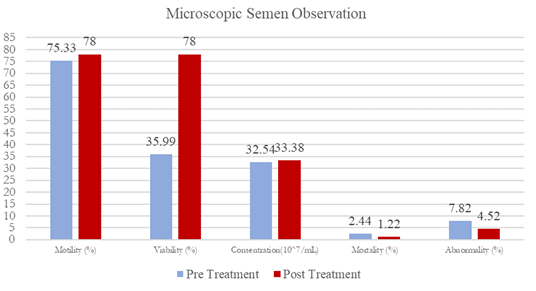
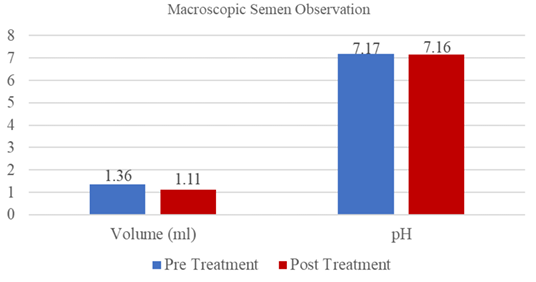
The macroscopic observation of semen showed a higher average difference in the post-treatment phase (Figure 1), as well as in the microscopic observation of semen.
The results of the study showed, the average volume was not significant different (p>0.05), volume of fresh semen of Ettawa Crossbred goats was 1.36 ml (pre treatment) and 1.11 ml (post treatment) (Table 1).
This study demonstrated that supplementation with a multi-nutrient block feed enhanced both total motility and viability of Etawah Crossbred goat sperm.
Further studies were recommended to explore the specific impacts of these minerals on libido, motility, and sperm viability in Etawah Crossbred goats.
Selected from the article's own text.
Abstract
This study investigated the effects of multi-nutrient block supplementation on macroscopic and microscopic semen quality indicators in male Etawah crossbred. By describing these effects, we intended to provide practical insights on improving reproductive output in this crucial livestock breed. Throughout the trial, a total of 8 ejaculate samples (4 ejaculates/goat pre-treatment and 4 ejaculates/goat post-treatment), were collected. The study involved male Etawah corssbreed goats aged 2-4 years. Goats were not given multi-nutrient block for 2 weeks (pre-treatment), after that male Etawah crossbred goats were given additional multi-nutrient block feed for 4 weeks and then goats were not given multi-nutrient block for 2 weeks (post-treatment), each addition 150 gram of multi-nutrient block/goat/day. The independent sample t-test was used to compare the measured variables. Multi-nutrients block did not significantly (p>0.05) to volume, smell, pH, consistency, mass spermatozoa movement, motility, mortality, and concentration, but significantly (p<0.05) colour creamy white typical, increase viability (35.99% to 78%), decrease abnormality primary (2.31% to 1.05%) and tertiary (3.49% to 1.84%). The macroscopic semen observation findings of the semen improved after the treatment multi-nutrient block compared to the previous case. Also, there is no difference in the colour, smell, and consistency of goat semen. In addition, providing a multi-nutrient block has the impact of increasing sperm mortality, viability, and concentration, as well as decreasing the quantity of mortality and semen abnormalities. The abnormalities showed a decrease in post-treatment. The motility and viability of the semen in this study were identified as 78% on post-treatment. This result of motility and viability of semen indicated a good semen quality on post-treatment. The results of macroscopic and microscopic observations of semen showed that the quality of semen post-treatment was in good quality.
The effectiveness of breeding programmes and genetic advancement is influenced by the quality of semen, which is a critical factor in determining reproductive efficiency in livestock. Sperm quality refers to the health and features of sperm cells, such as their number, motility, morphology, and viability. These elements are crucial for successfully fertilizing an egg and establishing a viable pregnancy . Optimising semen quality is crucial for livestock, as it is essential for effective conception and embryonic development . Additionally, the reproduction of livestock contributes an important role in producing milk and meat production .
Goat’s reproductive system and nutrition dietary supplements are two factors that affect the quality of their semen . It has been demonstrated that adding mineral supplements, such as zinc and selenium, improved the quality of semen in terms of motility, viability, volume, concentration, and reaction to hypoosmotic swelling . The multi-nutrient block is an efficient and affordable method to give essential nutrients such as minerals (Ca and P), provide adequate nutrition, and increase appetite. Feed supplementation with Ca and P minerals improves sperm motility and capacitation, while Zn supports spermatogenesis, and motility ; Syariffuddin et al., 2022). To improve animal reproduction, several dietary approaches have been investigated; multi-nutrient block supplementation has drawn particular attention. Multi-nutritional blocks are used to supplement energy, protein, vitamins, and minerals. Multi-nutrient blocks as an alternative feed supplement to partially replace commercial concentrate in goat nutrition . However, its reliable impact on semen quality in Etawah crossbred males has not been widely studied. Understanding this influence is important not only to improve breeding efficiency but also to ensure the survival and genetic diversity of this important livestock.
This study aims to investigated the effects of multi-nutrient block supplementation on macroscopic and microscopic semen quality indicators in Etawah crossbred goats. By comprehending these effects, we intended to provide practical insights on improving reproductive output in this crucial livestock breed.
MATERIALS AND METHODS
Ethical Approval
All procedures prominently followed the standard operating procedure (SOP). The researchers were responsible for the use and management of bucks, which were healthy and not sick. The experimental method was approved by the Research Ethics Committee of the Animal and Agricultural Sciences, Universitas Diponegoro (No. 60-09/A-17/KEP-FPP).
Animal
Throughout the experiment, four male Etawah Crossbred goats aged 2 to 4 years and weighing 29 to 61 kg were kept at the Teaching Farm Agriculture and Animal Science, Universitas Diponegoro (7°03’14.6”S 110°26’28.5”E). The Teaching Farm has regular ventilation, so it can be exposed to light.
Diet and Feeding
Each goat received concentrates and forages (comparison 80:20) given according to the weight requirements of each goat. The multi-nutrient block components are presented in Table 1. The results of the proximate analysis: concentrate, forages, and multi-nutrient Block are presented in Table 2. Nutrient content of feed supplemented with multi-nutrient block and not supplemented with multi-nutrient block are presented in Table 3. The basin contained enough water to drink throughout the day. Throughout the experiment, all of the goats ate properly and remained healthy.
Table 1: Percentage of multi-nutrient block ingredients.
Ingredients
Percentage
Molasses
40.00
Corn Forage
15.50
Copra Meal
25.00
Papaya leaf
4.00
Salt
3.00
Premix
0.50
Urea
5.00
Bentonite
7.00
Total
100.00
Table 2: Nutrient content of concentrates. Forages and multi-nutrient block.
Concentrate feed was provided twice daily at 08:00 a.m. and 02:00 p.m. Forage in the form of mango leaves was given twice daily at 10.00 a.m. and 4:00 p.m. Multi-nutrient block supplementation was administered concurrently with the morning concentrate feed (at 08:00 a.m), 150 gram of multi-nutrient blocks per day. Goats were not given multi-nutrient block for 2 weeks (pre-treatment), then goats were given additional multi-nutrient block feed for 4 weeks, and then goats were not given multi-nutrient block for 2 weeks (post-treatment).
Semen Collection
In this study, goats were trained to collect sperm using estrous female Etawah crossbred and an artificial vagina. Semen was collected from all four male goats twice a week, on Mondays and Thursdays, between 6:00 a.m. and 9:00 a.m., and again from 3:00 p.m. to 5:00 p.m. A total of 8 ejaculate/goat samples were collected: 4 ejaculate on pre-treatments and 4 ejaculate on post-treatments.
Table 3: Nutrient content of rations with supplementation of multi-nutrient block.
Semen quality consists of semen volume, colour, smell, pH, consistency, mass spermatozoa movement, percentage of spermatozoa motility, viability, mortality, abnormality, and spermatozoa concentration, which were evaluated after semen collection. The volume of semen is measured using a semen collection vial. Sperm concentration was estimated by using an erythrocyte pipette up to a scale of 0.5, then 0.9% NaCl solution was sucked up to a scale of 101 and counted spermatozoa on a hemocytometer using a light microscope at 400× magnification . Spermatozoa motility was measured using a light microscope at 400× magnification, with signs of +, ++, and +++ indicating mass spermatozoa movement . The percentage of progressively moving sperm relative to non-progressive sperm was computed and reported. Eosin-nigrosine staining was used to assess the morphology and viability of the sperm in the meantime. Initially, 40 µL of eosin-nigrosine (1:4 ratio) was combined with 10 µL of a semen sample. Subsequently, the eosin-nigrosine and semen mixture were spread out on a heating stage and allowed to dry for ten seconds. Sperm that were viable do not take up colour; they remain transparent. Non-viable (dead) sperm heads, on the other hand, will be stained reddish-purple . Sperm morphologies were used to categorize the sperms into four groups:
Normal morphologies.
Aberrant heads/abnormality primary.
Abnormal midpieces/abnormality secondary.
Abnormal principal piece tails/tertiary ; .
Statistical Computation
The Microsoft Excel sheet was updated with the recorded data. The average mass spermatozoa movement, motility, viability, mortality, abnormality, color, smell, pH, consistency, and volume of semen were all computed and expressed as means. With SPSS® Version 27.0, an independent sample t-test was used to analyze the properties of the semen. For every parameter, a p-value of less than 0.05 was deemed statistically significant.
RESULTS AND DISCUSSION
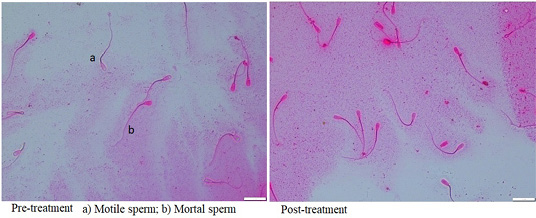
All the semen characteristics of Etawah Crossbreed Goats are shown in Table 4. The macroscopic observation of semen showed a higher average difference in the post-treatment phase (Figure 1), as well as in the microscopic observation of semen. It was also in line with the microscopic observation of semen (Figure 2). The difference between motile and mortal sperm can be seen in (Figure 3).
In this study mango leaves were included in the feed as a source of forages, causing supply of minerals. Similar to the study by Kumar et al. (2021), mango leaves were a possible supply of minerals such as nitrogen, potassium, phosphate, iron, salt, calcium, and magnesium as well as vitamins A, B, E, and C. In addition, mango leaves can help reduce the food scarcity for livestock in developing countries by serving as an alternate source of livestock feeding. Figure 1 shows how the macroscopic semen observation findings of the semen improved more after post-treatment multi-nutrient block compared to the previous case study. In addition, providing mineral block has the impact of increasing sperm mortality, viability, and concentration and decreasing the quantity of mortality and semen abnormalities. Our results were supported by reported that dietary multi-nutrient block, supplementation Zn, and Se improved the semen quality of Samosir goat. Hafid et al. (2021) reported that the characteristics of semen addition feeding combined with minoxvit (source of essential and mineral) increase the volume, mass motility, individual motility, viability, and concentration of spermatozoa. Syarifuddin et al. (2022) also reported that a multi-nutrient block combined with moringa is a dietary source that is rich in essential elements like zinc and selenium, which are needed for spermatogenesis, zinc minerals have affected to trigger the production of testosterone by Leydig cells in the testes. By reducing oxidative damage, the mineral selenium (Se) serves as a potent antioxidant when combined with amino acids to produce selenium-proteins and enzymes, which in effect alter sperm quality.
The results of the study showed, the average volume was not significant different (p>0.05), volume of fresh semen of Ettawa Crossbred goats was 1.36 ml (pre treatment) and 1.11 ml (post treatment) (Table 1). Several researchers have previously reported varying volumes of Ettawa goat semen, 1.15±0.13 ml , 1.00-1.16 ml . The volume in the study was higher than the study of Nubatonis et al. (2024), compared to the volume of semen in Kacang goats 0.7±0.06 ml.
The pH was not significant different (p>0.05), but pH in this study was appropriate,range of 7.16-7.17. Supported by Lavanya et al. (2022), in the pH range of 6.9-7.5, sperm show significantly increased motility, viability, mitochondrial activity, and metabolic performance. However, when the pH drops below 6.5 or exceeds 8, these parameters are severely compromised. The decrease in motility and viability under acidic conditions was attributed to the inhibition of Na/K+ ATPase activity. Supported by Ramukhithi et al. (2021), acidic and alkaline pH levels in semen have been found to create an unfavorable environment for sperm survival, resulting in cell damage and reduced fertilization potential. The lower pH of the spermatozoa would tend to fall with time due to the progressive rise in spermatozoa metabolism. This causes a significant rise in the creation of lactic acid .
Spermatozoa concentration and consistency are closely correlated with semen colour. Semen that is lightening in colour or fading may indicate that the spermatozoa concentration is lower and the semen consistency is thinner. In the present study shown in Table 1, the colour, smell, and consistency of goat semen, there is still no difference. This finding was similar to the report of , the consistency of the semen from the Gembrong and Boerka goats in this investigation was medium to thick because of their cream colour. Moreover, several studies also reported that the colour, smell, and consistency of semen in goats are related respectively ; ; . Concentration semen was not significant different (p>0.05), but concentration in this study increased from 3254 billion/ml (pre-treatment) to 3338.8 billion/ml (post-treatment) (Table 4). The observed increase may be attributed to protein content of the multi-nutrient block on post-treatment, according to Khan et al. (2022) the required level of protein increased the sperm concentrate.
Figure 1 shows the abnormality value of spermatozoa obtained from primary, secondary and tertiary additions. Abnormality showed a decrease after treatment, according to Ramadhan et al. (2023) spermatozoa abnormality prospectively found in healthy goats was 7.50% ± 2.52. In this study, pH did not undergo significant changes and the movement of spermatozoa mass increased after treatment (Figure 2), followed by motility and viability which also increased consistently (Figure 1). While the research of He et al. (2023) that spermatozoa motility and pH levels have a significant correlation. Semen motility and viability in this study also reached 78% after treatment. Higher when compared to the research of Syarifuddin et al. (2022) etawah crossbred goat semen given urea multi-nutreint block produced a total motility of 75.47%. However, good fertility can still be achieved if viability is not below 50%. But lower than Hardyastuti et al. (2023), goat sperm viability was estimated at 84.38 ± 2.74%.
Table 4: Semen characteristics.
Semen Characteristics
Pre- treatment
Post- treatment
p -value
References
Volume (mL)
1.36
1.11
0.44
1.15 ± 0.13
Colour
Creamy White
Creamy White
0.027*
Creamy
Smell
typical
typical
1.000
Typical
pH
7.17
7.16
0.149
6.70 ± 0.10
Consistency
thick
thick
0.361
Medium and thick
Mass Spermatozoa Movement
++
+++
0.386
++ - +++ ; Hardyasttuti et al., 2023)
Motility (%)
75.33
78.00
0.672
76.25 ± 4.43
Viability (%)
35.99
78.00
0.004*
84.56±2.61
Mortality (%)
2.44
1.22
0.059
12.25%
Abnormality Primary (%)
2.31
1.05
0.001*
Total abnormality 8.34%
Abnormality Secondary (%)
2.02
1.63
0.388
Abnormality Tertiary (%)
3.49
1.84
0.042*
Consentration(bilion/mL)
3254.0
3338.8
0.074
3870 ± 96.8 bilion/ml
Note: *means in the same row differ significantly (p<0.05).
The motility was not significant different (p>0.05), but this study was revealed that semen viability was significant different (p<0.05) (Table 4), increased from 35.99% to 78%. It In contrast to Khan et al. (2022), sperm viability was above 85% in all groups, with the highest viability being recorded in the case of treatment groups compared to the control group, and that there were no significant differences in sperm viability among the studied groups. The motil and mortal sperm are shown in Figure 3. Addition Syarifuddin et al. (2022), multi-nutrient block supplementation increased libido, motility, and sperm viability in Etawah cross bred goats. Multi-nutrient block with moringa increased total sperm motility (from 69.67±0.76 to 74.67±1.46) and sperm viability (from 80.37±0.68 to 86.48±1.74). The high Zn content in Moringa leaves stimulated testosterone production, while the Ca, P, and Zn minerals improved sperm health and motility. Exploring the mechanisms by which minerals such as zinc (Zn), calcium (Ca), phosphorus (P), and selenium (Se) enhance semen quality, with a particular focus on their effects on testosterone production, reduction of oxidative stress, and spermatogenesis, would provide valuable insights for future research.
CONCLUSIONS AND RECOMMENDATIONS
This study demonstrated that supplementation with a multi-nutrient block feed enhanced both total motility and viability of Etawah Crossbred goat sperm. Macroscopic and microscopic semen evaluations confirmed good quality. The observed improvements were likely attributed to increased crude protein intake, with essential minerals such as Ca, Zn and P playing key roles in spermatogenesis, sperm motility, and sperm protection. Further studies were recommended to explore the specific impacts of these minerals on libido, motility, and sperm viability in Etawah Crossbred goats.
ACKNOWLEDGMENTS
This study was funded by LPPM (Institute of Research and Community Services Universitas Diponegoro, Semarang, Indonesia). RPI Competitive Grant No. 569-89/UN7.D2/PP/VII/2022.
NOVELTY STATEMENTS
This research explores the novel impact of multinutrient block supplementation on semen quality in Etawah crossbred goats, an area with limited scientific investigation. By assessing key semen parameters, this study provides new insights into the potential of multinutrient block as a practical nutritional strategy to enhance reproductive performance in small ruminants.
AUTHOR’S CONTRIBUTIONS
Limbang Kustiawan Nuswantara was responsible for the research conception, supervision, and writing the original draft. Enny Tantini Setiatin and Asep Setiaji, provided supervision, with Asep Setiaji also validating the manuscript. Pupus Galau Prahara and Fatmawati Mustofa, contributed to writing the manuscript. All authors reviewed and approved the final version of the manuscript.
Conflict of Interest
The authors declare that they have no conflict of interest.
Figures
Figure 1:.
Comparison of microscopic semen observation.
Figure 2:.
Comparison of macroscopic characteristics of semen.
de Evan T, Carro, Fernández JEY, Haro A, Arbesú L, Romero-Huelva M, Molina-Alcaide E (2022). Feeding mango wastes to dairy goats: Effects on diet digestibility, ruminal fermentation, and milk yield and composition, Animal Feed Science and Technology, 286:1016. https://doi.org/10.1016/j.anifeedsci.2022.115252[CrossRef]
Ducha N, Budijastuti W, Rahayau DA (2021). Senduro Goat Semen Characteristics as A Candidate for Low Temperature Storage. E3S Web Conf., 328:1-4. https://doi.org/10.1051/e3sconf/202132808010[CrossRef]
Hafid A, Sianturi RG, Kusumaningrum DA, Widiawati Y, Anggraeni A, Saputra F (2021). The quality of buck semen after feed additive minoxvit administration. Livestock Anim. Res., 19(1): 87-93. https://doi.org/10.20961/lar.v19i1.41894[CrossRef]
Hardyastuti DM, Sumaryadi MY, Saleh DM, Setyaningrum A, Susanto A (2023). Kualitas Semen Cair dan Semen Beku Kambing Peranakan Etawa (PE) pada Berbagai Jenis Pengencer. In Prosiding Seminar Nasional Pembangunan dan Pendidikan Vokasi Pertanian 4(1): 388-396. https://doi.org/10.47687/snppvp.v4i1.661[CrossRef]
He Q, Gao F, Wu S, Wang S, Xu Z, Xu X, Lan T, Zhang K, Quan F (2023). Alkaline Dilution Alters Sperm Motility in Dairy Goat by Affecting sAC/cAMP/PKA Pathway Activity. Int. J. Mol. Sci., 24(2):1771. https://doi.org/10.3390/ijms24021771[CrossRef]
Husnurrizal H, Akbar DGP, Siregar TN, Hafizuddin H, Wahyuni S, Anwar A, Febretrisiana A (2023). Comparison of reproductive performance of gembrong goats and male boerka goats. Livestock Anim. Res., 21(1):1-8. https://doi.org/10.20961/lar.v21i1.63859[CrossRef]
Iskandar H, Sonjaya H, Arifiantini RI, Hasbi H (2022). The quality of fresh and frozen semen and its correlation with molecular weight of seminal plasma protein in Bali cattle. Trop. Anim. Sci. J., 45(4): 405-414. https://doi.org/10.5398/tasj.2022.45.4.405[CrossRef]
Kaur J (2022). Scrotal Infrared Digital Thermography as an indicator of Seasonal Effect on Seminal Attributes and physio-biochemical parameters of tharparkar and karan fries bulls. In: thesis of Animal Physiology division ICAR-National Dairy Research Institute (Deemed University) Karnal-132001 (Haryana), India.
Khan MKI, Hossain MI, Momin MM (2022). Impact of protein supplementation on semen quality, fertility, and BMP1R gene expression in sheep of Bangladesh. Transl. Anim. Sci., 6: 1-8. https://doi.org/10.1093/tas/txac072[CrossRef]
Kumar M, Saurabh V, Tomar M, Hasan M, Changan S, Sasi M, Maheshwari C, Prajapati U, Singh S, Prajapat RK, Dhumal S, Punia S, Amarowicz R, Mekhemar M (2021). Mango (Mangifera indica L.) Leaves: Nutritional Composition, Phytochemical Profile, and Health-Promoting Bioactivities. Antioxidants (Basel),10(2):299. https://doi.org/10.3390/antiox10020299[CrossRef]
Lavanya M, Selvaraju S, Krishnappa B, Krishnaswamy N, Nagarajan G, Kumar H (2022). Microenvironment of the male and female reproductive tracts regulate sperm fertility: Impact of viscosity, pH, and osmolality. Andrology, 10(1):92-104. https://doi.org/10.1111/andr.13102[CrossRef]
Nubatonis, A, Wiguna IGA, Kolo Y (2024). Pengukuran Kualitas Semen dan Morfologi Spermatozoa Kambing Kacang sebagai Dasar Pembuatan Semen Beku. Jurnal Ilmu dan Industri Peternakan, 10(1), 39-51. https://doi.org/10.24252/jiip.v10i1.42938[CrossRef]
Norfaiziyah, R, Nugraha, CD (2024). Pengaruh Lama Ekuilibrasi Suhu Dingin dan Uap Nitrogen Cair terhadap Kualitas Semen Kambing Boer menggunakan Tris-aminomethane yang Disuplementasi Antioksidan Quercetin. J. Trop. Anim. Vet. Sci., 14(2). https://doi.org/10.46549/jipvet.v14i2.394[CrossRef]
Pangestu MSA, Sumaryadi MY, Nugroho AP (2021). Relationship between Length, Circumference, and Volume of the scrotum with Viability and Abnormality of Spermatozoa in Etawa Crossbreed. J. Anim. Sci. Technol., 3(3):252-262.
Pascal C, Nechifor I, Florea MA, Pânzaru C, Simeanu D, Mierliță D (2023). Diet Influence on Sperm Quality, Fertility, and Reproductive Behavior in Karakul of Botoșani Rams. Agriculture, 13(11): 2168. https://doi.org/10.3390/agriculture13112168[CrossRef]
Putri DA., Pujaningsih RI, Subrata A (2020). Evaluasi Fisik Organoleptik Multinutrien Blok yang dibuat dengan Metode Panas pada Penambahan Level Molases yang Berbeda. Bull. Appl. Anim. Res., 2(1): 31-26. https://doi.org/10.36423/baar.v2i1.224[CrossRef]
Ramadhan JA, Riyadhi M, Syarifuddin NA, Wahdi A, Rizal M (2023). Daya Hidup Spermatozoa Kambing Peranakan Etawah yang Dipreservasi dengan Pengencer air Tebu. Agrinimal Jurnal Ilmu Ternak dan Tanaman, 11(1): 45-50. https://doi.org/10.30598/ajitt.2023.11.1.45-50[CrossRef]
Ramukhithi VF, Chokoe CT, Ronald T (2021). Characterisation of Semen and Phenotypic Parameters in Relation to Male Goat Fertility. Goat Science - Environment, Health and Economy. IntechOpen. https://doi.org/10.5772/intechopen.99213[CrossRef]
Rostini T, Zakir I, Biyatmoko D (2020). The Effect of Zinc-Biocomplex and Vitamin E Supplementation on Local Kacang Goats Semen. Am. J. Anim. Vet. Sci., 15:169-175. https://doi.org/10.3844/ajavsp.2020.169.175[CrossRef]
Santolaria P, Rickard JP, Pérez-Pe R (2023). Understanding Sperm Quality for Improved Reproductive Performance. Biology, 12(7): 980. https://doi.org/10.3390/biology12070980[CrossRef]
Silvestre M, Francisco V, Calderon-Leyva, Guadalupe C, Viridiana C, Juan G, Oscar A (2021). Determination of the quality of semen cryopreserved with soy lecithin or egg yolk, in male goats. Abanico veterinario, 11:1-12.
Siswoyo P, Tafsin M, Handarini R (2023). Potential reproduction and response of selenium and zinc mineral supplementation on quality of Goat Samosir Semen. IOP Conf. Ser. Earth Environ. Sci., 122: 012126. https://doi.org/10.1088/1755-1315/122/1/012126[CrossRef]
Slamet N C K., Mudawamah, Sumartono (2023). Comparison Productivity of PE and Boer Goats Based on Body Size and Semen Macroscopic. Jurnal Ternak. 14(2):96-102. https://doi.org/10.30736/jt.v14i2.168[CrossRef]
Swarna M, Saha NG, Biswas S, Paul AK (2022). Collection and evaluation of indigenous buck semen at the coastal region of Bangladesh. Insights Vet Sci. 6:v1-4. https://doi.org/10.29328/journal.ivs.1001034[CrossRef]
Syarifuddin NA, Rizal M, Riyadhi M, Anis W (2022). Libido and Sperm Quality of the Etawah Cross-Breed Fed Urea Moringa Molasses Multi-nutrient Block Supplement. J. Hunan Univ. Nat. Sci., 49. 131-140. https://doi.org/10.55463/issn.1674-2974.49.3.14[CrossRef]
Wurlina W, Hariadi M, Safitri E, Susilowati S, Meles DK (2020). The effect of crude guava leaf tannins on motility, viability, and intact plasma membrane of stored spermatozoa of Etawa crossbred goats. Vet. World, 13(3):530-537. https://doi.org/10.14202/vetworld.2020.530-537[CrossRef]
Zaenuri LA, Rodiah R, Dradjat AS, Sumadiasa IWL (2021). Komparasi Bioetri Semen dan Morfometri Spermatozoa Kambing Kacang, Ettawa dan Boer. Jurnal Ilmu dan Teknologi Peternakan Indonesia (JITPI) Indones. J. Anim. Sci. Technol., 7(1): 19-28. https://doi.org/10.29303/jitpi.v7i1.85[CrossRef]
Zakaria MA, Santoso H, Zayadi H (2020). The Spermatozoa Normality and Abnormality Analysis of Etawa crossbreed Goat (Capra aegagrus hircus L.) Before and After Freezing Phase. Jurnal Biologi FMIPA Unisma. 5(2): 77-83.