ResearchersLinks

Research Article · Volume 13, Issue 10, 7 October 2025 · Open Access

Moringa oleifera Enriched UMMB Improves Semen Quality and Fertility in Etawah Cross Bucks

· · · · · · ·

Affiliations & Notes ⌄
  1. 1Department of Animal Science, Faculty of Agriculture, University of Lambung Mangkurat, Jl. Jend. A. Yani, Banjarbaru, 70714, Indonesia
  2. 2Department of Animal Production, Faculty of Animal Science, Hasanuddin University, Jl. Perintis Kemerdekaan, Makassar, 90245, Indonesia
  3. 3Department of Animal Nutrition, Faculty of Animal Science, Hasanuddin University, Jl. Perintis Kemerdekaan, Makassar, 90245, Indonesia. *Correspondence | Nursyam Andi Syarifuddin, Department of Animal Science, Faculty of Agriculture, University of Lambung Mangkurat, Jl. Jend. A. Yani, Banjarbaru, 70714, Indonesia
  4. 4Email: nursyam_as@ulm.ac.id
Article Info ⌄
Journal:
Advances in Animal and Veterinary Sciences
Published:
7 October 2025

From the article

  • The present study provides compelling evidence that dietary inclusion of Moringa oleifera leaf powder in a modified urea-molasses multinutrient block (UMMMB) significantly enhances reproductive performance in Etawah Cross (EC) bucks, as reflected by improvements in semen quality, cryotolerance, and conception rates.
  • The enhanced semen quality translated into improved fertility outcomes, as evidenced by the significantly higher conception rate in does inseminate with semen from UMMMB-fed bucks (65.22%) compared to the control group (41.18%).
  • Trends toward improved semen quality, post-thaw cryosurvival, and conception rates were observed, although these findings should be interpreted with caution.
  • Collectively, our findings suggest that UMMMB has potential as a practical nutritional strategy to support semen quality and fertility in tropical goat production systems, but confirmation is needed before recommending broad application.

Selected from the article's own text.

Abstract

Etawah Cross (EC) goats are an important genetic resource in Indonesia’s small ruminant industry, yet the reproductive performance of bucks is often limited by poor semen quality under tropical conditions. Urea-molasses multinutrient blocks (UMMB) are widely used as feed supplements, but rarely combined with phytogenic additives such as Moringa oleifera, which possesses strong antioxidant properties. This study evaluated the effects of a modified UMMB enriched with M. oleifera leaf powder (UMMMB) on semen quality and fertility in EC bucks. Eight bucks were randomly allocated into two groups: control (standard UMMB) and treatment (UMMMB containing 30% Moringa powder). After 8 weeks of supplementation, semen was collected, evaluated macroscopically and microscopically, and partially cryopreserved with Andromed® extender. Artificial insemination was subsequently conducted on 40 synchronized does. Data were analyzed using independent t-tests and chi-square tests (p < 0.05). UMMMB supplementation improved (p < 0.05) fresh semen motility (80.26 ± 0.61%) and viability (85.92 ± 0.77%) compared with controls (76.72 ± 1.16% and 81.48 ± 1.02%). Sperm concentration was higher in the UMMMB group (4,190 × 10⁶/mL vs. 3,890 × 10⁶/mL, p = 0.05). Post-thaw sperm motility (50.75 ± 0.62% vs. 45.83 ± 1.46%; p = 0.03) and membrane integrity (66.30 ± 1.07% vs. 64.18 ± 1.32%; p = 0.05) were also enhanced. Conception rates following insemination were significantly greater in does breed with UMMMB semen (65.22%) compared with UMMB (41.18%). In conclusion, dietary supplementation with UMMMB effectively improved semen quality, cryotolerance, and fertility, offering a practical strategy to enhance reproductive efficiency of EC goats in tropical production systems.
 
Keywords | Moringa oleifera, Urea-molasses multinutrient block (UMMB), Semen quality, Cryopreservation, Artificial insemination, Etawah cross bucks

INTRODUCTION

Etawah Cross (EC) goats locally known as Peranakan Etawah represent a cornerstone of Indonesia’s small ruminant industry. As a dual-purpose composite breed developed through the crossbreeding of local Kacang goats with the Indian Jamunapari, EC goats are widely reared across Java and other islands due to their adaptability and potential for both milk and meat production (Rahim et al., 2020; Handayani et al., 2024). Their genetic potential, however, is often not fully realized due to systemic reproductive inefficiencies, especially involving male fertility. In many field conditions, semen quality and conception rates remain below optimal levels, limiting the effectiveness of artificial insemination (AI) programs as tools for genetic improvement and herd productivity (Hasrin et al., 2022; Toleng et al., 2020).

Semen quality in bucks is a critical determinant of reproductive success, particularly in tropical climates where heat stress and dietary limitations can exacerbate oxidative damage to spermatozoa, reducing motility, membrane integrity, and post-thaw viability (Bodu et al., 2025; Kumar, 2025). Nutritional strategies aimed at mitigating these stressors have gained traction in recent years, with urea-molasses multinutrient blocks (UMMBs) being a widely adopted supplement for ruminants due to their ability to provide fermentable nitrogen, minerals, and energy in a controlled-release form (Alfian et al., 2025; Arisanti et al., 2025). However, conventional UMMB formulations lack functional bioactive components that support reproductive health at the cellular level.

The incorporation of phytogenic feed additives especially those with high antioxidant content into UMMB formulations offers a promising approach to enhance male reproductive traits. One such candidate is Moringa oleifera, a fast-growing multipurpose tree native to South Asia and widely cultivated across tropical regions. Moringa leaves are particularly rich in crude protein (20–30%), essential amino acids, calcium, iron, vitamins A, C, and E, and potent antioxidant compounds such as flavonoids, carotenoids, and polyphenols (Arora and Arora, 2021; Chhikara et al., 2021). These nutrients are critical for supporting testicular function, sperm maturation, and antioxidative defense systems in the male reproductive tract (Syarifuddin et al., 2017; Dutta et al., 2021). Several studies have shown that supplementation with Moringa leaf powder improves semen volume, motility, concentration, and membrane integrity in ruminants under both natural and heat stress conditions (Suprapto et al., 2021; Alfian et al., 2025; Ali and Khatun, 2025).

In addition to its nutritional merits, Moringa has been reported to improve the resilience of sperm cells during cryopreservation, a critical process in AI programs, by stabilizing membrane lipids and reducing oxidative damage (El-Seadawy et al., 2022; Shokry et al., 2024).

Despite several reports on the positive effects of Moringa oleifera in livestock reproduction, most studies have employed it either as a direct dietary supplement (leaf powder mixed into rations) or as an additive in semen extenders during cryopreservation (Suprapto et al., 2021; El-Seadawy et al., 2022; Shokry et al., 2024). These approaches, while effective, require either continuous dietary inclusion or laboratory-based handling, which may not always be practical under smallholder field conditions. In contrast, the incorporation of Moringa into a urea-molasses multinutrient block (UMMMB) provides a block-based delivery system that combines the nutritional benefits of conventional UMMB with the antioxidative and bioactive compounds of Moringa. This format is particularly attractive because it offers a cost-effective, farmer-friendly, and slow-release supplementation strategy suitable for tropical goat production systems. Such a delivery system has not been empirically tested, representing a distinct innovation compared with previous feeding or extender-based applications.

Therefore, this study aimed to evaluate whether UMMMB supplementation could improve semen quality and fertility in Etawah Cross (EC) bucks. We hypothesized that integrating Moringa into the UMMB matrix would enhance reproductive performance through multiple mechanisms, including strengthened antioxidative defense against reactive oxygen species, stabilization of sperm plasma membranes during cryopreservation, and potential hormonal modulation that supports spermatogenesis.

MATERIALS AND METHODS

Experimental design and ethical approval

This study was conducted using a completely randomized design (CRD) involving two dietary treatments: A standard urea-molasses multinutrient block (UMMB; control) and a modified block enriched with Moringa oleifera leaf powder (UMMMB; treatment). Eight Etawah Cross (EC) bucks were randomly assigned into two groups (n = 4 per group). Baseline semen quality was not recorded prior to supplementation; thus, random allocation was used to minimize potential bias arising from pre-existing individual variation. All animal procedures were reviewed and approved by the Animal Ethics Committee of the Faculty of Agriculture, University of Lambung Mangkurat (Approval No.: 017/UN8.1.23.5/PG/2025), and adhered to Indonesian animal welfare guidelines.

Animals and management

Eight healthy EC bucks (age: 36.72 ± 1.06 months; body weight: 54 ± 2.97 kg) were sourced from the Pelaihari Breeding Center, South Kalimantan, Indonesia. Additionally, 64 adult female goats (does), aged 18–24 months, were recruited from the Rukun Jaya Makmur Farmer Group (Landasan Ulin, Banjarbaru City). All does had exhibited regular estrous cycles and had given birth at least once prior to the study.

Bucks were housed individually in elevated wooden pens (1.25 m × 1.00 m; 1 m above ground level) for 8 weeks. All animals had free access to clean water and were fed native grass (ad libitum). The UMMB and UMMMB blocks (200 g/day/head) were administered before forage feeding to ensure complete consumption.

Supplement block formulation

The composition of each block is presented in Table 1. The UMMMB contained 30% Moringa oleifera leaf powder, replacing palm kernel meal used in the UMMB. The 30% inclusion rate was selected based on preliminary feeding trials in our laboratory and previous reports indicating that high-level incorporation of Moringa leaf powder (20–30%) in ruminant diets enhances reproductive traits without compromising palatability or block hardness (Syarifuddin et al., 2017; Ali and Khatun, 2025). While a formal dose–response study was not conducted within the present experiment, this level was considered a biologically relevant and practically feasible inclusion rate to balance nutrient enrichment with block stability. Blocks were formulated by thoroughly mixing dry ingredients, then incorporating molasses gradually to form a semi-solid mixture. This was moulded into blocks and allowed to harden for 48 hours at room temperature (27–30°C), then stored in a ventilated area. The nutritional content of native grass, UMMB, and UMMMB is presented in Table 2, based on proximate analysis performed at the Laboratory of Nutrition and Animal Feedstuff, Faculty of Agriculture, University of Lambung Mangkurat.

Table 1: Compositions of the mult nutrient block used as supplements.

Feed ingredients (%)

UMMB (Control)

UMMMB (Treatments)

Moringa leaf powder

-

30

Palm kernel meal

25

-

Concentrate laying ducks (CP144®)

5

-

Fine rice bran

33

33

Molasses

20

20

Limestone

5

5

Common salt

5

5

Urea (46% N)

5

5

Mineral mix

2

2

Total

100

100

Semen collection and evaluation

Beginning in the fourth week, semen was collected weekly using an artificial vagina (AV) between 07:00 and 10:00 a.m., prior to feeding. Collected semen was evaluated macroscopically (volume) and microscopically for sperm concentration, progressive motility, viability, and morphological abnormalities. All semen quality parameters were assessed following standard procedures outlined by Diansyah et al. (2025) and adapted for goats. Evaluations were performed by two trained technicians who had undergone prior calibration exercises to ensure consistency. Inter-observer reliability was checked periodically by cross-evaluating subsamples, yielding >90% concordance across key parameters. To minimize bias, evaluators were blinded to the treatment groups during assessment.

Table 2: Nutrient Content of Native Grass, UMMB, and UMMMB (as % DM*)

Nutrient composition (%)

Native grass

UMMB

UMMMB

Dry matter

30.77

60.11

59.62

Ash

11.92

12.18

11.40

Crude protein

10.79

19.75

21.41

Crude fiber

31.52

3.11

2.59

Ether extract

0.62

2.82

2.51

Calcium (Ca)

0.78

3.61

3.78

Phosphorus (P)

0.44

2.05

2.81

Nitrogen-free extract

45.15

64.34

62.09

TDN (calculated)

55.38

83.44

83.14

Note: TDN (calculated) = total digestible nutrients estimated from proximate analysis using standard formulae (NRC, 2007).

Frozen semen processing

At week 8, semen from each buck was selected for cryopreservation using Andromed® extender (Minitüb GmbH, Germany). The extender was prepared by diluting 5 mL Andromed® with 20 mL sterile distilled water (1:4 ratio) and equilibrated in a 38 °C water bath. Semen was then diluted to achieve a final concentration of approximately 100 × 10⁶ sperm/mL and loaded into 0.25 mL mini straws. The filled straws were equilibrated at 5 °C for 2 hours before freezing. Freezing was performed by exposing straws to liquid nitrogen vapor (–80 to –120 °C) for 10 minutes before plunging them into liquid nitrogen (–196 °C) for storage, following the protocol adapted from Diansyah et al. (2023).

Artificial insemination and conception rate

Estrus synchronization was performed using two intramuscular injections of Lutalyse® (dinoprost tromethamine, 5 mg/mL) with an 11-day interval. On the third day after the second injection, does showing estrus signs were inseminated with frozen semen collected at week 8 (Yusuf et al., 2024). A total of 17 does were inseminated with semen from bucks fed UMMB and 23 does with semen from bucks fed UMMMB. The distribution of inseminated does was therefore unbalanced between groups. In addition, conception rates were based on semen collected from four bucks per group, and the potential influence of individual “buck effect” could not be fully eliminated within this design. Random allocation of does to treatments was used to minimize bias, but these limitations should be considered when interpreting fertility outcomes.

Artificial insemination was performed via the intracervical method using an insemination gun and speculum, with one 0.25 mL straw per doe. Following the second prostaglandin injection, estrus was monitored twice daily and does showing behavioral and physical signs of estrus were inseminated 48–72 hours after detection, in accordance with established protocols (Yusuf et al., 2024). This timing was standardized across all does to reduce variation in fertility outcomes. Pregnancy diagnosis was conducted by observing estrus return over two subsequent cycles post-AI, with non-returning does considered pregnant and later confirmed by parturition data. This approach provided practical field-based confirmation but may have overestimated conception rates by failing to detect early embryonic losses. More accurate methods such as ultrasonography were not available within the scope of this study.

Statistical analysis

Semen quality data (fresh and frozen) were reported as means ± standard error of the mean (SEM). Between-group comparisons were performed using independent samples t-tests. Conception rate data were analyzed using the chi-square (χ²) test. All statistical analyses were conducted using SPSS® Version 26 (IBM Corp., Armonk, NY, USA), and significance was set at p < 0.05.

RESULTS

The quality of EC bucks fresh Semen

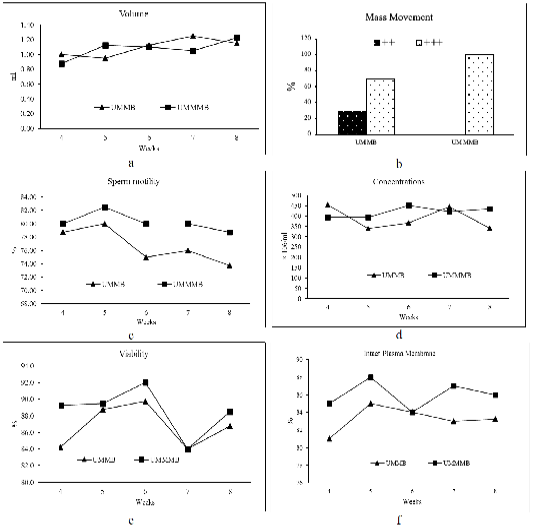
The quality of fresh semen collected from bucks in both treatment groups is presented in Table 3. Bucks receiving UMMMB supplementation exhibited significantly higher (p < 0.05) sperm motility (80.26 ± 0.61%) and viability (85.92 ± 0.77%) compared to the UMMB group. Sperm concentration in the UMMMB group showed a numerical increase compared to controls (p ≈ 0.05), which should be interpreted as a trend rather than a definitive difference given the limited sample size. No significant differences were observed in semen volume or intact plasma membrane integrity (p > 0.05).

The supplementation of UMMB and UMMMB over an 8-week period (Figure 1) showed distinct effects on various fresh semen quality parameters in EC bucks. Semen volume exhibited a consistent increase in the UMMMB group, peaking at week 7 (1.26 mL), while the UMMB group displayed a slower and less consistent trend, reaching only 1.08 mL at week 8. Mass movement showed a notable difference, with 100% of samples in the UMMMB group attaining +++ category, compared to only 70% in the UMMB group. Sperm motility was consistently higher in the UMMMB group throughout the study, maintaining levels above 80%, whereas the UMMB group demonstrated a decline from week 5 onward, dropping below 76% at week 8.

Table 3: Fresh semen quality parameters of EC bucks fed UMMB and UMMMB supplements.

Parameter

UMMB (Control)

UMMMB (Treatment)

p value

Reference range

Volume (mL)

1.12 ± 0.06

1.08 ± 0.05

0.50

0.5–1.21

Mass Movement

++ (30%), +++ (70%)

+++ (100%)

-

++ to +++2

Sperm Motility (%)

76.72 ± 1.16

80.26 ± 0.61

0.05

60–802

Concentration (×10⁶/mL)

3,890 ± 25.43

4,190 ± 39.41

0.05

1,580 – 1,9401

Viability (%)

81.48 ± 1.02a

85.92 ± 0.77b

0.05

60–803

Intact Plasma Membrane (%)

87.00 ± 1.11

88.94 ± 0.63

0.14

≥602

Note: Superscripts (a, b) indicate significant differences at p < 0.05 (actual p-value < 0.05, rounded to two decimals). Mass movement assessed subjectively using categorical scoring (++, +++). References: 1Swarna et al. (2023), 2Saratsi et al. (2023), 3Syarifuddin et al. (2022).

Table 4: Frozen semen quality of EC bucks after feeding UMMB or UMMMB.

Parameter

UMMB

UMMMB

p-Value

Reference range

Motility (%)

45.83 ± 1.46

50.75 ± 0.62

0.03

30.6–36.01

Recovery Rate (%)

59.99 ± 1.65

63.47 ± 0.74

0.12

–

Viability (%)

61.97 ± 1.68

64.05 ± 0.98

0.06

–

Intact Plasma Membrane (%)

64.18 ± 1.32

66.30 ± 1.07

0.05

–

Frozen semen quality

As shown in Table 4, the post-thaw motility of sperm was significantly higher (p < 0.05) in the UMMMB group (50.75 ± 0.62%) than in the UMMB group (45.83 ± 1.46%). Intact plasma membrane percentages in the UMMMB group showed a trend toward improvement (p ≈ 0.05), but with the small sample size this should be interpreted as a numerical tendency rather than statistical confirmation. Although viability and recovery rate tended to be higher in the treatment group, the differences were not statistically significant (p > 0.05).

Conception rate

The conception rate following artificial insemination using frozen semen is summarized in Table 5. Does inseminated with semen from UMMMB-supplemented bucks showed a significantly higher conception rate (65.22%) compared to those inseminated with semen from UMMB-fed bucks (41.18%) (p < 0.05).

DISCUSSION

The present study provides compelling evidence that dietary inclusion of Moringa oleifera leaf powder in a modified urea-molasses multinutrient block (UMMMB) significantly enhances reproductive performance in Etawah Cross (EC) bucks, as reflected by improvements in semen quality, cryotolerance, and conception rates. These enhancements are likely attributable to the synergistic effects of superior nutrient composition and the high antioxidant content of Moringa leaves. Fresh semen analysis revealed significantly higher sperm motility and viability in the UMMMB group compared to the standard UMMB group, suggesting enhanced spermatogenesis and reduced oxidative damage to sperm cells. This is consistent with previous studies indicating that Moringa supplementation can mitigate reactive oxygen species (ROS) and support testicular function through its rich profile of flavonoids, vitamins A, C, and E, selenium, and polyphenols. The consistently higher mass movement (+++ in 100% of ejaculates), increased sperm concentration, and a numerical advantage in membrane integrity further reinforce the positive role of UMMMB in maintaining sperm functionality (Syarifuddin et al., 2017; Liang et al., 2023).

The superior nutritional profile of UMMMB particularly its higher crude protein, calcium, phosphorus, and total digestible nutrients (TDN) may have provided additional nutritional support for spermatogenesis. The reduced crude fiber content could also have improved digestibility, indirectly benefiting reproductive function (Syarifuddin et al., 2022; Mobashar et al., 2023). While endocrine regulation and metabolic pathways are plausible contributors, these mechanisms remain speculative in the absence of direct hormonal or metabolic measurements in the present study. Although volume and intact plasma membrane (IPM) differences were not statistically significant, their favorable trends in the UMMMB group remain biologically relevant. Sperm membrane integrity is critical for capacitation and fertilization, and its preservation suggests that Moringa bioactives may stabilize the lipid bilayer and protect against early capacitation or premature acrosome reaction (Kamel et al., 2024).

Improvements in frozen semen quality further validate the benefits of UMMMB supplementation. Post-thaw motility and membrane integrity were significantly higher in the UMMMB group, suggesting improved cryotolerance. These findings are important considering that cryopreservation commonly causes oxidative damage, lipid peroxidation, and structural compromise to spermatozoa (Gualtieri et al., 2021). The antioxidant-rich diet likely enhanced sperm resilience during freeze-thaw cycles by reinforcing the structural stability of the plasma membrane (Saratsi et al., 2023). Although viability and recovery rate did not reach statistical significance, the consistent numerical improvements in the treatment group indicate a favorable cryoprotective effect, likely mediated by lipid-soluble antioxidants such as β-carotene, phytosterols, and vitamin E found in Moringa (Authaida et al., 2025; Iqbal et al., 2022). It is noteworthy that the reference range cited for post-thaw motility (30.6–36.0%; Swarna et al., 2023) is lower than the values obtained in this study (45–50%). This discrepancy likely reflects differences in breed, nutritional background, and cryopreservation protocols, as Swarna et al. reported data from indigenous bucks raised under coastal field conditions. Although the absolute increase in post-thaw motility (approximately 5%) may appear modest, even small improvements at this stage can have meaningful biological implications. Post-thaw motility is a key determinant of fertilization success, and previous studies have shown that incremental gains of 3–5% in motility can translate into disproportionately higher conception rates under field conditions (Pardede et al., 2020; Kujoana et al., 2024). This is because cryopreservation typically imposes severe oxidative and structural stress on spermatozoa, leaving only a limited proportion functionally competent for fertilization. Therefore, the ~5% enhancement observed in this study likely contributed to the higher conception rates recorded in does inseminated with UMMMB semen, underscoring the practical relevance of even modest gains in cryosurvival.

The enhanced semen quality translated into improved fertility outcomes, as evidenced by the significantly higher conception rate in does inseminate with semen from UMMMB-fed bucks (65.22%) compared to the control group (41.18%). This fertility advantage reflects not only better motility and membrane functionality but also the likely improvement in the ability of sperm to traverse the female reproductive tract and undergo successful fertilization. These findings are consistent with literature showing that antioxidant supplementation in male livestock improves reproductive efficiency, particularly in systems utilizing cryopreserved semen for artificial insemination (Kujoana et al., 2024; Moretti et al., 2024). However, interpretation of fertility outcomes should be made with caution due to the unbalanced distribution of inseminated does between groups (17 vs. 23). Moreover, while conception rates in this study fall within the range reported by Suyadi et al. (2021) for Indonesian goats (41–68%), broader reference ranges such as 50–80% may not adequately capture breed- or system-specific variation.

From a mechanistic standpoint, the reproductive benefits of Moringa oleifera may be multifactorial, with antioxidative defense often proposed as a central pathway. Previous studies have demonstrated that Moringa supplementation can reduce reactive oxygen species, lipid peroxidation, and enhance total antioxidant capacity in ruminant semen (El-Seadawy et al., 2022; Iqbal et al., 2022; Shokry et al., 2024), which lends biological plausibility to this explanation. However, in the present study no oxidative stress biomarkers were measured, and therefore the antioxidative mechanism remains speculative. This represents a missed opportunity that should be addressed in future work by integrating biochemical assays of oxidative stress alongside semen quality endpoints. It is also possible that other nutritional effects, such as higher levels of calcium and phosphorus supporting flagellar activity and intracellular signaling, or the reduction of indigestible components after replacing palm kernel meal with Moringa, contributed to improved metabolic efficiency and sperm function under tropical conditions.

This study has several limitations. The small number of bucks (n=8) reduces statistical power and limits generalizability, particularly given the high variability in semen quality, and baseline semen data were not collected, so pre-existing differences cannot be excluded. Fertility outcomes may also have been influenced by the “buck effect,” since conception rates were based on semen from only four bucks per group with unequal doe distribution. Moreover, no oxidative stress biomarkers were measured, leaving the proposed antioxidative mechanism hypothetical, and pregnancy diagnosis relied on non-return to estrus with confirmation by parturition, which may have overestimated conception rates by missing early embryonic loss. Importantly, parameters such as sperm concentration and membrane integrity only showed numerical tendencies (p ≈ 0.05) rather than robust statistical differences, and with the small sample size these should be interpreted cautiously as trends. Future studies should therefore include larger cohorts, baseline semen evaluation, more balanced AI designs, biomarker assays, and accurate early pregnancy diagnostics, together with a more nuanced statistical interpretation beyond a strict reliance on p = 0.05, to validate and extend these findings.

Taken together, the findings of this study provide preliminary evidence that UMMMB supplementation may offer reproductive benefits in EC bucks, with observed trends toward improvements in semen quality, cryosurvival, and fertility outcomes. This plant-based intervention has potential practical relevance for male fertility and artificial insemination programs in tropical production systems. Nevertheless, these results should be regarded as exploratory, as the small sample size, absence of baseline semen data, and lack of mechanistic biomarkers limit the strength of inference. Economic feasibility also remains to be determined. Therefore, while the outcomes are encouraging, they should be interpreted cautiously, and confirmation through larger-scale, mechanistically oriented studies is required before firm conclusions or broad application in breeding programs can be justified.


CONCLUSION

In conclusion, this study provides preliminary evidence that dietary supplementation with a modified urea-molasses multinutrient block enriched with Moringa oleifera leaf powder (UMMMB) may confer reproductive benefits in Etawah Cross (EC) bucks. Trends toward improved semen quality, post-thaw cryosurvival, and conception rates were observed, although these findings should be interpreted with caution. The small sample size, absence of baseline semen quality data, potential “buck effect” from using semen of only four males per group, and reliance on non-return to estrus for pregnancy diagnosis all limit the strength of inference. Future studies with larger cohorts, balanced AI designs, and inclusion of hormonal, metabolic, and oxidative biomarkers will be necessary to substantiate these preliminary results. Collectively, our findings suggest that UMMMB has potential as a practical nutritional strategy to support semen quality and fertility in tropical goat production systems, but confirmation is needed before recommending broad application.

ACKNOWLEDGMENTS

The authors would like to thank the Ministry of Research, Technology and Higher Education, Indonesia, for supporting this research through APPLIED RESEARCH. The author also expresses his deepest gratitude to the Rukun Jaya Makmur Farmers Group, Banjarbaru City, South Kalimantan, for providing goat cages and female goats for the research.

NOVELTY STATEMENT

To our knowledge, this is the first study to evaluate a Moringa-enriched modified urea-molasses multinutrient block (UMMMB) as a dietary supplement for bucks, demonstrating its effects on semen quality, cryotolerance, and fertility outcomes. The novelty of this work lies in the block-based delivery system, which integrates Moringa with other nutrients into a farmer-friendly supplement format. This approach distinguishes the present study from previous nutritional interventions and highlights its potential relevance for small ruminant reproductive management in tropical field conditions. Nevertheless, the economic feasibility and practicality of producing and distributing UMMMB in smallholder systems remain uncertain. While block-based supplements are generally low-cost and widely adopted in ruminant feeding, further cost–benefit analyses and field trials are required to determine whether large-scale adoption of UMMMB is financially and logistically viable for smallholder farmers.

AUTHOR’s CONTRIBUTION

NAS, MR, MRi, AW, MY and AMD: Conceived and designed the experiment.

NAS, MRi, MR and AW: Performed the experimental procedures.

NAS, MR, JAS and MY: Supervised and coordinated the research and provided clinical data.

AMD and RR: Conducted statistical analysis.

NAS, MR, MY, AMD and RR: Prepared the initial draft of the manuscript.

All authors critically reviewed and approved the final version of the manuscript.

Generative AI and AI-assisted technology statement

The authors declare that no Generative AI was used in the creation of this manuscript.

Conflict of interest

The authors have declared no conflict of interest.

Figures

Figure 1:
Figure 1:.

Fresh semen quality profiles of EC bucks throughout 8 weeks of UMMB and UMMMB supplementation; (a) volume; (b) mass movement; (c) sperm motility; (d) concentration; (e) viability; (f) intact plasma membrane.

References

  1. Table 5: Conception rates in does inseminate with frozen semen from UMMB and UMMMB fed bucks.
  2. Number of acceptors (head)
  3. Note: ab Mean in the same colomn without a common superscript letter are different at p<0.05. References: 1Suyadi et al. (2021).
  4. Sperm concentration values were relatively stable in the UMMMB group (ranging from 400 ×10⁶/mL to 460 ×10⁶/mL), while the UMMB group fluctuated more broadly, especially showing a dip at week 5 (approximately 320 ×10⁶/mL). Viability percentages in both groups peaked at week 6 (92.5% for UMMMB and 91.2% for UMMB), but declined thereafter. Overall, UMMMB supplementation maintained a consistently higher viability rate across most time points. Intact plasma membrane (IPM) integrity was also superior in the UMMMB group, with values peaking at week 5 (88.9%) and remaining higher than UMMB across all weeks, which remained in the range of 81–85%.

Cited by 1 article

In journals published by ResearchersLinks.

  1. Impact of Urea Moringa Molasses Multi-Nutrient Block Supplementation on Liquid Semen Quality and Fertility in Etawah Crossbreed GoatsJournal of Animal Health and Production · 2026

Services

Article usage statistics

Loading…