
Effect of paint chemicals on liver and renal profile in occupationally exposed household painters was evaluated in this study. For this purpose, 25 healthy male controls and 25 male painters were selected from Lahore, Pakistan. Unpaired Student “t” test was applied to analyse the parameters for statistical interpretation. There was significant increase in Alanine Aminotransferae (ALT), Alanine Phosphatase (ALP) and total bilirubin in painters as compared to control group. However, Aspartate Aminotransferae (AST) was mildly increased in painters. Creatinine and urea exhibited significant elevation in painters as compared to controls. Conclusively, long-term exposure to paints and associated chemicals may lead to severe hepatic and renal damages.
Research Article · 5 June 2023 · Open Access
Hepatorenal Profile Variations in Occupationally Exposed Domestic Painters
· · · ·
Affiliations & Notes ⌄
- 1Institute of Zoology, University of the Punjab, Lahore, Pakistan. *Correspondence | Nabila Roohi, Institute of Zoology, University of the Punjab, Lahore, Pakistan
- 2Email: nabilaruhi@gmail.com
Article Info ⌄
- Journal:
- Biologia (Lahore)
- Published:
- 5 June 2023
From the article
- The results of present study have shown a significant increase in parameters of liver profile i.e., ALT (P=0.006), ALP (P=0.03) and total bilirubin of painters when compared with control group.
- Moreover, AST (P=0.3) of painters was non-significantly increased.
- Conclusively, prolonged exposure to paint chemicals affects adversely the hepatorenal functions resulting in severe health problems.
- Further research is required to find out the mechanism of liver and renal damages caused by the exposure to paint chemicals so that reasonable medical procedures could be employed to address the issues.
Selected from the article's own text.
Abstract
Introduction
Paints are combination of different solvents, pigments and additives. To give the paints its properties like dryness and hardening; pigments and additives are mixed that usually does not completely solubilize in paints rather they remain suspended in it to form emulsions . Moreover, paints provide, beauty, protection against corrosion, insulation against electricity and fire proofing. There are variety of ways by which paints can be applied like using brush, roller, spray, disk spraying and powder coating (Handbook of Occupational Safety and Health, 1999).
There are 2.9 billion workers worldwide who are exposed to different chemicals at various work sites. Each year, about 120 million occupational accidents and 200,000 deaths are reported in developing countries . During working hours, workers have to face a lot of occupational risks including chemical agents, physical factors, biological agents and adverse ergonomic conditions. These circumstances may lead towards multiple health risks .
About 140 large scale and around 2000 smaller units of paint production are operating in Pakistan. Major demands of country come from institutes of defence, shipyards, dams and railways . Data regarding the number of painters in paint industry and the effect of exposure is still scarce in Pakistan.
Spray painting creates paint mist that rapidly fills the space around paint operation and when they come in contact with any kind of ignition source like spark or cigarette, they immediately catch fire (Occupational Safety and Health Branch Labour Department, 2003).
Harmful contents of paints can get entry into the body through inhalation, skin, eye-contact and accidental ingestion, hence, accumulating in different vital organs like liver, kidney and various other lymphatic regions. Serious health outcomes may occur in regions away from the site of contact .
Commonly used lead paints are lead carbonates and lead chromates. Lead speeds up the process of drying, enhances durability and fights off the moisture that is responsible for corrosion . Lead is a toxicant and it is also known as “The Silent epidemic” and can cause disturbances in liver functioning . Paints containing benzene can also induce hepatic injury .
The liver is the main target organ of the chemical induced injury, due to its unique position in the circulatory system. Since, it is the major organ for chemical transformations, hence, any toxicant that get entry into the liver tissue disturbs its biosynthetic machinery ; . Severity of toxicity depends on several factors like quantity of chemicals, duration of exposure and either chemical is present alone or in form of complex .
Liver produces several enzymes that can be used as a marker to find liver injury. Serum alanine aminotransferase (ALT), aspartate aminotransferase (AST), alkaline phosphatase (ALP) and total bilirubin are routinely used in both clinical analysis and research purposes, any deviation in these biomarkers can disturb the normal liver metabolism .
Urea and creatinine are very good indicators of renal health status . Kidneys play vital role in their filtration. About 90% of creatinine is filtered by the glomerulus in kidney of healthy individuals but it gets disturbed due to structural damages in the kidney tubules due to long-term exposure of chemicals .
In this regard, present study is an endeavour to investigate the hazardous effects of continuous exposure of paint chemicals on hepatic and renal profile of painters.
Materials and Methods
For blood sampling, healthy males (n=25) with age ranging from 23-42 were selected from the Department of Zoology, University of the Punjab, Lahore, Pakistan. Similarly, healthy painters (n= 25) with no any previous medical history, having 10-15 years period of exposure to paints and age ranging from 25-65, were recruited from local paint market, Lahore Pakistan. A proforma was designed to collect demographic information, anthropometric measurements, presence or absence of disease, smoking or drinking habits, etc. Subjects with any kind of disease were excluded from both groups. Fasting of at least 12 hours was necessary for taking blood samples of both groups. A registered technician was hired to collect the blood.
Afterwards further blood processing was performed to separate the serum. Blood samples were centrifuged at the rate of 3000 rounds per minute for at least 10 minutes. Clear serum was placed in labelled Eppendorf and stored in refrigerators at -20 degree. Samples were thawed at room temperature for further biochemical analysis. Serum samples of painters and control group were analysed to evaluate liver and renal profile including ALT, ALP, AST, total bilirubin, creatinine and urea by means of Clinical Chemistry Analyser Photometer (Model 5010 Robert Riele GmbH and Co. KG. D-13467. Berlin, Germany) using commercially available kits of DiaSys, Diagnostic System.
Statistical analysis
Statistical analysis was done by Graphpad Prism (Version 6.0) and data was presented as mean ± SEM. Variations between two groups were compared at significance level of 0.05, CI: 95% by applying two tail Unpaired Student “t” test.
Results and Discussion
The results of present study have shown a significant increase in parameters of liver profile i.e., ALT (P=0.006), ALP (P=0.03) and total bilirubin of painters when compared with control group. Moreover, AST (P=0.3) of painters was non-significantly increased. Marked elevation (P<0.0001) of Total bilirubin was present in painters as compared to control group. Urea and creatinine have shown significant rise P=0.04, 0.03 in painters as compared to control group, respectively. Mild elevation was present in systolic (SBP) and diastolic blood pressure (DBP) of painters as compared to control group (Figure 1, Table 1).
Serum ALT levels of painters were significantly elevated when compared with control group. There was mild increase in serum AST of painters. Further, serum ALP level was significantly increased in painters as compared to control group and total bilirubin of painters was also significantly increased in this study.
Liver enzymes mainly reside inside the liver cells but after liver damage these enzymes begin to leak into the blood stream, thus elevation in the levels of ALT in the blood indicates liver damage . If the liver is damaged, ALT level in blood can be increased by 50 folds .
The elevated liver enzymes may be due to paint constituents like lead, cadmium, chromium, toluene, benzene etc. which are a potential source of risk for painters’ health (U.S. Army Public Health Command, 2011). Toluene when gets entery into the body, it generates free radicals in liver during its biotransformation resulting in the increased level of serum liver enzymes ultimately leading to liver damage .
Moreover, benzene being a vital paint constituent can induce hepatic injury, detected by elevated levels of serum liver enzymes as their leakage depicts malformed liver . Previous investigations have also documented prominent increase in serum levels of ALT and ALP due to exposure to benzene . Physicoochemical properties of benzene include low evaporation temperature and vapor pressure that is responsible for its direct incorporation into the atmosphere . Inhalation is the chief route of entry of benzene in the body and the liver is the main location of its metabolism. Depending upon the concentration of benzene, exposure time and pulmonary ventilation humans can absorb 30-52% of inhaled benzene .
Table 1: Average values of liver and renal profile of painters and control group.
| Parameters | Control (N= 25) | Painters (N= 25) | P-value | % difference |
| ALT (U/L) | 23.40 ±1.54 | 30.24±1.86 | 0.006 | 29↑** |
| AST (U/L) | 25.68±1.35 | 27.24±1.20 | 0.3 | 6↑ |
| ALP (U/L) | 162.2±10.92 | 191.1±7.33 | 0.03 | 18↑* |
| Total Bilirubin (mg/dL) | 0.40±0.35 | 0.58±0.01 | ˂0.0001 | 45↑*** |
| Urea (mg/dL) | 23.60 ± 4.64 | 26.28 ± 4.39 | 0.04 | 11.35 ↑* |
| Creatinine (mg/dL) | 0.84 ± 0.11 | 0.91 ± 0.12 | 0.03 | 8.33 ↑* |
| Systolic (mmHg) | 132.8 ± 3.61 | 135.0 ± 3.61 | 0.53 | 2 ↑ |
| Diastolic (mmHg) | 87.52 ± 1.82 | 93.16 ± 2.73 | 0.09 | 6.44 ↑ |
*, **, *** represents significance at P < 0.05, 0.01 and 0.001, respectively. ↑ represents increase in values of parameters.
In our investigation, total bilirubin of painters was also significantly increased. Lead causes oxidative stress by generating reactive oxygen species . These free radicals cause lipid peroxidation of membrane of red blood cell (RBCs) causing breakdown of RBCs . As bilirubin is formed by breakdown of RBCs in several events which involves breakdown of heme portion of blood cells into biliverdin in the presence of heme oxygenase. Biliverdin is further converted into bilirubin (non-conjugated) in presence of biliverdin reductase. This non-conjugated bilirubin after combining with albumin enters in liver where glucuronic acid is attached with it thus, forming conjugated bilirubin which then moves to intestine. From intestine bilirubin gets absorbed in blood and some of its proportion also removed from the body . So, when the free radicals increase in body, breakdown of RBCs takes place resulting in increasing total bilirubin in blood.
In the present study, renal profile assessment has shown that urea level is significantly increased in painters as compared to control group. Urea is a by- product of protein metabolism and excreted by kidneys. Increased serum urea level indicates impaired renal functioning which may be due to the renal tubular necrosis .
In our study, the significant increase in serum creatinine was evidenced in painters. This elevated serum creatinine can be a manifestation of disturbed renal functioning. Structural damages in the glomerular part of the nephron hinder normal filtration process, thus reducing the creatinine clearance leading to its elevated state .
Although, hepatic parameters like ALT, AST, ALP and total bilirubin of painters are more than that of control group but still these parameters are within the normal range. Hence, it cannot be said that the painters have any kind of serious liver ailment because of exposure to paints but if the exposure goes unchecked, it could cause severe liver damage (liver cirrhosis) and jaundice.
The renal profile alterations have also indicated that occupational painters are at risk of developing renal impairment due to prolonged and unchecked exposure of paint chemicals.
Conclusions and Recommendations
Conclusively, prolonged exposure to paint chemicals affects adversely the hepatorenal functions resulting in severe health problems.
Painters should get regular medical check-up. Government should educate and implement SOPs regarding the workplace environments to minimize the health issues associated with paints through print and social media. Further research is required to find out the mechanism of liver and renal damages caused by the exposure to paint chemicals so that reasonable medical procedures could be employed to address the issues.
Acknowledgement
Authors of present investigation gratefully acknowledge Institute of Zoology for providing the opportunity and facilities for present research.
Novelty Statement
This study reflects significant changes in hepatorenal profile of occupationally exposed household painters. However, precautionary measures can reduce the risk associated with exposure.
Author’s Contribution
Saba Yasin and Kausar Imran: Helped in biochemical analysis of hepatic profile.
Komal Mukhtar: Helped in arranging experiment.
Muhammad Amir Iqbal: Helped in statistical analysis.
Nabila Roohi: Supervision of study.
Conflict of interest
The authors have declared no conflict of interest.
Figures
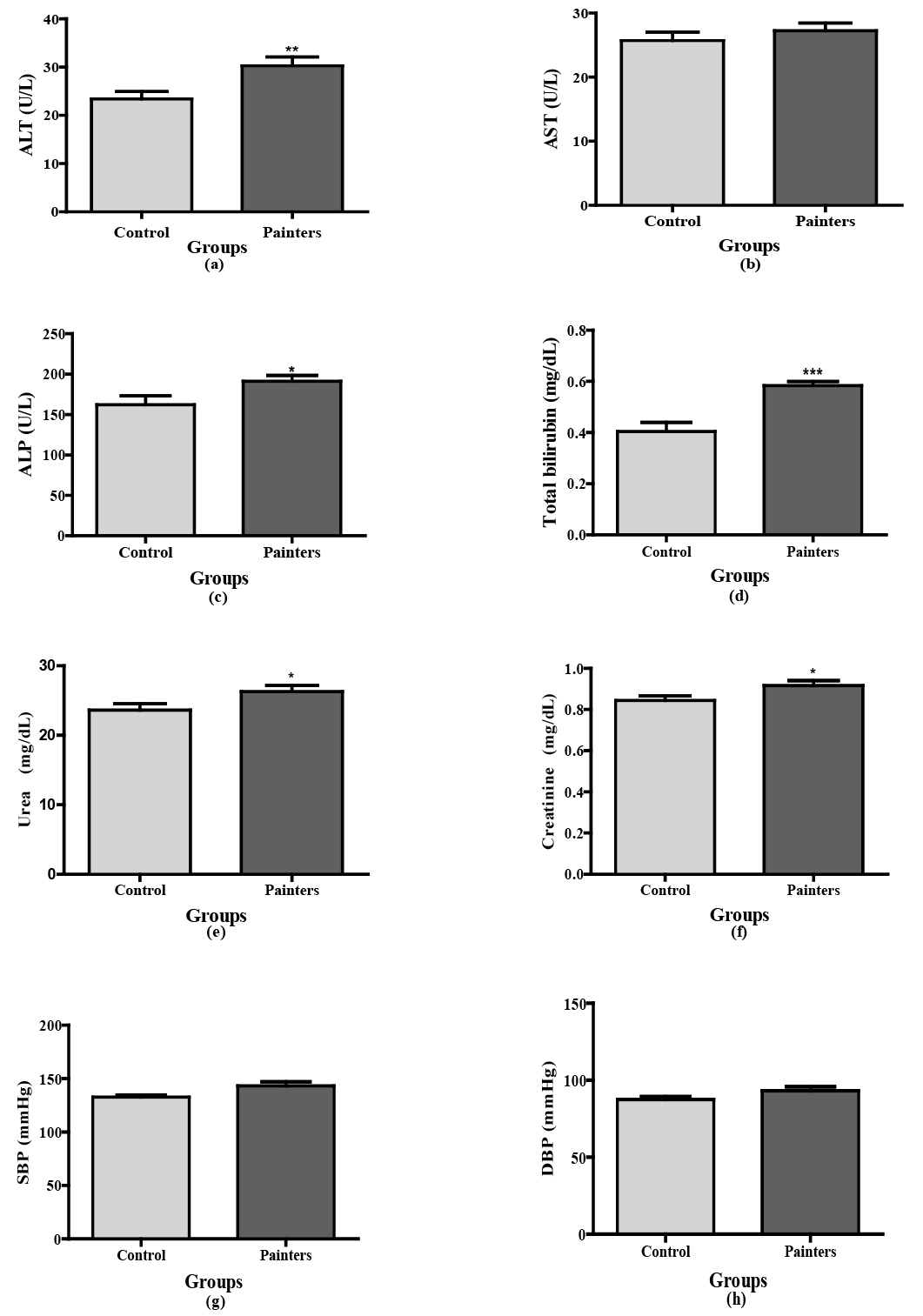
(a-h) Comparison of parameters in comparable groups. Values are Mean ± SEM. *, **, *** indicate significance at P < 0.05, 0.01, 0.001, respectively.
References
- Agarwal, R. and Deorari, A.K., 2002. Unconjugated hyperbilirubinemia in newborns: Current perspective. Indian Paediatr., 39(1): 30-42.
- Awodele, O., Popoola, T.D., Ogbudu, B.S., Akinyede, A., Coker, H.A. and Akintonwa, A., 2014. Occupational hazards and safety measures amongst the paint factory workers in Lagos, Nigeria. Saf. Health Work, 5(2): 106-111. https://doi.org/10.1016/j.shaw.2014.02.001[CrossRef]
- Chuhitha, S., Kumar, R.V., Mohan, V.C., Madhavi, K. and Rao, P.P., 2014. The study of hepato-renal profile associated with lead toxicity in spray painters. J. Evol. Med. Dental Sci., 3(31): 8697-8704. https://doi.org/10.14260/jemds/2014/3109[CrossRef]
- Clark, C.S., Rampal, K.G., Thuppil, V., Chen, C.K., Clark, R. and Roda, S., 2006. The lead content of currently available new residential paint in several Asian countries. Environ. Res., 102: 9. https://doi.org/10.1016/j.envres.2005.11.002[CrossRef]
- Dafour, D.R., Lott, J.A., Nolte, F.S., Gretch, D.R., Koff, R.S. and Seeff, L.B., 2000. Diagnosis and monitoring of hepatic injury. I. Performance characteristics of laboratory tests. Clin. Chem., 46: 2027–2049. https://doi.org/10.1093/clinchem/46.12.2027[CrossRef]
- Fayed, H.M., Aly, S.S., Saleh, S.M., Ebeid, M.E.S. and Ahmed, Y.A., 2017. Phenotype analysis of lymphocytes in workers with chronic benzene exposure. Egypt. J. Haematol., 42(4): 161-168.
- Fliser, D., Laville, M., Covic, A., Fouque, D., Vanholder, R., Juillard, I. and Van Biesen, W., 2012. A European renal Best Practice (ERBP) position statement on the Kidney Disease Improving Global Outcomes (KDIGO) clinical practice guidelines on acute kidney injury: part 1: Definitions, conservative management and contrast-induced nephropathy. Nephrol. Dial. Transplant., 27(12): 4263-4272. https://doi.org/10.1093/ndt/gfs375[CrossRef]
- Hand Book of Occupational Safety and Health 1999. Recognition of health hazards in the work place. Second edition. Edited by Louis J. DiBerardinis, pp. 80-85.
- Huang, X.J., Choi, Y.K., Im, H.S., Oktay, Y., Euisik, Y. and Kim, H.S., 2006. Aspartate aminotransferase (AST/GOT) and alanine aminotransferase (ALT/GPT) detection techniques. Sensors, 6: 756–782. https://doi.org/10.3390/s6070756[CrossRef]
- Jacob, S., He´ry, M., Protois, J.C., Rossert, J. and Stengel, B., 2007. Effect of organic solvent exposure on chronic kidney disease progression: The GN-progress cohort study. J. Am. Soc. Nephrol., 18(1): 274-281. https://doi.org/10.1681/ASN.2006060652[CrossRef]
- Jones, S.K. and Kennedy, C.T., 1988. Chloroacetamide as an allergen in paint industry. Contact Dermat., 18(5): 304-305. https://doi.org/10.1111/j.1600-0536.1988.tb02842.x[CrossRef]
- Kumar, A. and Gothesfeld, P., 2008. Lead content n household paints in India. Sci. Total Environ., 407: 333-337. https://doi.org/10.1016/j.scitotenv.2008.08.038[CrossRef]
- Malaguarnera, G., Cataudella, E., Giordano, M., Nunnari, G., Chisari, G. and Malaguarnera, M., 2012. Toxic hepatitis in occupational exposure to solvents. World J. Gastrolenterol., 18(22): 2756-2766. https://doi.org/10.3748/wjg.v18.i22.2756[CrossRef]
- Moro, A.M., Brucker, N., Charao, M., Bulcao, R., Freitas, F., Baierle, M., Nascimento, S., Valentini, J., Cassini, C., Salvador, M., Linden, R., Thiesen, F., Buffon, A., Moresco, R. and Garcia, S.C., 2012. Evaluation of genotoxicity and oxidative damage in painters exposed to low levels of toluene. Mutat. Res. Genet. Toxicol. Environ. Mutagensis., 746: 42–48. https://doi.org/10.1016/j.mrgentox.2012.02.007[CrossRef]
- Mwatu, A.K., 2011. Health hazards associated with spray painting among workers in small scale auto garages in Embakasi Division, Nairobi, Kenya (Doctoral dissertation).
- National report on lead in solvent-based paints for home use in Pakistan 2017.
- Occupational Safety and Health Branch Labour Department, 2003. Chemical safety in the workplace guidance notes on paint spraying and related coating processes, http://www.info.gov.hk/labour/eng/public/os/B12 3.exe.
- Pimenta, E., Jensen, M., Jung, D., Schaumann, F., Boxnick, S. and Truebel, H., 2016. Effect of diet on serum creatinine in healthy subjects during a phase I study. Clin. Med. Res., 8(11): 836. https://doi.org/10.14740/jocmr2738w[CrossRef]
- Samra, M. and Abcar, A.C., 2012. False estimates of elevated creatinine. Perm. J., 16: 51-52. https://doi.org/10.7812/tpp/11-121[CrossRef]
- Saxena, G. and Flora, S.J.S., 2004. Lead-induced oxidative stress and hematological alterations and their response to combined administration of calcium disodium EDTA with a thiol chelator in rats. J. Biochem. Mol. Toxicol., 18(4): 221-233. https://doi.org/10.1002/jbt.20027[CrossRef]
- Senior, J.R., 2012. Alanine aminotransferase: A clinical and regulatory tool for detecting liver injury past, present and future. Clin. Pharmacol. Ther., 92: 332-339. https://doi.org/10.1038/clpt.2012.108[CrossRef]
- Snyder, R. and Hedli, C.C., 1996. An overview of benzene metabolism. Enviorn. Health Perspect., 104: 1165–1171. https://doi.org/10.1289/ehp.961041165[CrossRef]
- Soyinka, O.O., Adeniyi, F.A.A. and Ajose, O.A., 2007. Biochemical parameters of liver function in artisans occupationally exposed to vat dyes. India J. Occupant. Environ. Med., 11(2): 76-79 https://doi.org/10.4103/0019-5278.34533[CrossRef]
- Tadesse, S., Kelaye, T. and Assefa, Y., 2016. Utilization of personal protective equipment and associated factors among textile factory workers at Hawassa Town, southern Ethiopia. J. Occup. Med. Toxicol., 11(1): 6. https://doi.org/10.1186/s12995-016-0096-7[CrossRef]
- U.S. Army Public Health Command, 2011. Technical guide 144. Guidelines for controlling health hazards in painting operations, pp. 1-57.
- Uzma, N., Kumar, B., Salar, K., Madhuri, A. and Reddy, V., 2008. In vitro and in vivo evaluation of toxic effect of benzene on lymphocytes and hepatocytes. Int. J. Toxicol., 6: 2. https://doi.org/10.5580/12d4[CrossRef]
Services
Article usage statistics
Loading…