
The Dhok Pathan Formation belongs to the Late Miocene to Early Pliocene of the Middle Siwaliks of Pakistan. Lithologically, the Dhok Pathan Formation is dominantly composed of alternating fine detritic rocks of various colours: pale yellow to orange, brown, reddish-brown mudstone and subordinate lightened white grey. This formation is rich in artiodactyl faunal material, especially specimens that belonged to taxa of the family Bovidae. The specimens studied in this paper are represented by upper and lower jugal teeth. Following morphological analysis, measurements, and comparison to previously described fossils, these specimens are assessed up to species level and identified as belonging to Gazella lydekkeri, Selenoportax lydekkeri, S. vexillarius, Tragoportax punjabicus, T. salmontanus, and Pachyportax latidens. The presence of these bovid species indicates moderate taxonomic diversity of bovid fauna in the Dhok Pathan region of the Siwaliks of Pakistan.
Research Article · 5 June 2023 · Open Access
New Fossil Material of Bovidae (Mammalia) from Dhok Pathan Formation of Northern Pakistan
· · · ·
Affiliations & Notes ⌄
- 1Dr. Abu Bakr Fossil Display and Research Centre, Institute of Zoology, University of the Punjab, Quid-e-Azam Campus, Lahore 54590, Pakistan
- 2Department of Zoology, University of Narowal, Pakistan
- 3Department of Zoology, University of Okara, Pakistan. *Correspondence | Khalid Mahmood, Dr. Abu Bakr Fossil Display and Research Centre, Institute of Zoology, University of the Punjab, Quid-e-Azam Campus, Lahore 54590, Pakistan
- 4Email: khalidkasuri1@gmail.com
Article Info ⌄
- Journal:
- Biologia (Lahore)
- Published:
- 5 June 2023
From the article
- New dental elements of the Neogene bovids are recorded from the Dhok Pathan Formation of Middle Siwaliks of Pakistan.
- The six bovid species recovered are Selenoportax cf. vexillarius, Selenoportax cf. lydekkeri, Tragoportax cf. punjabicus, Tragoportax cf. salmontanus, Pachyportax cf. latidens, and Gazella lydekkeri.
- Presence of these species indicates diverse Late Miocene bovid faunas in Siwaliks of Pakistan.
- Occurrence of these species in the middle Miocene Siwaliks of Northern Pakistan show that their grazing/ browsing habit at that time.
Selected from the article's own text.
Abstract
Introduction
The Siwaliks Group comprises the freshwater deposits accumulated at the foothills of the Himalayas. The Middle Siwalik, and especially Dhok Pathan Formation, is highly fossiliferous and it is the area of interest for this study ; ; ; ; ; Khan et al., 2011a, b).
New dental remains were unearthed and studied at the village Dhok Pathan, located at about 27 km Talagong to Rawalpindi Road in Chakwal district, Pakistan (Figure 1), found in deposits accumulated from the Miocene to the Early Pliocene , 2002; . The Dhok Pathan Formation comprises sandstone (light hue) with substitute clay, shale (orange) and mudstone (red brown) . The Dhok Pathan Formation is highly fossiliferous yielding abundant faunal elements like most of mammalian fauna ; ; ; , 2011a, 2012).
The Dhok Pathan Formation is found in the middle Siwalik subgroup and has yielded numerous remains belonging to various bovid taxa that lived in south Asia, like Gazella, Selenoportax, Tragoportax, and Pachyportax. These genera are present in Eurasia, and also in the Siwaliks, in deposits accumulated during the 10.5–5.5 Ma time interval ; ; ; , 2010a, 2014, 2015). Among the bovids found in this area, the most abundant tribe is Boselaphini (represented here by the genera Selenoportax, Tragoportax, and Pachyportax), which occurs in Upper Miocene localities of Africa, Europe, and Asia ; ; , 2010a). This research paper describes new bovid specimens from the Dhok Pathan Formation, and adds fruitful information depicting the occurrence of bovids in this formation. Another aim of this research is to document the presence of the four different genera mentioned above, and their abundance in the Dhok Pathan Formation. The occurrence of bovid remains in the Dhok Pathan Formation provides additional information on the presence of these bovid species and on the paleoenvironment of the area. The new remains of Gazella lydekkeri, Selenoportax lydekkeri, S. vexillarius, Tragoportax punjabicus, T. salmontanus, and Pachyportax latidens described in this paper were collected from the Dhok Pathan Formation.
Materials and Methods
A new dental collection was made during various field visits from the stereotype of the Dhok Pathan type locality, Punjab district Chakwal, Pakistan (Figure 1). Most fossils were collected from the surface, and excavation was employed only for a few partially exposed specimens, using geological hammers, chisels, penknives. After excavation the specimens were wrapped in cotton and transported to the Palaeontology laboratory of Institute of Zoology, University of the Punjab, Lahore, Pakistan. After transportation, specimens were cleaned and prepared for morphological and taxonomic analysis in this laboratory. The studied specimens were catalogued and measured by Digital Vernier caliper. The samples are compared with the already published specimens of bovid species of the same geological age. The studied material is housed at Dr. Abu Bakr Fossil Display and Research Centre, Institute of Zoology, University of the Punjab, Lahore, Pakistan.
Systematic palaeontology
Family Bovidae Gray, 1821
Subfamily Bovinae Gray, 1821
Tribe Boselaphini Knottnerus-Meyer, 1907
Genus Selenoportax Pilgrim, 1937
Selenoportax cf. vaxillarius Pilgrim, 1937
New material: PUPC 15/56 – right m3
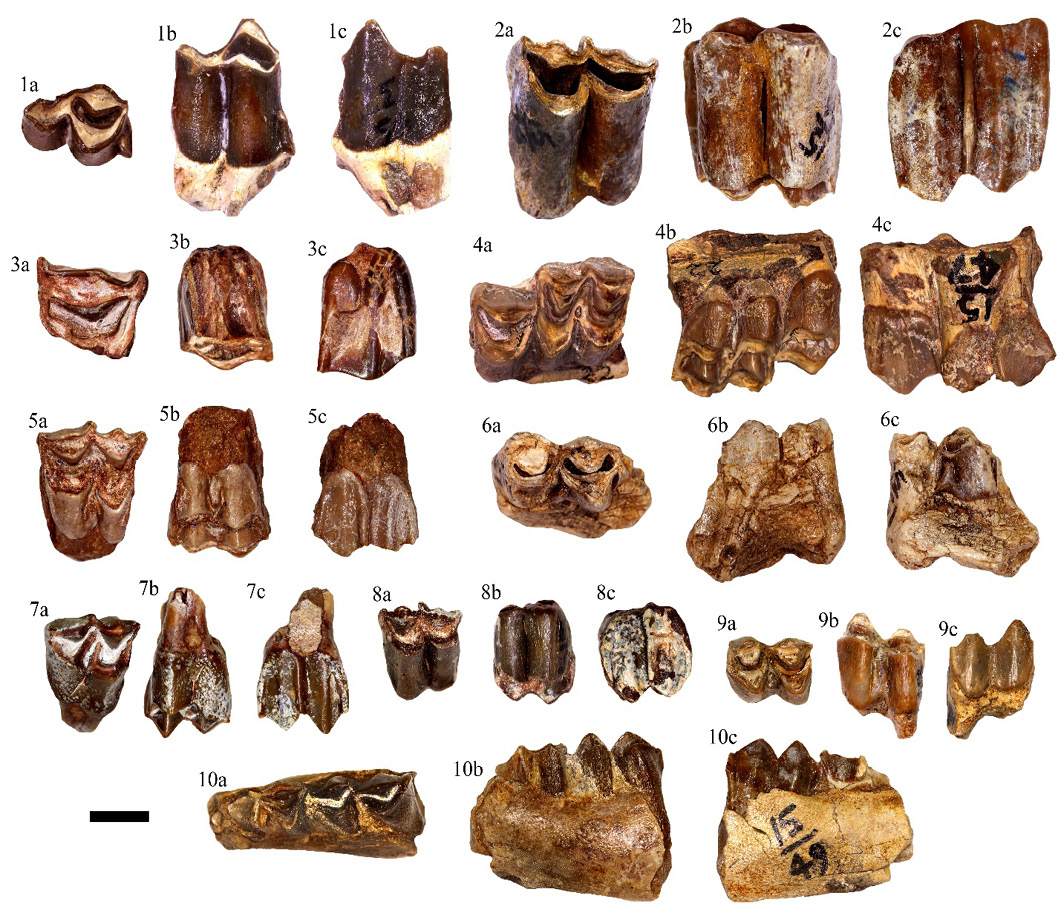
Description and comparison: PUPC 15/56, is in early wear, crescent and the conids are pronounced. The pre-protocristids are somewhat elongated. The tooth has a pointed ectostylid and lacks the hypoconulid. The specimen shows enamel rugosity, strong ectostylid, prominent median ribs, strong and divergent stylids. Dentine is prominent at the occlusal view (Figure 2 1a-c).
These characters associate the specimen PUPC 15/56 to the genus Selenoportax ; , 1995, 1996; . The specimen differs from cervids, giraffids and tragulids. It has narrow and highly crowned hypsodont feature which are the major distinguishing features of the genus Selenoportax. The genus has two species, S. vexillarius and S. lydekkeri. Metrically, the specimen is compared to specimens of AMNH, GCUF and PUPC, showing close similarity to values reported for Selenoportax vexillarius (Table 1).
Selenoportax cf. lydekkeri (Pilgrim, 1910)
New material: PUPC 15/46 –second upper left molar (M2).
Table 1: Comparative measurements of the cheek teeth of Selenoportax cf. vexillarius and S. cf. lydekkeri, Pachyportax cf. latidens, Tragoportax cf. punjabicus, T. cf. salmantanus, and Gazella lydekkeri in mm (millimeters).
| Taxa | Inventory number | Nature/Position | Length | Width | W/L |
| S. cf. vexillarius | PUPC 15/56* | rm3 | 25.5 ca | 11.2 | 0.44 |
| PC-GCUF 10/03 | rm3 | 34.0 | 16.4 | 0.43 | |
| PC-GCUF 10/02 | rm3 | 31.5 | 13.5 | 0.43 | |
| PUPC 04/01 | lm3 | 31.4 | 16.0 | 0.51 | |
| AMNH 10514 | lm3 | 33.0 | 15.0 | 0.45 | |
| AMNH 19514 | lm3 | 33.0 | 21.5 | 0.65 | |
| S. cf. lydekkeri | PUPC 15/46* | lM2 | 28.8 | 27.6 | 0.96 |
| PUPC 69/368 | M2 | 26.0 | 18.6 | 0.72 | |
| P. cf. latidens | PUPC 15/55* | rP4 | 16.5 | 18.3 | 0.90 |
| P.M.N.H. 86/215 | P4 | 16.3 | 21.6 | 1.33 | |
| T. cf. punjabicus | PUPC 15/47* | lP4 | 11.3 | 16.2 | 0.69 |
| lM1 | 16.9 | 18.3 | 10.08 | ||
| PUPC 15/48* | rM1 | 16.0 | 18.2 | 0.87 | |
| PUPC 00/89 | rM1 | 15.0 | 16.0 | 1.06 | |
| PUPC 83/671 | rM1 | 17.4 | 16.2 | 0.93 | |
| PUPC 87/677 | rM1 | 18.0 | 16.0 | 0.88 | |
| PUPC 83/673 | lM1 | 18.0 | 18.0 | 1.00 | |
| PUPC 83/30 | lM1 | 15.0 | 16.0 | 1.06 | |
| PUPC 83/676 | rM1 | 16.4 | 15.0 | 0.91 | |
| PUPC 83/674 | rM1 | 16.4 | 16.4 | 1.00 | |
| T. cf. salmontanus | PUPC 15/50* | rM1 | 16.0 | 15.7 | 0.98 |
| AMNH 19467 | lM1 | 10.62** | 14.4** | 1.40 | |
| AMNH 19467 | rM1 | 10.62** | 14.04** | 1.32 | |
| G. lydekkeri | PUPC 15/49* | m1 | 12.5 ca | 7.70 | 0.64 |
| m2 | 16.6 | 8.00 | 0.48 | ||
| PUPC 15/54* | m2 | 14.2 | 9.95 | 0.70 | |
| PUPC 15/53* | M3 | 14.8 | 15.3 | 1.03 | |
| PUPC 96/6 | rm1 | 13.0 | 8.00 | 0.61 | |
| AMNH 19663 | rm1 | 10.0 | 12.0 | 1.20 | |
| PUPC 84/133 | rm1 | 12.0 | 6.00 | 0.50 | |
| PUPC 87/245 | M3 | 14.1 | 12.2 | 0.86 | |
| PUPC 85/46 | M3 | 14.1 | 13.6 | 0.96 | |
| PUPC 83/67 | M3 | 13.6 | 11.7 | 0.86 |
*The studied specimens. **Estimated from picture. Referred data are taken from Pilgrim (1937, 1939) and Khan et al. (2009a, b, 2013).
Description and comparison: PUPC 15/46, show slight wear (Figure 2 2a-c). The pre-fossette and post-fossettes are very deep. The molar is quadrate in shape. Median basal pillar is broken but the specimen has clearly distinct parastyle, mesostyle, and metastyle. At lingual side the protocone is more pronounced. The molar shows fine enamel rugosity towards the lingual side.
The morphometric analysis of PUPC 15/46 depicts all the features of the genus Selenoportax. The studied specimen is showing similarities with the referred specimen PUPC 69/368, which is second upper molar of S. lydekkeri (Table 1). It has well developed styles . All conids and all stylids are similar to those described for S. lydekkeri .
Genus Pachyportax
Pachyportax latidens
New material: PUPC 15/55, an isolated right dP4.
Description and comparison: PUPC 15/55, is hypsodont and narrow crowned premolar (Figure 2 3a-c). It has well developed cones and styles. It has a deeper anterior valley but a narrower median valley. Behind the metacone, the anterior median rib is located towards the buccal side.
The studied specimen PUPC 15/55 shows characters of the genus Pachyportax . Its enamel is rough, owing to weathering. The studied specimen is compared with the referred specimen of Pakistan Museum of Natural History having catalogue number PMNH. 86/215 both have almost exact similarity (Table 1) , 1939). Morphologically the specimen belongs to the species Pachyportax latidens .
Genus Tragoportax Pilgrim, 1937
Tragoportax cf. punjabicus Pilgrim, 1910
New material: PUPC 15/47, a piece of left maxilla having P4-M1; PUPC 15/48, right M2; PUPC 15/51, left dp4.
Description and comparison: PUPC 15/47, is a left maxillary fragment having P4 of a horseshoe shape, with strong anterio-posterior folds (Figure 2 4a-c). The median rib is slightly present and prominent and it has a divergent parastyle with a moderate metastyle. A short spur projects in the P4’s central fossette. A sharp preprotocrista unites the protocone and parastyle. While the M1 of the maxilla is quadrate in shape and is hypsodont. There is fine rugosity in enamel. The molar has a small entostyle which is comparatively close to the hypocone. All the styles are well developed. PUPC 15/48, a right M2, is a quadrate, hypsodont tooth, with finely rugose enamel (Figure 2 5a-c). The protocone is extended lingually. The paracone, and metacone are in single line. The deep valley is present labially. The median basal pillar is short and stout. All the styles are well developed. The root of the teeth is still embedded in the surrounding mudstone. PUPC 15/51, is a narrow-crowned dp4 (Figure 2 6a-c), having thick and shiny enamel and showing slight wear. The protoconid and hypoconids are almost joined. The metaconid is better developed than any other conids. The posterior valley is larger than the anterior valley.
The specimen’s characters i.e., selenodonty, smaller size and weak basal pillars, differ greatly from the features seen in the genera Selenoportax and Pachyportax, and match with those of the genus Tragoportax ; . The teeth are almost similar to the genus Tragoportax and the species T. punjabicus. Morphometrically, the specimens PUPC 15/47, PUPC 15/48, and PUPC 15/51, are compared with specimens in the Punjab University Paleontological collection (PUPC), showing similarity to the species Tragoportax punjabicus (Table 1).
Tragoportax cf. salmontanus Pilgrim, 1937
New material: PUPC 15/50, an isolated right M1.
Description and comparison: PUPC 15/50 are a well-preserved specimen (Figure 2 7a-c) which still preserves the two roots. The molar is hypsodont and quadrate. The entostyle is present towards the hypocone. A posteriorly-extended strong metastyle is present. Morphologically, PUPC 15/50 is similar to the referred specimen of American Museum of Natural History 19467 having both left and right M1, hence specimen is placed in Tragoportax salmontanus , 1939; .
Genus Gazella Blainville, 1816
Gazella lydekkeri
New material: PUPC 15/53, left M3; PUPC 15/54, left m2. PUPC 15/49, left mandibular fragment containing molars (m1-2).
Description and comparison: PUPC 15/53 is a M3 of quadrate shape and moderately hypsodont (Figure 2 8a-c). The entostyle is absent and the protocone is slightly projecting outward. All principal conids are well preserved. The tooth is crescent shaped, has pointed major cones, and prominent mesostyle and narrow fossette. The posterior rib is weaker, whereas the anterior one is stronger. PUPC 15/54 is a m2 showing a prominent goat fold anteriorly (Figure 2 9a-c). The specimen is partially broken. The root of the specimen is broken and it is bi-rooted. The enamel is present and has a slightly rugose surface. PUPC 15/49 comprises the m1 and m2 (Figure 2 10a-c). The conids are conical in the molars. Broader ribs, weak mesostylid, robust ectostylid and moderate fossette are found in the studied teeth.
The upper and lower dental material included in this research show clear matchings with the referred dental material of the species Gazella lydekkeri of the middle Siwaliks. Hypsodonty, narrow styles/stylids, deep and narrow fossettes are prominent features that can be observed in the new dental material. These are the important characters of the Gazella lydekkeri , 1939; . All the above-described specimens show good resemblance in morphometric features with Gazella lydekkeri (Table 1).
Results and Discussion
The Dhok Pathan Formation has a diverse bovid fauna including particularly baselophines ; ; ; , 2009a, b, 2010a, b, 2011a, b, 2012, 2015, 2016, 2017). The Middle Siwalik genera Selenoportax, Pachyportax Tragopotax, and Gazella show large-sized bovids are present. This shows rich diversity of boselaphins in Late Miocene epoch of the Siwalik Hills before going to extinct at the end of Pliocene. The fossil boselaphins (in studied area) propose an overlapping of the North African, Greco-Iranian (sub-Paratethyan), and Oriental (South Asian) provinces ; .
Selenoportax is best known from the Late Miocene subepoch of the Siwaliks , 2009a). There is great variation in size and morphology of Tragoportax. The two forms of Tragoportax identified are Tragoportax punjabicus and T. salmontanus. Tragoportax was widespread in Oriental region and in densely forested areas of Western Europe . Middle Miocene to early pliocene T. punjabicus is prevalent in southern Asia and Europe , 1939; ; .
Pachyportax is a boselaphine of large size (Lydekker, 1876, 1884; and occurred during the whole Miocene in the Siwaliks . Pachyportax species have been continuously present during the Late Miocene to Early Pliocene subepochs of the Siwalik . There is an overlapping in the stratigraphic range of Pachyportax, Selenoportax, and Gazella depicting the Late Miocene age as the most suitable age for the studied area .
The genus Gazella was erected based on specimens dating from the Miocene . In the Middle Siwaliks, G. superba is larger in size than G. lydekkeri . After boselaphines ; ; ; , b). Gazella lydekkeri is the most abundant antilopine taxon in Dhok Pathan Formation of the Siwaliks, and, since gazelles are mixed feeders, this supports the existence of herbaceous environment at that time ; , 1939).
The lithologies and fossil assemblages of the Dhok Pathan Formation allow the reconstruction of a mosaic habitat which ranges from closed wet to open grassland environment. It favors the abundance of boselophines in the Dhok Pathan region of the middle Siwaliks which depicts their alliance soft food and browsing habit at that time. This shows that there was more vegetation in the Late Miocene to Early Pliocene environment than in present local environments ; ; ; , 2010a).
Conclusions and Recommendations
New dental elements of the Neogene bovids are recorded from the Dhok Pathan Formation of Middle Siwaliks of Pakistan. The six bovid species recovered are Selenoportax cf. vexillarius, Selenoportax cf. lydekkeri, Tragoportax cf. punjabicus, Tragoportax cf. salmontanus, Pachyportax cf. latidens, and Gazella lydekkeri. Presence of these species indicates diverse Late Miocene bovid faunas in Siwaliks of Pakistan. Occurrence of these species in the middle Miocene Siwaliks of Northern Pakistan show that their grazing/ browsing habit at that time.
Novelty Statement
Reassement of the Siwalik bovids is being done, the described material adds more morphological features to assist the reassement.
Author’s Contribution
MAK provided concept and designed the study. KM acquired, analyzed and interpreted the data. MAB and MA worked in photography and mapping. AL drafted the manuscript.
Abbreviations
AMNH, American Museum of Natural History, New York, USA; Ma, Million Year; M1, First upper molar; M2, Second upper molar; dp4, deciduous lower fourth premolar; m1, first lower molar; m2, second lower molar; m3, third lower molar; dP4, deciduous upper fourth premolar; r, right; l, left; GCUF, Govt. College University, Faisalabad; PUPC, Punjab University Paleontological Collection.
Conflict of interest
The authors have declared no conflict of interest.
Figures
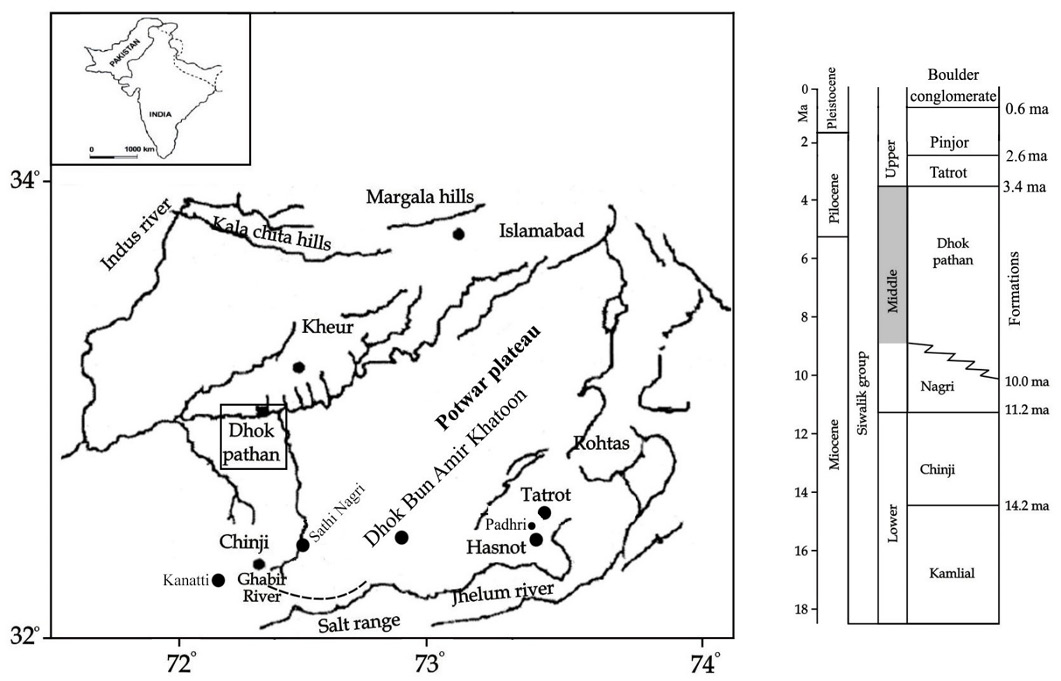
Map showing the studied areas, Dhok Pathan Formation, and a generalized stratigraphic section of the main Siwalik formations (Dennell et al., 2008; Nanda, 2008).
References
- Akhtar, M., 1992. Taxonomy and distribution of the Siwalik bovids. Unpublished PhD Dissertation, University of the Punjab, Lahore, Pakistan, pp. 372.
- Akhtar, M., 1995. Pachyportax giganteus, new species (Mammalia, Artiodactyla, Bovidae) from the Dhok Pathan, district Chakwal, Punjab, Pakistan. Pak. J. Zool., 27(4): 337-340.
- Akhtar, M., 1996. A new species of the genus Selenoportax (Mammalia, Artiodactyla, Bovidae) from Dhok Pathan, district Chakwal, Punjab, Pakistan. Proc. Pak. Cong. Zool., 16: 91-96.
- Barry, J.C., Behrensmeyer, A.K. and Morgan, M., 1980. A geologic and biostratigraphic framework for Miocene sediments near Khaur Village, northern Pakistan. Postil., 183: 1-19.
- Barry, J.C., Morgan, M.E., Flynn, L.J., Pilbeam, D., Behrensmeyer, A.K., Raza, S.M. and Kelley, J., 2002. Faunal and environmental change in the Late Miocene Siwaliks of northern Pakistan. Paleobiology, 28(2): 1-71. https://doi.org/10.1666/0094-8373(2002)28[1:FAECIT]2.0.CO;2[CrossRef]
- Behrensmeyer, A.K. and Tauxe, L., 1982. Isochronous fluvial systems in Miocene deposits of northern Pakistan. Sediment., 29: 331-352.
- Bibi, F., 2007. Dietary niche partitioning among fossil bovids in late Miocene C3 habitats: Consilience of functional morphology and stable isotope analysis. Palaeogeogr. Palaeoclimatol. Palaeoecol., 253: 529-538. https://doi.org/10.1016/j.palaeo.2007.06.014[CrossRef]
- Bibi, F., and Güleç, E.S., 2008. Bovidae (Mammalia: Artiodactyla) from the Late Miocene of Sivas, Turkey. J. Verteb. Paleont., 28(2): 501-519. https://doi.org/10.1671/0272-4634(2008)28[501:BMAFTL]2.0.CO;2[CrossRef]
- Bibi, F., Bukhsianidze, M., Gentry, A.W., Geraads, D., Kostopoulos, D.S. and Vrba, E.S., 2009. The fossil record and evolution of Bovidae: State of the field. Palaeontol. Electron., 12: 1-11.
- Chen, G., 1997. The genus Gazella Blainville, 1816 (Bovidae, Artiodactyla) from the Late Neogene of Yushe Basin, Shanxi, Province, China. Vert. Palasia., 35(4): 233–249.
- Colbert, E.H., 1935. Siwalik mammals in the American museum of natural history. Trans. Am. Phil. Soc., N. S., 26: 1-401. https://doi.org/10.2307/1005467[CrossRef]
- Dennell, R.W., Coard, R. and Turner, A., 2008. Predators and scavengers in Early Pleistocene southern Asia. Quat. Int., 192(1): 78-88. https://doi.org/10.1016/j.quaint.2007.06.023[CrossRef]
- Gentry, A.W., 1994. The Miocene differentiation of old world Pecora (Mammalia). Hist. Biol., 7: 115-158. https://doi.org/10.1080/10292389409380449[CrossRef]
- Gentry, A.W., 1999. Fossil pecorans from the Baynunah Formation, Emirate of Abu Dhabi, United Arab Emirates, In: P.J., Whybrow, and A., Hill, editor. Fossil Vertebrates of Arabia. New Haven: Yale University Press. pp. 290-316.
- Ghaffar, A., Khan, M. and Akhtar, M., 2009. Predator-prey relationship (Cervidae & Carnivora) and its impact on fossil preservation from the Siwaliks of Pakistan. J. Anim. Pl. Sci., 19: 54-57.
- Haile-Selassie, Y., Woldegabriel, G., White, T., Bernor, R.L., Degusta, D., Renne, P.R., Hart, W.K., Vrba, E.S., Stanley, A. and Howell, F.C., 2004. Mio-Pliocene mammals from the Middle Awash, Ethiopia. Géobios, 37: 536-552. https://doi.org/10.1016/j.geobios.2003.03.012[CrossRef]
- Iqbal, M., Liaqat, A., Khan, M.A. and Akhtar, M., 2009. Some new remains of Hipparion from the Dhok Pathan type locality, Pakistan. J. Anim. Plant Sci., 19(3): 154-157.
- Khan M.A., Abbas, S.G., Babar, M.A., Kiran, S., Riaz, A. and Akhtar, M., 2017. Dorcatherium (Mammalia: Tragulidae) from Lower Siwaliks of Dhok Bun Amir Khatoon, Punjab, Pakistan. Pak. J. Zool., 49(3): 883-888. https://doi.org/10.17582/journal.pjz/2017.49.3.883.888[CrossRef]
- Khan, I.A., Bridge, J.S., Kappelman, J. and Wilson, R., 2006. Evolution of Miocene fluvial environments, eastern Potwar Plateau, northern Pakistan. J. Int. Assoc. Sediment., 44(2): 221-225. https://doi.org/10.1111/j.1365-3091.1997.tb01522.x[CrossRef]
- Khan, M.A., Akhtar, M., Ghaffar, A., Iqbal, M. and Samiullah K., 2011b. New fossil locality in the middle Miocene of lava from the Chinji Formation of the lower Siwaliks. Pak. J. Zool., 43: 61-72.
- Khan, M.A., 2008. Fossil bovids from the late Miocene of Padri, Jhelum, Pakistan. Pak. J. Zool., 40(1): 25- 29.
- Khan, M.A., Akhtar M., and Ikram T., 2012. True ungulates from the Nagri type locality (Late Miocene), northern Pakistan. J. Anim. Plant Sci. Suppl. Ser., 1: 1-59.
- Khan, M.A., Akhtar, M., Ghaffar, A., Iqbal, M., Khan, A.M. and Farooq, U., 2008. Early ruminants from Dhok Bin Mir Khatoon (Chakwal, Punjab, Pakistan): systematics, biostratigraphy and paleoecology. Pak. J. Zool., 40: 457-463.
- Khan, M.A., Akhtar, M., Rohi, G., Iqbal, M. and Samiullah, K., 2011a. Sivaceros gradiens Pilgrim 1937 (Mammalia, Bovidae, Boselaphini) from the Lower Siwaliks of Dhok Bun Amir Khatoon, Chakwal, Pakistan: Systematics and Biostratigraphy. Turk. J. Zool., 35: 281-286. https://doi.org/10.3906/zoo-0812-18[CrossRef]
- Khan, M.A., Aziz, H., Gul, S., Babar, M.A., Mahmood, K., and Akhtar, M., 2015. New Hipparionine (Equidae) Remains from Dhok Pathan Formation of Siwaliks, Pakistan. Pak. J. Zool., 47(6): 1617-1624.
- Khan, M.A., Babar, M.A., Akhtar, M., Iliopoulos, G., Rakha, A. and Noor, T., 2016. Gazella (Bovidae, Ruminantia) remains from the Siwalik Group of Pakistan. Alcheringa, 40: 182-197. https://doi.org/10.1080/03115518.2016.1103152[CrossRef]
- Khan, M.A., Butt, S.S., Khan, A.M. and Akhtar, M., 2010b. A New Collection of Giraffokeryx punjabiensis (Giraffidae, Ruminantia, Artiodactyla) from the Lehri Outcrops, Jhelum, Northern Pakistan. Pak. J. Sci., 62(2): 120-123.
- Khan, M.A., Ghaffar, A., Farooq, U. and Akhtar, M., 2007. New Fossil remains of Selenoportax vexillarius from the Late Miocene of Hasnot. Pak. J. Zool., 39: 333-338.
- Khan, M.A., Jamil, M., Mahmood, K. and Babar, M.A., 2014. Some New Remains of Cervids (Cervidae, Ruminantia) from Tatrot Formation of Northern Pakistan. Biol. Pak., 60: 225-230.
- Khan, M.A., Kostopoulos, D.S., Akhtar, M. and Nazir, M., 2010a. Bison remains from the Upper Siwaliks of Pakistan. Neu. Jahrb. für Geol. Und Paläont., 258(1): 121-128. https://doi.org/10.1127/0077-7749/2010/0090[CrossRef]
- Khan, M.A., Liopoulos, G. and Akhtar, M., 2009a. Boselaphines (Artiodactyla, Ruminantia, Bovidae) from the Middle Siwaliks of Hasnot. Pakistan. Géobios, 42: 739-753. https://doi.org/10.1016/j.geobios.2009.04.003[CrossRef]
- Khan, M.A., Malik, M., Iqbal, M. and Akhtar, M., 2009b. Mammalian remains in the Chinji type locality of the Chinji Formation: A new collection. J. Anim. Plant Sci., 19(4): 224-229.
- Khan, M.A., Raza, A., Batool, A., Nayyer, A.Q., Akhtar, M. and Rubab, K., 2013. New Boselaphine Remains from the Dhok Pathan Formation of the Middle Siwaliks, Northern Pakistan. Pak. J. Zool., 45: 1377-1385.
- Lydekker, R., 1876. Indian Tertiary and Post-Tertiary vertebrate. 3. Crania of Ruminants. Pal. Ind., 10: 88-181.
- Lydekker, R., 1884. Rodents and New Ruminants from the Siwalik and synopsis of Mammalia. Paleontol. Ind., 10(3): 105–134.
- Merceron, G., Zazzo, A., Spassov, N., Geraads, D. and Kovachev, D., 2006. Bovid palaeoecology and palaeo environments from the late miocene of Bulgaria: Evidence from dental microwear and stable isotopes. Palaeogeogr. Palaeoclimat. Palaeoecol., 241(3-4): 637-654. https://doi.org/10.1016/j.palaeo.2006.05.005[CrossRef]
- Moya-Sola, S., 1983. Los Boselaphini (Bovidae, Mammalia) del Neogeno de la Peninsula Iberica. Dissertation, Universidad Autonoma de Barcelona, Publ. Geol., 18: 1-236.
- Nanda, A.C., 2008. Comments on the Pinjor Mammalian Fauna of the Siwalik Group in relation to the Post-Siwalik Faunas of Peninsular India and Indo-Gangetic Plain. Quater. Int., 192: 6-13. https://doi.org/10.1016/j.quaint.2007.06.022[CrossRef]
- Pilgrim, G.E., 1937. Siwalik antelopes and oxen in the American museum of natural history. Bull. Am. Mus. Nat. Hist., 72: 729-874.
- Pilgrim, G.E., 1939. The fossil Bovidae of India. Paleont. Ind., 26(1): 1-356.
- Thomas, H., 1984. Les bovides des ante-hipparions des Siwaliks inferieurs (Plateau du Potwar), Pakistan. Mem. Soc. Geol. France, 145: 1-68.
- Vrba, E.S. and Schaller, G., 2000. Phylogeny of Bovidae based on behavior, glands, skulls, and postcrania, In: E.S. Vrba, and G. Schaller (Eds.), Antelopes, deer, and relatives. New Haven: Yale University Press, pp. 203-222.
Services
Article usage statistics
Loading…