
Brucellosis is a worldwide zoonosis. It is transmitted by direct contact or consumption of contaminated unpasteurized dairy milk. A total of 193 sera were collected from occupationally exposed participants in Quetta, Pakistan and analyzed by Rose Bengal Plate Test (RBPT). An overall 4/193 (2.1%, CI 0.6-5.2) seropositive were found. A higher seropositive rate was found in participants with >40 years age, livestock contact, poor socioeconomic group and no raw milk consumption. All variables didn’t show statistical significance by Fischer’s exact test. Further epidemiological studies and awareness programs are recommended. Based on the results and review of the literature, the authors urge to consider higher age ≥40 years, direct contact and raw milk intake as risks for the infection.
Short Communication · Volume 69, Issue 1, 28 October 2023 · Open Access
Seroprevalence of Brucellosis in Occupationally Exposed Humans in Quetta, Pakistan
· · · · · · · ·
Affiliations & Notes ⌄
- 1Institute for Bacterial Infections and Zoonoses, Friedrich-Loeffler-Institute, 07743 Jena, Germany
- 2Department of Clinical Medicine and Surgery, Faculty of Veterinary Science, University of Agriculture, 38000 Faisalabad, Pakistan
- 3Directorate of Medical Sciences, Government College University, 38000 Faisalabad, Pakistan
- 4Department of Animal and Veterinary Sciences, College of Agricultural and Marine Sciences, Sultan Qaboos University, Muscat 123, Oman
- 5Livestock and Dairy Development Department, Government of Balochistan, 87300 Quetta, Pakistan
- 6Department of Pathology, Faculty of Veterinary and Animal Sciences, The Islamia University of Bahawalpur, 63100 Bahawalpur, Pakistan. *Correspondence | Muhammad Saqib and Mudassar Iqbal, Department of Clinical Medicine and Surgery, Faculty of Veterinary Science, University of Agriculture, 38000 Faisalabad, Pakistan
- 7Department of Pathology, Faculty of Veterinary and Animal Sciences, The Islamia University of Bahawalpur, 63100 Bahawalpur, Pakistan
- 8Email: drsaqib_vet@hotmail.com, mudassar.iqbal@i
Article Info ⌄
- Journal:
- Biologia (Lahore)
- Published:
- 28 October 2023
From the article
- Age >40 years showed higher seroprevalence ratio (5.6%, CI 0.7-18.7) when compared to ≤40 years of age (1.3%, CI 0.2-4.5).
- Raw milk consumption showed a lower seroprevalence rate (1.9%, CI 0-10.1) than those who didn’t consume raw milk (2.1%, CI 0.4-6.1).
Selected from the article's own text.
Abstract
Introduction
Brucellosis is a worldwide zoonotic disease caused by intracellular living Gram-negative bacteria of the genus Brucella (B.). In Pakistan, B. abortus is the main cause of brucellosis in bovines, B. melitensis in small ruminants and B. canis in dogs whereas B. suis has never been reported . Infected animals shed the organism in body fluids or birth products e.g., vaginal fluid, milk or fetal membranes which act as source of direct and indirect transmission to humans and other animals. Additionally, consumption of contaminated raw/unpasteurized milk in humans remains a main source of infection . The clinical picture is not pathognomonic but undulant fever, weakness, splenomegaly with occasional reproductive problems are prominent symptoms . Considered as one of the most frequent zoonosis in the world, it infects, an estimated 2.1 million humans worldwide every year . Brucellosis is one of the priority zoonotic diseases of the National Institute of Health (NIH) in Pakistan and calls have been made to tackle this disease under “One Health” paradigm (CDC, 2017; NIH, 2017). Sporadic cases in humans do occur every year throughout the country but are highly likely to be underreported (NIH, 2022). Balochistan is the largest province (44% by landmass) of the country but studies on human brucellosis are scarce ; . In this scenario, the purpose of this study was to establish our understanding about the seroprevalence rate of occupationally exposed humans in the district Quetta of Balochistan, Pakistan (Figure 1).
Table 1: Univariable analysis of the risk factors of human brucellosis (n=193) in Quetta, Pakistan.
| Variable | Category | Pos./ Tested | Prev. % (95% CI) |
| Age | > 40 | 2/36 | 5.6 (0.7-18.7) |
| ≤ 40 | 2/157 | 1.3 (0.2-4.5) | |
| Occupation | Farm Worker | 3/73 | 4.1 (0.9-11.5) |
| Butcher | 1/117 | 0.9 (0-4.7) | |
| Veterinarian | 0/3 | 0 (0-70.8) | |
| Contact with animals | Small ruminants | 2/55 | 3.6 (0.4-12.5) |
| Cattle | 2/82 | 2.4 (0.3-8.5) | |
| Both | 0/56 | 0 (0-6.4) | |
| Previous infection | No | 4/185 | 2.2 (0.6-5.4) |
| Yes | 0/8 | 0 (0-36.9) | |
| Socioeconomic group | Poor | 2/85 | 2.4 (0.3-8.2) |
| Middle class | 2/108 | 1.9 (0.2-6.5) | |
| Raw milk intake | No | 3/140 | 2.1 (0.4-6.1) |
| Yes | 1/53 | 1.9 (0-10.1) | |
| Total | 4/193 | 2.1 (0.6-5.2) | |
Materials and Methods
A total of 193 occupationally exposed persons (livestock farm workers, butchers and veterinarians) were recruited conveniently for this study. Biological plausible variables’ data (age, occupation, contact with animals, previous infection history, socioeconomic status and raw milk intake) were noted on a questionnaire proforma. Sera were separated and stored at -20 ℃ until further use. These sera were subjected to Rose Bengal Plate test (RBPT) using Pourquier® Rose Bengal Antigen (IDEXX, Montpellier, France) along with positive and negative control sera provided by the Friedrich-Loeffler-Institut (FLI), Jena, Germany as described by World Organization for Animal Health (OIE, 2022). Briefly, 25µL of each serum were mixed in equal amounts of antigen on a white enamel plate at room temperature and waited for four minutes. A visible agglutination comparable to the positive control serum was considered as positive. Fischer’s exact test was performed on the variables by using SPSS Statistics (IBM Corporation, New York, USA).
Results and Discussion
Four of 193 (2.1%, CI 0.6-5.2) sera were found positive by RBPT in the study. Age >40 years showed higher seroprevalence ratio (5.6%, CI 0.7-18.7) when compared to ≤40 years of age (1.3%, CI 0.2-4.5). Livestock farm workers showed higher seroprevalence (4.1%, CI 0.9-11.5). Seroprevalence (3.6%, CI 0.4-12.5) was found higher in the persons having contact with small ruminants. Poor socioeconomic status showed higher seroprevalence (2.4%, CI 0.3-8.2). Raw milk consumption showed a lower seroprevalence rate (1.9%, CI 0-10.1) than those who didn’t consume raw milk (2.1%, CI 0.4-6.1). A gender-based analysis could not be undertaken as all samples were from male subjects (Table 1). Similarly, multivariate analysis was not considered as all variables showed non-significant association with the seropositivity of the infection.
Although our study could not find a significant association with the factors, based on the previous published data, occupational exposure, duration and age should be considered as risks for brucellosis transmission . Previously, inadequate knowledge and at least one risky practice have been found in animal workers/owners in different areas of the country ; ; ; . Additionally, contact with the diseased animals and contaminated raw milk consumption could be associated factors in clinical human cases ; . A more variable data for health status would be needed to confirm its association with the disease. Pasteurization of the milk before consumption is recommended as the bacteria is killed when boiled at 62-63 °C for 3 minutes . Although brucellae respond well to various antimicrobials, culling of the infected animals remains a preferred choice to eliminate the infection. Awareness programs must be implemented.
Acknowledgments
All participants and resource persons are highly thanked for their participation and efforts in this study. Dr. Abdul Rehman from Department of Epidemiology and Public Health, University of Veterinary and Animal Sciences, Lahore, Pakistan is highly thanked for his technical assistance in map creation.
Novelty Statement
This study presents first detailed brucellosis seroprevalence among occupationally exposed individuals in Quetta, Balochistan. Despite being the largest province in Pakistan, prior research on human brucellosis in Balochistan are scarce. Our findings provide a foundation for future research and preventive measures in the region.
Author’s Contribution
MS: Conceptualized and supervised this study.
MAK: Helped collecting the samples.
TJ, MHT and AR: Performed the laboratory work.
KKK and MHH: Performed the analysis.
TJ: Wrote the manuscript.
HN and MI: Reviewed the masnucript.
Ethical statement
The biological specimens were collected as per ethical and standard procedures of the Department of Clinical Medicine and Surgery, University of Agriculture, Faisalabad 38000, Pakistan. All participants were prior informed about the possible outcomes of the study and a verbal consent was taken based on the participant’s free will of participation before recruiting in the study.
Conflicts of interest
The authors have declared no conflict of interest.
Figures
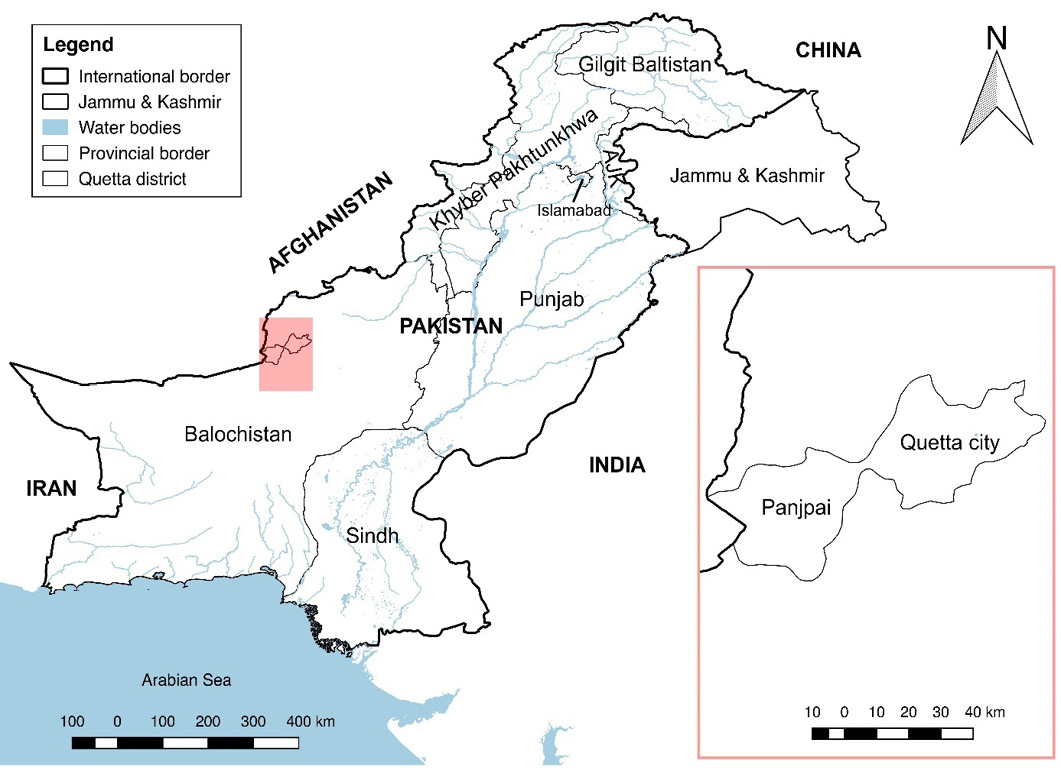
Spatial presentation of the sampling site.
References
- Ali, S., S. Akhter, H. Neubauer, A. Scherag, M. Kesselmeier, F. Melzer, I. Khan, H. El-Adawy, A. Azam, S. Qadeer and Q. Ali. 2016. Brucellosis in pregnant women from Pakistan: An observational study. BMC. Infect. Dis., 16(1): 468. https://doi.org/10.1186/s12879-016-1799-1[CrossRef]
- Ali, S., A. Akber, M. Shafee, B. Tahira, A. Muhammad and N. Ullah. 2017. Sero-epidemiological study of brucellosis in small ruminants and associated human beings in district Quetta, Balochistan. Pure Appl. Biol., 6: 797-804. http://dx.doi.org/10.19045/bspab.2017.60084[CrossRef]
- Ali, S., U. Saeed, M. Rizwan, L. Hassan, M.A. Syed, F. Melzer, H. El-Adawy and H. Neubauer. 2021. Serosurvey and risk factors associated with brucella infection in high risk occupations from district Lahore and Kasur of Punjab, Pakistan. Pathogens, 10(5): 620. https://doi.org/10.3390/pathogens10050620[CrossRef]
- Arif, S., P.C. Thomson, M. Hernandez-Jover, D.M. McGill, H.M. Warriach and J. Heller. 2017. Knowledge, attitudes and practices (KAP) relating to brucellosis in smallholder dairy farmers in two provinces in Pakistan. PLoS One, 12(3): e0173365. https://doi.org/10.1371/journal.pone.0173365[CrossRef]
- CDC, 2017. One health zoonotic disease prioritization workshop in Pakistan (Islamabad, Pakistan). https://stacks.cdc.gov/view/cdc/84617. Accessed: 19.10.2023
- Hakeem, M. and S. Saeed. 2019. Brucellosis: A case report and literature review. J. Postgrad Med. Educ. Res., 53(3): 126-127. https://doi.org/10.5005/jp-journals-10028-1328[CrossRef]
- Hussain, S., A. Hussain, U.R., Zia, S.M.R. Naqvi, M.Y. Zahoor, M. Bilal, J. Ho and O.A.E. Sparagano. 2021. Knowledge, attitude, and practices associated with brucellosis among livestock owners and its public health impact in Punjab, Pakistan. Biologia, 76: 2921-2929. https://doi.org/10.1007/s11756-021-00765-2[CrossRef]
- Jamil, T., A.U. Khan, M. Saqib, M.H. Hussain, F. Melzer, A. Rehman, M.Z. Shabbir, M.A. Khan, S. Ali, A. Shahzad, I. Khan, M. Iqbal, Q. Ullah, W. Ahmad, M.K. Mansoor, H. Neubauer and S. Schwarz. 2021. Animal and human brucellosis in Pakistan. Front. Publ. Health, 9: 660508. https://doi.org/10.3389/fpubh.2021.660508[CrossRef]
- Laine, C.G., V.E. Johnson, H.M. Scott and A.M. Arenas-Gamboa. 2023. Global Estimate of Human Brucellosis Incidence. Emerg. Infect. Dis., 29: 1789-1797. https://doi.org/10.3201/eid2909.230052[CrossRef]
- Murray, C., S. McNutt and P. Purwin. 1932. The effect of pasteurization upon Brucella melitensis var. suis. J. Dairy Sci., 15(1): 6-13. https://doi.org/10.3168/jds.S0022-0302(32)93382-7[CrossRef]
- NIH, 2017. Notification of priority diseases in Pakistan. In 1-31/Misc/FEDSD/2017, Health, N.I.o., ed. (Islamabad, Pakistan, Ministry of National Health Services, Regulations and Coordinations), pp. 1-2. https://www.nih.org.pk/wp-content/uploads/2018/11/Notification-of-Priority-Diseases-in-Pakistan.pdf
- NIH, 2022. Integrated disease surveillance and response weekly bulletin (Islamabad, Pakistan, National Institue of Health, Islamabad, Pakistan), IDSR-weekly-report-16-2022 and 2011-2022.
- OIE Terrestrial Manual, 2022. Brucellosis (Brucella abortus, B. melitensis and B. suis) (Infection with B. abortus, B. melitensis and B. suis). OIE, Paris, France.
- Qazilbash, A.A. and A. Bari. 1997. Sero-diagnosis of human brucellosis among TB suspected patients. J. Pak. Med. Assoc., 47(10): 243-246.
- Saddique, A., S. Ali, S. Akhter, I. Khan, H. Neubauer, F. Melzer, S.U. Khan, A. Azam and H. El-Adawy. 2019. Acute febrile illness caused by Brucella abortus infection in humans in Pakistan. Int. J. Environ. Res. Publ. Health, 16(21): 4071. https://doi.org/10.3390/ijerph16214071[CrossRef]
- Tahir, A., S. Naz, M.S. Afzal, R.M.K. Shabbir, S. Ali, N. Shah and H. Ahmed. 2022. Community based assessment on knowledge, attitude and practices (KAP), risk factors and one health perspective of brucellosis in rural and urban settings of Pakistan: A cross-sectional study. J. Hellenic. Vet. Med. Soc., 73(3): 4339-4356. https://doi.org/10.12681/jhvms.26869[CrossRef]
Services
Article usage statistics
Loading…