The current study highlighted the hepatoprotective potential of piperine in preventing hepatotoxicity induced by CCl₄.
Piperine exerts a protective effect by suppressing the excessive production of liver damage indicators and enhancing antioxidant biomarkers.
Therefore, our study suggests that piperine could be a potent remedy for the prevention of liver damage.
Selected from the article's own text.
Abstract
The aim of the current study was to evaluate the hepatoprotective effects of piperine against carbon tetrachloride (CClâ‚„)-induced liver injury in male rats. To assess the impact of piperine therapy on liver damage caused by CClâ‚„, 24 male rats were divided into four groups, with six rats in each group. Group 1 served as the control and received oral administration of distilled water. Group 2 underwent hepatotoxicity induction by administering CClâ‚„ at a dose of 0.8 ml/kg intraperitoneally. Group 3 received an oral dose of piperine at a concentration of 30 mg/kg body weight (bw) for 3 weeks. Finally, Group 4 received both piperine and CClâ‚„ for 3 weeks. The results showed a significant reduction (p < 0.05) in liver enzyme levels following piperine treatment in CClâ‚„-exposed rats. Additionally, piperine treatment resulted in significant improvements (p < 0.05) in lipid profiles, including reductions in total triglycerides, total cholesterol, low-density lipoprotein (LDL), and very low-density lipoprotein (VLDL), while also increasing high-density lipoprotein (HDL) levels. Furthermore, piperine significantly increased (p < 0.05) antioxidant enzyme activities, including superoxide dismutase (SOD) and glutathione peroxidase (GPx), compared to the CClâ‚„-only treated rats. Overall, the findings of this study suggest that piperine is a potent hepatoprotective agent.
Keywords | Piperine, Liver, Rat, CCL4, Oxidative damage
INTRODUCTION
Various potent phytomedicines are available on the market in the form of entire plant extracts . Practitioners have long relied on the synergistic effects of the multiple components in these herbal preparations, whether derived from single herbs or blends, to significantly enhance their medicinal efficacy . The exact mechanisms by which many herbal preparations, including botanical extracts, exert their effects are not yet fully understood . However, several studies have indicated that the synergistic effect of combining various herbal extracts can lead to more potent and effective outcomes compared to using a single isolated component at the same dose .
Piperine, scientifically known as 1-peperoylpiperidine, is an alkaloid compound found in the fruit of plants from the Piperaceae family. Notable examples include black pepper (Piper nigrum) and long pepper (Piper longum) . Plants in this family have been widely used in traditional medicine and as culinary spices across various cultures. Research has demonstrated that piperine possesses several pharmacological properties, such as antioxidant effects ; , anti-inflammatory properties ; , and vasodilatory effects ; . Additionally, piperine has shown potential neuroprotective effects against ischemia-reperfusion and may also offer protection against lead acetate-induced nephrotoxicity .
Piperine naturally occurs in four isomeric forms . However, only two isomers of piperine exhibit both pungency and biological activity, distinguishing them from the other two isomers. Carbon tetrachloride (CCl₄) is commonly used in liver studies due to its well-established role in inducing liver fibrosis and damage . Liver damage induced by CCl₄ occurs through the generation of reactive oxygen species (ROS), triggered by CYP2E1 enzymes . Piperine helps mitigate liver damage by inhibiting the function of NF-κB and stimulating Nrf2, which in turn inhibits the synthesis of pro-inflammatory cytokines and mediators. Additionally, piperine activates the antioxidant response system, aiding in the removal of ROS and reducing lipid peroxidation .
Beyond its hepatoprotective properties, piperine has a diverse array of biological activities, including antidepressant, anxiolytic, antithyroid, immune-stimulating properties against malignancies, anti-inflammatory, and anti-metastatic effects . Moreover, this alkaloid enhances the bioavailability of several drugs and provides hepato-protection against toxicity . The present investigation aimed to assess the efficacy of piperine in mitigating oxidative damage associated with hepatotoxicity and liver fibrosis induced by CCl₄.
MATERIALS AND METHODS
Chemicals
Piperine and CCl4 were purchased from highly qualified supplier companies.
Animals
A total of 32 male Wistar rats, with weights ranging from 200 to 250 g, were used in the study. Each cage housed four animals and maintained controlled circumstances, including a steady ambient temperature of 22 ± 2 °C and a reverse light-dark cycle of 12 hours. Complimentary food and beverages were available.
Ethical Approval
The experimental design and methodologies used in this work were carefully assessed and approved to meet the animal welfare ethical criteria set by the Scientific Committee of the Faculty of Veterinary Medicine at Al-Qasim Green University.
Experimental Design
Group I: Six rats were administered 0.8 ml/kg.bw of distilled water daily by intragastric intubation and were designated as the control negative control.
Group II: 6 rats injected CCL4 0.8 ml/kg intrapretonially, for 4 weeks (2 injection in each week) to induce hepatotoxicity .
Group III: 6 rats were administered CCL4 (as in the preceding group) together with piperine by intragastric intubation at a daily dosage of 30mg/kg for a duration of 4 weeks.
Group IV: 6 rats were given 30 mg/kg.bw of piperine every day for four weeks through an intragastric tube.
Evaluation of Liver Enzyme
The levels of alkaline phosphatase (ALP), alanine aminotransferase (ALT), and aspartate aminotransferase (AST) in the serum were measured using commercially available kits (Elab Science, China).
Evaluation of Lipid Profile
Serum samples were collected and analyzed for lipid profiles. Using a kit provided by Elabscience (China), the concentrations of triglycerides, high-density lipoproteins (HDL), and total cholesterol were measured. The low-density lipoprotein cholesterol (LDL-C) was determined by subtracting the concentration of high-density lipoprotein cholesterol (HDL-C) and very-low-density lipoprotein cholesterol (VLDL-C) from the total cholesterol.
Assessment of Antioxidant Biomarkers
The activity of superoxide dismutase (SOD) was assessed using the methodology by Marklund and Marklund (1974). The measurement of glutathione peroxidase (GPx) activity was conducted using the method outlined by Mohandas et al. (1984).
Statistical Analysis
The statistical approach used to analyze differences between groups was one-way analysis of variance (ANOVA). Comparisons were considered statistically significant at a significance level of p < 0.05.
RESULTS AND DISCUSSION
Liver Enzymes
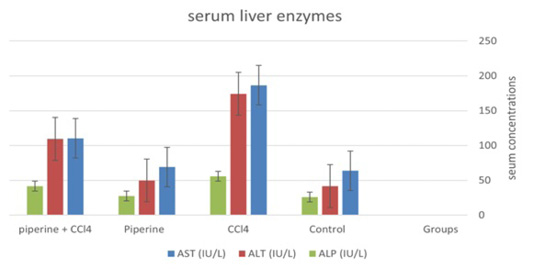
The animals exposed to CCl4 exhibited a statistically significant increase (p < 0.05) in the levels of liver enzymes compared to the control group. CCl4 induces hepatotoxicity by promoting the release of liver enzymes into the bloodstream. However, administration of 30 mg/kg body weight (bw) of piperine resulted in a significant decrease (p<0.05) in the activity of liver enzymes, as shown in Figure 1.
Parameters of Lipid Profiles
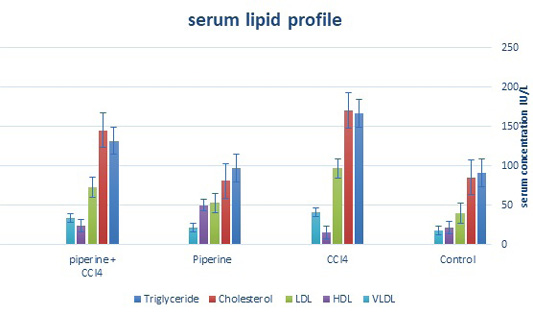
The lipid profile showed a significant improvement (p < 0.05), except for HDL, which decreased following CCl4 treatment compared to the control group, as shown in Figure 2. Administration of piperine at a dosage of 30 mg/kg significantly reduced (p < 0.05) the lipid profile, except for HDL, which exhibited an increasing trend.
Antioxidant biomarkers
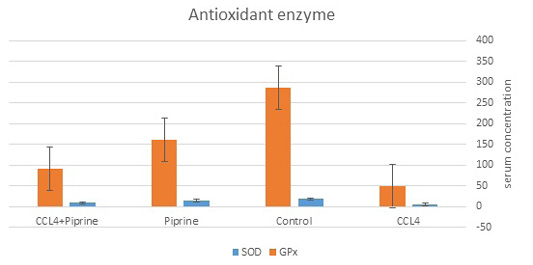
The study investigated the protective effect of piperine on antioxidant enzyme activity. As shown in Figure 3, mice treated with piperine exhibited a statistically significant increase (p < 0.05) in antioxidant enzymatic activity compared to those exposed to CCl4. The administration of piperine restored antioxidant enzyme activity to baseline levels.
The hepatotoxic effects of CCl₄ are primarily attributed to the generation of harmful free radicals, specifically the trichloromethyl radical (CCl₃) and the trichloromethyl peroxy radical (CCl₃O₂) ; . Liver enzymes serve as reliable biomarkers for assessing both the rate and extent of liver damage. Elevated levels of these enzymes in the bloodstream are directly correlated with liver injury . In our study, we observed clear evidence of hepatic damage in Wistar rats exposed to CCl₄. The significant increase in the levels of AST, ALP, and ALT (p ≤ 0.05) indicates that CCl₄ acts as both an inflammatory and hepatotoxic agent .
The administration of piperine effectively reduced the elevated liver enzyme levels, as shown in Figure 1. This suggests that piperine may protect hepatocytes from damage induced by CCl₄. The protective effect could involve maintaining the structural integrity of hepatocyte membranes and preventing the release of enzymes. Our findings are consistent with several studies that report the hepatoprotective effects of piperine ; ; .
Additionally, rats treated with CCl₄ exhibited a significant (p ≤ 0.05) increase in their lipid profile, including total cholesterol (TC), triglycerides (TG), low-density lipoprotein (LDL), and very low-density lipoprotein (VLDL), along with a decrease in high-density lipoprotein (HDL) levels. However, oral administration of piperine resulted in the restoration of the lipid profile, as shown in Figure 2. This aligns with a study by Tu et al. (2014), which found that a high-cholesterol diet led to an increase in TC levels and the TC/HDL ratio, though methyl piperine effectively reduced this increase.
Superoxide dismutase (SOD) activity is a reliable biomarker for hepato-renal damage, as it neutralizes superoxide anions and produces hydrogen peroxide, which helps alleviate harmful effects. Hepatic cells rely on the combined actions of glutathione peroxidase (GPx) and catalase to eliminate peroxides during detoxification processes ; . Antioxidant enzymes, such as GPx and SOD, are essential components of the body’s internal defense mechanisms against oxidative stress. Our study found a significant decrease in SOD and GPx levels in rats treated with CCl₄. However, the administration of piperine led to a notable recovery of these enzymes, as depicted in Figure 3. This suggests that piperine plays a critical role in promoting the efficient removal of reactive oxygen species (ROS) produced by the P450 bio-activation induced by CCl₄.
Our findings are in line with research by Abdel-Daim et al. (2019), which demonstrated the antioxidant potential of piperine. Furthermore, piperine has been shown to enhance the bioavailability of both synthetic drugs and bioactive phytochemicals. For instance, Bi et al. (2019) used piperine to improve the absorption of silybin, a flavonoid known for its liver-protective properties, in a CCl₄-induced liver damage model. Additionally, research by Jin et al. (2018) found that the bioavailability of ginsenoside Rh₂, a compound known to modulate the immune system, was significantly enhanced when co-administered with piperine.
CONCLUSIONS AND RECOMMENDATIONS
The current study highlighted the hepatoprotective potential of piperine in preventing hepatotoxicity induced by CCl₄. Piperine exerts a protective effect by suppressing the excessive production of liver damage indicators and enhancing antioxidant biomarkers. It also prevents liver cell death, reduces free radical levels, and boosts antioxidant activity. Therefore, our study suggests that piperine could be a potent remedy for the prevention of liver damage.
NOVELTY STATEMENTS
The novelty of this research lies in the investigation of piperine for its hepatoprotective effects. The objective of this study was to elucidate the hepatoprotective potential of piperine by analyzing the levels of certain enzymes that are elevated during CCl₄-induced hepatotoxicity.
AUTHOR’S CONTRIBUTIONS
Mohammed A. Aboktifa conceptualized and designed the study Ali I. Al-ameedi and Zahraa M Ayad participated in the investigation and the drafting of the paper as well as, analyzed and interpreted the data. Ahmed Hamzah Mosa revised the paper critically for intellectual content and approved the final version of the paper to be published. All authors agree to be accountable for all aspects of the work.
Conflict of Interest
The authors have declared no conflict of interest.
Figures
Figure 1:.
Levels of liver enzymes in different groups of the study.
Figure 2:.
Levels of lipid profiles in different groups of the study.
Figure 3:.
Levels of antioxidant enzymes in different groups of the study.
References
Abdel-Daim MM, Sayed AA, Abdeen A, Aleya L, Ali D, Alkahtane AA, Alkahtani S (2019). Piperine enhances the antioxidant and anti-inflammatory activities of thymoquinone against microcystin-LR-induced hepatotoxicity and neurotoxicity in mice. Oxidative Med. Cell. Longevity, 1: 1309175. https://doi.org/10.1155/2019/1309175[CrossRef]
Al-Ameedi AI, Ayad ZM, Mohammed WA, Hajwal SK (2023). Ginkgo Biloba extract’s efficacy to mitigate the genotoxicity that hydroxyurea induces in mice. Adv. Anim. Vet. Sci., 11: 552-557. https://dx.doi.org/10.17582/journal.aavs/2023/11.4.552.557[Full text][CrossRef]
Al-Ameedi I. Ali, Falah MK. Al-Rekabi, Ahmed ShJ (2016). Hepatotoxic effect of chronic exposure of Tacrolimus in male Albino rats. The Iraqi J. Vet. Med., 40: 161-166. https://www.iasj.net/iasj/download/3c2b216fe234730e
Arora S, Singh B, Kumar S, Kumar A, Singh A, Singh C (2023). Piperine Loaded Drug Delivery Systems for Improved Biomedical Applications: Current Status and Future Directions. Health Sci. Rev., 100138. https://doi.org/10.1016/j.hsr.2023.100138[CrossRef]
Ayad ZM, Alameedi AI, Abbas HA, Al-Rubaie LS (2021). Gastroprotective Effect of Conocarpus Erectus Plus Omega-3 on Experimentally Induced Ulcer in Rats. World’s Vet. J., 11: 698-704. https://eprints.science-line.com/id/eprint/378
Bahcecioglu IH, Koca SS, Poyrazoglu OK, Yalniz M, Ozercan IH, Ustundag B, Isik A (2008). Hepatoprotective effect of infliximab, an anti-TNF-α agent, on carbon tetrachloride-induced hepatic fibrosis. Inflammation., 31: 215-221. https://link.springer.com/article/10.1007/s10753-008-906
Bi X, Yuan Z, Qu B, Zhou H, Liu Z, Xie Y (2019). Piperine enhances the bioavailability of silybin via inhibition of efflux transporters BCRP and MRP2. Phytomedicine., 54: 98-108. https://www.sciencedirect.com/science/article/abs/pii/S0944711318304999
Biswas S, Kar A, Sharma N, Haldar PK, Mukherjee PK (2021). Synergistic effect of ursolic acid and piperine in CCl4 induced hepatotoxicity. Ann. Med., 53: 2009-2017. https://www.tandfonline.com/doi/full/10.1080/07853890.2021
Desai SK, Gawali VS, Naik AB, D’souza LL (2008). Potentiating effect of piperine on hepatoprotective activity of Boerhaavia diffusa to combat oxidative stress.
Dhargawe N, Mahakalkar S, Mohod B, Raj JP (2021). Evaluation of Analgesic, Anti Inflammatory, and Antipyretic Activity of Piperine: An Experimental Study. Pharmacogn. Res., 12(2). https://www.phcogres.com/article/2021/12/2/104103prpr9419
Haq IU, Imran M, Nadeem M, Tufail T, Gondal TA, Mubarak MS (2021). Piperine: A review of its biological effects. Phytother. Res., 35: 680-700. https://onlinelibrary.wiley.com/doi/abs/10.1002/ptr.6855
Harwansh RK, Chauhan S, Deshmukh R, Mazumder R (2024). Recent insight into herbal bioactives-based novel approaches for chronic intestinal inflammatory disorders therapy. Curr. Pharm. Biotechnol., 25: 1835-1857. https://doi.org/10.2174/0113892010282432231222060355[CrossRef]
Jin ZhaoHui JZ, Qiu Wen QW, Liu Hui LH, Jiang XueHua JX, Wang Ling WL (2018). Enhancement of oral bioavailability and immune response of Ginsenoside Rh2 by co-administration with piperine. https://www.cabidigitallibrary.org/doi/full/10.5555/20183173401
Joshi S, Salahuddin Mazumder A, Kumar R, Shabana, K, Tyagi S, Khurana N (2023). Significant advancement in various synthetic strategies and pharmacotherapy of piperine derivatives: a review. Current., 23: 2394-2415. https://doi.org/10.2174/0115680266256255231009075303[CrossRef]
Marklund S, Marklund G (1974). Involvement of the superoxide anion radical in the autoxidation of pyrogallol and a convenient assay for superoxide dismutase. Eur. J. Biochem., 47: 469-474. DOI: file:///C:/Users/%D9%87%D9%88%D8%A7%D9%8arklundandMarklund%20(1).pdf
Mohandas J, Marshall JJ, Duggin GG, Horvath JS, Tiller D J (1984). Differential distribution of glutathione and glutathione-related enzymes in rabbit kidney: possible implications in analgesic nephropathy. Biochem. Pharmacol., 33: 1801-1807. DOI: https://doi.org/10.1016/0006-2952(84)90353-8[CrossRef]
Paul T, Kumar KJ (2024). Standardization of Herbal Medicines for Lifestyle Diseases. In Role of Herbal Medicines: Management of Lifestyle Diseases (pp. 545-557). Singapore. Springer Nature Singapore., https://link.springer.com/chapter/10.1007/978-981-99-7703-1_27
Rajput M, Panwar H (2024). Black Pepper: A Spice of Endless Possibilities–A Mini Review. Annals of Science and Allied Research., 2: 10-25. https://sdsuv.co.in/science_journal/wp-content/uploads/2024/06/PAPER-2-MADHU-AND-HEM-10-25.pdf
Rehman MU, Rashid S, Arafah A, Qamar W, Alsaffar RM, Ahmad A, Ahmad SB (2020). Piperine regulates Nrf-2/Keap-1 signalling and exhibits anticancer effect in experimental colon carcinogenesis in Wistar rats. Biol., 9: 302. https://www.mdpi.com/2079-7737/9/9/302
Saha P, Talukdar AD, Nath R, Sarker SD, Nahar L, Sahu J, Choudhury MD (2019). Role of natural phenolics in hepatoprotection: a mechanistic review and analysis of regulatory network of associated genes. Front. Phamacol., 10: 509. https://www.frontiersin.org/journals/pharmacology/articles/10.3389/fphar.2019.00509/full
Siddiqui S, Khushtar M, Zafar A, Hasan SM, Arshad M, Ahmad MA, Mujahid M (2023). Mechanism-based physiological effects of piperine: A review. Curr. Pharmacol. Rep., 9: 117-127. https://link.springer.com/article/10.1007/s40495-023-00314-2#citeas
Solanki YB, Jain SM (2011). Hepatoprotective effects of Clitoria ternatea and Vigna mungo against acetaminophen and carbon tetrachloride-induced hepatotoxicity in rats.
Sudjarwo SA, Eraiko K, Sudjarwo GW (2017). Protective effects of piperine on lead acetate induced nephrotoxicity in rats. Iran. J. Basic Med. Sci., 20: 1227. https://doi.org/10.22038/IJBMS.2017.9487[CrossRef]
Tiwari A, Mahadik KR, Gabhe SY (2020). Piperine: A comprehensive review of methods of isolation, purification, and biological properties. Med. Drug. Discov., 7: 100027. https://doi.org/10.1016/j.medidd.2020.100027[CrossRef]
Tu Y, Sun D, Zeng X, Yao N, Huang X, Huang D, Chen Y (2014). Piperine potentiates the hypocholesterolemic effect of curcumin in rats fed on a high fat diet. Exp. Ther. Med., 8: 260-266. https://www.spandidos-publications.com/10.3892/etm.2014.1717?text=fulltext
Vaibhav K, Shrivastava P, Javed H, Khan A, Ahmed ME, Tabassum R, Islam F (2012). Piperine suppresses cerebral ischemia–reperfusion-induced inflammation through the repression of COX-2, NOS-2, and NF-κB in middle cerebral artery occlusion rat model. Mol. Cell. Biochem., 367: 73-84. https://link.springer.com/article/10.1007/s11010-012-1321-z
Wali AF, Ali S, Rashid S, Alsaffar RM, Arafah A, Qamar W, Rehman MU (2021). Attenuation of oxidative damage-associated hepatotoxicity by piperine in CCl4-induced liver fibrosis. J. King. Saud. Univ. Sci., 33: 101629. https://doi.org/10.1016/j.jksus.2021.101629[CrossRef]