
This population data relates to Y chromosomal short tandem repeat (Y-STR) haplotype diversity analysis of 143 healthy unrelated male individuals from Jat population of Pakistan. Seventeen Y-STR loci were simultaneously amplified through AmpFISTR®YfilerTM PCR amplification kit. Evaluation of statistical parameters for forensic importance revealed in recognition of 124 unique haplotypes with diversity value of 0.996. Locus DYS385a/b demonstrated highest power of discrimination, polymorphism information content and gene diversity as 0.907, 0.854 and 0.807 respectively. Analysis of Molecular Variance (AMOVA) and multidimensional scaling plot (MDS) were also generated by using online tools at YHRD database. The data from this study could have significant importance in forensic applications, population studies and in strengthening the Y-STR database.
Short Communication · Volume 54, Issue 4, 26 April 2022 · Open Access
Haplotype Diversity of 17 Y Chromosomal STRs in Jat Population of Pakistan
· ·
Affiliations & Notes ⌄
- 1Forensic DNA Typing Research Laboratory, Centre of Excellence in Molecular Biology, University of the Punjab Lahore Pakistan-53700. * Corresponding author: abida@cemb.edu.pk
Article Info ⌄
- Journal:
- Pakistan Journal of Zoology
- Published:
- 26 April 2022

Abstract
Materials and methods
To explore the genetic portrait of Pakistani Jat population, a total of 143 blood samples from healthy unrelated male individuals were collected from Punjab Pakistan, with their informed consent. The genomic DNA extraction was carried out by organic extraction procedure followed by DNA quantification on ABI7500 Real-Time PCR using Quantifiler Kit and amplification through AmpFISTR®Yfiler™PCR kit. The amplified PCR product was run for capillary electrophoresis on ABI Genetic Analyzer 3730xl and the genotype data was analyzed on Gene Mapper ID software v3.2. Allele frequencies, power of discrimination and match probability were calculated through PowerStat software v1.2 . Powermarker v3.25 was used for estimation of haplotype frequency, polymorphism information content and gene diversity . Pairwise Rst p-values for Y-STR haplotypes and MDS of Jat population with 22 reference populations were generated through AMOVA tool available at YHRD database , whereas haplogroups were determined through online tool at Haplogroup Predictor (http://www.hprg.com/hapest5/).
Results and discussion
Among 143 unrelated male individuals, a total of 131 haplotypes were found with 124 unique haplotypes while seven haplotypes were repeated more than once. The highest haplotype diversity value obtained was 0.996 as given in Supplementary Table I. Among seventeen Y-STR loci, highest power of discrimination, polymorphism information content and gene diversity were observed as 0.907, 0.854 and 0.807, respectively at locus DYS385a/b (Table I). The allele 15 was found most frequent at locus DYS456 with frequency value of 0.699. MDS plot clearly depicts that Jat population is clustered in close proximity to Haryana India, Pakistani Sheikh, Gujjar, Sindhi, Karnataka India and Andhra Pradesh population while Urdu Punjabi (Christians), Arain Pakistani and Turkish also shared the same quadrant. However, rest of the populations were scattered in different quadrants as shown in Figure 1. The most common haplogroup observed in studied population was R1a (42%) likewise to previous study reporting R1a as major haplogroup in Eurasia and Indian geographic
Table I. Forensic efficiency and statistical parameters for 17 Y-STRs in Jat population, Pakistan.
| STRs | MP | PD | PIC | GD |
| DYS456 | 0.518 | 0.482 | 0.454 | 0.482 |
| DYS389I | 0.382 | 0.618 | 0.557 | 0.618 |
| DYS390 | 0.225 | 0.775 | 0.738 | 0.775 |
| DYS389II | 0.257 | 0.743 | 0.703 | 0.743 |
| DYS458 | 0.253 | 0.747 | 0.711 | 0.747 |
| DYS19 | 0.316 | 0.684 | 0.625 | 0.684 |
| DYS385a/b | 0.093 | 0.907 | 0.854 | 0.807 |
| DYS393 | 0.381 | 0.619 | 0.559 | 0.619 |
| DYS391 | 0.514 | 0.486 | 0.397 | 0.486 |
| DYS439 | 0.314 | 0.686 | 0.627 | 0.686 |
| DYS635 | 0.212 | 0.788 | 0.761 | 0.788 |
| DYS392 | 0.439 | 0.561 | 0.532 | 0.561 |
| GATA_H4 | 0.339 | 0.661 | 0.596 | 0.661 |
| DYS437 | 0.488 | 0.512 | 0.461 | 0.512 |
| DYS438 | 0.386 | 0.614 | 0.558 | 0.614 |
| DYS448 | 0.356 | 0.644 | 0.586 | 0.644 |
MP, matching probability; PD, power of discrimination; PIC, polymorphism information content; GD, gene diversity; STRs, short tandem repeats.
regions . The population data of Jat Punjab, Pakistan was submitted to YHRD (www.yhrd.org) with accession number YA004734. The data generated through this study would be very helpful in population genetics, forensic applications and the Y-STR database development.
Supplementary material
There is supplementary material associated with this article. Access the material online at: https://dx.doi.org/10.17582/journal.pjz/20210805110806
Statement of conflict of interest
All authors have declared no conflict of interest.
Figures
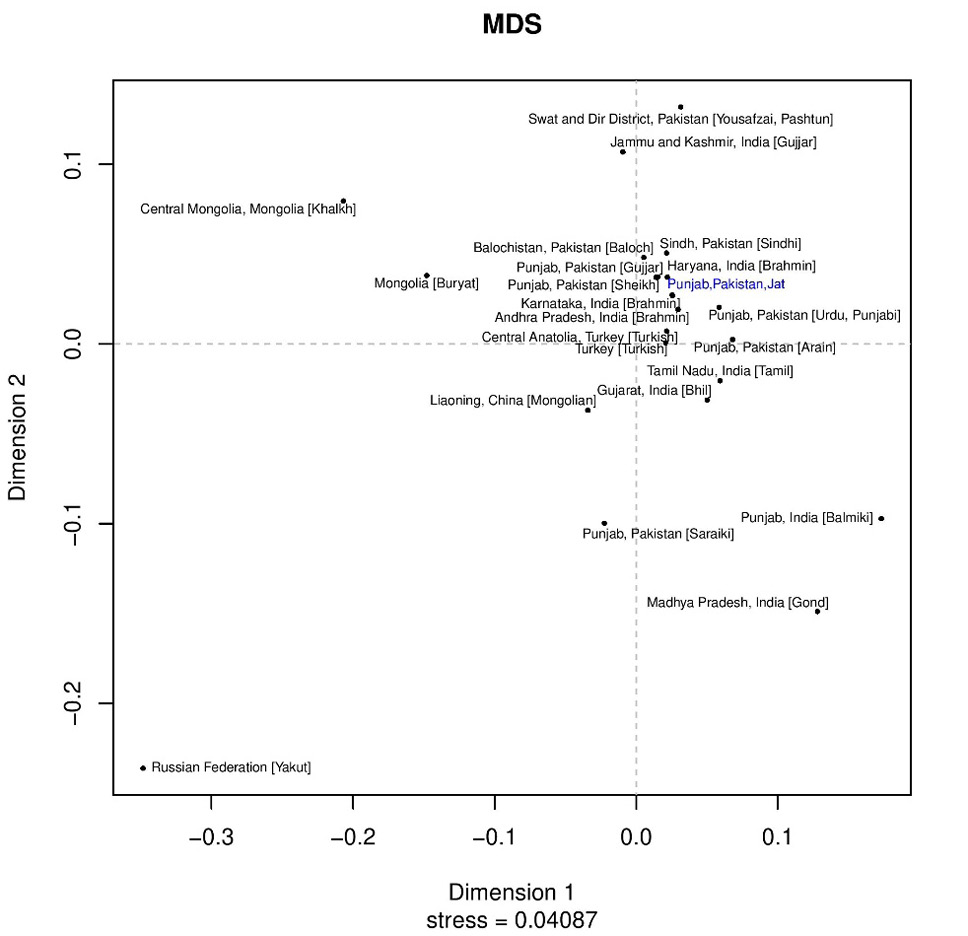
Multidimensional scaling plot (MDS) generated at online YHRD AMOVA tool for Jat population of Pakistan, compared with 22 other populations of the world.
References
- Barbisin, M., Fang, R., O’Shea, C.E., Calandro, L.M., Furtado, M.R., and Shewale, J.G., 2009. J. Forensic Sci., 54: 305-319. https://doi.org/10.1111/j.1556-4029.2008.00951.x[CrossRef]
- Liu, K., and Muse, S.V., 2005. Bioinformatics, 21: 2128-2129. https://doi.org/10.1093/bioinformatics/bti282[CrossRef]
- Mahal, D.G., and Matsoukas, I.G., 2017. Front. Genet., 8: 121. https://doi.org/10.3389/fgene.2017.00121[CrossRef]
- Signer, E., Kuenzle, C.C., Thomann, P.E., and Hübscher, U., 1988. Nucl. Acids Res., 16: 7738. https://doi.org/10.1093/nar/16.15.7738[CrossRef]
- Singh, M., Sarkar, A., and Nandineni, M.R., 2018. Sci. Rep., 8: 1-7. https://doi.org/10.1038/s41598-018-33714-2[CrossRef]
- Tereba, A., 1999. Profiles DNA, 2: 14-16. https://doi.org/10.1016/S0958-2118(99)90163-5[CrossRef]
- Willuweit, S., Roewer, L., and International Forensic Y Chromosome User Group, 2007. Forensic Sci. Int. Genet., 1: 83-87. https://doi.org/10.1016/j.fsigen.2007.01.017[CrossRef]
Supplementary material
Cited by 1 article
In journals published by ResearchersLinks.
Services
Article usage statistics
Loading…