
Genetic variability and structure in Octopus minor was investigated from 154 individuals using mtDNA ATPase 6, sampled from Dalian, Dongshan, Nantong, Qingdao, Shanghai, Wenzhou, Xiamen, and Zhoushan China. Based on 672 bp fragment of Mitochondrial DNA subunit ATPase 6, thirty haplotypes and 140 polymorphic sites were noted, whereas (0.740, 0.048) high and low haplotype and nucleotide diversity observed. The data was further tested with AMOVA that validates 91.24% variation among populations and 8.76% within population. Genetic fixation index was also calculated as 0.91243*. The neighbor-joining phylogenetic analysis revealed three lineages. The Dongshan population distinctly has shown separate lineage. The haplotype networking has shown that Hap1 contributed 48.051% and appeared in six populations whereas, Hap6, Hap11, Hap 16 and Hap17 were also shared by some populations, rest of the haplotypes were unique. This study solely provide species specific information on its genetic structure and population variability in Chinese waters.
Short Communication · Volume 51, Issue 1, 21 January 2019 · Open Access
Genetic Structure of Octopus minor (Sasaki, 1920) (Cephalopoda: Octopoda) from Chinese Waters using Mitochondrial ATPase 6 Gene
· · · · ·
Affiliations & Notes ⌄
- 1National Engineering Research Center of Marine Facilities Aquaculture, College of Marine Sciences and Technology, Zhejiang Ocean University, Zhoushan, Zhejiang, PR China 2Center of Excellence in Marine Biology, University of Karachi, Karachi, Pakistan 3Lasbella University of Agriculture, Water and Marine Sciences, Baluchistan, Pakistan , * Corresponding author: nblzmnb@163.com
Article Info ⌄
- Journal:
- Pakistan Journal of Zoology
- Published:
- 21 January 2019

From the article
- ATPase 6 gene was sequenced from 154 individuals of eight populations.
- The haplotype diversity was higher (0.740) whereas nucleotide diversity was lower (0.04845) in the investigated populations of O. minor.
- The details of each population are given in Table I. The high haplotype diversity was observed in Zhoushan following Xiamen, Nantong, Qingdao, Wenzhou, Dongsha, Dalian, and Shanghai, respectively.
- This study would solely provide species specific information on its genetic structure and population variability in Chinese waters.
Selected from the article's own text.
Abstract
Materials and methods
Specimens of Octopus minor were collected from commercial trawl catches from eight different geographical locations, Dalian, Donghsan, Nantong, Qingdao, Shanghai, Wenzhou, Xiamen, and Zhoushan (Supplementary Fig. S1). Samples were preserved following standard procedure at the site, and were transported to the laboratory in 95% ethyl alcohol and placed in refrigerator until further investigation. Total genomic DNA was isolated from muscle tissues , extracted DNA was electrophoresed and concentrated DNA was further diluted with DEPC water to reach working concentration (20ng/ µl) for PCR reactions.
The complete ATPase 6 gene was amplified by PCR, using primers ATP6F2 5´ACATGCCACAATTATCACCA 3´ andATP6R 5´ AGCTTAATAAGAGCGTAACG 3´. The pair of primers were designed from mtDNA gene sequence taken from NCBI accession number AB158363. The PCR mixture consisted of 0.2µM of each primer, 5.0µL of 10XTaq Plus polymerase buffer, 0.2 mM of dNTPs, 2 units of Taq Plus DNA polymerase, and 1 µL of DNA template. The PCR conditions were as follows: denaturation at 94 ◦C for 5 min, 35 cycles at 94 ◦C for 30 s, annealing at 55 ◦C for 30 s, and extension at 72 ◦C for 30s, and the final extension at 72 ◦C for 10 min. The PCR products were electrophoresed on a 1.5% agarose gel to check integrity, and visualized, using Molecular Imager Gel Doc XR system (Bio- Rad USA). The PCR products were sequenced, using ABI 3730 automated sequencer for which the same PCR primers were used. The DNA sequences were aligned using CLUSTALW and sequence composition was estimated using software MEGA 6 . Analysis of genetic differentiation, AMOVA, molecular diversity indices, genetic differentiation values and Fst values were determined with software ARLEQUIN . Haplotype and nucleotide diversity was estimated, using DnaSP . The neighbor joining tree was constructed to evaluate genetic relationship between the populations using MEGA 6 . The haplotype networking was created, using NETWORK software version 5.0.0.1 .
Results
ATPase 6 gene was sequenced from 154 individuals of eight populations. Only 672 bp fragment of ATPase 6 of O. minor was used for data analyses. The average nucleotide composition of T, C, A, and G were 42.5%, 18.4%, 31.9% and 7.2%, respectively. A total of 30 haplotypes, 140 polymorphic sites were identified based on 154 individuals from eight populations. The haplotype diversity was higher (0.740) whereas nucleotide diversity was lower (0.04845) in the investigated populations of O. minor. The average number of nucleotide variations, “K” was 32.028. The details of each population are given in Table I. The high haplotype diversity was observed in Zhoushan following Xiamen, Nantong, Qingdao, Wenzhou, Dongsha, Dalian, and Shanghai, respectively.
Table I.- Nucleotide and haplotype diversities for different populations.
| Location | n | P. sites | Hap. (h) | Hap. div.(Hd) | Nucl. div.(π) | Avg. diff. (K) |
| DL | 18 | 2 | 2 | 0.209 | 0.00063 | 0.418 |
| DS | 24 | 109 | 4 | 0.239 | 0.01386 | 9.159 |
| NT | 28 | 7 | 7 | 0.576 | 0.00121 | 0.798 |
| Q | 16 | 15 | 5 | 0.450 | 0.00286 | 1.875 |
| SH | 10 | 0 | 1 | 0.00000 | 0.00000 | 0.000 |
| W | 18 | 1 | 2 | 0.424 | 0.00064 | 0.424 |
| X | 28 | 25 | 12 | 0.78307 | 0.00947 | 6.256 |
| Z | 12 | 7 | 7 | 0.86364 | 0.00309 | 2.045 |
n, sample number; P. sites, number of polymorphic sites; Hap., Haplotype; Hap. div., Haplotype diversity; Nucl. div., Nucleotide diversity; Avg. diff., average number of differences; DL, Dalian; DS, Dongshan; NT, Nantong; Q, Qingdao; SH, Shanghai; W, Wenzhou; X, Xiamen; Z, Zhoushan.
The AMOVA test validates 8.76% within population and 91.24% among populations (Supplementary Table I). The population structure illustrated high and significant FST value of 0.912* at P < 0.05. The Tajima’s D test defined significant negative values ranging (-0.684 - -2.728). The detailed description of Tajima’s D, Fu’s Fs, corresponding P values and mismatch distribution parameter estimates are shown in Supplementary Table II, whereas the pairwise FST between populations of O. minor are described in Table II. The phylogenetic analysis revealed three lineages. The lineage one clustered five populations. Second lineage included the Xiamen and Wenzhou populations while Lineage three distinctly distinguishes Dongshan population (Fig. 1).
Table II.- Pairwise FST between eight populations of O. minor.
| DL | DS | NT | Q | SH | W | X | Z | |
| DL | 0.000 | |||||||
| DS | 0.947 | 0.000 | ||||||
| NT | 0.055 | 0.955 | 0.000 | |||||
| Q | 0.014 | 0.938 | 0.036 | 0.000 | ||||
| SH | 0.012 | 0.938 | 0.004 | -0.032 | 0.000 | |||
| W | 0.975 | 0.949 | 0.963 | 0.921 | 0.921 | 0.000 | ||
| X | 0.092 | 0.927 | 0.120 | 0.079 | 0.079 | 0.739 | 0.000 | |
| Z | 0.067 | 0.9322 | 0.0823 | 0.015 | 0.021 | 0.925 | 0.078 | 0.000 |
For abbreviations, see Table I.
The phylogenetic relationship illustrated, using neighbor-joining (NJ) method which exhibit three lineages. The lineage one is extended group that describes populations from six location. However Dongshan population was distinctly different from rest of populations. The Lineage II is supported with a bootstrap value of 64% whereas the Lineage III supported with a bootstrap value of 100%. Lineage II included the individuals of Xiamen and Wenzhou populations, and Lineage III distinctly describes the Donghshan population (Fig. 2).
The haplotype network (Fig. 2) revealed that haplotype 1 (Hap1) contributed 48.051% of total O. minor individuals and appeared in six populations. Hap6 and Hap 11 shared by Nantong and Xiamen populations, whereas the Hap16 and Hap 17 was shared by Wenzhou and individuals of Xiamen population. Rest of the haplotypes are unique in their respective populations.
Discussion
The genetic structure and relationship of O. minor populations in the present study was analyzed using ATPase 6 gene which is essential for successful recovery and long-term conservation strategies of important cephalopod species. The genetic diversity ensures evolutionary potential and even a small decrease or increase in genetic diversity causes significant threat to wild populations inhabiting variable environment . Therefore, such studies play major role in collection information on the conservation genetics of a species ; .
In this investigation, one hundred fifty four individuals from eight different localities of Chinese coastal waters were investigated. The results revealed 140 polymorphic sites, 30 haplotypes and high Hd values and low nucleotide diversity. AMOVA analysis of ATPase 6 sequences revealed genetic variation in O. minor. These variations are similar to findings reported by earlier workers in a number of Cephalopod species ; ; ; .
Wright (1978) described relationship between FST values and degree of differentiation: FST 0-0.05 denotes little differentiation among populations; FST 0.05-0.15 indicate moderate differentiation, whereas FST 0.15-0.25 means high distinction and above 0.25 demonstrate very high differentiation .
The pairwise FST values shows highest FST value in Wenzhou population then Donghsan population, other populations have comparatively lower FST values. The phylogenetic tree and pairwise distance results may suggest a sub-species of Donghsan population. The morphological analysis also suspected this population as a sub-species.
The genetic diversity among populations or marine organisms influenced by certain factors, such as geographic segregation, habitat differences, and human activities ; . The lifestyle differences make it hard to carry out suitable gene exchange; as a result, variations revealed different geographical clades. Such general rules are also applied to target species because long armed octopus O. minor also has meager dispersal potential and it is adapted to benthic environment. Adult O. minor are sessile and juveniles develop directly, benthic eggs without a planktonic larval stage , 1991). Therefore, O. minor fishery require special care for exploitation and management of future resource along the coast of China. Lü et al. (2013) reported that long armed octopus fishery needs a special care for exploitation when many populations involved over a wide range of geographic distance.
This study would solely provide species specific information on its genetic structure and population variability in Chinese waters.
Acknowledgement
This research was supported by the National Natural Science Foundation of China (NSFC) (41576131) and Talented Yong Scientist Program (PAK-15-012).
Supplementary material
There is supplementary material associated with this article. Access the material online at: http://dx.doi.org/10.17582/journal.pjz/2019.51.1.sc5
Statement of conflict of interest
Authors declared no conflict of interest.
Figures
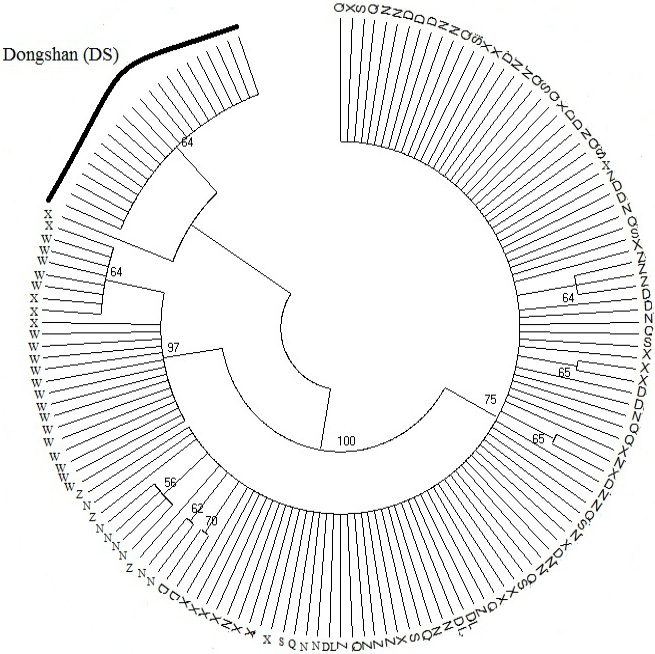
Neighbor joining tree from eight populations of O. minor. The abbreviations in tree are given as: DL, Dalian; DS, Dongshan; N, Nantong; Q, Qingdao; S, Shanghai; X, Xiamen; W, Wenzhou; Z, Zhoushan.
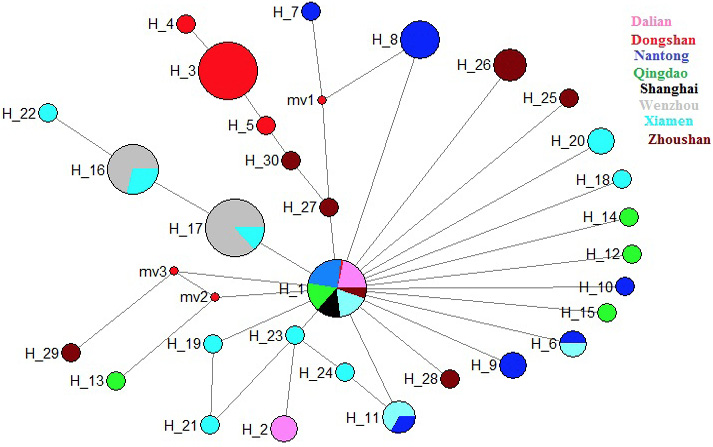
Median joining networks for the ATPase 6 haplotypes in O. minor populations.
References
- Bandelt, H.J., Forster, P. and Rohl, A., 1999. Mol. Biol. Evol., 16: 37-48.
- Chang, K.M., Li, H., Lü, Z.M. and Chi, C.F., 2010. Oceanol. Limnol. Sin., 41: 307-314.
- Crandall, K.A., Posada, D. and Vasco, D., 1999. Anim .Conserv., 2: 317-319. https://doi.org/10.1111/j.1469-1795.1999.tb00078.x[CrossRef]
- Daniels, S.R., Stewart, B.A. and Cook, P.A., 2002. Hydrobiologia, 468: 171-179. https://doi.org/10.1023/A:1015203909091[CrossRef]
- Dong, Z.Z., 1988. Fauna sinica: Phylum Mollusca (Class Cephalopoda). Science Press, Beijing, China.
- Dong, Z.Z., 1991. Biology of the economic species of cephalopods in the World Oceans. Shandong Science and Technology Pres, Jinan, China.
- Divya, P.R., Gopalakrishnan, A., Basheer, V.S., Raja Swaminathan, Mohitha, C., Linu J., Kumar R., Manoj, P. and Jena, J.K., 2015. Mitochond. DNA, 26: 189-194.
- Excoffier, L. and Lischer, H.E.L., 2010. Mol. Ecol. Res., 10: 564-567. https://doi.org/10.1111/j.1755-0998.2010.02847.x[CrossRef]
- Guo, B.Y., Zhou, C., Lu, ZM, Li, J.J. and Wu, C.W., 2011. Oceanol. Limnol. Sin., 42: 868-873.
- Gao, X., Zheng, X., Bo, Q. and Li, Q., 2016. Biochem. Syst. Ecol., 66: 129-136. https://doi.org/10.1016/j.bse.2016.03.014[CrossRef]
- Gyllensten, U.B., 1985. J. Fish Biol., 26: 691-699. https://doi.org/10.1111/j.1095-8649.1985.tb04309.x[CrossRef]
- Han, Z.Q., Gao, T.X., Yanagimoto, T. and Sakurai, Y., 2008. Fish. Sci., 74: 770-780. https://doi.org/10.1111/j.1444-2906.2008.01588.x[CrossRef]
- Hedrick, P.W., 1999. Evolution, 53: 313-318. https://doi.org/10.2307/2640768[CrossRef]
- Hutchings, J.A., 2000. Nature, 406: 882-885. https://doi.org/10.1038/35022565[CrossRef]
- Kang, J.H., Kim, Y.K., Park, J.Y., An, C.M. and Jun, J.C., 2012. Mol. Biol. Rep., 39: 8277-8286. https://doi.org/10.1007/s11033-011-1058-x[CrossRef]
- Librado, P. and Rozas, J., 2009. Bioinformatics, 25: 1451-1452. https://doi.org/10.1093/bioinformatics/btp187[CrossRef]
- Li, H.M., Lü, Z.M., Liu, L.Q., Wu, C.W. and Zhang, J.S., 2013. Ocean Limnosin.,44: 626-631.
- Liu, J.X., Gao, T.X., Wu, S.F. and Zhang, Y.P., 2007. Mol. Ecol., 16: 275-288. https://doi.org/10.1111/j.1365-294X.2006.03140.x[CrossRef]
- Liu, Z., Song, N., Yanagimoto, T., Han, Z., Shui, B. and Gao, T., 2017. Pakitan J. Zool., 49: 111-120. http://dx.doi.org/10.17582/journal.pjz/2017.49.1.111.120[CrossRef]
- Lu, C.C., Zhang, X.D. and Lin, X.Z., 2012. In: Proceedings of the 1st Mainland and Taiwan symposium of marine biodiversity studies (eds. M. Lin and C.G. Wang). Ocean Press, Beijing, pp. 76-87.
- Lü, Z.M., Li, H., Wu.,C.W., Fan, Z.J. and Zhang, J.S., 2011. J. Fish. Sci. China, 18: 29-37.
- Lü, Z.M., Liu, L.Q., Li, H., Wu, C.N. and Zhang, J.S., 2013. Biochem. Syst. Ecol., 51: 224-231. https://doi.org/10.1016/j.bse.2013.09.019[CrossRef]
- Okutani, T., Tagawa, M. and Horikawa, H., 1987. Cephalopods from continental shelf and slope around Japan: the intensive research of unexploited fishery resources on continental slopes. Jap. Fish. Res. Cons. Soc., Tokyo, pp. 164-165.
- Ovender, R.J. and Street, R., 2003. Mar. Freshw. Res., 54: 127-137.
- Qian, Y.S., Zheng, X.D., Wang, P. and Li, Q., 2010. Mar. Sci., 34: 14-18.
- Riginos, C. and Victor, B.C., 2001. Proc. R. Soc. London Ser. B., 268: 1931-1936. https://doi.org/10.1098/rspb.2001.1748[CrossRef]
- Shaw, P.W., 2003. Conserv. Genet., 4: 533-535. https://doi.org/10.1023/A:1024729100857[CrossRef]
- Tamura, K., Stecher, G., Peterson, D., Filipski, A. and Kumar, S., 2013. Mol. Biol. Evol., 30: 2725-2729. https://doi.org/10.1093/molbev/mst197[CrossRef]
- Wright, S., 1978. Evolution and the genetics of population, variability within and among natural populations. The University of Chicago Press, Chicago.
- Yang, B., Chen, X.Y. and Yang, J.X., 2008. Zool. Res., 29: 379-385. https://doi.org/10.3724/SP.J.1141.2008.00379[CrossRef]
- Yamamoto, T., 1942. Japan J. Malacol., 12: 9-20.
Supplementary material
Services
Article usage statistics
Loading…