
Aggression in animals is mostly related to the territory protection, competition for resources like water, food, offspring and mating probabilities. It is an antisocial behavior having strong genetic relation. Current study focused mainly on the screening of genetic marker V158M located in COMT gene for its relation to physical aggression in the four domestic bovine species of Pakistan, which are normally less aggressive. Selected animal species were cattle (Bos indicus), buffalo (Bubalus bubalis), sheep (Ovis aries) and goat (Capra hircus). Selected marker V158M is present in exon-8 of COMT gene. Each specie was subjected to blood sampling (n=20 each). DNA was extracted, purified, quantified and amplified through PCR by using specific primer set. Then Sanger’s method of DNA sequencing was used. Multiple sequence alignment demonstrated that sheep and goat were having the wild base Guanine against which the cattle and buffalo depicted the mutant form Adenine. Results of this study illustrated the genetic tendency of large domestic bovines towards aggression and attack, so they should be handled with great caution.
Short Communication · Volume 50, Issue 5, 24 August 2018 · Open Access
Genetic Screening of COMT Gene for Aggression in Domestic Bovines of Pakistan
· · · · ·
Affiliations & Notes ⌄
- 1Institute of Biochemistry and Biotechnology, University of Veterinary and Animal Sciences, Lahore , * Corresponding author: maryam.javed@uvas.edu.pk
Article Info ⌄
- Journal:
- Pakistan Journal of Zoology
- Published:
- 24 August 2018

From the article
- Current study was aimed to characterize the genomic mutation in COMT gene (V158M) as marker for aggression in four Bovid species (cattle, buffalo, sheep and goat).
- In this study, four domestic bovine species were selected to test the genetic tendency for aggression.
- Results of multiple sequence alignment indicated that cattle and buffaloes were carrying AA genotype, which is more linked to higher risk of aggression and sheep and goat are carrying GG and AG genotype with less tendency of aggression (Fig. 2).
- Results of this report are useful in devising useful strategies for animal handling and control by observing their genetic tendencies towards aggression.
Selected from the article's own text.
Abstract
Materials and methods
Taxonomic species for this study were cattle, buffalo, goat and sheep (n=20 each). Animals with greater physical aggression and anger were selected for this study. Blood samples were collected from Outdoor Clinic, University of Veterinary and Animal Sciences, Lahore. Visual signs of aggression (continuous push, paw and dig in the ground, tendency to attack, Hitting, slapping, loud noises and quick, snappy movements) were observed in animals before sampling. Sampling was performed during January and February, 2017. Blood samples were collected from the jugular vein of the animals by considering all ethical measures. DNA extracted and quantified by using standard protocols (.
Table I.- Primer set for V158M amplification through PCR.
| Primer name | Sequence |
| COMT | F: GATGCCCGACGCCACA |
| R: CCCTTCTTCTGCTGCTCACT |
Specific primer set was designed to amplify the region of COMT gene carrying V158M mutation by using Reference sequence-AC_000174.1 (Chromosome#17) (Table I). The purified amplicons were sequenced by using the Sanger’s Chain Termination method (Figs. 1, 2).
DNA sequences were further analyzed for Multiple Alignment (ClustalW) to identify the genetic polymorphism in COMT gene.
Results and discussion
Current study was aimed to characterize the genomic mutation in COMT gene (V158M) as marker for aggression in four Bovid species (cattle, buffalo, sheep and goat). This functional variant has been documented for four fold reduction of COMT enzyme activity resulting in increasing the level of Dopamine. A G/A transition found in codon 108/158 (depending on the used start codon) results in a valine-to-methonine substitution (GenBank accession No. Z26491); Met (108/158) is coded by the low-activity (L allele), whereas Val (108/158) is coded by the high-activity variant (H allele). The COMT L allele has been associated with pronounced violent behavior. This marker has been tested for many traits as cognition, addiction, depression, suicide and aggression tendencies in human ; but no previous reports are available for its genotypic distribution among bovines (although there are some studies on aggression in dogs, rats and hamsters). In this study, four domestic bovine species were selected to test the genetic tendency for aggression. Results of multiple sequence alignment indicated that cattle and buffaloes were carrying AA genotype, which is more linked to higher risk of aggression and sheep and goat are carrying GG and AG genotype with less tendency of aggression (Fig. 2). Presence of Alanine amino acid at position 158 increases the risk of anger and physical assault (Fig. 3). So according to results, cattle and buffalo are more potent to show aggression and should be handled with great caution and care while milking and treatment. In sheep and goat heterozygous and homozygous wild type is found prevalent which makes them less dangerous and aggressive for handling . Results of this report are useful in devising useful strategies for animal handling and control by observing their genetic tendencies towards aggression. This study can further be extended to more animal species to study their temper at genetic level. This will aid in developing safe animal handling practices.
Statement of conflict of interest
The authors declare that there are no competing interests regarding the publication of this paper.
Figures
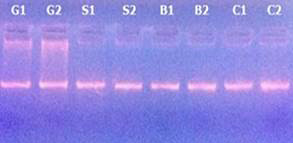
DNA extracted from various bovine species of Pakistan. G1 and 2, goat; S1 and 2, sheep; B1 and 2, buffalo; C1 and 2, cattle.
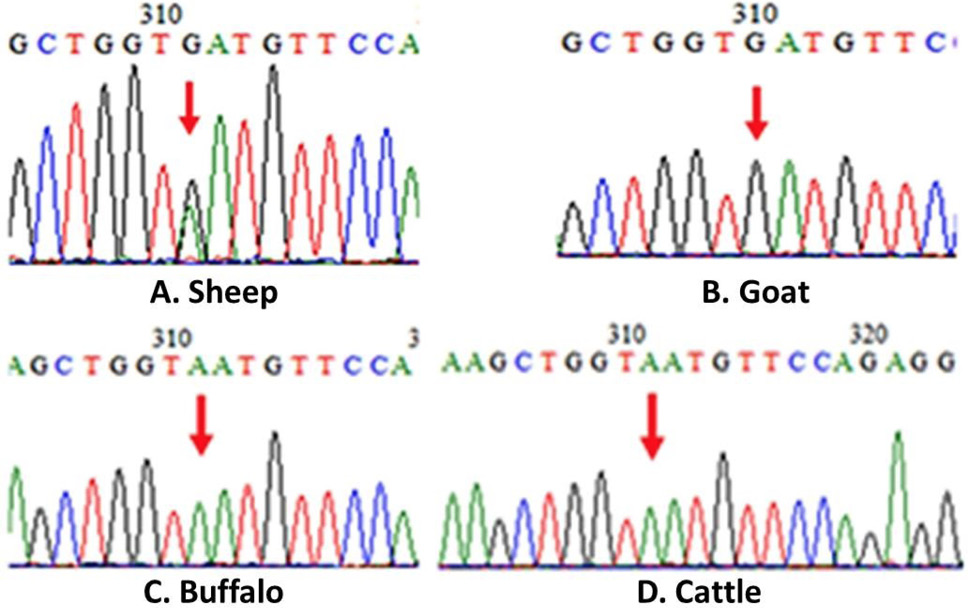
Chromatogram of identified polymorphic site in four bovid species.
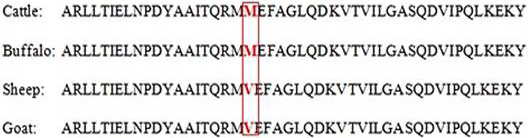
Amino acid substitution in four bovid species.
References
- Akil, M., Kolachana, B.S., Rothmond, D.A., Hyde, T.M., Weinberger, D.R. and Kleinman, J.E., 2003. J. Neurosci., 23: 2008-2013. https://doi.org/10.1523/JNEUROSCI.23-06-02008.2003[CrossRef]
- Andersen, I.L., Bøe, K.E. and Kristiansen, A.L., 1999. Appl. Anim. Behav. Sci., 65: 91-104. https://doi.org/10.1016/S0168-1591(99)00058-1[CrossRef]
- Boe, K.E., Berg, S. and Andersen, I.L., 2006. Appl. Anim. Behav. Sci., 98: 249-259. https://doi.org/10.1016/j.applanim.2005.10.001[CrossRef]
- Buss, D.M., 2006. The murderer next door: Why the mind is designed to kill. Penguin Books, USA, ISBN 9780143037057, pp. 288.
- Clutton-Brock, J., 1999. A natural history of domesticated mammals. Cambridge University Press.
- Gershman, K.A., Sacks, J.J. and Wright, J.C., 1994. Pediatrics, 93: 913-917.
- Grossman, M., Emanuel, B. and Budarf, M., 1992. Genomics, 12: 822-825. https://doi.org/10.1016/0888-7543(92)90316-K[CrossRef]
- Jorgensen, G.H.M., Andersen, I.L. and Bøe, K.E., 2007. Appl. Anim. Behav. Sci., 107: 239-251. https://doi.org/10.1016/j.applanim.2006.10.007[CrossRef]
- Macdonald, D.W., Apps, P.J., Carr, G.M. and Kerby, G., 1987. In: Advances in ethology: Supplements to ethology, Vol. 28. Paul Parey Scientific Publishers, Berlin and Hamburg, West Germany, pp. 66.
- Mannisto, P.T. and Kaakkola, S., 1999. Pharmacol. Rev., 51: 593-628.
- Manzoor, S., Nadeem, A., Babar, M.E., Shehzad, W., Hashmi, A.S., Imran, M., Hussain, T., Wajid, A. and Javed, M., 2017. Pakistan J. Zool., 49: 1-3.
- Potegal, M., Ferris, C., Hebert, M., Meyerhoff, J. and Skaredoff, L., 1996. Neuroscience, 75: 869-880. https://doi.org/10.1016/0306-4522(96)00236-9[CrossRef]
- Weinshilboum, R.M. and Raymond, F.A., 1977. Am. J. med. Genet., 29: 125-135.
Services
Article usage statistics
Loading…