
We analyzed the complete mitochondrial DNA displacement-loop (D-loop) and the cytochrome b (cyt b) gene of ten Pakistani domestic goat breeds (Capra hircus). The sequence analysis showed 209 variable sites in goat breeds and each haplotype was unique. All the haplotypes were rich in A/T content. Analysis of variable sites revealed 178 transitions and 31 transversions. Out of 178 transitions 81 were A↔G and 97 were C↔T. Of the 31 transversions, 2 were heteromorphic transversion G→T/C and T→G/C, one transversion also showed a pattern of transition. The ratio between transitions to transversion was 8.5:1.5. The phylogenetic analyses and sequence divergence (SD) established two major distinct mt-lineages termed as A, B. An A mt-lineage is further branched into three clades A1, A2, A3. This suggested that at least two different strains of wild Capra might have been the source of the modern domestic goats. Phylogenetic analysis of all haplotypes of this research work was performed with some reported haplotypes of Capra hircus and wild goats. Origin of domestication seemed to be from Europe, Asia and Africa. Our haplotypes have close relationship with Cashmiree breed, inner Mangolia and probably have originated from wild Capra aegagrus.
Research Article · Volume 57, Issue 1, 14 January 2025 · Open Access
Genetic Characterization of Pakistani Goat Breeds through Mitochondrial D-Loop and Cytochrome b Gene Analyses
· · · · · · ·
Affiliations & Notes ⌄
- 1Department of Biotechnology, BUITEMS, Quetta, Pakistan. 2The University of Agriculture, Dera Ismail Khan, Pakistan 3Department of Biotechnology, Virtual University of Pakistan, Lahore, Pakistan. 4Department of Molecular Biology, Virtual University of Pakistan, Lahore, Pakistan 5Department of Bioinformatics & Computational Biology, Virtual University of Pakistan, Lahore, Pakistan 6Gomal Centre of Biochemistry and Biotechnology, Gomal University, Dera Ismail Khan, Pakistan. 7Institute of Biologica
Article Info ⌄
- Journal:
- Pakistan Journal of Zoology
- Published:
- 14 January 2025

From the article
- A phylogenetic tree constructed from the 50 haplotypes of Pakistani Goat (Cytochrome b and mtD-loop) (Figs. 1 and 2) showed 2 major clad with branching and rebranching pattern.
- We analyzed the complete mitochondrial DNA Displacement-loop (D-loop) and the Cytochrome b (cyt b) gene of ten Pakistani domestic goat breeds (Capra hircus).
- The sequence analysis showed 209 variable sites in goat breeds and each haplotype was unique.
- From the results it has been concluded that Pakistani goats are purely domestic and has a close relation with Capra aegagrus and Capra sibrica.
Selected from the article's own text.
Abstract
Introduction
Small ruminants are very important part of livestock production and agricultural systems worldwide particularly in the semi-arid and arid regions. Goats play very vital role in the livelihood of rural peoples and contribute significantly to poverty alleviation and food security among the poor peoples and farmers in many developing countries of Africa and Asia . According to estimates (FAO, 2014) of the total population of 1.0 billion, more than 590 breeds of goats have been characterized on the basis of genetic diversity Asia in this regard shares more than 58% population of global goat possessing significant genetic diversity. 31% of goat breeds existing globally are from the region of Asia and these breeds of goats have different beneficial properties like ability to produce animal protein by converting the low quality feedstuff, disease resistance and adaptation to extreme environmental conditions . Mitochondrial DNA (mtDNA) of higher animals is a double stranded, closed circular molecule of 16-23 kb, and is regarded as one of the key regulators of metabolism and apoptosis . Mitochondria are the only organelles outside nucleus containing genes. Due to its unique properties of having low molecular weight, stability, simple structure, and maternal inheritance, mitochondria best suited for studying animal origins, evolutionary process, and differentiation . mtDNA of most mammals possess 37 genes and a non-coding sequence of variable length, called D-loop or control region. The 37 genes contain 22 transfer RNA (tRNA) genes, 13 protein-coding genes, and two ribosomal RNA (rRNA) genes. The 13 protein- coding genes are cytochrome c oxidase subunits, cytochrome b (Cytb), ATP synthase subunits ATPase6 and ATPase8, and seven subunits of NADH dehydrogenase. The two rRNA genes are 12s rRNA and 16s rRNA. D-loop region and Mitochondrial Cyt-b gene have provided significant insights into domestication, past migration history and characterization of various phylogenetic relations ; . Cytochrome b gene of mitochondria has a moderate evolutionary rate and a clear evolutionary pattern that makes it suitable for the studies regarding phylogenetic evolution at both inter and intra-species levels . Exploration of genetic diversity at molecular level is very useful counterpart for the evaluation of production systems and phenotypes. It provides valuable information about breed history, guides about the development of breeds and also helps to take decision about conservation ; . Molecular data can be particularly helpful in identifying potential conservation gaps when knowledge about phenotype is inadequate ; . During this study, it was aimed at molecularly characterizing Pakistani goat breeds so as to identify novel SNPs of in mitochondrial D- loop and cytochrome b region, to determine the specie differences of Pakistani goat and to study the evolutionary characterization of Pakistani goat breeds.
Materials and Methods
Breeds selection
Ten different breeds of goats with particular phenotypic features (Table I) throughout Pakistan were selected from Government livestock farms and breeding tracts and their blood samples were collected in 15 ml tubes containing EDTA.
Amplification, purification and DNA sequencing
DNA was extracted by using organic method . For a total of 2622bp region, starting from Cytochrome b and ending at D-loop, including the start 85bp of mitochondria, four sets of
Table I. Sampling areas of different goat breeds.
| S. No | Breed | Sample size | Location. | Province |
| 1 | Barbari | 05 | Baram baran Sibi | Balochistan |
| 2 | Beetal | 05 | Small Ruminant Patoki | Punjab |
| 3 | Pahari hairy | 05 | Quetta | Balochistan |
| 4 | Kamori | 05 | Kamori goat farm, Khuda Abad | Sindh |
| 5 | Damani | 05 | D.I Khan Near Gomal University | Khyber Pakhtunkhwa |
| 6 | Khurasani | 05 | Swat valley | Khyber Pakhtunkhwa |
| 7 | L.hairy | 05 | BLPRI, Kherimurat, Attok | Khyber Pakhtunkhwa |
| 8 | Teddy | 05 | Chak Katora Hasil Pur | Punjab |
| 9 | Lehri | 05 | Mithri bolan/Village Aziz Raisani | Balochistan |
| 10 | Nachi | 05 | Rakh Khairwala(Layyah) | Punjab |
Table II. Sequence of primers used for amplification of 2622 bp region of mitochondrial DNA, starting from Cytochrome b and ending at D-loop, including the start 85 bp of mitochondria.
| Set of primers | Sequence of primers 5`→3` | Annealing temp | Product size (bP) |
| Set 1 | F: CCAATGATATGAAAAACCATCG R: TCTTAGGCGCCATGCTACTA | 57 oC | 752 |
| Set 2 | F: ACAGGAATTCCATCAGACACAG R: AACCAGAAAAGGAGAATAGCCA | 57 oC | 575 |
| Set 3 | F: AAGCCATAGCCTCACTATCAGC R: ACATCTGGTTCTTTCTTCAGG | 50 oC | 830 |
| Set 4 | F: GATCACGAGCTTGTTGACCA R: TAAACACATAGGTTTGGTCCCAG | 50 oC | 659 |
primers (Table II) were designed using primer 3 software in overlapping manner . For PCR reaction to perform, 150-200 ng genomic DNA, 240 µM of each dNTP, 1 unit of Taq DNA polymerase, 4.5 pmol of each primer and 1x Taq reaction buffer were used in 25 µL reaction volume. The reaction was carried out through 35 cycles that consisted of denaturation at 95°C for 30 second, annealing at 57/50°C for 35 sec and extension at 72°C for 30 sec. During the first cycle, denaturation was done at 95°C for 5 min while the final extension was done at 72°C for 10 min. Gel electrophoresis of the PCR product was done on 1.5% agarose gel containing gel red for visualization. The amplified products were processed using ethanol precipitation method and bidirectionally sequenced through direct Sanger method .
Sequence analysis and polymorphism detection
The sequences were blast against reference sequence by using Chromas software version 2.2.10 . Single nucleotide polymorphic sites were detected from aligned sequences. Any change in the DNA sequence was confirmed by sequencing both sense and antisense strands. Analysis of the sequences was done with the help of appropriate software. Phylogenetic tree was prepared by using Mega 3.1 .
Results
This study, focused on molecularly characterizing Pakistani goat breeds by identify SNPs in mitochondrial D- loop and Cytochrome b region, determining the specie differences of Pakistani goat and analyzing evolutionary characterization of Pakistani goat breeds. Cytochrome b and D-loop region lie in 14151-15290bp and 15429- 16640bp, respectively. A total of 2622bp region was selected for sequencing that consisted of 138bp section lying between cytochrome b and D- loop, the region from 14103 to16640bp and 85bp section tRNA post D-loop. Two hundred and nine variable sites were observed. Haplotype diversity showed each haplotype was unique. All the haplotypes were rich in A/T content (Table II). The variable sites revealed 178 transitions and 31 transversions (Supplementary Table I). Of 178 transitions, 81 were A↔G and 97 were C↔T (Supplementary Table I). Of the total 31 transversions, 02 were heteromorphic transversions G→T/C and T→G/C (Supplementary Table I). One transversion also showed a pattern of transition. The ratio between transition to transversion was 8.5:1.5.
A phylogenetic tree constructed from the 50 haplotypes of Pakistani Goat (Cytochrome b and mtD-loop) (Figs. 1 and 2) showed 2 major clad with branching and rebranching pattern. The two maternal lineages were A and B. Lineage A had three mini clades A1, A2, A3. A comparison of haplotypes of the present study with previously reported haplotypes showed that (Fig. 3) that one haplotype seemed to be evolved from Europe and others from India and Africa. This topology was further confirmed by constructing Parsimony tree (Fig. 3). Neighbor joining tree showed many nodes and branches in phylogenetic tree (Fig. 1). This type of distribution indicated the migration of animals for trade purpose and their DNA shuffling due to breeding between different breeds. NJ Phylogenetic tree (Fig. 1) and maximum parsimony tree of goat (Fig. 3) showed intermingled results, no breed differentiation. Domestic goat had very close relation with wild Capra aegagrus. There were 41 insertions and 9 deletions observed in goat with reference to sheep (AF010406.1).
Discussion
The present study was planned to explore D-loop and cytochrome b of Pakistani goat breeds for better understanding the determination of genetic diversity and breeds/species differentiation, and the future plan of breed selection and conservation accordingly. The haplotypes combined region of cytochrome b and D-loop were unique. The existence of mutations in cytochrome b were highly associated with D-loop region. There were 209 variable sites found in a 1190bp sequence of Cyt b gene, much higher than what was reported previously . Neighbour joining phylogenetic tree showed domestic goat with at least two maternal lineages, A and B. Teddy breed came at the bottom of A lineage. Some other breeds like Kamori, Beetal, Pahary hairy and Damani (10 haplotypes) were also included in lineage A. however other group B has all 10 breeds (40 haplotypes). Earlier studies on mtDNA control region of 30 Pakistani domestic goats had reported 22 were sequenced. Twenty-two new haplotypes with two distinct clusters in mt-lineage A, into A1 and A2 . Similarly, McNulty et al. (2004) reported two types of maternal origins from lineage A and lineage B in Chinese goats ; . The findings of the present study did agree with previous reports in terms of haplogrouping. Wang et al. (2008) studied 107 entities, belonging to 7 breeds of Chinese goat and founded haplogroup C group in the inner Mongolia and Taihang, and haplogroup D in breeds of inner Mongolia, Taihang, Jining . On analyzing 6 subpopulations of goats, Zhao et al. (2011) observed 21 insertion mutations and 29 transversions mutation in the D-loop of mitochondria, showing Cyt b to be more conserved compared to non-coding region of D-loop . This study, on the basis of phylogenetic trees, showed that breeds were intermixed, no clear significant difference was found between breeds, most probably because of migration flow and gene flow, climatic changes and hybridization pattern. To understand the origin of goat breeds, different haplotypes reported globally were compared haplotypes of the present findings. The phylogenetic trees revealed that one haplotype originated from Europe while the 2nd cluster had close association with breeds of India and Namibia. The main reason behind this association could be the migration of animals for trade purposes and their DNA shuffling due to breeding between different breeds accordingly. Studies showed that the domestic goat (C. hircus), the bezoar (Capra aegagrus), and the markhor (C. falconeri) belong to one clade, plausibly because of introgression between ancestral taxa before colonization to Europe and East Africa ; . Mitochondrial and nuclear DNA analysis revealed that domestic goat Capra hircus originated and domesticated from the bezoar Capra aegagrus ; ; . Phylogenetic tree showed that Capra hircus and new haplotypes of the present study were very close to domestic goat, strong association with haplotype of Cashmeree goat and bezoar Capra aegagrus. The findings of this work hence, support the previous reports but still needs to compare molecularly with Pakistani sheep breeds to have better understanding for conservation, adaptability to heat stress conditions and commercialization.
Conclusion
We analyzed the complete mitochondrial DNA Displacement-loop (D-loop) and the Cytochrome b (cyt b) gene of ten Pakistani domestic goat breeds (Capra hircus). The sequence analysis showed 209 variable sites in goat breeds and each haplotype was unique. All the haplotypes were rich in A/T content. Analysis of variable sites revealed 178 transitions and 31 transversions. From the results it has been concluded that Pakistani goats are purely domestic and has a close relation with Capra aegagrus and Capra sibrica.
Acknowledgements
The authors are grateful to Livestock and Dairy Development Departments of the Punjab, Sindh, Khyber Pakhtunkhwa and Balochistan for their support in samples collection, Dr. Farooq Sabar from the Centre for Applied Molecular Biology University of the Punjab, Lahore, Pakistan and Dr. Ahmad Nawaz Khosa from Lasbela University of Agriculture, Water & Marine Sciences, Uthal, Balochistan is acknowledged for their kind cooperation.
Funding
This work was supported by HEC funded project titled” Genetic Diversity of Pakistani Sheep and Goat Breeds by Analysis of Mitochondrial D- Loop”. (NRPU-HEC-20-872).
IRB approval and ethical approval
Current study was approved by Ethical committee of Virtual University ERB (vide letter no. 215/mb/vu dated 09/02/2021).
Supplementary material
There is supplementary material associated with this article. Access the material online at: https://dx.doi.org/10.17582/journal.pjz/20230424060425
Statement of conflict of interest
The authors have declared no conflict of interest.
Figures
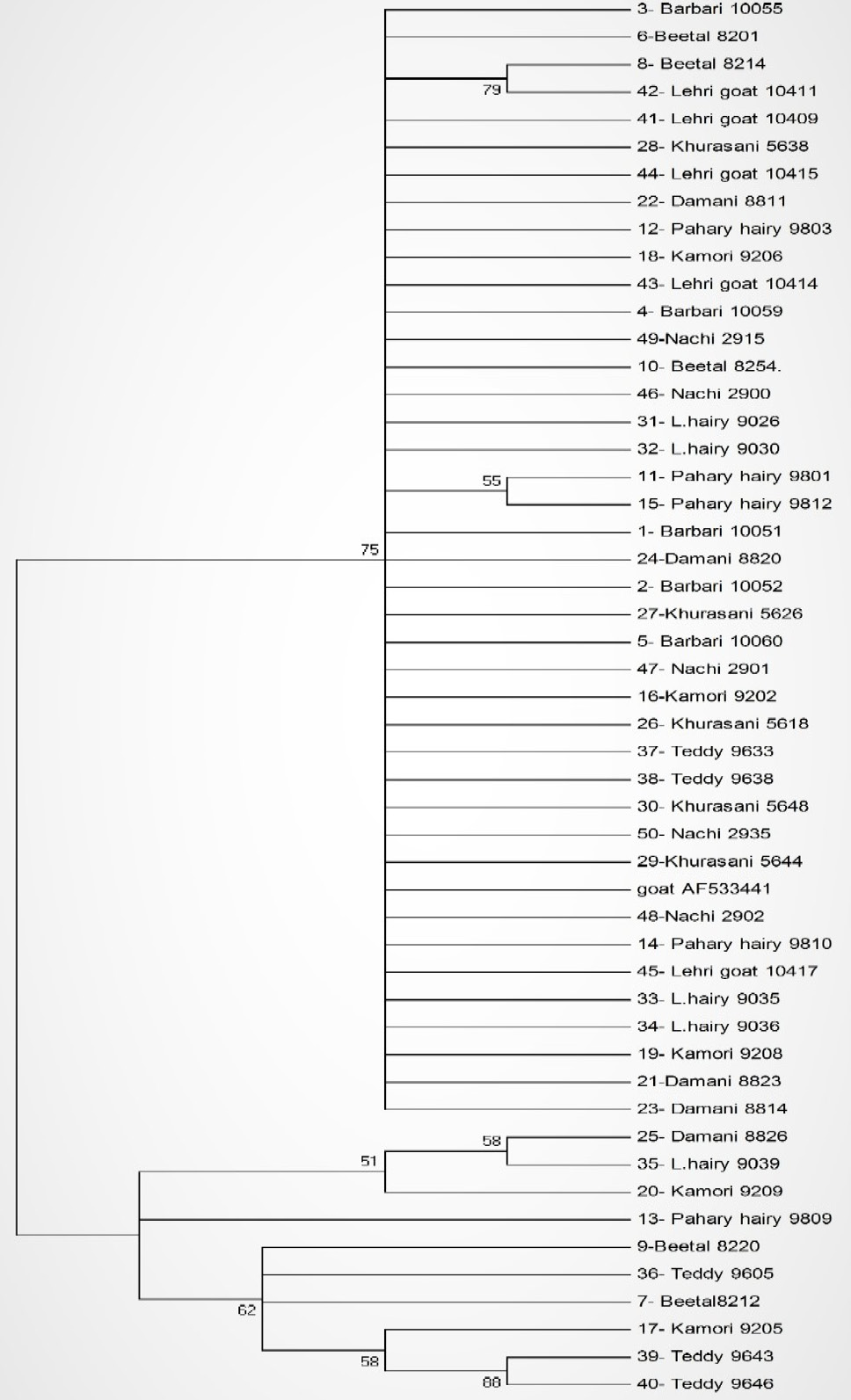
Neighbour phylogenetic tree (Mega 4.1, Goat).
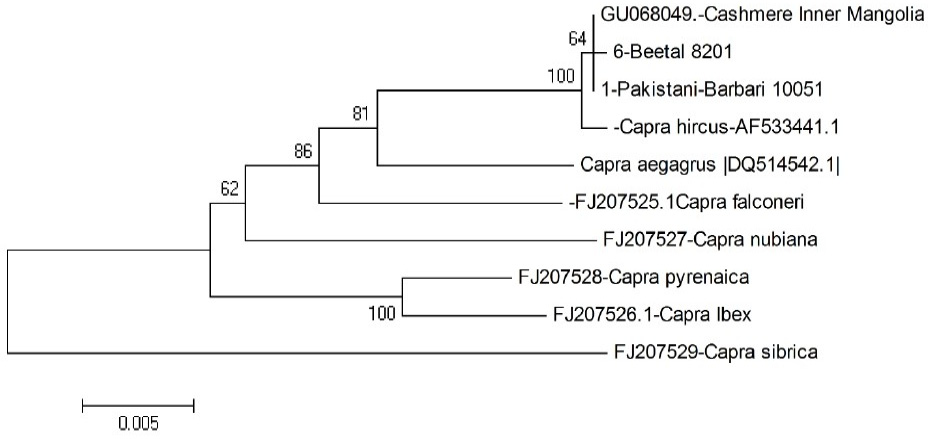
Comparison of haplotypes of goat in this research work with Capra family.
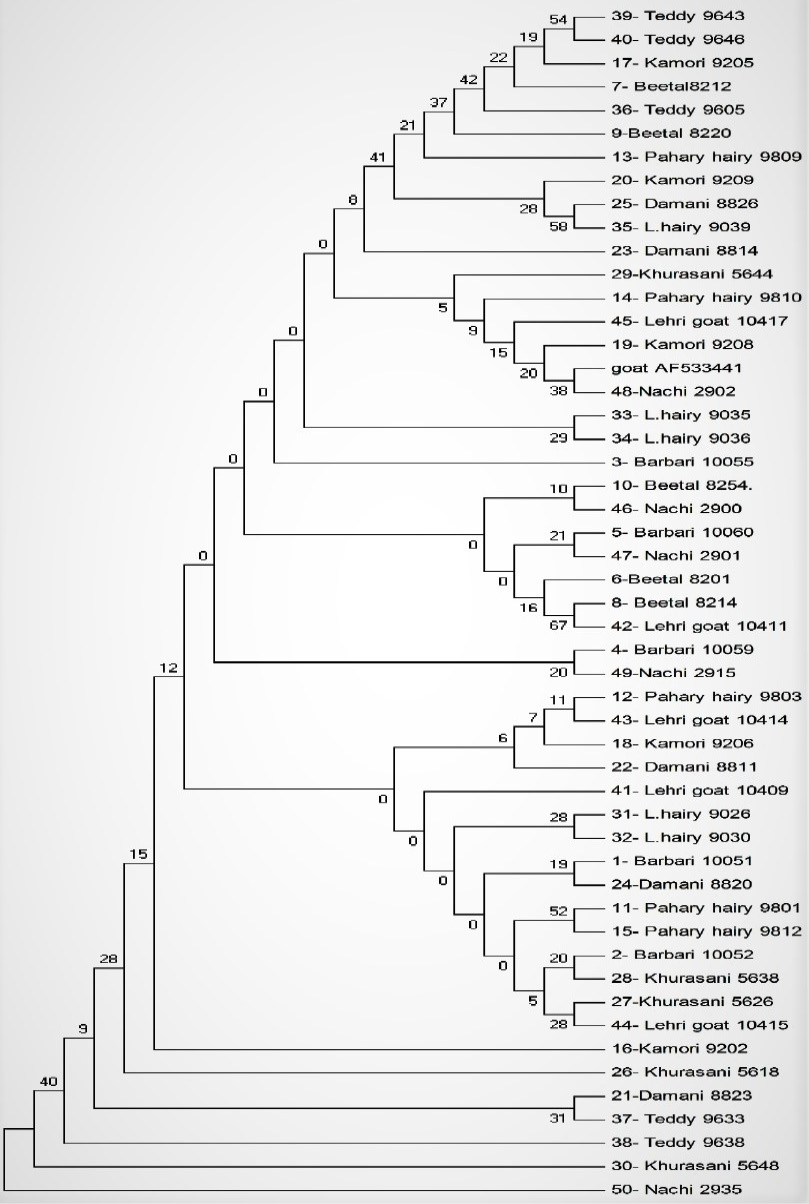
Maximum parsimony tree (Goat breeds Mega 4.1 goat).
References
- Ahmed, S., Grobler, P., Madisha, T. and Kotze, A., 2017. Mitochondrial D-loop sequences reveal a mixture of endemism and immigration in Egyptian goat populations. Mitochondrial DNA A DNA Mapping, Seq. Anal., 28: 711-716. https://doi.org/10.3109/24701394.2016.1174225[CrossRef]
- Ajmone-Marsan, P., Colli, L., Han, J.L., Achilli, A., Lancioni, H., Joost, S., Crepaldi, P., Pilla, F., Stella, A., Taberlet, P., Boettcher, P., Negrini, R. and Lenstra, J.A., 2014. The characterization of goat genetic diversity: Towards a genomic approach. Small Rumin. Res., 121: 58-72. https://doi.org/10.1016/j.smallrumres.2014.06.010[CrossRef]
- Chen, S., Fan, B., Liu, B., Yu, M., Zhao, S., Zhu, M., Xiong, T. and Li, K., 2006. Genetic variations of 13 indigenous Chinese goat breeds based on cytochrome b gene sequences. Biochem. Genet., 44: 87–97. https://doi.org/10.1007/s10528-006-9013-6[CrossRef]
- Chen, S.Y., Duan, Z.Y., Sha, T., Xiangyu, J., Wu, S.F. and Zhang, Y.P., 2006. Origin, genetic diversity, and population structure of Chinese domestic sheep. Gene, 376: 216-223. https://doi.org/10.1016/j.gene.2006.03.009[CrossRef]
- Diwedi, J., Singh, A.W., Ahlawat, S., Sharma, R., Arora, R., Sharma, H., Raja, K.N., Verma, N.K. and Tantia, M.S., 2020. Comprehensive analysis of mitochondrial DNA based genetic diversity in Indian goats. Gene, 756: 144910. https://doi.org/10.1016/j.gene.2020.144910[CrossRef]
- Dixit, S.P., Verma, N.K., Aggarwal, R.A.K., Vyas, M.K., Rana, J., Sharma, A., Tyagi, P., Arya, P. and Ulmek, B.R., 2010. Genetic diversity and relationship among southern Indian goat breeds based on microsatellite markers. Small Rumin. Res., 91: 153-159. https://doi.org/10.1016/j.smallrumres.2010.02.015[CrossRef]
- FAO, 2014. International Dairy Federation, International Farm Comparison Network. World mapping of animal feeding systems in the dairy sector. Available from: http://www.fao.org/publications/card/en/c/3fe753e29f1f4397acde2bd25afb95b7/
- Goldstein, D.B. and Pollock, D.D., 1997. Launching microsatellites: A review of mutation processes and methods of phylogenetic inference. J. Hered., 88: 335–342. https://doi.org/10.1093/oxfordjournals.jhered.a023114[CrossRef]
- Hoffmann, I., 2010. Climate change and the characterization, breeding and conservation of animal genetic resources. Anim. Genet., 41: 32-46. https://doi.org/10.1111/j.1365-2052.2010.02043.x[CrossRef]
- Kamalakkannan, R., Jose, J., Thomas, S., Prabhu, V.R. and Nagarajan, M., 2018. Genetic diversity and maternal lineages of south Indian goats. Mol. Biol. Rep., 45: 2741–2748. https://doi.org/10.1007/s11033-018-4322-5[CrossRef]
- Kumar, S., Tamura, K. and Nei, M., 2004. MEGA3: Integrated software for molecular evolutionary genetics analysis and sequence alignment. Brief. Bioinform., 5: 150–163. https://doi.org/10.1093/bib/5.2.150[CrossRef]
- Leme, G.M., Coutinho, I.D., Creste, S., Hojo, O., Carneiro, R.L., Bolzani, V.D.S. and Cavalheiro, A.J., 2014. HPLC-DAD method for metabolic fingerprinting of the phenotyping of sugarcane genotypes. Anal. Methods, 6. https://doi.org/10.1039/C4AY01750A[CrossRef]
- Lestari, D.A., Purbowati, E., Sutopo, S. and Kurnianto, E., 2018. Amino acid sequence based on Cytochrome b gene in Kejobong goat and its genetic relationships among several local goats in Asia. Vet. World, 11: 1196-1202. https://doi.org/10.14202/vetworld.2018.1196-1202[CrossRef]
- MacHugh, D.E. and Bradley, D.G., 2001. Livestock genetic origins: Goats buck the trend. Proc. natl. Acad. Sci. U.S.A., https://doi.org/10.1073/pnas.111163198[CrossRef]
- McNulty, S.L., Mole, B.M., Dailidiene, D., Segal, I., Ally, R., Mistry, R., Secka, O., Adegbola, R.A., Thomas, J.E., Lenarcic, E.M., Peek, R.M., Berg, D.E. and Forsyth, M.H., 2004. Novel 180- and 480-base-pair insertions in African and African-American strains of Helicobacter pylori. J. clin. Microbiol., 42: https://doi.org/10.1128/JCM.42.12.5658-5663.2004[CrossRef]
- Oetting, W.S. and King, R.A., 1999. Molecular basis of albinism: Mutations and polymorphisms of pigmentation genes associated with albinism. Hum. Mutat., 13: 99-115. https://doi.org/10.1002/(SICI)1098-1004(1999)13:2<99::AID-HUMU2>3.0.CO;2-C[CrossRef]
- Pidancier, N., Jordan, S., Luikart, G. and Taberlet, P., 2006. Evolutionary history of the genus Capra (Mammalia, Artiodactyla): Discordance between mitochondrial DNA and Y-chromosome phylogenies. Mol. Phylogenet. Evol., 40: 739-749. https://doi.org/10.1016/j.ympev.2006.04.002[CrossRef]
- Rozen, S. and Skaletsky, H., 2000. Primer3 on the WWW for general users and for biologist programmers. Methods Mol. Biol., 132: 365-86. https://doi.org/10.1385/1-59259-192-2:365[CrossRef]
- Sambrook, J. and Russell, D.W., 2001. Molecular cloning: A laboratory manual, 3th edn. Cold Spring Harbor Laboratory, New York.
- Sanger, F., Nicklen, S. and Coulson, A.R., 1977. DNA sequencing with chain-terminating inhibitors. Proc. natl. Acad. Sci. U.S.A., 74: 5463-5467. https://doi.org/10.1073/pnas.74.12.5463[CrossRef]
- Sultana, S. and Mannen, H., 2004. Polymorphism and evolutionary profile of mitochondrial DNA control region inferred from the sequences of Pakistani goats. Anim. Sci. J., 75: 303-309. https://doi.org/10.1111/j.1740-0929.2004.00190.x[CrossRef]
- Takada, T., Kikkawa, Y., Yonekawa, H., Kawakami, S. and Amano, T., 1997. Bezoar (Capra aegagrus) is a matriarchal candidate for ancestor of domestic goat (Capra hircus): Evidence from the mitochondrial DNA diversity. Biochem. Genet. 35: 315-326. https://doi.org/10.1023/A:1021869704889[CrossRef]
- Tatusova, T.A. and Madden, T.L., 1999. Blast 2 sequences, a new tool for comparing protein and nucleotide sequences. FEMS Microbiol. Lett., 174: 247-250. https://doi.org/10.1111/j.1574-6968.1999.tb13575.x[CrossRef]
- Wang, H., Pei, D., Gu, R.S. and Wang, B.Q., 2008. Genetic diversity and structure of walnut populations in central and southwestern China revealed by microsatellite markers. J. Am. Soc. Hortic. Sci., 133: 197-203. https://doi.org/10.21273/JASHS.133.2.197[CrossRef]
- Zeder, M., 2005. A view from the Zagros: New perspectives in livestock domestication in the fertile crescent. First Steps Anim. Domest.
- Zeder, M.A., Emshwiller, E., Smith, B.D. and Bradley, D.G., 2006. Documenting domestication: The intersection of genetics and archaeology. Trends Genet., 22: 139-155. https://doi.org/10.1016/j.tig.2006.01.007[CrossRef]
- Zhao, Y., Zhang, J., Zhao, E., Zhang, X., Liu, X. and Zhang, N., 2011. Mitochondrial DNA diversity and origins of domestic goats in Southwest China (excluding Tibet). Small Rumin. Res., 95: 40-47. https://doi.org/10.1016/j.smallrumres.2010.09.004[CrossRef]
Supplementary material
Services
Article usage statistics
Loading…