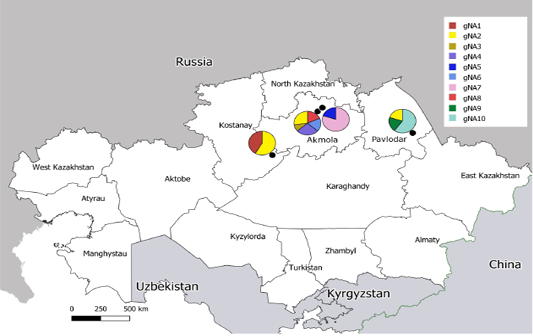
As a result of bacteriological studies, 35 bacterial isolates were identified on the basis of phenotypic characteristics as M. bovoculi. Using the MALDI-TOF method, all isolates were assigned to the genus Moraxella, however, in 33 isolates the protein profile corresponded to M. bovoculi, and in two isolates the protein profiles were identified as Moraxella_sg_Branhamella ovis, with a high Score Value (1.7-1.9). Genetic identification by nucleotide sequence analysis of the 16SrRNA gene identified all isolates as M. bovoculi (Table 1). The percentage of identity with the NR_043583 sequence of M. bovoculi was 99.8-100%, with M. bovis - 98.4-98.8%, with M. ovis - 95.7-96.1% and with M. lacunata - 99.4-99.6%. The isolates were from 4 farms in Kostanay, Akmola and Pavlodar regions (Figure 1).
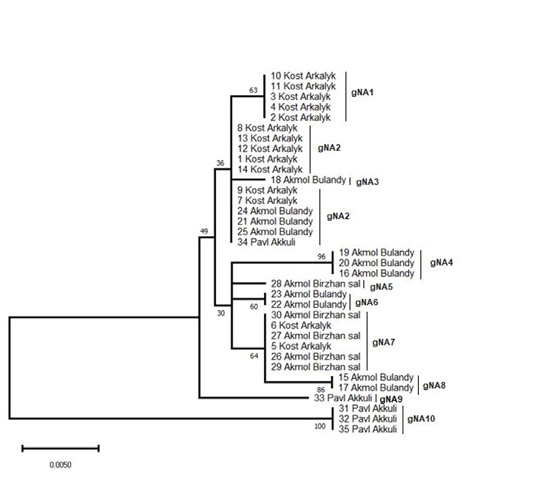
Based on the nucleotide sequence of the pilA gene, the analyzed isolates were grouped into 10 genotypes (Figure 2) designated gNA1 through gNA10.
It was determined that 3 genotypes were represented by single isolates (gNA3, gNA5, gNA9) which were isolated from Akmola and Pavlodar regions. The gNA1 genotype contained 5 isolates from the Kostanay region. The largest gNA2 genotype represented 11 isolates: 7 were isolated on a farm in the city of Arkalyk, Kostanay region, 3 from the Bulandy district of the Akmola region, and 1 from the Akkuli district of the Pavlodar region. The gNA4 genotype includes 3 isolates from the Bulandy district of the Akmola region. The gNA6 genotype was represented by two isolates from the Bulandy district of the Akmola region, which, based on MALDI-TOF, had been identified as Branhamella ovis. The gNA7 genotype included 4 isolates from the Birzhan sal district of the Akmola region and 2 isolates from the Kostanay region. The gNA8 genotype contained 2 isolates from the Bulandy district of the
Table 1: Results of isolate identification
Table 2: Amino acid substitutions identified in the PilA protein
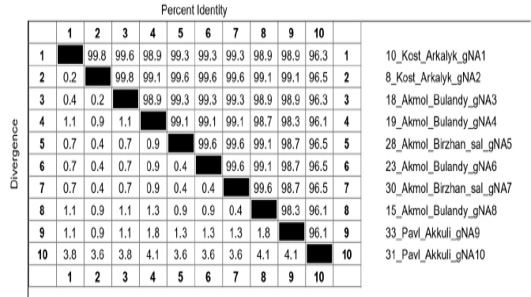
Akmola region. The gNA10 genotype was represented by 3 isolates from the Pavlodar region. Identity between genotypes varied from 99.8% to 96.1%, which, in nucleotide equivalents, was from 1 to 17 nucleotides (Figure 3).
Most of the variable nucleotides were silent mutations and did not lead to protein amino acid substitutions. A total of 8 nucleotides were missense mutations and resulted in amino acid substitutions (Table 2). The maximum difference between the genogroups was 2 amino acid residues out of 152.
The deduced PilA amino acid sequence from genotypes gNA1, gNA2, gNA3, gNA5 and gNA7 did not differ from each other. In the gNA4 genotype, serine was replaced by asparagine at position 61 (S61N). In the gNA6 genotype, at position 98 of the amino acid sequence, isoleucine was replaced by valine (I98V). In the gNA8 genotype, the substitution of cytosine for thymine at position 97 of the nucleotide sequence of the pilA gene led to the formation of a stop codon, which would result in the expression of a truncated protein in the 15_Akmol_Bulandy and 17_Akmol_Bulandy isolates. Also in this genotype, a substitution of glycine for serine at position 130 (G130S) was identified. In the gNA9 genotype, 2 amino acid substitutions were found at positions 130 and 131 of glycine for aspartic acid and glutamine for lysine, respectively (G130D and Q131K). In the gNA10 genotype, two amino acid substitutions of aspargine for serine at position 62 of the protein and valine for proline (N62S and V81P) were also found.
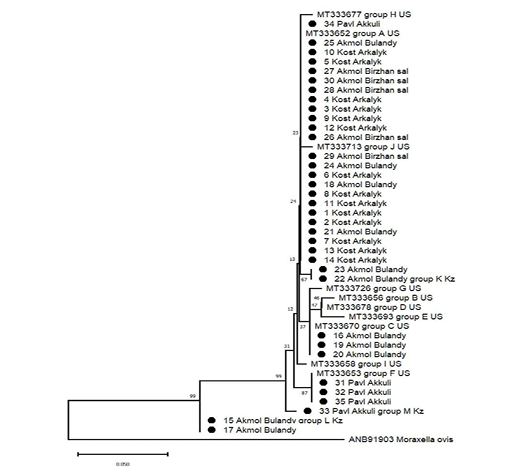
Phylogenetic analysis of the PilA deduced amino acid sequence of isolates from Kazakhstan with previously established groups made it possible to establish the group affiliation of the PilA gene genotypes (Figure 4). It was determined that more than 68% of the isolates (N=24) belonged to PilA group A. Three isolates each belonged to PilA groups C and F. Two isolates from the Akmola region under accession numbers 22 and 23 have a unique amino acid sequence and were assigned to a new group designated PilA group K. The two truncated PilA sequences (gNA8; isolates 15 and 17) were located in a separate clade and were assigned to an additional new group designated PilA group L. Isolate number 33 was also located separately and was designated as belonging to a new group designated PilA group M.
Nucleotide sequences of pilA gene has been deposited in GenBank under accession numbers OP352320 - OP352329.