
Because of the significance of root-knot nematodes, the Meloidogyne species were recognized in the green spaces of Khorasan Razavi Province (Mashhad, Iran) using soil and plant samples collected from the rhizosphere of Wisteria sinensis roots (30 to 50 cm) during 2024 to 2025. Samples were transferred to an ice box to the laboratory. Second-stage juveniles (J2s) were extracted from soil by the Jenkins method. Root systems showing galling symptoms were dissected under the microscope, and females were obtained for morphological and molecular analysis. Male was not found. Meloidogyne javanica was identified based on morphological and morphometric characteristics of J2s and females. Species-specific primers affirmed morphological investigations, and this isolate generated a particular band of 670bp utilizing Fjav and Rjav primers. To our knowledge, this is the first report of M. javanica infecting W. sinensis in Iran. So, monitoring it to take measures to restrict its further spread is crucial and more research would be necessary to develop control strategies.
Research Article · Volume 44, Issue 1, 19 December 2025 · Open Access
First Report of Root-Knot Nematode, Meloidogyne javanica from Wisteria sinensis in Razavi Khorasan Province, Iran
· ·
Affiliations & Notes ⌄
- 1Department of Plant Protection, Faculty of Agriculture, Ferdowsi University of Mashhad, Mashhad, Iran
- 2Plant Protection Research Department, Khorasan Razavi Agricultural and Natural Resources Research and Education Center, AREEO, Mashhad, Iran. *Correspondence | Fatemeh Azad-Disfani, Plant Protection Research Department, Khorasan Razavi Agricultural and Natural Resources Research and Education Center, AREEO, Mashhad, Iran. Email: fa.azad@areeo.ac.ir
Article Info ⌄
- Journal:
- Pakistan Journal of Nematology
- Published:
- 19 December 2025
From the article
- After examining the samples collected from the green space in this study, M. javanica was identified as a new report on W. sinensis in Khorasan provinces, Iran.
- This survey reports for the first time the infection of Wisteria sinensis with the nematode Meloidogyne javanica in Khorasan Razavi Province, Iran.
- Morphological and morphometric analysis of females and second-stage larvae (J2) showed agreement with existing descriptions of M. javanica.
- Molecular verification using SCAR species-specific primers (Fjav/Rjav), which produced the expected 670 bp fragment, confirmed the morphological identification.
Selected from the article's own text.
Abstract
Introduction
Root-knot nematodes are among the most important plant-parasitic nematodes worldwide. reducing crop quality and annual yields by about $157 million . Berkeley (1889) provided the first report of the root-knot nematode (Meloidogyne spp.), concerning cucumbers grown in greenhouses . The symptoms of nematode infections in plant aerial parts are often overlooked because they are similar to those caused by drought, nutrient deficiencies, or other stress factors . To date, the characteristics of over 97 species of Meloidogyne include several described species, among which M. javanica (Treub, 1885), M. incognita , M. arenaria (Neal, 1889), and M. hapla have the highest economic importance and distribution . Identifying Meloidogyne species often depends on morphological and morphometric data, such as the structure of the perineal pattern in the female nematode, the shape of the esophagus, and certain features of J2s . As mentioned, considering the significant economic damage caused by root-knot nematodes, their control is essential. The first step in controlling any disease is to identify it in different hosts. Therefore, given the importance of these nematodes, it is essential to investigate their presence on other plants.
Wisteria is a plant variety of the Fabaceae family. Woody, flowering, and climbing features are some of its main characteristics. It has around 10 subspecies that are found plentifully in Asian countries . W. sinensis is cultivated as an ornamental for homesites and gardens; it is highly ornamental in spring for pendulous racemes of pink blossoms . Consequently, these plants are cultivated in many gardens and outdoor landscapes globally . Other than ornamentals, Wisterias are also recognized as medicinal and edible plants. Moreover, their stems are applied for paper manufacturing . Therefore, considering the importance of this plant and the role it plays in the beauty of green spaces, it seems necessary to investigate its diseases. As root-knot nematodes are known as one of the most devastating and harmful pathogens, this study investigated the presence of Meloidogyne nematodes in the green spaces of Khorasan Province, Iran, especially on Wisteria sinensis.
Materials and Methods
Soil sampling
Ten rhizosphere soil samples were obtained from landscaped areas in Razavi Khorasan province (Mashhad), Iran. These soil samples were extracted from a depth of around 30-50cm. Then, they were packed in polyethylene bags with essential labeling, and delivered to laboratory to conduct analysis.
Processing of samples
J2s were taken from soil samples by employing the Jenkins method . Root samples were cleaned and used for extracting swollen females and egg masses from the galled tissues of Wisteria sinensis plants (n= 8) by using a fine pointed needle under a stereomicroscope. The females and J2s were heat-killed by adding boiling 4% formaldehyde solution, transferred to anhydrous glycerin and mounted on permanent slides. Perineal patterns were cut from preserved female specimens in lactic acid.
Measurements
The specimens (eight females and J2s) were observed using a light Olympus BH-2 microscope. Interpretation of morphological features was based on Jepson (1987) and Subbotin et al. (2021).
DNA extraction and PCR assays
An inclusive female nematode specimen of an isolate was selected and then moved to a minor drop of TE buffer (10 mM Tris-Cl, 0.5 mM EDTA; pH 9.0, Qiagen) on a completely polished slide and squashed by applying a clean coverslip. By inserting 50 ul of TE buffer, the suspension was gathered. Before using as a PCR template, DNA samples were stored at −20°C environment. Specific primers, Fjav/Rjav, were used for quick confirmation . Amplification was conducted under the following cycling conditions: 94°C for 5 min, then 35 cycles of 94°C for 30 seconds, 64°C for 30 seconds, 72°C for 30 seconds, and final extension at 72°C for 10 min.
Result and Discussion
After examining the samples collected from the green space in this study, M. javanica was identified as a new report on W. sinensis in Khorasan provinces, Iran. As can be seen in Figure 1, the symptoms of this nematode are visible on the roots of the plant in the form of swollen galls.
Morphological and morphometric data in Table 1 and Figure 2.
Table 1: Morphometric data of adult females and J2 of M. javanica.
| Character (µm) | Female | Second-stage juveniles | |||
| Population from Wisteria sinensi ( n = 8) | M. javanica | Population from Wisteria sinensis (n = 8) | M. javanica | ||
| Body length | 843.8±69.1 (750-940) | 545-800b | 439±45 (380-500) | 340-400b | |
| Body width | 573.8±32.5 (530-630) | 300-545b | 15.8±0.8 (14.5-17) | 15.6±0.1d (14.8-16.9) | |
| Stylet | 15.7 ±0.6 (15 – 16.5) | 16.0b | 11.4±0.7 (10.5-12.5) | 10b | |
| DGO | 4.9 ±0.4 (4.5-5.5) | 3.0-4.0b | 3.8±0.6 (3-4.5) | 4b | |
| Median bulb | 93.5±5.3 (85-99.5) | - | 58.9±4.9 (54-69) | - | |
| Excretory pore to anterior end | 26.1±6.0 (20 – 35) | 44.8b | 85.3±4.8 (79-92) | 83.9±0.4c (80.8-86.7) | |
| Vulval slit | 24.5±1.6 (22 – 26.5) | 25.4±0.5c (21.5-28.1) | - | - | |
| Vulva – anus | 18.2±2.6 (14 – 21) | 16±4.0d (12 – 28) | - | - | |
| Interphasmid distance | 27.1±2.6 (24-31) | 27.9±0.5c (24.1-34.2) | - | - | |
| Tail length | - | - | 49.8±4.8 (43-56) | 56.1±0.5c (51.8-60.8) | |
| Hyaline | - | - | 13.2±1.3 (11.5-15) | 13±4d (7-20) | |
a Mean ± typical deviation (scale); n = number of specimens; b Paratypes, Java, Indonesia, Chitwood (1949); c Georgia, USA Rammah and Hirschmann (1990); d Ghaderi et al. (2020).
Female Body pear-shaped, lacking a posterior terminal protuberance, 750-940 μm long. Stylet 15.0-16.5 µm long, robust, slightly dorsally curved, basal knobs ovoid, offset. Perineal pattern rounded, with a low dorsal arch, smooth striae, tail whorl often distinct, accompanied by two prominent lateral lines. Phasmids are usually indistinct.
Male was not found.
Second-stage juveniles Vermiform, 380-537 μm long. Stylet slender, 9.5-14.5 μm long, with rounded and small knobs. Lateral field with four incisures. Tail length 35-57 μm with a hyaline region 10-17 μm long and a finely rounded tip.
Species-specific primers- Sequence Characterized Amplified Region (SCAR) primer approved morphological investigations, and this isolate created a certain band in 670bp by applying Fjav and Rjav primers shown in Figure 3.
Discussion
W. sinensis is an ornamental plant which is cultivated in many gardens and outdoor landscapes globally . In the present study, surveyed Meloidogyne species was found in landscaped areas in Razavi Khorasan province (Mashhad), Iran and characterized as M. javanica using morphological and morphometric characters. Morphological and morphometric data of M. javanica in this study are largely in agreement with the original description and others ; , except for some variations in body length and body width of females. However, it is well known that there exist considerable variations in measurements of adult root-knot nematodes between different populations because of their great body size ; . Accurate distinction of M. javanica and M. incognita remained challenging using various molecular techniques, except when using SCAR-PCR . In this survey, the presence of M. javanica confirmed with species-specific SCAR-PCR. As far as we know, this is the first time that M. javanica on W. sinensis was reported in Iran.
Conclusions
This survey reports for the first time the infection of Wisteria sinensis with the nematode Meloidogyne javanica in Khorasan Razavi Province, Iran. It expands the host range and geographical distribution of this nematode. Morphological and morphometric analysis of females and second-stage larvae (J2) showed agreement with existing descriptions of M. javanica. Molecular verification using SCAR species-specific primers (Fjav/Rjav), which produced the expected 670 bp fragment, confirmed the morphological identification. The absence of male nematodes also confirms the parthenogenetic nature of this species. According to the first report of this economically important nematode on wisteria in Iran, the need to strengthen plant health monitoring in ornamental nurseries and green spaces is emphasized to prevent its further spread.
Novelty Statement
To the authors’ knowledge, this is the first report of M. javanica on Wisteria sinensis in Iran. This is the first study reporting Wisteria sinensis as a new host species for M. javanica in Iran. We believe our findings contribute meaningfully to nematology and are relevant to your journal’s scope.
Author’s Contribution
Fatemeh Shekari Mahoonaki: Data analysis, investigation, resources, methodology, manuscript editing.
Fatemeh Azad-Disfani: Perception, data interpretation, investigation, resources, methodology, writing- review, and correcting.
Majid Shahi-Bajestani: Data interpretation, investigation, methodology, writing- original draft.
Generative AI and AI-assisted technology statement
The authors declare that no Genrative AI was used in the creation of this manuscript.
Conflict of interest
The authors have declared no conflict of interest.
Figures
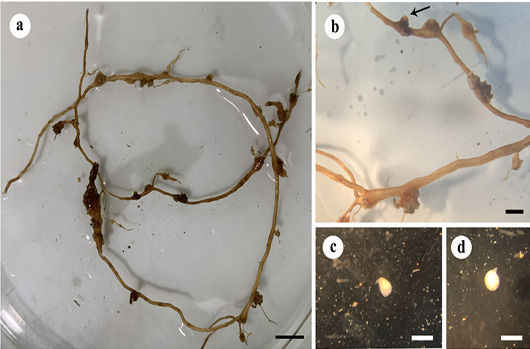
Gall and eggs of M. javanica on the roots of Wisteria sinensis. (Scale bars in a, b 10 mm and in c, d 1000 μm).
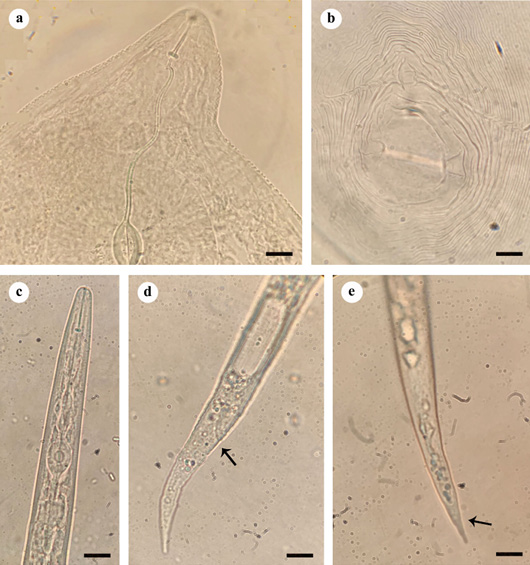
Light microphotographs of the anterior and posterior regions of adult female and J2 of the studied M. javanica on Wisteria sinensis. (Scale bar size: 10 µm).
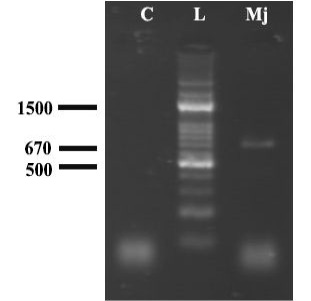
Species-specific 670bp band in Meloidogyne javanica isolate infecting Wisteria sinensis.
References
- Chitwood, B.G., 1949. Root-Knot Nematodes Part I. A Revision of the Genus Meloidogyne Goeldi, 1887. Proceedings of the Helminthological Society of Washington, 16, 90-104.
- Coyne, D.L., Cortada, L., Dalzell, J.J., Claudius-Cole, A.O., Haukeland, S., Luambano, N. and Talwana, H., 2018. Plant-parasitic nematodes and food security in Sub-Saharan Africa. Ann. Rev. Phytopathol., 56(1): 381-403. https://doi.org/10.1146/annurev-phyto-080417-045833[CrossRef]
- De-Grisse, A.T., 1969. Redescription and modification of some techniques used in the study of nematode phytoparasitaires. Mededelingen Rijksfacultiet Landbouw Wetenschappe Gent, 34: 351-369.
- Ghaderi, R., Dehghan, A.A., Hesar, A.M. and Karegar, A., 2020. Genetic intraspecific diversity of Meloidogyne javanica parasitizing vegetables in southern Iran. J. Nematol., 52: 1-13. https://doi.org/10.21307/jofnem-2020-035[CrossRef]
- Hunt, D.J. and Handoo, Z.A., 2009. Taxonomy, identification, and principal species. In root-knot nematodes. Wallingford, UK: CABI. pp. 55-97. https://doi.org/10.1079/9781845934927.0055[CrossRef]
- Jenkins, W., 1964. A rapid centrifugal-flotation technique for separating nematodes from soil. Plant Dis. Rep., 48(9).
- Jepson, S.B., ١٩٨٧. Identification of Root-knot Nematodes (Meloidogyne species). Commonwealth Agricultural Bureaux, Farnham Royal, UK.
- Jones, J.T., Haegeman, A., Danchin, E.G., Gaur, H.S., Helder, J., Jones, M.G. and Perry, R.N., 2013. Top 10 plant-parasitic nematodes in molecular plant pathology. Mol. Plant Pathol., 14(9): 946-961. https://doi.org/10.1111/mpp.12057[CrossRef]
- Keskin, S., Sirin, Y., Cakir, H.E. and Keskin, M., 2019. Phenolic composition and antioxidant properties of Wisteria sinensis. Int. J. Sci. Technol. Res., 5(2): 98-103.
- Kofoid, C.A. and White, W.A, 1919. A new nematode infection of man. JAMA, 72: 567–569. https://doi.org/10.1079/9781845934927.0055.[CrossRef]
- Liu, J., Wang, E.T. and Chen, W.X., 2005. Diverse rhizobia associated with woody legumes Wisteria sinensis, Cercis racemosa, and Amorpha fruticosa grown in the temperate zone of China. Syst. Appl. Microbiol., 28(5): 465-477. https://doi.org/10.1016/j.syapm.2005.02.004[CrossRef]
- Onkendi, E.M., Kariuki, G.M., Marais, M. and Moleleki, L.N., 2014. The threat of root-knot nematodes (Meloidogyne spp.) in Africa: A review. Plant Pathol., 63(4): 727-737. https://doi.org/10.1111/ppa.12202[CrossRef]
- Pedrelli, A., Panattoni, A. and Cotrozzi, L., 2024. First molecular analysis of wisteria vein mosaic virus in Italy: Eight new variants reported in Wisteria sinensis. J. Plant Pathol., 106(1): 117-125. https://doi.org/10.1007/s42161-023-01526-7[CrossRef]
- Rammah, A. and Hirschmann, H., 1990. Meloidogyne morocciensis n. sp. (Meloidogyninae), a root-knot nematode from Morocco. J. Nematol., 22: 279–291.
- Seinhorst, J.W., 1959. A rapid method for the transfer of nematodes from fixative to anhydrous glycerin. Nematologica, 4(1): 67-69. https://doi.org/10.1163/187529259X00381[CrossRef]
- Siddiqi, M.R., 2000. Tylenchida parasites of plants and insects. 2nd ed. Wallingford, UK: CABI Publishing. https://doi.org/10.1079/9780851992020.0000[CrossRef]
- Subbotin, S.A., Rius, J.E.P. and Castillo, P., 2021. Systematics of root-knot nematodes (Nematoda: Meloidogynidae) (Vol. 14). Brill. https://doi.org/10.1163/9789004387584[CrossRef]
- Wei Z. and Pedley, L., 2010. Wisteria. In: (eds. Z.Y. Wu, P.H. Raren and D.Y. Hong) Flora of China. Science Press & St. Louis: Missouri Botanical Garden Press, Beijing, pp. 188–189.
- Whitehead, A.G., 1968. Taxonomy of meloidogyne (Nematodea: Heteroderidae) with descriptions of four new species. Trans. Zool. Soc. London, 31: 263–401. https://doi.org/10.1111/j.1096-3642.1968.tb00368.x[CrossRef]
- Zijlstra, C., Donkers-Venne, D.T. and Fargette, M., 2000. Identification of Meloidogyne incognita, M. javanica, and M. arenaria using sequence-characterised amplified region (SCAR) based PCR assays. Nematology, 2: 847-853. https://doi.org/10.1163/156854100750112798[CrossRef]
Services
Article usage statistics
Loading…