
This study examined whether multiple combinations of freshly-harvested green leaves of medicinal brimstone, neem and bitter leaf trees against phytoparasitic nematodes (PPNs) could be complementary to improve okra plant biomass (OPB). Therefore, field evaluation technique was methodically used to collect data of visual root-galling severity (VR-GS), overall PPNs suppressed (OPPNss) and OPB for analysis. The VR-GS was positively correlated, (correlation coefficient (r) = 0.32; P-value = 0.07569), with number of botanicals combined (NBC) in treatments. Percentage of OPPNss in treatments that had single, two-combined and three-combined botanicals was 84±6, 85±7 and 91±5%, respectively. However, relative biomass of an okra plant was negatively correlated, (r =-0.34; P-value = 0.05615), with NBC in treatments. Consequently, all single botanicals in treatments triggered an increase in OPB, whereas two-combined or three-combined botanicals in treatments largely caused a decrease in OPB. Freshly-harvested green leaves of A. indica, M. lucida and V. amygdalina in single botanical treatments achieved 7.32, 18.22 and 43.4% increase in OPB, respectively. Therefore, V. amygdalina will most likely increase okra yield better, while suppressing PPNs.
Research Article · Volume 44, Issue 1, 1 March 2026 · Open Access
Combining Freshly-Harvested Green Leaves of Medicinal Morinda lucida, Azadirachta indica and Vernonia amygdalina for Effective Management of Diverse Invasive Soil-Borne Crop-Damaging Phytoparasitic Nematodes Reduced Okra (Abelmoschus esculentus) Plant Bio
· ·
Affiliations & Notes ⌄
- 1Department of Biological Sciences, University of Environment and Sustainable Development, Somanya, Ghana. *Correspondence | Dr. William K. Heve, Department of Biological Sciences, University of Environment and Sustainable Development, Somanya, Ghana
- 2Email: hevde999@gmail.com, wkheve@uesd.edu.gh
Article Info ⌄
- Journal:
- Pakistan Journal of Nematology
- Published:
- 1 March 2026
From the article
- The VR-GS values in treatments of V. amygdalina alone, M. lucida alone and ‘A. indica + V. amygdalina’ were significantly (P < 0.05) lower than those in control, ‘V. amygdalina + M. lucida’, ‘A. indica + M. lucida’ or ‘V. amygdalina + M. lucida + A. indica’ treatment (Figure 1A).
- Also, numbers of Longidorus spp. in all treatments, except the trial involving ‘A. indica + V. amygdalina’, were significantly (P < 0.05) lower than that of control (Table 2).
- The numbers of OPPNs observed in each of the individual treatments of single, two-combined or three-combined medicinal botanicals were significantly (P < 0.05) lower than that of control (Figure 2A).
- Moreover, V. amygdalina effectively suppressed overall PPNs, similar to the way M. lucida, A. indica, two-combined or three-combined botanicals did.
Selected from the article's own text.
Abstract
Introduction
Okra (Abelmoschus esculentus L.) is a widely cherished vegetable for having ample nutrients. It is often used to be a major component of health-focused dietary medicinal formulations . After mangoes, okra is the second largest income-generating crop for livelihood in Yilo Krobo Municipal (YKM) of Eastern Region in Ghana (first author’s personal communication with YKM Agricultural Extension Agents). However, okra plant root system (OPRS) is highly susceptible to diverse phytoparasitic nematodes (PPNs), although root-knot nematodes (Meloidogyne spp.) are more problematic on this crop ; , 2017; ; ; ; ; ; . These PPNs on OPRS can cause okra yield losses up to 40% if the right management techniques are not adopted against them ; , 2017; ; .
Nematicide and non-nematicide options have been assessed and suggested to vegetable crop growers to use against PPNs in the field ; ; ; ; ; ; ; ; . Unfortunately, synthetic nematicides, which are more effective in suppressing PPNs in field conditions, are seriously regulated across the world ; ; ; ; FAO, 2024). Thus, the high global demand for food and plant commodities, coupled with increasing severity of PPNs on crops in the field, require research considerations to upgrade non-nematicide approaches ; . Some of the upgrading efforts for effective non-nematicide strategies include research and advancement into the use of beneficial microbial entities and botanicals for management of PPNs on crop plants ; ; ; ; ; ; ; ; ; .
In a recent field trial, Heve et al. (2025) examined and compared efficacies among neem plant (Azadirachta indica Jussieu), brimstone tree (Morinda lucida Benth) and bitter leaf (Vernonia amygdalina Delile) for management of PPNs on tomato (Solanum lycopersicum L.). The three botanicals achieved similar percentage increase in tomato plant root (TPR) weight. Although V. amygdalina could be recommended for management of PPNs, the three botanicals again had similar percentage decrease in TPR galling severity . Therefore, we hypothesized, in the current study, that combining the botanicals in treatments would be complementary against PPNs in the field. Our main objective was to examine whether performances of multiple combinations of these three botanicals against PPNs could be additive, synergistic or antagonistic. Therefore, similar field trial procedures in report of Heve et al. (2025) were used to study the effects of multiple combinations of these three botanicals on both PPNs and okra plant biomass.
Materials and Methods
The study site and field preparation
The study site (SS) was at the coordinate (6° 3’0.66” N, 0° 0’4.64” W, with elevation = 69 m). The site had undulating topographical landscape. Soils in Yilo Krobo Municipal, including the SS, had been characterised to be predominantly calcic vertisols that have high clay content, ranging between 32 and 41% ; .
Bushes at SS were cleared close to the ground, using a cutlass. This manual weed clearing was adopted to achieve zero-tillage that was to conserve topsoil structure, any beneficial soil-borne microorganisms, phytopathogens (i.e., bacteria and fungi), microscopic phytoparasitic nematodes (PPNs), microinvertebrates and earthworms, among others ; .
Pre-treatment organization in experimental plot
The experimental plot was divided into seven rows, similar to the approach used by Heve et al. (2025). Along each row, eight planting stations were pegged. The distance between two successive pegged stations within a row was one (1) m, whereas the distance between two successive rows was 2 m. After pegging the planting stations, a hole (depth = 20 cm; width = 15 cm; length = 20 cm) was created at the position of every peg in each row, using a hoe. After that, the holes were labelled again for each of intended treatments in such a way that all the treatments could be arranged in a randomized complete block design layout (RCBDL) in the field. Hence, each treatment unit was randomly positioned in each of the seven rows, similar to the way it was done in recent report of Heve et al. (2025).
Pre-planting treatments with green leaves of medicinal botanicals in holes created in the experimental plot
On March 23 and 24, 2025, fresh green leaves of M. lucida, A. indica and V. amygdalina were separately harvested at the geographical coordinates (6°3’3.10” N, 0°0’16.06” W), (6°3’2.07” N, 0°0’13.86” W) and (6°1’39.82” N, 0°27’23.42” W), respectively. On March 25, 2025, about 50 g of green leaves of M. lucida alone was added to a randomly-selected hole in each row and then covered with soil. On the same day, similar procedures used for M. lucida were repeated for A. indica alone, V. amygdalina alone, two-combined and three-combined botanicals. However, for two botanicals combined in a treatment, 50 g of their green leaves was maintained in ratio 1:1, similar to the technique used in report of Heve et al. (2018). Also, for three medicinal botanicals combined in a treatment, 50 g of combined green leaves was from M. lucida, A. indica and V. amygdalina in a ratio 1:1:1 . An “empty hole” that did not receive green leaves of the botanicals was the control. In all, there were eight (8) treatments. A replicate of each treatment was randomly positioned in each of the seven (7) rows. Thus, each of the eight (8) treatments was replicated seven times and then arranged in RCBDL on the plot at the study site, similar to the experimental design used in reports of Heve et al. (2018, 2025).
The 50 g of green leaves, incorporated into soil at each planting station, decomposed from March 25, 2025 until planting was done on April 9, 2025. Precipitation between these two dates was 42 mm.
Planting at pegged stations after incorporating 50 g of green leaves of medicinal botanicals into soil
On April 9, 2025, four (4) viable okra (A. esculentus L.; variety = Ladies’ fingers) seeds were sown at each labelled planting station, which had already received treatments for ‘control’, single, two or three botanicals combined. After germination, the okra seedlings were thinned out to maintain one at each pegged planting spot.
Maintenance of growing okra plants against weeds, leaf-damaging pests and climate change
Using a hoe for soil tillage, weeds were controlled in the experimental plot to allow healthy-looking okra seedlings develop well. According to recent reports ; , suspensions of smoothly-mashed garlic (Allium sativum L.) protect crop plants against insect pests and okra-damaging snails, among others. Therefore, 7.5 g of garlic cloves was smoothly mashed in a mixer grinder (BOSCHTM) at speed of 45,000 rpm (revolutions (minute)-1) for 5 minutes. After that, a litre of tapwater was added to the smoothly-mashed garlic paste (SMGP), thereby adjusting the concentration of the paste to be 7.5 g L-1. On April 16, 2025, about 10 mL of the suspension of SMGP was sprinkled over leaves of a growing okra seedling at each planting spot, using a 20-mL measuring cylinder. Again, on April 30, 2025, about 10 mL of similar concentration of freshly prepared SMGP in suspension was sprinkled over the leafy parts of each developing okra plant at each planting station. The two consecutive applications of SMGP suspensions were to effectively repel leaf-chewing insects (i.e., coleopterans) from all delicate growing okra plants at their early stage. Hence, influence of applied mashed-garlic suspensions on okra plants would be similar in all replicates of treatments and control.
No fertilizers were applied. Also, none of the okra plants was irrigated. Precipitation from April 9, 2025 (the date of sowing) to June 23, 2025 (the date of harvesting) was 281 mm, whereas daily temperatures varied from 23 to 34 oC. Moreover, okra plants were exposed to sufficient daily sunshine hours, which varied between six (6) and 10.
Data collection
Assessment of visual root-galling severity (VR-GS) and okra plant biomass (OPB): When the okra plants were 11-week-old from the date of planting, each was carefully uprooted on June 23, 2025. The amount of soil around the root system was gently removed into a 600-mL polythene bag, thereby making the roots of each okra plant appear visibly clean . Each clean root system of each okra plant was then examined for incidence of root galls. Hence, VR-GS was visually estimated using the procedures in reports (Heve et al., 2015a, 2025; . After that, OPB was determined by weighing each whole uprooted fresh okra plant for each replicate of a treatment.
Extraction, identification and quantification of actively-motile phytoparasitic nematodes (PPNs)
The modified Baermann funnel method (MBFM) (OEPP/EPPO, 2013; , recently recommended by Bui et al. (2025) and Heve et al. (2025), was used to extract live PPNs from both ‘200 mL of fresh rhizosphere soil sample’ and ‘fresh okra plant roots’ into suspensions for each replicate of a treatment over a week. Using a microscope, all the PPNs in 5 mL of a suspension for each replicate of a treatment were identified to genus level only, according to their morphological features in reports ; ; Heve et al., 2015b; ; ; ; ; ; ; . After that, total number of identified individual nematodes belonging to each genus of PPNs in a volume of nematode suspension collected from MBFM was quantified using Equation 1, similar to the approach used by Heve et al. (2025), as:
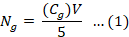
Where Ng was the total number of individuals belonging to a genus of PPNs; Cg was the number of individual nematodes belonging to a genus of PPNs in a 5 mL of nematode suspension from MBFM; V was total volume of nematode suspension collected from MBFM for each replicate of each treatment.
Assessment of overall phytoparasitic nematodes (PPNs) suppressed in each replicate of a treatment
Similar to the methods used by Heve et al. (2025), overall phytoparasitic nematodes (OPPNs) for each replicate of a treatment was obtained by summing Ng (in Equation 1) for each of all the genera of PPNs. Therefore, the percentage of OPPNs suppressed (OPPNss) in each treatment was assessed using Equation 2, similar to the procedure used by Heve et al. (2025), as:

Where Pt was the percentage of overall phytoparasitic nematodes suppressed (OPPNss) in treatment; Tcontrol was the overall phytoparasitic nematodes (OPPNs) observed in control; Ttreatment was OPPNss in treatment.
Data analysis
R software [R.v.4.5.1 and RStudio.v.SHA-2562c3cf96a] by R Core Team (2025) for computing was used to analyze data. Shapiro-Wilk test was first used to examine normality in data; the P-values of the test were < 0.05, thereby proving that data lacked normality, according to reports by Gotelli and Ellison (2013), Dinno (2015), Mishra et al. (2019) and Heve et al. (2025). Nonetheless, parametric two-way (or multi-factor) analysis of variance (ANOVA) was fitted to unbalanced data better than its analogous non-parametric Scheirer-Ray-Hare test could be ; ; ; ; ; ; . This observation was similar to the first author’s previous experience in his recent report . This is because the P-values of the parametric two-way ANOVA model were lower than those of the analogous non-parametric Scheirer-Ray-Hare model. Therefore, “two-way” ANOVA was used to determine whether the categorical factors could be the significant sources of variation in the data for VR-GS, OPPNs, Pt or OPB. The factors considered to be the likely sources of variation included (1) “incidence of no, single, two-combined and three-combined botanicals in treatments (IBT)”, (2) “treatments in rows (TR)” and (3) “interaction between IBT and TR”. After that, the non-parametric Dunn’s test was applied to data to compare values of “mean ± standard errors (SE)” between treatments, according to suggestions in reports ; ; ; . Pearson correlation coefficient was used to examine linear relationship between two variables. The “mean ± SE” values were presented in either bar graphs or Tables.
Results
Multiple combinations of fresh green leaves of the medicinal botanicals in treatments against visual root-galling severity (VR-GS)
Incidence of botanicals in treatments (IBT) and “interaction between IBT and treatments in rows (TR)” significantly (P < 0.05) caused variation in VR-GS (Table 1). Thus, VR-GS values varied between the individual treatments (Figure 1A). The VR-GS values in treatments of V. amygdalina alone, M. lucida alone and ‘A. indica + V. amygdalina’ were significantly (P < 0.05) lower than those in control, ‘V. amygdalina + M. lucida’, ‘A. indica + M. lucida’ or ‘V. amygdalina + M. lucida + A. indica’ treatment (Figure 1A). Also, the VR-GS values in A. indica treatment were significantly (P < 0.05) less than those in control (Figure 1A). However, the mean±SE values of VR-GS in treatments of A. indica alone, ‘V. amygdalina + M. lucida’, ‘A. indica + M. lucida’ and ‘V. amygdalina + M. lucida + A. indica’ were not significantly (P > 0.05) different from one another (Figure 1A).
Values of the VR-GS in treatments of single botanicals were significantly (P < 0.05) lower than those in
Table 1: Multi-functional “two-way” analysis of variance (ANOVA), predicting categorical sources of variation in each set of data collected from the field trial.
| Categorical source of variation | Sets of data measured and collected from the field trial | ||||||||||||||
| Visual root-galling severity (VR-GS) | Number of overall phytoparasitic nematodes (OPPNs) | Percentage of OPPNs suppressed (Pt in equation 2) | Okra plant biomass (OPB) | ||||||||||||
| Categorical source of variation | DF1 | MS | P-value | DF1 | MS | P-value | DF2 | MS | P-value | DF1 | MS | P-value | |||
| Incidence of botanicals in treatment (IBT) ¶ | 3 | 2495.50 | 0.00015 *** | 3 | 599069.6 | < 0.00001 ***** | 2 | 3149.84 | 0.3286 NS | 3 | 0.063462 | 0.19039 NS | |||
| Treatment in rows (TR) | 6 | 422.56 | 0.2753 NS | 6 | 65724.53 | 0.0254 * | 6 | 598.65 | 0.9682 NS | 6 | 0.01618 | 0.8682 NS | |||
| Interaction between IBT and TR | 18 | 856.03 | 0.00183 ** | 18 | 141681.4 | <0.000003 ***** | 12 | 936.58 | 0.9764 NS | 18 | 0.018234 | 0.966 NS | |||
| Residuals | 84 | 330.59 | NA | 84 | 25728.57 | NA | 42 | 2755.82 | NA | 84 | 0.039128 | NA | |||
¶: Only incidence of no, single, two-combined and three-combined botanicals in treatments (IBT), which had overall replicates to be 7, 21, 21 and 7, respectively, was considered; DF1 was the degree of freedom, when data for replicates of control were included; DF2 was the degree of freedom, when data for replicates of control were excluded; MS was mean squares, whereas P-value was probability statistic for F statistic of parametric two-way ANOVA test; “Two-way” ANOVA test: *, **, *** and ***** indicate significance at P < 0.05, P < 0.01, P < 0.001 and P < 0.00001, respectively, whereas “NS” denotes no significance; NA was “not applicable”.
Table 2: Numbers of phytoparasitic nematodes (PPNs) per okra plant in treatments that had green leaves of medicinal botanicals.
| Diverse invasive soil-borne phytoparasitic nematodes (PPNs) | Medicinal botanical treatments, with control, to okra plant roots | |||||||
| Control (i.e., no green leaves) | A. indica (AZ) | M. lucida (ML) | V. amygdalina (VA) | AZ+ML | AZ+VA | ML+VA | AZ+ML+VA | |
| Meloidogyne spp. | 464±55 A | 13±2 C | 7±7 C | 126±77 B | 3±3 C | 0±0 C | 130±92 B | 15±10 C |
| Scutellonema spp. | 13±11 D | 0±0 D | 8±7 D | 0±0 D | 6±5 D | 0±0 D | 0±0 D | 0±0 D |
| Xiphinema spp. | 27±5 E | 0±0 F | 30±7 E | 24±4 E | 0±0 F | 2±2 F | 0±0 F | 0±0 F |
| Trichodorus spp. | 28±3 G | 17±8 GH | 0±0 H | 16±11 GH | 12±7 GH | 0±0 H | 5±3 H | 25±7 G |
| Pratylenchus spp. | 44±8 I | 5±4 K | 4±3 K | 7±4 JK | 8±7 JK | 9±5 JK | 31±14 IJ | 10±7 JK |
| Radopholus spp. | 3±2 L | 0±0 L | 0±0 L | 0±0 L | 0±0 L | 0±0 L | 0±0 L | 0±0 L |
| Trichotylenchus spp. | 16±10 M | 0±0 M | 0±0 M | 0±0 M | 8±7 M | 0±0 M | 1±1 M | 0±0 M |
| Belonolaimus spp. | 18±10 N | 0±0 N | 22±10 N | 2±2 N | 0±0 N | 5±5 N | 0±0 N | 8±6 N |
| Amplimerlinius spp. | 7±5 O | 0±0 O | 4±3 O | 0±0 O | 0±0 O | 5±5 O | 9±6 O | 5±3 O |
| Hoplolaimus spp. | 26±15 P | 0±0 P | 0±0 P | 0±0 P | 17±14 P | 0±0 P | 0±0 P | 0±0 P |
| Longidorus spp. | 15±4 Q | 0±0 R | 0±0 R | 4±3 R | 0±0 R | 17±5 Q | 3±3 R | 0±0 R |
| Helicotylenchus spp. | 13±11 S | 0±0 S | 4±3 S | 0±0 S | 8±7 S | 0±0 S | 0±0 S | 0±0 S |
| Rotylenchus spp. | 3±2 T | 0±0 T | 4±4 T | 0±0 T | 0±0 T | 0±0 T | 0±0 T | 0±0 T |
| Tylenchorhynchus spp. | 15±6 U | 0±0 U | 9±5 UV | 0±0 U | 0±0 U | 0±0 U | 0±0 U | 0±0 U |
| Rotylenchulus spp. | 17±2 W | 0±0 X | 0±0 X | 0±0 X | 0±0 X | 0±0 X | 6±5 X | 0±0 X |
According to Dunn’s test at P < 0.05, different uppercase letters against ‘mean±SE-values’ in each row denote significant difference between treatments , with control.
either control or ‘V. amygdalina + M. lucida + A. indica’ treatment (Figure 1B). Also, significant difference was observed in VR-GS values between ‘single botanical’ and ‘two combined botanicals’ treatments (Figure 1B). However, the values of VR-GS in ‘V. amygdalina + M. lucida + A. indica’ treatment were similar to those in control (Figure 1A, B). Excluding all observations in control, an increase in values of VR-GS in Figure 1B was positively correlated, (r = 0.32; P-value = 0.07569), with an increase in number of botanicals combined in treatments.
Multiple combinations of fresh green leaves of the medicinal botanicals in treatments against diverse phytoparasitic nematodes (PPNs) on okra plant roots
The significant categorical sources of variation in numbers of overall phytoparasitic nematodes (OPPNs) included IBT, TR and “interaction between IBT and TR” (Table 1). However, in Table 2, numbers of uncharacterized PPN species of Scutellonema, Radopholus, Trichotylenchus, Belonolaimus, Amplimerlinius, Hoplolaimus, Helicotylenchus, Rotylenchus and Tylenchorhynchus in each of the medicinal botanical treatments were not significantly (P > 0.05) different from those observed in control. In contrast, number of either Meloidogyne spp. or Rotylenchulus spp. in all the medicinal botanical treatments was significantly (P < 0.05) lower than that in control (Table 2). Number of Xiphinema spp. in treatment of A. indica, ‘A. indica + M. lucida’, ‘A. indica + V. amygdalina’, ‘M. lucida + V. amygdalina’ or ‘A. indica + M. lucida + V. amygdalina’ was significantly (P < 0.05) less than that of control (Table 2).
Similarly, number of Trichodorus spp. in treatment of M. lucida, ‘A. indica + V. amygdalina’ and ‘M. lucida + V. amygdalina’ were significantly (P < 0.05) lower than that of control (Table 2). Numbers of Pratylenchus spp. in all treatments, except the trial involving ‘M. lucida + V. amygdalina’, were significantly (P < 0.05) less than that of control (Table 2). Also, numbers of Longidorus spp. in all treatments, except the trial involving ‘A. indica + V. amygdalina’, were significantly (P < 0.05) lower than that of control (Table 2).
The numbers of OPPNs observed in each of the individual treatments of single, two-combined or three-combined medicinal botanicals were significantly (P < 0.05) lower than that of control (Figure 2A). Numbers of OPPNs achieved in treatments of A. indica, M. lucida, ‘A. indica + M. lucida’, ‘A. indica + V. amygdalina’ and ‘A. indica + M. lucida + V. amygdalina’ were not significantly (P > 0.05) different from one another (Figure 2A). Moreover, numbers of OPPNs observed in treatments of M. lucida, ‘A. indica + M. lucida’ and ‘A. indica + M. lucida + V. amygdalina’ were not significantly (P > 0.05) different from those achieved in treatments of V. amygdalina and ‘M. lucida + V. amygdalina’ (Figure 2A). However, the number of OPPNs obtained in treatment of either A. indica alone or ‘A. indica + V. amygdalina’ was significantly (P < 0.01) lower than that observed in treatment of V. amygdalina alone or ‘M. lucida + V. amygdalina’ (Figure 2A).
Although numbers of OPPNs were significantly (P < 0.05) reduced across all treatments that had botanicals (Figure 2A), none of the categorical factors caused variation in percentage of OPPNs suppressed (Pt) (Table 1). In effect, values of Pt across the individual treatments were similar (Figure 2B) in such a way that single, two-combined and three-combined botanicals in treatments had Pt values to be 84±6, 85±7 and 91±5%, respectively (Figure 2B). Overall, increasing Pt had an extremely weak positive correlation, (r = 0.063; P-value = 0.737), with increasing number of medicinal botanicals combined in treatments.
Effects of multiple combinations of fresh green leaves of the botanicals in treatments on biomass of an okra plant
None of the categorical factors was a source of variation in an okra plant biomass (OPB) (Table 1). The mean±SE value of OPB in the treatment of V. amygdalina was not significantly (P > 0.05) higher than that of control (Figure 3A). Also, the mean±SE-values of OPB in treatments of M. lucida, A. indica and ‘V. amygdalina + M. lucida’ were similar to that of control (Figure 3A). Nevertheless, treatments of V. amygdalina, M. lucida and ‘V. amygdalina + M. lucida’ had significantly (P < 0.05) higher OPB than that
The mean±SE value of OPB in treatment of A. indica in the treatment of ‘A. indica + V. amygdalina’ or ‘M. lucida + V. amygdalina + A. indica’ (Figure 3A). alone, ‘A. indica + V. amygdalina’, ‘A. indica + M. lucida’ or ‘M. lucida + V. amygdalina + A. indica’ was similar to that of control (Figure 3A). Also, the mean±SE value of OPB in treatment of ‘A. indica + M. lucida’ was not significantly (P > 0.05) higher than that in the treatment of ‘M. lucida + V. amygdalina + A. indica’ (Figure 3A). Relative to control, V. amygdalina alone, M. lucida alone and A. indica alone in treatments achieved 43.4, 18.22 and 7.32% increase in OPB, respectively (Figure 3A).
In Figure 3B, the values of relative biomass of an okra plant (RBAOP) in all treatments of single botanicals were not significantly (P > 0.05) higher than those in either control or ‘two botanicals combined in treatments. Also, the mean±SE value of RBAOP in ‘two botanicals combined in treatments’ was not significantly (P > 0.05) higher than values of RBAOP in ‘three botanicals combined in treatments’ (Figure 3B). Using the control as a reference for RBAOP, the single, two-combined and three-combined botanicals in treatments had mean±SE values of RBAOP to be 1.261± 0.212, 0.9± 0.131 and 0.44± 0.209, respectively (Figure 3B). Therefore, excluding control, the RBAOP was negatively correlated (r =-0.34; P-value = 0.05615) with number of medicinal botanicals combined in treatments.
Discussion
Nematicidal properties of phytochemicals in Azadirachta indica, Morinda lucida, Vernonia amygdalina and other botanicals
Carbohydrates, saponins, terpenes, terpenoids, sterols, steroids and flavonoids are common in leafy parts of M. lucida, A. indica and V. amygdalina ; ; . However, alkaloids, glycosides and polyphenols are additional phytochemical constituents in green leaves of A. indica and V. amygdalina only ; . Apart from all the aforementioned phytochemicals, tannins and oxalic acid are other unique ones in the leaves of A. indica , whereas resins are exceptional extra constituents in the leaves of V. amygdalina . Thus, phytochemical contents in green leaves of the three medicinal botanicals used for the study vary.
Several phytochemicals from Artemisia species have been effective in causing death of crop plant-infecting second-stage juveniles (J2) and/or inhibiting egg-hatching of root-knot nematodes (RKN; Meloidogyne incognita) . Consequently, a significant decline in severity of M. incognita-induced galls on tomato (Lycopersicon esculentum L.) plant roots was achieved . In recent report of Mezerket et al. (2025), the use of essential oil from Algerian wild (Origanum vulgare subspecies glandulosum Defs) for both preventive and curative treatment techniques significantly reduced both M. incognita J2 and tomato plant root-galling severity. Consequently, a significant increase in tomato plant biomass was observed across treatments . A phytochemical profile study on Algerian wild revealed that its essential oil contains a mixture of biologically-active compounds, which include glycosides, flavonoids, saponins, gallic tannins and tannins . Some of the bioactive chemical compounds in green leaves of M. lucida, A. indica and V. amygdalina are similar to those in the Algerian wild, Artemisia spp., Arisaema erubescens (Wallich), Medicago sativa (L.) and other numerous medicinal botanicals, which have been suppressive to PPNs ; ; ; . This is because reports have shown that flavone-C-glycosides, flavonoids, saponins, phytoterpenoids and tannins from diverse medicinal botanicals suppress PPNs ; ; ; ; ; .
Extracted forms of phytochemicals showed dissimilar modes of actions to suppress PPNs ; . In a recent study, about 39 plant-based different chemicals damaged all the internal organs of a root-lesion nematode (Pratylenchus penetrans Cobb) . According to Greiffer et al. (2022), tannins suppress PPNs by making their cuticle to become rigid and thickened, thereby impairing nematode’s mobility towards hosts. Plants naturally use flavonoids to defend themselves against harmful microorganisms that cause parasitic and pathogenic disease to them . According to reports ; , the major suppressive functions of flavonoids against PPNs include (i) being effective in repelling phytonematodes, (ii) reducing hatchability of nematode eggs, (iii) causing improper coordination in movement of nematodes and (iv) being toxic to directly kill crop-damaging phytoparasitic ones. Several other bioactive compounds in botanicals are also toxic to cause death of PPNs or suppress their egg-hatching potential in the field .
Combining green leaves of Azadirachta indica, Morinda lucida and Vernonia amygdalina in treatments was antagonistic to visual root-galling severity (VR-GS)
We observed that visual root-galling severity (VR-GS) increased in treatments where two or three botanicals were combined better than treatments that had single botanicals. Plant-feeding mites, phytopathogens and other diverse microbes in rhizosphere use various mechanisms to suppress plant defense or root immune system (PDRIS) ; ; Blaazer et al., 2018; . Moreover, PPNs, including the topmost-ranked world-wide crop-damaging RKN, often secrete numerous effectors to weaken PDRIS . Possibly, phytotoxins in green leaves of combined botanicals in treatments could weaken the okra PDRIS. In this case, any releases of effectors by RKN will further weaken the already weakened okra PDRIS, thereby allowing development and formation of root galls by Meloidogyne spp. in our field trial. In effect, all the pre-treatments that had M. lucida only, A. indica alone or V. amygdalina alone suppressed VR-GS better than pre-treatments that had two or three combined botanicals, except field trial that involved combination of “A. indica + V. amygdalina”. Thus, studies are needed to understand the correct interactive mechanisms that might have facilitated an increase in VR-GS in treatments that had combined botanicals. Although the treatments for two or three combined botanicals had an increase in VR-GS, the observed numbers of J2 of RKN were generally low in this study. Perhaps, phytochemicals in these combined botanicals could synergistically inhibit egg-hatching of RKN in MBFM, similar to the way those of M. incognita were significantly suppressed by phytochemicals from Artemisia spp. . Again, studies are needed to understand how pre-treatments with combinations of green leaves of M. lucida, A. indica and V. amygdalina suppress hatching J2 from RKN eggs in galled plant roots.
In terms of suppressing root galls, Heve et al. (2025) observed that V. amygdalina alone, M. lucida alone and A. indica alone in treatment caused similar decrease in visual root-galling severity (VR-GS) of tomato plants in a field trial. Hence, each of the three botanicals was more promising. In the current study, V. amygdalina alone, M. lucida alone and A. indica alone in treatments achieved similar low VR-GS, thereby suggesting that any of the three botanicals can be used to effectively reduce plant root-galling severity. Our observations in the current study are in agreement with recent report of Heve et al. (2025).
Combining green leaves of Azadirachta indica, Morinda lucida and Vernonia amygdalina in treatments suppressed overall phytoparasitic nematodes (PPNs) better
In the current study, individual combinations of green leaves of M. lucida, A. indica, V. amygdalina across treatments significantly suppressed the overall PPNs in field trial. However, no significant differences in efficacies were observed between treatments that had single, two and three combined botanicals. Of course, combinations of numerous bioactive phytochemical compounds in the combined green leaves should be expected to exhibit individual different modes of actions to synergistically suppress PPNs better. This is because several factors can be considered for this phenomenon to occur. Firstly, all bioactive compounds reported in M. lucida, A. indica, V. amygdalina or any other medicinal botanicals naturally exist in combinational form ; ; ; ; Ogwudire, 2025). Secondly, the bioactive compounds in combined green leaves of different botanicals often manifest differential modes of actions ; ; ; ; ; . Thirdly, some phytochemicals inhibit nematode egg-hatching ; , whereas others cause destruction of vital internal tissues of infectious PPNs . Fourthly, tannins cause disruption of nematode cuticle to impair mobility of PPNs . Fifthly, some bioactive phytochemicals have been highly nematotoxic to cause death of infective nematodes ; ; ; . Sixthly, resins and flavonoids potentially protect plants against numerous harmful biological entities in either aquatic or terrestrial ecosystems on Earth ; ; . Probably, the varying modes of nematicidal actions of different phytochemicals in green leaves of M. lucida, A. indica and V. amygdalina might have contributed to significantly suppress soil-borne PPNs across all treatments in similar manner. Hence, the percentages for the suppression of overall PPNs were similar across all the individual treatments in this study.
In terms of suppressing overall PPNs on tomato plants in previous field trial by Heve et al. (2025), V. amygdalina was more promising. In the current study, V. amygdalina alone, M. lucida alone and A. indica alone in treatments significantly (P < 0.05) suppressed PPNs in similar manner, thereby suggesting that any of the three botanicals can be used to effectively manage PPNs on okra plants. However, field trials will be required to measure optimum efficacy of M. lucida, A. indica and/or V. amygdalina so that suggestions for the use of any of these medicinal botanicals will sustain maximum suppression of PPNs.
Combining green leaves of Azadirachta indica, Morinda lucida and Vernonia amygdalina in treatments suppressed okra plant biomass
According to reports ; ; , high doses of naturally-occurring alkaloids in botanicals can be toxic to both animals and plants. Green leaves of botanicals that have higher levels of heavy metals can be phytotoxic to okra plant roots (OPRs) . According to Choudhary et al. (2023), knowledge in allelopathic interactions between plants in the field can be explored for management of noxious weeds across cultivated fields. This is largely because environmental factors cause plants to release several powerful allelopathic phytotoxic secondary volatiles (APSV) into soil environments. The APSV often modify soil ecosystem to become phytotoxic to neighbouring plants in the same vicinity . Any toxified soil environments generally inhibit seed germination, retard plant growth and suppress physiological and biochemical processes in plants ; ; . Perhaps, incorporating green leaves of two or three botanicals into soil might become phytotoxic to OPRs in the field. In effect, toxified soil environment for OPRs in “two or three combined botanicals” in treatments could reduce okra plant growth and biomass. Thus, relative to control, all the individual single botanicals in treatments achieved an average of 26.13% increase in okra plant biomass (OPB), whereas two and three botanicals combined in treatments caused 10 and 56% decrease in OPB, respectively. Therefore, we concluded that single botanicals in treatments will improve yield of okra plants, whereas the combined botanicals will cause significant economic losses at a larger scale.
Among the single botanical treatment, we observed that V. amygdalina alone in treatments will most likely increase okra yield by 43.4% better than M. lucida alone or A. indica alone in treatments will achieve. However, in previous field trial by Heve et al. (2025), V. amygdalina alone, M. lucida alone and A. indica alone in treatments caused similar percentage increase in tomato plant root weight, thereby suggesting that any of the three botanicals can be used to improve plant biomass, while suppressing PPNs. Our observations in the current study are partially in agreement with recent report of Heve et al. (2025).
Conclusions
An increase in number of botanicals combined in treatments caused an increase in visual root-galling severity (VR-GS). All treatments that had single, two-combined and three-combined botanicals effectively suppressed overall phytoparasitic nematodes (PPNs). However, all single botanicals in treatments triggered an increase in okra plant biomass (OPB), whereas two-combined or three-combined botanicals in treatments caused a decrease in OPB. Among the single botanicals in treatments, green leaves of V. amygdalina achieved a 43.4% increase in OPB higher than that of M. lucida or A. indica achieved. Moreover, V. amygdalina effectively suppressed overall PPNs, similar to the way M. lucida, A. indica, two-combined or three-combined botanicals did. Therefore, field trials for assessment of optimum efficacy of V. amygdalina will be useful to maximise suppression of PPNs.
Acknowledgements
Authors are thankful to the management of the University of Environment and Sustainable Development (UESD) for allocating a piece of farmland at the coordinate (6° 3’0.66” N, 0° 0’4.64” W) for field trials, near the residence of UESD’s Vice Chancellor. Authors also thanked the laboratory technicians for making the correct microscopes available for nematode diagnostics in the UESD’s Senior Biology Laboratory.
Novelty Statement
Our field trial demonstrated that multiple combinations of fresh green leaves of medicinal brimstone, neem and bitter leaf trees effectively suppressed diverse invasive soil-borne crop-damaging phytoparasitic nematodes (PPNs) in rhizospheres of okra plants. Nevertheless, the protected growing okra crops lost potential to produce desired bio-mass, thereby suggesting that such a decline in output of okra crops on a larger scale can threaten both “global food security” and “sustainable development”.
Author’s Contribution
Dr. William K. Heve: Conceived the research idea, expertly developed procedures for field trial, methodically supervised data collection, carefully identified PPNs in nematode suspensions, analysed data using R software, drafted the manuscript and carefully revised it for publication. Nechamah N. O. Aryee and Abigail M. Norvor: Executed the field trial, collected samples from the study site and then extracted diverse PPNs, under the auspices of Dr. William K. Heve.
Funding
This study received no support and/or no grant from any funding agencies, public sector or commercial institutions. Notwithstanding, Dr. William K. Heve used his small resources to fund this study.
Human and animal rights
The authors did not use humans, animals or both as objects or materials for this study.
Generative AI and AI-assisted technology statement
The authors have declared that no AI and no AI-assisted technology were used for this study. Rather, observations in the authors’ current study were from a carefully-executed field trial at a place, located at (6° 3’0.66” N, 0° 0’4.64” W).
Conflict of interest
The authors have declared no conflict of interest.
Figures
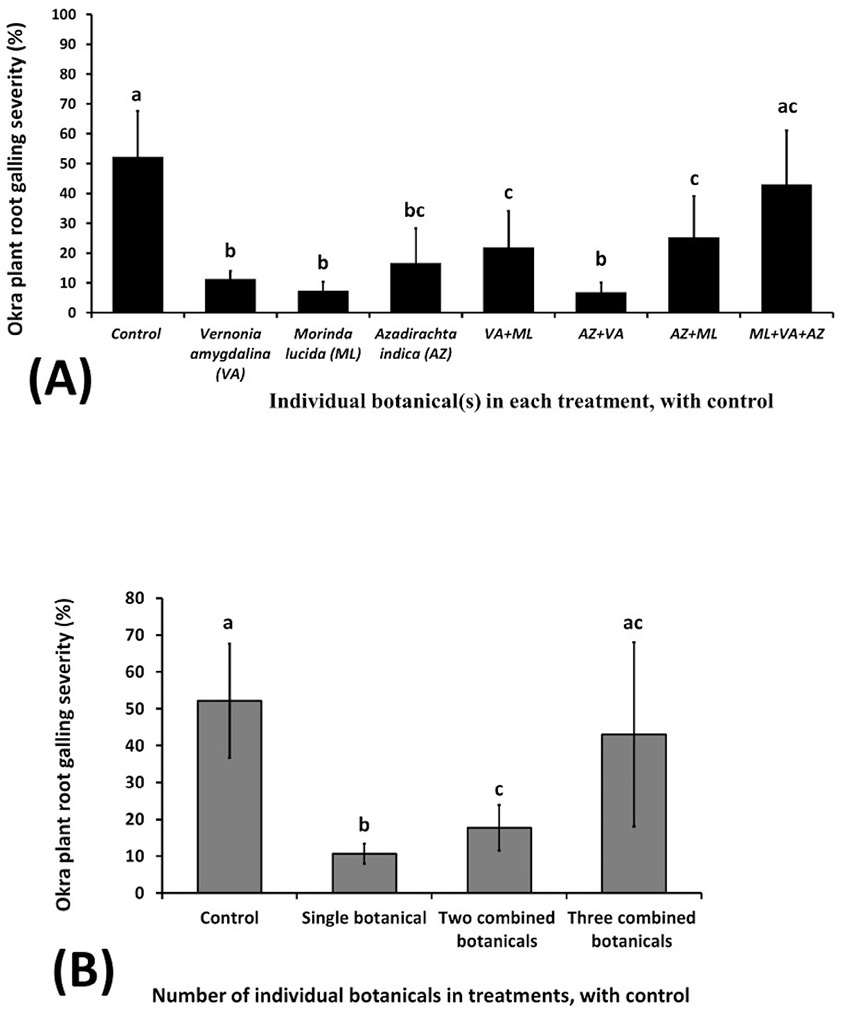
Observations revealing: (A) the performance of individual treatments against visual root-galling severity (VR-GS); (B) antagonistic effects of combining botanicals in treatments on VR-GS. According to Dunn’s test at P ≤ 0.05, different lowercase letters on top of bars denote significant differences in VR-GS between treatments.
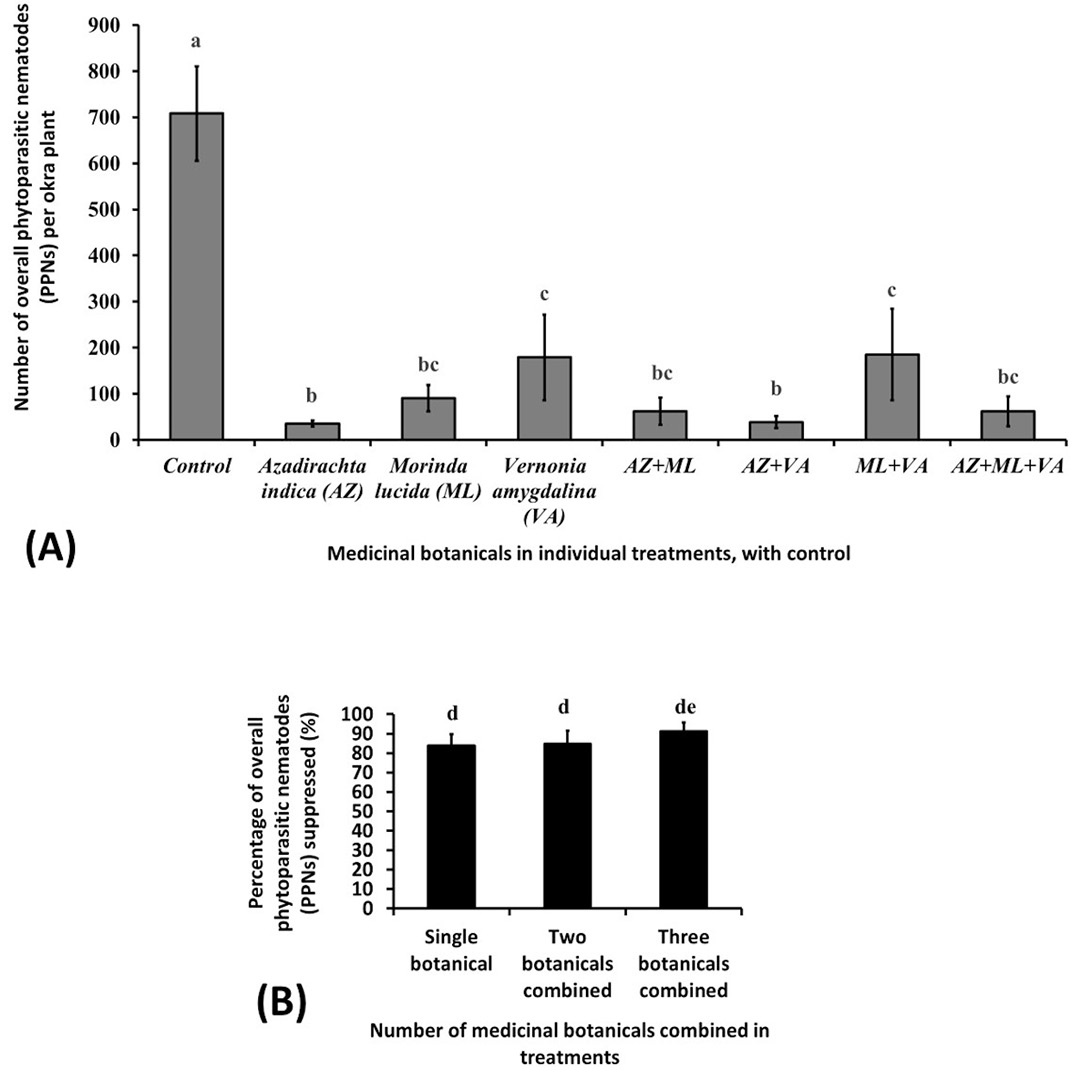
Observations indicating: (A) numbers of overall PPNs (okra pant)-1 for each of the individual treatments, with control; (B) percentage of overall PPNs suppressed by each number of medicinal botanicals combined in each treatment. According to Dunn’s test at P ≤ 0.05, different lowercase letters on top of bars denote significant differences in observations between treatments.
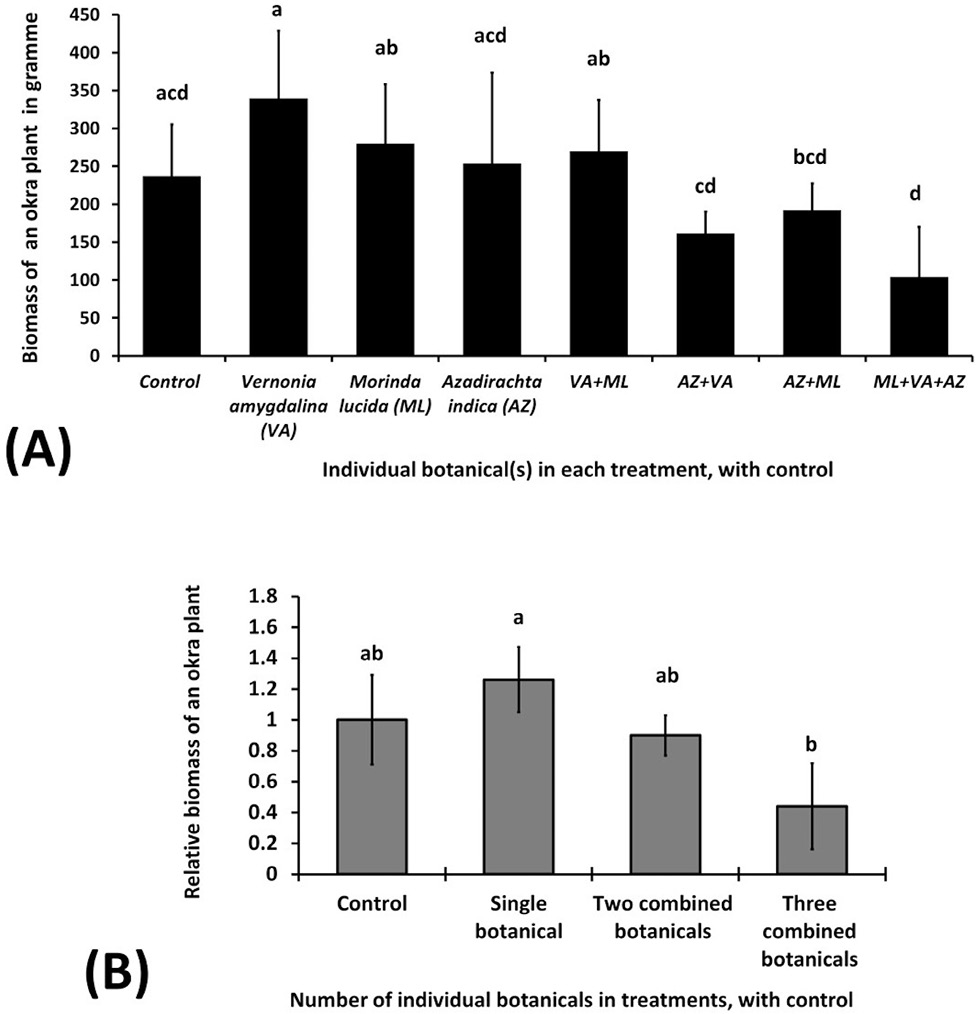
Observations showing: (A) biomass of an okra plant for the individual medicinal botanical(s) in each treatment, with control; (B) relative biomass of an okra plant for each number of medicinal botanicals combined in each treatment, with control. According to Dunn’s test at P ≤ 0.05, different lowercase letters on top of bars represent significant differences in observations between treatments.
References
- Abd-Elgawad, M.M.M., 2024. Upgrading. Strategies for managing nematode pests on profitable crops. Plants (Basel, Switzerland), 13(11): 1-20. https://doi.org/10.3390/plants13111558[CrossRef]
- Abdel-Rahman, F.H., Alaniz, N.M. and Saleh, M.A., 2013. Nematicidal activity of terpenoids. J. Environ. Sci. Health B, Pestic. Food Contam. Agric. Wastes, 48(1): 16-22. https://doi.org/10.1080/03601234.2012.716686[CrossRef]
- Adibah, K.Z.M. and Azzreena, M.A., 2019. Plant toxins: Alkaloids and their toxicities. GSC Biol. Pharma. Sci., 6(2): 21–29. https://doi.org/10.30574/gscbps.2019.6.2.0003[CrossRef]
- Afzal, A. and Mukhtar, T., 2024. Revolutionizing nematode management to achieve global food security goals-an overview. Heliyon, 10: e25325. https://doi.org/10.1016/j.heliyon.2024.e25325[CrossRef]
- Ali, B. and Gill, R.A., 2022. Editorial: Heavy metal toxicity in plants: Recent insights on physiological and molecular aspects, volume II. Front. Plant Sci., 13(1016257): 01-03. https://doi.org/10.3389/fpls.2022.1016257[CrossRef]
- Angon, P.B., Islam, M.S., Shreejana, K.C., Das, A., Anjum, N., Poudel, A. and Suchi, S.A., 2024. Sources, effects and present perspectives of heavy metals contamination: Soil, plants and human food chain. Heliyon, 10 (7): e28357. https://doi.org/10.1016/j.heliyon.2024.e28357[CrossRef]
- Azeem, W., Mukhtar, T., Inam-ul-Haq, M., Khan, M.A., Ibrahim, M.S., Hassan, A., Regmi, H. and Duncan, L.W., 2025. The nematicidal potential of Moringa oleifera extracts and rhizobacteria against Meloidogyne incognita in tomato. Front. Plant Sci., 16 (1562074): 1-10. https://doi.org/10.3389/fpls.2025.1562074[CrossRef]
- Baah, P., Nyaku, S.T., Agamah, B. and Tongoona, P.B., 2024. Evaluation of preplant seed protectants for the management of root-knot nematode of okra in Ghana. Int. J. Agron., 4025844: 1-11. https://doi.org/10.1155/2024/4025844[CrossRef]
- Baidoo, E., Logah, V., Adjei-Gyapong, T., Ocansey, C.M., Ametsitsi, G.K.D., Narh, S. and Veenendaal, E.M., 2024. Soil properties of thickets and adjacent land use types in coastal savanna landscape of Ghana. Geoderma Regional., 37: e00803. https://doi.org/10.1016/j.geodrs.2024.e00803[CrossRef]
- Bano, S., Iqbal, E.Y., Lubna, Zik-ur-Rehman, S., Fayyaz, S. and Faizi, S., 2020. Nematicidal activity of flavonoids with structure activity relationship (SAR) studies against root knot nematode Meloidogyne incognita. Eur. J. Plant Pathol., 157: 299-309. https://doi.org/10.1007/s10658-020-01988-w[CrossRef]
- Barbosa, P., Faria, J.M.S., Cavaco, T., Figueiredo, A.C., Mota, M. and Vicente, C.S.L., 2024. Nematicidal activity of phytochemicals against the root-lesion nematode Pratylenchus penetrans. Plants, 13(726): 1-15. https://doi.org/10.3390/plants13050726[CrossRef]
- Bhattacharya, S. and Chakraborty, S., 2024. Resins Covering medicinally activated plants and their significance in medicinal cum pharmaceutical areas: An overview. Int. J. Res. Appl. Sci. Eng. Technol., 12: 1241-1253. https://doi.org/10.22214/ijraset.2024.64861[CrossRef]
- Bhosle, B.B., Sehgal, M., Patait, D.D., Yada, S.M., Bora B.C. and Chaudhary, B.N., 2012. Efficacy of nematicides in management of root knot nematode, Meloidogyne incognita in okra in farmer’s participatory mode. Pak. J. Nematol., 30(1): 67-73. (accessed 24 August 2025).
- Blaazer, C.J.H., Villacis-Perez, E. A., Chafi, R., Van Leeuwen, T., Kant, M.R. and Schimmel, B.C.J., 2018. Why do herbivorous mites suppress plant defenses? Front. Plant Sci., 9 (1057): 1-16. https://doi.org/10.3389/fpls.2018.01057[CrossRef]
- Bui, H., Jacobs, D., Xie, C., Nguyen, H.Q. and Desaeger, J., 2025. Effect of soil storage duration and two nematode extraction methods on nematode recovery from a Florida sandy soil. Nematology, 27(8): 887–893. https://doi.org/10.1163/15685411-bja10427[CrossRef]
- Catani, L., Manachini, B., Grassi, E., Guidi, L. and Semprucci, F., 2023. Essential oils as nematicides in plant protection. A review. Plants, 12(6): 1-21. https://doi.org/10.3390/plants12061418[CrossRef]
- Chen, Y., Han, Y.C., Wang, H.Z., Xie, H. and Xu, C.L., 2023. Redescription and molecular characterization of Trichotylenchus dispersus (Nematoda: Dolichodoridae) in China. Zootaxa, 5231(5): 552–566. https://doi.org/10.11646/zootaxa.5231.5.4[CrossRef]
- Chin, S., Behm, C.A. and Mathesius, U., 2018. Functions of flavonoids in plant-nematode interactions. Plants (Basel, Switzerland), 7(4): 1-17. https://doi.org/10.3390/plants7040085[CrossRef]
- Choo, S., Chin, V.K., Wong, E.H., Madhavan, P., Tay, T.S., Yong, P.V.C. and Chong, P.P., 2020. Review: antimicrobial properties of allicin used alone or in combination with other medications. Folia Microbiol., 65: 451–465. https://doi.org/10.1007/s12223-020-00786-5[CrossRef]
- Choudhary, C.S., Behera, B., Raza, Md.B., Mrunalini,K., Bhoi,T.K., Lal, M.K., Nongmaithem, D., Pradhan,S., Song, B. and Das, T.K., 2023. Mechanisms of allelopathic interactions for sustainable weed management. Rhizosphere, 25: 100667. https://doi.org/10.1016/j.rhisph.2023.100667[CrossRef]
- Chung, S.H., Rosa, C., Scully, E.D., Peiffer, M., Tooker, J.F., Hoover, K., Luthe, D.S. and Felton, G.W., 2013. Herbivore exploits orally secreted bacteria to suppress plant defenses. Proc. Natl. Acad. Sci. USA, 110(39): 15728–15733. https://doi.org/10.1073/pnas.1308867110[CrossRef]
- D’Addabbo, T., Carbonara, T., Leonetti, P. and Avato, P., 2011. Control of plant parasitic nematodes with active saponins and biomass from Medicago sativa. Phytochem. Rev., 10: 503–519. https://doi.org/10.1007/s11101-010-9180-2[CrossRef]
- Dandurand, L.M., Zasada, I.A. and LaMondia. J.A., 2019. Effect of the trap crop, Solanum sisymbriifolium, on Globodera pallida, Globodera tabacum, and Globodera ellingtonae. J. Nematol., 51: 1-11. https://doi.org/10.21307/jofnem-2019-030[CrossRef]
- Danso, Y. and Abugri, B., 2022. Plant parasitic nematodes associated with okra in the forest savanna transition and semi-deciduous forest agro-ecologies of Ghana. Agric. Food Sci. J. Ghana, 14: 1483-1492. https://doi.org/10.4314/afsjg.v14i1.12[CrossRef]
- Desaeger, J., Wram, C. and Zasada, I., 2020. New reduced-risk agricultural nematicides - rationale and review. J. Nematol., 52(e2020-91): 1-16. https://doi.org/10.21307/jofnem-2020-091[CrossRef]
- Dinno, A., 2015. Nonparametric pairwise multiple comparisons in independent groups using Dunn’s test. Stata J., 15: 292-300. https://doi.org/10.1177/1536867X1501500117[CrossRef]
- Długosz, J., Dębska, B. and Piotrowska-Długosz, A., 2024. The effect of soil tillage systems on the soil microbial and enzymatic properties under soybean (Glycine max L. Merrill) cultivation implications for sustainable soil management. Sustainability, 16(24): 1-21. https://doi.org/10.3390/su162411140[CrossRef]
- Du, S.S., Zhang, H.M., Bai, C.Q., Wang, C.F., Liu, Q.Z., Liu, Z.L., Wang, Y.Y. and Deng, Z.W., 2011. Nematocidal flavone-C-glycosides against the root-knot nematode (Meloidogyne incognita) from Arisaema erubescens Tubers. Molecules, 16(6): 5079-5086. https://doi.org/10.3390/molecules16065079[CrossRef]
- Dutta, T.K., Khan, M.R. and Phani, V., 2019. Plant-parasitic nematode management via biofumigation using brassica and non-brassica plants: current status and future prospects. Curr. Plant Biol., 17: 17-32. https://doi.org/10.1016/j.cpb.2019.02.001[CrossRef]
- Elkhalifa, A.E.O., Alshammari, E., Adnan, M., Alcantara, J.C., Awadelkareem, A.M., Eltoum, N.E., Mehmood, K., Panda, B.P. and Ashraf, S.A., 2021. Okra (Abelmoschus Esculentus) as a potential dietary medicine with nutraceutical importance for sustainable health applications. Molecules, 26(3/696): 1-21. https://doi.org/10.3390/molecules26030696[CrossRef]
- Etim, D.O., Umana, E.J., Udo, I.A. and Ini-Ibehe, N.A., 2024. Management of the disease complex of okra (Abelmoschus esculentus (L.) Moench) in screenhouse caused by Meloidogyne incognita and Sclerotium rolfsii using Trichoderma species and neem cake. Pak. J. Nematol., 42(2): 88-106. https://doi.org/10.17582/journal.pjn/2024/42.2.88.106.[Full text][CrossRef]
- FAO, 2024. Pesticide registration toolkit. Food and Agriculture Organization, Rome, Italy. https://www.fao.org/pesticide-registration-toolkit/information-sources/restrictions-and-bans/en/ (accessed 24 August 2025).
- Fourie, H., Spaull, W.V., Jones, K.R., Daneel, M.S. and De Waele, D., 2017. Nematology in South Africa: A view from the 21st Century. Springer International Publishing AG, Cham, Switzerland. https://doi.org/10.1007/978-3-319-44210-5[CrossRef]
- Gawade, B.H., Khan, Z., Gangopadhyay, K.K., Pandey C.D. and Chalam., V.C., 2025. Evaluation of diverse okra germplasm for identification of source of resistance to root-knot nematode, Meloidogyne incognita. J. Environ. Biol., 46(3): 382-388.
- Ghaderi, R., Karegar, A. and Miraeiz, E., 2018. Morphological characterization of Trichotylenchus gorganiensis n. sp. (Nematoda: Dolichodoridae) and photomicrographs of several other species of the subfamily Telotylenchinae Siddiqi, 1960. Zootaxa, 4526(4): 447–480. https://doi.org/10.11646/zootaxa.4526.4.3[CrossRef]
- Gotelli, N.J. and Ellison, A.M., 2013. A primer of ecological statistics. 2nd Edition. Sinauer Associates, Inc. Publishers, Sunderland, USA.
- Greiffer, L., Liebau, E., Herrmann, F.C. and Spiegler, V., 2022. Condensed tannins act as anthelmintics by increasing the rigidity of the nematode cuticle. Sci. Rep., 12 (18850). https://doi.org/10.1038/s41598-022-23566-2[CrossRef]
- Griffiths, M.R., Strobel, B.W., Hama, J.R. and Cedergreen, N., 2021. Toxicity and risk of plant-produced alkaloids to Daphnia magna. Environ Sci Eur., 33(10): https://doi.org/10.1186/s12302-020-00452-0[CrossRef]
- Heve, W.K., 2021. Introduction to principles and applications of general morphology and biology of nematodes. Ghana Publishing Co. Ltd., Accra, Ghana. ISBN 978-9988-3-2757-6 (print); 978-9988-3-2758-3 (ebook).
- Heve, W.K., Been, T.H., Schomaker, C.H. and Teklu, M.G., 2015a. Damage thresholds and population dynamics of Meloidogyne chitwoodi on carrot (Daucus carota L., cv. Nerac) at different seed densities. Nematology, 17(5): 501–514. https://doi.org/10.1163/15685411-00002884[CrossRef]
- Heve, W. K., Crow, W.T. and Mengistu, T., 2015b. Dagger nematode (Xiphinema (Cobb, 1913) Inglis, 1983 (Nematoda: Enoplea: Dorylaimia: Dorylaimina: Xiphinematinae)). Featured Creatures-EDIS UF/IFAS: EENY 626. http://edis.ifas.ufl.edu/in1097; http://entnemdept.ufl.edu/creatures/nematode/dagger_nematode.htm (accessed 6 September 2025). https://doi.org/10.32473/edis-in1097-2015[CrossRef]
- Heve, W.K., El-Borai, F.E., Carrillo, D. and Duncan, L.W., 2018. Increasing entomopathogenic nematode biodiversity reduces efficacy against the Caribbean fruit fly Anastrepha suspensa: Interaction with the parasitoid Diachasmimorpha longicaudata. J. Pest Sci., 91(2): 799-813. https://doi.org/10.1007/s10340-017-0942-0[CrossRef]
- Heve, W.K., Norvor, A.M. and Opata, J., 2025. Field evaluation of native Ghanaian medicinal botanicals for management of plant root feeding nematodes on tomato (Solanum lycopersicum L.). Pak. J. Nematol., 43(2): 97-109.
- Khan, R., Naza, I., Hussain, S., Khan, R.A.A., Ullah, S., Rashid, M.U. and Siddique, I., 2020 . Phytochemical management of root knot nematode (Meloidogyne incognita) Kofoid and White Chitwood by Artemisia spp. in tomato (Lycopersicon esculentum L.). Braz. J. Biol., 80(4): 829-838. https://doi.org/10.1590/1519-6984.222040[CrossRef]
- Klasson, K.T., 2020. Two-way ANOVA for unbalanced data: The Spreadsheet Way. USDA–ARS, New Orleans LA, USA. www.ars.usda.gov/ARSUserFiles/60540520/Two-wayANOVAspreadsheet.pdf (accessed 7 September 2025).
- Kwakye, M.O., Mengistie, B., Ofosu-Anim, J., Nuer, A.T.K. and Van den Brink, P.J., 2019. Pesticide registration, distribution and use practices in Ghana. Environ. Dev. Sustain., 21: 2667 –2691. https://doi.org/10.1007/s10668-018-0154-7[CrossRef]
- Lehr, N.A., Schrey, S.D., Bauer, R., Hampp, R. and Tarkka, M.T., 2007. Suppression of plant defence response by a mycorrhiza helper bacterium. New Phytologist., 174: 892-903. https://doi.org/10.1111/j.1469-8137.2007.02021.x[CrossRef]
- Maher, S., Javed, S., Mina, G., R. Salam, Mukhttar, F., Khan N. and Batool, F., 2024. Nematicidal effect of methanolic plant crude extracts against the root-knot nematode, Meloidogyne incognita. Pak. J. Nematol., 42(2): 120–126. https://doi.org/10.17582/journal.pjn/2024/42.2.120.126[Full text][CrossRef]
- Mekete, T., Dababat, A., Sekora, N., Akyazi, F. and Abebe, E., 2012. Identification key for agriculturally important plant-parasitic nematodes prepared for the international nematode diagnosis and identification course-a manual for nematology. CIMMYT, D.F. Mexico. ISBN: 978-607-8263-02-8. https://nematologia.com.br/files/uploads/2013/07/nemkeymex.pdf (accessed 6 September 2025)
- Mezerket, A., Palomares-Rius, J. E., Bouasla, S. and Saib, H., 2025. Phytochemical profile and nematicidal potential of essential oil from Algerian wild Origanum vulgare subsp. glandulosum Defs. Turk. J. Biol. (Turk Biyoloji Dergisi), 49(1): 52–59. https://doi.org/10.55730/1300-0152.2723[CrossRef]
- Mishra, P., Pandey, C.M., Singh, U., Gupta, A., Sahu, C. and Keshri, A., 2019. Descriptive statistics and normality tests for statistical data. Ann. Cardiac Anaesth., 22(1): 67 –72. https://doi.org/10.4103/aca.ACA_157_18[CrossRef]
- Mukhtar, T., Hussain, M.A, Kayani, M.Z., 2017. Yield responses of 12 okra cultivars to southern root-knot nematode (Meloidogyne incognita). Bragantia, Campinas, 76(1): 108-112. https://doi.org/10.1590/1678-4499.005[CrossRef]
- Mukhtar, T., Hussain, M.A., Kayani, M.Z. and Aslam, M.N., 2014. Evaluation of resistance to root-knot nematode (Meloidogyne incognita) in okra cultivars. Crop Prot., 56: 25-30. https://doi.org/10.1016/j.cropro.2013.10.019[CrossRef]
- Najafi, M., Çokuysal, B., Rezaee Danesh, Y., Farda, B., Mignini, A. and Pellegrini, M., 2025. Evaluation of Funneliformis mosseae inoculation effects on growth, nutrient uptake, and essential oil content in Turkish oregano under drought stress. PeerJ, 13: e19499. https://doi.org/10.7717/peerj.19499[CrossRef]
- Nimnoi, P., Pirankham, P., Srimuang, K. and Ruanpanun, P., 2024. Insights into soil nematode diversity and bacterial community of Thai jasmine rice rhizosphere from different paddy fields in Thailand. PeerJ, 12(e17289): 1–28. https://doi.org/10.7717/peerj.17289[CrossRef]
- Noling, J.W., 2002. Nematode Management in Okra. EDIS, UF/IFAS, Gainesville FL, USA. https://edis.ifas.ufl.edu/publication/NG027 (accessed 24 August 2025). https://doi.org/10.32473/EDIS-NG027-1999[CrossRef]
- Noskov, Y.A., Polenogova, O.V., Yaroslavtseva, O.N., Belevich, O.E., Yurchenko, Y.A., Chertkova, E.A., Kryukova, N.A., Kryukov, V.Y. and Glupov, V.V., 2019. Combined effect of the entomopathogenic fungus Metarhizium robertsii and avermectins on the survival and immune response of Aedes aegypti larvae. PeerJ, 7: e7931. https://doi.org/10.7717/peerj.7931[CrossRef]
- OEPP/EPPO, 2013. Diagnostics: Nematode extraction. OEPP/EPPO Bulletin, 43: 471–495.
- Ogwudire, V.E., 2025. Flavonoids from physicnut (Jatropha curcas) as nematicides for root-knot nematode (Meloidogyne incognita) management on okra (Abelmoschus esculentus L.) Moench). Pakistan J. Nematol., 43(1): 70–79. https://dx.doi.org/10.17582/journal.pjn/2025/43.1.70.79[Full text][CrossRef]
- Okechalu, O.B., Danbong, T.P., Wonang, D.L. and Danahap, L.S., 2021. The efficacy of aqueous leaf extracts of Moringa and bitter leaf in the control of Meloidogyne spp. infecting carrot. NJB, 34 (2): 215-228. https://www.ajol.info/index.php/njbot/article/view/225025 (accessed 21 August 2025)
- Okhale, S.E., Imoisi, C., Okoli, C.P., Aliyu, A., Kazeem, T. Josiah, J.G., Egbeneje V.O. and Sa’ad, M., 2024. Phytochemical and synergistic antimicrobial effects of M. lucida, Anogeissus leiocarpus and Sarcocephalus latifolius leaf extract. Ghana J. Sci., 65 (1): 145-159. https://doi.org/10.1111/epp.12077[CrossRef]
- Ordon, J., Logemann, E., Maier, LP., Lee, T., Dahms, E., Oosterwijk, A., Flores-Uribe, J., Miyauchi, S., Paoli, L., Stolze, S.C., Nakagami, H., Felix, G., Garrido-Oter, R., Ma, K-W. and Paul Schulze-Lefert, P., 2025. Conserved immunomodulation and variation in host association by Xanthomonadales commensals in Arabidopsis root microbiota. Nat. Plants, 11: 612-631. https://doi.org/10.1038/s41477-025-01918-w[CrossRef]
- Osei-Owusu, J., Heve, W.K., Aidoo, O.F., Opoku Jnr, M., Apau, J., Dadzie, K.N., Vigbedor, B.Y., Awuah-Mensah, K.A., Appiah, M., Acheampong, A., Birkett, M. and Hooper, A., 2023. Repellency potential, chemical constituents of Ocimum plant essential oils, and their headspace volatiles against Anopheles gambiae s.s., Malaria vector. J. Chem., 3848998: 1–12. https://doi.org/10.1155/2023/3848998[CrossRef]
- Owoade, F.M., Adiku, S.G.K., Atkinson, C.J. and MacCarthy, D.S., 2021. Differential impact of land use types on soil productivity components in two agro-ecological zones of southern Ghana. In: Oguge, N., Ayal, D., Adeleke, L., da Silva, I. (eds) African handbook of climate change adaptation. Springer, Cham., Switzerland. https://doi.org/10.1007/978-3-030-45106-6_144[CrossRef]
- Patil, J.A., Kumar, A., Yadav, S. and Verma, K.K., 2020. Nematicidal effect of cruciferous bio-fumigants against the root-knot nematode, Meloidogyne incognita infesting okra. J. Nematol., 52: 1–7. https://doi.org/10.21307/jofnem-2020-080[CrossRef]
- Perry, R.N., Moens, M., and Jones, J.T., 2024. Plant nematology. 2nd Edition. CABI Publishing, Wallingford, UK. ISBN 978100622425. https://www.cabidigitallibrary.org/doi/book/10.1079/9781800622456.0000 (accessed 6 September 2025). https://doi.org/10.1079/9781800622456.0000[CrossRef]
- Prajapati, A., Singh, T., Patel, A.D. and Patel, B.A., 2021. Estimation of avoidable yield losses due to root-knot nematodes, Meloidogyne spp. infesting okra [Abelmoschus esculentus (L.) Moench.]. Pharma Innov. J., 10(5): 1541-1542. https://www.thepharmajournal.com/archives/2021/vol10issue5/PartT/10-5-137-168.pdf (accessed 24 August 2025).
- R Core Team., 2025. A language and environment for statistical computing. R Foundation for Statistical Computing, Vienna, Austria. https://www.R-project.org/ (accessed 19 August 2025).
- Rinaldi, S., Casorri, L., Masciarelli, E., Ficociello, B., Visconti, U., Papetti, P., Neri, U. and Beni, C., 2019. Prospects of using garlic extracts for pest control in sustainable agriculture. Fresenius Environ. Bull., 28(2): 535-540.
- Scheirer, C.J., Ray, W.S. and Hare, N., 1976. The analysis of ranked data derived from completely randomized factorial designs. Biometrics, 32(2): 429–434. https://doi.org/10.2307/2529511[CrossRef]
- Schwarz, T., Chitra, Jennings, K. and Gorny, A., 2024. Evaluation of weed species for host status to the root-knot nematodes Meloidogyne enterolobii and M. incognita Race 4. J. Nematol., 56 (1): 1–9. https://doi.org/10.2478/jofnem-2024-0017[CrossRef]
- Sethi, A., Lin, C.Y., Madhavan, I., Davis M., Alexander, P., Eddleston, M. and Shu-Sen Chang, S.S., 2022. Impact of regional bans of highly hazardous pesticides on agricultural yields: The case of Kerala. Agric. Food Secur., 11(9): 1-13. https://doi.org/10.1186/s40066-021-00348-z[CrossRef]
- Sharma, H. and Chaubey, K.A., 2023. Plant parasitic nematodes: Insights into the parasitic potential, adaptations and their interaction with other microorganisms. IntechOpen, Rijeka, Croatia. https://doi.org/10.5772/intechopen.1003258[CrossRef]
- Shendge, A.G., Mhase, N.L., Landge, S.A. and Kadu, R.V., 2010. Assessment of yield losses due to root-knot nematode, Meloidogyne incognita infesting okra [Abelmoschus esculentus (L.) Moench]. Int. J. Plant Prot., 3(2): 325-326. https://www.cabidigitallibrary.org/doi/pdf/10.5555/20113030886 (accessed 24 August 2025).
- Sinha, N., 2025. Non-parametric alternative of 2-way ANOVA (ScheirerRayHare). MATLAB Central File Exchange, Natick MA, USA. https://www.mathworks.com/matlabcentral/fileexchange/96399-non-parametric-alternative-of-2-way-anova-scheirerrayhare (accessed 8 September 2025).
- Smart, G.C. Jr. and Nguyen, K.B., 1988. Illustrated key for the identification of common nematodes in Florida. Entomology and Nematology Department, Institute of Food and Agricultural Sciences, University of Florida, Gainesville FL, USA. https://www.echocommunity.org/resources/e2855da5-4726-4531-bc46-11ec2f743ab1 (assessed 6 September 2025).
- Söderberg, T.A., Johansson, A. and Gref, R., 1996. Toxic effects of some conifer resin acids and tea tree oil on human epithelial and fibroblast cells. Toxicology, 107(2): 99–109. https://doi.org/10.1016/0300-483X(95)03242-8[CrossRef]
- Sourisse, J.M., Semmelhack, J.L. and Schunter, C., 2024. Parental thermal conditions affect the brain activity response to alarm cue in larval zebrafish. PeerJ, 12: e18241. https://doi.org/10.7717/peerj.18241[CrossRef]
- Srivastava, D.S. Sehgal, M., Kumar, A., Verma, S., Dwivedi B.K. and Singh, S.P., 2012. Plant-parasitic nematodes associated with tomato and okra fields of Allahabad, Uttar Pradesh, India. Pak. J. Nematol., 30(2): 157-167. https://www.cabidigitallibrary.org/doi/pdf/10.5555/20123307011 (accessed August 2025)
- Sroisai, P., Beesa, N. and Jindapunnapat K., 2024. Morphological and molecular characterization of Trichotylenchus dispersus (Nematoda: Dolichodoridae), a newly recorded plant parasitic nematode in the rhizosphere soil of tomato plants in Thailand. Trends Sci., 21(12): 8796. https://doi.org/10.48048/tis.2024.8796[CrossRef]
- Tintori, S.C., Sloat, S.A. and Rockman, M.V., 2022. Rapid isolation of wild nematodes by Baermann funnel. J. Visual. Exp., 179: e63287. https://doi.org/10.3791/63287-v[CrossRef]
- Ujah, I.I., Nsude, C.A., Ani, O.N., Alozieuwa, U.B., Okpako, I.O. and Okwor, A.E., 2021. Phytochemicals of neem plant (Azadirachta indica) explains its use in traditional medicine and pest control. GSC Biol. Pharma. Sci., 14(02): 165-171. https://doi.org/10.30574/gscbps.2021.14.2.0394[CrossRef]
- Vezikov, L.V. and Simpson, M., 2023. Plant alkaloids toxicity. StatPearls Publishing, Bethesda MD, USA. https://www.ncbi.nlm.nih.gov/books/NBK587364/ (accessed 22 August 2025).
- Zheng, X., Wang, Z., Zhu, Y., Wang, J. and Liu, B., 2020. Effects of a microbial restoration substrate on plant growth and rhizosphere bacterial community in a continuous tomato cropping greenhouse. Sci. Rep., 10: 13729. https://doi.org/10.1038/s41598-020-70737-0[CrossRef]
Services
Article usage statistics
Loading…