
The scorpion fauna of Pakistan is rich in diversity and applicability. However, limited information is available on these animals especially in Punjab province of Pakistan. Furthermore, distributional pattern and habitat structure of known species is also ambiguous. In this study, we report the scorpion Androctonus finitimus (Pocock, 1897) from several areas of Punjab, Pakistan. This scorpion species has not been previously documented from this part of the country, highlighting the wide distribution of this specie across the country. We identified that A. finitimus prefers dry sandy habitat with lower vegetation. This information furthers our scientific understanding on the existing record of this scorpion species in Pakistan.
Research Article · Volume 33, Issue 1, 21 June 2018 · Open Access
First Record of Androctonus finitimus (Pocock, 1897) from Punjab, Pakistan
· ·
Affiliations & Notes ⌄
- 1Department of Zoology, University of Education Lahore, D.G. Khan Campus, D.G. Khan, Pakistan 2Department of Zoology, Government College University, Lahore, Pakistan 3Department of Zoology, Government College University, Faisalabad, Pakistan , *Corresponding author: Hafiz Muhammad Tahir, hafiztahirpk1@yahoo.com
Article Info ⌄
- Journal:
- Punjab University Journal of Zoology
- Published:
- 21 June 2018
From the article
- Previously, A. finitimus was only reported form Sindh province, Pakistan.
- In this paper we reported this scorpion species from areas of Punjab province.
Selected from the article's own text.
Abstract
Introduction
Scorpions are primitive , venomous and widely distributed terrestrial arachnids . Their venom has wide range of applications especially in medical and biological sciences. Scorpion venom has historically been proposed for the treatment of certain diseases and disorders. It has anti-inflammatory, anti-microbial , anti-tumor and strong insecticidal potentials ; .
Ecology and distribution of scorpions are not well documented in Pakistan especially in Punjab province. Fauna of British India monograph contains limited information about scorpion fauna of the Subcontinent i.e. Pakistan and India . Since 1900, there are only few reports on scorpions in the country. However, several studies ; Lourenço and Vachon, 1997; Lourenço, 2005; ; , 2004, 2007; ; ; Lourenço and Monod, 1998) added new species to Pocock scorpion data, around the globe. According to unauthentic data, Pakistan has approximately 50 species belonging to 17 genera and five families, and most of them are reported by Pocock (1900), Tahir et al. (2014) and Tahir and Prendini (2014).
Androctonus finitimus (Pocock, 1897) is an important scorpion species due to medical importance of its venom. However, unfortunately it was not previously reported from Punjab, Pakistan. Kovařík and Ahmed (2013) have reported this species from Sindh province of Pakistan. Therefore, the present study was designed to record the distributional patterns and habitat preference of Androctonus finitimus in the Punjab province of Pakistan.
Materials and Methods
Study area
The current study was conducted to locate the occurrence and habitats of scorpion species Androctonus finitimus in the province of Punjab, Pakistan. A wide range of area was surveyed for possible collection of this scorpion species (i.e., Mirza Goryia 32.37º N, 74.45º E; Abadi Adda Bosan 30.39º N, 71.56º E; Chak # 3 Hans 30.23º N, 71.83º E; Chak 87/E.B 30.23º N, 73.03º E; Hakumat Garh 30.43º N, 73.73º E; Chak 6/1 AL 30.93º N, 73.70º E; Bhatti Dhilwan 31.69º N, 74.07º E; Kolowala 32.55º N, 74.15º E; Padhrala 32.85º N, 73.17º E; Ahmadal 33.30º N, 72.50º E; Attock 33.08º N, 71.83º E; Shadia 32.40º N, 71.79º E; Dhllewala 31.88º N, 71.53º E; Mankera 31.35º N, 71.53º E; Dera Dhalla 30.31º N, 71.30º E; Chak # 1 Hans 30.27º N, 71.81º E; Kotala Sultan Shah 29.71º N, 70.93º E; Ali Pur Road 29.30º N, 70.89º E; Cholistan 29.00º N, 72.12º E; Bahawalpur Desert 28.58º N, 71.41º E) but the A. finitimus was only found in Shorkot (30.85º N, 72.13º E), Jhang (31.33º N, 72.35º E), Maulomor (31.66º N, 72.15º E), Midh Ranjha (30.82º N, 72.09º E) and Dodha (31.98º N, 73.06º E). The scorpion habitat structure was also observed in those areas. Previously unauthentic information about presence of this scorpion species in Punjab was present, but no published record was available in literature.
Scorpion collection
A team of four researchers visited the sampling sites. Scorpions were collected by digging the sand dunes, pitfall traps and by using ultra violet (UV) lights. During the day times, scorpions were collected by digging sand dunes with shovel while pitfall traps and ultra violet (UV) lights were used at night.
Pitfall traps method
Pitfall jars (10 cm length and 10 cm diameter) were buried in the semi-arid and sandy areas of selected sites in a way that their rims remained at the ground level. About 400 ml of alcohol (60%) was added to each jar. Alcohol of the jars was replaced after every fourth day and trapping session was repeated after every 15 days from June to September 2015.
Ultraviolet (UV) lamps
Scorpions can glow under ultraviolet light (Lowe et al., 2003). After detection of scorpion in their habitat by battery operated ultraviolet (UV) lights (SOGO-JPN-139), the scorpions were picked up by using forceps that were 12 inches in length. From the fields, scorpions were transferred to plastic jars (15 cm in length and 5 cm in diameter). All scorpions were transferred to the Department of Zoology, University of Sargodha, Punjab, Pakistan for further study.
Digging burrows
In this method the burrows in sand dunes were dug during daytime. When we found a scorpion, it was picked up with 12 inches forceps and transferred to a plastic jar containing alcohol.
Data recording
Garmin™ GPS V Plus device (portable) was used to record the geo-coordinates of each sample that was collected from field. Other information like temperature and humidity levels, time and date, type and locality of sampling site was also recorded. For the map preparation of the study areas, the software Arc GIS 10.2 was used.
Scorpion preservation and identification
The scorpions that were collected from field were first washed with absolute alcohol and then transferred in to special plastic bags with the absolute alcohol and then stored in refrigerator at -40ºC in the laboratory. All collected scorpions were identified using the Key to Asian species of Androctonus . Scorpion identification was also confirmed by Dr. Lorenzo Prendini, Curator, Division of Invertebrate Zoology, American Museum of Natural History, New York in 2013-2014.
Results and Discussion
Previously, A. finitimus was only reported form Sindh province, Pakistan. In this paper we reported this scorpion species from areas of Punjab province. District Jhang and district Sargodha were hotspots for this specie (Figure 1).
Systematics
Phylum: Arthropoda
Subphylum: Chelicerata
Class: Arachnida
Subclass: Dromopoda
Order: Scorpiones
Family: Buthidae C.L. Koch, 1837
Genus: Androctonus Ehrenberg, 1828
Androctonus finitimus (Pocock, 1897)
Scorpion morphology
Androctonus finitimus is 9-12 mm in length and is brownish in colour. The venom pouch and last two segments of tail are black. The last two segments are larger in diameter as compared to remaining 3 segments. Female is always larger than male in size. Pedipalps including trochanter and legs are always yellow. Chelicerae yellow, pectinal teeth number 28–32 in males, 22–24 in females. Anal arch contains two or three lobes.
Habitat and ecology
Figure 2 is showing habitats of A. finitimus in province Punjab, Pakistan. The habitat of this scorpion species was sand dunes with lower vegetation. These scorpions dug burrow approximately 1.5 to 2 meter in length and remain in the burrow at daytime. But at night they leave their burrows and travel a long journey searching for food and mate. Sometime the members of this scorpion species visit up to 100 meters from their original burrows. It was observed that if the adults visit long area than they make new burrows; on the other hand after their normal activities they returned to their original burrows. They were found more active during 7 to 11 PM. High temperature and humidity is directly proportional to the scorpion activity at night.
Fights are more important feature of this scorpion species. These scorpions are highly aggressive and powerful. When adults come across each other, they began to fight that may last for 2-3 h. Result comes in the shape of cannibalism of one member. This type of observation was also reported by Ahsan et al. (2016a); Buskirk et al. (1984) and Peretti et al. (1999).
A. finitimus scorpions were more active in dark nights comparing to nights when moon light present. Similar results were reported by Ahsan et al. (2016b). These scorpions aggressively attack on every living and moving objects, smaller in size, even some cases the adults attacked on larger sized prey (small lizards). But the more common scorpion prey were white crickets, hoppers, black crickets, moths and spiders that were already reported by Ahsan et al. (2016b). Owl, rats, lizards, shrews were more noticeable predators for this scorpion species (Ahsan et al., 2016b).
Acknowledgments
This publication is based on the research that has been supported in part by the Higher Education Commission of Pakistan. We are also grateful to Dr. Lorenzo Prendini (Division of Invertebrate Zoology, American Museum of Natural History, New York) for his help in identifying the material.
Conflicts of interest
The authors declare no conflicts of interest.
Figures
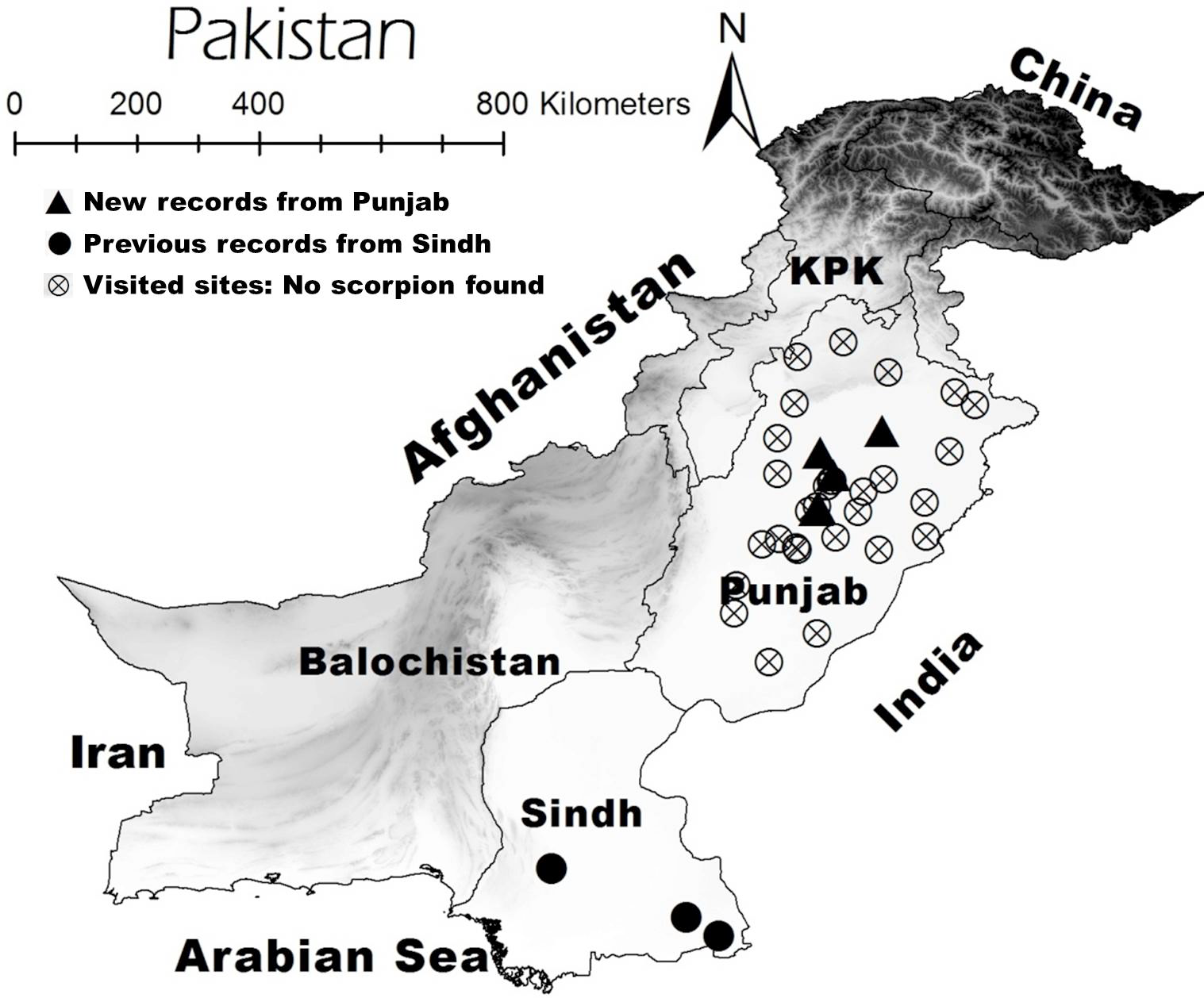
Map showing the distribution of A. finitimus from Pakistan.
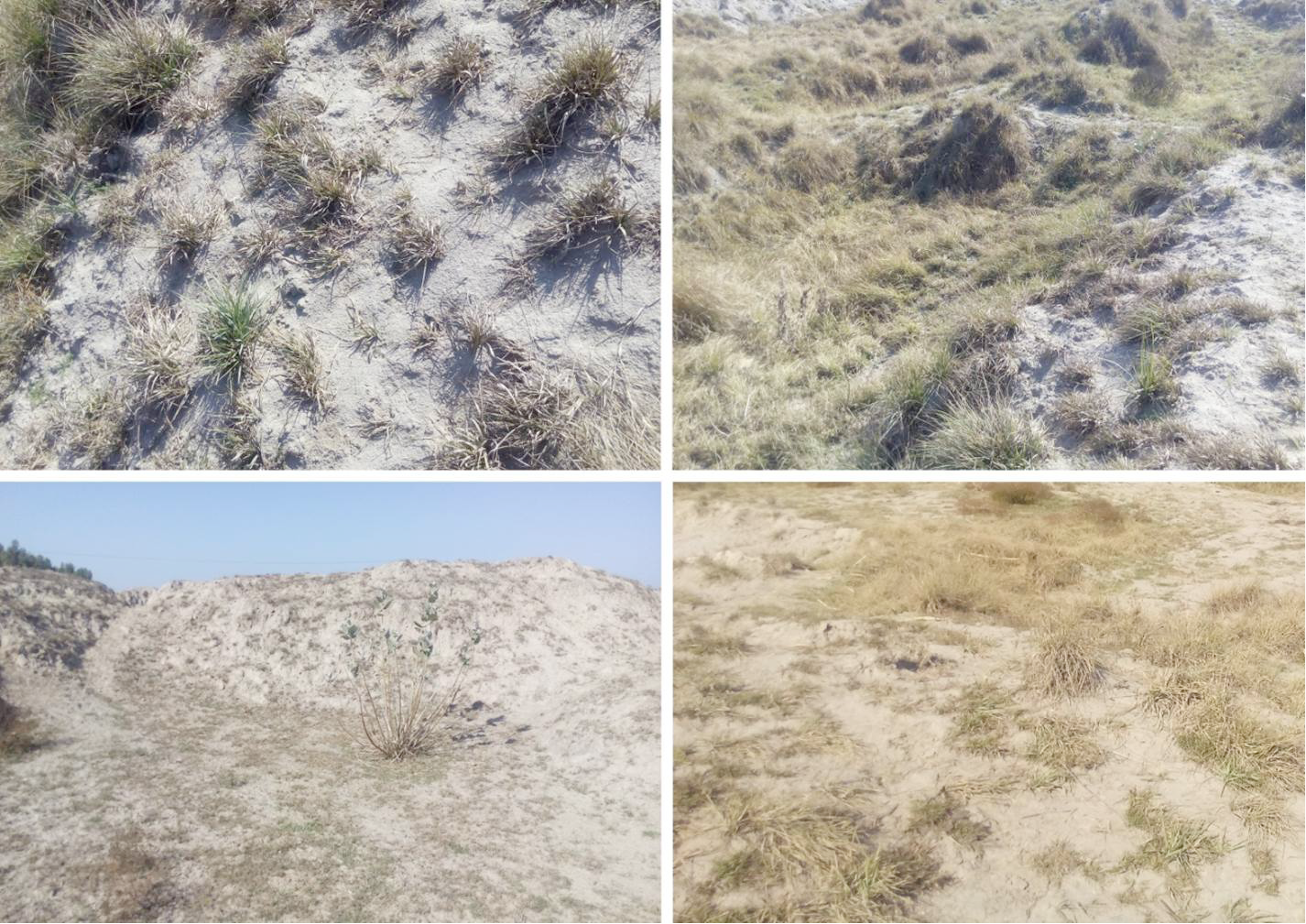
Field photographs showing particular habitats of the scorpion species Androctonus finitimus in the study area of the Punjab Province, Pakistan.
References
- Ahsan, M.A., Tahir, H.M., Mukhtar, M.K., Ali, A., Kahan, Z.I. and Ahmed, K., 2016a. Intra- and inter-specific foraging in three scorpion species. Punjab Univ. J. Zool., 31: 69-76.
- Ahsan, M.M., Tahir, H.M. and Mukhtar, M.K., 2016b. Effect of lunar cycle on active population density of scorpions, their potential prey and predators. Punjab Univ. J. Zool., 31: 159-163.
- Buskirk, R.E., Frohlich, C. and Ross, K.G., 1984. The natural selection of sexual cannibalism. Am. Natural., 123: 612-625. https://doi.org/10.1086/284227[CrossRef]
- Cheong, A., Li, J., Sukumar, P., Kumar, B., Zeng, F., Riches, K., Munsch, C. and Wood, I.C., 2010. Potent suppression of vascular smooth muscle cell migration and human neointimal hyperplasia by KV1.3 channel blockers. Cardiovasc. Res., 89: 282-289. https://doi.org/10.1093/cvr/cvq305[CrossRef]
- Gomes, A., Bhattacharjee, P., Mishra, R., Biswas, A. K., Dasgupta, S.C. and Giri, B., 2010. Anticancer potential of animal venoms and toxins. Indian, J. exp. Biol., 48: 93-103.
- Harrison, P.L., Abdel-Rahman, M.A., Miller, K. and Strong, P.N., 2014. Antimicrobial peptides from scorpion venoms. Toxicon, 88: 115-137. https://doi.org/10.1016/j.toxicon.2014.06.006[CrossRef]
- Kovařík, F., 2000. Revision of family Scorpiopidae (Scorpiones), with descriptions of six new species. Acta Soc. Zool. Bohemicae, 64: 153-201.
- Kovařík, F., 2004. Revision and taxonomic position of genera Afghanorthochirus Lourenco and Vachon, Baloorthochirus Kovařík, Butheolus Simon, Nanobuthus Pocock, Orthochiroides Kovařík, Pakistanorthochirus Lourenco, and Asian Orthochirus Karsch, with descriptions of twelve new species (Scorpiones, Buthidae). Euscorpius, 16: 1-33.
- Kovařík, F., 2007. A revision of the genus Hottentotta Birula, 1908, with descriptions of four new species (Scorpiones, Buthidae). Euscorpius, 58: 1-107.
- Kovařík, F. and Ahmed, Z., 2013. A review of Androctonus finitimus (Pocock, 1897), with description of two new species from Pakistan and India (Scorpiones, Buthidae). Euscorpius, 168: 1-10.
- Kovařík, F. and Fet, V., 2006. Taxonomic position of the genus Sassanidotus Farzanpay, 1987 (Scorpiones: Buthidae). Euscorpius, 39: 1-9.
- Lourenco, W.R. and Vachon, M., 1997. Un nouveau genre et quatre nouvelles especes de scorpions (Buthidae) du Moyen-Orient. Zoosystema, 19: 327-336.
- Lourenco, W.R. and Monod, L., 1998. Redescription of Compsobuthus rugosulus (Pocock, 1900) (Scorpiones, Buthidae) based on specimens from Pakistan. Rev. Suisse Zool., 105: 789-796. https://doi.org/10.5962/bhl.part.80057[CrossRef]
- Lourenco, W.R., 2005. New taxonomic considerations on the species of the genus Androctonus Ehrenberg, 1828 and description of two new species (Scorpiones, Buthidae). Rev. Suisse Zool., 112: 145-171. https://doi.org/10.5962/bhl.part.80291[CrossRef]
- Lowe, G., Kutcher, S.R. and Edwards, D., 2003. A powerful new light source for ultraviolet detection of scorpions in the field. Euscorpius, 8: 1-7.
- Menez, A., 1998. Functional architectures of animal toxins: A clue to drug design? Toxicon, 36: 1557-1572. https://doi.org/10.1016/S0041-0101(98)00148-2[CrossRef]
- Ozkan, O., Adiguzel, S., Yakistiran, S., Kar, S., Cesaretli, Y. and Karaer, K.Z., 2007. Determination of potency and paraspecific effects of Androctonus crassicauda (Olivier, 1807) antivenom against Mesobuthus gibbosus (Brulle, 1832) venom (Scorpiones: Buthidae). J. Venom Anim. Toxins trop. Dis., 13: 500-508. https://doi.org/10.1590/S1678-91992007000200008[CrossRef]
- Peretti, A.V., Acosta, L.E. and Benton, T., 1999. Sexual cannibalism in scorpions: Fact or fiction? Biol. J. Linnean Soc., 68: 485-496. https://doi.org/10.1111/j.1095-8312.1999.tb01184.x[CrossRef]
- Pocock, R.I., 1900. Arachnida. In: The fauna of British India including Ceylon and Burma (ed. W.T. Blandford). Taylor & Francis, London, pp. 279.
- Rein, J.O., 2017. The scorpion files. Norwegian University of Science and Technology, Høgskoleringen 1, 7491 Trondheim, Norway. http://www.ntnu.no/ub/scorpion-files/
- Tahir, H.M. and Prendini, L., 2014. Redescription of Heterometrus latimanus and confirmation of the genus Heterometrus (Scorpiones: Scorpionidae) in Pakistan. Am. Mus. Novit., 3805: 23. https://doi.org/10.1206/3805.1[CrossRef]
- Tahir, H.M., Navidpour, S. and Prendini, L., 2014. First reports of Razianus (Scorpiones: Buthidae) from Iraq and Pakistan, descriptions of two new species, and redescription of Razianus zarudnyi. Am. Mus. Novit., 3806: 26. https://doi.org/10.1206/3806.1[CrossRef]
- Tikader, B.K. and Bastawade, D.B., 1983. The fauna of India: Scorpions: Scorpionida: Arachnida. Zoological Survey of India, Calcutta, pp. 671.
- Zlotkin, E., Fishman, Y. and Elazar, M., 2000. AaIT: From neurotoxin to insecticide. Biochimie, 82: 869-881. https://doi.org/10.1016/S0300-9084(00)01177-9[CrossRef]
Services
Article usage statistics
Loading…