
Abstract | In this study, cellulase enzyme production was assessed by pretreating cotton stalk with dilute sulphuric acid which was optimized through response surface methodology. Pretreatment conditions were optimized using three variable with three levels like sulfuric acid concentrations (0.6%, 0.8%, 1% v/v), biomass loading (5%, 10%, 15% w/v), and residence time (4, 6 and 8h). After pretreatment process, cellulase production was achieved by solid substrate which was conducted in 250mL capacity Erlenmeyer flask in which incubation of Bacillus subtilis was carried out for 24 h of fermentation period at temperature of 50oC. Results showed that cellulase production was greatly affected by the thermochemical pretreatment as compared to the chemical pretreatment. At the pretreatment condition of 1% H2SO4 conc, 6h residence time, 15% substrate concentration maximum CMCase production (0.858 IU/ml/min) was obtained while at pretreatment conditions of 1% H2SO4 concentration, 8h residence time, 10% substrate concentration at room temperature followed by routine autoclaving, FPase production up to 0.876 IU/ml/min was recorded. The results of present study were found significant. The cellulase enzyme produced in this process affectively hydrolyzes the pretreated substrate at temperature of 50oC and 53 h of incubation period by releasing reducing sugars of 0.74 mg/ml. This study ensures the effective usage of lignocellulosic biomass at large scale biofuel production.
Research Article · Volume 33, Issue 1, 16 May 2018 · Open Access
Dilute Sulphuric Acid Pretreatment Optimization of Cotton Stalk for Cellulase Production through Box-Bhenken Design
· · ·
Affiliations & Notes ⌄
- 1Microbial Biotechnology Laboratory, Department of Zoology, University of the Punjab, New Campus Lahore 54590, Pakistan 2Department of Biotechnology, University of Sargodha, Sargodha, Pakistan , *Corresponding author: Muhammad Irfan, m.irfan@uos.edu.pk
- 2irfan.biotechnologist@gmail.com
Article Info ⌄
- Journal:
- Punjab University Journal of Zoology
- Published:
- 16 May 2018

From the article
- Box-Bhenken design results (Tables III, IV) revealed that under pretreatment conditions of 15% substrate concentration, 1% H2SO4, and time of 6 h.
- The highest FPase production (0.876 IU/ml/min) was noted with pretreatment condition of 1% H2SO4, 10% substrate concentration and residence time of 10h followed by steaming.
- Results of this study concluded that H2SO4 pretreatment is efficient for cellulase production by Bacillus subtilis in submerged fermentation.
- The produced cellulase effectively hydrolyzed the pretreated substrate for sugar production which could be utilized for fermentation process for the production of different compounds like bioethanol.
Selected from the article's own text.
Abstract
Introduction
Structural complexity and rigidity of lignocellulosic substrate have given rise to the diverse variety of degradative enzyme - the cellulases (Bayer et al., 1998). A great deal of variety of lignolytic microorganisms mainly fungi and bacteria are identified and isolated among them Trichoderma reesei and its mutants, white rot fungi an efficient lignin degraders and Phanerochaete chrysosporium are most commonly used forcellulose and hemicellulases production ; ; ; ; . The bond beta-1, 4-d-glucan in cellulose basically breaks down by the enzyme cellulases and glucose, cellobiose and cello-oligosaccharides produce as primary product.
Cellulose degradation is achieved by several methods. One of the important methods is the use of cellulase which includes three types of enzyme that degrade cellulose, by a phenomenon of synergism . These three enzymes are endo-glucanases (EG), cellobiohydrolases also called exoglucanases (CBH) and β-glucosidases (BGL). Endo-glucanases and cellobiohydrolases by attacking on the reducing and non-reducing end of the cellulose structure produces the nicks at internal sites, oligosaccharides and new chain ends and cello-oligosaccharides and cellobiose respectively and glucosidases complete the hydrolysis by hydrolyzing the cellobiose and soluble cellodextrins to liberate glucose .
Cellulases are produced by microorganisms when grown on cellulosic materials . Global production of cellulase enzymes has great interest in research field. One of the major concerns is low titers of cellulase production. Multifaceted approaches are adopted to improve enzyme production, such as for substrate using inexpensive raw materials, bioengineering the microorganisms, effective bioprocess technologies, etc. ; .
Cellulase secretion is largely effected by the lignocellulosic substrate. Some substrates not required any specific inducers to enhance the synthesis of lignocellulolytic enzyme . Solid state and submerged fermentation techniques are most commonly used for cellulase production. The SSF is carried out in absence of free water as it is close to the natural environment to produces the high titers of enzyme ; .
Various parameters effected the cellulase production like the kind of the substrate, medium pH, nutrient availability, temperature of the fermentation, supply of inducer etc. Cellolulytic organisms like fungal species Trichoderma, Penicillium, Humicola and Aspergillus . Due to the capacity of producing the large quantities of extracellular enzyme Bacillus sp. is considered one of the important species due to their capacity of producing of large quantities of enzymes . Bacillus sphaericus and Bacillus subtilis both species are reported to express high cellulose degradation activities ; .
Table I: Coded and actual levels of the factors for three factors Box-Behnken design.
| Independent variables | Symbols | Coded and actual values | ||
| -1 | 0 | +1 | ||
| Acid concentration (%) | X1 | 0.6 | 0.8 | 1.0 |
| Substrate concentration (%) | X2 | 5 | 10 | 15 |
| Time (Hours) | X3 | 4 | 6 | 8 |
Response surface methodology (RSM) is empirical and statistical analysis widely used for analyzing and modeling the problems by studying the aggregated effect of the several variables, mathematical technique in which several variables influences the response of interst ; . It is used for optimization of different steps in the multivariable systems. Quantification of input levels and levels of selected response is carried out by using design of experiment. Box-Bhenken and central composite designs are common designs of RSM ; . The objective of the present study was production of cellulase enzyme from pretreated cotton stalk and its application in saccharification process.
Materials and Methods
Microbial strain
Bacillus subtilis K-18 was taken from repository of Microbial Biotechnology Laboratory and revive on nutrient agar plates and then used in present study.
Pretreatment of cotton stalk
Cotton stalk was collected from field of Shahkot, District Nankana, Punjab, Pakistan. Cotton stalks was washed to remove dust, then sundried for seven days and then oven drying at 70oC for 1 day. The dried cotton stalk was cut into small pieces and turn into powdered form. Pretreatment of powdered cotton stalk was performed as discussed earlier .
Fermentation methodology
Cellulase enzyme production was carried out in 25ml of fermentation medium (1% yeast extract and 2% pretreated substrate, pH of 5) in the 250ml capacity of Erlenmeyer flask. This medium was autoclaved and then flasks were inoculated employing 2% (v/v) of inoculum. The culture was incubated at 50°C with shaking 120 rpm for of 24 h. The cultures were filtered by muslim cloth at the end of fermentation period. After filtration, to obtain the clear filterate as crude source of enzyme, the filtrate obtained by muslim cloth was centrifuged at 10,000 rpm for 10 min at 4°C were carried out. Each fermentation experiments were carried out in triplicate.
Cellulase assay
CMCase and FPase were determined as described in our earlier reports . One unit of CMCase or FPase activity defined as the amount of enzyme required to liberate one micromole of glucose from substrate per milliliter per minute under standard assay conditions.
Experimental design
For cellulase production optimization of different pretreatment conditions was carried out by Box-Bhenken design (BBD) with three variables i.e., sulfuric acid con (X1), substrate con, (X2) and time (X3) (Table I). The response was calculated using STATISTICA software.
Results and Discussion
In this study dilute acid pretreatment of cotton stalk was performed with three factors i.e. dilute sulphuric acid concentration (X1), substrate concentration (X2) and residence time (X3) with three levels as mentioned in Table I. After pretreatment, the solid residue was washed up to neutrality, dried and further used for the production of cellulase in submerged fermentation by Bacillus subtilisin at 50oC for 24 h. The experiments were conducted according to Box-Bhenken design of response surface methodology.
The calculation of the response was carried out according to polynomial regression equations (Equations 1 to 4). The cellulase enzyme production was found minimum in acid treated cotton stalk while acid followed by steam treated cotton stalk. In case of cellulase production, during fermentation process nature of substrate play a key role in influencing the production of enzyme . Box-Bhenken design results (Tables III, IV) revealed that under pretreatment conditions of 15% substrate concentration, 1% H2SO4, and time of 6 h. Maximum CMCase activity of 0.885 IU/ml/min was obtained. The highest FPase production (0.876 IU/ml/min) was noted with pretreatment condition of 1% H2SO4, 10% substrate concentration and residence time of 10h followed by steaming. Close matching of the observed and predicted values showed the accuracy of model.
Table II: Cellulase production by H2SO4 treated cotton stalk using Box-Bhenken design.
| Run No. | X1 | X2 | X3 | CMCase activity (IU/ml/min) | FPase activity (IU/ml/min) | ||||
| Observed | Predicted | Residual | Observed | Predicted | Residual | ||||
| 1 | 0.8 | 10 | 6 | 0.322 | 0.322 | 0.000 | 0.148 | 0.148 | 0.000 |
| 2 | 1.0 | 10 | 8 | 0.246 | 0.226 | 0.020 | 0.219 | 0.211 | 0.008 |
| 3 | 1.0 | 15 | 6 | 0.303 | 0.289 | 0.013 | 0.129 | 0.167 | -0.037 |
| 4 | 1.0 | 10 | 4 | 0.310 | 0.291 | 0.018 | 0.156 | 0.141 | 0.0147 |
| 5 | 1.0 | 5.0 | 6 | 0.124 | 0.177 | -0.052 | 0.266 | 0.251 | 0.0149 |
| 6 | 0.6 | 15 | 6 | 0.231 | 0.178 | 0.052 | 0.195 | 0.210 | -0.014 |
| 7 | 0.8 | 5.0 | 4 | 0.151 | 0.117 | 0.034 | 0.100 | 0.130 | -0.029 |
| 8 | 0.6 | 10 | 8 | 0.162 | 0.181 | -0.018 | 0.118 | 0.132 | -0.014 |
| 9 | 0.8 | 15 | 8 | 0.137 | 0.172 | -0.034 | 0.142 | 0.112 | 0.029 |
| 10 | 0.6 | 10 | 4 | 0.151 | 0.172 | -0.020 | 0.180 | 0.188 | -0.008 |
| 11 | 0.6 | 5.0 | 6 | 0.110 | 0.123 | -0.013 | 0.214 | 0.176 | 0.037 |
| 12 | 0.8 | 5.0 | 8 | 0.078 | 0.046 | 0.032 | 0.098 | 0.121 | -0.023 |
| 13 | 0.8 | 15 | 4 | 0.126 | 0.158 | -0.032 | 0.113 | 0.089 | 0.023 |
Table III: Cellulase production by H2SO4 followed by steam treated cotton stalk using Box-Bhenken design.
| Run No. | X1 | X2 | X3 | CMCase activity (IU/ml/min) | FPase activity (IU/ml/min) | ||||
| Observed | Predicted | Residual | Observed | Predicted | Residual | ||||
| 1 | 0.8 | 10 | 6 | 0.800 | 0.800 | 0.000 | 0.695 | 0.695 | 0.000 |
| 2 | 1.0 | 10 | 8 | 0.754 | 0.758 | -0.003 | 0.876 | 0.751 | 0.124 |
| 3 | 1.0 | 15 | 6 | 0.885 | 0.858 | 0.027 | 0.341 | 0.415 | -0.074 |
| 4 | 1.0 | 10 | 4 | 0.784 | 0.775 | 0.009 | 0.344 | 0.314 | 0.030 |
| 5 | 1.0 | 5 | 6 | 0.744 | 0.777 | -0.032 | 0.348 | 0.429 | -0.080 |
| 6 | 0.6 | 15 | 6 | 0.762 | 0.730 | 0.032 | 0.789 | 0.708 | 0.080 |
| 7 | 0.8 | 5 | 4 | 0.684 | 0.660 | 0.023 | 0.628 | 0.577 | 0.050 |
| 8 | 0.6 | 10 | 8 | 0.645 | 0.654 | -0.009 | 0.657 | 0.687 | -0.030 |
| 9 | 0.8 | 15 | 8 | 0.731 | 0.754 | -0.023 | 0.738 | 0.788 | -0.050 |
| 10 | 0.6 | 10 | 4 | 0.620 | 0.616 | 0.003 | 0.695 | 0.820 | -0.124 |
| 11 | 0.6 | 5 | 6 | 0.616 | 0.643 | -0.027 | 0.652 | 0.578 | 0.074 |
| 12 | 0.8 | 5 | 8 | 0.587 | 0.551 | 0.036 | 0.660 | 0.704 | -0.043 |
| 13 | 0.8 | 15 | 4 | 0.587 | 0.624 | -0.036 | 0.654 | 0.610 | 0.043 |
Equations for chemical treated cotton stalk
CMCase activity (IU/ml/min) = -1.383+ 1.06 X1+ 0.0740 X2+ 0.2693 X3- 0.453 X12 - 0.00449 X22- 0.02168 X32+ 0.0145 X1*X2 - 0.0466 X1*X3+ 0.00210 X2 X3 ……….. (Eq. 1)
FPase activity (IU/ml/min) = 0.879 - 2.308 X1 + 0.0172 X2 + 0.0327 X3 + 1.358 X12 - 0.000036 X22 - 0.00846 X32 - 0.0296 X1*X2 + 0.0784 X1*X3 + 0.00078 X2*X3 ……….. (Eq. 2)
Equations for thermochemical treated cotton stalk
CMCase activity (IU/ml/min) = -0.446 + 0.424 X1+ 0.0140 X2+ 0.2754 X3 + 0.078 X12- 0.002028 X22 - 0.02543 X32 - 0.0014 X1*X2 - 0.0345 X1*X3+ 0.00600 X2*X3 ……….. (Eq. 3)
FPase activity (IU/ml/min) = 0.94 + 1.47 X1+ 0.0813 X2- 0.388 X3- 2.38 X12- 0.00272 X22 + 0.0107 X32 - 0.0360 X1*X2 + 0.356 X1*X3 + 0.00130 X2*X3 ……….. (Eq. 4)
All the response (CMCase and FPase activity) calculated was statistical analyzed with analysis of variance and results revealed for CMCase production, the proposed model was found significant in both treatments (H2SO4 treatment and H2SO4 followed steam treatment) while the model was not significant for FPase production. In H2SO4 treated cotton stalks the F and P value of the CMCase model was 4.75 and 0.050 while in H2SO4 followed by steam treated cotton stalks the values was 7.99 and 0.017, respectively. Coefficient of determination (R2 value) of treated (89.54 %) and H2SO4 followed by steam treated (93.50%) further confirmed the fitness of the model by accurately showing the predicting response. Furthermore, the model also supported by adjusted R2 value of 70.71% (H2SO4 treated) and 81.80% (H2SO4 followed by steam treated).
These results indicated that pretreatment of substrate is very effective in conversion of raw materials into valuable products with aid of microbes. In previous study, pretreatment of rice straw with 0.5M KOH followed by 0.1N H2SO4 yielded better CMCase activity from Bacillus sp. 313SI . Ghazanfar et al. (2018) reported maximum FPase production from B. subtilis K-18 when substrate Sacharum spontaneum pretreated with 1% H2SO4, substrate concentration of 10% and 4h of residence time followed by autoclaving. Anjum et al. (2017) obtained highest yield of cellulase from acacia dust pretreated with 0.8% H2SO4, 4 h residence time and 15% substrate concentration. Similarly, peanut shells treated with 0.6% and 0.8% H2SO4yielded maximum CMCase and FPase production by B. subtilis K-18 in submerged fermentation, respectively . Eucalyptus leaves treated with 0.8% and 1.0% H2SO4 gave maximum titer of CMCase and FPase production using B. subtilis K-18 in submerged fermentation, respectively . Arooj et al. (2017) stated that banana peduncle produced best cellulase under optimized pretreatment conditions of 0.4N H2SO4, substrate concentration of 15% and soaking time of 6h. Another study reported that pretreatment effectively improved cellulase production revealing correlation between physiochemical properties of substrates and enzyme production .
Table IV: ANOVA of chemical (H2SO4) and thermochemical treated cotton stalk.
| Sources | DF | Adj SS | Adj MS | F value | P value | |
| Chemical (H2SO4) treated | ||||||
| CMCase (IU/ml/min) | Model | 9 | 0.102398 | 0.011378 | 4.75 | 0.050 |
| Linear | 3 | 0.029160 | 0.009720 | 4.06 | 0.083 | |
| X1 | 1 | 0.013474 | 0.013474 | 5.63 | 0.064 | |
| X2 | 1 | 0.014046 | 0.014046 | 5.87 | 0.060 | |
| X3 | 1 | 0.001639 | 0.001636 | 0.68 | 0.446 | |
| Square | 3 | 0.069242 | 0.023081 | 9.65 | 0.016 | |
| X12 | 1 | 0.001210 | 0.001210 | 0.51 | 0.509 | |
| X22 | 1 | 0.046529 | 0.046529 | 19.45 | 0.007 | |
| X32 | 1 | 0.027778 | 0.027778 | 11.61 | 0.019 | |
| 2 Way interaction | 3 | 0.003997 | 0.001332 | 0.56 | 0.666 | |
| X1*X2 | 1 | 0.000839 | 0.000839 | 0.35 | ||
| X1*X3 | 1 | 0.001387 | 0.001387 | 0.58 | ||
| X2*X3 | 1 | 0.001770 | 0.001770 | 0.74 | ||
| Error Lack of fit Pure error | 5 3 2 | 0.011964 0.011964 0.000000 | 0.002393 0.003988 | |||
| Total | 14 | 0.114362 | 0.000000 | |||
| FPase (IU/ml/min) | Model | 9 | 0.025788 | 0.002865 | 2.12 | 0.210 |
| Linear | 3 | 0.001837 | 0.000612 | 0.45 | 0.726 | |
| X1 | 1 | 0.000500 | 0.000500 | 0.37 | 0.569 | |
| X2 | 1 | 0.001239 | 0.001239 | 0.92 | 0.382 | |
| X3 | 1 | 0.000098 | 0.000098 | 0.07 | 0.798 | |
| Square | 3 | 0.016279 | 0.005426 | 4.02 | 0.084 | |
| X12 | 1 | 0.010892 | 0.010892 | 8.08 | 0.036 | |
| X22 | 1 | 0.00003 | 0.000003 | 0.00 | 0.964 | |
| X32 2 way interaction | 1 3 | 0.004226 0.007672 | 0.004226 0.002557 | 3.13 1.90 | 0.137 0.248 | |
| X1*X2 | 1 | 0.003494 | 0.003494 | 2.59 | 0.168 | |
| X1*X3 | 1 | 0.003936 | 0.003936 | 2.92 | 0.148 | |
| X2*X3 | 1 | 0.000242 | 0.000242 | 0.18 | 0.689 | |
| Error Lack of fit Pure error | 5 3 2 | 0.006743 0.006743 0.000000 | 0.001349 0.002248 | |||
| Total | 14 | 0.032531 | 0.000000 | |||
| Thermochemical treated | ||||||
| CMCase (IU/ml/min) | Model | 9 | 0.109443 | 0.012160 | 7.99 | 0.017 |
| Linear | 3 | 0.048495 | 0.016165 | 10.63 | 0.013 | |
| X1 | 1 | 0.034350 | 0.034350 | 22.58 | 0.005 | |
| X2 | 1 | 0.013931 | 0.013931 | 9.16 | 0.029 | |
| X3 | 1 | 0.000214 | 0.000214 | 0.14 | 0.723 | |
| Square | 3 | 0.045775 | 0.015258 | 10.03 | 0.015 | |
| X12 | 1 | 0.000036 | 0.000036 | 0.02 | 0.884 | |
| X22 | 1 | 0.009490 | 0.009490 | 6.24 | 0.055 | |
| X32 | 1 | 0.038218 | 0.038218 | 25.12 | 0.004 | |
| 2 Way interaction | 3 | 0.015173 | 0.005058 | 3.32 | 0.114 | |
| X1*X2 | 1 | 0.000008 | 0.000008 | 0.01 | 0.946 | |
| X1*X3 | 1 | 0.000761 | 0.000761 | 0.50 | 0.511 | |
| X2*X3 | 1 | 0.014404 | 0.014404 | 9.47 | 0.028 | |
| Error Lack of fit Pure error | 5 3 2 | 0.007606 0.007606 0.000000 | 0.007606 0.007606 0.000000 | |||
| Total | 14 | 0.117049 | 0.117049 | |||
| Sources | DF | Adj SS | Adj MS | F value | P value | |
| Thermochemical treated | ||||||
| FPase (IU/ml/min) | Model Linear | 9 3 | 0.296322 0.151086 | 0.032925 0.050362 | 2.50 3.83 | 0.163 0.091 |
| X1 | 1 | 0.097806 | 0.097806 | 7.43 | 0.041 | |
| X2 | 1 | 0.006805 | 0.006805 | 0.52 | 0.504 | |
| X3 Square | 1 3 | 0.046475 0.058044 | 0.046475 0.019348 | 3.53 1.47 | 0.119 0.329 | |
| X12 | 1 | 0.033334 | 0.033334 | 2.53 | 0.172 | |
| X22 | 1 | 0.017100 | 0.017100 | 1.30 | 0.306 | |
| X32 2 way interaction | 1 3 | 0.006715 0.087191 | 0.006715 0.029064 | 0.51 2.21 | 0.507 0.205 | |
| X1*X2 | 1 | 0.005194 | 0.005194 | 0.39 | 0.557 | |
| X1*X3 | 1 | 0.081325 | 0.081325 | 6.18 | 0.055 | |
| X2*X3 | 1 | 0.000672 | 0.000672 | 0.05 | 0.830 | |
| Error Lack of fit Pure error | 5 3 2 | 0.065803 0.065803 0.000000 | 0.013161 0.021934 | |||
| Total | 14 | 0.362125 | 0.000000 | |||
The cellulase enzyme produced from these pretreated substrates was further used for enzymatic hydrolysis of best treated substrate (having maximum total phenolic compounds liberation). The enzymatic hydrolysis was performed at 50oC, pH 5.0 for various time periods to check the optimum time for maximum reducing sugar production. Results (Figure 3) reveals that reducing sugar production was increased with increase in time period, but maximum reducing sugar production was achieved at 53 h of incubation period. Various studies reported different optimum time for saccharification of various substrates like 8h for wheat straw (Asghar et al., 2014), pine needles , 72h for rice straw and 105 h for disposable wooden chopsticks .
Conclusion
Results of this study concluded that H2SO4 pretreatment is efficient for cellulase production by Bacillus subtilis in submerged fermentation. The produced cellulase effectively hydrolyzed the pretreated substrate for sugar production which could be utilized for fermentation process for the production of different compounds like bioethanol.
Acknowledgement
Authors are thankful to the technical staff of the Microbial Biotechnology Lab of Department of Zoology, University of the Punjab, New Campus, Lahore, Pakistan.
Conflicts of interest
The authors declare no conflicts of interest.
Figures
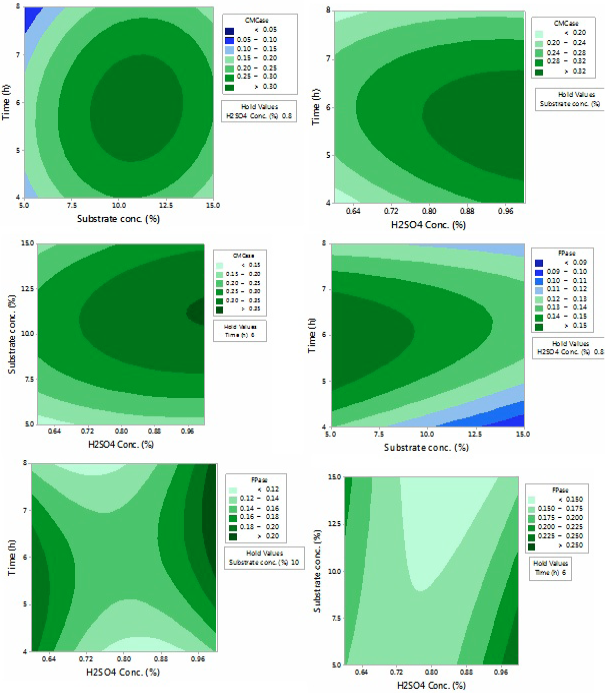
CMCase (IU/ml/min) and FPase (IU/ml/min) production from H2SO4 treated cotton stalk.
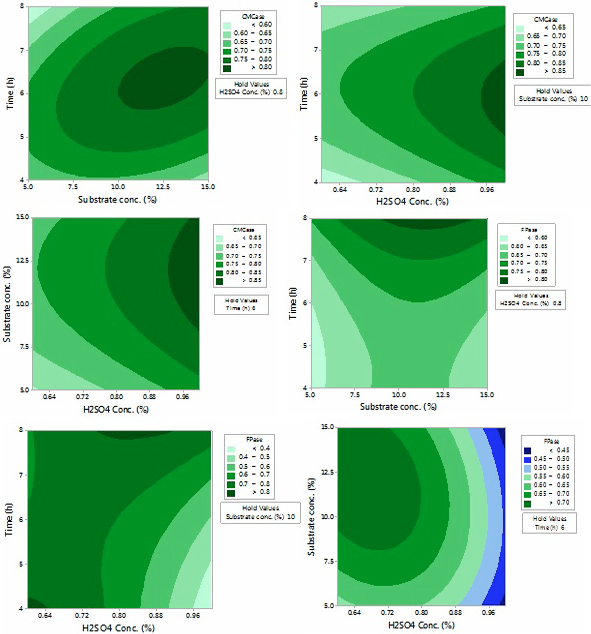
CMCase (IU/ml/min) and FPase (IU/ml/min) production from H2SO4 steam treated cotton stalk.
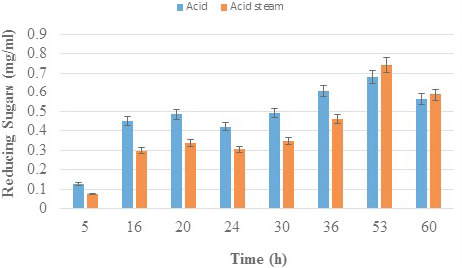
Enzymatic hydrolysis of H2SO4 and H2SO4 followed by steam treated cotton stalks.
References
- Anjum, A., Irfan, M., Tabassum, F., Shakir, H.A. and Qazi, J.I., 2017. Optimization of sulphuric acid pretreatment of Acacia saw dust through box-bhenken design for cellulase production by B. subtilis K-18. Adv. Life Sci., 5: 19-24.
- Arooj, A., Irfan, M., Tabassum, F., Shakir, H.A. and Qazi, J.I., 2017. Effect of dilute sulphuric acid pretreatment on cellulase production by Bacillus subtilis K-18 through response surface methodology. Proc. Pak. Acad. Sci. B: Life environ. Sci., 54: 11-20.
- Arshad, F., Irfan, M., Tabassum, F., Shakir, H.A. and Qazi, J.I., 2017. Optimization of dilute sulphuric acid pretreatment of peanut shells through Box- Bhenken design for cellulase production by Bacillus subtilis K-18. Punjab Univ. J. Zool., 32: 81-90.
- Asghar, U., Irfan, M., Iram, M., Huma, Z., Nelofer, R., Nadeem, M. and Syed, Q., 2015. Effect of alkaline pretreatment on delignification of wheat straw. Nat. Prod. Res., 29: 125-131. https://doi.org/10.1080/14786419.2014.964712[CrossRef]
- Baldrian, T. and Gabriel, J., 2003. Lignocellulose degradation by Pleurotus ostreatus in the presence of cadmium. FEMS Microbiol. Lett., 220: 235-240. https://doi.org/10.1016/S0378-1097(03)00102-2[CrossRef]
- Bas, D. and Boyaci, I.H., 2007. Modeling and optimization I: Usability of response surface methodology. J. Fd. Engg., 78: 836-845. https://doi.org/10.1016/j.jfoodeng.2005.11.024[CrossRef]
- Bayer, E.A., Chanzy, H., Lamed, R. and Shoham, Y., 1998. Cellulose, cellulases and cellulosomes. Curr. Opin. Struc. Biol., 8: 548-557. https://doi.org/10.1016/S0959-440X(98)80143-7[CrossRef]
- Brijwani, K. and Vadlani, P.V., 2011. Cellulolytic enzymes production via solid-state fermentation: Effect of pretreatment methods on physicochemical characteristics of substrate. Enzyme Res., 2011: 860134. https://doi.org/10.4061/2011/860134[CrossRef]
- Cen, P. and Xia, L., 1999. Production of cellulase by solid-state fermentation. Adv. Biochem. Engg. Biotechnol., 65: 69-92. https://doi.org/10.1007/3-540-49194-5_4[CrossRef]
- Elisashvili, V., Kachlishvili, E., Tsiklauri, N., Metreveli, E., Khardziani, T. and Agathos, S.N., 2009. Lignocellulose-degrading enzyme production by white-rot Basidiomycetes isolated from the forests of Georgia. World J. Microbiol. Biotechnol., 25: 331-339. https://doi.org/10.1007/s11274-008-9897-x[CrossRef]
- Falcón, M.A., Rodríguez, A., Carnicero, A., Regalado, V., Perestelo, F., Milstein, O. and Fuente, G.D., 1995. Isolation of microorganisms with lignin transformation potential from soil of Tenerife Island. Soil Biol. Biochem., 27: 121-126. https://doi.org/10.1016/0038-0717(94)00174-Y[CrossRef]
- Ghazanfar, M., Irfan, M., Tabassum, F., Shakir, H.A. and Qazi, J.I., 2018. Effect of different pretreatment conditions on cellulase production by Bacillus subtilis K-18 through Box-Bhenken Design. Iranian J. Sci. Technol., https://doi.org/10.1007/s40995-017-0463-y[CrossRef]
- Goyal, V., Singh, G., Mittal, A., Yadav, A., Bhuwal, A.K. and Aggarwal, N.K., 2014. Parametric Optimization of cultural conditions for carboxymethyl cellulase production using pretreated rice straw by Bacillus sp. 313SI under stationary and shaking conditions. Biotechnol. Res. Int., 2014: Article ID 651839. https://doi.org/10.1155/2014/651839[CrossRef]
- Iqbal, S., Irfan, M., Tabassum, F., Shakir, H.A. and Qazi, J.I., 2017. Application of Box-Bhenken design for optimization of different pretreatment conditions for cellulase production. J. Northeast Agric. Univ., 24: 51-59.
- Iqbal, H.M.N., Asgher, M., Ahmed, I. and Hussain, S., 2010. Media optimization for hyper-production of carboxymethyl cellulase using proximally analyzed agro-industrial residue with Trichoderma harzianum under SSF. Int. J. Agro Vet. med. Sci., 4: 47-55.
- Irfan, M., Gulsher, M., Abbas, S., Syed, Q., Nadeem, M. and Baig, S., 2011. Effect of various pretreatment conditions on enzymatic saccharification. Songklanakarin J. Sci. Technol., 33: 397-404.
- Irfan, M., Mushtaq, Q., Tabassum, F., Shakir, H.A. and Qazi, J.I., 2017. Carboxymethyl cellulase production optimization from newly isolated thermophilic Bacillus subtilis K-18 for saccharification using response surface methodology. AMB Exp., 7: 29. https://doi.org/10.1186/s13568-017-0331-3[CrossRef]
- Jha, K., Khare, S.K. and Gandhi, A.P., 1995. Solid-state fermentation of soyhull for the production of cellulase. Biores. Technol., 54: 321-322. https://doi.org/10.1016/0960-8524(95)00154-9[CrossRef]
- Kang, S.W., Park, Y.S., Lee, J.S., Hong, S.I. and Kim, S.W., 2004. Production of cellulases and hemicellulases by Aspergillus niger KK2 from lignocellulosic biomass. Biores. Technol., 91: 153-156. https://doi.org/10.1016/S0960-8524(03)00172-X[CrossRef]
- Khuri, A.I. and Cornell, J.A., 1987. Response Surfaces: Design and analysis. Marcel Dekker, New York.
- Kim, J.K., Oh, B.R., Shin, H.J., Eom, C.Y. and Kim, S.W., 2008. Statistical optimization of enzymatic saccharification and ethanol fermentation using food waste. Process Biochem., 43: 1308-1312. https://doi.org/10.1016/j.procbio.2008.07.007[CrossRef]
- Kshirsagar, S.D., Waghmare, P.R., Loni, P.C., Patil, S.A. and Govindwar, S.P., 2015. Dilute acid pretreatment of rice straw, structural characterization and optimization of enzymatic hydrolysis conditions by response surface methodology. RSC Adv., 5: 46525-46533. https://doi.org/10.1039/C5RA04430H[CrossRef]
- Lee, S.M. and Koo, Y.M., 2001. Pilot-scale production of cellulose using Trichoderma reesei Rut C-30 in fed-batch mode. J. Microbiol. Biotechnol., 11: 229-233.
- Lynd, L.R., Weimer, P.J. and van Zyl, W.H., 2002. Pretorius IS. Microbial cellulose utilization: fundamentals and biotechnology. Microbiol. Mol. Biol. Rev., 66: 506. https://doi.org/10.1128/MMBR.66.3.506-577.2002[CrossRef]
- Mawadza, C., Boogerd, F.C., Zvauya, R. and Van, H.W., 1996. Verseveld: Influence of environmental factors on endo-β- 1,4-glucanase production by Bacillus HR 68, isolated from a Zimbabwean hot spring. Antonie Van Leeuwenhoek, 69: 363-369. https://doi.org/10.1007/BF00399625[CrossRef]
- McCarthy, A.J., 1987. Lignocellulose-degrading actinomycetes. FEMS Microbiol. Lett., 46: 145-163. https://doi.org/10.1111/j.1574-6968.1987.tb02456.x[CrossRef]
- Montgomery, D.C., 2005. Design and analysis of experiments, 6th ed. John Wiley & Sons Inc., New York.
- Nascimento, R.P., Junior, N.A., Pereira, N., Bon, E.P.S. and Coelho, R.R.R., 2009. Brewer’s spent grain and corn steep liquor as substrates for cellulolytic enzymes production by Streptomyces malaysiensis. Lett. appl. Microbiol., 48: 529-535. https://doi.org/10.1111/j.1472-765X.2009.02575.x[CrossRef]
- Phummala, K., Imai, T., Reungsang, A., Higuchi, T., Sekine, M., Yamamoto, K. and Kanno, A., 2015. Optimization of enzymatic hydrolysis of wood waste by response surface methodology in fermentative hydrogen production. J. Water environ. Technol., 13: 153-166. https://doi.org/10.2965/jwet.2015.153[CrossRef]
- Robson, L.M. and Chambliss, G.H., 1989. Cellulases of bacterial origin. Enzyme Microb. Technol., 11: 626-644. https://doi.org/10.1016/0141-0229(89)90001-X[CrossRef]
- Singh, J., Batra, N. and Sobti, R.C., 2004. Purification and characterization of alkaline cellulase produced by a novel isolate Bacillus sphaericus JS1. J. Ind. Microbiol. Biotechnol., 31: 51-56. https://doi.org/10.1007/s10295-004-0114-0[CrossRef]
- Sukumaran, R.K., Singhania, R.R. and Pandey, A., 2005. Microbial cellulases production, applications and challenges. J. Sci. Ind. Res., 64: 832-844.
- Vicuňa, R., 1988. Bacterial degradation of lignin. Enzyme Microb. Technol., 10: 646-655. https://doi.org/10.1016/0141-0229(88)90055-5[CrossRef]
- Zimmermann, W., 1990. Degradation of lignin by bacteria. J. Biotechnol., 13: 119-130. https://doi.org/10.1016/0168-1656(90)90098-V[CrossRef]
Services
Article usage statistics
Loading…