
Balashark, Balantiocheilus melanopterus (Bleeker, 1850), has been discovered for the first time in the swamp inside Muara Angke Wildlife Reserve, Jakarta, Indonesia. Balashark in Indonesia is originally distributed in Sumatra and Kalimantan. However, the fish was collected in the public waters of Java which is not its distribution areas. Fishing gear used was gill net with a diameter of 2 inches”.The characteristics, morphometric and meristic records are supplemented with water quality information to supplement existing data.
Short Communication · Volume 54, Issue 6, 23 September 2022 · Open Access
First Record of Balashark, Balantiocheilos melanopterus (Bleeker, 1850), in the Muara Angke Wildlife Reserve, North Jakarta, Indonesia
· · · · ·
Affiliations & Notes ⌄
- 1Research Center for Biology, National Research and Innovation Agency (BRIN), Republic of Indonesia, Cibinong Science Center, Bogor 16911 2Research Center for Limnology, National Research and Innovation Agency (BRIN), Republic of Indonesia, Cibinong Science Center, Bogor 16911 * Corresponding author: gema_wahyudewantoro@yahoo.com
Article Info ⌄
- Journal:
- Pakistan Journal of Zoology
- Published:
- 23 September 2022

From the article
- The swamp where this study was conducted have overflowing water from the Angke river and depth of 1 to 3 meters.
- The collected balashark have a standard length of 142.24 mm and a total length of 180.71 mm (Fig. 2).
- The discovery of this species of fish in the waters of the Muara Angke Wildlife Reserve has two possibilities, that is because it spreads naturally or fish are released from the maintenance container.
- In addition, the balashark is known to be a freshwater fish species, while at the sampling location the influence of salinity in these waters was recorded.
Selected from the article's own text.
Abstract
Materials and methods
Balashark fish sample was collected in the Angke Swamp, Muara Angke Wildlife Reserve, Kapuk Muara Village, Penjaringan Subdistrict, North Jakarta City, Indonesia. on April 3, 2021 (Fig. 1). The coordinates of the location where this fish species was found are S 6°06’52.4” and E 106°46’01.7”. The fishing gear used was a gill net with a mesh size of 2 inches, which was plugged in using bamboo stakes at a depth of ± 3 meters, and for 2 h, from 9.00 to 11.00. The fish sample was fixed with 10% formalin solution and labeled collection. Furthermore, at the fish Laboratory in Bogor Zoological Museum, Research Center for Biology BRIN, the fish was washed with running water and preserved in 70% alcohol, after which it was identified based on Kottelat et al. (1993). Morphological characters such as morphometrics and meristics were analyzed with Affandi et al. (1992) and Turan (1999). The measurement process uses the Mitutoyo brand digital funnel with a precision of 0.01 mm.
Measurements of water quality were carried outusing the YSI Water Quality Checker and some chemical parameters were analyzed at the Hydrodynamic Laboratory, Research Center for Limnology-BRIN.
Results
The swamp where this study was conducted have overflowing water from the Angke river and depth of 1 to 3 meters. The physical conditions of the swamp included turbid, greenish water color, smelly and surrounding api-api trees Avicennia spp., bakau Rhizopora spp., nipah Nypha fruticans, nyamplung Calophyllum inophyllum, pidada Sonneratia caseolaris and waru laut Hibiscus tiliaceu.
Balashark fish collected along with several other species of fish namely bandeng Chanos chanos, belanak Planiliza tade, bulan-bulan Megalops cyprinoides, julung-julung Dermogenys pussila, paray Rasbora lateristriata, tawes Barbonymus gonionotus.
The collected balashark have a standard length of 142.24 mm and a total length of 180.71 mm (Fig. 2). Head length is 25.75% shorter than the standard length, body height is 37.59% shorter than standard length. The snout is 34.98% shorter than the head length. The eye diameter is 85.40% of the snout length and 73.07% of the distance between the eyes. The mouth is not equipped with barbels, protactile type, and is located inclined downwards. The lower lip is curved at the back to form a pouch that opened towards the back. The thickness of the pouch at the bottom of the mouth is 25.82% compared to the length of the snout. Starting from the tip of the snout to the top of the head straight, and slightly curved towards the dorsal fin. The dorsal fin is higher than the base length 54.48%. The dorsal fin lied on the 10th scale of the lateral line, and the pelvic fin on the 9th scale of the lateral line. There are 12 scales in front of dorsal fin. The dorsal fin is concave, equipped with 4 spines with a serrated back, and 8 soft rays. The pelvic fins are 88.99% longer than the pectoral fins. Pectoral fin has 1 spine and 16 soft rays. Pelvic fin is with 2 spines and 9 soft rays. The anal fin height is 54.48% compared to the length. The anal fin has 3 spines, with the third spine being thicker, and 6 soft rays. The perfect lateral line is 35 scales, and the distance from the beginning of the dorsal fin is 7½ /1/ 5½ from the pelvic fin. The caudal peduncle is surrounded by 16 scales. Caudal fin is fork-shaped, generally silver in color, and yellow fins with black edges.
Furthermore, the observed physical parameters are a transparency of 30 cm, and the water depth ranging from 100 to 300 cm. As for the observed water quality parameters are temperature 31.05o-31.15oC, pH 7.1-8.6, conductivity 0.282-6.76 mS/cm, DO 0.285-1.994 mg/L, COD 29.09 - 42.41 mg/L, ORP 48-51 mV, TDS 0.181-4.27 g/L, salinity 1-1.2 ppm, TSS 200 mg/L, TN 2.024 – 5.362 mg/L and TP 0.137 – 1.388 mg/L.
Discussion
Based on the results obtained, that the balashark caught was in juvenile size, because the maximum recorded size was 350 mm ; . Groups of the genus Balantiocheilos were identified as having thick, fleshy lips, and forming a sac-like slit ; . The snout of the fish is blunt and short and has no barbels. Meanwhile, Ng and Kottelat (2007) argue that B. melanopterus has a slightly longer snout to head length ratio than B. ambusticauda, which is 27.50 to 33.90%. The dorsal fin is elevated and tapered. The pectoral fins are shorter than the pelvic fins. On the edges of the dorsal, ventral, anal and caudal fins are black. Differences are also seen in B. ambusticauda, where the black on the edges of the pelvic and anal fins is thinner, or even the abdomen is often completely black .
Several reports have mentioned about declining population of balashark in the wild. The threat to balashark population in distribution areas such as Thailand, Cambodia, Malaysia and Laos is already very worrying (Barras et al., 2007). In addition, there has been a population decline in the waters of Sumatra and Kalimantan, which are the distribution regions of the balashark in Indonesia ; ; ; . This information was strengthened by field study in the Kapuas river and Mahakam tributaries in Kalimantan, and Lake Bedegum, Hutan Harapan Jambi, where only 1 to 4 individuals were found ; ; .
Furthermore, to preserve the balashark in nature, several laboratory studies have been carried out to domesticate the fish ; ; , but have not obtained encouraging results. Meanwhile, the demand for ornamental fish, especially native to Indonesia tends to increase, so this is what makes fishing in nature quite high.
Meanwhile, cases of balashark fish found in public waters outside their habitat have been reported in the Temengor Reservoir, Perak Malaysia . Whereas in Indonesia, especially the Muara Angke Wildlife Reserve, data on fish species previously did not record the presence of balashark fish in these waters ; . The discovery of this species of fish in the waters of the Muara Angke Wildlife Reserve has two possibilities, that is because it spreads naturally or fish are released from the maintenance container. This is because the balashark is already a popular ornamental fish and the price is relatively affordable, so it is widely kept by hobbyists.
As a mangrove area, the presence of swamps observed in the Muara Angke Wildlife Reserve tends to be influenced by the flow of the Angke river at low tide. As for the Angke river, the information obtained is a river that has been polluted by several heavy metals ; . Therefore, the results of observations and analysis of water quality conditions in this area are noted to have a relatively high level of pollution, both organic and inorganic pollutants. Meanwhile, in their natural habitat, the balashark lives in waters that tend to be clear and have fast currents, with a water temperature of 27 oC to 32 oC ; . In addition, the balashark is known to be a freshwater fish species, while at the sampling location the influence of salinity in these waters was recorded.
Acknowledgments
This research was funded by the Capacity Building Project of the Coral Reef Rehabilitation and Management Program-Coral Triangle Initiative, (COREMAP-CTI) 2021. Thanks also to those who have helped this research both in the field and in the laboratory.
Statement of conflict of interest
The authors have declared no conflict of interest.
Figures
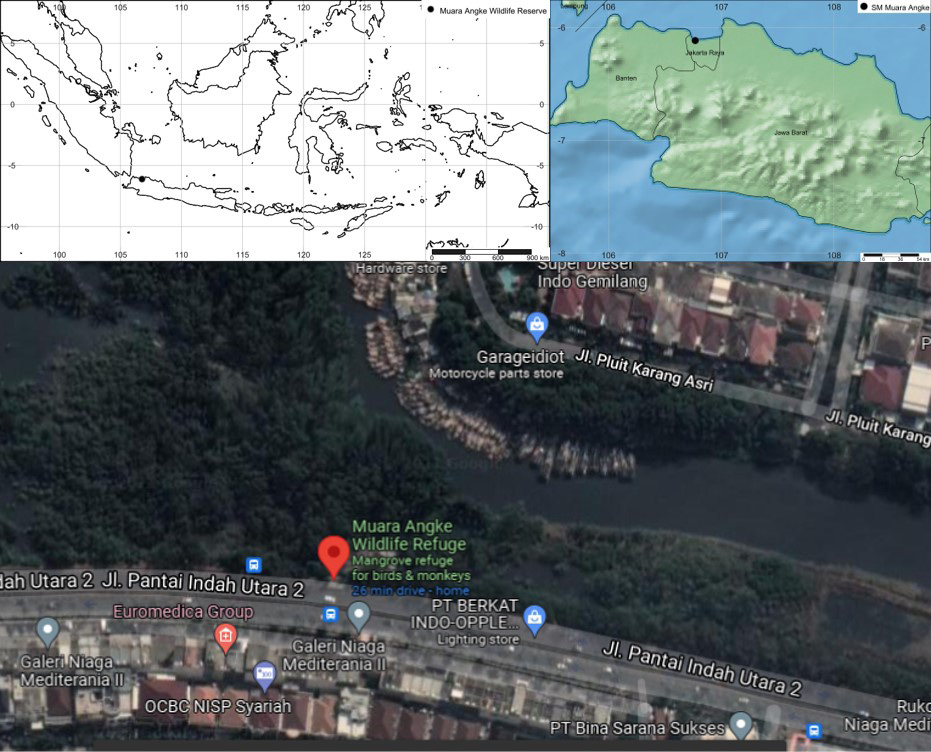
Muara Angke Wildfire Reserved (David, 2010).
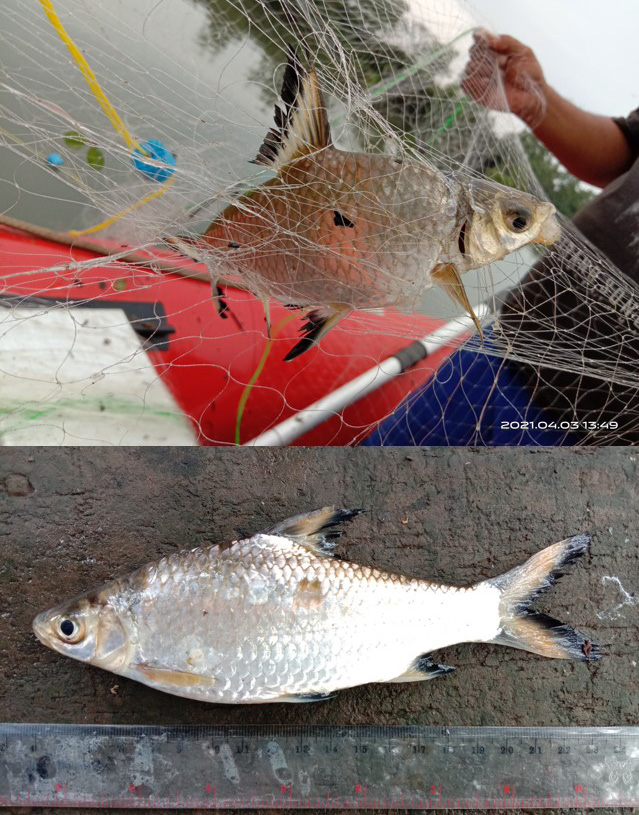
Balashark from Muara Angke Wildlife Reserve.
References
- Adjie, S. and Utomo, A.D., 2011. Bawal, 3: 277-286. https://doi.org/10.15578/bawal.3.5.2011.277-286[CrossRef]
- Affandi, R., Syafei, D.S., Rahardjo, M.F. and Sulistiono. 1992. Ichthyology, a guide to laboratory work. IPB. pp. 344. http://perpustakaan.kkp.go.id/union/index.php?p=show_detail&id=43623.
- Amirrudin, B.A. and Ismail, M.Z., 2014. Malayan Nat. J., 66: 404-419.
- Balai Konservasi Sumber Daya Alam DKI Jakarta, 2015. Muara Angke Wildlife Reserve. https://bksdadki.com/page/kawasan_dki/Suaka-Margasatwa-Muara-Angke. Retrieved August 10, 2021.
- Baras, E., Priyadi, A. and Legendre, M., 2007. Indones. Aquac. J., 2: 59-66.
- Chumaidi, Sudarto, Priyadi, A., Subamia, I.W. and Yuliati, P., 2008. Captivity and hatchery of balashark (Balantiocheilus melanopterus, Bleeker). Proceedings of the 5th National Seminar on Fish, Bogor, June 3, 2008. Organized by the fish stock promotion research workshop, PRPT, BRKP-KKP, Department of Aquatic Resources Management FPIK-IPB, Research Center for Biology-LIPI, Research Center for Oceanography-LIPI. pp. 245-252.
- David, P., 2010. Map Muara Angke Wildfire Reserved. SimpleMappr, an online tool to produce publication-quality point maps. Retrieved from https://www.simplemappr.net. Accessed September 08, 2021
- Effendi, I., Ratih, T.D. and Kadarini, T., 2008. Indones. J. Aquac., 7: 189–197. https://doi.org/10.19027/jai.7.189-197[CrossRef]
- Froese, R. and Pauly, D., 2021. Balantiocheilos melanopterus. FishBase.World Wide Web electronic publication. www.fishbase.org, version (06/2021). https://www.fishbase.se/summary/Balantiocheilos-melanopterus.html. Retrieved August 12, 2021.
- Haryono, Wahyudewantoro, G., Kholik, N. and Sholeh, K., 2015. Directory of freshwater ornamental fish. Series 1: Thirty species of fish native to borneo. Cooperation between the center for testing the application of fishery products. Directorate General of Strengthening the Competitiveness of Marine and Fishery Products, KKP and Research Center for Biology-LIPI, pp. 42.
- Hui, T.H. and Kottelat, M., 2009. Ichthyol. Explorat. Freshw., 20: 13-69. http://scholarbank.nus.edu.sg/handle/10635/101912
- Humphrey, S.R. and Bain, J.R., 2018. Endangered animals of Thailand. Flora and Fauna Handbook Number 6. CRC Press, Thailand. pp. 417. https://doi.org/10.1201/9780429187438[CrossRef]
- Insan, I., 2011. J. Aquac. Res., 6: 413-423. https://doi.org/10.15578/jra.6.3.2011.413-423[CrossRef]
- International Union for Conservation of Nature, 2021. Balantiocheilos melanopterus. https://www.iucnredlist.org/species/1494305/IUCN.UK.2020-2.RLTS.T149451010A90331546.en. Retrieved August 16, 2021. https://doi.org/10.2305/IUCN.UK.2020-2.RLTS.T149451010A90331546.en[CrossRef]
- Jusmaldi., Hariani, N. and Doq, N., 2019. Indones. J. Ichtiol., 19: 391-410. https://doi.org/10.32491/jii.v19i3.471[CrossRef]
- Kottelat, M., 2001. Fishes of Laos. WHT Publications Ltd., Colombo 5, Sri Lanka. pp. 198.
- Kottelat, M., Whitten, A.J., Kartikasari, S.N. and Wirjoatmodjo, S., 1993. Freshwater fishes of Western Indonesia and Sulawesi. Periplus Editions Limited. Jakarta. pp. 229.
- Kottelat., M., 2013. Raffles Bull. Zool., 27: 1–663. https://doi.org/10.1080/09502386.2013.773646[CrossRef]
- Lumbantobing, D., 2020. Balantiocheilos melanopterus. The IUCN red list of threatened species 2020: e.T149451010A90331546.
- Mujadid, I., Dewi, I.J.P. and Rahmad, B., 2020. Sintesa J. Educ. Sci., 15: 17-25.
- Ng, H.H. and Kottelat, M., 2007. Zootaxa, 1463: 13-20. https://doi.org/10.11646/zootaxa.1463.1.2[CrossRef]
- Oktavia, S.R., Efendie, H. and Affandi, R., 2018. J. Environ. Sustain. Manage., 2: 220-234. https://doi.org/10.36813/jplb.2.3.220-234[CrossRef]
- Sukmono, T., Solihin, D.D., Rahardjo, M.F. and Affandi, R., 2013. Indones. J. Ichtiol., 13: 161-174.
- Turan, C., 1999. J. Zool., 23: 259-263.
- Wahyudewantoro, G., Kamal, M.M., Affandie, R. and Mulyadi. 2014. Zoo Indonesia, 23: 75-83.
- Wargasasmita, S., 2002. Indones. J. Ichtiol., 2: 41-19.
Services
Article usage statistics
Loading…