
Forage productivity is generally the most important resource for animal production in any ecosystem which is rapidly being depleted due to heavy grazing over vast areas of rangelands. Rangeland conservation plays a crucial role in sustaining biodiversity, maintaining, and ensuring long-term food security for livestock. This research provides the essential data for range productivity, which are key factors for effective rangeland management. The study was conducted to determine forage productivity and carrying capacity in the rangelands of Mohmand and Bajaur districts. The quadrat method was used to collect data on species composition, foliar cover, and aboveground biomass. Samples were weighed fresh in the field, and a subsample was dried to constant weight to compute dry biomass. Carrying capacity was estimated based on 50% allowable grazing material. The results revealed a total of 21 forage species were identified across both districts. There was considerable variation in forage production between districts. Bajaur sites exhibited higher species richness (6–11 species) and greater foliar cover (72–95%) than Mohmand sites (2–6 species and with foliar cover (20–75% ). Fresh forage yields ranged from 750 kg ha-¹ to 8600 kg ha-¹, while dry forage productivity varied from 400 kg ha-¹ to 4130 kg ha-¹. Correspondingly, the carrying capacity of both ranged from 0.7 to 7.6 AU ha-¹ month-¹, with Bajaur rangelands showing significantly greater grazing potential than Mohmand. These results highlight the importance of site-specific management, controlled grazing, and rehabilitation measures in restoring forage productivity and sustaining livestock production in the semi-arid rangelands of Khyber Pakhtunkhwa.
Research Article · Volume 76, Issue 2, 14 September 2026 · Open Access
Evaluating Forage Productivity and Carrying Capacity in the Semi-Arid Rangelands of Mohmand and Bajaur, Khyber Pakhtunkhwa
· ·
Affiliations & Notes ⌄
- 1Pakistan Forest Institute, Peshawar, Khyber Pakhtunkhwa, Pakistan. *Correspondence | Khalid Imran, Pakistan Forest Institute, Peshawar, Khyber Pakhtunkhwa, Pakistan
- 2Email: Khalidpfian@gmail.com
Article Info ⌄
- Journal:
- Pakistan Journal of Forestry
- Published:
- 14 September 2026
From the article
- This study measured forage biomass and carrying capacity in representative rangelands of Mohmand and Bajaur districts.
- Bajaur sites produced 2–3 times more forage and had greater grazing capacity than Mohmand, due to denser grasslands.
Selected from the article's own text.
Abstract
Introduction
Rangelands cover about half of the world’s land surface, comprising arid to semi-arid grasslands, shrublands, and savannas that support livestock production. Vegetation in such dryland systems provides soil protection and key forage; perennial grasses and browses offer year-round nutrition, especially during dry seasons . In Pakistan, an estimated land is covered by rangeland is around 62%, important for 97 million livestock production (14% GDP) during 2021-22 . However, overuse has degraded many pastures through overgrazing, change in climate, and replacement of palatable species by xeric shrubs . Monitoring forage yield and carrying capacity is thus essential to guide sustainable grazing management and conserve range condition .
Socio-ecological pressures in Pakistan are increasingly degrading rangeland conditions. According to , the main indicators of degradation include lower plant cover, reduced biomass production, loss of palatable species, and rising presence of non-palatable and invasive species. Moreover, the arid and semi-arid lands of Pakistan suffer from periodic droughts and erratic rainfall, exacerbating the decline in vegetation cover and forage output. Studies in specific rangeland systems of Pakistan support the notion of a decline in productivity. In the Cholistan Desert, it is reported an average dry grass biomass of 370 kg ha-¹ during wet seasons, dropping to 263 kg ha-¹ during dry periods. They also showed that carrying capacity varies similarly, being much higher in the wet season than in the dry . Pressure of increased grazing on rangelands also shows a reduction in vegetation cover in Quetta, with above-ground dry biomass production varying from 40-200 kg ha-¹ in open areas compared to 200-865 kg ha-¹ in protected areas .
These semi-arid and arid rangelands are essential for the livelihoods of millions of pastoralists, providing sustenance through grazing . However, in regions such as Mohmand and Bajaur, located in the semi-arid zone of Khyber Pakhtunkhwa, rangelands face pressures due to their rugged terrain, erratic rainfall patterns, and limited vegetation cover. Despite the importance of these areas for livestock production, empirical data on their forage productivity and carrying capacity remain scarce. Any future management planning requires baseline data about the existing rangeland productivity .
This study aims to determine forage productivity and carrying capacity across selected rangeland sites in Mohmand and Bajaur. To assess (1) forage yield and vegetation cover for representative sites, and (2) calculate carrying capacity, thereby providing baseline information to inform sustainable rangeland management in these understudied semi-arid districts.
Materials and Methods
Study area and sampling
The study was conducted in the Bajaur and Mohmand rangelands of KPK, Pakistan. The area selected for the study was divided into different sites, whereas three sites in Bajaur were (Utman Khel, Barang Khel, Salarzai), and six in Mohmand (Ghalanai, Safi, Baizai, Pindiali, Yaka Ghund, Parang Ghar) that represent local grazing areas. The landscape was undulating hills and valleys with sparse semi-desert vegetation. At each site, a random quadrat design was used for data collection. Herbaceous and grass cover were measured in 1 m² quadrats; shrubs in 4 m² quadrats; trees (if present) in 10 m² plots. In each quadrat, all species were identified and assigned cover and frequency estimates, then clipped. Samples were weighed fresh in the field, and a subsample was dried to constant weight to compute dry biomass. Foliar cover (%) and bare ground (%) were recorded for each plot.
Range carrying capacity
Range carrying capacity is an important management tool that connects forage supply with forage consumption. Carrying capacity was estimated based on 50% allowable grazing material. The one animal unit (AU) was taken as a cow having a 360 kg weight, demanding 9 kg dry matter forage per day, 270 kg/month .

Microsoft Excel spreadsheet analysis (MS Office, 2010) was conducted to determine simple averages, percentiles, and mean values, and to make needful tables and graphs .
Results and Discussion
Forage productivity and cover
Vegetation differed markedly between districts as shown in Table 1. Bajaur sites are relatively species-rich (6–11 species per site) with high foliar cover (72–95%) and low bare ground (5–28%). Mohmand sites are poor with 2–6 species per site, vegetation cover ranged between 20–75%, and bare ground 25–80%. The higher species richness generally increases vegetation cover across different grassland types, independent of grazing treatments . Furthermore, it is confirmed by showing that plant coverage and species richness substantially enhance aboveground biomass across plant growth forms .
Table 1: Forage productivity and cover.
|
District |
Site |
No of species |
Foliar cover (%) |
Bare ground (%) |
Fresh forage (kg/ha) |
Dry forage (kg/ha) |
|
Bajaur |
Utman Khel |
6 |
90 |
10 |
8410 |
3840 |
|
Bajaur |
Barang Khel |
11 |
72 |
28 |
8600 |
4130 |
|
Bajaur |
Salarzai |
6 |
95 |
5 |
5330 |
2380 |
|
Mohmand |
Ghalanai |
2 |
20 |
80 |
0 |
0 |
|
Mohmand |
Safi |
5 |
75 |
25 |
2840 |
1460 |
|
Mohmand |
Baizai |
2 |
30 |
70 |
750 |
400 |
|
Mohmand |
Pindiali |
6 |
65 |
35 |
5610 |
2020 |
|
Mohmand |
Yaka Ghund |
4 |
70 |
30 |
2350 |
990 |
|
Mohmand |
Parang Ghar |
3 |
60 |
40 |
3970 |
1820 |
In Table 1, the forage yields are highest in Bajaur. Barang Khel produced 8600 kg ha-¹ of fresh biomass (4130 kg ha-¹ dry), and Utman Khel 8410 kg ha-¹ fresh (3840 kg ha-¹dry). Salarzai is lower at 5330 kg ha-¹ fresh and 2380 kg ha-¹ dry. In contrast, Mohmand yields are generally much lower: Ghalanai yielded nothing, as it had overgrazed, leaving nothing for samples. Safi yielded 2840 kg ha-¹ fresh (1460 kg ha-¹ dry), and Pindiali yielded 5610 kg ha-¹ fresh (2020 kg ha-¹dry). Intermediate values were found at Parang Ghar (3,970/1,820 kg ha-¹) and Baizai (750/400 kg ha-¹) (Table 1). The overall mean dry yield across all sites is 1890 kg ha-¹ (fresh approximately 4200 kg ha-¹), reflecting the arid and semi-arid ecosystem. In arid and semi-arid ecosystems, rainfall is a major environmental agent, affecting the forage productivity, and it is extremely variable throughout the year .
The higher productivity in Bajaur corresponds to denser grass cover and diversity. Sites dominated by deep-rooted grasses (e.g., Themeda, Dichanthium, Cynodon) produced more forage than shrub-dominated sites. For example, Yaka Ghund (Mohmand) had 70% cover but only 990 kg ha-¹dry yield, because much cover is from shrubs (Prosopis, Ziziphus) contributing little herbaceous biomass. In contrast, Safi and Pindiali (mixed grasslands) yielded proportionally more. These patterns reflect that sustainable feed resources depend on maintaining palatable grass species .
Species composition and contribution
A total of 21 species are identified across both districts as shown in Table 2. The dominant species in Bajaur are perennial grasses (Cynodon dactylon, Themeda gigantea, Chrysopogon aucheri, Dichanthium annulatum) and shrubs (Berberis lycium, Periploca aphylla, Rumex hastatus, Andrachne cordifolia, Quercus incana). In Mohmand, common grasses included Cynodon dactylon, Cenchrus ciliaris, Pennisetum orientale, and woody species (Prosopis juliflora, Ziziphus jujuba, Ziziphus nummularia, Acacia modesta). Cynodon dactylon is the most significant forage contributor and is found in all richer sites across both districts. It plays a major role in sustaining livestock by providing high-quality forage and has the highest potential intake rate . Similarly, Rumex hastatus is also found in the richer sites of Utman, Barang, and Parang, and it significantly contributes to the forage yield. However, some grasses like Cenchrus ciliaris, Pennisetum orientale, Desmostachya bipinnata, Heteropogon contortus, and Cymbopogon jwarancusa contribute less to the overall biomass and are considered minor forage species. In addition, various shrubs including Periploca aphylla, Ziziphus jujuba, Andrachne cordifolia, Indigofera heterantha, Fagonia indica, Prosopis juliflora, and Ziziphus nummularia, make a moderate contribution to forage availability. While they are not as significant as grasses, they still play an important role in providing feed, particularly during dry periods when grasses may be less available . The distribution of the species in Bajaur is more diverse compared to Mohmand, with Bajaur sites supporting a wider variety of species that enhance forage availability. On the other hand, Mohmand’s sites have fewer species and lower productivity, likely due to harsher climatic conditions.
Carrying capacity
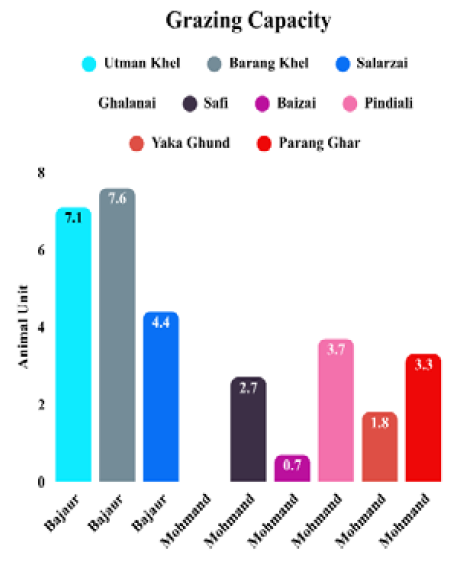
Table 3 and Figure 1 show that the estimated carrying capacity of each rangeland site, expressed as the number of Animal Units (AU) that one hectare of land can support for one month. Figure 1 also shows that the Bajaur sites have a much greater potential that supports 4.4–7.6 AU per ha-month, indicating a strong forage base and better grazing capacity. Whereas the most potential site Barange Khel supports 7.6 AU per ha-month, followed by
Table 2: Key forage species and their presence in surveyed sites.
|
S. No |
Species |
Growth form |
Sites present (District) |
Relative forage role |
|
01 |
Cynodon dactylon |
Grass |
Barang, Ghalanai, Safi, Baizai, Pindiali, Yaka, Parang (all) |
Major |
|
02 |
Chrysopogon aucheri |
Grass |
Utman, Barang, Parang |
Moderate |
|
03 |
Themeda gigantean |
Grass |
Utman, Barang |
Moderate |
|
04 |
Dichanthium annulatum |
Grass |
Barang, Salarzai |
Moderate |
|
05 |
Cenchrus ciliaris |
Grass |
Safi |
Minor |
|
06 |
Pennisetum orientale |
Grass |
Pindiali |
Minor |
|
07 |
Desmostachya bipinnata |
Grass |
Salarzai, Pindiali |
Minor |
|
08 |
Heteropogon contortus |
Grass |
Salarzai |
Minor |
|
09 |
Chrysopogon aucheri |
Grass |
Parang |
Moderate |
|
10 |
Cymbopogon jwarancusa |
Grass |
Safi |
Minor |
|
11 |
Periploca aphylla |
Shrub |
Barang |
Minor |
|
12 |
Ziziphus jujube |
Shrub |
Baizai, Pindiali |
Moderate |
|
13 |
Andrachne cordifolia |
Shrub |
Utman, Barang |
Moderate |
|
14 |
Indigofera heterantha |
Shrub |
Utman, Barang |
Moderate |
|
15 |
Ziziphus nummularia |
Shrub |
Pindiali, Yaka Ghund |
Moderate |
|
16 |
Fagonia indica |
Shrub |
Safi, Yaka Ghund |
Moderate |
|
17 |
Rumex hastatus |
Shrub |
Utman, Barang, Parang |
Major |
|
18 |
Prosopis juliflora |
Shrub |
Safi, Yaka Ghund |
Moderate |
|
19 |
Berberis lyceum |
Shrub |
Salarzai |
Minor |
|
20 |
Acacia modesta |
Tree |
Pindiali |
Minor |
|
21 |
Quercus incana |
Tree |
Utman, Barang |
Minor |
Table 3: Carrying capacity by different sites.
|
District |
Site |
Carrying capacity (AU/ha-M) |
|
Bajaur |
Utman Khel |
7.1 |
|
Bajaur |
Barang Khel |
7.6 |
|
Bajaur |
Salarzai |
4.4 |
|
Mohmand |
Ghalanai |
0.0 |
|
Mohmand |
Safi |
2.7 |
|
Mohmand |
Baizai |
0.7 |
|
Mohmand |
Pindiali |
3.7 |
|
Mohmand |
Yaka Ghund |
1.8 |
|
Mohmand |
Parang Ghar |
3.3 |
Utman Khel and Salarzai with 7.1 AU and 4.4 AU per ha-month, respectively. While Mohmand sites ranged from 0.7–3.7 AU/ha-M, with the most potential site, Pindiali supports 3.7 (AU) per ha-month, followed by Parang Ghar with 3.3 AU and Yaka Ghund 1.8 AU. Whereas the Baizai site has 0.7 AU per ha-month, and the least potential site Ghalanai had effectively zero measurable grazing capacity due to scarce and overgrazed vegetation. The most potential site for grazing in Bajaur (Barang Khel) sustains 7 cattle for one month, whereas the most potential site from Mohmand (Pindiali) supports 3 cattle for one month. These values from some Mohmand sites are low, indicating that current grazing demand likely exceeds sustainable supply. The data were collected in October, which might also explain the decline in some regions of Mohmand, as productivity gradually increased from April to July and thereafter declined towards October . So, it is revealed that Bajaur rangelands exhibit higher productivity and carrying capacity than Mohmand, reflecting better grass cover. Even so, absolute production is modest (dry biomass 2500 kg ha⁻¹at most sites) and carrying capacity is generally under 4 AU/ha-month on average.
Conclusion
This study measured forage biomass and carrying capacity in representative rangelands of Mohmand and Bajaur districts. Bajaur sites produced 2–3 times more forage and had greater grazing capacity than Mohmand, due to denser grasslands. Overall, dry matter production averaged from 1600 to 3800 kg ha-¹ in productive areas, yielding 2–7 AU/ha-month. The species composition was mainly grasses, with Cynodon dactylon and other perennials contributing most forage. These results suggest that current stocking levels should be conservative to protect range health, and interventions such as grazing rotation or reseeding may be necessary on lower-yielding sites. Additionally, future research shall examine seasonal changes in forage availability and explore ways to improve the range. Our findings provide essential baseline data for establishing sustainable grazing strategies in this semi-arid region.
Recommendations
- Implement rotational or deferred grazing systems to reduce continuous grazing pressure and allow the natural recovery of vegetation during the growing season.
- Rehabilitate degraded rangelands through reseeding with drought-tolerant and high-yielding forage grasses such as Cynodon dactylon and Cenchrus ciliaris.
- Involve local communities in rangeland management activities to ensure responsible grazing, protection of regenerating areas, and equitable use of forage resources.
Acknowledgments
The authors express their sincere gratitude to the Worthy Director, Biodiversity Research Division, PFI Peshawar, for providing valuable guidance and continuous support throughout this research work. This study was carried out under the ADP Project of the Government of Khyber Pakhtunkhwa, whose financial and technical assistance enabled the successful execution of field activities in rangelands of Mohmand and Bajaur. We also acknowledge the efforts of all team members who assisted in data collection and analysis.
Novelty Statement
This study presents the first integrated assessment of forage productivity and rangeland carrying capacity specifically for the semi-arid ecosystems of Mohmand and Bajaur, regions where quantitative ecological data are extremely limited.
Author’s Contribution
Khalid Imran: Performed experimental work and contributed in manuscript writing.
Mansoor Ali Khan: Contributed in data analysis and helped in the composition of manuscript, refining.
Ashar Farooq: Helped in research layout throughout study and proof reading of the paper.
Generative AI and AI-assisted technology statement
During the preparation of this manuscript, generative artificial intelligence (AI) and AI-assisted technologies were not used to generate, analyze, or interpret the research data, scientific results, or conclusions. The study design, field data collection, data analysis, interpretation of results, and scientific conclusions were conducted by the authors. Data analysis was performed using Microsoft Excel.
Conflict of interest
The authors have declared no conflict of interest.
Figures
Graphical representation of the carrying capacity.
References
- Abdullah, M., Rafay, M., Sial, N., Rasheed, F., Nawaz, M.F., Nouman, W. and Khalil, S., 2017. Determination of forage productivity, carrying capacity and palatability of browse vegetation in arid rangelands of Cholistan desert (Pakistan). Appl. Ecol. Environ. Res., 15(4). https://doi.org/10.15666/aeer/1504_623637[CrossRef]
- Ahmad, S., Islam, M. and Mirza, S.N., 2012. Rangeland degradation and management approaches in Balochistan, Pakistan. Pak. J. Bot., 44: 127-136.
- Bonham, C.D., 1989. Measurement for terrestrial vegetation. John Wiley and Sons. New York. pp. 199-264.
- Durand-Chávez, L.M., Vásquez-Pérez, H.V., Ushiñahua-Ramírez, D., Carrasco-Chilón, W., Depaz-Hizo, B.A. and Saucedo-Uriarte, J.A., 2022. Yield performance of forage shrubs and effects on milk production and chemical composition under the tropical climatic conditions of Peru. Sustainability, 14(19): 12774. https://doi.org/10.3390/su141912774[CrossRef]
- Farooq, S., Hussein, S. and Kunwal, N., 2024. Towards sustainable range resource management in Pakistan (No. 2024: 113). Pakistan Institute of Development Economics.
- Guo, T., 2020. Grazing exclusion effects on the relationship between species richness and vegetation cover in Mongolian grasslands. Polish J. Ecol., 68(3): 211-228. https://doi.org/10.3161/15052249PJE2020.68.3.003[CrossRef]
- Hussain, F. and Durrani, M., 2009. Seasonal availability, palatability and animal preferences of forage plants in Harboi arid range land, Kalat, Pakistan.
- Landsberg, J. and Crowley, G., 2004. Monitoring rangeland biodiversity: plants as indicators. Austral. Ecol., 29(1): 59-77. https://doi.org/10.1111/j.1442-9993.2004.01357.x[CrossRef]
- McCullough, B.D. and Heiser, D.A., 2008. On the accuracy of statistical procedures in Microsoft Excel 2007. Comput. Stat. Data Anal., 52(10): 4570-4578. https://doi.org/10.1016/j.csda.2008.03.004[CrossRef]
- Mtengeti, E.J. and Mhelela, A., 2006. Screening of potential indigenous browse species in semi-arid central Tanzania. A case of Gairo division. Livest. Res. Rural Dev., 18(8): 108.
- Nawaz, H., Javed, I. and Hameed, M., 2008. Mineral profile, palatability and digestibility of marginal land grasses of Trans-Himalayan grasslands of Pakistan. Pak. J. Bot., 40(1): 237-248.
- Patton, B.D., Dong, X., Nyren, P.E. and Nyren, A., 2007. Effects of grazing intensity, precipitation, and temperature on forage production. Rangel. Ecol. Manage., 60(6): 656-665. https://doi.org/10.2111/07-008R2.1[CrossRef]
- Rubanza, C.D.K., Shem, M.N., Ichinohe, T. and Fujihara, T., 2006. Biomass production and nutritive potential of conserved forages in silvopastoral traditional fodder banks (Ngitiri) of Tanzania. Asian-Austral. J. Anim. Sci., 19(7): 978–983. https://doi.org/10.5713/ajas.2006.978[CrossRef]
- Sanaei, A., Chahouki, M.A.Z., Ali, A., Jafari, M. and Azarnivand, H., 2018. Abiotic and biotic drivers of aboveground biomass in semi-steppe rangelands. Sci. Total Environ., 615: 895-905. https://doi.org/10.1016/j.scitotenv.2017.10.010[CrossRef]
- Tariq, M., 2023. Future policy interventions for the development of livestock sector in Pakistan. UN Dep Econ. Soc. Aff., pp. 1-4.
Services
Article usage statistics
Loading…