
This study presents a comparative evaluation of moisture content and density across five prominent wood species deodar (Cedrus deodara), shisham (Dalbergia sissoo), keekar (Acacia nilotica), kail (Pinus wallichiana), and phulai (Acacia modesta) collected from different geographic regions of Khyber Pakhtunkhwa, Pakistan. The samples were seasoned in a solar kiln properly. Their physical properties like moisture content and density were determined to assess their suitability for carpentry, structural and industrial applications. Moisture contents were found to range between 10.3% and 13.7%, with Phulai (Acacia modesta) showing the lowest and kail (Pinus wallichiana) the highest values. In terms of density, phulai (Acacia modesta) and keekar (Acacia nilotica) exhibited higher performance, with values of 842 kg/m³ and 828 kg/m³ respectively. While kail (Pinus wallichiana) and deodar (Cedrus deodara) presented relatively lower densities. The variations and differences in these physical properties reflect the effects of both local climatic conditions and species characteristics. This research work supports sustainable forestry management and provides insight into wood selection practices for region specific applications and in the province. The findings can help furniture manufacturers, wood engineers, and policy makers in making informed material choices based on scientific evidence.
Research Article · Volume 76, Issue 2, 20 October 2026 · Open Access
Comparative Analysis of Moisture Content and Density in Different Wood Species Across Diverse Geographic Regions of Khyber Pakhtunkhwa
· · · · ·
Affiliations & Notes ⌄
- 1Pakistan Forest Institute, Peshawar, Khyber Pakhtunkhwa, Pakistan
- 2Khyber Medical College, Peshawar, Khyber Pakhtunkhwa, Pakistan. *Correspondence | Mansoor Ali Khan, Pakistan Forest Institute, Peshawar, Khyber Pakhtunkhwa, Pakistan
- 3Email: mansoorchemist87@gmail.com
Article Info ⌄
- Journal:
- Pakistan Journal of Forestry
- Published:
- 20 October 2026
From the article
- The research work compared moisture contents and the density of five different wood species from diverse regions of Khyber Pakhtunkhwa deodar, shisham, keekar, kail, and phulai showing significant variation in their physical properties.
- Phulai had the lowest moisture content (10.3%) and maximum density (842 kg/m³), making it the most stable and durable, while Kail exhibited the maximum moisture and lowest density, demonstrating lower strength.
Selected from the article's own text.
Abstract
Introduction
Wood is the hard fibrous part of the plant body and is mainly made up of cellulose and lignin. Wood gives shape and support to the plant body. Wood is used as a fuel, making furniture, building purposes, papers and tools etc . Moisture contents and density are the two important parameters of wood which remarkably influence the selection and application of wood in various sectors. Both moisture contents and density significantly influence the durability, strength and dimensional stability etc . Moisture content of wood is considered the amount of water which is present in cell cavity and fibers. Generally, it is expressed in percentage. Moisture contents in the wood play an important role in weight, biological degradation and swelling of wood . Density shows the mass per unit volume of the wood. High density wood exhibits greater mechanical strength which makes them suitable for heavy duty applications . The precise determination of the above stated parameters of wood will enable the public to use the different varieties of wood in a proper conservatory approach.
Deodar (Cedrus deodara) is a useful wood species found in the mountainous and hilly regions of Khyber Pakhtunkhwa, Pakistan especially in areas like Malakand, Hazara, Swat and Dir. Deodar (Cedrus deodara) tree belongs to pine family and is famous for its durability, tree strength and pleasant scent. The physical properties of Cedrus deodara wood vary across geographic regions due to differences in altitude, climate and site conditions . Deodar natural resistance is so strong against decay and insects which make them quite suitable for furniture, windows, roofing and construction. Deodar (cedrus deodara) forests in Khyber Pakhtunkhwa play a significant role in forest ecosystems and local livelihood, providing shelter, protection against soil erosion and timber. Due to deforestation and ruthless cutting this valuable wood species is under threat and it is the need of hour to take immediate measures for its conservation .
Dalbergia sissoo Roxb., commonly known as Shisham or North Indian rosewood, is a fast-growing deciduous hardwood species belonging to the family Fabaceae. It is widely distributed throughout the Indian subcontinent, including Pakistan, India, Nepal, and Bangladesh, where it is valued for both economic and ecological purposes . Dalbergia sissoo is considered one of the most prominent and widely cultivated wood species KP (Khyber Pakhtunkhwa) due to its cultural, economic and ecological importance. In KP and other regions of Pakistan, Dalbergia sissoo represents one of the most important indigenous timber species. Its growth performance and wood properties are influenced by local environmental factors . Shisham generally grow rich in Dera Ismail Khan, Mardan, Charsada, Nowshera, Karak and Peshawar etc. The species is recognized for its rapid growth, adaptability to diverse environmental conditions, and high-quality wood, which is extensively used in furniture production, construction, and agricultural implements. The wood of Dalbergia sissoo is characterized by its strength, durability, and favorable physical properties, making it a valuable resource for commercial forestry . It plays a significant role in environment like prevents erosion, carbon sequestration and nitrogen fixation etc. Its fast growth and versatile utility make it significant to conserve and grow this woody species more and more .
Keekar (Acacia nilotica) is a drought resistant woody species and it holds significant economic and ecological value. It is generally found in the southern districts of Khyber Pakhtunkhwa (KP), like Karak, Kohat, Dera Ismail Khan, Bannu and Lakki Marwat. The semi - arid climate and the soil of the southern districts of Khyber Pakhtunkhwa (KP), make its natural growth suitable. Keekar (Acacia nilotica) helps in soil fertility through nitrogen fixation and play an important role in agroforestry and land restoration in degraded areas of Khyber Pakhtunkhwa (KP). Local communities use the wood of keekar (Acacia nilotica) for fuel, fencing, small scale construction works and agricultural tools .
Kail (Pinus wallichiana) also called as a blue pine, is a coniferous wood species commonly grown in the northern regions of Khyber Pakhtunkhwa (KP) particularly in districts like Buner, Swat, Dir, Shangla Kohistan, Abbottabad and Mansehra at an alititude of about 1800-3300 meters above sea level. Kail (Pinus wallichiana) can grow upto 30 to 50 meter in height with a bluish green colour needle like leaves. It prefers a mountainous region with an ideal rain fall. It has immense social, ecological and economic importance. Economically, kail (Pinus wallichiana) wood because of its lightness is highly used in matchsticks, buildings and paper and pulp formation. Ecologically, it plays a role in soil conservation, providing shelter to wildlife and maintaining of watershed health. Socially the local communities use it, as a fuel wood, construction timber and resin tapping etc. .
Phulai (Acacia modesta) is also a drought resistant wood species; commonly grows in arid and semi-arid regions of Khyber Pakhtunkhwa. It is found in Karak, Dera Ismail Khan, Kohat Mardan, Bannu, Tank, Nowshera and Lakki Marwat. Phulai (Acacia modesta) belong to the family fabaceae. It has rough bark with compound leaves. Phulai (Acacia modesta) wood is used for fuel, building and construction purposes. It provides gum of high quality. Ecologically, it prevents soil erosion, increasing soil fertility and stabilizing slopes. Afforestation and conservation of all the above trees are very necessary to combat with climate change and its useful availability for future generation . The present study explores and compares these two parameters across five prominent wood species deodar (Cedrus deodara), Shisham (Dalbergia sissoo), Keekar (Acacia nilotica), kail (Pinus wallichiana), and Phulai (Acacia modesta) collected from diverse geographic regions of Khyber Pakhthunhwa, Pakistan.
Materials and Methods
Samples collection
Wood samples of deodar (Cedrus deodara), shisham (Dalbergia sissoo), keekar (Acacia nilotica), kail (Pinus wallichiana) and phulai (Acacia modesta) were collected from diverse regions such as Upper Dir, Kohat, Lakki Marwat, Swat and Karak respectively. The samples were collected from green plants on fresh wood basis. The map of study area is shown below.
Samples processing and seasoning
These samples of wood were properly debarked through various sharp tools. Then they were kept at solar kiln. After four weeks they were properly seasoned and checked through moisture meter. Germany made moisture meter was used which works through pin point accuracy. Moistures were determined at three different site of each wood sample. Then average moisture contents were found. For density determination the five samples from each wood species was prepared. Average density was determined. The sample size was 6 ×2×2 cm .
Results and Discussion
The proposed study evaluated the moisture content and density of five differenet wood species generally found in the Khyber Pakhtunkhwa region: Cedrus deodara (deodar), Dalbergia sissoo (Shisham), Acacia nilotica (keekar), Pinus wallichiana (kail), and Acacia modesta (Phulai). These properties and characteristics are vital for determining the suitability of wood for different commercial and structural applications .
Moisture contents report
Table 1: This table shows the moisture contents report of various wood species. The table represents also the standard deviation value.
|
S. No |
Sample name |
Area of collection |
Average % |
SD value |
|
01 |
Deodar (Cedrus deodara) |
Upper Dir |
12.2 |
0.251 |
|
02 |
Shisham (Dalbergia sissoo) |
Kohat |
11.6 |
0.332 |
|
03 |
Keekar (Acacia nilotica) |
Lakki Marwat |
13.1 |
0.262 |
|
04 |
Kail (Pinus wallichiana) |
Swat |
13.7 |
0.298 |
|
05 |
Phulai (Acacia modesta) |
Karak |
10.3 |
0.311 |
Moisture content is a crucial parameter influencing wood’s physical properties, durability and workability. Amongst the tested wood species, kail (Pinus wallichiana) showed the highest moisture content (13.7%), followed by keekar (Acacia nilotica) (13.1%) and deodar (Cedrus deodara) (12.2%). The lowest moisture content was observed in Phulai (Acacia modesta) (10.3%). These results align with the findings of Fredrokson (2019), who noted that moisture content is largely affected by the tree’s native environment and wood porosity (Fredrokson, 2019).
In case of density phulai (Acacia modesta), exhibited the highest value of density (842 kg/m³), very closely followed by phulai (Acacia modesta), (828 kg/m³), proposing and suggesting their excellent mechanical strength. shisham (Dalbergia sissoo); (760 kg/m³) also exhibited high density and is known for its resistance to termites and durability. On the other hand, kail (Pinus wallichiana) and deodar (Cedrus deodara) had the lowest densities at 495 kg/m³ and 510 kg/m³, respectively, which may limit their use and utility in heavy load applications, but make them appropriate for lightweight structures and carpentry work .
Density report
Table 2: The density report of various wood species. This table represents also the standard deviation value.
|
S. No |
Sample name |
Area of collection |
Density (Kg/m3) |
SD value |
|
01 |
Deodar (Cedrus deodara) |
Upper Dir |
510 |
0.0231 |
|
02 |
Shisham (Dalbergia sissoo) |
Kohat |
760 |
0.0198 |
|
03 |
Keekar (Acacia nilotica) |
Lakki Marwat |
828 |
0.0190 |
|
04 |
Kail (Pinus wallichiana) |
Swat |
495 |
0.0213 |
|
05 |
Phulai (Acacia modesta) |
Karak |
842 |
0.0234 |
The variation in moisture content and density among these wood species highlights the diversity of wood characteristics within the same geographical region. This variation must be considered when selecting wood for specific engineering or construction purposes to ensure performance, durability and longevity.
Conclusions
The research work compared moisture contents and the density of five different wood species from diverse regions of Khyber Pakhtunkhwa deodar, shisham, keekar, kail, and phulai showing significant variation in their physical properties. Phulai had the lowest moisture content (10.3%) and maximum density (842 kg/m³), making it the most stable and durable, while Kail exhibited the maximum moisture and lowest density, demonstrating lower strength. All samples were seasoned through eco-friendly solar kiln. These findings support the selection of various wood species for engineering, furniture, construction and industrial applications which may help the sustainable forest management.
Recommendations
- Future research projects should include a broader range of wood species and regions to accelerate the understanding of wood characteristics and properties across Khyber Pakhtunkhwa.
- Solar kiln drying technology should be used for better and eco-friendly wood seasoning.
Acknowledgement
I am thankful to the Director General (DG) of Pakistan Forest Institute, Peshawar, for providing the opportunity to complete this study. I also extend my gratitude to the respected director of Forest Products Research Division (FPRD) for their valuable co-operation and guidance throughout this work.
Novelty Statement
This project presents a novel comparative analysis of moisture contents and density in major wood species across diverse geographic regions of Khyber Pakhtunkhwa, incorporating a solar kiln seasoning technology as a sustainable, standardized and eco-friendly drying method.
Author’s Contribution
MAK: Contributed in samples collection, experimental work, manuscript writing and acted as a principal author. SA: Cooperated in samples collection, drying and statistical analysis. MUK: Contributed in proof reading and removal of grammatical mistakes. Also helped in experimentation and statistical data determination. ARK: Helped in experimental work and graphical representation of data. AR: Contributed in manuscript writing and proof reading of research paper. SRW: Helped in samples collection and experimental work.
Generative AI and AI assisted technology statement
The authors declare that no generative AI and AI assisted technology was used in the creation of this manuscript.
Conflict of interest
The authors have declared no conflict of interest.
Figures
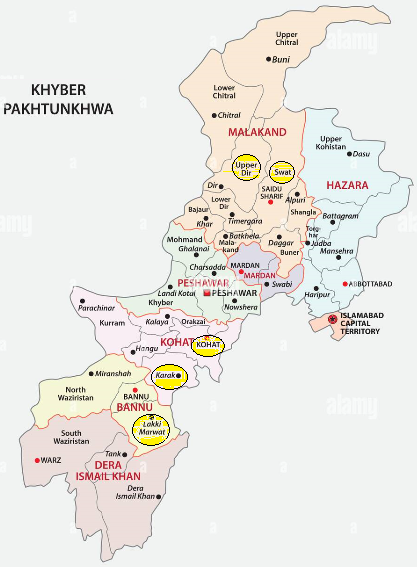
Study areas map: The highlighted in yellow colour areas shows the sample collection regions.
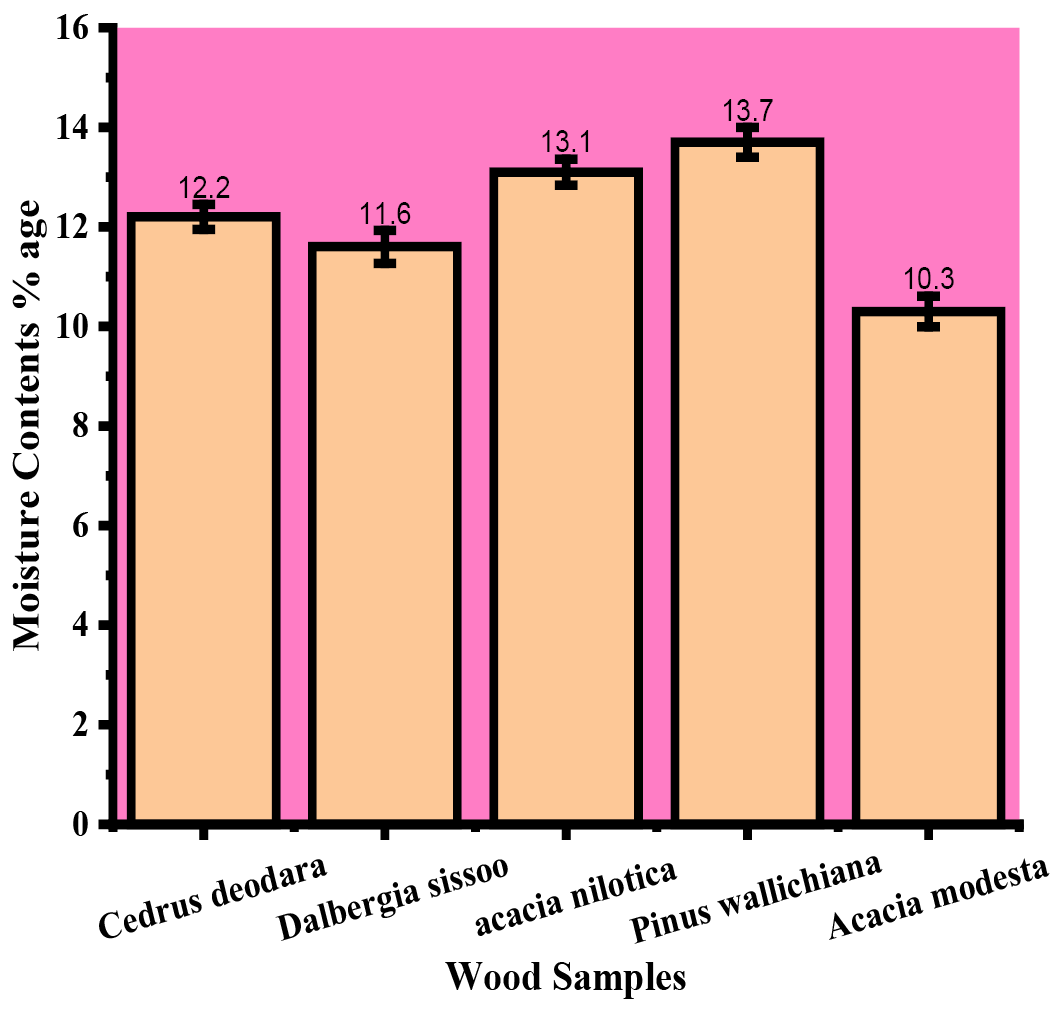
The graphical representation of average percent moisture contents. The arrow on the bar graph shows the standard deviation value.
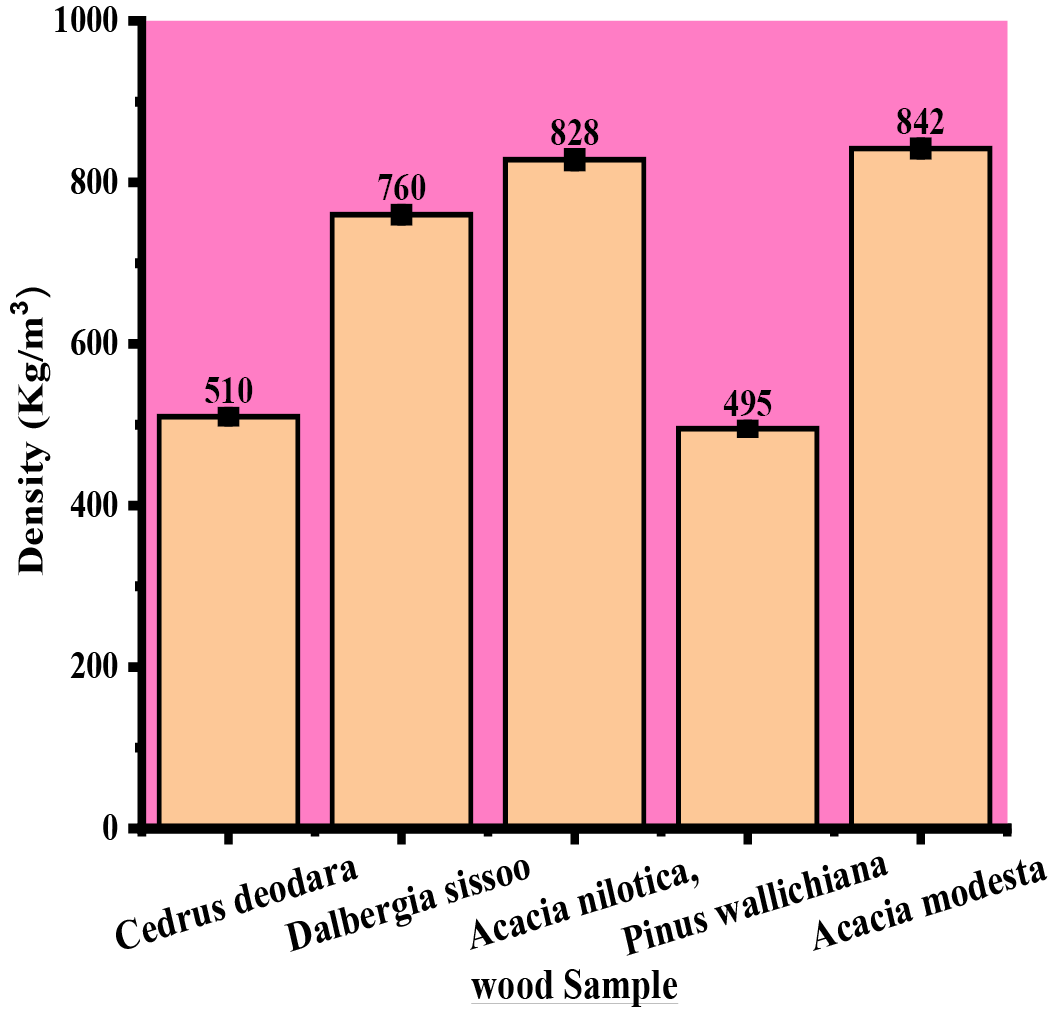
The graphical representation of average densities in Kg/m3. The arrow on the bar graph shows the standard deviation value.
References
- Abdullah, M. and M. Rafay, 2021. Ecology of Dalbergia sissoo Dalbergia sissoo: CRC Press. pp. 13-26. https://doi.org/10.1201/9781003175940-3[CrossRef]
- Ali, C.A., M. Ali and A.A. Awan. 2010. Seasonal variation in chemical composition of twigs and leaves of phulai (Acacia modesta). Pak. J. For., 60(1/2): 13.
- Fredriksson, M., 2019. On wood–water interactions in the over-hygroscopic moisture range Mechanisms, methods, and influence of wood modification. Forests, 10(9): 779. https://doi.org/10.3390/f10090779[CrossRef]
- Gayda, S., and K. Orest. 2023. Study of physical and mechanical properties of post-consumer wood of different age. Drewno. Prace naukowe. Doniesienia. Komunikaty, 66(212). https://doi.org/10.53502/wood-177453[CrossRef]
- Ghayas, H., S. Wei, A.M. Shah, M. Khan, N. Ullah, Riaz and B. Amir. 2025. Synthesis and characterization of cedrus deodara sawdust-deposited silver and copper nanoparticles using punica granatum extract for sensing of uric acid. Waste Biomass Valoriz., 16(4): 1701-1713. https://doi.org/10.1007/s12649-024-02763-2[CrossRef]
- Glass, S. and S. Zelinka. 2021. Moisture relations and physical properties of wood. Chapter 4 in FPL-GTR-282: 4-1-4-22.
- Kallarackal, J. and F. Ramírez. 2024. Wood and wood density wood density: Functional trait in plants. Springer. pp. 5-19. https://doi.org/10.1007/978-3-031-61030-1_2[CrossRef]
- Khan, P., K. Ullah, B.M. Hung, A. Ahmad, S.Y. Lee, L.D. Hai and S. Ullah. 2024. Assessing the biomass and carbon productivity of pure Pinus willachiana Forest in Kumrat Valley, Pakistan. Biol. Bull., 51(6): 1863-1876. https://doi.org/10.1134/S1062359024609133[CrossRef]
- Muhammad, N., G.M. Nasir, T. Hussain, K.H. Solangi, A. Zamir, Z. Rauf and A. Muhammad. 2022. Properties of kikar and ash species grown in Quetta city. J. Pharma. Negat. Result., 13. https://doi.org/10.47750/pnr.2022.13.S01.141[CrossRef]
- Nishan, U., N. Khan, N. Muhammad, S. Afridi, A. Badshah, M. Shah and R. Ullah. 2023. Colorimetric sensing of uric acid based on sawdust-deposited silver nanoparticles via an eco-friendly and cost-effective approach. Front. Mater., 10: 1298873. https://doi.org/10.3389/fmats.2023.1298873[CrossRef]
- Nishan, U., K. Ullah, N. Muhammad, A. Badshah, S. Afridi, N. Khan and Zulqarnain. 2024. Environment-Friendly and efficient colorimetric sensing of hydrogen peroxide based on Dalbergia sissoo Sawdust-Deposited nickel nanoparticles. Waste Biomass Valorizat., 15(9): 5151-5162. https://doi.org/10.1007/s12649-024-02525-0[CrossRef]
- Nishan, U., R. Ullah, N. Muhammad, N. Khan, S. Afridi, M. Asad and S.C. Ojha. 2024. Dalbergia sissoo extract for the fabrication of manganese dioxide nanoparticles on Erythrina suberosa Sawdust: An eco-friendly approach for colorimetric glucose detection. Arab. J. Sci. Eng., 49(7): 9235-9247. https://doi.org/10.1007/s13369-023-08572-4[CrossRef]
- Parthiban, K.T., M.V.J. Vishnu, S. Revathi, D. Singh, R. Hindumathi and P. Kumar. 2025. Empirical investigations on the wood quality assessment of five tropical species for multifarious industrial utility. Wood Fiber Sci., 57(2): 66-72. https://doi.org/10.22382/wfs-2025-06[CrossRef]
- Phillips, O.L., M.J.P. Sullivan, T.R. Baker, M. Monteagudo, A. Vargas, P. Núñez and R. Vásquez. 2019. Species matter: Wood density influences tropical forest biomass at multiple scales. Surv. Geophys., 40(4): 913-935. https://doi.org/10.1007/s10712-019-09540-0[CrossRef]
- Pu, Y., M. Kosa, U.C. Kalluri, G.A. Tuskan and A.J. Ragauskas. 2011. Challenges of the utilization of wood polymers: How can they be overcome? Appl. Microbiol. Biotechnol., 91(6): 1525-1536. https://doi.org/10.1007/s00253-011-3350-z[CrossRef]
- Rahman, I.U., A. Afzal, Z. Iqbal, E.S. Calixto, J. Alkahtani, M.S. Alwahibi and R.W. Bussmann. 2022. Typology of pure deodar forests driven by vegetation–environment relations in Manoor valley, Northwestern Himalaya. Appl. Sci., 12(5): 2753. https://doi.org/10.3390/app12052753[CrossRef]
- Thybring, E.E. and M. Fredriksson. 2023. Wood and moisture Springer handbook of wood science and technology: Springer. pp. 355-397. https://doi.org/10.1007/978-3-030-81315-4_7[CrossRef]
Services
Article usage statistics
Loading…