
The objective of this study was to explore the efficacy of 0.25 mg dose of epinephrine as a low-dose on the severe asthma. A total of 114 patients with severe asthma of hospital were selected between December 2017 and February 2020 as the subjects of this study and divided into the observation group and the control group randomly. Patients in the control group received the regular treatment, while those in the observation group received the treatment by low-dose epinephrine, and the efficacy of these two methods was compared between two groups. Besides, we compared the changes in the vital sign (including blood pressure and heart rate), blood-gas indicators and scores of symptoms before and after treatment between two groups. Additionally, we also observed the adverse reactions of patients in two groups. After treatment, the effectiveness rate of patients in the observation group and control group were 96.49% and 79.70%, and the difference had statistical significance (P < 0.05); besides, patients in two groups gained significant improvement in vital signs, while the improvement of patients in the observation group was much better than that in the control group (P < 0.05). Following the treatment, significant decreases were seen in the blood-gas indicators of patients in two groups, while the decrease in the observation group was much more obvious than that in the control group (P < 0.05). Similar changes were also observed in comparison of the clinical symptoms between two groups: Medication could significantly improve the symptoms of patients in two groups as compared to the status before medication, while the improvement in the observation group was much better than that in the control group (P < 0.05). As for the adverse events, there were 3 cases of allergy and 1 apnea, and the rate of adverse event was 7.02%, significantly lower than 21.05 in the control group (4 cases of allergy, 3 cases of apnea and 5 cases of shock) (P < 0.05). For patients with severe asthma, medication of low-dose epinephrine could stabilize the vital signs, improve the blood-gas indicators and relieve the patients form dysphoria, perspiration, wheezing rale and cyanosis, with fewer adverse reactions.
Short Communication · Volume 54, Issue 6, 21 September 2022 · Open Access
Efficacy of Low-Dose Epinephrine in Treatment of Severe Asthma
· ·
Affiliations & Notes ⌄
- 1Emergency Department, Qingdao Huangdao District Hospital of Traditional Chinese Medicine, Qingdao, Shandong 266500, China. 2Health Development Center of Qingdao West Coast New Area, Qingdao, Shandong 266500, China. 3Department of Renal and Pulmonary Diseases, Qingdao Huangdao District Hospital of Traditional Chinese Medicine, Qingdao, Shandong 266500, China. * Corresponding author: yanqiuyue2021@gmail.com
Article Info ⌄
- Journal:
- Pakistan Journal of Zoology
- Published:
- 21 September 2022

From the article
- The patients gained significant improvement in vital signs, while the improvement of patients in the observation group was much better than in the control group (P < 0.05; Fig. 1B).
- There were significant decreases in the blood-gas indicators of patients in two groups, while the decrease in the observation group was much more obvious than that in the control group (P < 0.05; Fig. 1C).
- As for the adverse events, there were 3 cases of allergy and 1 apnea, and the rate of adverse event was 7.02%, significantly lower than 21.05% in the control group (4 cases of allergy, 3 cases of apnea and 5 cases of shock) (P < 0.05).
- In conclusion, for patients with severe asthma, medication of low-dose epinephrine could stabilize the vital signs and improve the blood-gas indicators, thus relieving the patients from some problems such as dysphoria, perspiration, wheezing rale and cyanosis.
Selected from the article's own text.
Abstract
Materials and methods
A total of 114 patients including 59 men and 55 women aged from 26 to 67 years old with severe asthma were selected from the hospital between December 2017 and February 2020 according to the following inclusion criteria: 1) Patients conforming to the Criteria for Diagnosis and Categorization of Bronchial Asthma stipulated by Chinese Medical Association in 2008; 2) Patients with no history of drugs that were used in this study within 3 months prior to this study; 3) Patients who cooperated with the staff and signed the written informed consents. Exclusion criteria were patients with 1) organic diseases; 2) severe infections; 3) cardiac asthma or pneumothorax; 4) history of coronary heart disease, hypertension or diabetes mellitus. These patients were divided randomly into the observation group and the control group, with 57 patients in each group. For patients in the control group, sex ratio was 10:9, age ranged from 26 to 67 years old, with an average of 47.24±3.22 years old, disease course ranging from 2 to 15 years (with an average of 6.13±1.46 years), heart rate ranging from 85 to 140 beats/min, while the blood pressure ranging from 100 to 164/70 to 105 mmHg. For patients in the observation group, sex ratio was 29:28, age ranged from 28 to 65 years old, with an average of (47.19±3.20) years old, disease course of patients ranged from 2 to 16 years, with an average of (6.46±1.40) years, heart rate ranged from 85 to 138 beats/min, while the blood pressure ranged from 100 to 163/70 to 102 mmHg. Comparison over the general data above showed no statistical significance in the differences (all P > 0.05) and divided into the observation group and the control group randomly. Patients in the control group received the regular treatment, while those in the observation group received the treatment by low-dose epinephrine, and the efficacy of these two methods was compared between two groups. Besides, we compared the changes in the vital sign, blood-gas indicators and scores of symptoms before and after treatment between two groups. Additionally, we also observed the adverse reactions of patients in two groups.
After admission, vital signs were immediately monitored for all patients, and simultaneously, patients were required to wear the mask for oxygen inhaling. Then, venous channel was constricted, and the reactions of patients to the treatment were supervised via the electrocardiograph monitoring. Patients in the control group received the intravenous injection of aminophylline (Fu’an Pharmaceutical Group, Ningbo Tianheng Pharmaceutical Co., Ltd, Approval No. of State Food and Drug Administration (SFDA): H20000076; Specification: 0.2 g): 0.5 g aminophylline was mixed with 500 mL 0.9% sodium chloride and the intramuscular injection of 80 mg methylprednisolone (Pfizer Manufacturing Belgium NV, Approval No. of SFDA: H20130301; Specification: 40 mg). Patients in the observation, in addition to the drugs used for patients in the control group, took epinephrine (Zhendong Group, Zhendong Health Industry Group Co. Ltd.; Approval No. of SFDA: H14020817; Specification: 0.25 mg) for treatment via the subcutaneous injection of 0.25 mg epinephrine, and 10 min later, 0.25 mg epinephrine was injected subcutaneously if no remission was seen in the respiration, while the total dose was maintained within 1 mg. Patients in two groups took medication for 2 weeks.
The indicators used to determine the efficacy of epinephrine:
- Observation via the vital signs and improvement in the clinical symptoms of patients: excellence for patients with no dyspnea or wheezing and whose respiration rate < 24/min and heart rate < 100/min; effectiveness for patients with significant alleviation in the dyspnea and significant reduction in wheezing, or with no significant limitation, and whose respiration rate < 30/min and heart rate < 120/min and failure for patients who failed to attain the above criteria. The effectiveness rate of treatment was the total of excellence rate and effectiveness rate.
- Changes in the vital signs were also recorded, including the respiration rate (RR), oxyhemoglobin saturation (SpO2) and heart rate (HR).
- Blood-gas indicators, including the oxygen partial pressure (PaO2) and carbon dioxide partial pressure (PaCO2), were measured and recorded by MEDICA Easy Gas Analyzer to calculate the oxygenation index (IO).
- Fidgets, perspiration, wheezing and cyanosis were evaluated before and after treatment, where patients with no fidgets, perspiration or cyanosis were recorded as 0 point, mild as 1 point, moderate as 2 points and severe as 3 points and those with no wheezing were recorded as 0-point, mild wheezing as 1-point, heavy wheezing as 2 points and loud wheezing as 3 points.
- Adverse events mainly included the allergy, apnea and shock.
Data of this study were sorted and analyzed using the SPSS 20.0 software. Differences in the effectiveness rate of treatment and the rate of adverse events were validated by using the chi-square test, while those in the vital signs, blood-gas indicators and the scores in evaluation of symptoms were validated by t test. P < 0.05 suggested that the difference had statistical significance.
Results
After treatment, the effectiveness rate of patients in the observation group and control group were 96.49% and 79.70%, respectively (P < 0.05; Fig. 1A). The patients gained significant improvement in vital signs, while the improvement of patients in the observation group was much better than in the control group (P < 0.05; Fig. 1B). There were significant decreases in the blood-gas indicators of patients in two groups, while the decrease in the observation group was much more obvious than that in the control group (P < 0.05; Fig. 1C). Similar changes were also observed in comparison of the clinical symptoms between two groups: Medication significantly improved the symptoms of patients in two groups as compared to the status before medication. While the improvement in the observation group was much better than that in the control group (P < 0.05; Fig. 1D).
Respiratory rate and heart rate were obtained through a physical examination by a physician. SpO2 and PaCO2 were obtained by drawing blood from the femoral artery and testing with a blood gas analyzer. As for the adverse events, there were 3 cases of allergy and 1 apnea, and the rate of adverse event was 7.02%, significantly lower than 21.05% in the control group (4 cases of allergy, 3 cases of apnea and 5 cases of shock) (P < 0.05).
Discussion
Severe asthma is believed to be correlated with the immune responses, allergy, inheritance and environmental factors. It is usually featured by the sudden attack and rapid changes, and any delayed measures would result in an acute increase in the risk of respiration failure, threatening the safety and life of patients .
Several immune cells are involved in the asthma development including mast cells, neutrophils, macrophages and T cells . Airway inflammation is identified by enhanced numbers of T cells, macrophages, mast cells and eosinophils in the lumen and mucosa. The allergic response is the main trigger of airway inflammation .
Currently, β2-receptor agonist, glucocorticoid and theophylline are recommended in clinical practice, while the efficacy varies due to the variance in the individuals. β2-receptor agonist could activate β2 airway on the surface of smooth muscle cells and mastocytes to dilate the smooth muscle, decrease the vascular permeability, accelerate the
motion of airway cilium and reduce the airway resistance, thereby relieving patients from the existing symptoms . However, the acute attack would weaken the efficacy of pressured aerosol because most of the drugs could hardly be delivered into the airway . Theophylline could dilate the airway smooth muscle and airway and suppress the respiratory center but it also presents with the significant side effect on the cardiovascular system due to approximated effective and toxic concentration. Thus, blood concentration of theophylline should be monitored during treatment , which results in inconvenience in treatment and poor efficacy on bronchodilation . Glucocorticoid, as an effective anti-inflammatory drug, could reduce the release of inflammatory factors to suppress the synthesis of inflammatory proteins . However, it fails to control the symptoms within a short time, thus bringing about tremendous pains to patients and prolonging the disease course of patients ; .
Epinephrine, as a non-selective adrenergic agonist, can activate β and α receptor, of which β receptor could dilate the smooth muscle of airway while α receptor could reduce the mucosal edema . At the time of acute onset, it can improve the airway obstruction and increase the airway ventilation to improve the pulmonary function. Besides, epinephrine, through the subcutaneous injection, could work at 5 min after injection, and the peak level is attained within 30 min. In addition, efficacy of epinephrine lasts for 4 h . Gao (2019) reported that epinephrine can increase the excitability of nerve system to accelerate the respiration rate, increase the pulmonary ventilation and promote the organic vascular constriction, but the excessive medication could induce the adverse events in the cardiovascular system. Thus, low-dose epinephrine is recommended for ensuring the efficacy and safety. The results of this study indicated that patients in the observation group gained more significant efficacy as compared to their counterparts in the control group, which suggested that epinephrine could improve the symptoms and vital signs of patients and mitigate the deterioration of disease. Besides, patients in the observation group had better vital signs than those in the control group, coinciding with the previous findings ; , indicating that low-dose epinephrine, in addition to the safety in medication, can ameliorate the symptoms, blood-gas indicators and vital signs of patients rapidly. So, it is worthy of being promoted in clinical practice.
Conclusion
In conclusion, for patients with severe asthma, medication of low-dose epinephrine could stabilize the vital signs and improve the blood-gas indicators, thus relieving the patients from some problems such as dysphoria, perspiration, wheezing rale and cyanosis. Unsuitable blood-gas content can cause different side effects.
Statement of conflict of interest
The authors have declared no conflict of interest.
Figures
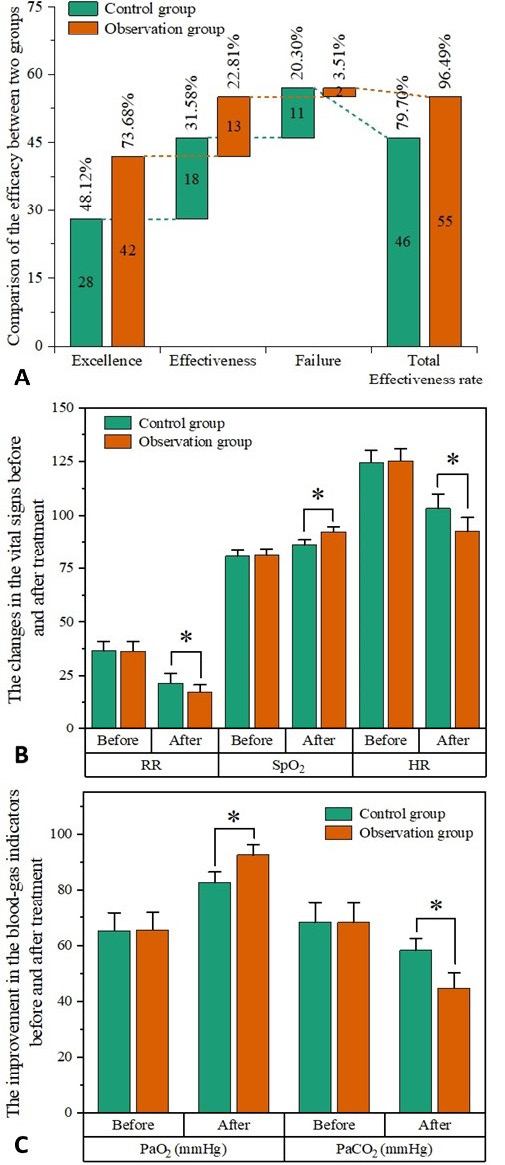
Effect of epinephrine on its efficiency (A), Vital signs (B), blood-gas indicators (C) clinical symptoms (D) of patients suffering from severe asthma.
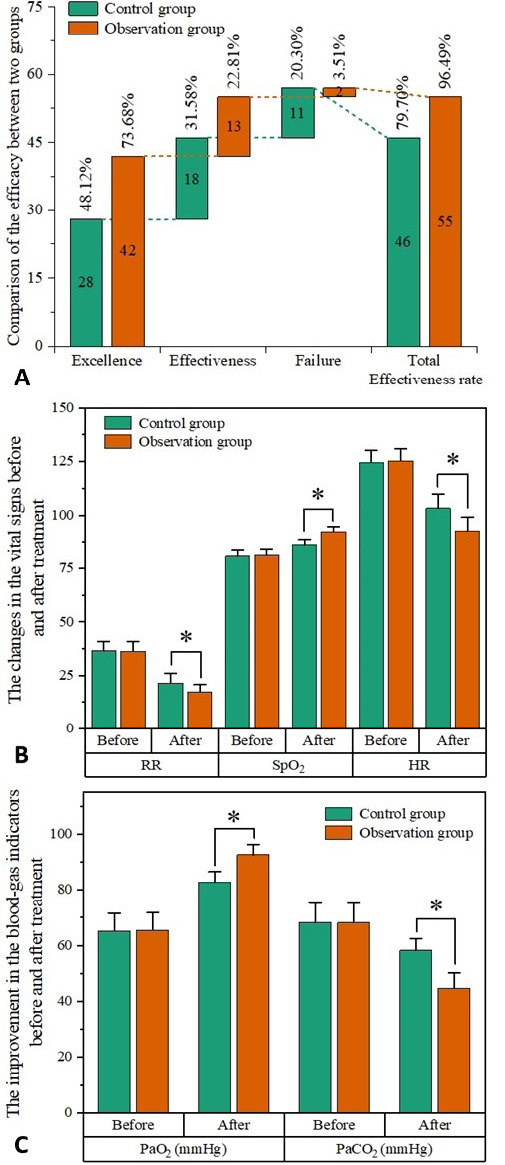
Effect of epinephrine on its efficiency (A), Vital signs (B), blood-gas indicators (C) clinical symptoms (D) of patients suffering from severe asthma.
References
- Chen, B., 2019. J. Shanxi Staff med. Coll., 12: 73–74.
- Chen, M., and Hong, Y., 2020. Chinese Foreign Med. Res., 18: 43–45.
- Cui, B., 2016. China Pract. Med., 11: 206–207.
- Gao, C., 2019. J. Shanxi Staff med. Coll., 29: 11–13. https://doi.org/10.3329/jafmc.v13i2.41370[CrossRef]
- Guo, J., and Zhou, C., 2020. Chin. J. Emerg. Med., 29 : 268–271.
- Hu, A., 2014. Chin. J. Gerontol., 34: 4678–4679.
- Jia, Z., Chen, G., and Ma, D., 2019. J. Hum. Normal Univ. (Med. Ed.), 16 : 168–171.
- Lambrecht, B.N., Hammad, H., and Fahy, J.V., 2019. Immunity, 50: 975-991. https://doi.org/10.1016/j.immuni.2019.03.018[CrossRef]
- Lei, Y., and Li, W., 2015. Anhui Med., 19: 1585–1588.
- Li, L., 2018. Heilongjiang Trad. Chin. med., 47: 81–83.
- Li, M., Huang, C., and Pan, X., 2019. Chin. For. med. Res., 17: 49–50.
- Liu, Q., 2017. World clin. Med., 11: 56–58. https://doi.org/10.21820/23987073.2017.11.56[CrossRef]
- Luo, X., 2018. Clin. Res. Pract., 3: 21–22.
- Meltzer, E.O., 2003. J. Manage. Care Pharm., 9(5 Supp. A): 8-13. https://doi.org/10.18553/jmcp.2003.9.s5.8[CrossRef]
- Wu, W., Hu, Y., and Zhang, H., 2019. Jilin med. Sci., 40: 500–501.
- Xiang, Y., Tan, Q., and Zhong, J., 2019. Chin. For. med. Res., 17: 69–70.
- Yang, Q., 2020. Chin. med. Guide, 18: 18–19. https://doi.org/10.1016/S0262-1762(20)30220-0[CrossRef]
- Zhang, N., 2017. World clin. Med., 11: 44. https://doi.org/10.1016/S0262-1762(18)30036-1[CrossRef]
- Zhang, X., 2013. Henan med. Res., 22: 590–591. https://doi.org/10.12968/bjon.2013.22.10.590[CrossRef]
- Zhang, Y., 2019. J. med. Forum, 40: 161–163.
- Zhang, Y.Y., and Chen, R., 2019. Chin. Pres. Drugs, 17: 75–76.
- Zhong, A., 2018. Chin. med. Guide, 16: 41. https://doi.org/10.1007/978-3-319-73573-3_4[CrossRef]
- Zhu, X., Cui, J., Yi, L., Qin, J., Tulake, W., Teng, F., and Dong, J., 2020. Mediators Inflamm., 2020. https://doi.org/10.1155/2020/7835284[CrossRef]
Services
Article usage statistics
Loading…