
The proposed research work was conducted at Honeybee Research Institute of National Agricultural Research Centre, Islamabad on Apis mellifera Lingustica honeybee colonies during the spring months of March-April 2017. The effects of four larval grafting techniques, addition of royal jelly (A), dry grafting (B), grafting with addition of one drop of distilled water (C) Royal jelly plus distilled water (D) on queen bee rearing were investigated under field conditions. A considerable variation in queen rearing success was observed as calculated by percentage of secluded queen cells vs. grafted larvae over the study interlude. The highest larval acceptance 80.85 ± 0.64 and 81.25 ± 2.05 was observed by addition of royal jelly in March and April and lowest 42.05 ± 0.69 and 48.21 ± 2.02. The shortest pre oviposition period by addition of royal jelly in March and highest was by addition of distilled water droplet during March and April. The length of queen cell was highest in royal jelly added treatment followed by dry grafting, royal jelly plus distilled water and distilled water respectively. The queen emergence weight was slightly higher in the royal jelly added grafting than other treatments. The queen spermatheca diameter, emergence rate and mating rate were not found to be affected by the treatments and rearing interludes. Additional research is suggested and needed for clear recommendation.
Short Communication · Volume 51, Issue 6, 22 September 2019 · Open Access
Effects of Rearing Interlude and Grafting Technique on Honeybee Apis mellifera L. Queen under Field Conditions
· · ·
Affiliations & Notes ⌄
- 1Honeybee Research Institute, National Agriculture Research Centre, Islamabad 2Department of Entomology, PMAS-Arid Agriculture University, Rawalpindi , * Corresponding author: rashid_ento1@yahoo.com
Article Info ⌄
- Journal:
- Pakistan Journal of Zoology
- Published:
- 22 September 2019

Abstract
Materials and methods
The proposed research work was conducted in the apiary of PARC Agrotech Company and Honeybee Research Institute during 2017 at National Agricultural Research Centre Islamabad Pakistan. Three queen breeding colonies were selected prior grafting on the basis of hygienic behavior, mite infestation, and honey production. It can be concluded that screen bottom board trays alone and with soft chemicals in all three seasons effectively control the Varroa mite and can be used without any side effect during all the three seasons . Three mother colonies and twenty experimental colonies were selected from 110 strong colonies. Doolittle grafting method was used to rear queen bee in March-April. Four grafting techniques including grafting with addition of some royal jelly (A), dry grafting (B) grafting with addition of distilled water (C) and Diluted royal jelly with distilled water (D) were adopted. A total of 180 larvae of 24 h age were used to raise queen bees by grafting 30 larvae for each frame. Their age was estimated by size. The larvae were grafted from comb cells to bees wax queen cups 9mm in diameter mounted on frame bar using a match stick. The grafted frames were inserted into queen less nurse colony. The nurse colony contained at least four brood combs mostly at capped stage. The nurse colonies were supplied every week with two combs of brood of different age but mostly of capped brood. In a single nurse colony the rearing was done 1 to 2 replications. The numbers of replications depended on the acceptance of successive grafts.
After 2-3 days following grafting, the colonies were inspected for larval acceptance. On 10thday of grafting, the height of queen cells were measured and placed in nursery cages having some candy (1:4 honey: Icing sugar) and nurse bees that were put in the cell building colony until queens emerged out. Shortly after emergence queens were weighed via digital weighing balance, and pre-oviposition period in field condition in mating nucs. The queens were marked, tagged and placed in mating nuclei for 48 h and then permitted to be mated naturally in Honeybee Research Institute queen mating yard after fixing the mating nuclei on iron stand. The mating rate were recorded after 07 to 10 days by observing eggs in nuclei and spermatheca diameters of queen were calculated by dissecting the queen under 4x stereomicroscope.
The data were analyzed using multiple regression analysis. Student’s t-test (Johnston, 2018) was used to test for a significant difference between means. One way ANOVA was used by using the software XLSTAT 2008 to compare variables the grafting methods rearing efficiency against the different rearing interludes.
Results and discussion
Maximum rate of larval acceptance 80.85 ± 0.64and 81.25 ± 2.05 was recorded during the months of March and April when royal jelly was used as substrate prior to larval grafting followed by Diluted Royal Jelly, dry grafting and distilled water droplet where acceptance rate was 78.31±1.02 and 73.05 ± 0.69, 77.21 ± 2.02 and 71.05 ± 0.67, 42.05 ± 0.69 and 48.21 ± 2.02, respectively (Table I). The highest larvae acceptance rate with addition of royal jelly could be explained by higher nectar flow at this
Table I.- Queen bee characteristics as influenced by grafting method and month.
| Grafting method × Rearing months interaction | Accep-tance rate (%) | Sealed queen cells | Sealed cell length (mm) | Mating rate (%) | Queen size (mm) | Sperm-atheca diameter (mm) | Queen emerg ence weight (mg) | Pre-ovip osition period (days) |
| A× 1 | 80.85±0.64 | 24.21± 0.13 | 18.35± 1.20 | 73.9± 1.98 | 16 ± 0.99 | 0.0983 ± 0.02 | 163.75± 2.05 | 11.85 ± 0.92 |
| A× 2 | 81.25±2.05 | 24.37± 0.6 | 17.55± 1.15 | 71.95± 2.05 | 16 ± 0.28 | 0.955 ± 0.10 | 159.7± 1.98 | 12.75 ± 2.05 |
| B× 1 | 78.31±1.02 | 23.49 ±0.2 | 16.05± 1.10 | 69.24± 1.14 | 15.2 ± 0.38 | 0.852 ± 1.4 | 153.4± 1.25 | 13.15 ± 1.15 |
| B× 2 | 73.05±0.69 | 22.27 ±0.23 | 17.18± 1.70 | 64.9± 1.38 | 15.10± 0.98 | 0.796 ± 0.03 | 160.17 ±1.24 | 12.95 ± 0.72 |
| C× 1 | 77.21±2.02 | 21.49 ±0.47 | 15.05± 1.10 | 62.04 ±1.12 | 15.4 ± 0.58 | 0.885 ± 1.7 | 155.2± 1.14 | 12.15 ± 1.16 |
| C× 2 | 71.05±0.67 | 21.27± 0.54 | 16.18± 1.70 | 61.9 ±1.28 | 15.3 ± 0.75 | 0.746 ± 0.47 | 152.14± 1.34 | 13.15 ± 0.78 |
| D× 1 | 42.05±0.69 | 14.27 ±0.23 | 15.18± 1.70 | 51.9 ±1.38 | 14.10± 0.98 | 0.712 ± 0.03 | 149.18± 1.21 | 12.95 ± 0.72 |
| D× 2 | 48.21±2.02 | 13.43 ±0.47 | 15.05± 1.10 | 48.04± 1.12 | 13.4 ± 0.58 | 0.811 ± 1.7 | 148.20± 1.11 | 12.15 ± 1.16 |
A, royal jelly; B, diluted royal jelly; C, dry grafting; D, distilled water; 1, March; 2, April.
period of time in the region. The results are in lined with then findings of Gul and Kaftanoglu (1990) who reported acceptance rate of queen bees (64.8%) grafted with addition of royal jelly and (55.2%) dry grafting but these results were lower than our findings. However, the higher acceptance rate is lower than the results with addition of royal jelly obtained by Kaftanoglu and Kumova (1992).
The highest sealed queen cells were obtained when royal jelly was used in grafting during the month of March and April followed by Diluted Royal Jelly. The highest queen cells were obtained when royal jelly was used in grafting in the months of March and April but there was no significantly different results were observed between royal jelly and other treatments except in distilled water substrate where less than fifty percent sealed queen cells were recorded as compared to grafted larvae which may be due to less appealing substrate for bees (Table I). The result of queen cells was similar to the findings of Dodologlu and Genc (1997) and Emsen (2001). On the other hand, another research showed that the results of queen cell were found lower in royal jelly addition method in the month of June. The reason for lower queen cell in July with addition of royal jelly could be explained by lower swarming in that month.
The longest pre-oviposition period was obtained in March. The shortest period was observed by addition of royal jelly in July and by the other two methods in June and July. Gul and Kaftanoglu (1990) also reported similar pre-oviposition period (10.36 days) by addition of royal jelly. Grafting methods and rearing interludes had no effect on number of spermatheca diameter (Fig. 1) and queen emergence weight, which indicate characteristics of queen bees. The reason of this result could be sufficient nursing bee numbers, suitable climate and higher nectar flow in the months of March and April. It is concluded that better quality queen can be obtained by rearing with the addition of royal jelly as substrate into queen cell cups just before grafting in the month of March and April. However, more studies are needed before making definite recommendations.
Another characteristic to be analyzed was queen rearing efficiency verses the various grafting methods used. Based on the study interlude observations, it was found the larval acceptance of grafted larvae varied only slightly in royal jelly, diluted royal, and dry grafting but acceptance was at lower stage in distilled water addition treatment. As in the previous studies the difference was not significant. In this study, the rearing efficiency was assessed as the number of capped queen cells vs. grafted larvae. An important issue to be resolved was the assessment of losses over successive rearing interludes via various grafting techniques. Rearing efficiency was recorded maximum in royal jelly and minimum in distilled water added grafting methods (Fig. 2).
Conclusion
It can be concluded that addition of royal jelly in queen cups prior to larval grafting during the month of March is effective for maximum larval acceptance during the queen rearing process.
Acknowledgments
We acknowledge Mr. Muhammad Riaz, Technical Scientific Assistant and Mr. Zafar Iqbal, Bee Attendant for assisting in grafting larvae, royal jelly collection and making mating nucs. Mr. Tahir Mahmood, Bee Attendant, is also highly acknowledged for preparation of queen nursery cages and bee candy. The technical assistance of Dr. Asif Aziz, Assistant Professor, PMAS- Arid Agriculture University, Rawalpindi during the queens Spermathecal study is highly acknowledged.
Statement of conflict of interest
Authors have declared no conflict of interest.
Figures
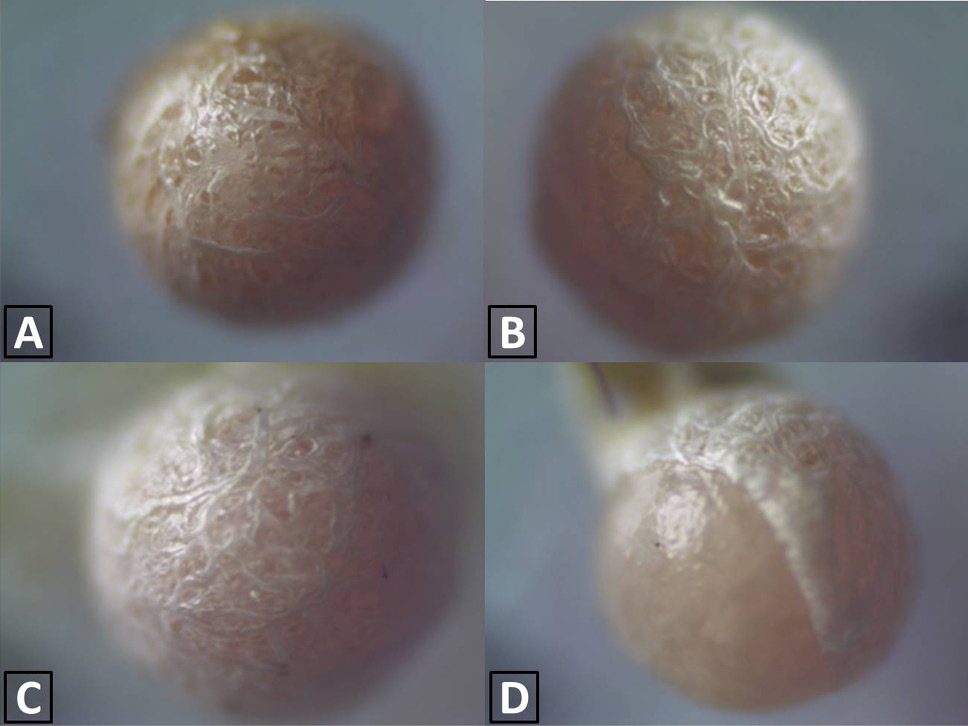
Spermatheca of dissected queens reared via various grafting Methods under stereomicroscope at 4x. A, royal jelly; B, diluted royal jell; C, dry grafting; D, distilled water droplet.
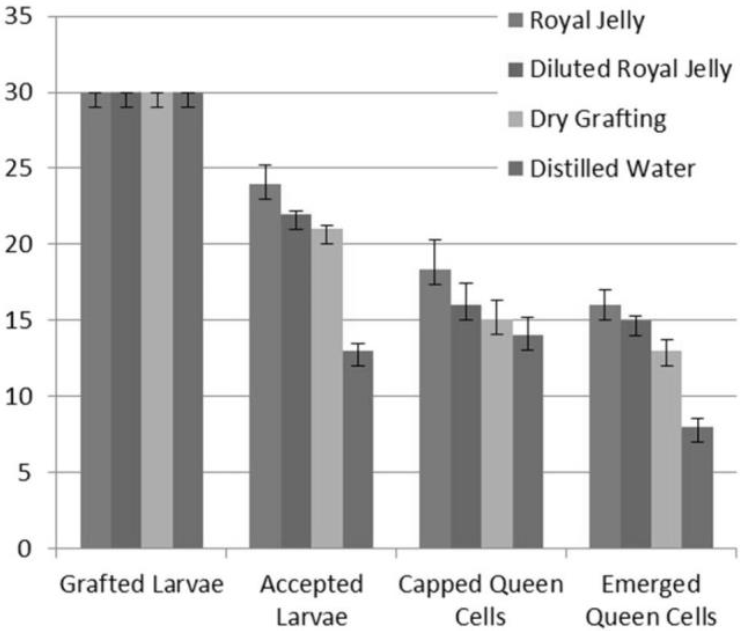
Queen rearing efficiency as affected by various grafting methods (Mean ± SE).
References
- Chang, S.Y., 1977. Effect of size and type of queen cup on the production of royal jelly and acceptance by nurse bees. Master thesis, National Chung Hsing University, Taichung, Taiwan.
- Delaplane, K.S. and Harbo, J.R., 1988. Am. Bee J., 128: 439-440.
- Dodologlu, A. and Genc, F., 1997. Turk. J. Vet. Anim. Sci., 21: 379-385.
- Emsen, B., 2001. Characteristics of queen bees (Apis mellifera L.) reared by using various aged larvae and different methods. M. Sc. dissertation, College of Agriculture, Ataturk University, Erzurum, pp. 28.
- Fell, R.D. and Morse, R.A., 1984. Insects Soc., 31: 221-237. https://doi.org/10.1007/BF02223608[CrossRef]
- Genc, F., 1997. The basic beekeeping. College of Agriculture, Ataturk University, Erzurum, pp. 188.
- Gul, M.A. and Kaftanoglu, O., 1990. Cukurova Univ. Sci. Engin. Yearb., 4: 41-53.
- Jhonston, L.W., 2018. J. Qual. Technol., 2: 243-245. https://doi.org/10.1080/00224065.1970.11980443[CrossRef]
- Kaftanoglu, O. and Kumova, U., 1992. Turk. J. Vet. Anim. Sci., 16: 569-577.
- Laidlaw, Jr. H.H., 1985. Contemporary queen rearing. Dadant and Sons, Hamilton, Illions, pp. 199.
- Mudassar , A., Saeed, S., Sajjad, A. and Whittington, A., 2011. Appl. Ent. Zool., 46: 353-361. https://doi.org/10.1007/s13355-011-0051-0[CrossRef]
- Muzaffar, N., 1982. Progr. Farm., 2: 5-7.
- PARC, 2010-2011. Honeybee annual report. Pakistan Agriculture Research Council, Islamabad, Pakistan, pp. 98.
- Rashid, M., Asad, S., Ahmad, W., Sarwar, G., Rafique, M.K., Islam, N., Qadir, Z.A. and Abideen, Z., 2017. Pakistan J. Zool., 49: 9-13.
- Skowronek, W. and Skubida, P., 1988. Pszczeln. Zesz. Nauk., 32: 3-18.
Cited by 1 article
In journals published by ResearchersLinks.
Services
Article usage statistics
Loading…