
One major problem of dairy cattle industry is the high prevalence of mammary gland infection. Despite significant technological developments in animal husbandry, udder infection is still widespread; particularly in large herds that causes high production losses to the dairy industry of Pakistan. Identification of molecular marker sequences that are directly related to immunity against mastitis might be helpful for animal selection trait and prevention of this disease. The aim of the present study was to assess the effect of polymorphism in bovine tumor necrosis factor alpha (TNF-α) gene on immune function and its role in mastitis susceptibility in Pakistani Sahiwal cows. In this study, a total of 150 Sahiwal cows were selected suffering from clinical (n=50), subclinical (n=50) mastitis along with non-mastitic (n=50) cows from different dairy farms of Punjab. TNF-α gene was amplified with specific primer and sequenced to get the full-length sequence of this gene. A total of nine changes including transition (n=6) and transversion (n=3) were found at the different position of this gene. Due to these changes, the amino acid is changed that leads to significant change in the folding of 3D protein structure of clinical sample, while in subclinical samples, showing the same variation in overall 3D protein structure analysis of TNF-α gene. The association between polymorphism identified within the TNF-α gene with mastitis reported in this study revealed that SNPs has potential to serve as a molecular marker for screening of mastitis resistant and susceptible Sahiwal cows.
Short Communication · Volume 51, Issue 6, 22 September 2019 · Open Access
Genetic Association of Bovine TNF-α Gene Polymorphism with Clinical and Sub-clinical Mastitis in Sahiwal Cows
· · · · ·
Affiliations & Notes ⌄
- 1Institute of biochemistry and biotechnology, University of Veterinary and Animal Sciences, Lahore, 54000 2Department of Physiology, University of Veterinary and Animal Sciences, Lahore, 54000 3Department of Epidemiology and public health, University of Veterinary and Animal Sciences, Lahore, 54000 4Department of Medicine, Cholistan University of Veterinary and Animal Sciences, Bahawalpur, 63100 , *Corresponding author: sehrishfiryal@uvas.edu.pk
- 2amjadwaseer@gmail.com
Article Info ⌄
- Journal:
- Pakistan Journal of Zoology
- Published:
- 22 September 2019

From the article
- In this present study, the TNF- α gene of Pakistani Sahiwal cow was sequenced for identification of polymorphism.
- In TNF- α gene sequence of clinical and subclinical mastitic cows, six transition SNPs were identified at location 268 (A>G), 383 (G>A), 750 (C>T), 2075 (A>G), 2444 (T>C), 2511(C>T).
- The present investigation demonstrates the presence of nucleotide changes at various positions in bovine TNF- α gene that leads to change in amino acid sequence.
- Our result suggests that these SNPs may be used as a potential genetic marker for screening of mastitis resistant and susceptible Sahiwal cows.
Selected from the article's own text.
Abstract
Materials and methods
For the identification of polymorphism within TNF- α gene, a total of 150 Sahiwal cows (clinical mastitis n= 50; subclinical mastitis n=50; non-mastitis n=50) were selected. For subclinical mastitis detection, Surf Field mastitis test was performed at the animal site. For this purpose, 3% solution of household detergent (Lever Brothers, Surf Excel, and Arial) was mixed with quarter foremilk sample in equal volume and was swirled for 15-20 seconds and looked for thickening of the mixture (i.e. gel formation). About 5-10 mL blood sample was collected from jugular vein aseptically in blood vacutainer tubes. Organic DNA extraction method was used for DNA extraction from blood samples .
For amplification of TNF- α gene, six sets of primer were designed using already reported sequence of B. taurus from NCBI (NCBI GenBank; Accession no. AC_ 000180.1) (Table I). Optimization of primers was carried out with following temperature profile; initial denaturation-95°C for 5 min, denaturation-94°C for 30 s, annealing of TNF1 at 56ºC, TNF2 at 60ºC, TNF3 at 55ºC, TNF4 at 52ºC, TNF5 at 56ºC and TNF6 at 58ºC for 30 s, extension-72ºC for 60 s, final extension-72ºC for 10 min, repeat step 1-3 for 30 cycle.
Purified amplicon was subjected for commercial sequencing. The sequencing result was analyzed manually using BioEdit software followed by sequence alignment through NCBI BLAST. Protein analysis was done using ExPasy translate tool along with the development of 3D structure using PAYMOl software.
Results
In this present study, the TNF- α gene of Pakistani Sahiwal cow was sequenced for identification of polymorphism. Comparative sequence analysis with reference sequence revealed SNPs at different position of the gene. In TNF- α gene sequence of clinical and subclinical mastitic cows, six transition SNPs were identified at location 268 (A>G), 383 (G>A), 750 (C>T), 2075 (A>G), 2444 (T>C), 2511(C>T). Three changes were identified at position 538 (G>C), 1139 (T>G) and 2512 (T>G) that show transversion polymorphism (Table II). The protein analysis shows missense mutation in amino acid sequence i.e., Leucine is changed with Tryptophan at 215 (Fig.1).
Table I.- Details of primers used to investigate the polymorphism within TNF- α gene
| Primer Name | 5’-3’ Sequence | GC (%) | Product size (bp) |
| TNF1 F | CTTCCCTTTCTCCAGCTCCT | 55 | 692 |
| TNF1 R | GAGACAGGAGAGCCTTGTGG | 60 | |
| TNF2 F | CCACAAGGCTCTCCTGTCTC | 60 | 484 |
| TNF2 R | TGCTTACTCATTCGTCCAACA | 43 | |
| TNF3 F | TGTTGGACGAATGAGTAAGCA | 43 | 690 |
| TNF3 R | ACCCTGCACTGTCTCTCTGC | 60 | |
| TNF4 F | CTGGGTCATGAAGAAGCAGAG | 53 | 664 |
| TNF4 R | TAGTCCGGCAGGTTGATCTC | 55 | |
| TNF5 F | GAGATCAACCTGCCGGACTA | 55 | 524 |
| TNF5 R | GCAAACATAAACAGAGGGAGTTG | 44 | |
| TNF6 F | AACTCTCCCTTCCTGCCAAT | 50 | 480 |
| TNF6 R | AAGAGGCCCATGCAGAATTA | 45 |
Table II. SNPs identified in TNF- α gene sequence in clinical & subclinical mastitic Sahiwal cows.
| Position | Reference | SNPs | Region | Type of mastitis | Results |
| 268 | A | G | Intron | Clinical & Subclinical | Transition |
| 383 | G | A | Intron | Clinical & Subclinical | Transition |
| 538 | G | C | Intron | Clinical & Subclinical | Transversion |
| 750 | C | T | Exon | Clinical & Subclinical | Transition |
| 1139 | T | G | Intron | Clinical & Subclinical | Transversion |
| 2075 | A | G | Intron | Clinical & Subclinical | Transition |
| 2444 | T | C | Exon | Clinical & Subclinical | Transition |
| 2511 | C | T | Exon | Clinical & Subclinical | Transition |
| 2512 | T | G | Exon | Clinical & Subclinical | Transversion |
Discussion
SNPs were identified in TNF- α gene in both clinical and subclinical cases but not in non-mastitic samples so, this candidate gene are associated with cow immune response against invading microorganism. A total of nine changes including transition (n=6) and transversion (n=3) were found at different positions (exon and intron) of this gene. The polymorphism at position 111 (C/T), 209 (C/T) and 308 (A/G) in exon 4 of TNF-α were reported by Shirasuna (2011) and Maksymiec (2013) in Holstein-Friesian cows and Firyal (2018) in Sahiwal cows ; ; but the other SNPs are not reported.
The protein analysis performed indicates that there is a change in amino acid from Leucine to tryptophan at amino acid position 215. These mutational changes in polar groups produce a change in the overall 3D protein structure of TNF- α gene (Fig. 2).
All these changes were found in both clinical and subclinical mastitis samples of Sahiwal cows at different intronic and exonic region. A comparison of the TNF-α gene in various type of mastitis in the present study indicates variations within the TNF-α gene that is responsible for mastitis. So, TNF-α is a potential candidate gene for the screening of the mastitis susceptible and resistant dairy cows.
Conclusion
The present investigation demonstrates the presence of nucleotide changes at various positions in bovine TNF- α gene that leads to change in amino acid sequence. Our result suggests that these SNPs may be used as a potential genetic marker for screening of mastitis resistant and susceptible Sahiwal cows. This can be useful in the selective breeding of cattle for an enhanced immune response as a tool to improve inherent animal health.
Statement of conflict of interest
The authors declare no conflict of interest.
Figures
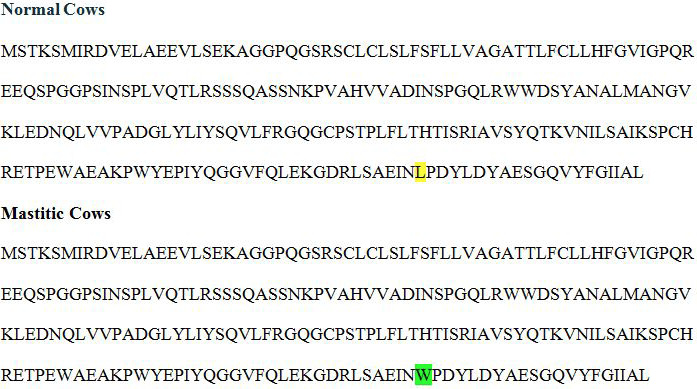
Deduced amino acid sequence of TNF-α gene of normal and mastitic Sahiwal cows.
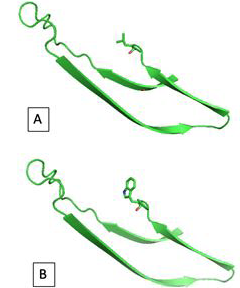
3D modeling for the peptide of TNF-α gene of normal (A) and mastitic (B)cows
References
- Ali, M., Ahmad, M., Muhammad, K. and Anjum, A., 2011. Name of the journal, 150: 42.
- Aqib, A.I., Kulyar, M.F.A., Ashfaq, K., Bhutta, Z.A., Shoaib, M. and Ahmed, R., 2019a. Trends Fd. Sci. Technol. 88: 497-504. https://doi.org/10.1016/j.tifs.2019.04.009[CrossRef]
- Aqib, A.I, Nighat, S., Ahmed, R., Sana, S., Jamal, M.A., Kulyar, M.F.A, Khan, N.U., Sarwar, M.S., Hussain, A., Asadullah, Attaur Rahman, A. and Rahman, S.U.R., 2019b. Pakistan J. Zool., 51: 307-315. http://dx.doi.org/10.17582/journal.pjz/2019.51.1.307.315[Full text][CrossRef]
- Bannerman, D. 2009. J. Anim. Sci., 87: 10-25. https://doi.org/10.2527/jas.2008-1187[CrossRef]
- Carvajal, A.M., Huircan P. and Lepori, A., 2013. Genet. Mol. Res., 12: 2702-2711. https://doi.org/10.4238/2013.July.30.8[CrossRef]
- Firyal, S., Awan, A.R., Sattar, H., Ullah, H.K.R., Tayyab, M., Wasim, M., Saeed, S., Naseer, R., Umer M.O. and Rashid, I., 2018. Int. J. Agric. Biol., 20: 750-752.
- Fourichon, C., Beaudeau, F., Bareille, N. and Seegers, H., 2005. Prev. Vet. Med., 72: 177-181. https://doi.org/10.1016/j.prevetmed.2005.08.018[CrossRef]
- Ibeagha-Awemu, E.M., Kgwatalala P. and Zhao, X., 2008. Mammal. Genom., 19: 591-617. https://doi.org/10.1007/s00335-008-9141-x[CrossRef]
- Mahboob, A., Avais M., Hussain, R., Prince, K., Ijaz, M., Chaudhry, M., Firyal, S., Aqib, A.A., Khan, N.U. and Sarwar, M.S., 2018. Pakistan J. Zool., 51:603-609. http://dx.doi.org/10.17582/journal.pjz/2019.51.2.527.532[Full text][CrossRef]
- Mesquita, A.Q.D., Mesquita, A.J.D., Jardim, E.A.G.D.V. and Kipnis, A.P.J., 2012. Brazilian J. Microbiol., 43: 692-697. https://doi.org/10.1590/S1517-83822012000200034[CrossRef]
- Moyes, K., Drackley, J., Salak-Johnson, J., Morin, D., Hope J. and Loor, J., 2009. J. Dairy Sci., 92: 4301-4316. https://doi.org/10.3168/jds.2009-2170[CrossRef]
- Muhammad, G., Athar, M., Shakoor, A., Khan, M.Z., Rehman, F. and Ahmad, M., 1995. Pakistan J. Fd Sci., 5: 91-93.
- Parameswaran, N. and Patial, S., 2010. Crit. Rev. Eukary. Gene Expr., 20: 87-103. https://doi.org/10.1615/CritRevEukarGeneExpr.v20.i2.10[CrossRef]
- Rupp, R. and Boichard, D., 2003. Vet. Res., 34: 671-688. https://doi.org/10.1051/vetres:2003020[CrossRef]
- Sambrook, J., Russell D.W. and Russell, D.W., 2001. Molecular cloning: a laboratory manual (3-volume set). Cold Spring Harbor Laboratory Press, New York.
- Shirasuna, K., Kawashima, C., Murayama, C., Aoki, Y., Masuda, Y., Kida, K., Matsui, M., Shimizu T. and Miyamoto, A., 2010. J. Reprod. Develop., volume : Page number?
- Sordillo, L.M. and Streicher, K.L., 2002. J. Mamm. Gland Biol. Neopl., 7: 135-146. https://doi.org/10.1023/A:1020347818725[CrossRef]
- Tang, P., Hung, M.-C. and Klostergaard, J., 1996. Biochemistry, 35: 8216-8225. https://doi.org/10.1021/bi952182t[CrossRef]
- Wojdak-Maksymiec, K. and Mikolajczyk, K., 2012. Pakistan Vet. J., 32: 477-482.
- Wojdak-Maksymiec, K., Szyda, J. and Strabel, T., 2013. BMC Vet. Res., 9: 114. https://doi.org/10.1186/1746-6148-9-114[CrossRef]
Services
Article usage statistics
Loading…