So, for cattle slaughtered, liver condemned and economic loss, the study was a retrospective abattoir survey, performed for a period of one full year from 22 December 2018 to 21 December 2019.
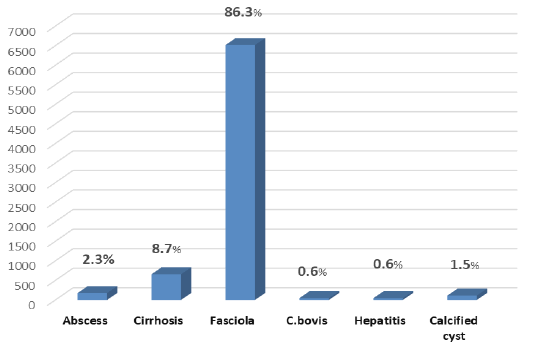
Whereas the pathological conditions causing live condemnation in this study were Fascioliasis 6516 (86.3), liver Cirrhosis 657 (8.7), liver Abscess 175 (2.3), Hepatitis 46 (0.6), Calcified cyst 112 (1.5), and C. bovis 47 (0.6) as showed in Table 2 and Figure 2.
Considering that each liver weighed 5.33 kg on average, and that a value of USD 4.69(LE 75) was assigned per kg; the total economic losses in USD were 173554.21$ whereas the economic losses due to Fascioliasis were 152718 $ as showed in Table 3.
Also, it can help in controlling of these diseases for improving animal health, prevention of disease and reduction of economic losses by liver condemnations.
Selected from the article's own text.
Abstract
Amer MA Rassol1, Ali M. Ahmed2, Hassan M. Sobhy3, Sherein S. Abdelgayed4*, Sahar HA Hekal3
1GOVS/ Abu Simbel veterinary Quarantine, Aswan Governorate, Egypt; 2Deptartment of Food Hygiene, Faculty of Veterinary Medicine, Arish University, Egypt; 3Department of natural resources, Faculty of African Post Graduated Studies, Cairo University, Egypt; 4Department of Pathology, Faculty of Veterinary Medicine, Cairo University, Giza, Egypt.
Abstract | Beef liver as human food is a good source of protein and provides many vitamins as B12, vitamin A, riboflavin and copper. Fascioliasis is an acquired infection occured by eating contaminated water plants and caused by the liver fluke (Fasciola hepatica). Therefore, the aim this of work was to determine i) the liver lesions of cattle in Abu Simbel Abattoir, Aswan Governorate, Egypt imported from Sudan; ii) the prevalence of bovine Fascioliasis and iii) estimate their economic losses as a result of liver lesions. The study was performed for a period of one year from 22 December 2018 to 21 December 2019. During the survey, 81452 male cattle were slaughtered and inspected. The total number of condemned livers was 7553 (9.3%). The pathological conditions causing liver condemnation were Fascioliasis (86.3%), cirrhosis (8.7%), abscesses (2.3%), calcified cyst (1.5%), hepatitis (0.6%), and Cysticercus bovis (0.6%). The total economic losses were 173554.21$ while with respect to Fascioliasis were 152718$. In conclusion, these results indicated that the bovine Fascioliasis was the main cause of liver condemnation in the present study causing highly economic losses.
Imported animals play a significant role in Egypt to bridge the gap between low domestic production and increased consumption level. According to the Egyptian Guidelines for Cattle Inspection, the carcasses were classified into the categories of capable for human consumption (edible), capable for processing (conditionally edible), and condemned based on the results obtained from the ante-mortem and postmortem inspection . Slaughter houses supply important data that allowing diseases detection of both economic and public health importance . Liver is the largest gland in the body that play many important functions including synthetic, catabolic, detoxifying, secretory and excretory activities ; . Pathological affections of liver attributable to a variety of causes including parasites, viruses, mycoses and bacteria ; resulting in great economic losses through condemnation of affected liver at slaughter houses in addition to that the liver lesions may be carry great risks to the consumers’ health . Out of these pathological affections; Fascioliasis plays a great role in direct and indirect economic losses;mainly through mortality, liver condemnation, reduced production of meat, milk, and wool, and expenditure for anthelmintic . In addition to that, Fascioliasis is a zoonotic food and waterborne infection that has a great public health importance . In Abu Simbel city, thousands of slaughtered animals are processed as meat for human consumption each year. However, there are non-available literatures concerning the prevalence of the pathological lesions affecting liver of imported cattle slaughtered at this abattoir. Therefore, the current study was focused on liver inspections within the processes of ante-mortem and post-mortem inspections in Abu Simbel abattoir to estimate the prevalence of different pathological liver conditions especially hepatic fascioliasis and evaluate their direct economic impact.
MATERIALS AND METHODS
Ethical statement
Ethical approval was not needed in this study as the liver samples were collected from slaughtered cattle from the abattoir. However, consent from the abattoir authorities was taken prior collection of samples.
Study population
Male cattle of Sudanese-origin were kept in quarantine for 21 days under observation and supervision of Egyptian Quarantine Veterinarians in the Sudanese city of Wadi Half (bordering Egypt). Afterwards, cattle are shipped down the Nile to the city of Abu Simbel, Aswan Governorate where they were slaughtered.
Specimen collection
Regular visits were done to the Abu Simbel Abattoir during the period from 22 December 2018 to 21 December 2019. Routine post-mortem examination of 81452 slaughtered male cattle was carried out with attention to the hepatic affections. It was examined visually on both parietal and visceral surfaces, then palpated and incised on the visceral surfaces in such a way that the incision come across most of the bile ducts. A visual examination with palpation was made for different pathological affections. The portal lymph nodes, large bile ducts and gall bladder also were incised and inspected.
Histopathological examinations
All affected livers were collected, weighted and imaged by digital camera. Specimens from different lesions of liver were fixed in 10% neutral buffered formalin, then washed, dehydrated, cleared and embedded in paraffin. Preparation of tissue for histopathological examination was carried out according to the method described by Bancroft et al. (1996). The paraffin embedded blocks were sectioned at 4-5 μm thickness, stained with hematoxylin and eosin and examined for the histological changes using digital microscope (Olympus BX50, Japan) and histological findings were recorded.
Estimation of economic loss
Direct economic loss was resulted from condemnation of affected liver was calculated using the following parameters; average weight of liver, and monthly liver price per kg (75 Egyptian Pound as the average retail price of edible organs per kilogram in Abu Simbel city). Average monthly economic loss was estimated by multiplying the number of condemned livers times the average liver weight and the monthly selling price. The sum of monthly values resulted in the total economic losses.
Statistical analysis
Statistical analysis was conducted using SPSS v.25.0 (IBM Corp., Armonk, NY, USA). The prevalence of different pathological conditions causing liver condemnation and confidence intervals were obtained, and the prevalence differences between the four seasons when the animal was slaughtered were also tested by chi-square with P value ≤ 0.05.
RESULTS AND DISCUSSION
Slaughterhouses provide useful epidemiological data to verify the presence of diseases of economic concern and warn of potential threats to public health (Khan et al., 2017). So, for cattle slaughtered, liver condemned and economic loss, the study was a retrospective abattoir survey, performed for a period of one full year from 22 December 2018 to 21 December 2019. During this period, a total of 81452 male cattle was slaughtered and inspected. Based on seasons, 16294 (20%), 26968 (33%), 26556 (33%) and 11634 (14%) male cattle were slaughtered in winter, spring, summer, and autumn, respectively (Table 1).
Table 1: Absolute numbers and percentages of condemned liver in Abu-Simbel Abattoir during four seasons.
Season
Slaughter animal
Total condemned liver
Total condemned liver for fascioliasis
No.
No.
%
No.
%
Winter
16294
1841
11.29
1431
8.78
Spring
26968
2203
8.17
1959
7.26
Summer
26556
2386
8.98
2111
7.94
Autumn
11634
1123
9.65
1015
8.72
Total seasons
81452
7553
9.27
6516
7.99
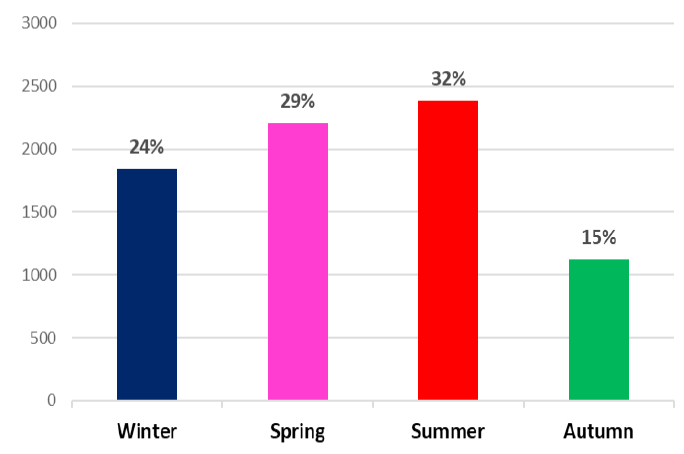
A total of 7553 (9.27%) pathological findings in liver were reported in slaughtered animal at Abu Simbel abattoirs. The frequency percentage of liver lesions during winter, spring, summer, and autumn were 24%, 29%, 32%, and15%, respectively (Figure 1). Whereas the pathological conditions causing live condemnation in this study were Fascioliasis 6516 (86.3), liver Cirrhosis 657 (8.7), liver Abscess 175 (2.3), Hepatitis 46 (0.6), Calcified cyst 112 (1.5), and C. bovis 47 (0.6) as showed in Table 2 and Figure 2.
Table 2: Prevalence distribution of different causes of liver condemnation and losses during four seasons.
Table 3: Estimated economic losses (USD) associated with liver condemnation.
Seasons
Liver lesions
Price
Liver fascioliasis
Price
No.
Weight (Kg)
$
No.
Weight (Kg)
$
Winter
1841
9205
43148.4
1431
7155
33539
Spring
2203
11015
51632.8
1959
9795
45914
Summer
2386
11190
52453
2111
10555
49476
Autumn
1123
5615
26320
1015
5075
23789
Total
7553
37025
173554.2
6516
32580
152718
Considering that each liver weighed 5.33 kg on average, and that a value of USD 4.69(LE 75) was assigned per kg; the total economic losses in USD were 173554.21$ whereas the economic losses due to Fascioliasis were 152718 $ as showed in Table 3.
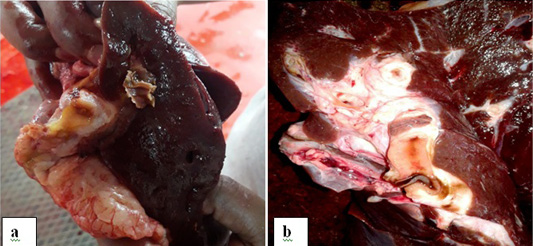
Fascioliasis represented the most common pathological lesion of the condemned livers. Gross examination of cross sectioned condemned livers with Fascioliasis revealed the presence of Fasciola helminth in the bile ducts which appeared enlarged with thickened and fibrosed wall (Figure 3a), together with whitish foci on the surface of the liver with size varied from 0.5 to 1.5 cm in diameter (Figure 3b).
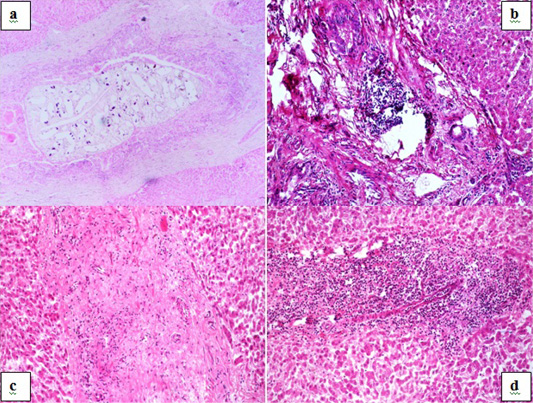
Histopathological examination of the condemned livers recorded fascioliasis as the most pathological lesions which appeared in the bile ducts (Figure 4a) with a subsequent biliary cirrhosis which represented by hyperplastic bile ducts, newly formed bile ductules, fibrous connective tissue proliferations, and mononuclear cells infiltrations (Figure 4b). Different minimal other histopathological lesions were also recorded including inflammatory reactions, cirrhosis (Figure 4c), degeneration and necrosis (Figure 4d).
The result revealed that the bovine fascioliasis is a problem in cattle slaughtered at Abu Simbel abattoirs causing high economic loss due to liver condemnation and carcass weight reduction; Which confirms that the bovine fasciolosis is economically important and widely distributed disease .
With respect to the source of slaughtered cattle; Sudan has a higher prevalence of Bovine fascioliasis , which attributed to many causes including lack of veterinary service in addition to presence of swampy areas for survival of the potential vector snails for Fasciola . In addition to the economic importance Fascioliasis has great role as re-emerging and widespread zoonotic problem affecting a number of human populations as a waterborne and foodborne zoonotic disease .
Elsewhere, numerous surveys on the prevalence of fascioliasis in slaughtered animals have been reported but there are variety of prevalence rate between different countries as result of different climatic conditions and presence of suitable habitat for intermediate host of Fasciola spp. such as boggy and humid pasture, and high herd density in northern Ethiopia,
The prevalence rates of Fascioliasis were 33.42%, 41.22% and 90.65% as estimated from qualitative coproscopy, egg-shedding index and abattoir survey data, respectively . While in the southern part of Ethiopia the autopsy study indicates prevalence, rate was of (14.0%) , Of the total 600 livers examined in Addis Ababa abattoir, Ethiopia 20.3% (122/600) were found infested with Fasciola . In Egypt abattoirs the prevalence of Fascioliasis was 2.67% , also the overall prevalence of fascioliasis in the Nile Delta region of Egypt was 9.77% .
The result of this work clearly helped to determine the importance of meat inspection in determination of disease situation and detect possible long term trends of the diseases .
CONCLUSION
Fascioliasis considered to be the most common cause of liver condemnation and was responsible for total liver condemnation in imported cattle in Abu Simbel abattoir; it also should know that this result can help in clarification of the critical role of liver inspection records, especially for Fasciola spp. which are economically and zoonotic important disease of animal and human. Also, it can help in controlling of these diseases for improving animal health, prevention of disease and reduction of economic losses by liver condemnations.
Acknowledgment
Authors are thankful to Dr. Wafaa Ahmed Ali Mahmoud, Manger, Assuit Quarantine and all the team at Abu Simbel governorate slaughterhouses in Aswan for supporting this work.
Authors Contribution
Amer MA Rassol carried out the practical work of the study, Sahar HA Hekal prepared the manuscript. Sherein S. Abdelgayed carried out the histopathological examination. Ali M. Ahmed and Hassan M. Sobhy, took part in preparing and critical checking of this manuscript
CONFLICT OF INTEREST
The authors have declared no conflict of interest.
References
• Abunna F, Asfaw L, Megersa B (2010). Bovine fasciolosis: Coprological, abattoir survey and its economic impact due to liver condemnation at Soddo municipal abattoir, Southern Ethiopia. Trop. Anim Health Prod., 42: 289–292. https://doi.org/10.1007/s11250-009-9419-3[CrossRef]
• Ahmed AM, Ismail SAS, Dessouki AA (2013). Pathological lesions survey and economic loss for male cattle slaughtered at Ismailia abattoir. Int. Food Res. J., 20(2): 857–863.
• Ali S, Ijaz M, Ahmed A, Aziz MU, Naveed M, Javed MU, Nawab Y, Ghumman NZ, Ghaffar A (2020). Prevalence and associated risk factors of bovine babesiosis in Lahore, Pakistan. Agrobiol. Rec., 2: 17-23. https://doi.org/10.47278/journal.abr/2020.009[CrossRef]
• Aragaw K, Sheferaw D (2012). Fasciolosis in slaughtered cattle in addis ababa abattoir, ethiopia fasciolosis in slaughtered cattle in Addis Ababa Abattoir, Ethiopia. Glob. Vet., 8(2): 115–118.
• Badreldeen MB, Elfadil AA (2015). A cross-sectional survey of bovine fasciolosis at elkadaro abattoir, Khartoum State, Sudan. Global J. Med. Res., 15(2): 1-8.
• Bancroft JD, A Stevens (1996). Theory and practice of histological techniques. Edinburgh: Churchill Livingstone; p. 766.
• Borai MGE, Nagi AR, Gab-Allah MS, El-Mashad AI, Moustafa SA (2013). Comparative pathological studies on parasitic affections of liver in farm animals. Benha Vet. Med. J., 25(2): 284–295.
• Chakiso B, Menkir S, Desta M (2014). On farm study of bovine Fasciolosis in Lemo District and its economic loss due to liver condemnation at Hossana Municipal abattoir, Southern Ethiopia. Int. J. Curr. Microbiol. App. Sci., 3(4): 1122–1132.
• El-tahawy AS, Bazh EK, Khalafalla RE (2017). Epidemiology of bovine fascioliasis in the Nile Delta region of Egypt : Its prevalence, evaluation of risk factors, and its economic significance. Vet. World, 10: 1241–1249. https://doi.org/10.14202/vetworld.2017.1241-1249[CrossRef]
• Kasim SA, Nurdan SM, Taleb M, Raheem ZS (2019). Study of bovine and ovine pulmonary and hepatic abscessation at kirkuk abattoir. Plant Arch., 19: 1640-1644 .
• Keyyu JD Monrad J, Kyvsgaard NC, Kassuku AA (2005). Epidemiology of Fasciola gigantica and amphistomes in cattle on traditional, small-scale dairy and large-scale dairy farms in the southern highlands of Tanzania. Trop. Anim. Health Prod., 37(4): 303–314. https://doi.org/10.1007/s11250-005-5688-7[CrossRef]
• Khan UD, Khan A, Gul ST, Saleemi MK, Du XX (2020). Seroprevalence of brucellosis in cattle (Bos taurus) kept in peri urban areas of Pakistan. Agrobiol. Rec., 1: 6-10. https://doi.org/10.47278/journal.abr/2020.003[CrossRef]
• Novobilský A, Novák J, Björkman C, Höglund J (2015). Impact of meteorological and environmental factors on the spatial distribution of Fasciola hepatica in beef cattle herds in Sweden. BMC Vet. Res. 11: Article number: 128 (2015). https://doi.org/10.1186/s12917-015-0447-0[CrossRef]
• Nyindo M, Lukambagire A (2015). Fascioliasis: An ongoing zoonotic trematode infection. BioMed. Res. Int., 2015: 1-8. https://doi.org/10.1155/2015/786195[CrossRef]
• Nyirenda SS, Sakala M, Moonde L, Kayesa E, Fandamu P, Banda F, Sinkala Y (2019). Prevalence of bovine fascioliasis and economic impact associated with liver condemnation in abattoirs in Mongu district of Zambia. BMC Vet. Res., 15(1): 1–8. https://doi.org/10.1186/s12917-019-1777-0[CrossRef]
• Ochi E, Elmalik K (2013). Prevalence and monetary loss due to fasciolosis in juba slaughter house south. Nat. Sci., 11: 145–148.
• Raji MA, Salami SO, Ameh JA (2010). Pathological conditions and lesions observed in slaughtered cattle in Zaria abattoir. J. Clin. Pathol. Forensic Med., 1(2): 9–12.
• Sanjari A, Davari SA, Rasekh M (2018). Macroscopic and histopathological examinations of liver lesions in slaughtered cattle in Zabol City, Iran. Iran. J. Vet. Med., 12(2): 135–144.
• Seid U, Melese M (2018). Review on prevalence, distrbution and economic significance of liver fluke in Ethiopia. ARC J. Anim. Vet. Sci., 4(2): 38–48. https://doi.org/10.20431/2455-2518.0402006[CrossRef]
• Yimam M, Pharmaceuticals U, Makonnen YJ (2000). Dry season bovine fasciolosis in Northwestern part of Ethiopia. Rev. Méd. Vét., 151(6): 493–500.