Research Article · Volume 41, Issue 2, 2 October 2026 · Open Access
Effects of Drying Methods on Hydration Properties and Color Characteristics of Okara for Feed Processing Applications
· ·
Affiliations & Notes ⌄
1Department of Animal Science, Faculty of Animal Husbandry, Universitas PGRI Kanjuruhan Malang, Jl. S. Supriadi No. 48, Malang, Jawa Timur, Indonesia. Corresponding Author: Tri Ida wahyu Kustyorini triida@unikama.ac.id
Among the three drying methods evaluated, each method exhibited distinct effects on the physical properties of okara.
Drying methods significantly influenced the physical quality of okara, particularly color characteristics and water absorption capacity, while fineness modulus was not significantly affected.
Overall, oven drying may be recommended when functional hydration properties are prioritized, whereas microwave drying is suitable when visual quality and rapid processing are desired.
Selected from the article's own text.
Abstract
The utilization of agro-industrial by-products such as okara has been widely explored; however, most previous studies have primarily focused on its nutritional composition, with limited attention given to its functional physical properties relevant to feed processing systems. In particular, the influence of different drying methods on hydration behavior and physical quality attributes of okara remains insufficiently understood. This study aimed to evaluate the effects of different drying methods (sun drying, oven drying, and microwave drying) on key physical properties of okara, including color characteristics (L*, a*, b*), fineness modulus, and water absorption capacity, with emphasis on their relevance to feed processing applications. A completely randomized design with three treatments and ten replications was applied. Data were analyzed using analysis of variance followed by Duncan’s Multiple Range Test. The results showed that drying methods significantly affected color parameters and water absorption capacity (p < 0.05), while no significant effect was observed on fineness modulus (p > 0.05). Microwave drying resulted in higher lightness values, indicating better preservation of visual quality, whereas oven drying improved water absorption capacity, suggesting enhanced hydration functionality. These findings demonstrate that drying methods not only influence the physical appearance of okara but also its functional behavior during feed processing. This study provides practical insights into optimizing drying strategies to improve the handling and hydration characteristics of okara as a feed material, thereby contributing to more efficient utilization of agro-industrial by-products in livestock systems.
Novelty Statement | This study introduces a functional approach to okara valorization by linking drying methods with hydration performance and physical quality, providing new insights for optimizing its utilization as a sustainable feed ingredient.
Introduction
The increasing demand for livestock products has intensified the need for alternative and sustainable feed ingredients, particularly those derived from agro-industrial by-products. The utilization of agricultural residues in animal feeding systems not only helps reduce feed costs but also mitigates environmental pollution associated with waste disposal ; . In this context, by-products from soybean processing industries have gained considerable attention due to their abundance and potential nutritional value.
Tofu residue, commonly referred to as okara, is a major by-product of tofu manufacturing and is produced in large quantities worldwide. Okara is known to contain appreciable levels of crude protein, dietary fiber, and residual lipids, making it a promising feed ingredient for livestock ; ; . Okara (Tofu residue) is recognized as a nutritionally valuable agro-industrial by-product, containing considerable amounts of crude protein (approximately 20–30% on a dry matter basis), dietary fiber (30–50%), and residual lipids (10–15%). In addition, it provides essential amino acids and bioactive compounds, making it a promising alternative feed ingredient for livestock. Compared to conventional feed ingredients such as cereal by-products, Okara offers a higher protein content and a balanced fiber fraction that can support gut health and digestive function. Its relatively high water-holding capacity and fiber composition may also contribute to improved feed texture and hydration behavior during feed processing. Despite these nutritional advantages, the high moisture content of fresh okara remains a major limitation, requiring appropriate processing methods such as drying to enhance its shelf life and practical usability. However, the fresh residue typically contains high moisture content, often exceeding 70%, which limits its direct utilization due to rapid spoilage, microbial growth, and difficulties in storage and transportation ; ; . Therefore, appropriate processing techniques are required to enhance its shelf life and usability.
Drying is one of the most widely applied processing methods to improve the stability and handling characteristics of high-moisture feed ingredients. In addition to moisture reduction, drying processes may significantly influence the physical properties of feed materials, including color, particle size distribution, and water interaction behavior ; . These physical characteristics are critical in feed formulation, as they affect mixing uniformity, bulk density, palatability, and hydration behavior during feed preparation and digestion ; .
Different drying methods, such as sun drying, hot-air oven drying, and other controlled drying techniques, differ in temperature regimes, drying duration, and exposure to oxygen and light, which may result in distinct physical attributes of the final product ; . Color is often associated with thermal degradation and consumer acceptance, fineness modulus reflects particle size distribution and grinding efficiency, while water absorption capacity is related to feed hydration and gastrointestinal functionality ; ; ; . Despite the growing interest in tofu residue as an alternative feed resource, comparative studies evaluating the effects of different drying methods on these specific physical characteristics remain limited.
Therefore, this study aims to conduct a comparative evaluation of drying methods on the physical characteristics of tofu residue as a potential feed ingredient. The effects of various drying techniques on color, fineness modulus, and water absorption capacity are systematically investigated. The results of this study are expected to contribute to the optimization of processing strategies and support the effective utilization of tofu residue in sustainable livestock feed systems. Despite the growing interest in tofu residue (okara) as an alternative feed resource, comparative studies evaluating the effects of sun drying, oven drying, and microwave drying on functional physical properties remain limited. Most previous studies have focused primarily on nutritional composition and general physical characteristics, with little attention given to hydration behavior and its implications for feed processing performance. Therefore, this study evaluates how different drying methods influence color characteristics, fineness modulus, and water absorption capacity of okara, providing a more application-oriented perspective for feed processing systems.
Materials and Methods
This study was conducted at the Laboratory of Animal Nutrition and Feed Technology, Faculty of Animal Husbandry, Universitas PGRI Kanjuruhan Malang, Malang, East Java, Indonesia. Fresh tofu residue (okara) was obtained from a local tofu processing industry on the day of production to ensure uniformity of raw material quality. The residue was transported to the laboratory in airtight containers and processed immediately to minimize microbial deterioration prior to drying treatments.
The experiment was arranged in a completely randomized design (CRD) with three drying methods as treatments and Each replication represented an independent drying batch rather than subsamples from a single batch to ensure experimental independence. The drying methods evaluated were:
Sun drying: Sun drying was carried out under natural sunlight conditions. The ambient temperature during drying ranged from approximately 30–35 °C, with relative humidity between 60–70%. Samples were spread in a thin layer (approximately 100 mm thickness) and dried for 6 h per day until the desired dryness was achieved. Temperature and environmental conditions were monitored using a digital thermometer-hygrometer. .
Oven drying: Approximately 500 g of fresh okara was spread in a thin layer (1–2 cm thickness) and dried in a forced-air oven at 60 °C until constant weight was achieved. The drying process was monitored periodically, and drying was terminated when the difference between two consecutive weight measurements was less than 2%.
Microwave drying: Samples were dried using a microwave oven at a power level of 600 W for 90 minutes with intermittent operation (5 min on/ 2 min off) to prevent overheating and ensure uniform moisture removal. .
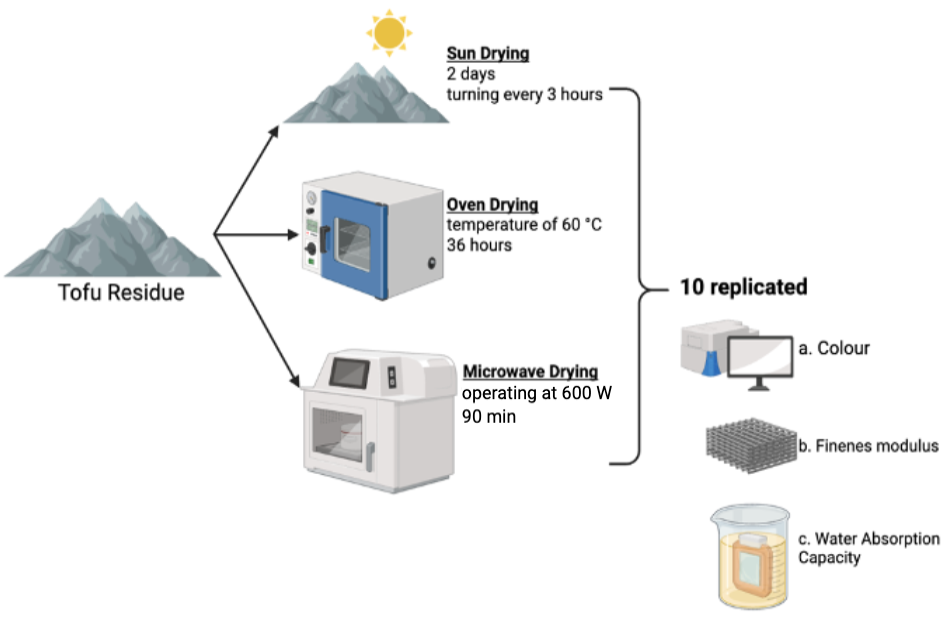
After drying, all samples were cooled to room temperature, ground using a laboratory mill, and sieved through a standard mesh to obtain uniform particle size prior to physical analysis. For all drying treatments, approximately 500 g of fresh okara was spread in a uniform layer with a thickness of 1–2 cm to ensure consistent drying conditions. Drying was continued until a constant weight was achieved, defined as less than 2% variation between consecutive measurements. The drying procedure is presented in Figure 1.
Physical characteristics analysis
The dried samples were finely ground and stored in airtight containers. Subsequently, laboratory analyses were conducted as follows:
Color: Color was measured using a colorimeter based on the CIE color system, with parameters L* (lightness), a* (red–green), and b* (yellow–blue). Each sample was measured at three different surface points, and the average value was used for analysis.
Fineness modulus: The dried samples were ground into flour and sieved using a series of standard sieves (mesh sizes 10–100). The weight of flour retained on each sieve was recorded, and the fineness modulus (FM) was calculated using a standard equation . The fineness modulus was calculated as follows:
Figure 1.
Water absorption capacity: Five grams of tofu residue flour were soaked in 50 mL of distilled water for 30 min. After soaking, the samples were filtered and reweighed . Water absorption capacity was calculated using the following equation:
Figure 2.
Statistical analysis
All data were analyzed using analysis of variance (ANOVA) appropriate for a completely randomized design. Prior to analysis, the assumptions of normality and homogeneity of variance were evaluated using the Shapiro–Wilk test and Levene’s test, respectively. When significant differences among treatments were detected (p < 0.05), mean comparisons were performed using Duncan’s Multiple Range Test. Statistical analyses were conducted using IBM SPSS Statistics version 25.
Results
Color characteristics
The drying method significantly affected the color characteristics of tofu residue. Statistical analysis showed a highly significant effect (p < 0.01) of drying methods on the L* (lightness) value, while significant effects were observed on a* and b* values (p < 0.05). The mean color values of tofu residue subjected to different drying methods are presented in Table 1.
Table 1: Color values of tofu residue obtained from the experiment.
Drying method
L*
a*
b*
Sun drying
74.52 ± 0.38ᵃ
5.88 ± 1.72ᵇ
15.81 ± 0.53ᵃ
Oven drying
79.26 ± 1.57ᵇ
3.11 ± 0.49ᵃ
12.95 ± 1.79ᵃ
Microwave drying
82.30 ± 0.20ᶜ
2.77 ± 0.30ᵃ
16.30 ± 0.49ᵇ
Different superscript letters (a–c) within the same column indicate significant differences among drying methods. L values show a highly significant effect (p < 0.01), while a* and b* values indicate significant effects (p < 0.05).*Tofu residue dried using microwave exhibited the highest L* value (82.30 ± 0.20), indicating a lighter color compared to oven drying (79.26 ± 1.57) and sun drying (74.52 ± 0.38). In contrast, sun-dried samples showed the highest a* value (5.88 ± 1.72), indicating a more reddish appearance. The b* value was highest in microwave-dried samples (16.30 ± 0.49), followed by sun-dried samples (15.81 ± 0.53), while oven-dried samples showed the lowest b* value (12.95 ± 1.79).
Different superscript letters within the same column indicate significant differences among drying methods. These results demonstrate that drying techniques distinctly influence the visual appearance of tofu residue, particularly in terms of lightness and chromatic attributes.
Fineness modulus
The fineness modulus of tofu residue was not significantly affected by the different drying methods (p > 0.05). The mean fineness modulus values for sun drying, oven drying, and microwave drying were 4.92 ± 0.30, 4.61 ± 0.21, and 4.89 ± 0.33, respectively, as shown in Table 2.
Table 2: Fineness modulus of tofu residue obtained from the experiment.
Drying method
Fineness modulus
Sun drying
4.92 ± 0.30
Oven drying
4.61 ± 0.21
Microwave drying
4.89 ± 0.33
Although slight numerical variations were observed among treatments, statistical analysis indicated that the drying method did not alter the particle size distribution of the ground tofu residue. This suggests that subsequent grinding and sieving procedures resulted in relatively uniform particle characteristics regardless of the drying technique applied.
Water absorption capacity
Drying methods had a highly significant effect (p < 0.01) on the water absorption capacity of tofu residue. The mean values of water absorption capacity are presented in Table 3.
Table 3: Water absorption capacity of tofu residue obtained from the experiment.
Drying method
Water absorption capacity (%)
Sun drying
3.74 ± 0.14ᵇ
Oven drying
4.08 ± 0.35ᶜ
Microwave drying
2.83 ± 0.41ᵃ
Different superscript letters (a–c) within the same column indicate highly significant differences among drying methods (p < 0.01).
Oven-dried tofu residue exhibited the highest water absorption capacity (4.08 ± 0.35%), followed by sun-dried samples (3.74 ± 0.14%). In contrast, microwave-dried samples showed the lowest water absorption capacity (2.83 ± 0.41%). Significant differences among treatments were indicated by different superscript letters.
These findings indicate that the drying technique plays an important role in determining the hydration properties of tofu residue, which may influence its functional behavior during feed preparation and digestion.
Discussions
Effect of drying methods on color characteristics
The results of this study demonstrated that drying methods significantly influenced the color characteristics of tofu residue, particularly lightness (L*) and chromatic parameters (a* and b*). The higher lightness (L*) observed in microwave-dried okara can be attributed to the rapid volumetric heating mechanism, which reduces exposure time to oxygen and heat, thereby limiting enzymatic and non-enzymatic browning reactions. In contrast, sun drying involves prolonged exposure to solar radiation and oxygen, which promotes Maillard reactions and pigment oxidation, resulting in darker coloration. From a physicochemical perspective, browning intensity is closely associated with the interaction between reducing sugars and amino groups under extended thermal exposure. The shorter processing time in microwave drying likely minimizes these reactions, preserving the native color of okara. These findings are consistent with previous reports indicating that rapid drying techniques better preserve color quality in plant-based materials; however, unlike earlier studies that primarily described color changes, the present study highlights the role of drying kinetics in controlling oxidative and thermal degradation processes. This finding is consistent with previous studies reporting that rapid drying techniques, such as microwave drying, can minimize enzymatic browning and pigment degradation due to shorter exposure time to heat and oxygen .
Sun-dried tofu residue exhibited lower L* values and higher a* values, suggesting a darker and more reddish appearance. This phenomenon may be attributed to prolonged drying duration and direct exposure to solar radiation, which can enhance non-enzymatic browning reactions such as Maillard reactions . Similar trends have been reported in dried agricultural by-products, where extended drying time under uncontrolled conditions negatively affected visual quality ; .
Color is not only a visual attribute but may also be indirectly associated with the nutritional quality and acceptability of feed materials. Changes in color, particularly darkening during drying, are often linked to Maillard reactions, which can reduce the availability of essential amino acids such as lysine. Therefore, excessive browning may indicate a decline in protein quality. In addition, color can influence feed palatability, as animals may show preference or aversion based on visual cues, although this effect varies among species. Lighter-colored feed ingredients are generally perceived as less heat-damaged and potentially more nutritionally intact. Furthermore, color changes may reflect structural and chemical modifications that could affect digestibility. For example, heat-induced reactions may lead to the formation of less digestible complexes between proteins and carbohydrates. Therefore, although color is not a direct measure of nutritional value, it can serve as a practical indicator of processing effects on feed quality. In addition to visual quality, color changes may serve as an indirect indicator of thermal history during processing. Excessive darkening is often associated with advanced Maillard reactions that may reduce amino acid availability, particularly lysine, which is one of the most heat-sensitive essential amino acids in protein-rich feed ingredients.
Effect of drying methods on fineness modulus
The fineness modulus of tofu residue was not significantly affected by the drying methods applied in this study. This indicates that the particle size distribution of the ground material was relatively uniform regardless of the drying technique. The absence of significant differences may be attributed to the standardized grinding and sieving procedures applied after drying, which likely minimized the influence of initial drying conditions.
The absence of significant differences in fineness modulus suggests that drying-induced structural changes were not sufficient to influence particle size distribution after milling. This indicates that mechanical processing plays a more dominant role than pre-treatment conditions in determining particle uniformity. From a structural standpoint, drying may alter internal matrix rigidity; however, the subsequent grinding process likely overrides these differences by producing particles within a controlled size range. This supports previous findings that milling conditions are the primary determinant of particle size distribution, although this study further confirms that drying methods do not significantly interfere with this parameter under standardized grinding conditions.
Previous studies have reported that post-drying mechanical processing plays a more dominant role in determining particle size characteristics than the drying method itself . Similar findings were observed in other dried feed ingredients, where drying methods influenced moisture content and physical appearance but had limited impact on fineness modulus when milling conditions were controlled. Uniform particle size is desirable in feed formulation, as it contributes to consistent mixing behavior and reduces feed segregation .
Effect of drying methods on water absorption capacity
Drying methods significantly affected the water absorption capacity of tofu residue, with oven-dried samples exhibiting the highest values, followed by sun-dried samples, while microwave-dried samples showed the lowest water absorption capacity. These differences may be related to structural changes in the fibrous and protein matrix of tofu residue induced by different heat treatments.
Oven drying at moderate temperature (60 °C) over a longer duration may promote gradual moisture removal and partial disruption of cell wall structures, thereby increasing porosity and enhancing the ability of the material to absorb water . In contrast, microwave drying involves rapid volumetric heating, which can cause localized overheating and structural collapse, potentially reducing the availability of hydrophilic sites for water binding .
Water absorption capacity is a critical functional property of feed ingredients, as it influences hydration behavior, pellet quality, and digestive processes in livestock . Color changes observed in dried okara may be associated with heat-induced reactions such as the Maillard reaction, which can reduce the availability of essential amino acids, particularly lysine ; . Darker color formation is often used as an indirect indicator of thermal damage in protein-rich materials. However, it should not be directly concluded that microwave drying results in lower nutritional quality. Microwave drying involves rapid volumetric heating, which can reduce drying time and potentially limit prolonged thermal degradation compared to conventional drying methods . The observed differences in color and physical properties in this study may reflect variations in heat distribution and drying intensity rather than a direct indication of reduced feed quality. Therefore, further evaluation involving chemical composition and nutrient digestibility would be required to confirm the nutritional implications. Therefore, the observed variation among drying methods highlights the importance of selecting appropriate processing techniques based on the intended application of tofu residue in livestock feeding systems.
The higher water absorption capacity observed in oven-dried okara may improve mash feed hydration, enhance pellet binding characteristics, and support ruminal or intestinal water retention during digestion. Improved hydration properties may contribute to better feed texture, reduced dustiness, and potentially higher feed intake. Conversely, microwave drying, while preserving lighter color, produced lower water absorption capacity, which may be more suitable for dry feed formulations requiring lower moisture reactivity during storage.
The variation in water absorption capacity among drying methods can be explained by structural modifications at both cellular and molecular levels. Oven drying, which involves gradual heat transfer, likely preserves and enhances internal porosity by allowing controlled moisture migration. This process can create capillary structures that facilitate water retention.
In contrast, microwave drying generates rapid internal heating due to dipole rotation of water molecules, which may lead to localized pressure build up and subsequent collapse of cellular structures. This structural collapse reduces pore volume and limits the availability of hydrophilic binding sites, resulting in lower water absorption capacity. Additionally, thermal treatments may induce protein denaturation and partial disruption of the fiber matrix, which can alter water-binding properties. Moderate heating, as observed in oven drying, may expose hydrophilic groups, whereas excessive or uneven heating may reduce their accessibility. Compared to previous studies, which mainly reported differences in water absorption values, this study provides a functional interpretation by linking hydration behavior to structural modifications induced by different drying mechanisms. This perspective is particularly relevant for feed processing, where hydration capacity influences mixing efficiency, pellet formation, and digestive interactions. From a feed manufacturing perspective, higher water absorption capacity may improve pellet durability and reduce fines generation during feed processing. Materials with better hydration properties can facilitate starch gelatinization and enhance particle binding during pelleting, ultimately contributing to improved feed physical quality and handling efficiency. Therefore, the superior hydration behavior observed in oven-dried okara may provide practical advantages for commercial feed production. From a livestock nutrition perspective, physical characteristics of feed ingredients may influence palatability, mixing uniformity, pellet durability, and digestive kinetics. Therefore, selecting an appropriate drying method is important not only for preservation but also for optimizing feeding efficiency.
The findings of this study indicate that drying methods distinctly affect key physical characteristics of tofu residue. Microwave drying was superior in preserving color quality, while oven drying enhanced water absorption capacity, and fineness modulus remained unaffected by drying techniques. These results align with previous research emphasizing that processing conditions play a crucial role in determining the functional properties of agro-industrial by-products used as animal feed ; .
The comparative evaluation presented in this study provides practical insights for optimizing drying strategies to improve the physical quality and utilization efficiency of tofu residue as a sustainable feed ingredient. Future studies may explore the combined effects of drying methods on nutritional value, digestibility, and animal performance to further support its application in livestock production systems. Although similar studies have evaluated the effects of drying methods on agro-industrial by-products, most have focused on descriptive physical or chemical changes. In contrast, the present study emphasizes the functional implications of these changes, particularly in relation to hydration behavior and feed processing performance. This distinction is important because physical functionality, rather than composition alone, determines the suitability of feed ingredients in practical applications. Therefore, the findings of this study contribute to a more application-oriented understanding of okara processing. This study has several limitations, including the absence of proximate composition analysis, microstructural characterization, and digestibility evaluation. These aspects should be considered in future research to provide a more comprehensive assessment of feed quality. The present study focused on the physical and functional characteristics of okara after different drying treatments. However, direct analyses of chemical composition, amino acid availability, nutrient digestibility, and microstructural properties were not performed. Consequently, interpretations regarding structural modifications and potential nutritional implications remain inferential. Future studies should integrate physicochemical, microscopic, and biological evaluations to provide a more comprehensive understanding of drying-induced changes in okara quality.
Conclusion
Among the three drying methods evaluated, each method exhibited distinct effects on the physical properties of okara. Drying methods significantly influenced the physical quality of okara, particularly color characteristics and water absorption capacity, while fineness modulus was not significantly affected. Microwave drying better preserved light color appearance, whereas oven drying improved hydration capacity. Sun drying remained a low-cost alternative but showed less consistent quality attributes. Overall, oven drying may be recommended when functional hydration properties are prioritized, whereas microwave drying is suitable when visual quality and rapid processing are desired.
Practical implications
The results of this study provide practical guidance for the utilization of tofu residue in livestock feed systems. Microwave drying may be preferred when visual quality and color preservation are prioritized, whereas oven drying at moderate temperature is more suitable for enhancing water absorption capacity, which is beneficial for feed hydration and processing. Sun drying, although cost-effective, may result in less favorable color characteristics due to prolonged drying duration. These findings can assist feed producers and small-scale agro-industries in selecting suitable drying techniques based on processing objectives, available resources, and intended feed applications, thereby supporting the sustainable use of tofu residue as an alternative feed ingredient.
Declarations
Acknowledgement
The authors would like to thank the Laboratory of Animal Nutrition and Feed Technology, Faculty of Animal Husbandry, Universitas PGRI Kanjuruhan Malang, for providing laboratory facilities and technical support during this study.
Funding
This research received no specific grant from any funding agency in the public, commercial, or not-for-profit sectors.
Generative AI and AI assisted technology statement
The authors declare that no generative AI and AI assisted technology was used in the creation of this manuscript.
Statement of conflict of interest
The authors have declared no conflict of interest.
Figures
Figure 1:.
Flow diagram of sample preparation and drying procedures.
References
Amerah, A.M., Ravindran, V., Lentle, R.G. and Thomas, D.G., 2007. Feed particle size: Implications on the digestion and performance of poultry. World’s Poult. Sc. J., 63(3): 439–455. https://doi.org/10.1017/S0043933907001560[CrossRef]
Asghar, A., Afzaal, M., Saeed, F., Ahmed, A., Ateeq, H., Abbas, Y., Fakhar, S. and Muzzamal, I., 2023. Valorization and food applications of okara (soybean residue): A concurrent review. Fd. Sci. Nutr., 11: 3631–3640. https://doi.org/10.1002/fsn3.3363[CrossRef]
Belwal, T., Cravotto, C., Prieto, M.A., Venskutonis, P.R., Daglia, M., Devkota, H.P., Baldi, A., Mohammed, S., Gómez-gómez, L., Salama, M.M., Campone, L., Rastrelli, L., Echave, J., Jafari, S.M., Cravotto, G., Daglia, M., Devkota, H.P., Baldi, A., Ezzat, S.M. and Rastrelli, L., 2022. Effects of different drying techniques on the quality and bioactive compounds of plant-based products: A critical review on current trends. Dry. Technol., 40: 1539–1561. https://doi.org/10.1080/07373937.2022.2068028[CrossRef]
Besouw, G.V., Manoppo, M.R.E., Teknik, F., Sipil, J., Sam, U., Manado, R., Kehalusan, M. and Belakang, L., 2019. Pengaruh modulus kehalusan agregat terhadap penentuan kadar aspal pada campuran jenis AC-WC. J. Sipil Statik, 7: 481–490. https://ejournal.unsrat.ac.id/v2/index.php/jss/article/view/23397
Bhatkar, N.S., Shirkole, S.S., Mujumdar, A.S. and Bhaskar, N., 2021. Drying of tomatoes and tomato processing waste: A critical review of the quality aspects. Dry. Technol., 39: 1720–1744. https://doi.org/10.1080/07373937.2021.1910832[CrossRef]
Čech, M., Herc, P., Ivanišová, E., Kolesárová, A. and Urminská, D., 2022. Okara by product from soy processing: Characteristic, properties, benefits, and poten- tial perspectives for industry. Int. J. Exper. Res. Rev., 28: 66–83. https://doi.org/10.52756/ijerr.2022.v28.009[CrossRef]
Dou, Z., Toth, J.D. and Westendorf, M.L., 2018. Food waste for livestock feeding: Feasibility, safety, and sustainability implications. Glob. Fd. Secur., 17: 154–161. https://doi.org/10.1016/j.gfs.2017.12.003[CrossRef]
Fellow, P.J., 2017. Food processing technology: Principles and practice (4th ed.). Woodhead Publishing.
Gopalraaj, J. and Velayudhannair, K., 2025. Eco-friendly valorization of fruit peels: Physicochemical and functional characterization for feed industry applications. Fd. Sci. Appl. Biotechnol., 8: 37–46. https://doi.org/10.30721/fsab2025.v8.i1.443[CrossRef]
Kandasamy, S. and Naveen, R., 2022. A review on the encapsulation of bioactive components using spray-drying and freeze-drying techniques. Fd. Process Eng., 45: 1–14. https://doi.org/10.1111/jfpe.14059[CrossRef]
Kinsella, J.E. and Melachouris, N., 1976. Functional properties of proteins in foods: A survey. Crit. Rev. Food Sci. Nutri., 7(3): 219–280. https://doi.org/10.1080/10408397609527208[CrossRef]
Makkar, H.P.S., 2018. Review: Feed demand landscape and implications of food-not feed strategy for food security and climate change. Animal, 12(8): 1744–1754. https://doi.org/10.1017/S175173111700324X[CrossRef]
Martinez, J., Dabert, P., Barrington, S. and Burton, C., 2009. Bioresource technology livestock waste treatment systems for environmental quality, food safety, and sustainability. Bioresour. Technol., 100: 5527–5536. https://doi.org/10.1016/j.biortech.2009.02.038[CrossRef]
Moradi, A., Moradi, S. and Abdollahi, M.R., 2018. Influence of feed ingredients with pellet-binding properties on physical pellet quality, growth performance, carcass characteristics and nutrient retention in broiler chickens. Anim. Prod. Sci., 59(1): 73–81. https://doi.org/10.1071/AN17109[CrossRef]
Novita, E., Purbasari, D., Putrianggraini, L., Purnomo, B.H., Pertanian, T. and Jember, U., 2023. Pengaruh variasi waktu pengukusan dan suhu pengeringan terhadap karakteristik tepung maggot black soldier fly. Agrointek J. Teknol. Ind. Pertan., 17: 449–457.
Nurdin, A., Setiasih, I.S. and Djali, M., 2018. Pengaruh pengeringan ampas tahu terhadap karakteristik fisik dan kimia tepung ampas tahu. J. Penelitian Pangan, 2: 47–54. https://doi.org/10.24198/jp2.2017.vol2.1.07[CrossRef]
Nursten, H.E., 2005. The Maillard reaction: Chemistry, biochemistry and implications. Cambridge, UK: Royal Society of Chemistry.
Oehme, M., Aas, T. Olsen, H.J., Sorensen, M., Hillestad, M., Li, Y. and Asgard, T., 2014. Effects of dietary moisture content of extruded diets on physical feed quality and nutritional respons in atlantic salmon (Salmo salar). Aquacult. Nutr., 20: 451–465. https://doi.org/10.1111/anu.12099[CrossRef]
Pathare, P.B., Opara, U.L. and Al-Said, F.A.J., 2013. Colour measurement and analysis in fresh and processed foods: A review. Fd. Biopr. Technol., 6: 36–60. https://doi.org/10.1007/s11947-012-0867-9[CrossRef]
Pornsuwan, R., Pootthachaya, P., Bunchalee, P. and Hanboonsong, Y., 2023. Evaluation of the physical characteristics and chemical properties of black soldier fly (Hermetia illucens) larvae as a potential protein source for poultry feed. Animals, 13: 1–17. https://doi.org/10.3390/ani13142244[CrossRef]
Privatti, R.T., Elisabete, C. and Privatti, R.T., 2021. An overview of the composition, applications, and recovery techniques of the components of okara aimed at the biovalorization of this soybean processing residue. Fd. Rev. Int., 00:1–24.
Rahman, M.M., Mat, K., Ishigaki, G. and Akashi, R., 2021. A review of okara (soybean curd residue) utilization as animal feed: Nutritive value and animal performance aspects. Anim. Sci. J., 92: 1–16. https://doi.org/10.1111/asj.13594[CrossRef]
Salami, S.A., Luciano, G., O’Grady, M.N., Biondi, L., Newbold, C.J., Kerry, J.P. and Priolo, A., 2019. Sustainability of feeding plant by-products: A review of the implications for ruminant meat production. Anim. Feed Sci. Technol., 251: 37–55. https://doi.org/10.1016/j.anifeedsci.2019.02.006[CrossRef]
Santos, D.C. dos, Filho, J.G.de.O., Silva, J.S., Sousa, M.F., Vilela, M.S., Silva, M.A.P., Lemes, A.C. and Egea, M.B., 2019. Okara flour: Its physicochemical, microscopical and functional properties. Nutr. Fd. Sci., 49: 1252–1264. https://doi.org/10.1108/NFS-11-2018-0317[CrossRef]
Setianingsih, A.T., Pujaningsih, R.I. and Tampoebolon, B.I., 2018. Kualitas organoleptik ampas tahu yang dikeringkan dengan metode pengeringan yang berbeda. Agromedia, 36: 67–74.
Sorensen, M., 2012. A rwview of the effect of ingredient composition and processing conditions on the physical qualities of extruded high-energy fish feed as measured by prevailing methods. Aquacult. Nutr., 18: 233–248. https://doi.org/10.1111/j.1365-2095.2011.00924.x[CrossRef]
Tumuluru, J.S., Rajan, K., Hamilton, C. and Pope, C., 2022. Pilot-scale pelleting tests on high-moisture pine, switchgrass, and their blends: Impact on pellet physical properties, chemical composition, and heating values. Front. Energy Res., 9: 1–17. https://doi.org/10.3389/fenrg.2021.788284[CrossRef]
Utama, C.S., Sulistiyanto, B. and Rahmawati, R.D., 2020. Kualitas fisik organoleptis, hardness dan kadar air pada berbagai pakan ternak bentuk pellet. J. Litbang Provinsi Jawa Tengah, 18: 43–53. https://doi.org/10.36762/jurnaljateng.v18i1.808[CrossRef]
Van Boekel, M.A.J.S., 2006. Formation of flavour compounds in the Maillard reaction. Biotechnol.Adv., 24(2): 230–233. https://doi.org/10.1016/j.biotechadv.2005.11.004[CrossRef]
Wray, D. and Ramaswamy, H. S., 2015. Novel microwave drying of food products: A review. Drying Technol., 33(6): 648–667. https://doi.org/10.1080/07373937.2014.985785[CrossRef]
Yarfaryh, U.H., Handayani, B.R., Ariyana, M.D. and Perdhana, F.F., 2023. Pengaruh lama pengeringan ampas tahu menggunakan oven dryer terhadap mutu tempe ampas tahu. J. Teknol. Ind. Hasil Pertan., 28: 120–128. https://doi.org/10.23960/jtihp.v28i2.120-128[CrossRef]
Zhang, M., Tang, J., Mujumdar, A.S. and Wang, S., 2006. Trends in microwave-related drying of fruits and vegetables. Trends Food Sci. Technol., 17(10), 524–534. https://doi.org/10.1016/j.tifs.2006.04.011[CrossRef]