The current research revealed that a dose-effective protective and restorative action of nano-Spirulina platensis extract on male reproductive system of adult albino rats (10–12 weeks of age; 200–250 g) is dose-dependent.
Reductions in reproductive hormones (LH and FSH), seminiferous tube diameter, height of the germinal epithelium, seminiferous tubule spermatogenic cell, Sertoli and Leydig cell counts were related to low doses.
However, the increased doses led to significant improvement and partial to complete recovery of spermatogenic activity and normal testicular architecture.
The results indicate that nano-Spirulina can be utilized as a potential natural therapeutic agent to enhance the reproductive performance of male by effecting activities of antioxidant, anti-inflammatory and cytoprotective properties.
Selected from the article's own text.
Abstract
The current research was conducted to explore the physiological and histological influence of nano-Spirulina platensis extract on some procreative sexual activity, fertility parameters in male albino rats. Thirty adult rats were randomly assigned to four groups: a control group that admitted normal saline only and three experimental groups that received intraperitoneal nano-Spirulina extract at doses of 25, 50, and 75 mg/kg body weight for 30 consecutive days. The experiment was carried out over a 12-week period from January 2024 and March 2024. The values of the hormonal assays showed that low doses (T1 and T2) provoked a marked decline in LH and FSH relative to the control; but higher concentrations (T3) caused a marked recovery approaching normal status. Histomorphometric results showed that the seminiferous tubules diameter and height of germinal epithelium decreased significantly in the low-dose group, but increased in all high-dose groups. These findings were further confirmed by histological analysis, revealing degeneration and inflammatory infiltration in the low-dose group, partial recovery in the moderate-dose group, and almost normal spermatogenic activity together with a number of Leydig and Sertoli cells in high-dose-treated group. In conclusion, nano- Spirulina platensis extract correlates with the dose of protection and restoration of testicular structure and male fertility parameters, probably related to its strong antioxidant properties together with its bioactivity. These findings indicate that the nano-Spirulina can be used as a natural therapeutic supplement to improve male reproductive system.
Novelty Statement | This paper shows how beneficial and reparative the nano Spirulina platensis extract is for the testicular tissues and reproductive function of the male albino rats. The results showed dose-dependent improvements in sperm development, hormonal regulation, and testicular tissue structure after the administration of the nano Spirulina. These findings indicate the potential use of the nano Spirulina as a supplement for male reproductive health.
Introduction
Algae especially microalgae have gained attention as potential natural resources for their unique nutritional and pharmacological properties. Spirulina platensis is a photosynthetic microalga, which has been extensively investigated for its therapeutic effectiveness. It consists of about 60–70% proteins (high quality, essential amino acids), vitamins, polyunsaturated fatty acids (n-3/n-6) minerals and bioactive pigment (phycocyanin, chlorophyll, b-carotene) . These bioactive compounds impart great antioxidant, anti-inflammatory, immunomodulatory, and detoxification capabilities that base on the variety of biomedical as well as nutraceutical uses for Spirulina .
Spirulina has become known to serve as a functional food and therapeutic source for protection against oxidative and toxic organ damage. Worth noting are the findings of reduced heavy metal induced reproductive toxicity post-Spirulina supplementation, with an associated restoration of antioxidant defense system, hormonal balance alongside preserving testicular histoarchitecture following exposure to a heavy metal challenge ; . As a main pigment, phycocyanin is vital in the elimination of free radicals (ROS) and promotion of antioxidant enzymes such as superoxide dismutase, catalase, and glutathione peroxidase . Thus, Spirulina has become considered as a promising natural approach in male infertility and preservation of reproductive organs from toxicants.
With the development of nanotechnology, nano-fabricated Spirulina formulations have discovered applications in increasing biological effectiveness of its active components. Nano-extraction enhance superfacial area, stability, increase cellular uptake and bioavailability and targeted delivery of antioxidants ; . Khalil et al. (2025) stated that nano-Spirulina exhibited improved antioxidant and reproductive protective effects compared with conventional preparations. These improvements may be attributed to enhanced bioavailability and controlled release properties demonstrated in nano-encapsulation systems . In addition, through nano-encapsulation, degradation of the bioactive compounds can be prevented; this would make it possible to prolong the therapeutic activities in several physiological systems such as hepatic, renal and reproductive organs .
Oxidative stress, endocrine disruption and toxicant exposure all have the potential to adversely affect the male reproductive system. Hypothalamic pituitary gonadal (HPG) axis Testicular function is normal due to the existence of gonadotropins luteinizing hormone (LH), follicle-stimulating hormone (FSH), which controls testosterone secretion and spermatogenesis. Alteration of this axis by agents (such as arsenic, heavy metals), in turn leading to sex hormone imbalance, lower sperm quality, and testicular degeneration have been reported ; . The resultant oxidative stress and inflammation afford the local testicular microenvironment conducive to spare Leydig-Sertoli cells damaged or impaired in their proliferation of spermatogenic cells, resulting finally in infertility .
Corruption needs to be cured by drugs of combined anti-oxidant and anti-inflammatory activities. The high content of phycocyanin, β-carotene, and essential fatty acids in Spirulina can exert a cooperative antioxidant behavior against oxidative stress through tissue rejuvenation . The Nano-Spirulina preparations, for instance, have been shown not just to bring back the normal hormonal equilibrium but also to maintain the testicular architectural integrity and improve the sperms’ quality by controlling of redox homeostasis as well as apoptotic signaling pathways .
Animal experiments on rats demonstrate that Spirulina treatment improves arsenic induced testicular toxicity through the modulation of antioxidant enzymes, reproductive hormones and spermatogenesis . The efficacy of those effects was enhanced when nanoSpirulina was employed, and thus nano-delivery systems prove to have an advantage in reproductive protection . Moreover, the beneficial influence of Spirulina on the HPG axis and in reversing the oxidative changes make it a candidate for bioactive nanonutrient against male reproductive health .
Thus, the current work was conducted to explore the physiological and histopathological impact of Spirulina nano-extract on an adult testicular activity and fertility in male albino rats. The principal hypothesis was that the feeding of Spirulina nano-extract would improve dose-related testicular histopathological changes in terms of spermatogenic activity, gonadotropic hormones (LH and FSH) levels, fertility outcome, minus any systemic ill effects. This study is a part of the wider evidence that has been emerged on the therapeutic utilization regarding nanoparticles΄ processed microalgal use resisting to end induced reproductive toxicity, and secured boosting of male fertility .
Materials and Methods
Experimental animals
Twenty-four adult male albino rats (Rattus norvegicus) aged between 10 and 12 weeks old and weighed between 200 and 250 g were involved in the study. The animals were kept in ventilated plastic cages (six rats/cage) under strictly controlled laboratory settings [temperature 22±2 °C, relative humidity 55–60%, with a light/dark cycle (12 h). All rats were allowed to feed on standard pellet diet and water ad libitum. The experimental procedures, including acclimatization, treatment, and sample processing, were conducted over a 12-week period from January 2024 to March 2024. Handling of animals and experimental procedures were consistent with the standards for the care and use of experimental animals laid down in the OECD (2004).
Preparation of Spirulina extract
The dried powder of Spirulina platensis was purchased from a trusted local dealer. The alcoholic extract was prepared as per Abdel-Daim et al. (2015). To prepare Spirulina ethanol extract, 10 g of Spirulina powder is soaked in 100 mL of 95% ethanol to w/v; soaking is done for the duration of 72 h at room temperature with continuous stirring.
The filtrate was treated as described above (in 2.1), filtered under vacuum through Whatman No. 1 filter paper, and subsequently the solvent from each extract was evaporated in vacuo at 40 °C employing a rotary evaporator to yield the concentrated extracts. The resulting extract was kept at 4 °C until used.
Preparation of nano-Spirulina extract
The Spirulina extract in nanoform was prepared as previously reported in the third chapter of this study and following El-Sheekh et al. (2014). Appropriate concentration of the concentrated extract was dissolved in deionized distilled water and sonicated in an ultrasonic bath to reduce particle size, and prepare a homogenous (stable) nanosuspension.
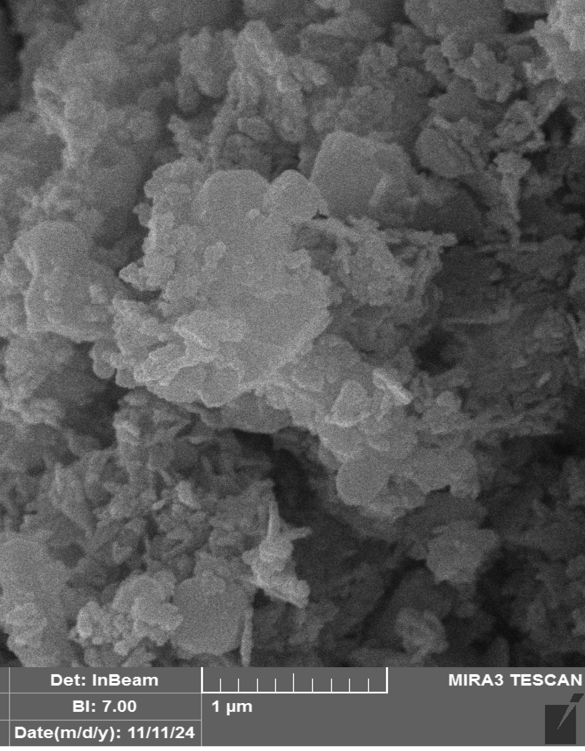
The synthesized nanoparticles were visualized by scanning electron microscope (SEM) (Figure 1), surface of the particles was spread evenly Spherically with a smooth texture suggests quite stability, indicating the formation of nano sized Spirulina extract.
The experimental animals were randomly divided into four distinct groups, each comprising six rats.
Group C (control): Received normal saline (0.9% NaCl).
Group T1: Received nano-Spirulina powder at 25 mg/kg body weight.
T2 group: Received nano-Spirulina powder at 50 mg/kg BW.
Group T3: Received nano-Spirulina powder at 75 mg/kg body weight.
Treatment was provided intraperitoneally once daily for 30 days; they were given through IP once daily during 30days according to sub-acute toxicity methodology from (OECD, 2004).
Sample collection
The animals were anesthetized with chloroform at the end of four weeks, and blood was taken by potion directly from into the heart. The serum portion was separated after centrifuging the samples at 3000 rpm for 15 min and maintained at −20 °C for hormone analysis.
Hormonal assay
Serum levels of luteinizing hormone (LH) and follicle-stimulating hormone (FSH) were determined using enzyme-linked immunosorbent assay (ELISA) with the aid of the manufacturer’s protocol as described in commercial kits supplied by BioAssay Systems, USA. The process is performed following Amballi et al. (2007).
Morphometric measurements
The morphometric features (seminiferous tubule diameter and germinal epithelium height) were recorded from the histological sections by ImageJ software. The measurements were made on randomly selected fields, and the average values for each group were calculated as previously described .
Histological examination
Epididymides were removed after sacrifice and the testes excised, washed in physiological saline solution to remove blood traces, then preserved in 10% neutral buffered formalin for 48 h. Dehydration with alcohols (70, 80, 90 and 100%), clearing in xylene, and paraffin embedding followed fixation. 5μm-thick sections were derived with a rotary microtome and stained with hematoxylin and eosin (H and E) for general histologic examination. The sections were observed under light microscope to investigate the alterations of seminiferous tubular, Leydig cell and Sertoli cell structures according to Bancroft and Gamble (2008).
Statistical analysis
One-way ANOVA and the LSD post hoc test were used to compare groups with SPSS 26. The results are reported as mean+SE and p 0.05 was considered to be significant.
Results
Changes in serum LH and FSH following treatment with nano-Spirulina extract
The impact of nano-Spirulina platensis extract on luteinizing hormone (LH) and follicle stimulating hormone (FSH) concentration in male albino rats is presented in Table 1.
Table 1: Effect of nano-Spirulina extract on serum LH and FSH in male rats (Mean± SE).
Groups
LH (mIU/mL)
FSH (mIU/mL)
Control (C)
1.31 ± 0.22 A
5.19 ± 0.27 A
T1
0.75 ± 0.09 B
1.13 ± 0.11 C
T2
0.99 ± 0.04 B
2.01 ± 0.20 C
T3
0.91 ± 0.10 B
4.43 ± 1.07 B
LSD (0.05)
0.29
1.355
Superscripted letters (a, b, c) denote that the means differ significantly at p ≤ 0.05 (LSD test). C = Control group; T1= 25 mg/kg nano-Spirulina; T2 = 50 mg/kg; T3 = 75 mg/kg.
All the treated groups (T1, T2, and T3) significantly (p ≤ 0.05) had reduced serum LH values relative to the control group. T1 had the lowest LH (0.75 ± 0.09 mIU/mL) with the highest LH being in the control group (1.31 ± 0.22 mIU/mL). T2 and T3 had a partial improvement, but the values were still much lower than the control.
In terms of the level of FSH, it was found that T1 (1.13 ± 0.11 mIU/mL) and T2 (2.01 ± 0.20 mIU/mL) had significant reductions (p ≤ 0.05) than the control group (5.19 ± 0.27 mIU/mL). T3 group showed a significant improvement (4.43 + 1.07 mIU/mL) which is close to that of control indicating that the levels of hormones have improved with a dose-dependent effect on the levels after the administration of nano-Spirulina.
Effect of nano-Spirulina extract on spermatogonia and testicular cell parameters
Table 2 shows the impact of nano-Spirulina platensis extract on the spermatogenic and interstitial count of the testicular cells in male albino rats. The experimental groups were found to have meaningful variations (p ≤ 0.05) with the control.
Table 2: Effect of nano-Spirulina extract on spermatogenic and testicular cell numbers (Mean ± SE).
Groups
Spermatogonia
Spermatozoa
Spermatids
Leydig cells
Sertoli cells
Control (C)
75.00 ± 1.78 A
109.00 ± 0.89 A
130.40 ± 0.74 A
17.80 ± 0.86 D
9.00 ± 0.44 A
T1
51.00 ± 1.18 C
75.40 ± 2.50 C
82.00 ± 2.80 D
10.60 ± 0.87 C
7.40 ± 0.40 B
T2
68.60 ± 0.87 B
102.60 ± 1.46 B
118.00 ± 1.51 C
12.40 ± 0.74 C
8.20 ± 0.37 AB
T3
72.60 ± 1.07 A
105.00 ± 1.73 AB
123.00 ± 1.81 B
14.40 ± 0.50 B
7.80 ± 0.37 B
LSD
3.14
4.30
4.66
1.87
0.98
Superscripted letters (a, b, c) denote that the means differ significantly at p ≤ 0.05 (LSD test). C= Control group; T1= 25 mg/kg nano-Spirulina; T2= 50 mg/kg; T3= 75 mg/kg.
The higher numbers were those of the control group, in all parameters analyzed spermatogonia (75.00), spermatozoa (109.00) and spermatids (130.40) characterize normal spermatogenetic activity.
The T1 also presented a significant decrease in all spermatogenic cell types (51.00; 75.40 and 82.00, sequentially), which were lower than those observed in the other groups. It increased slightly in T2 and significantly led at a value of close to the control values in T3 (72.60 for spermatogonia, 105.00 for spermatozoa and 123.00 for spermatids). In the Leydig cells, control had 17.80 T1 (10.60) and T2 (12.40). But the T3 group recovered (14.40), near to normal. Sertoli cells also paralleled the above trend reducing in T1 (7.40) and T2 (8.20) respect to control (9.00), with partial amelioration being recorded in T3 (7.80). It shows a dose-related regenerative effect of the nano-extract on the number of testicular spermatogenic and interstitial cells.
Influence of nano-Spirulina extract on the seminiferous tubule diameter and germinal epithelium height
Table 3 shows the morphometric measurements of seminiferous tubule diameters in the testes of male albino rats that were treated with various doses of nano- Spirulina platensis extract.
In this case, the control group also showed higher mean values of seminiferous tubule diameter (191.40 µm) and germinal epithelium height (37.60 um), characterizing typical testicular morphology.
Conversely, T1 group exhibited the minima parameters (130.20 µm and 17.20 µm for diameter and height respectively) revealing a significant degeneration in seminiferous structure. A significant expansion was observed at T2 where tubule diameter became 163.40 µm and epithelial height 27.80 µm. The T3 group, however, had moderate recovery (155.00 µm for diameter and 20.80 µm for height) than that of the T1 but still below those of control. These results indicate that nano-Spirulina extract attenuates the histomorphometric changes due to oxidative or toxic damage in a dose-dependent manner.
Table 3: Effect of nano-Spirulina extract on diameter of seminiferous tubules and height of germinal epithelium (Mean ± SE).
Groups
Seminiferous tubule diameter (µm)
Germinal epithelium height (µm)
Control (C)
191.40 ± 3.37 A
37.60 ± 1.36 A
T1
130.20 ± 5.54 C
17.20 ± 1.24 D
T2
163.40 ± 2.42 B
27.80 ± 1.24 B
T3
155.00 ± 1.87 B
20.80 ± 1.01 C
LSD (0.05)
8.82
3.00
Superscripted letters (a, b, c) denote that the means differ significantly at p ≤ 0.05 (LSD test). C= Control group; T1= 25 mg/kg nano-Spirulina; T2= 50 mg/kg; T3= 75 mg/kg.
Histological results
General histological description
Histological study of testis tissue disclosed that different architectural changes were noticed in the experimental groups.
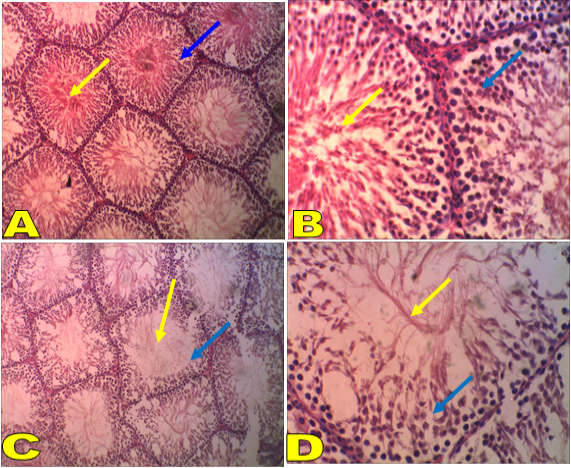
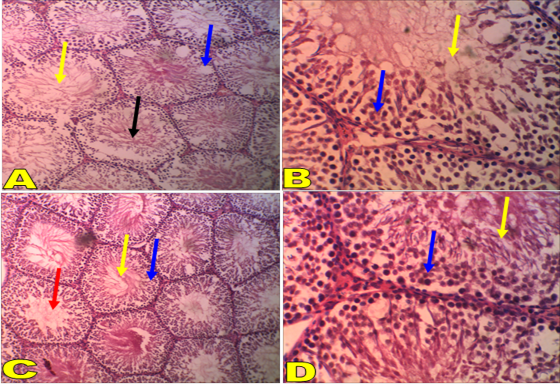
The testes in the control rats exhibited normal histoarchitecture with properly organized seminiferous tubules whose lining was composed of full layers of spermatogenic cells that contained mature spermatozoa within their lumen (Figure 2).
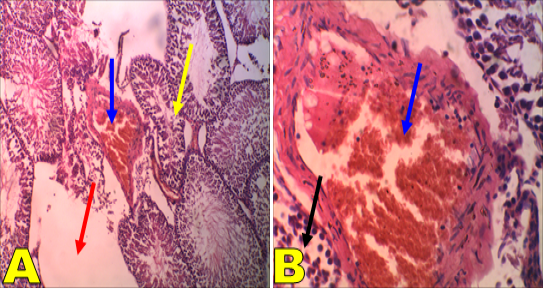
Rats treated with the lowest nano-Spirulina dose (T1) showed marked testicular degeneration; vascular congestion, seminiferous tubule disorganization, germ cell depletion and inflammatory cell infiltration (Figure 3).
The T2 group had partial recovery of the seminiferous epithelium and restoration of some spermatogenic layers with a decrease in histopathological damage compared to T1 (Figure 4).
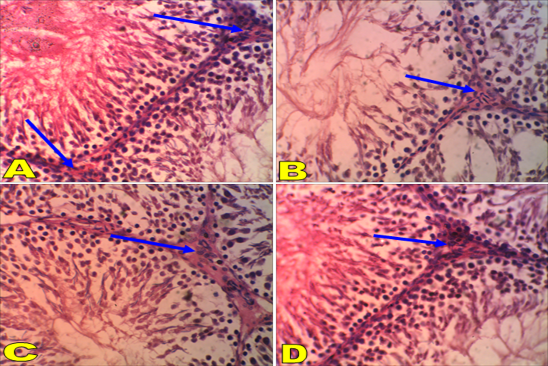
SGs in the T3 group looked almost normal as possible, with active spermatogenesis and much increase number of Leydig cells and Sertoly cells gaps of interstitial tissue presents partially regenerative effect observed with higher dose from nano-Spirulina platensis.
These findings verified the protective and curative effect of nano-Spirulina on testicular architecture and spermatogenic function in dose-dependent pattern.
Discussion
Effects of Nano Spirulina extract on serum levels of LH and FSH
The present results demonstrated that the nano-Spirulina significantly reduced the serum values of LH and FSH in all nano-Spirulina–treated groups compared to those in the Control, particularly T1 and T2. These findings indicate that low doses of nano-Spirulina can have a temporary inhibitory effect on pituitary gonadotropins secretion as a part of the adaptive process in the hypothalamic-pituitary-gonadal axis. Nevertheless, the T3 highest dose group showed significant hormonal recovery suggesting that nano-Spirulina has dose-dependent regulation on gonadotropin secretion. The hormonal reduction observed at lower doses may reflect transient regulatory modulation rather than endocrine toxicity, whereas the partial recovery at the higher dose suggests adaptive endocrine normalization.
Similar results were observed by Khalil et al. (2025) reported that nano-Spirulina reversed cisplatin-induced reproductive dysfunction by normalizing the expression of StAR and gonadotropins. Moreover, Salah et al. (2025) stated that the application of Spirulina led to improvement in methotrexate-mediated infertility through enhanced FSH and LH molecules from pituitary, suggesting restoration of HPG axis function by antioxidative and anti-inflammatory reactions. It is evident that Spirulina maintains hypothalamic signaling and decreases cytokine’s interference with gonadotropin release ; .
Antioxidant potential of Spirulina as regard phycocyanin, β-carotene vitamins C and E is possible to keep the neuroendocrine control of reproduction that causes hormonal modulation ; . All such observations may reveal that nano-Spirulina modulates gonadotropins dose-dependently in a biphasic manner, with its lower to higher doses improving LH and FSH secretion possibly through the protection of pituitary cells and increased responsiveness of Leydig cells.
Effect on spermatogenic and testicular cell elements
There was a marked decrease in the number of spermatogonia, spermatids and spermatozoa at doses T1 and T2 while there is improvement observed even though not to level of control group with increased dosage (T3) indicating the regenerative capacity of nano-Spirulina. The same restorative trends were described by Moghanlo and Shariatzadeh (2022) where Spirulina supplementation was found to ameliorate spermatic epithelial degeneration in mice caused following the administration of silver nanoparticles. The revival of the spermatogonia and spermatid population may be due to antioxidant protection at the germinal epithelium, and sustentocyte-mediated nourishment.
Leydig cell number improvement was dose-dependent and in correlation with recovery of testosterone biosynthesis. Ibrahim et al. (2021) have demonstrated Spirulina as a protective agent against lead-acetate mediated reduction in Leydig cell number and vacuolation by maintaining the expression of androgen receptor. Maintaining the integrity of Sertoli cells evident in this investigation is consistent with Elkelany and Kashef (2023) who pointed out that Spirulina inhibited sertraline-induced structural disorganization and conserved tight-junction continuity between the Sertoli cells.
The general enhancement of spermatogenic indices with the increasing doses reaffirms Spirulina as an agent capable of preventing germinal cells from oxidative apoptosis and maintaining mitotic activity in seminiferous tubules ; . This recovery may be ascribed to the enhancement of antioxidant enzymes and regulation of the apoptotic pathways .
Effect on seminiferous tubule calibre and germinal epithelium height
Morphometric analysis revealed a considerable attenuation in seminiferous-tubule diameter and germinal-epithelium height of T1 group, whereas elevated levels of nano-Spirulina (T2 and T3) enhanced both parameters. These findings are consistent with the prior histometric investigations; Spirulina supplementation maintains the tubular architecture and epithelium thickness from diverse toxic agents ; .
In cisplatin-administered rats, Khalil et al. (2025) reported that nano-Spirulina displayed a remarkable improvement in seminiferous-tubule diameter and Johnsen’s score, implicating Spirulina antioxidant property is highly related to germinal-epithelium restoration. In the same vein partial restoration in seminiferous architecture along with increased epithelial height post Spirulina treatment on sertraline-treated rats has been reported by Elkelany and Kashef (2023).
These morphometric improvements may be due to Spirulina’s high protein and vitamin content that promotes cell repair and collagen formation, as well as the preservation of the basal lamina. Furthermore, gamma-linoleic acid (GLA) and also the essential minerals help for membrane stabilization as well as microcirculatory efficiency at seminiferous tissue level ; .
Histopathological findings and structural restoration
Histological analysis showed that T1 group appeared as a high degeneration with vascular congestion, epithelial disorganization and germ-cell loss while T3 had almost near normal seminiferous tubules containing mature spermatozoa. These results are in a close agreement with those of the histopathological descriptions where Spirulina supplementation treated testicular degeneration attributed by environmental and chemical toxicants.
Seminiferous architecture was preserved by Spirulina against AgNPs induced disruption with organized germinal layers and relatively uniform distribution of spermatozoa in lumen, as reported . Elkelany and Kashef (2023) also reported similar enhancements with attenuated vascular congestion and reduced inflammatory infiltration in Spirulina treated rats. Additionally, Abd El-Hakim et al. (2018) which showed that Spirulina reduced furan-induced necrosis and inflammation in the testicular tissue.
The recovery of Leydig- and Sertoli-cells in this research, is supported by the regeneration of these cells reported earlier by Ibrahim et al. (2021) and El-Ratel et al. (2023) who reported re-establishing of interstitial-cell organization and increased expression of the androgen receptor. Together, these histological changes support that Spirulina is able to maintain testicular microarchitectures and spermatogenic persistency via antioxidative and anti-inflammatory mechanisms.
Physiological bases of protective activity of nano-Spirulina
Multi mechanism protection played by nano-Spirulina occurs mainly attributable to its antioxidant, anti-inflammatory, and anti-apoptotic impacts. Phycocyanin and β-carotene of Spirulina act as strong free-radical scavengers, which significantly decreased lipid peroxidation levels and eventually restored the actions of some antioxidant-enzymes like SOD, CAT, and GPx ; ; . Improved total antioxidant capacity helps to restore redox homeostasis in the testes, avoiding germ-cell degeneration (Monageng, 202٣).
Its anti-inflammatory activity may be attributed to inhibition of proinflammatory factors (TNF-α, IL-6, and IL-1β) as well as the NF-κB pathway ; . These effects decrease vascular stasis and interstitial edema, which is confirmed by the best histological patterns.
Moreover, Spirulina exerts strong anti-apoptotic activities via deregulation of the p53/Bcl-2 pathway and downregulation of caspase-3 ; ; . Further evidence of the maintenance of mitochondrial functioning with Spirulina treatment is apparent in the preservation of membrane potential and ATP production, which are associated with sperm motility and viability ; .
The nano-formulation enables increased bioavailability and testicular localization of Spirulina’s active ingredients. Studies by Milia et al. (2025) and Rasia et al. (2025) demonstrated that nanoencapsulation enhances physicochemical stability, improves intestinal absorption, and enables controlled release of Spirulina bioactive compounds. Indeed, the reversal in litter size observed in this study could be linked to better cellular uptakes and pharmacokinetic behavior of the nano-Spirulina product.
Combining the above discussion, it is proposed that the nano-Spirulina extract has a dose-dependent effect of ameliorating hormonal imbalance, spermatogenic indices, supporting cell parameters and testicular histoarchitecture in male albino rats. These positive effects can be explained by a complex of antioxidative, anti-inflammatory, and anti-apoptotic processes to protect germ cells and endocrine compounds against oxidative and toxic damage ; ; ; . The results are in line with the existing literature and indicate that nano-Spirulina can be an attractive therapeutic choice in alleviating male reproductive toxicity and infertility.
Conclusion
The current research revealed that a dose-effective protective and restorative action of nano-Spirulina platensis extract on male reproductive system of adult albino rats (10–12 weeks of age; 200–250 g) is dose-dependent. Reductions in reproductive hormones (LH and FSH), seminiferous tube diameter, height of the germinal epithelium, seminiferous tubule spermatogenic cell, Sertoli and Leydig cell counts were related to low doses. However, the increased doses led to significant improvement and partial to complete recovery of spermatogenic activity and normal testicular architecture. The results indicate that nano-Spirulina can be utilized as a potential natural therapeutic agent to enhance the reproductive performance of male by effecting activities of antioxidant, anti-inflammatory and cytoprotective properties.
Declarations
Acknowledgement
The authors are grateful to the department of biology/college of education/ University of Al-Qadisiyah for providing labs and other facility support to carry out this research. The authors also wish to express special thanks to the admin staff of the Histology and Physiology Laboratories for their technical support in terms of preparation of the samples and microscopic works, respectively.
Funding
The study did not receive any external funding.
IRB approval
Approval of this experimental design was granted by the Institutional Animal Ethics Committee, University of Al-Qadisiyah, Iraq.
Ethical statement
Experimental procedures on the animals were done following the care of laboratory animals and OECD (2004) recommendations.
Generative AI and AI assisted technology statement
The authors declare that no generative AI and AI assisted technology was used in the creation of this manuscript.
Statement of conflict of interest
The authors have declared no conflict of interest.
Figures
Figure 1:.
SEM image of nano-Spirulina platensis extract indicating aggregation in spherical particles with smooth surfaced uniform distribution. The particle size is in the nanometer, indicating that nano-Spirulina extract could be prepared successfully.
Figure 2:.
Cross-section of testicular tissue in control group (A and B) showing normal seminiferous tubules contains mature spermatozoa (yellow arrows) and well-identified spermatogenic cells represented at different steps of maturation (blue arrow). C and D: The testicular section of the affected group with loss of spermatogenic cells (blue arrows) and empty seminiferous tubules (yellow arrows) (H and E stain, ×40).
Figure 3:.
Testicular test issue cross section of the first treated group (T1) with severe vascular congestion (blue arrows), irregular seminiferous tubules (yellow arrows), and inflammatory cells infiltrate accumulation (black arrows). The red arrow represents the disarrangement and destruction of testicular tissue structure (H and E stain, ×40).
Figure 4:.
A comparable picture of T2 testicular section, with respect to partial regeneration of seminiferous tubular architecture along and mild vascular congestion, but with lower-level positive response in recovery spermatogenic event was observed for the second single treated group (H and E stain, ×40).
Figure 5:.
Cross sections of testes demonstrating leydig cells (blue arrows). (A) Normal Leydig cells in the interstitium of control group. (B) First treated group (T1) presented with significant reduction in the number of Leydig cells. (C) Second treated group (T2) with a slight elevated number of Leydig cells. (D) The third T3 treated group, where testicular structure was more improved and the number of Leydig cells was increased strikingly (H and E stain, ×40).
References
Abd El-Hakim, Y.M., Mohamed, W.A. and El-Metwally, A.E., 2018. Spirulina platensis attenuates furan reprotoxicity by regulating oxidative stress, inflammation, and apoptosis in testis of rats. Ecotoxicol. Environ. Saf., 161: 25–33. https://doi.org/10.1016/j.ecoenv.2018.05.073[CrossRef]
Abd El-Hamied, H.M., Elshenewany, N. and Ahmed Abel Meged, S., 2024. Evaluation of the effective role of natural antioxidants against the reproductive toxicity of furan in male albino rats. J. Sci. Res. Sci., 41: 195–214. https://doi.org/10.21608/jsrs.2024.311917.1133[CrossRef]
Abdel-Daim, M.M., Farouk, S.M., Madkour, F.F. and Azab, S.S., 2015. Anti-inflammatory and immunomodulatory effects of Spirulina platensis in comparison to Dunaliella salina in acetic acid-induced rat experimental colitis. Immunopharmacol. Immunotoxicol., 37: 126–139. https://doi.org/10.3109/08923973.2014.998368[CrossRef]
Abdrabou, M.I., Elleithy, E.M., Yasin, N.A., Shaheen, Y.M. and Galal, M., 2019. Ameliorative effects of Spirulina maxima and Allium sativum on lead acetate-induced testicular injury in male albino rats with respect to caspase-3 gene expression. Acta Histochem., 121: 198–206. https://doi.org/10.1016/j.acthis.2018.12.006[CrossRef]
Aboulthana, W.M., Madboli, A.E.N.A., Hussien, A.G. and Seif, M., 2024. Exploring the protective effect of silver Croton tiglium nano-extract against azoxymethane induced toxicity in female reproductive organs in rats. Heliyon, 10. https://doi.org/10.1016/j.heliyon.2024.e38820[CrossRef]
Afkhami-Ardakani, M., Hasanzadeh, S., Shahrooz, R., Delirezh, N. and Malekinejad, H., 2021. Spirulina platensis (Arthrospira platensis) attenuates cyclophosphamide-induced reproductive toxicity in male Wistar rats: evidence for sperm apoptosis and p53/Bcl-2 expression. J. Fd. Biochem., 45: e13854. https://doi.org/10.1111/jfbc.13854[CrossRef]
Alrushdy, M.A.A. and Obeid, A.K., 2024. Protective effect of nano-extract of Lepidium meyenii on some functional parameters and epididymal tissue in male albino rats treated with oxymetholone. J. Kerbala Agric. Sci., 11: 1–15. https://doi.org/10.59658/jkas.v11i4.2780[CrossRef]
Amballi, A.A., Dada, O.A., Adeleye, A.O. and Jide, S., 2007. Evaluation of the determination of reference ranges for reproductive hormones (prolactin, FSH, LH, and testosterone) using enzyme immunoassay method. Sci. Res. Essays, 2: 135–138.
Bancroft, J.D. and Gamble, M., 2008. Theory and practice of histological techniques. London: Elsevier.
Bashandy, S.A., El-Awdan, S.A., Ebaid, H. and Alhazza, I.M., 2016. Antioxidant potential of Spirulina platensis mitigates oxidative stress and reprotoxicity induced by sodium arsenite in male rats. Oxid. Med. Cell. Longev., p. 7174351. https://doi.org/10.1155/2016/7174351[CrossRef]
Behairy, A., Elkomy, A., Elsayed, F., Gaballa, M.M., Soliman, A. and Aboubakr, M., 2024. Antioxidant and anti-inflammatory potential of Spirulina and thymoquinone mitigate the methotrexate-induced neurotoxicity. Naunyn-Schmiedeberg’s Arch. Pharmacol., 397: 1875–1888. https://doi.org/10.1007/s00210-023-02739-4[CrossRef]
Carrageta, D.F., Guerra-Carvalho, B., Spadella, M.A., Yeste, M., Oliveira, P.F. and Alves, M.G., 2022. Animal models of male reproductive ageing to study testosterone production and spermatogenesis. Rev. Endocr. Metab. Disord., 23: 1341–1360. https://doi.org/10.1007/s11154-022-09726-9[CrossRef]
El-Desoky, G.E., Bashandy, S.A., Alhazza, I.M., Al-Othman, Z.A., Aboul-Soud, M.A. and Yusuf, K., 2013. Improvement of mercuric chloride-induced testis injuries and sperm quality deteriorations by Spirulina platensis in rats. PLoS One, 8: e59177. https://doi.org/10.1371/journal.pone.0059177[CrossRef]
Elkelany, M.M. and Kashef, S.M., 2023. Role of Spirulina extract in ameliorating histological and immunohistochemical changes induced by sertraline in the testis of adult albino rat. Egypt. J. Histol., 46: 136–149.
El-Newary, S.A., Aly, M.S., Hameed, A.R.A.E., Kotp, M.S., Youssef, A.A. and Ali, N.A., 2022. Sperm quality and testicular histopathology of Wistar albino male rats treated with hydroethanolic extract of Cordia dichotoma fruits. Pharma. Biol., 60: 282–293. https://doi.org/10.1080/13880209.2021.2008455[CrossRef]
El-Ratel, I.T., Elbasuny, M.E., El-Nagar, H.A., Abdel-Khalek, A.K.E., El-Raghi, A.A., El Basuini, M.F., El-Kholy, K.H. and Fouda, S.F., 2023. The synergistic impact of Spirulina and selenium nanoparticles mitigates the adverse effects of heat stress on rabbit bucks. PLoS One, 18: e0287644. https://doi.org/10.1371/journal.pone.0287644[CrossRef]
El-Sheekh, M.M., Hamad, S.M. and Gomaa, M., 2014. Protective effects of Spirulina on the liver function and hyperlipidemia of rats and human. Braz. Arch. Biol. Technol., 57: 77–86. https://doi.org/10.1590/S1516-89132014000100012[CrossRef]
Gondo, H.K., 2021. The effect of Spirulina on apoptosis through the caspase-3 pathway in a preeclamptic Wistar rat model. J. Natl. Sci. Biol. Med., 12: 280–284. https://doi.org/10.4103/jnsbm.JNSBM_12_3_2[CrossRef]
Gul, A., Baig, M.N., Ahmed, D., Najam, Z., Aslam, T. and Ali, S., 2024. Green synthesis of silver nanoparticles from Spirulina platensis extract: Antibacterial and antioxidant potential. BioNano Sci., 14: 2327–2336. https://doi.org/10.1007/s12668-024-01473-2[CrossRef]
Ibrahim, I.A., Shalaby, A.A., Abd Elaziz, R.T. and Bahr, H.I., 2021. Chlorella vulgaris or Spirulina platensis mitigate lead acetate-induced testicular oxidative stress and apoptosis with regard to androgen receptor expression in rats. Environ. Sci. Pollut. Res., 28: 39126–39138. https://doi.org/10.1007/s11356-021-13411-w[CrossRef]
Ibrahim, I.H., Sabour, A.N. and Hadi, F.A.A.H., 2022. Histological study to the effect of resveratrol nanoparticles in the testis in white male rats treated with cisplatin. Neuro Quantol., 20: 3540–3550.
Karami, S., Heidary, Z., Khaleghi, S., Falsafi, S., Karim Rahimi, M. and Hajrasouliha, S., 2024. The application of Spirulina platensis-based green synthesized silver nanoparticles demonstrating potent anti-Shigella flexneri effects. Avicenna J. Clin. Microbiol. Infect., 11: 107–112. https://doi.org/10.34172/ajcmi.3532[CrossRef]
Khair, A., Awal, M.A., Hoque, M.N., Talukder, A.K., Das, Z.C., Rao, D.R. and Shamsuddin, M., 2021. Spirulina ameliorates arsenic-induced reproductive toxicity in male rats. Anim. Reprod., 18: e20210035. https://doi.org/10.1590/1984-3143-ar2021-0035[CrossRef]
Khalil, E.M., Rady, M.I., Darwish, S.F. and Abd-Allah, E.R., 2025. Nano Spirulina platensis countered cisplatin-induced reprotoxicity by reversing the expression of altered steroid hormones and downregulation of the StAR gene. Naunyn-Schmiedeberg’s Arch. Pharmacol., 398: 4053–4070. https://doi.org/10.1007/s00210-024-03483-z[CrossRef]
Latifi, M., Jalali Bidgoli, F., Hajihassani, H., Hassani, D., Ingvarsson, P.K. and Farrokhi, N., 2025. Recent advances and future directions on GLA-producing organisms. Front. Bioeng. Biotechnol., 13: p.1567840. https://doi.org/10.3389/fbioe.2025.1567840[CrossRef]
Liu, R., Qin, S. and Li, W., 2022. Phycocyanin: Anti-inflammatory effect and mechanism. Biomed. Pharmacother., 153: 113362. https://doi.org/10.1016/j.biopha.2022.113362[CrossRef]
Milia, M., Castangia, I., Corrias, F., Aroffu, M., Casula, M., Manca, M.L. and Angioni, A., 2025. Physicochemical characteristics of phospholipid vesicles for Spirulina-based dietary supplement delivery. Molecules, 30: p.2581. https://doi.org/10.3390/molecules30122581[CrossRef]
Moghanlo, H. and Shariatzadeh, S.M.A., 2022. Beneficial effects of Spirulina platensis on mice testis damaged by silver nanoparticles. Andrologia, 54: p.e14606. https://doi.org/10.1111/and.14606[CrossRef]
Monageng, E., 2023. A review on the impact of oxidative stress and medicinal antioxidants on testicular cells. Antioxidants, 12: 1559. https://doi.org/10.3390/antiox12081559[CrossRef]
Nawrocka, D., Kornicka, K., Śmieszek, A. and Marycz, K., 2017. Spirulina platensis improves mitochondrial function impaired by elevated oxidative stress in adipose-derived mesenchymal stromal cells and intestinal epithelial cells, and enhances insulin sensitivity in equine metabolic syndrome horses. Mar. Drugs, 15: p.237. https://doi.org/10.3390/md15080237[CrossRef]
Organisation for Economic Co-operation and Development (OECD), 2004. OECD Guidelines for the testing of chemicals. Paris: OECD Publishing.
Podgórska-Kryszczuk, I., 2024. Spirulina: An invaluable source of macro- and micronutrients with broad biological activity and application potential. Molecules, 29: 5387. https://doi.org/10.3390/molecules29225387[CrossRef]
Rasia, T.A., da Silva Vaz, B., Costa, J.A.V. and de Morais, M.G., 2025. Nanoencapsulation of protein-rich Spirulina biomass: New frontiers for superfoods. A review. Fd. Biosci., p. 107587. https://doi.org/10.1016/j.fbio.2025.107587[CrossRef]
Rosidawati, R.W. and Supranianondo, K., 2017. Effect of Spirulina platensis on the number of spermatogenic cells in the seminiferous tubules of rat (Rattus norvegicus) with excessive physical exercise. In: The Veterinary Medicine International Conference 2017. KnE Life Sciences, pp. 84–92. https://doi.org/10.18502/kls.v3i6.1118[CrossRef]
Salah, N.I., Abd El-Aziz, R.M., Elnabtity, S. and Darwish, W.S., 2025. Ameliorative effect of Spirulina on methotrexate-induced male fertility and oxidative stress in rats. Open Vet. J., 15: 2532. https://doi.org/10.5455/OVJ.2025.v15.i6.25[CrossRef]
Sedaghatizadeh, K., Gholamitabar Tabari, M., Bishehkolaei, R., Ghadikolaii, F.P. and Nemati, F., 2023. Protective effect of Spirulina and phycocyanin on testicular tissue and sperm parameters in adult rats treated with hydrogen peroxide. J. Mazandaran Univ. Med. Sci., 32: 49–60.
Sliwowska, J.H., Woods, N.E., Alzahrani, A.R., Paspali, E., Tate, R.J. and Ferro, V.A., 2024. Kisspeptin: A potential therapeutic target in treatment of both metabolic and reproductive dysfunction. J. Diabetes, 16: p.e13541. https://doi.org/10.1111/1753-0407.13541[CrossRef]
Xu, Z., Yan, Q., Zhang, K., Lei, Y., Zhou, C., Ren, T., Gao, N., Wen, F. and Li, X., 2025. Mitochondrial regulation of spermatozoa function: metabolism, oxidative stress and therapeutic insights. Animals, 15: 2246. https://doi.org/10.3390/ani15152246[CrossRef]
Zaki, A.K.A., Aldahmashi, F.S., Madboli, A.E.N.A., Attia, K.A., Almulhim, F.S. and Albarrak, S.M., 2023. Therapeutic approaches for anti-sperm-antibodies in the testicular sperm aspiration rat model. Vet. World, 16: 296. https://doi.org/10.14202/vetworld.2023.296-308[CrossRef]