Research Article · Volume 12, Issue 2, 29 January 2024 · Open Access
Effectiveness of Butylated Hydroxytoluene in Maintaining the Quality of Gaga Chicken Sperm in Liquid Storage for 72 Hours
· · · · ·
Affiliations & Notes ⌄
1Doctoral Program in Animal Science, Faculty of Animal Science, University of Brawijaya, Jl. Veteran, Malang 65145, East Java, Indonesia
2Department of Animal Science, Faculty of Animal Science, University of Brawijaya. Jl. Veteran, Malang 65145, East Java, Indonesia
3Livestock Reproduction Laboratory, Faculty of Animal Science, Universitas Hasanuddin Jl. Perintis Kemerdekaan, Makassar 90245, South Sulawesi, Indonesia
4Politeknik Pembangunan Pertanian Malang, Jl. DR. Cipto No.144a, Malang 65215, East Java, Indonesia. *Correspondence | Sri Wahjuningsih, Department of Animal Science, Faculty of Animal Science, University of Brawijaya. Jl. Veteran, Malang 65145, East Java, Indonesia
In conclusion, this study showed that the addition of 3 mM BHT in semen diluent improved the motility, viability, membrane integrity, acrosome integrity, and mitochondrial activity.
However, a significant reduction was observed in DNA damage of Gaga chicken sperm and lipid peroxidation after liquid storage at 5oC.
Further studies were recommended to examine the effect of adding BHT to the diluent on poultry sperm fertility after chilling storage.
Selected from the article's own text.
Abstract
Artificial insemination is beneficial for the poultry industry and breeding programs due to the ability to efficiently use superior male chickens for mating with multiple females. This study aimed to examine the effect of adding BHT (butylated hydroxytoluene) into the diluent and storage time on the quality of Gaga chicken spermatozoa during liquid storage. The semen was collected using abdominal massage methods and divided into 4 tubes filled with diluent. For the analysis, the diluent selected was egg yolk Ringer’s lactate added with BHT at concentrations of 1, 2, and 3 mM, respectively as well as a control treatment without BHT. Liquid semen was stored for 72 hours at 5°C, with spermatozoa quality monitored every 24 hours in 10 replicated experiments. The results showed that sperm motility, viability, and plasma membrane integrity were significantly higher (P<0.01) when 2-3 mM BHT was added, while acrosome integrity was elevated after the addition of 1 and 3 mM BHT. Furthermore, the addition of BHT did not significantly change semen pH. DNA damage was lower (P<0.05) when 3 mM BHT was added and mitochondrial activity was enhanced under the same condition. The concentration of malondialdehyde (MDA) was lower (P=0.05) with the addition of 3 mM BHT at 24 hours of storage. In conclusion, the addition of 3 mM BHT showed promising potential to maintain chicken sperm quality after liquid storage.
Gaga chicken is native to Indonesia, with a unique sound, originating from Sidenreng Rappang Regency, South Sulawesi Province . This distinctive sound resembling laughter makes chicken widely kept by hobbyists to take part in contests. The judging criteria in the contest usually include the sound craft and duration. However, not all Gaga chicken have a voice that meets the desired criteria, leading to a significantly high selling price for those with the required voice and long duration. This phenomenon requires the careful selection of male Gaga chicken with good voices and efforts to obtain offspring through artificial insemination technology for optimal use of males.
Artificial insemination of chicken increases production and profits, serving as a solution to address the problem of increasing demand for poultry . AI is beneficial for the poultry industry and breeding programs due to the ability to efficiently use superior male chickens for mating with multiple females . However, the success of insemination depends on the quality of the sperm inseminated, as high-quality sperm will increase fertility, enhancing the amount of DOC produced. Examples of quality that can be evaluated are sperm motility, viability, plasma membrane integrity, and acrosome integrity. Sperm motility and viability are positively correlated with chicken sperm fertility . The acrosome, containing proteolytic enzymes, plays an important role in the fertilization process ; . The process of liquid semen preservation is carried out to use superior male chicken to mate with females through artificial insemination across different places and times.
The practice of preserving semen in liquid form at cold temperatures aims to reduce metabolism for longer survival of spermatozoa ; . However, the quality of spermatozoa decreases during storage due to lipid peroxidation resulting from the formation of reactive oxygen species. Lipid peroxidation is a process where free radicals attack lipids containing double bonds, specifically polyunsaturated fatty acids included in the abstraction of hydrogen from carbon, leading to the insertion of oxygen . Chicken spermatozoa cell membranes are often vulnerable to this phenomenon due to the abundance of polyunsaturated fatty acids . Semen preservation can disrupt several functions, resulting in fatal damage to sperm . Moreover, liquid storage of poultry semen has a negative impact on motility and viability, leading to reduced sperm fertilization ability . Lemoine et al. (2011) reported that the number of intact acrosome-reacting chicken sperm was significantly decreased by 48 h liquid storage. To address this decline in the quality during storage, previous study has explored the addition of antioxidants in the diluent ; ; .
BHT also known as dibutylhydroxytoluene is a non-enzymatic, synthetic analogue of vitamin E . Furthermore, it is an antioxidant classified as a synthetic phenolic compound , which can effectively inhibit the formation of active free radicals and lipid peroxidation ; . BHT has been reported to have positive effects on mammalian spermatozoa ; ; ; . In poultry, particularly turkeys, the addition of 0.02-1.25 mM BHT can increase spermatozoa viability, and membrane integrity and prevent a decrease in motility in spermatozoa stored at 5 °C for 48 hours . The addition of BHT has not been reported in chicken semen stored in liquid form. Consequently, the aim of this study was to examine the effect of adding BHT in the diluent and storage time on the quality of Gaga chicken sperm during liquid storage.
Materials and Methods
Farm management and semen collection
A total of five male Gaga chicken aged 10 months were kept in individual drums measuring 55 x 60 x 60 cm3. Commercial feed with a crude protein content of 17%, crude fat 3%, crude fiber 7%, and ash content 14% was given 100 grams per day, and drinking water was administered ad libitum. Semen was collected three times a week using a massage technique based on Burrows and Quinn (1937). The semen was collected using a small funnel and microtube, which was taken to the laboratory.
Evaluation of the fresh semen
Fresh semen samples were evaluated macroscopically (volume, color, concistency, and pH) and macroscopically (sperm mass movement, motility, viability, abnormality, and concentration). Subsequently, observation of mass movement was carried out by dripping semen onto a glass object and observed under a microscope (Olympius CX23, Japan) with 10x magnification. Sperm abnormalities were observed by eosin-nigrosin staining using a microscope with 40x magnification. The procedure for calculating the concentration of spermatozoa was carried out by diluting the semen with 3% NaCl (1:500) and dropping it into a Neubaeur chamber, which was continued on a microscope with 10x magnification.
Diluent preparation
The basic diluent used was ringer lactate (PT. Widatra Bakti, Indonesia) with a composition of 3 g sodium chloride, 1.55 g sodium lactate, 0.1 g calcium chloride, and 0.15 g potassium chloride in 500 mL sterile water, supplemented with 10% egg yolk. The basic diluent was centrifuged at 3000 rpm for 15 minutes and 1000 IU/ml penicillin (PT. Meiji, Indonesia), 1 mg/ml streptomycin (PT. Meiji, Indonesia) were added to the supernatant and the pH of the diluent was adjusted to 7.4. The diluent was divided into four tubes and treated with the addition of BHT (Merck KGaA, Germany) at concentrations of 1 mM, 2 mM, and 3 mM respectively, while the treatment without BHT was used as a control. The osmolarity of the control diluent was 266 mOsmol/kg, the diluent added with 1 mM, 2 mM, and 3 mM BHT had an osmolarity of 267 mOsmol/kg, 267 mOsmol/kg, and 268 mOsmol/kg, respectively.
Semen dilution and storage
Fresh semen was diluted in a ratio of 1:5 using a retailer according to treatment. Liquid semen was stored in microtubes and placed in a refrigerator at 5°C for 72 hours and evaluated every 24 hours.
Evaluation of semen parameters during storage
Sperm motility, viability, membrane integrity, acrosome integrity and semen pH were evaluated in the four treatments every 24 hours for a maximum of 72 hours. Sperm DNA damage and mitochondrial activity were evaluated in two treatments, namely the control and the best BHT concentration, every 24 hours with a maximum of 72 hours of storage. MDA concentration was measured in the control treatment and the best BHT concentration was stored for 24 and 48 hours.
Motility was subjectively evaluated in five fields of view based on the percentage of moving sperm using a light microscope with 40x magnification.
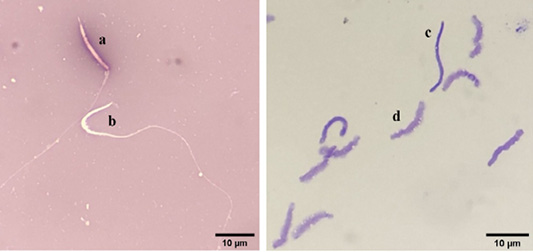
Viability assessment was carried out using the semen smear method with eosin-nigrosin stain and observed under a light microscope at 40x magnification in 10 fields of view. Live spermatozoa were characterized by not absorbing color, while dead spermatozoa absorb color (Figure 1 left).
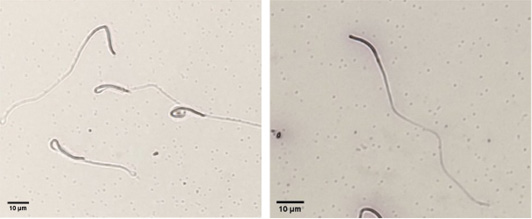
Plasma membrane integrity was evaluated using the hypoosmotic swelling test (HOST) method. A 10 µl of semen diluted in a hypoosmotic solution with a composition of 0.49 g sodium citrate and 0.9 g fructose plus 100 μl of distilled water, incubated for 30 minutes at 37 °C ; Najafi et al., 2019). The semen was smeared on a glass object with an eosin-nigrosin stain. Subsequently, sperm were observed in 10 fields of view using a light microscope with 40 x magnification. The identification of spermatozoa with intact plasma membranes followed the description of Santiago-Moreno et al. (2009), which included a bent tail, a folded tail tip, a bent middle part, and a shortened, thickened tail (Figure 2 left).
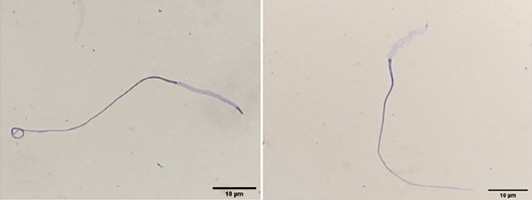
The integrity of the acrosome was assessed using Coomassie brilliant blue (CBB) staining. The semen was diluted with 5% formalin (1:1), spread thinly on a glass object, and air-dried. The preparations were fixed in a 5% formalin solution for 30 minutes at 37oC, rinsed with running water, and air dried. The staining procedure was based on Silyukova et al. (2022), which included immersing the semen for 5 minutes in a staining jar containing a solution with a composition of 0.25% Coomassie Brilliant Blue R 250 (Merck KGaA, Germany) in a 10% glacial acetic acid and 25% methanol. Subsequently, the preparations were rinsed with running water, air dried, dripped with immersion oil, and observed under a light microscope with 100x magnification in 5-6 fields of view. The acrosomes of intact sperm were dark blue, while the damaged or less colored ones were identified (Figure 3).
For DNA damage assessment, the toluidine blue staining method was used. The semen used was spread thinly on a glass object and air-dried. The preparations were fixed in 96% ethanol-acetone (1:1) solution for 30 minutes at 4°C, removed, air dried, and hydrolyzed in 0.1 N HCI solution for 5 minutes at 4°C. Subsequently, the preparations were washed using running water 3 times. Staining was carried out by dripping with toluidine blue O solution (Merck KGaA, Germany), left for 10 minutes at room temperature, washing with running water, and air dried. The preparations were observed using a light microscope with 40X magnification. Identification was carried out on spermatozoa heads with good chromatin integrity, appearing as bright blue or clear, while those with dark blue or purple were reduced (Figure 1 right).
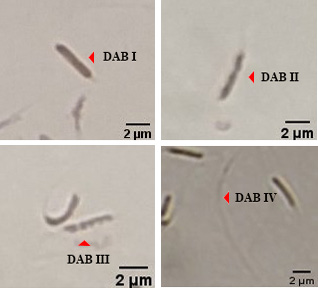
Mitochondrial activity was assessed using 3,3’-Diaminobenzidine (DAB) assay (Sigma-Aldrich, US). Semen was diluted (1:1) in DAB solution (DAB 1 mg/ml Phoshpate Buffer Saline) and incubated in the dark for 1 hour at 37 °C. The 10 μl of semen was then spread on a glass object and air-dried. The preparations were fixed in 10% formalin for 10 minutes, washed with running water, and air dried. A total of 100 spermatozoa cells were counted on a light microscope at 100x magnification with an oil immersion drop. Sperm were classified into four categories, namely all active mitochondria (DAB I marker: 100% of the middle piece stained), moderate active (DAB II marker: more than 50% of the middle piece stained), mostly inactive (DAB III marker: less than 50% of the middle piece stained) and all mitochondria were inactive (DAB IV marker: No staining in the middle piece) (Figure 6).
MDA measurements used the thiobarbituric acid reaction, based on the method of Eslami et al. (2016) with minor modifications. The semen was added to a thiobarbituric solution and distilled water in a tube. The tube was heated in water at a temperature of 100 oC for 30 minutes and centrifuged for 10 minutes at a speed of 4000 rpm. The absorbance of the top layer was read at a wavelength of 532 nm using a spectrophotometer (Shimadzu UV-1800, Japan).
Statistical analysis
Evaluation of liquid semen was repeated ten times and the study data were tested for normality using the Shapiro-Wilk test. Motility, viability, plasma membrane integrity, and acrosome cap integrity were tested by ANOVA. When the p-value was significant (P≤0.05), the analysis proceeded with the Duncan multiple-range test. Semen pH data at each storage time was tested by Kruskal Wallis. Subsequently, data on DNA damage, mitochondrial activity, and MDA at each storage time were tested by independent sample t-test. All statistical analysts used the SPSS 25 application.
RESULT and Discussion
Characteristics of fresh semen
The results of the study show that macroscopically, Gaga chicken semen has a volume of 0.14 ml, milky white color, thick, and a pH of 8.18. Macroscopically, Gaga chicken sperm concentrate 2.39 billion/ml, motility 86%, viability 98.13%, plasma membrane integrity 97.62% and abnormalities 12.62% (Table 1).
Table 1: Fresh semen characteristics of Gaga chicken sperm.
Variable
Mean ±SEM
Volume (ml)
0.14±0.02
Color
Milky
Consistency
Thick
pH
8.18±0.14
Sperm concentration (109 /ml)
2.39±0.25
Mass movement
++/+++
Motility (%)
86±2.45
Viability (%)
98.13±0.39
Plasma membrane integrity (%)
97.63±0.48
Abnormality (%)
12.62±1.31
Characteristics of liquid semen during storage
Motility: The motility of Gaga chicken sperm was significantly different (P<0.01) with the addition of various concentrations of BHT. The addition of 2-3 mM BHT increased motility with the best concentration being 3 mM (59.80%). Sperm motility also differed significantly (P<0.01) between storage times, where the longer storage, resulted in lower motility. Meanwhile, the interaction between the two factors was not significantly different (P>0.05) (Table 2).
Viability: Significant differences (P<0.01) were found in chicken sperm viability with different BHT concentrations. BHT concentration of 2-3 mM increased sperm viability, where the best concentration is 3 mM (90.18%). A significant difference was also observed in viability (P<0.01) between storage times, with the longer storage resulting in decreased viability, indicating insignificant variation in the interaction between the two factors (Table 3).
Plasma membrane integrity: The plasma membrane integrity (PMI) of Gaga chicken sperm was significantly different (P<0.01) with the addition of various concentrations of BHT. The addition of 1-3 mM BHT increased PMI, where the best concentration is 2-3 mM (88.44-90.90%). The differences in PMI were also found between storage times, where longer storage caused a decrease in PMI. Meanwhile, the interaction between the two factors was not significantly different (Table 4).
Acrosome integrity: The acrosome integrity of Gaga chicken sperm was significantly different (P<0.05) with the addition of various concentrations of BHT. The addition of 1 and 3 mM BHT increased acrosome integrity (98.26-98.30%). Acrosome integrity also varied significantly (P<0.01) between storage times, with longer storage decreasing acrosome integrity. Meanwhile, there was no significant effect (P>0.05) on the interaction of the two treatment factors (Table 5).
Table 2: Motility of Gaga chicken sperm with the addition of BHT in diluent during cold storage (%) (n=10)
Treatment
Storage time (h)
Mean
0
24
48
72
Control
81.10±1.06
57.60±1.24
46.50±1.12
38.70±1.31
55.97a
BHT 1 mM
81.90±1.05
58.40±1.28
49.10±1.27
40.70±1.03
57.52ab
BHT 2 mM
82.20±1.09
58.40±1.81
50.90±1.44
42.50±1.12
58.50bc
BHT 3 mM
83.70±1.08
60.20±1.69
52.10±1.12
48.20±1.02
59.80c
Mean
82.22A
58.65B
49.65C
41.27D
Note: different superscripts in the same column and row indicate significant differences (P<0.01).
Table 3: Viability of Gaga chicken sperm with the addition of BHT in diluent during cold storage (%) (n=10).
Treatment
Storage time (h)
Mean
0
24
48
72
Control
95.50±0.82
86.98±1.87
77.56±2.56
65.85±4.13
81.47a
BHT 1 mM
96.56±0.70
88.72±2.01
80.86±2.63
69.80±3.66
83.98ab
BHT 2 mM
97.22±0.58
89.91±2.05
83.71±2.55
71.67±3.58
85.63b
BHT 3 mM
97.70±0.55
93.55±2.20
87.96±2.47
83.49±2.66
90.18c
Mean
96.74A
89.29B
82.52C
72.70D
Note: different superscripts in the same column and row indicate significant differences (P<0.01).
Table 4: Plasma membrane integrity of Gaga chicken sperm with the addition of BHT in diluent during cold storage (%) (n=10).
Treatment
Storage time (h)
Mean
0
24
48
72
Control
96.23±0.61
88.51±1.54
79.74±1.86
70.13±2.74
83.65a
BHT 1 mM
96.92±0.58
89.84±1.44
84.85±1.93
74.26±3.16
86.46b
BHT 2 mM
97.47±0.57
91.32±1.31
86.09±1.83
78.89±2.90
88.44bc
BHT 3 mM
97.76±0.42
92.71±1.40
89.12±2.06
84.01±2.34
90.90c
Mean
97.09A
90.59B
84.95C
76.82D
Note: different superscripts in the same column and row indicate significant differences (P<0.01).
Table 5: Acrosome integrity of Gaga chicken sperm with the addition of BHT in diluent during cold storage (%) (n=10).
Treatment
Storage time (h)
Mean
0
24
48
72
Control
99.37±0.16
98.57±0.22
97.19±0.47
95.15±0.77
97.57a
BHT 1 mM
99.43±0.19
98.87±0.21
97.83±0.52
96.92±0.52
98.26b
BHT 2 mM
99.50±0.18
98.94±0.18
98.03±0.44
95.76±0.71
98.06ab
BHT 3 mM
99.48±0.16
98.93±0.17
98.04±0.31
96.77±0.30
98.30b
Mean
99.44A
98.83B
97.77C
96.15D
Note: different superscripts in the same column indicate significant differences (P<0.05), different superscripts in the same row indicate highly significant differences (P<0.01).
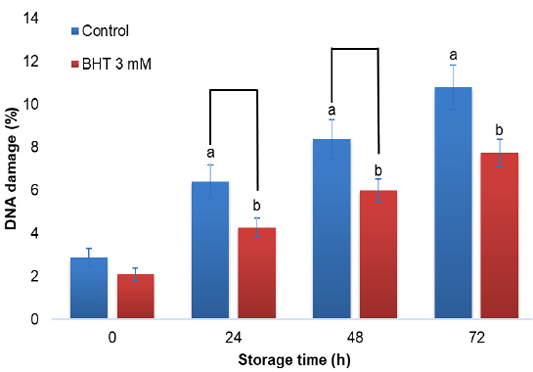
DNA damage: DNA damage was significantly different (P<0.05) at 24, 48, and 72 hours of storage. The addition of 3 mM BHT reduced DNA damage when compared to without BHT (control) at 24 hours (4.28 vs 6.39%), 48 hours (5.99 vs 8.36%), and 72 hours (7.75 vs 10.78%) storage (Figure 4).
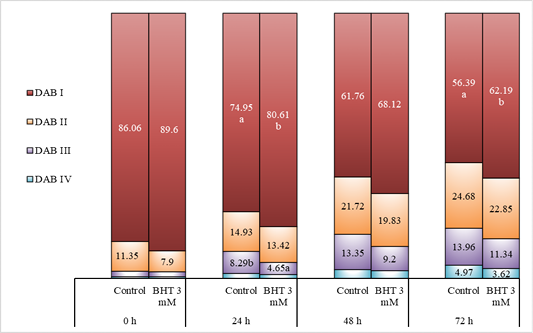
Mitochondrial activity: Mitochondria that were 100% active (DAB I) had the highest percentage across all treatments and inactive mitochondria (DAB IV) constituted the lowest percentage. The addition of 3 mM BHT significantly increased (P<0.01) the percentage of DAB I (80.61%) and decreased DAB III (4.65%) at 24 hours of storage. Furthermore, at 72 hours of storage, the addition of 3 mM BHT significantly also increased (P<0.05) the percentage of DAB I (62.19%) (Figure 5).
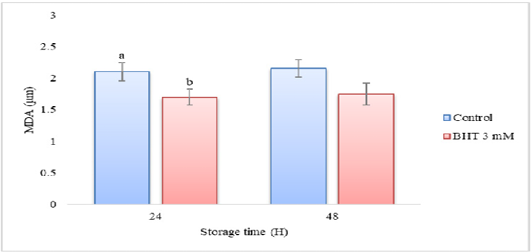
MDA: MDA levels were significantly lower (P=0.05) in the treatment with the addition of 3 mM BHT (1.7 μM) compared to the control (2.1 μM) at 24 hours of storage. Meanwhile, storage for 48 hours was not significantly (P>0.05) different with a range of 1.75-2.15 μM (Figure 7).
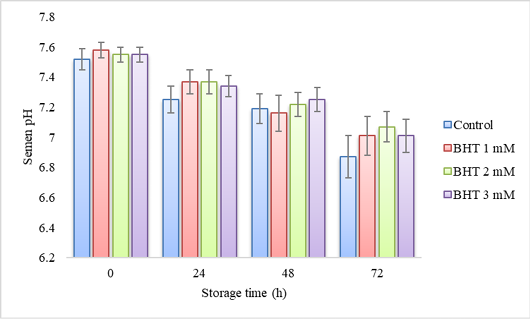
pH: The pH of Gaga chicken semen remained consistent across various BHT concentrations at each storage time. The pH of semen at 0 and 72 hours of storage was 7.52-7.55 and 6.87-7.01, respectively (Figure 8).
Storage of Gaga chicken spermatozoa significantly reduced motility, viability, and plasma membrane integrity due to the formation of free radicals in the form of ROS during storage. A decrease in spermatozoa viability was in line with an increase in ROS produced from spermatozoa metabolism . Juan et al. (2021) stated that cell membranes were sensitive to damage due to the presence of polyunsaturated fatty acids. Free radicals oxidize unsaturated lipid chains, leading to the formation of hydroperoxidized lipids and alkyl radicals that cause changes in the membrane structure, affecting fluidity and damaging its integrity .
In this study, the acrosome integrity of Gaga chicken sperm decreased during 24 to 72 hours of storage. This was in line with previous study, where storage for 24 hours affected acrosome integrity , and intact acrosome-reacting of chicken sperm percentage decreased significantly to less than 10% after 48 h storage at 4°C .
Storage of Gaga chicken spermatozoa tended to increase DNA damage and decrease mitochondrial activity, accompanied by a reduction in motility. Similarly, Blank et al. (2021) stated that longer storage affected many variables of spermatozoa quality related to mitochondrial activity and motility. During storage, there was a decrease in mitochondrial membrane potential and the production of adenosine triphosphate (ATP), which resulted in reduced motility (Słowińska et al., 2018).
The addition of the antioxidant BHT had a good positive effect in this study. This was consistent with supported previous reports indicating the effectiveness of antioxidants positive effect of antioxidants on the quality of chicken spermatozoa during liquid storage such as L-carnitine , serine , and α-tocopherol .
The addition of 1-3 mM BHT in egg yolk Ringer lactate diluent also increased the motility, viability, plasma membrane integrity, and acrosome integrity of Gaga chicken spermatozoa in this study. Similarly, Donoghue and Donoghue (1997) stated that the addition of 0.02-1.25 mM BHT in the BPSE diluent increased the viability, membrane integrity, and motility index of turkey spermatozoa stored at 5ºC for 48 hours. Similarly, other reports showed that BHT increased the motility and acrosome integrity of bull and cat sperm cat sperm . This was because BHT served as an effective chain-breaking antioxidant, primarily reacting with peroxyl radicals and interfering with the lipid peroxidation propagation reaction to inhibit lipid autoxidation . Antioxidants also help maintain cell structure and function by protecting the plasma membrane against ROS and the intact acrosome to prevent premature acrosome reactions . BHT is a phenolic compound and a synthetic antioxidant that eliminates or deactivates free radicals formed during initiation or propagation reactions, thereby stopping chain reactions . This antioxidant can protect spermatozoa membranes from ROS attacks , by disrupting the autoxidation chain reaction through the action of donating hydrogen molecules to lipid radicals, producing stable products . BHT also reacts with ROS and converts it into hydroperoxide .
In this study, the motility of spermatozoa stored for 24 hours was similar to the report by Fattah et al. (2017), which was 37.1-63.5%. Moreover, at 48 hours of storage, the motility remained higher compared to the results of Fattah, which was 3.7-28.2% at 48 hours. The viability of spermatozoa after 24 hours of storage was almost the same as the 84.77-86.13 reported by Kheawkanha et al. (2023), and higher compared to the result of Fattah et al. (2017), namely 40.1-69.5%. The viability of spermatozoa at 48 hours of storage was also higher than 5.7-33.2% obtained by the report by Fattah et al. (2017) and Mavi et al. (2022) namely 5.7-33.2% and 62-77.03%, respectively. Meanwhile, sperm viability at 72 hours of storage was close to the report of Kheawkanha et al. (2023) namely 74.08-75.83%. In this study, the integrity of the plasma membrane stored for 24-48 hours was higher compared to the 11.5-68.5% and 52.21-78.14% reported by Fattah et al. (2017) and Mavi et al. (2022), respectively. The integrity of the plasma membrane stored for 24-72 hours was also higher than the value obtained by Mavi et al. (2022), which was 51.33-78.04%.
The results showed that, the addition of 3 mM BHT reduced DNA damage in Gaga chicken sperm. Similarly, previous reports showed that BHT prevented DNA damage in human ; and bull sperm . Peroxidation is the most common cause of DNA damage in sperm . An imbalance of free radicals and antioxidants in sperm causes DNA fragmentation (breaks in DNA strands) . Antioxidants can protect sperm from ROS produced by sperm and prevent DNA fragmentation in sperm . Similarly, Kadhim and Zwamel (2023) stated that sperm medium containing antioxidants has shown a potential to reduce DNA fragmentation in sperm.
The addition of 3 mM BHT increased mitochondrial activity (DAB I) at 24 and 72 hours of storage. This was supported by previous investigations, showing that BHT maintained mitochondrial potential in human sperm . The results of this study were lower than the report by Kheawkanha et al. (2023), where 82.62-83.69% was obtained at 24-hour storage and 73.50-75.36% at 72-hour storage. Similarly, Masoudi et al. (2019) stated that the addition of antioxidants (CoQ10) in semen diluent maintained mitochondrial activity and reduced lipid peroxidation in chicken sperm. Lipid peroxidation indicated by high concentrations of MDA was also associated with low motility of chicken spermatozoa . The addition of 3 mM BHT in this study was effective in preventing lipid peroxidation, as indicated by the low concentration of MDA at 24 hours of storage. The results were in line with previous reports, showing the ability of BHT to reduce MDA concentrations in bull and human semen . Furthermore, MDA concentration was lower than the report by Masoudi et al. (2019), namely 2.04-3.97 μM at 24-hour storage and 3.94-5.12 μM at 48-hour storage using lake diluent with the antioxidant CoQ10 added.
In maintaining sperm function during fertilization, pH plays an essential role, serving as a crucial factor for preserving the integrity of biomolecules and physiological functions . According to Zhou et al. (2015), acidic environments damage sperm cell membranes directly, or increase the active oxygen content, thereby affecting sperm motility and capacitation. This was proven by Contri et al. (2013) that pH significantly affected the bull sperm motility pattern. In this study, the addition of BHT did not affect the pH of semen, which remained within a tolerable range during 120 hours of storage. This was in line with the results of Blesbois (2012), who indicated that chicken sperm tolerated a pH range of 6.0 to 8.0. Furthermore, Liu et al. (2016) stated that a stable pH during storage of liquid semen significantly maintained sperm viability and fertilization potential. This study suggests that the addition of 3 mM BHT in the diluent can be applied in the poultry industry due to the potential to reduce the failure of the fertilization process after sperm is stored in liquid at a temperature of 5oC. This application has the potential to improve the genetic quality of poultry through artificial insemination technology.
CONCLUSIONS AND RECOMMENDATION
In conclusion, this study showed that the addition of 3 mM BHT in semen diluent improved the motility, viability, membrane integrity, acrosome integrity, and mitochondrial activity. However, a significant reduction was observed in DNA damage of Gaga chicken sperm and lipid peroxidation after liquid storage at 5oC. Further studies were recommended to examine the effect of adding BHT to the diluent on poultry sperm fertility after chilling storage.
ACKNOWLEDGEMENT
The authors are grateful to Center for Higher Education Funding (BPPT) and Indonesia Endowment Funds for Education (LPDP). The authors appreciate the daily management of the teaching farm at Politeknik Pembangunan Pertanian Malang.
NOVELTY STATEMENT
This is the first study to report the effect of adding BHT to chicken semen diluent on the quality of sperm stored at 5°C.
AUTHOR’S CONTRIBUTION
K: conduct research, data analysis, statistical analysis, and writing original manuscripts. SW, GC, and MY: formulating methodology and supervision. I and SBU: Review and editing of the manuscript.
Ethical approval
University of Brawijaya Research Ethics Committee approved the procedures and animals used in this study (Approval No: 020-KEP-UB-2023).
Conflict of interest
The authors have declared no conflict of interest.
Figures
Figure 1:.
Evaluation of chicken sperm viability using eosin-nigrosin staining. a: dead sperm, b: alive sperm) (left), and evaluation of DNA damage in chicken sperm using toluidine blue staining (c: damaged DNA, d: intact DNA) (right).
Figure 2:.
Evaluation of plasma membrane integrity of chicken sperm using HOST (left: intact plasma membrane, right: damaged plasma membrane).
Figure 3:.
Evaluation of acrosome integrity of chicken sperm using coomassie brilliant blue staining (left: intact acrosome, right: damaged acrosome).
Figure 4:.
DNA damage of Gaga chicken sperm with the addition of BHT 3 mM in diluent during cold storage (%) (n=10).
Figure 5:.
Mitochondrial activity of Gaga chicken sperm with the addition of BHT 3 mM in diluent during cold storage (%) (n=10).
Figure 6:.
Evaluation of mitochondrial activity of chicken sperm using DAB assay.
Figure 7:.
MDA levels of Gaga chicken semn with the addition of BHT 3 mM in diluent during cold storage (n=10).
Figure 8:.
pH of Gaga chicken semen with the addition of in diluent during cold storage (n=10).
References
Agarwal A, Gupta S, Sharma, R (2016). Eosin-nigrosin staining procedure. In: Agarwal A, Gupta S, Sharma R, editors. Andrological evaluation of male infertility: A laboratory guide. Switzerland: Springer; pp. 73-77. https://doi.org/10.1007/978-3-319-26797-5_8[CrossRef]
Ahammad MU, Nishino C, Tatemoto H, Okura N, Okamoto S, Kawamoto Y, Nakada T (2013). Acrosome reaction of fowl sperm: evidence for shedding of the acrosomal cap in intact form to release acrosomal enzyme. Poult. Sci., 92(3): 798-803. https://doi.org/10.3382/ps.2012-02523[CrossRef]
Akinsola GO, Adewumi M, Falola A, Ojediran E, Jimoh A (2020). Economic analysis of artificial insemination in broiler production in Oyo State, Nigeria. J. Agribus. Rural Dev., 3(57): 249–254. https://doi.org/10.17306/J.JARD.2020.01237[CrossRef]
Asadpour R, Tayefi-Nasrabadi H (2012). The effect of butylated hydroxytoluene (bht) on bull spermatozoa frozen in two different extenders. Comp. Clin. Path., 21: 577–581. https://doi.org/10.1007/s00580-010-1137-8[CrossRef]
Bekele B, Esatu W, Dessie T (2023). Role of artificial insemination in poultry: A review. Proceeding book: International Food, Agriculture and Veterinary Sciences Congress, 17-19 February 2023, Kafkas University, Kar, Turkiye. pp. 680-683.
Bello TK, Oyelowo BB, Khumran AM, Hassan R, Oke-Ebgodo BE, Idris SY, Aliyu MA, Maikaji F (2020). Antioxidative roles of glutathione, butylated hydroxytoluene and melatonin in semen preservation. A review. Niger. J. Anim. Sci. Technol., 3(1): 130-139.
Blesbois E (2012). Biological features of the avian male gamete and their application to biotechnology of conservation. J. Poult. Sci., 49(3): 141-149. https://doi.org/10.2141/jpsa.011120[CrossRef]
Bugiwati SRA, Ashari F (2013). Crowing sound analysis of Gaga chicken: local chicken from South Sulawesi Indonesia. Int. J. Plant Anim. Environ. Sci., 3(2): 162–168.
Burrows WH, Quinn JP (1937). The collection of spermatozoa from the domestic fowl and turkey. Poult. Sci., 16(1): 19–24. https://doi.org/10.3382/ps.0160019[CrossRef]
Contri A, Gloria A, Robbe D, Valorz C, Wegher L, Carluccio A (2013). Kinematic study on the effect of pH on bull sperm function. Anim. Reprod. Sci., 136(4): 252-259. https://doi.org/10.1016/j.anireprosci.2012.11.008[CrossRef]
Dassarma B, Nandi DK, Gangopadhyay S, Samanta S (2018). Hepatoprotective effect of food preservatives (Butylated hydroxyanisole, Butylated hydroxytoluene) on carbon tetrachloride-induced hepatotoxicity in rat. Toxicol. Rep., 5: 31-37. https://doi.org/10.1016/j.toxrep.2017.12.009[CrossRef]
Dhumal SS, Naik P, Dakshinamurthy S, Sullia K (2021). Semen pH and its correlation with motility and count-a study in subfertile men. JBRA Assist. Reprod., 25(2): 172-175. https://doi.org/10.5935/1518-0557.20200080[CrossRef]
Donoghue AM, Donoghue DJ (1997). Effects of water- and lipid-soluble antioxidants on turkey sperm viability, membrane integrity, and motility during liquid storage. Poult. Sci., 76: 1440-1445. https://doi.org/10.1093/ps/76.10.1440[CrossRef]
Eslami M, Ghaniei A, Rad HM (2016). Effect of the rooster semen enrichment with oleic acid on the quality of semen during chilled storage. Poult. Sci., 95(6): 1418-1424. https://doi.org/10.3382/ps/pew041[CrossRef]
Fasihnia SH, Peighambardoust SH, Peighambardoust SJ, Oromiehie A, Soltanzadeh M, Peressini, D (2020). Migration analysis, antioxidant, and mechanical characterization of polypropylene‐based active food packaging films loaded with BHA, BHT, and TBHQ. J. Food Sci., 85(8): 2317-2328. https://doi.org/10.1111/1750-3841.15337[CrossRef]
Fattah A, Sharafi M, Masoudi R, Shahverdi A, Esmaeili, V (2017). L-carnitine is a survival factor for chilled storage of rooster semen for a long time. Cryobiology, 74: 13–18. https://doi.org/10.1016/j.cryobiol.2016.12.011[CrossRef]
Ghorbani M, Amiri I, Khodadadi I, Fattahi A, Atabakhsh M, Tavilani H (2015). Influence of BHT inclusion on post-thaw attributes of human semen. Syst. Biol. Reprod. Med., 61(1): 57-61. https://doi.org/10.3109/19396368.2014.968267[CrossRef]
Gibb Z, Aitken RJ (2016). The impact of sperm metabolism during in vitro storage: The stallion as a model. BioMed. Res. Int., pp. 9380609. https://doi.org/10.1155/2016/9380609[CrossRef]
Heydari M, Qasemi-Panahi B, Gh M, Daghigh-Kia H, Masoudi R (2021). Conservation of buck’s spermatozoa during cooling storage period through cooling medium supplementation with L-Carnitine. Arch. Razi Inst., 76(6): 1797.
Huo Y, Zhu H, He X (2022). Study of butylated hydroxytoluene inhibiting the coal oxidation at low temperature: combining experiments and quantum chemical calculations. ACS Omega, 7(22): 18552-18568. https://doi.org/10.1021/acsomega.2c01229[CrossRef]
Jara B, Merino O, Sánchez R, Risopatrón J (2019). Positive effect of butylated hydroxytoluene (BHT) on the quality of cryopreserved cat spermatozoa. Cryobiology, 89: 76–81. https://doi.org/10.1016/j.cryobiol.2019.05.003[CrossRef]
Juan CA., Pérez de la Lastra JM, Plou FJ, Pérez-Lebeña E (2021). The chemistry of reactive oxygen species (ROS) revisited: Outlining their role in biological macromolecules (DNA, lipids and proteins) and induced pathologies. Int. J. Mol. Sci., 22(9): 4642. https://doi.org/10.3390/ijms22094642[CrossRef]
Kadhim NK, Zwamel AH (2023). The GGC medium reduces the DNA fragmentation of human spermatozoa via in vitro activation. Arch. Razi Inst., 78(2): 709-714.
Kheawkanha T, Chankitisakul V, Thananurak P, Pimprasert M, Boonkum W, Vongpralub T (2023). Solid storage supplemented with serine of rooster semen enhances higher sperm quality and fertility potential during storage at 5° C for up to 120 h. Poult. Sci., 102(6): 102648. https://doi.org/10.1016/j.psj.2023.102648[CrossRef]
Khumran AM, Yimer N, Rosnina Y, Ariff MO, Wahid H, Kaka A, Ebrahimi M, Sarsaifi K (2015). Butylated hydroxytoluene can reduce oxidative stress and improve quality of frozen–thawed bull semen processed in lecithin and egg yolk based extenders. Anim. Reprod. Sci., 163: 128-134. https://doi.org/10.1016/j.anireprosci.2015.10.007[CrossRef]
Kumar KP, Swathi B, Shanmugam M (2019). Effect of supplementing vitamin E analogues on post-thaw semen parameters and fertility in chicken. Br. Poult. Sci., 60(3): 1-6 https://doi.org/10.1080/00071668.2019.1602249.[CrossRef]
Lemoine M, Mignon-Grasteau S, Grasseau I, Magistrini M, Blesbois E (2011). Ability of chicken spermatozoa to undergo acrosome reaction after liquid storage or cryopreservation. Theriogenology, 75(1): 122-130. https://doi.org/10.1016/j.theriogenology.2010.07.017[CrossRef]
Liu CH, Dong HB, Ma DL, Li YW, Han D, Luo MJ, Chang ZL, Tan JH (2016). Effects of pH during liquid storage of goat semen on sperm viability and fertilizing potential. Anim. Reprod. Sci., 164: 47-56. https://doi.org/10.1016/j.anireprosci.2015.11.011[CrossRef]
Masoudi R, Sharafi M, Pourazadi L (2019). Improvement of rooster semen quality using coenzyme Q10 during cooling storage in the Lake extender. Cryobiology, 88: 87-91. https://doi.org/10.1016/j.cryobiol.2019.03.003[CrossRef]
Mavi GK, Dubey PP, Sahoo SK, Grewal RS (2022). Effect of α-tocopherol supplementation in rooster semen on sperm quality parameters during in-vitro storage at 4 °C. The Indian J. Anim. Reprod., 43(1): 43-46. https://doi.org/10.48165/ijar.2022.43.1.7[CrossRef]
Mehdipour M, Kia HD, Najafi A, Dodaran HV, García-Álvarez, O (2016). Effect of green tea (Camellia sinensis) extract and pre-freezing equilibration time on the post-thawing quality of ram semen cryopreserved in a soybean lecithin-based extender. Cryobiology, 73(3): 297–303. https://doi.org/10.1016/j.cryobiol.2016.10.008[CrossRef]
Merino O, Aguagüiña, WE, Esponda P, Risopatrón J, Isachenko E, Isachenko V, Sánchez, R (2015). Protective effect of butylated hydroxytoluene on sperm function in human spermatozoa cryopreserved by vitrification technique. Andrologia, 47(2): 186–193. https://doi.org/10.1111/and.12246[CrossRef]
Mocé E, Grasseau I, Blesbois, E (2010). Cryoprotectant and freezing-process alter the ability of chicken sperm to acrosome react. Anim. Reprod. Sci., 122(3-4): 359-366. https://doi.org/10.1016/j.anireprosci.2010.10.010[CrossRef]
Mussa NJ, Ratchamak R, Ratsiri T, Chumchai R, Vongpralub T, Boonkum W, Semaming Y, Chankitisakul V (2020). Lipid peroxidation and antioxidant enzyme activity in fresh rooster semen with high and low sperm motility. Vet. Integr. Sci., 18(3): 183–192.
Mussa NJ, Ratchamak R, Ratsiri T, Vongpralub T, Boonkum W, Semaming Y, Chankitisakul V (2021). Lipid profile of sperm cells in Thai native and commercial roosters and its impact on cryopreserved semen quality. Trop. Anim. Health Prod., 53(2): 321. https://doi.org/10.1007/s11250-021-02664-9[CrossRef]
Najafi A, Taheri RA, Mehdipour M, Mart F (2019). Improvement of post-thawed sperm quality in broiler breeder roosters by ellagic acid-loaded liposomes. Poult. Sci., 98: 440–446. https://doi.org/10.3382/ps/pey353[CrossRef]
Noegroho BS, Siregar S, Tampubolon KAG (2022). Antioxidant supplementation on sperm DNA fragmentation and sperm parameters: A systematic review and meta-analysis. Turk. J. Urol., 48(5): 336-345. https://doi.org/10.5152/tud.2022.22058[CrossRef]
Olmedo R, Ribotta P, Grosso NR (2019). Decrease of chemical and volatile oxidation indicators using oregano essential oil combined with BHT in sunflower oil under accelerated storage conditions. J. Food Sci. Technol., 56(5): 2522-2535. https://doi.org/10.1007/s13197-019-03731-8[CrossRef]
Opuwari CS, Henkel RR (2016). An update on oxidative damage to spermatozoa and oocytes. BioMed. Res. Int., 2016: 9540142. https://doi.org/10.1155/2016/9540142[CrossRef]
Papas AM (1993). Oil-soluble antioxidants in foods. Toxicol. Ind. Health, 9(2): 123-128. https://doi.org/10.1177/0748233793009001-210[CrossRef]
Parodi J (2014). Motility, viability, and calcium in the sperm cells. Syst. Biol. Reprod. Med., 60(2): 65-71. https://doi.org/10.3109/19396368.2013.869273[CrossRef]
Partyka A, Nizański W, Bratkowska M, Maślikowski P (2015). Effects of N-acetyl-L-cysteine and catalase on the viability and motility of chicken sperm during liquid storage. Reprod. Biol. 15: 126–129. https://doi.org/10.1016/j.repbio.2015.03.001[CrossRef]
Partyka A, Niżański W (2022). Advances in storage of poultry semen. Anim. Reprod. Sci., 246, 106921. https://doi.org/10.1016/j.anireprosci.2021.106921[CrossRef]
Qamar AY, Naveed MI, Raza S, Fang X, Roy PK, Bang S, Tanga BM, Saadeldin IM, Lee S, Cho J (2023). Role of antioxidants in fertility preservation of sperm. A narrative review. Anim. Biosci., 36(3): 385. https://doi.org/10.5713/ab.22.0325[CrossRef]
Rui BR, Angrimani DS, Losano JDA, de Cássia Bicudo L, Nichi M, Pereira RJ (2017). Validation of simple and cost-effective stains to assess acrosomal status, DNA damage and mitochondrial activity in rooster spermatozoa. Anim. Reprod. Sci., 187: 133-140. https://doi.org/10.1016/j.anireprosci.2017.10.017[CrossRef]
Santiago-Moreno J, Castaño C, Coloma MA, Gómez-Brunet A, Toledano-Díaz A, López-Sebastián A, Campo JL (2009). Use of the hypo-osmotic swelling test and aniline blue staining to improve the evaluation of seasonal sperm variation in native Spanish free-range poultry. Poult. Sci., 88(12): 2661-2669. https://doi.org/10.3382/ps.2008-00542[CrossRef]
Seifi-jamadi A, Kohram H, Zareh-Shahne A, Dehghanizadeh P, Ahmad E (2016). Effect of various concentrations of butylated hydroxyanisole and butylated hydroxytoluene on freezing capacity of Turkman stallion sperm. Anim. Reprod. Sci., 170: 108–113. https://doi.org/10.1016/j.anireprosci.2016.04.010[CrossRef]
Silyukova Y, Fedorova E, Stanishevskaya O (2022). Influence of technological stages of preparation of rooster semen for short-term and long-term storage on its quality characteristics. Curr. Issues Mol. Biol., 44(11): 5531-5542. https://doi.org/10.3390/cimb44110374[CrossRef]
Slowińska M, Liszewska E, Judycka S, Konopka M, Cierezko A (2018). Mitochondrial membrane potential and reactive oxygen species in liquid stored and cryopreserved turkey (Meleagris gallopavo) spermatozoa. Poult. Sci., 83: 1-9. https://doi.org/10.3382/ps/pey209[CrossRef]
Sun L, Wu C, Xu J, Zhang S, Dai J, Zhang D (2020). Addition of butylated hydroxytoluene (BHT) in tris-based extender improves post-thaw quality and motion dynamics of dog spermatozoa. Cryobiology, 97: 71-75. https://doi.org/10.1016/j.cryobiol.2020.10.006[CrossRef]
Tesfay HH, Sun Y, Li Y, Shi L, Fan J, Wang, P, Zong Y, Ni A, Ma H, Mani AI, Chen, J (2020). Comparative studies of semen quality traits and sperm kinematic parameters in relation to fertility rate between 2 genetic groups of breed lines. Poult. Sci., 99(11): 6139-6146. https://doi.org/10.1016/j.psj.2020.06.088[CrossRef]
Yadav DK, Kumar S, Choi EH, Chaudhary S, Kim MH (2019). Molecular dynamic simulations of oxidized skin lipid bilayer and permeability of reactive oxygen species. Sci. Rep., 9(1): 4496. https://doi.org/10.1038/s41598-019-40913-y[CrossRef]
Yehye WA, Rahman NA, Ariffin A, Abd Hamid SB, Alhadi AA, Kadir FA, Yaeghoobi M (2015). Understanding the chemistry behind the antioxidant activities of butylated hydroxytoluene (BHT): A review. Eur. J. Med. Chem., 101: 295-312. https://doi.org/10.1016/j.ejmech.2015.06.026[CrossRef]
Yin H, Xu L, Porter NA (2011). Free radical lipid peroxidation: Mechanisms and analysis. Chem. Rev., 111(10): 5944–5972. https://doi.org/10.1016/j.freeradbiomed.2011.10.267[CrossRef]
Zhou J, Chen LI, Li J, Li H, Hong Z, Xie M, Chen S, Yao, B (2015). The semen pH affects sperm motility and capacitation. PLoS One, 10(7): e0132974. https://doi.org/10.1371/journal.pone.0132974[CrossRef]