Research Article · Volume 13, Issue 1, 23 February 2025 · Open Access
Effect of adding Kasumba Turate (Carthamus tinctorius L.) Extract in Tris-Egg Yolk Diluent on Sperm Quality in Bali Bulls
· · · · · · · · ·
Affiliations & Notes ⌄
1Post-Graduated Student, Faculty of Animal Science, Hasanuddin University, Jl. Perintis Kemerdekaan Km. 10 Tamalanrea Makassar, South Sulawesi, Indonesia, 90245
2Faculty of Animal Science, Hasanuddin University, Jl. Perintis Kemerdekaan Km. 10 Tamalanrea Makassar, South Sulawesi, Indonesia, 90245
3Research Center Of Animal Husbandry, National Research and Innovation Agency, Cibinong Science Center, Jl. Raya Jakarta-Bogor, West Java, Indonesia,16915
4Department of Animal Science, Faculty of Agriculture, Lambung Mangkurat University, Jl. Jenderal Ahmad Yani Km. 36 Banjarbaru, Indonesia, 70714. *Correspondence | Muhammad Yusuf, Faculty of Animal Science, Hasanuddin University, Jl. Perintis Kemerdekaan Km. 10 Tamalanrea Makassar, South Sulawesi, Indonesia
5Email: myusuf@unhas.ac.id
6Faculty of Vocation, Hasanuddin University, Jl. Perintis Kemerdekaan Km. 10 Tamalanrea Makassar, South Sulawesi, Indonesia, 90245
This study aimed to determine the effect of adding Kasumba Turate (Carthamus tinctorius L.) extract to Tris-Egg yolk diluent on the quality of Bali bull spermatozoa. The study was designed by comparing four treatments: T0 (non-Kasumba Turate), T1 (0.5% Kasumba Turate extract), T2 (1% Kasumba Turate extract), and T3 (1.5% Kasumba Turate extract). The semen was diluted with Tris-Egg yolk diluent containing Kasumba Turate extract, along with penicillin and streptomycin antibiotics. After equilibration at 3-5°C for 2-3 hours, pre-freezing was done by placing the straw 10 cm above liquid nitrogen for 5-10 minutes, followed by storage in liquid nitrogen at -196°C. For thawing, the straw was immersed in a 37°C water bath for 12 seconds. Semen quality was then evaluated through macroscopic (volume, color, odor, consistency, pH) and microscopic (concentration, motility, viability, membrane integrity, and acrosome integrity) assessments. The data obtained were analyzed using Repeated Measures ANOVA. The results showed that motility in T0 and T1 was significantly (p < 0.05) lower than in T2 and T3. Viability in T0 did not differ significantly (p > 0.05) from T1, T2, or T3. Membrane integrity of sperm in T0 did not differ significantly (p > 0.05) from T1 or T2. Likewise, T2 did not differ significantly (p > 0.05) from T3. However, T0 and T1 were significantly (p < 0.05) lower than T3. Acrosome integrity in T0 did not differ significantly (p > 0.05) from T1. Additionally, T2 did not differ significantly (p > 0.05) from T3. However, T0 and T1 were significantly (p < 0.05) lower than T2 and T3. In conclusion, adding Kasumba Turate extract to Tris-Egg yolk diluent can maintain the quality of spermatozoa during storage, particularly at concentrations of 1% and 1.5%.
Artificial insemination has become an essential method for improving the quality and productivity of cattle, including the Bali bull, a local breed with great potential in the livestock industry (Signer-Hasler et al., 2023). The quality of spermatozoa is a crucial factor in the success of artificial insemination making effective semen management during storage essential. A key aspect of this process is the use of semen diluents, which help maintain sperm quality during storage.
Tris-Egg yolk diluent is one of the most frequently used diluents in artificial insemination because it provides necessary nutrients to spermatozoa and maintains their optimal condition . However, despite the effectiveness of Tris-Egg yolk, spermatozoa can still experience oxidative stress during storage, decreasing quality. Oxidative stress was caused by free radicals that can damage cell membranes, proteins, and DNA of spermatozoa, thus affecting their viability and motility . To overcome the problem of oxidative damage, the addition of antioxidant compounds in semen diluents was a promising alternative.
Kasumba Turate (Carthamus tinctorius L.), also known as safflower, is rich in bioactive compounds and exhibits strong antioxidant activity. In South Sulawesi, it is commonly referred to as ralle. The plant contains various chemical compounds, including flavonoids, glycosides, sterols, polyphenols, and serotonin derivatives . These properties make Kasumba Turate flowers a valuable source of natural antioxidants, which can be used in antioxidant formulations . The antioxidant activity of the Kasumba Turate flower extract is classified as “strong” and helps mitigate the effects of oxidative stress.
This study aims to examine the effect of adding Kasumba Turate extract to Tris-Egg yolk (T-EY) diluent on the quality of Bali bull spermatozoa. The addition of Kasumba Turate extract is expected to enhance protection against oxidative damage and improve sperm quality during storage. The primary focus of the study is to evaluate the impact of Kasumba Turate extract on sperm viability, motility, membrane integrity, and acrosome integrity.
MATERIALS AND METHODS
Animals and Experimental Design
This study was conducted between May until July 2024 at the Samata Integrated Farming System (SIFS) Samata, Somba Opu District, Gowa Regency and Laboratory of Animal Reproduction, Faculty of Animal Science, Hasanuddin University, Makassar. This study used an experimental method. They were designed by comparing four treatments effectiveness (T0= non-Kasumba Turate, T1= 0.5% Kasumba Turate extract, T2= 1% Kasumba Turate extract, T3= 1.5% Kasumba Turate extract) and five replications (semen collection). The Animal Ethics Committee of Hasanuddin University, Makassar, Indonesia, approved all procedures in the present study.
Semen Collection
Semen collection was carried out for twice a week using an artificial vagina. The artificial vagina is filled with warm water at a temperature of about 55oC . Before collection, lubricant (Vaseline) was applied to the lips of the artificial vagina, and a semen collection scale tube was installed at the lower end. Bulls were first cleaned using running water to remove dirt and contamination. The master bull is next to the heifer. When the bull mounts the heifer, the erect penis was directed into the artificial vagina. After the semen was obtained, the volume was recorded and further processed was the semen processing laboratory .
Evaluation of Semen
Macroscopic evaluation: The macroscopic evaluation included volume, colour, odor, consistency, and pH. Volume was evaluated by looking at the scale on the reservoir tube. Colour was evaluated by visually observing the colour from milky white to cream. Consistency was evaluated by tilting the collection tube, straightening it again, and judging by the speed at which the semen returned to the bottom of the tube. The assessment was based on three categories, namely the watery category (semen quickly returns to the bottom of the tube), medium (semen slowly returns to the bottom of the tube and leaves some on the tube wall), and thick (semen very slowly returns to the bottom of the tube and leaves some on the tube wall). pH was evaluated using pH indicator paper in 6.0 – 8.0 .
Microscopic evaluation:
Concentration:Sperm concentration was evaluated using a photometer SDM 6 (Minitube, Germany). Insert a cuvette filled with 3 ml of physiological NaCl solution into the device with the triangular marker line on the cuvette facing sideways. In contrast, the line faces forward and then pressing zero. The cuvette is removed and then replaced with a cuvette containing NaCl solution to which 30 μl of fresh semen was added, and then press the result button. The concentration of spermatozoa will be obtained in numbers per ml.
Motility: Sperm motility was calculated by dropping one drop of semen (0.05 ml) on a glass slide and covering it with a glass cover. It was then analyzed using CASA Sperm (Vision Version TM 3.7.5 Minitube program, Germany) .
Viability: Sperm viability was calculated by dripping one drop of semen and eosin solution and then mixing evenly. After drying, it is observed using a 10 x 40 times magnification microscope. Dead spermatozoa will absorb colour, while live spermatozoa remain white .
Membrane Integrity:Membrane integrity was tested using the Hypoosmotic Swelling (HOS) test method. 10 µl of semen was mixed in 1 ml of HOS solution, done by dropping a mixture of HOS solution with semen that had been incubated on a glass object, covered with a cover glass and evaluated using a microscope at 400x magnification. Sperm with a coiled tail indicates the plasma membrane integrity, while spermatozoa with a straight tail indicate the plasma membrane is damaged .
Acrosome Integrity: Acrosome integrity evaluation was carried out on the integrity of the spermatozoa acrosome, indicated by the tip of the spermatozoa head, which is thick black when the semen is exposed to a physiological NaCl solution containing 1% formasalina . The evaluation was carried out on a minimum of 200 spermatozoa using a light microscope with a magnification of 400 times .
Dilution: Kasumba Turate was extracted using the maceration method, weighed and then soaked in 900 ml of ethyl acetate solution . The sample was macerated for 3 x 24 hours and stirred periodically . The macerate was then filtered with filter paper (filtrate I), and the dregs were re-macerated with 450 mL of ethyl acetate solution for one day and filtered again (filtrate II). Filtrate I and Filtrate II were collected and evaporated using rotary evaporation at 50 rpm and a temperature of 40oC to separate the extract and the solvent .
The semen was diluted with T-EY diluent + Kasumba Turate extract. Furthermore, the Kasumba Turate extract was substituted into the treatment; T-EY + non-Kasumba Turate extract (T0), 0.5% Kasumba Turate + T-EY (T1) 1% Kasumba Turate + T-EY (T2) and 1.5% Kasumba Turate extract + T-EY (T3), then the sample was centrifuged for 30 minutes at 3000 rpm. Each diluent was added with penicillin and streptomycin antibiotics at 1000 IU/mL and 1 mg/mL, respectively (Nanda et al., 2024). Post-dilution, motility, viability, membrane integrity and acrosome integrity examinations were carried out.
Cryopreservation: Semen cryopreservation was carried out following the procedure of Diansyah et al. (2023a). Filling and sealing were performed, and the specimen was equilibrated at 3-5° C for 2-3 hours in the refrigerator. Then, pre-freezing was carried out by placing the straw ±10 cm above the surface of liquid nitrogen for 10- 5 minutes. The straw was then inserted into the goblet and dipped into liquid nitrogen at -196°C, and stored in a storage container.
Thawing: The straw was taken from the liquid nitrogen container and thawed in a water bath for 12 seconds at 37℃. The straw was cleaned and cut near the cotton-plugged end. One drop of semen was dripped onto a glass slide, and post-thawing motility, viability, membrane integrity and acrosome integrity were assessed under a microscope .
Statistical Analysis
The data obtained in this study were tabulated in Microsoft Excel. The Repeated-Measures ANOVA test was used to compare each treatment. The Analyze was used SPSS version 25.
RESULTS AND DISCUSSION
Quality Characteristics of Fresh Semen
The sperm quality of Bali bull fresh semen in this study is summarized in Table 1. Macroscopically, the volume (2.79 ml) falls within the excellent category. Additionally, the pH (6.35), color (creamy white), odor (typical), and consistency (medium) are all considered excellent. Microscopically, motility (88.05%) is classified as good and meets the standards for proceeding to the semen processing stage. Similarly, concentration (1,314±0.399), viability (90.63%), membrane integrity (87.97%), and acrosome integrity (86.97%) are all categorized as excellent.
Table 1: The characteristics of Bali bulls fresh semen.
Parameter
Mean ± SD
95% Confidence Interval
Macroscopic
Volume (ml)
2.79±0.75
1.84-3.71
pH
6.35±0.84
6.27-6.48
Colour
Creamy White
Odor
Typical
Consistency
Medium
Microscopic
Concentration (×109/ml)
1.314±0.399
0.95-1.94
Motility (%)
88.05±1.38
0.86-0.90
Viability
90.63±2.96
0.88-0.95
Membrane Integrity (%)
87.97±1.93
0.86-0.90
Acrosome Integrity (%)
86.97±3.11
0.84-0.92
Post Freezing Quality Paramters of Semen
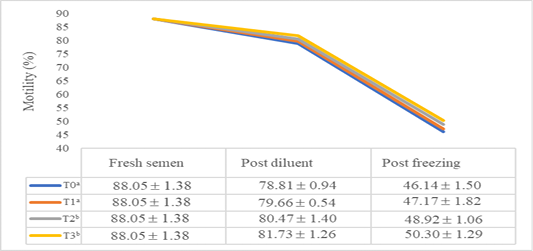
Motility: The motility of Bali bull sperm at the fresh stage and after adding Tris-Egg yolk diluent enriched with different concentrations of Kasumba Turate extract at the post-dilution and post-freezing stages is shown in Figure 1.
Statistical analysis showed that motility in T0 did not differ significantly (p > 0.05) from T1 (88.05%, 78.81%, and 46.14% vs. 88.05%, 79.66%, and 47.17%) at the fresh, post-dilution, and post-freezing stages, respectively. Similarly, T2 did not differ significantly (p > 0.05) from T3 (88.05%, 80.47%, and 48.92% vs. 88.05%, 81.73%, and 50.30%) at the fresh, post-dilution, and post-freezing stages, respectively. However, T0 and T1 were significantly (p < 0.05) lower than T2 and T3.
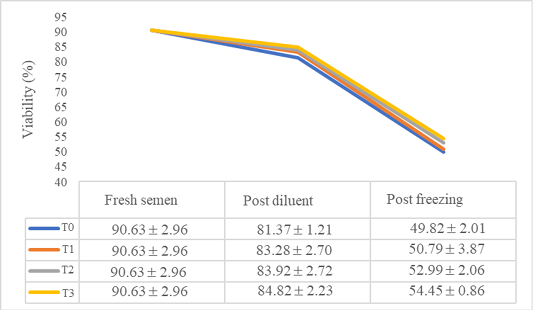
Viability: The viability of Bali bull sperm at the fresh stage and after adding Tris-Egg yolk diluent enriched with different concentrations of Kasumba Turate extract at the post-dilution and post-freezing stages was analyzed and presented in Figure 2.
Statistical analysis showed that viability in T0 did not differ significantly (p > 0.05) from T1 (90.63%, 81.37%, and 49.82% vs. 90.63%, 83.28%, and 50.79%) at the fresh, post-dilution, and post-freezing stages, respectively. Similarly, T0 did not differ significantly (p > 0.05) from T2 and T3 (90.63%, 81.37%, and 49.82% vs. 90.63%, 83.92%, and 52.99% vs. 90.63%, 84.82%, and 54.45%) at the fresh, post-dilution, and post-freezing stages, respectively.
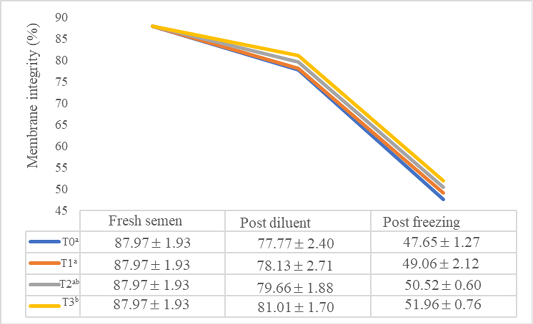
Membrane integrity: The membrane integrity of Bali bull sperm at the fresh stage and after adding Tris-Egg yolk diluent enriched with different concentrations of Kasumba Turate extract at the post-dilution and post-freezing stages was analyzed and exhibited in Figure 3.
Statistical analysis showed that membrane integrity in T0 did not differ significantly (p > 0.05) from T1 (87.97%, 77.77%, and 47.65%), T2 (87.97%, 78.13%, and 49.06%), and T3 (87.97%, 79.66%, and 50.52%) at the fresh, post-dilution, and post-freezing stages, respectively. Similarly, T2 did not differ significantly (p > 0.05) from T3 (87.97%, 79.66%, and 50.52% vs. 87.97%, 81.01%, and 51.96%) at the fresh, post-dilution, and post-freezing stages, respectively. However, T0 and T1 differed significantly (p < 0.05) from T3, with values of (87.97%, 77.77%, and 47.65%) vs. (87.97%, 78.13%, and 49.06%) vs. (87.97%, 81.01%, and 51.96%) at the fresh, post-dilution, and post-freezing stages, respectively.
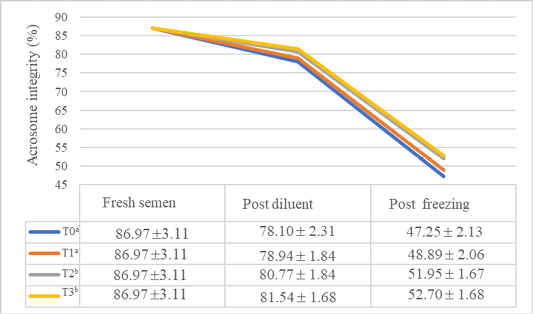
Acrosome integrity: The acrosome integrity Bali bull sperm at the fresh stage and after adding Tris-Egg yolk diluent enriched with different concentrations of Kasumba Turate extract at the post-dilution and post-freezing stages was analyzed and exhibited in Figure 4.
Statistical analysis showed that acrosome integrity sperms in the T0 did not differ significantly (p > 0.05) from T1 (86.97%, 78.10%, and 47.25% vs. 86.97%, 78.94%, and 48.89%) at the fresh, post-dilution, and post-freezing stages, respectively. Likewise, T2 did not differ significantly (p > 0.05) from T3 (86.97%, 80.77%, and 51.95% vs. 86.97%, 81.54%, and 52.70%) at the fresh, post-dilution, and post-freezing stages, respectively. However, T0 and T1 were significantly (p < 0.05) lower than in T2 and T3.
The results showed that adding Kasumba Turate extract at concentrations of 1% and 1.5% effectively improved the quality of spermatozoa in Tris-Egg yolk diluent. The observed improvements in motility, viability, membrane integrity, and acrosome integrity indicate that Kasumba Turate extract can effectively maintain spermatozoa quality of Bali bull.
The motility was the leading indicator that reflects the ability of spermatozoa to move and reach the egg. This study showed a significant increase in motility at 1% and 1.5% concentration of Kasumba Turate extract compared to the control and treatment with 0.5% concentration (Figure 1). This increase in motility can be explained by the antioxidant content in Kasumba Turate extracts, such as flavonoids and carotenoids, which effectively protect spermatozoa from oxidative damage during storage ; . These antioxidants help reduce free radical damage, maintaining spermatozoa energy and activity and improving motility .
The viability of spermatozoa indicates the percentage of live spermatozoa in the sample and was an important parameter to ensure the number of viable spermatozoa for fertilization remains optimal. This study showed a significant increase in viability in the group with a higher concentration of Kasumba Turate extract (Figure 2). This increase may be due to the bioactive content in Kasumba Turate extract that helps maintain the osmotic balance and integrity of the spermatozoa cell membrane, preventing damage and cell death during storage . With higher viability, the chances of successful artificial insemination increase, directly related to increased fertilization .
The membrane integrity was an essential indicator of the ability of spermatozoa to survive under external environmental conditions. A significant improvement in membrane integrity was observed in the group treated with Kasumba Turate extract, especially at a concentration of 1.5% (Figure 3). This improvement was due to the antioxidant-containing composition of Kasumba Turate extract, which maintains the quality of spermatozoa and provides the energy source required to maintain membrane integrity . This allows the spermatozoa to remain functional during more extended storage periods.
The integrity acrosome, an essential structure in the spermatozoa head that plays a role in egg penetration , was also examined in this study. Results showed that acrosome integrity in spermatozoa treated with Kasumba Turate extracts at 1% and 1.5% concentrations (Figure 4) was better than the control. Intact acrosomes are required to release enzymes that allow spermatozoa to penetrate the egg’s protective layer, contributing to successful fertilization .
CONCLUSIONS AND RECOMMENDATIONS
In conclusion, adding Kasumba Turate extract to Tris-Egg yolk diluent can maintain the quality of spermatozoa during storage, particularly at concentrations of 1% and 1.5%.
ACKNOWLEDGEMENTS
The first authors was supported by the Research Assistance for Research and Innovation Talents (BARISTA) scholarship, National Research and Innovation Agency. Our thanks to all members of the Laboratory of Animal Reproduction, Semen Processing Unit, Faculty of Animal Science, Hasanuddin University.
NOVELTY STATEMENTS
This study explores the use of Kasumba Turate (Carthamus tinctorius L.) extract in Tris-Egg yolk diluent to improve the quality of Bali bull spermatozoa during cryopreservation. By evaluating different concentrations, this study identifies optimal doses that enhance sperm motility, viability, membrane integrity, and acrosome integrity.
AUTHOR’S CONTRIBUTIONS
All authors equally contributed and approved the manuscript.
Conflict of Interest
The authors declared that there is no conflict of interests.
Figures
Figure 1:.
The motility of Bali bulls’ sperms at different concentration of Kasumba Turate extract.
Different superscript indicates differ significantly (p < 0.05).
Figure 2:.
The viability of Bali bulls’ sperms at different concentration of Kasumba Turate extract.
Figure 3:.
The membrane integrity of Bali bulls’ sperms at different concentration of Kasumba Turate extract. Different superscript indicates differ significantly (p < 0.05).
Figure 4:.
The acrosome integrity of Bali bulls’ sperms at different concentration of Kasumba Turate extract. Different superscript indicates differ significantly (p < 0.05).
References
Diansyah AM, Yusuf M, Toleng AL, Dagong MIA (2022b). Characteristic and kinematics of bali-polled bull sperms. Adv. Anim. Vet. Sci., 10(8): 1787- 1796. https://doi.org/10.17582/journal.aavs/2022/10.8.1787.1796[Full text][CrossRef]
Diansyah AM, Yusuf M, Toleng AL, Dagong MIA, and Maulana T (2022a). The Expression of Plasma Protein in Bali-polled Bulls Using 1D-SDS-PAGE. World Vet. J., 12 (3): 316-322. https://doi.org/10.54203/scil.2022.wvj40[CrossRef]
Diansyah AM, Yusuf M, Toleng AL, Dagong MIA, Maulana T, Hasrin, Baharun A (2023b). The sperms post-thawing quality and proteomic seminal plasma on fertility performance of bali-polled bull. Adv. Anim. Vet. Sci., 11(4): 517-525. https://doi.org/10.17582/journal.aavs/2023/11.4.517.525[Full text][CrossRef]
Diansyah AM, Yusuf M, Kaiin EM (2020). The quality of sperm post-immobilization at some parts of FH sperm using laser diodes. IOP Conf. Ser. Earth Environ. Sci., 492(1): 012074. https://doi.org/10.1088/1755-1315/492/1/012074[CrossRef]
Diansyah AM, Yusuf M, Toleng AL, Dagong MIA (2023a). The effect of thawing duration on the sperms quality of Bali polled bull. In AIP Conference Proceedings (Vol. 2628, No. 1). AIP Publishing. https://doi.org/10.1063/5.0146414[CrossRef]
Ducha N, Hariani D, Budijastuti W, Susilawati T, Aulanni’am AA, Wahyuningsih S (2023). Effects of Adding α-tocopherol to Brahman Bull Chilled Semen on Sperm Quality, Lipid Peroxidation, Membrane Integrity, and DNA Integrity. Iran. J. Vet. Sci. Technol., 15(1): 31-40.
Fadilla ZJ, Yusuf M, Toleng AL, Diansyah AM (2023). Characteristics and Kinematics of Bali Bull Sperms after Thawing Using Tris Soy Lecithin . J. Adv. Zool., 44(04): 477-487. https://doi.org/10.17762/jaz.v44i4.1967[CrossRef]
Fristiohady A, Al-Ramadan W, Asasutjarit R, Julian LOM (2023). Pytochemistry, Pharmacology and Medicinal Uses of Carthamus tinctorius Linn: An Updated Review. Biointerface Res. Appl. Chem., 13, 441. https://doi.org/10.33263/BRIAC135.441[CrossRef]
Hamsidi R, Widyawaruyanti A, Hafid AF, Ekasari W, Kasmawati H, Akib NI, Wahyuni Hajrul MM (2018). In Vitro Antimalarial Activity of Chloroform, N-Butanol, and Ethyl Acetate Fractions of Ethanol Extracts of Carthamus Tinctorius Linn. Flowers. Asian J. Pharm. Clin. Res., 11: 121–123. https://doi.org/10.22159/ajpcr.2018.v11i2.15856[CrossRef]
Hasan MM, Reshi QUA, Lättekivi F, Viil J, Godakumara K, Dissanayake K, Fazeli A (2021). Bovine Follicular Fluid Derived Extracellular Vesicles Modulate the Viability, Capacitation and Acrosome Reaction of Bull Spermatozoa. Biology, 10 (11): 1154. https://doi.org/10.3390/biology10111154[CrossRef]
Hitit M, Ugur MR, Dinh TTN, Sajeev D, Kaya A, Topper E, Memili E (2020). Cellular and Functional Pathophysiology of Bull Sperm with Altered Sperm Freezability. Front. Vet. Sci., 7: 581137. https://doi.org/10.3389/fvets.2020.581137[CrossRef]
Kowalczyk A, Kuczaj M, Czerniawska-Piątkowska E (2020). The role of environmental optimization for storing bulls’ sperm cells. Syst. Biol. Reprod. Med., 66(5): 300-310. https://doi.org/10.1080/19396368.2020.1795432[CrossRef]
Kulikova NE, Chernobrovina AG, Roeva NN, Popova OY (2023). Evaporation as a method for obtaining plant concentrates. Food Processing: Tech. Technol., https://doi.org/10.21603/2074-9414-2023-2-2438[CrossRef]
Lukusa K, Kabuba J (2020). Semen collection methods and cooling rates affect post-thaw sperm motility and kinematic parameters of Saanen goat. Asian Pac. J. Reprod., 9(5): 239-246. https://doi.org/10.4103/2305-0500.294666[CrossRef]
Meng Y, Du Z, Li Y, Wang L, Gao P, Gao X, Li C, Zhao M, Jiang Y, Tu P, Guo X (2018). Integration of metabolomics with pharmacodynamics to elucidate the anti-myocardial ischemia effects of combination of notoginseng total saponins and safflower total flavonoids. Front. Pharmacol., 9: 667. https://doi.org/10.3389/fphar.2018.00667[CrossRef]
Nandan D, Gaur M, Jhamb D, Sharma D, Pargi K, Ram V (2024). Effect of Streptomycin-Penicillin and Gentamicin- Tylosin-Lincomycin-Spectinomycin on the Quality and Bacterial Load of Frozen-Thawed Semen of Surti Buffalo Bull. Indian J. Vet. Sci. Biotechnol., 20(2). https://doi.org/10.48165/ijvsbt.20.2.05[CrossRef]
Qamar AY, Naveed MI, Raza S, Fang X, Roy PK, Bang S, Cho J (2023). Role of antioxidants in fertility preservation of sperm—A narrative review. Anim. Biosci., 36(3): 385. https://doi.org/10.5713/ab.22.0325[CrossRef]
Qolbi N, dan Yuliani R (2018). Antibacterial Activity Screening of Ten Leaves Extracts against Klebsiella Pneumoniae. Pharmacon: J. Farmasi Indones., 15(1): 8–18. https://doi.org/10.23917/pharmacon.v15i1.6169[CrossRef]
Rahmat, Yusuf M, Toleng AL, Herdis, Diansyah AM, Hasrin (2024). The quality of bali bull sexed sperms using freeze dry albumin at different con- centrations of sexing medium. Adv. Anim. Vet. Sci., 12(2): 249-258. https://doi.org/10.17582/journal.aavs/2024/12.2.249.258[Full text][CrossRef]
Reda AA, Almaw G, Abreha S, Tadeg W, Tadesse B (2020). Bacteriospermia and sperm quality of cryopreserved bull semen used in artificial insemination of cows in South Wollo zone, Ethiopia. Vet. Med. Int., 2020(1): 2098315. https://doi.org/10.1155/2020/2098315[CrossRef]
Signer‐Hasler H, Casanova L, Barenco A, Maitre B, Bagnato A, Vevey M, Berger B, Simcic, M, Boichon D, Capitan A, Medugorac I, Bennewitz J, Mészáros G, Sölkner J, Drögemüller C, Flury C. (2023) Genomic regionsunderlying positive selection in local, Alpine cattlebreeds. Animal Genetics, 54, 239–253. https://doi.org/10.1111/age.13295[CrossRef]
Silvestre MA, Yániz JL, Peña FJ, Santolaria P, Castelló-Ruiz M (2021). Role of Antioxidants in Cooled Liquid Storage of Mammal Spermatozoa, 10 (7): 1096. https://doi.org/10.3390/antiox10071096[CrossRef]
Suhardi R, Megawati N, Ardhani F, Summpunn P, Wuthisuthimethavee S (2020). Motility, viability, and abnormality of the spermatozoa of bali bull with andromed® and egg yolk-tris diluents stored at 4 C. Iran. J. Appl. Anim. Sci., 10(2): 249-256. Avaible at https://journals.iau.ir/article_673200_4988ec756516b6361f055f9a8311e47a.pdf
Surahman SM, Yusuf MYS, Garantjang SG, Toleng AL (2021). Sperms motility, viability, and abnormality of the frozen semen at different bull breeds. Sperms motility, viability, and abnormality of the frozen semen at different bull breeds. https://doi.org/10.1088/1755-1315/788/1/012140[CrossRef]
Sulistyo S, Anggraeni F (2023). Straw Quality and Success Rate of Artificial Insemination in Ongole Crossbred (PO) with Different Thawing Times. J. Sustainable Livestock, 1(1): 1-8.
Tahar N, Satrianegara F, Rukmana R, Hamzah N, Rukmana S, Alwi F, Mukhriani M (2023). Brine Shrimp Lethality, Aktivitas Antioksidan dan Kadar Total Fitokimia dari Ekstrak Etanol Kasumba Turate (Carthamus tinctorius). JFI Online | Print ISSN1412-1107e-ISSN2355-696X,15(1):72-78. https://doi.org/10.35617/jfionline.v15i1.71[CrossRef]
Wróblewski M, Wróblewska W, Sobiesiak M (2024). The Role of Selected Elements in Oxidative Stress Protection: Key to Healthy Fertility and Reproduction. Int. J. Mol. Sci., 25(17): 9409. https://doi.org/10.3390/ijms25179409[CrossRef]