
This study was aimed to determine the effect of fortified wheat flour on the hemoglobin level of anemic hostel girls belonging to Abbottabad. In this interventional study, fortified wheat flour was provided to hostel kitchen for the study subjects. Blood hemoglobin concentrations and anthropometric measurements of all participating hostel girls (n=219) were determined initially (Day-0) and at the end of 4 months feeding period. Mean age of the subjects was 21.88 years, with an average initial BMI of 24.71 kg/m2. Findings of the efficacy trial showed that the average hemoglobin level in anemic girls increased from 8.99 to 9.94g/dl. The prevalence of severe anemia was reduced from 8 to 4% (p < 0.05), moderate anemia reduced from 80 to 68%. However percentage of mild anemic girls increased from 12 to 28% as a result of shift of moderate anemic subjects to mild anemic group. It is concluded from the study results that prevalence rate of anemia among hostel girls reduced significantly and Hb levels improved after consuming iron fortified chapatti for 120 days.
Short Communication · Volume 54, Issue 3, 5 March 2022 · Open Access
Effect of Fortified Wheat Flour on Anemia Status of Adolescent Hostel Girls
· · · · ·
Affiliations & Notes ⌄
- 1University Institute of Dietetics and Nutritional Sciences, Faculty of Allied Health Sciences, University of Lahore, Lahore * Corresponding author: mehboob.riffat@gmail.com
Article Info ⌄
- Journal:
- Pakistan Journal of Zoology
- Published:
- 5 March 2022

From the article
- Current study suggested that iron fortified wheat flour improve the blood hemoglobin levels among adolescent females, as compared to 0day.
- The study suggested that the hemoglobin status of adolescent girls was significantly improved by consuming wheat flour fortified with ferrous sulphate, in comparison to placebo group.
- Results showed that iron fortified food increased average hemoglobin level by 0.42 g/dL.
- It can be concluded from the study that prevalence rate of anemia among hostel girls reduced significantly and Hb levels improved after consuming iron fortified chapatti for 120 days.
Selected from the article's own text.
Abstract
Materials and methods
This was an interventional non-randomized (quasi experimental) study with pre-, post-test, undertaken at the University Institute of Diet and Nutritional Sciences (UIDNS), Faculty of Allied Health Sciences, The university of Lahore. The statistical population included all female college students residing in college hostels in Abbottabad. Single stage cluster sampling technique was used for data collection because entire cluster was selected. Sample size was calculated by using the formula :
Z2 1-α/2 P(1-P) / d2
Where, Z2 1-α/2 is (1.96)2, P (anemia) is 21% 19, 1-P is 1-0.21, and α is 0.05.
Fortified wheat flour was obtained from a local flourmill at Abbottabad. Wheat flour was fortified according to the standard fortification procedures used under the Food Fortification Programme (FFP) of Pakistan. It requires addition of fortification premix containing NaFeEDTA, folic acid, zinc oxide, and vitamin B12. The addition rate was 200 g/MT (or 4g/20kg or 0.2g/kg) and results in fortification of the flour with 15 ppm iron in the form of NaFeEDTA, 1 ppm folic acid, 30 ppm zinc in the form of zinc oxide and 0.008 ppm vitamin B12.
This study was conducted involving female students residing in hostels of different girls’ colleges of Abbottabad. After permission of the relevant hostel authorities, students were invited to participate as subjects in the study. Fortified wheat flour was provided to the hostel kitchens for the study subject. The participating students underwent a medical examination. Blood analysis for hemoglobin concentrations and anthropometric measurements (WHO, 1995), of all participating hostel girls were conducted initially (Day-0) and at the end of 120 days feeding period. Twenty-four-hour dietary recall questionnaire was got filled from the participants to calculate the nutrient intake. Data on prevalence of anemia and Hb-levels among females were analyzed using paired sample T-test, where the p value less than 0.05 was considered statistically significant.
The study was approved by the Institutional Review Board of University of Lahore (UOL), and prior written informed consents were obtained from all the participants. Doses of iron fortified n wheat flour were within the safe range. Blood samples were obtained by a qualified phlebotomist.
The collected data were analyzed using the statistical software SPSS, version 24 (SPSS Inc., Chicago, IL., USA). Descriptive statistics, paired sample t-test, were performed to analyze the results. P < 0.05 was considered significant.
Results
Table I shows the general changes during the intervention period in different parameters. Average age of the participants was 21.88 years with 1.54m mean height and 58.18kg mean initial weight.
Average weight of the participants was significantly (p <0.05) influenced by the intervention. Mean weight increased from an initial value of 58.1kg to 60.33kg during the 4 months intervention period. That resulted an increase in average BMI status from initial 24.71 to final value of 25.48.
Table I.- Anthropometric and demographic characteristics of the study subjects.
| Variables | Day-0 | Day-120 | t-value | p-value |
| Age (years) | 21.88±2.76 | - | - | - |
| Height (m) | 1.54± 0.026 | - | - | - |
| Weight (kg) | 58.18 ±9.95 | 60.33±10.05 | -2.91 | 0.008 |
| BMI - (kg/m2) | 24.71±5.861 | 25.48±5.10 | -2.14 | 0.42 |
| Hb (g/dl) | 8.99 ±1.03 | 9.94 ±1.01 | -3.16 | 0.004 |
Values are mean±SD.
Changes in the average weight alone during the intervention period probably may not amply explain the influence of the intervention. Interesting changes in the distribution of BMI values among the study participants were also noted. Significant (p < 0.05) increase in the mean hemoglobin level of the individuals were observed after intervention (Table I). Mean blood Hb level increased from 8.9 to 9.94g/dl, resulting in an average increase of 0.95g/dl.
As it is evident from Figure 1, the overall increase in weight during the 4 months intervention period were accompanied by significant shifts among various BMI classes. The percentage of underweight individuals was reduced from initial 8% to a final prevalence of 4%; however, many of the individuals initially falling in normal BMI range ended up in slightly overweight class, entailing in a reduction of the normal BMI prevalence from 48% to 28%. That simultaneously resulted in an increase of the overweight class from 20 to 44%. However, the prevalence of obese individuals (BMI > 30) did not change from 24% during the intervention period.
The study essentially was conducted on anemic hostel girls. Figure 2 gives the distribution of different anemia classes among study participants before and after intervention. As a result of the iron, folic acid, vitamin B12 and Zn intervention for 4 months the prevalence of severely anemic girls was reduced from 8 to 4%. Initially 80% girls were moderately anemic and a reduction of 12 percentage points was noted in this class of anemic girls as a result of consuming fortified wheat flour for 4 months. The final prevalence of moderately anemic girls was 68%. However, prevalence of mild anemia increased from an initial value of 12% to a final prevalence of 28%. This increase, however was not due to an overall increase in the anemia prevalence, rather it was because many of the participants who were rated as moderate anemic, improved their blood hemoglobin concentrations and shifted from moderate anemia to mild anemia. Hence the phenomenon actually indicates an overall improvement in the iron nutritional status of the group.
A significant improvement in symptoms associated with anemia such as glossitis, spoon shaped nails, paleness of skin, coated tongue and depression reduced by 4, 8, 8, 8 and 8 percentage points, respectively. Twenty percent of the study participants reported high appetite at the end of the study as compared to 8% in the beginning. Similarly, 20% reported quicker digestion after intervention as compared to 8% before the intervention.
Table II.- Findings of the pre- and post-intervention medical examination.
| Symptoms | Pre-intervention | Post-intervention | |
| Lips | Dry | 8% | 4% |
| Normal | 84% | 92% | |
| Glossitis | 8% | 4% | |
| Skin | Pale | 16% | 8% |
| Normal | 76% | 88% | |
| Dry | 8% | 4% | |
| Appetite | Poor | 4% | 8% |
| Normal | 88% | 72% | |
| High | 8% | 20% | |
| Tongue | Coated | 12% | 4% |
| Normal | 84% | 96% | |
| Swell | 4% | 0% | |
| Digestion | Slow | 8% | 4% |
| Normal | 84% | 76% | |
| High | 8% | 20% | |
| Nails | Pale | 4% | 4% |
| Normal | 76% | 88% | |
| Brittle | 8% | 4% | |
| Spoon shaped | 12% | 4% | |
| Emotional status | Calm | 68% | 80% |
| Anxious | 8% | 8% | |
| Agitated | 12% | 8% | |
| Depressed | 12% | 4% | |
| Gums health | Good | 92% | 96% |
| Bad | 8% | 4% | |
Discussion
Current study suggested that iron fortified wheat flour improve the blood hemoglobin levels among adolescent females, as compared to 0day. Dad et al. (2017) supplemented the wheat flour with ferrous sulfate. The subjects of the study group were fed with ferrous sulfate fortified wheat flour while the control group was fed with non-fortified wheat flour as a placebo. The study suggested that the hemoglobin status of adolescent girls was significantly improved by consuming wheat flour fortified with ferrous sulphate, in comparison to placebo group.
The results of the study by Sun et al. (2007) did not demonstrated significant change between the Hb level, prevalence of IDA and iron status of the control group. On the other hand, fortified flours showed positive effects on IDA and improving iron status. Their result suggested that that NaFeEDTA has the best effectiveness in remedying IDA and refining iron status, within 2 months. FeSO4 was also operative, but not as worthy as NaFeEDTA.
Gera et al. (2012) also determined the change in Hb levels in a pseudo randomized study to explore the effect of iron fortification on Hb and ferritin levels. Results showed that iron fortified food increased average hemoglobin level by 0.42 g/dL. According to National Nutritional Survey (2001), there was a high proportion of anemia in Pakistan among women and children. The prevalence of iron deficiency anemia was 45% in women and 49.7% in children. After 10 years the prevalence of anemia seemed to have increased and that time 52% women and 62.5% children were found anemic.
In a review by O’Mahony (2017) on the effects of fortified foods with different fortificants, the impact of food fortification on micronutrients status was evaluated and measured the efficacy and effectiveness of food fortification. Results revealed that food fortification improves biological values of iron, hemoglobin and other nutrients. It also helps to improve cognition, growth, development and disease rate. NaFeEDTA is the preferred iron (Fe) compound, more suitable for fortification of flours.
Findings of the current study are also supported by a those reported from a randomized, controlled, double-blind school feeding trial conducted on children between the age of 6 to 15 years in India . The intervention group was provided with iron-fortified lunch in comparison to non-fortified controlled group. Findings of this seven months feeding study showed that at the end there was a significant increase in Fe and hemoglobin levels in anemic children. The levels of serum ferritin, Hb and RBCs increased in intervention group than controlled group. NaFeEDTA-fortified wheat flour noticeably improved body iron stores (BIS) and reduced iron deficiency (ID) in Fe-depleted children.
Conclusions
It can be concluded from the study that prevalence rate of anemia among hostel girls reduced significantly and Hb levels improved after consuming iron fortified chapatti for 120 days. There was also a clear reduction in symptoms of iron deficiency anemia such as glossitis, pale nails, coated tongue and inflamed gums. BMI status improved with intervention due to weight gain observed at the end of study.
Statement of conflict of interest
The authors have declared no conflict of interests.
Figures
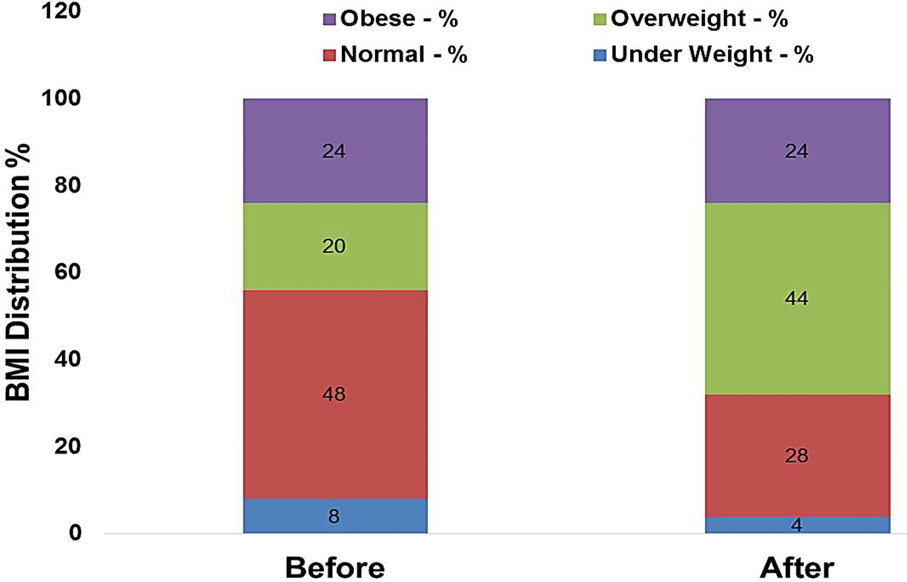
Distribution of BMI among study subjects before and after intervention.
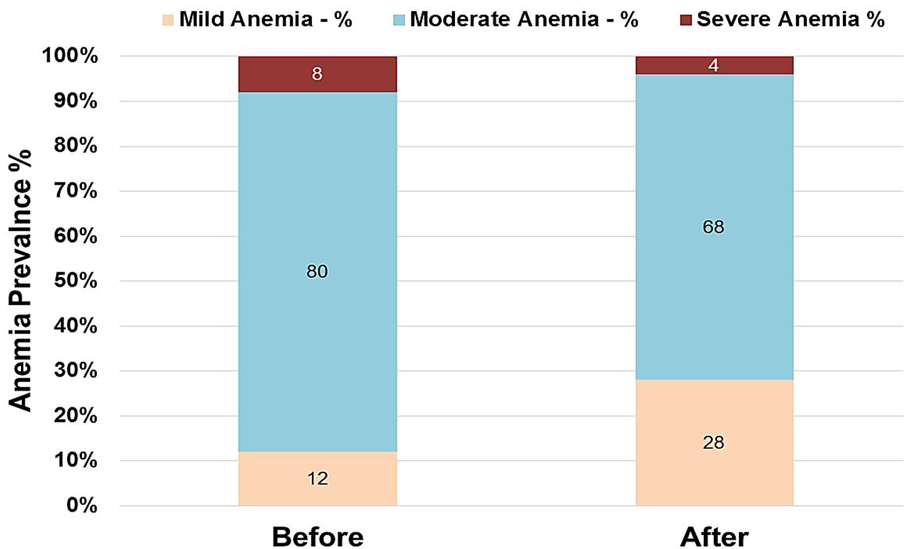
Distribution of anemia study subjects before and after the intervention.
References
- Annonymus, 2005. Mother and child health in Pakistan population stabilization: A priority for development. Ministry of Population Welfare, Islamabad, Government of Pakistan.
- Bhutta, Z.A., Soofi, S.B., Zaidi, S.S.H. and Habib, A., 2011. Pakistan national nutrition survey 2011. Planning Commission, Planning and Development Division, Government of Pakistan.
- Cook, J.D., Minnich, V., Moore, C.V., Rasmussen, A., Bradley, W.B. and Finch, C.A., 1973. Am. J. clin. Nutr., 26: 861-872. https://doi.org/10.1093/ajcn/26.8.861[CrossRef]
- Dad, F., Khan, S., Habib, I., Shah, B.R. and Sohail, M., 2017. Am. J. Fd. Sci. Hlth., 3: 1-6.
- FAO, 2017. Country fact sheet on food and agriculture policy trends. Socio-economic context and role of agriculture. Food and Agriculture Policy Decision Analysis, Food and Agriculture Organization.
- Gera, T., Sachdev, H.S. and Boy, E., 2012. Am. J. clin. Nutr., 96: 309-324. https://doi.org/10.3945/ajcn.111.031500[CrossRef]
- Gibson, R.S. and Anderson, V.P., 2009. Fd. Nutr. Bull., 30(Suppl 1): S108-S143.
- Hertrampf, E., 2002. Nutr. Rev., 60(Suppl 7): S22-S25. https://doi.org/10.1301/002966402320285056[CrossRef]
- Mannar, M.G.V., 2001. Food fortification as a major strategy to address micronutrient malnutrition in Asia. The Manila Forum on Food Fortification Policy.
- Moretti, D., Biebinger, R., Bruins, M.J., Hoeft, B. and Kraemer, K., 2014. Annls. N.Y. Acad. Sci., 1312: 54-65. https://doi.org/10.1111/nyas.12297[CrossRef]
- Muthayya, S., Thankachan, P., Hirve, S., Amalrajan, V., Thomas, T., Lubree, H., Agarwal, D., Srinivasan, K., Hurrell, R.F., Yajnik, C.S. and Kurpad, A.V., 2012. J. Nutr., 142: 1997-2003. https://doi.org/10.3945/jn.111.155135[CrossRef]
- Nkrumah, B., Nguah, S.B., Sarpong, N., Dekker, D., Idriss, A., May, J. and Adu-Sarkodie, Y., 2011. BMC clin. Pathol., 11: 5. https://doi.org/10.1186/1472-6890-11-5[CrossRef]
- NNS, 2018. National nutrition survey 2018. Nutrition Wing, Ministry of National Health Services, Regulation and Coordination, Government of Pakistan.
- O’Mahony, M. (ed.), 2017. In: Routledge. CRC Press, pp. 510. https://doi.org/10.1201/9780203739884[CrossRef]
- Steel, R.G.D., Torrie, J.H. and Dickey, D.A., 1997. Principles and procedures of statistics: A biometrical approach, 3rd edition. McGraw Hill, Inc. Book Co., New York, pp. 352-358.
- Sun, J., Huang, J., Li, W., Wang, L., Wang, A., Huo, J., Chen, J. and Chen, C., 2007. Asia-Pacific J. clin. Nutr., 16: 116.
- Walter, T., Pizarro, F., Abrams, S.A. and Boy, E., 2004. Eur. J. clin. Nutr., 58: 555-558. https://doi.org/10.1038/sj.ejcn.1601844[CrossRef]
- Walter, T., Pizarro, F., Boy, E. and Abrams, S.A., 2004. J. Nutr., 134: 380-383. https://doi.org/10.1093/jn/134.2.380[CrossRef]
- WHO, 1995. Physical status: The use and interpretation of anthropometry. WHO Technical Report Series 854, World Health Organization, pp. 55. https://www.who.int/childgrowth/publications/physical_status/en/ (accessed on 13 February, 2021).
Services
Article usage statistics
Loading…