
This study investigated the host preference and development of Sitotroga cerealella as well as its effect on the quality of Trichogramma chilonis under laboratory conditions at Agriculture Research Institute (ARI), Tarnab, Peshawar-Pakistan during, 2017-2018. The cereals (maize, oat, wheat and barley) were evaluated on the basis of total adult emergence, egg laying ability, developmental time of S. cerealella and enhancing parasitism along with sex ratio of T. chilonis raised on eggs from moths reared on cereals. The response of cereals to S. cerealella in no choice test revealed significantly greater adult emergence (18.9±12.6) and egg laying efficiency (82.2±6.8 eggs/female) with shortest developmental time (27.6±0.6 days) in wheat, while adult emergence (9.62±6.1) was less in maize grains. In choice test, significant effect of developmental time of S. cerealella was observed with wheat (27.4±0.2 days) and barley (27.2±0.2 days) allowing short duration. Similarly, T. chilonis preference to eggs of S. cerealella adults reared on different cereals showed that percent egg parasitism (89.6±1.7, 85.2±2.1), percent adult emergence (95.6 ±1.3, 92.1±1.4) and female sex ratio (73.1±0.7, 69.6±1.2) of T. chilonis was significantly high in moth eggs reared on maize and wheat in no choice conditions respectively. In choice test, sex ratio was significant and maximum females (70.4±0.5, 77.4±0.6) were observed in eggs from moth reared on wheat and maize. A positive strong correlation of percent adult moth emergence with protein and strong negative between development time and moisture content and carbohydrate was observed. Wheat proved to be suitable as host with high bio-chemical contents for mass rearing of S. cerealella that provide maximum moths in short duration and their eggs yield more of T. chilonis, thus recommended for production system of T. chilonis.
Research Article · Volume 37, Issue 4, 7 October 2021 · Open Access
Effect of Bio-Chemical Properties of Various Grains on the Quality Rearing of Factious Host, Sitotroga cerealella (Olivier) and its Subsequent Effect on Trichogramma chilonis in Vitro
· · · ·
Affiliations & Notes ⌄
- 1Department of Plant Protection, Faculty of Crop Protection Sciences, The University of Agriculture, Peshawar, P.O. Box 25130, Pakistan
- 2Agricultural Research Institute (ARI), Tarnab, Peshawar-Pakistan. *Correspondence | Muhammad Shehzad Khan, Department of Plant Protection, Faculty of Crop Protection Sciences, The University of Agriculture, Peshawar, P.O. Box 25130, Pakistan
- 3Email: mskhan_agrarian@yahoo.com
Article Info ⌄
- Journal:
- Sarhad Journal of Agriculture
- Published:
- 7 October 2021
From the article
- Wheat and maize both can develop maximum S. cerealella adults in short duration but the moisture and protein contents of wheat are high enough that meet the requirements of S. cerealella.
- Though, T. chilonis wasps prefer to parasitize large and fresh eggs so apparently good and strong S. cerealella adults should be selected for egg masses and subsequent rearing of T. chilonis.
- Furthermore, eggs from S. cerealella reared on wheat and maize grains should be exposed to T. chilonis as they can produce more females.
- However, number of seeds per gram of maize is much less than wheat and further, developmental time of S. cerealella in maize is greater than in wheat, yielding less number of hosts and eggs for parasitoid.
Selected from the article's own text.
Abstract
Introduction
Angoumois grain moth, Sitotroga cerealella (Lepidoptera: Gelechiidae), which is an important stored grains pest, is a common host for rearing Trichogramma chilonis. Development of S. cerealella takes place inside the grains, which are directly damaged (Weston and Rattlingourd, 2000).
Cereals, like rice, wheat and corn are suitable for S. cerealella; however, their chemical and physical nature, carbohydrate, fat, and protein content is responsible for variation in their attraction to insects. S. cerealella preference towards cereals varies by changes in nutritive and physical factors of grains (Hamed and Nadeem, 2012). The adult weight, growth period and fecundity of insect progeny are greatly affected by carbohydrate and protein contents of grains (Slansky and Scriber, 1985).
Egg parasitoids, Trichogramma chilonis (Trichogrammatidae) is used worldwide as a bio-control agent that attacks the egg of lepidopterans (Nadeem et al., 2010) depriving them of reaching the larval stage. T. chilonis prefer fresh host eggs and parasitization significantly reduces with time. The adult emergence, longevity and parasitism do not change among different age groups of S. cerealella; however, affected along with sex ratio in T. chilonis due to temperature and age of eggs (Farid et al., 2001).
Field release technique requires a huge quantity of Trichogramma individuals and therefore, numerous studies are paying attention on the mass rearing and storage of Trichogramma species. T. chilonis use host eggs to complete their life cycle and their sexes have great impact on progeny development and pest control. Since long, wheat is used as a host for rearing S. cerealella, but this study sole purpose is to investigate the best possible host that contains balanced bio-chemical compounds and provides large progeny within short duration and also more parasitoids with plenty of female wasps for mass production of T. chilonis. Keeping in view the importance of S. cerealella as a host for T. chilonis, the present study is designed for the life cycle parameters of Angoumois grain moth on four cereals to investigate the most preferred cereal and further parasitism rate and sex ratio of T. chilonis with respect to S. cerealella reared on cereals.
Materials and Methods
The common cereals like maize, oat, wheat and barley are frequently found infested by Angoumois grain moth in storages. Therefore, we focused to find a suitable host for the efficient rearing of S. cerealella as a host for T. chilonis under laboratory conditions.
Cereals/Seed collection and sterilization of grains
Seeds of cereal (maize, oat, wheat and barley) weighing one kg each were bought from local grain market of Peshawar. After washing and sun drying, the grains were put in plastic bags, labeled properly and sterilized in an autoclave at 121°C for 20 minutes, leaving a small portion untreated for chemical analyses.
Culture maintenance of Sitotroga cerealella
S. cerealella culture was maintained on wheat grains under laboratory at ARI, Tarnab. The collected adults from the rearing chamber in a jar were placed in a plate having starch. After 24 hours, the starch was sieved through 80 mesh sieve obtaining eggs of S. cerealella a few of which were kept in wheat jars to maintain the culture, while others particularly single eggs were pasted on hard cards and exposed to T. chilonis to raise its culture for experiments.
Experiment 1: Grain count and chemical analysis
No. of grains and Infestation level: A 50 g sample of each cereal was taken from the treated seeds and the number of grains was counted with the help of digital grain counter. The grains were subsequently subjected to infestation by S. cerealella to find the number of adults emerged from fixed quantity of grains for three successive generations.
Proximate composition: Chemical analyses of the untreated cereal grains were performed in a laboratory at the Department of Agricultural Chemistry, The University of Agriculture, Peshawar. Overall composition was made using the standard official methods of analysis of AOAC (2016).
Moisture: Oven drying technique was used where each sample (2 g) was weighed in petri dish (w1, primary weight of sample+petri dish) and placed in an oven at 105°C. After 4-6 hours, the petri dishes were partly displaced towards desiccators and chilled for 30 minutes. The petri dishes were weighed (w2, final weight of sample+petri dish) again and percent moisture content [(w1-w2)/ weight of sample ×100] was determined.
Ash content: Two grams of each grain sample was placed in a crucible, burned and placed in a muffle furnace for four hours at 550 °C and then kept in dryers for cooling where their color remained gray white. The crucible was weighed and percent ash (weight of ash/ weight of sample x100) was calculated.
Crude fat: Using Soxhlet’s apparatus, each sample (1 g) was folded in ringed filter paper and set in extraction tube. One-third of pre-weighed petroleum ether in a round bottom flask was joined to the extraction tube. Later, the solvent was fully dehydrated and shells were detached. The vials were exactly weighed after cooling. Percent crude fat was determined by [(weight of beaker + oil) - (weight of empty beaker)] / weight of sample ×100.
Crude fiber: Acid digestion and alkali method was used for crude fiber. A 200 ml solution containing 2% HCl and 2 g sample in a beaker, was boiled with constant stirring for 30 minutes and then filtered with muslin cloth. Same procedure was repeated replacing HCl with NaOH. The crucible was weighed and after adding sample, maintained at 105°C in an oven for four hours following cooling in desiccators. Sample was again weighed and kept in an oven at 550°C for four hours prior to final cooling and weight. Percent crude fiber was found using (Weight of oven dried resdue – weight after ignition)/ sample weight ×100.
Crude protein: Crude protein was observed by Kjeldhal technique. Each sample (2 g) was taken in digestion flask with 8 g K2SO4 digestion mixture; CuSO4 (7:1) and 12 ml concentrated H2SO4 and placed on heater for 30 minutes to get clear color mixture. To make 100 ml volume, distilled water was added to the sample from which 10 ml in funnel was added in distillation tube and to this 10 ml NaOH (40%) was mixed. The distillation remained for ten minutes. In return, NH3 was obtained as NH4OH in conical flask that altered color from pink to yellowish, with indicator modified methyl red and 20 ml of 4% boric acid solution, which was later titrated against standard HCl (0.05N) till pink color resumed. Percent crude protein was obtained (% NX 6.25) where N (%) was also calculated [(Sample reading – Blank reading)× NX×0.014×Sample dilution after digestion] / [ Sample Weight × Volume for titration] ×100
Crude carbohydrates: Carbohydrate contents were determined by calculating the difference of the sum of percent ash, crude oil and protein as of 100.
Statistical analysis
Data on host preference by S. cerealella and T. chilonis were subjected to analysis of variance through completely randomized design. Means were separated by Fischer’s protected least significance difference test at 5% probability level. All statistical tests were done using Statistix 8.1 and figures were structured by SigmaPlot 8.0 software.
Table 1: Chemical analysis of different cereal grains for percentage moisture, protein, fat, fiber, ash and carbohydrate contents.
| Cereals | %Mean ± SE | ||||||
| Moisture | Protein | Fat | Fiber | Ash | Carbohydrate | ||
| Maize | 13.2±0.21a | 8.7±0.20c | 3.7±0.32b | 1.9±0.11c | 1.3±0.08b | 70.4±0.36b | |
| Oat | 8.10±0.11d | 13.0±0.25a | 7.3±0.11a | 5.0±0.14a | 1.9±0.08a | 64.6±0.20c | |
| Wheat | 12.3±0.13b | 12.1±0.15b | 2.0±0.15c | 2.1±0.03bc | 2.0±0.05a | 69.6±0.46b | |
| Barley | 11.2±0.12c | 9.2± 0.08c | 2.2±0.17c | 2.4±0.05b | 2.0±0.15a | 72.9±0.19a | |
| LSD | 0.4982 | 0.6003 | 0.6810 | 0.3216 | 0.3351 | 0.9818 | |
Means in columns followed by same letters are not significantly different at 5% level of probability using Fischer’s Protected LSD test.
Results and Discussion
Number of grains and Infestation level
Results showed that number of grains varied significantly (F3,16=581; P<0.001) among the cereals (Figure 1a). Maize had significantly lowest mean number of grains in 50 g sample followed by wheat and barley, while highest number of grains was recorded in oat. Further, infestation level of grains (Figure 1b) revealed that a significantly (F3,16=48.3; P<0.001) highest mean number of S. cerealella adults emerged in wheat grains in three successive generations irrespective of grain size. This indicated that small number of grains irrespective of size can facilitate only few insects and consequently leads to poor rearing technique.
Chemical analysis
Results revealed a highly significant but inconsistent variation among the proximate chemical analysis of cereal types. The moisture content was highly significant (F3,8=216; P<0.001) in maize followed by wheat as compared to other cereals (Table 1). Protein content was highly significant (F3,8=130; P<0.001) in oat followed by wheat, whereas, fat content was found significantly higher (F3,8=138; P<0.001) in oat and lower in wheat grains. Crude fiber was found significantly maximum (F3,8=224; P<0.001) in oat and minimum in maize. A highly significant (F3,8=8.56; P=0.007) ash content was observed in both oat and barley. Carbohydrate content was highly significant (F3,8= 122; P<0.001) in barley and less amount observed in oat.
Correlation
Relationship of the life parameters of S. cerealella with others variables was determined (Table 4). The correlation of adult emergence under no choice test with number of grains and proteins was strong positive and with ash was positive and significant, whereas, all other correlations were non-significant. Similarly, with high significance the number of grains was positively correlated to protein and ash and negatively to moisture content; however, with fiber was positive and significant, while all other correlations were expressed as non-significant.
Table 4: Correlation coefficients (r) of some biological parameters of Sitotroga cerealella fed on different cereals with chemical compositions of the grains.
| Biological Parameters | No. of grains | Moisture | Protein | Fat | Fiber | Ash | Carbohydrate |
| Adult emergence | 0.8301** | -0.3966 | 0.7205** | -0.0160 | 0.3014 | 0.4766* | -0.2359 |
| Egg-laying efficiency | 0.0845 | 0.4094 | -0.0218 | -0.5197* | -0.4377 | -0.0550 | 0.4307 |
| Development time | 0.1442 | -0.6744** | 0.2846 | 0.8517** | 0.7514** | 0.0750 | -0.6492** |
Means in columns followed by same letters are not significantly different (NS) at 5% level of probability.** Highly significant, * Significant.
The correlation of egg laying efficiency was only significant with crude fat with positive impact. The developmental time in correlation with moisture and carbohydrate was strong negative and strong positive with crude fiber and crude fat, though non-significant with ash and protein.
This study investigated the host preference and development of Sitotroga cerealella on different cereals and their detailed effect on the quality of T. chilonis under laboratory conditions. Studies on different parameters have already been conducted in comparing the effects of different cereal types and even their different strains and on finding emergence, development time and fecundity of S. cerealella (Rizwana et al., 2011; Hamed and Nadeem, 2012; Borzoui et al., 2017; Safian Murad and Batool, 2017) that are attributed to varying nutritional values as well as physical and chemical nature of cereals (Khan et al., 2010; Mahmoud et al., 2020). While rearing S. cerealella on wheat as compared to maize and other cereal grains in present study, larger numbers of eggs were obtained and this is consistent with findings by Mahmoud et al. (2020).
Under no choice conditions, our study indicated that significantly shortest developmental period was recorded in wheat indicating its regular use for the insect as development occurs in shortest achievable time. These results are in line with the findings of Hamed and Nadeem (2012) proposing shortest developmental time on wheat and barley. Development time strong negatively correlated to the moisture content and carbohydrates of grains and this has previously been recognized by Demissie et al. (2015) indicating a decrease in development time with increased moisture and carbohydrate contents of grains. Percent adult emergence of S. cerealella was highest on wheat and lowest on barley in our findings and the cause might be several factors; however, this was in agreement with the evidences provided by Hamed and Nadeem (2012) and Shah et al. (2015) where a higher adult emergence of S. cerealella on wheat was recorded. Likewise, Soomro et al. (2017) revealed maximum adult emergence of Angoumois grain moth on wheat as compare to other cereals. On the other hand, S. cerealella adult emergence has strong positive correlation with the protein content of grains and this is similar to the results of Ignjatovic et al. (2018). Ash content of grains also helps in the emergence of S. cerealella adults (Demissie et al., 2015; Ignjatovic et al., 2018). Moreover, egg laying efficiency of S. cerealella reared on wheat was highest and lowest on oat. These results are supported by Hamed and Nadeem (2012) indicating maximum egg laying by S. cerealella females emerged on wheat and barley than on maize and oat.
In our study, results of choice test indicated an extended developmental period of S. cerealella on oat and maize, while shorter on wheat and barley, which is in line with the research work of Hamed and Nadeem (2012) identifying a prolonged developmental time on oat and maize. Variations in the susceptibility of cereals to insect were due to their chemical and physical nature of grains attributed by fat, carbohydrate, protein and moisture content as well as hardness of the grains (Khan et al., 2010; Ignjatovic et al., 2018; Mahmoud et al., 2020). Further, egg laying efficiency of S. cerealella was high when reared on wheat and low on oat. Similar results have been defined by Hamed and Nadeem (2012) that Sitotroga cerealella when reared on barley and wheat than maize and oat laid more eggs. Cereal grains resistance to storage insects may be due to oviposition preference for grains, egg hatch, insect progeny and grain weight loss (Shafique and Ahmad, 2003). In our research, maximum adult emergence was found in wheat grains.
Study of host preference by T. chilonis under no choice condition proposed that percent egg parasitism, and percent adult emergence was observed maximum on eggs from S. cerealella reared on maize and wheat, This is at par with results of Hamed and Nadeem (2012) where maximum egg parasitism and adult emergence of T. chilonis on maize host eggs was noted. Likewise, Shah et al. (2015) reported that T. chilonis egg parasitism and adult emergence was maximum on maize host eggs. The host value can influence developmental time, longevity, parasitism and adult emergence (Greenberg et al., 1998). Further, T. chilonis percent males were recorded maximum and minimum on oat and wheat respectively, while percent females were highest in wheat and lowest in oat. It has been documented that T. chilonis adjusts its sex ratio with change in nature and size of host eggs (Hamed and Nadeem, 2012).
Conclusions and Recommendations
Wheat and maize both can develop maximum S. cerealella adults in short duration but the moisture and protein contents of wheat are high enough that meet the requirements of S. cerealella. Though, T. chilonis wasps prefer to parasitize large and fresh eggs so apparently good and strong S. cerealella adults should be selected for egg masses and subsequent rearing of T. chilonis. Furthermore, eggs from S. cerealella reared on wheat and maize grains should be exposed to T. chilonis as they can produce more females. However, number of seeds per gram of maize is much less than wheat and further, developmental time of S. cerealella in maize is greater than in wheat, yielding less number of hosts and eggs for parasitoid. More number of seeds rich in protein, ash and carbohydrate with high moisture contents inflicting higher number of S. cerealella emergence with shortest duration of development that favors maximum number of female T. chilonis, ultimately will parasitize more host eggs; therefore, wheat is recommended as a perfect cereal for S. cerealella and subsequent mass rearing of T. chilonis.
Novelty Statement
This study concentrated on finding the most suitable host for S. cerealella, which could in turn produce enormous T. chilonis. Additionally, this research evidenced wheat among four cereals a better host containing ideal level of protein, carbohydrate, ash and moisture contents that provides shortest development time with maximum adults’ emergence and egg laying efficiency of S. cerealella, which is a confirmation that large progeny will be provided within short duration for mass production of T. chilonis. Further, investigating T. chilonis female to male ratio is advancement as more female progeny is required in biological control approaches.
Author’s Contribution
Arbab Zubair Ahmad: Conducted this research study and outlined this paper.
Farman Ullah: Planned and supervised this research.
Hayat Badshah and Muhammad Shehzad Khan: Analyzed data and helped in results interpretation.
Bashir Ahmad and Muhammad Shehzad Khan: Facilitated in technical writing and reviewed the manuscript.
All authors read and approved the final manuscript.
Conflict of interest
The authors have declared no conflict of interest.
Figures
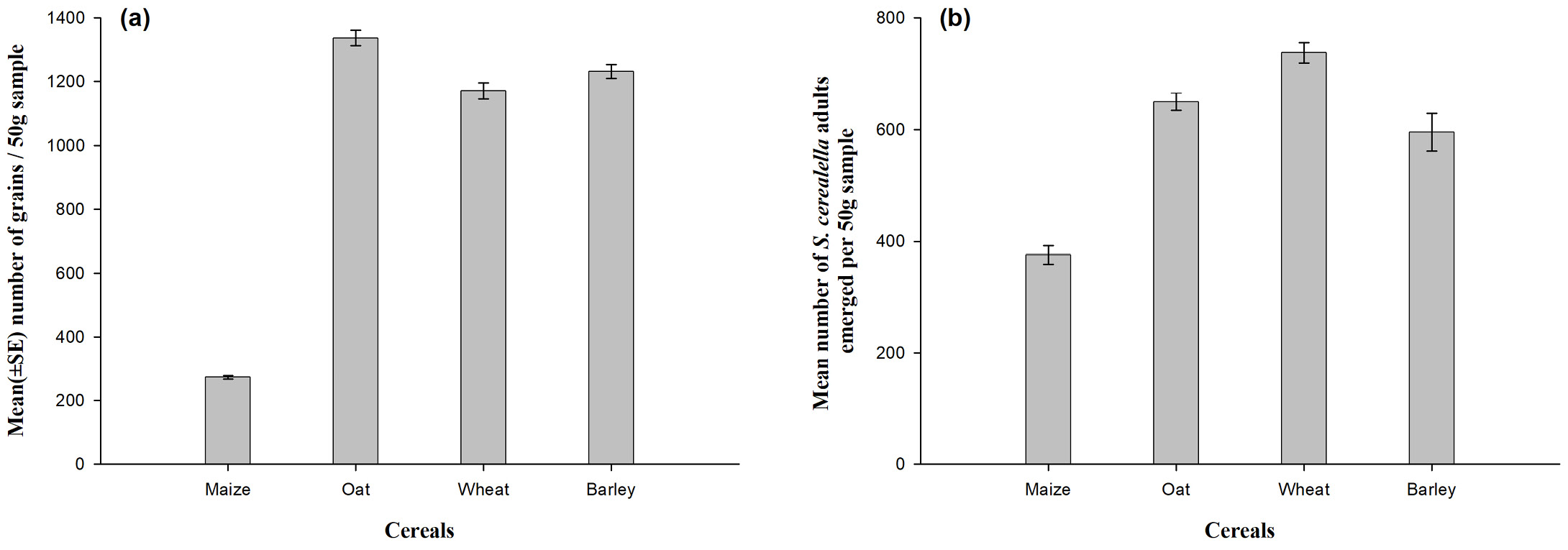
Mean (±SE) number of (a) grains and (b) adults emerged per 50 grams sample of different selected cereals.

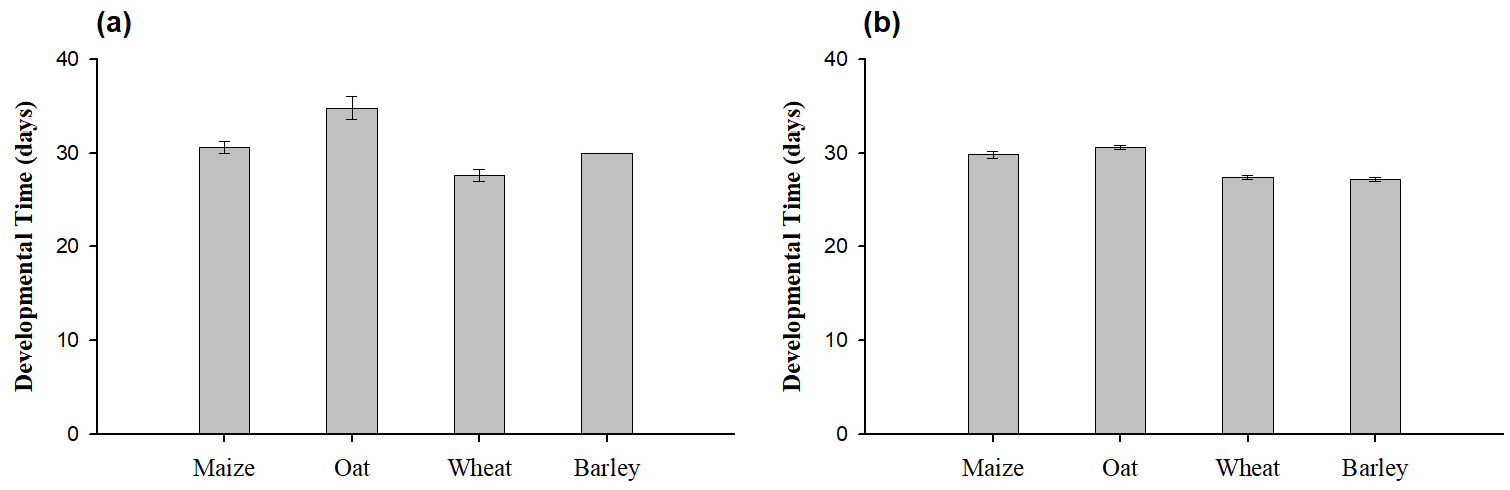
Mean (±SE) developmental time (days) of S. cerealella on selected cereal grains in (a) no choice test and (b) choice test under controlled laboratory conditions at ARI, Tarnab, Peshawar.
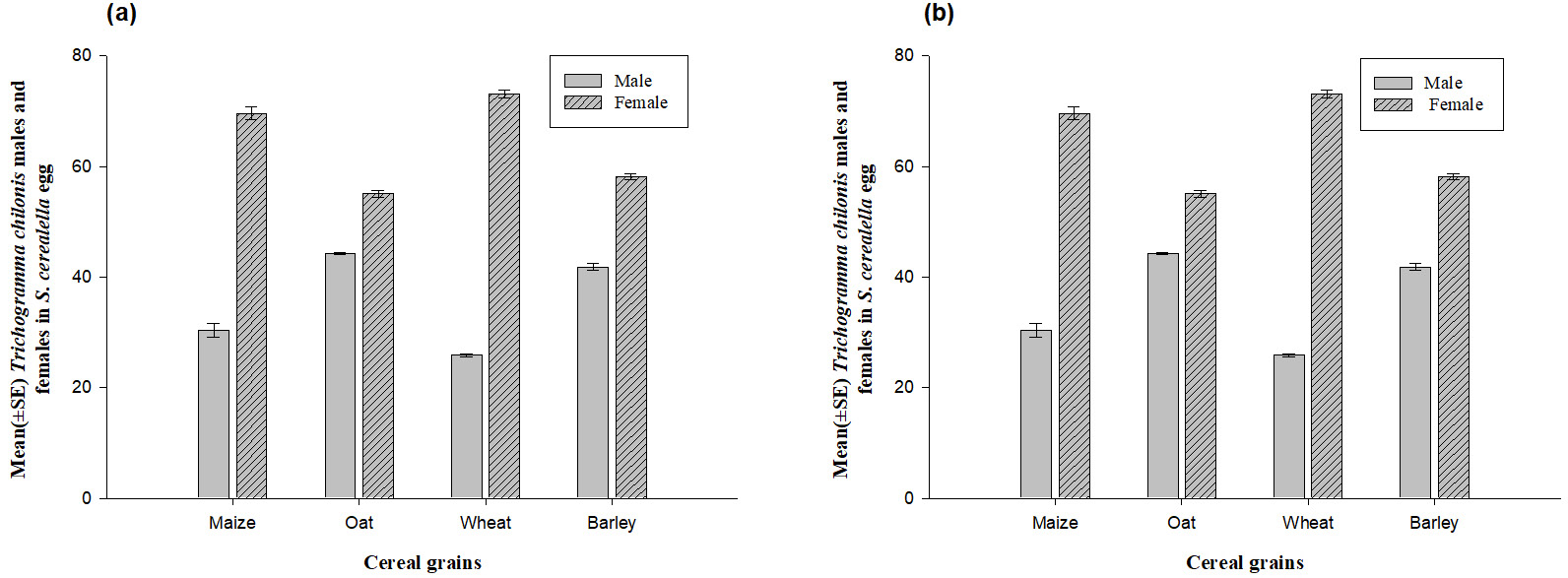
Mean (±SE) percent male and female T. chilonis developed in eggs of S. cerealella reared on selected cereal grains in (a) no choice test and (b) choice rest under controlled laboratory conditions at ARI, Tarnab, Peshawar.
References
- For both choice and no-choice tests of S. cerealella, Vos and Jander (2008) procedure was followed. The tests were replicated five times (n=5).
- No choice test: S. cerealella were reared on four hosts (maize, oat, wheat and barley) using separate 9×3cm plastic jars for which fifty eggs of each host from laboratory culture were examined under microscope for mites infestation and glued on cards prior to infesting grains in jars, enclosed by muslin cloth and maintained in laboratory arena at 27±2°C and 65±5% R.H. Moths were allowed to lay eggs on host grains till death.
- Choice test: 20 grains of each host (wheat, maize, oat and barley) were placed equidistant in a 14.5 cm diameter petri dish placing in the center a pair of S. cerealella and allowing it to lay eggs freely on its preferred host till death. For adult emergence, the hatched, un-hatched and damaged eggs were counted. The developmental time of S. cerealella on each host was recorded for three generations from eggs seeding till first moth emergence. Egg laying efficiency of S. cerealella with respect to different hosts in each experiment was determined by enclosing a pair of moth in test tube till death and each of the host grains were examined for eggs through microscope and counted.
Services
Article usage statistics
Loading…