
Although shrimp larvae are susceptible to many pathogens and water quality and diseases affect commercial shrimp production, the relation between these factors are less studied. Therefore, we aimed to investigate the effect of bacterial dynamics and water quality factors on Penaeus monodon larvae. We recorded the survival rates, water quality (total ammonia, nitrite, and nitrate concentration), heterotrophic bacteria, and vibrios during different P. monodon stages(nauplii, zoea, mysis stage, postlarvae). In ponds 1, 2, 3 and 4, the survival rates were significantly lower but the nitrite concentration and vibrio numbers (before mysis stage) were considerably higher than those in other ponds (P < 0.05), indicating that nitrite and vibrios influenced P. monodon survival during larva culture. Nitrite and nitrate concentrations increased from day 6, and increased dramatically by day 12. Total ammonia concentration increased continuously from day 1 to 15. Heterotrophic bacteria increased slowly in the nauplii and zoea stages, grew rapidly in the mysis stage, and remained almost stable and reduced slightly in postlarvae. In most ponds, vibrio numbers did not change significantly in the nauplii and zoea stages, but increased from the mysis stage and were >10-4 cfu/mL, which potentially cause shrimp disease. Therefore, we suggest that the mysis stage is the key time when water quality and bacteria increase rapidly, and precautions should be taken to improve water quality and inhibit vibrio growth.
Short Communication · Volume 52, Issue 6, 9 October 2020 · Open Access
Dynamic Changes in Bacteria and Water Quality and their Relationship with Survival Rate during Penaeus monodon Larva Culture
· ·
Affiliations & Notes ⌄
- 1South China Sea Fisheries Research Institute, Chinese Academy of Fishery Sciences, Guangzhou, PR China 2Key Laboratory of South China Sea Fishery Resources Exploitation and Utilization, Ministry of Agriculture, Guangzhou, PR China 3Key Laboratory of Aquatic Genomics, Ministry of Agriculture, PR China , * Corresponding author: qiugroup_bio@outlook.com
Article Info ⌄
- Journal:
- Pakistan Journal of Zoology
- Published:
- 9 October 2020

From the article
- Both water quality and bacterial community can directly influence the growth and survival of P. monodon larvae, and bacteria play an important role in regulating water quality.
- Therefore, understanding the dynamic relationship between water quality and bacterial community is important for successful P. monodon larva culture.
- Therefore, increasing the C/N ratio and using probiotics before the mysis stage may be beneficial to regulate water quality and inhibit vibrio growth.
- Furthermore, we speculated that the mysis stage is the key time when water quality and bacteria increase rapidly, and precautions should be taken to improve water quality and inhibit vibrio growth.
Selected from the article's own text.
Abstract
Materials and methods
We collected healthy P. monodon nauplii of the same cohort from a commercial hatchery in Shenzhen. The nauplii were stocked at a density of 80 ind./mL in 13 (marked number 1-13) 10 m3 concrete ponds. The temperature, dissolved oxygen, pH, and salinity were monitored using a multi-parameter water quality instrument (556MPS, YSI Incorporated, Ohio, USA), and the water parameters were within the optimum range. The survival rates in different stages of P. monodon (nauplii, zoea, mysis, and postlarvae) were recorded. Sample was randomly collected from five spots of each pond using a specialized sampling bottle, and the survival rate was estimated by counting numbers of shrimp in 1 L water samples.
Bacteria were counted using 2216E plates (for heterotrophic bacteria) or Thiosulfate-citrate-bile salts-sucrose (TCBS) plates (for vibrios). The sampling method and protocol were as follows: water sample from each pond was collected in triplicate, the water samples were transferred to sterilized flasks and polysorbate was added into each water sample to obtain a final concentration of 5 µg/mL, and each sample was shaken for 30 min. Then, 4.5 mL sterilized seawater was diluted to 10-1, 10-2, 10-3, and 100, 10-1, 10-2 concentrations for 2216E and TCBS plates, respectively, and 0.1 mL seawater sample was plated in two replicates. The TCBS and 2216E plates were incubated at 28ºC for 2 and 4 days, respectively, and the bacterial colonies were counted to quantify the concentration of heterotrophic bacteria and vibrio in seawater. The number of bacterial colonies in each diluted sample was from 30 to 300. Bacterial culture medium consisted of 2216E marine agar, 5 g peptone, 1 g yeast powder, 0.1 g ferric citrate, 15-20 g powdered agar, 1000 mL seawater (pH 7.2–7.5). The bacterial culture medium was sterilized at 121ºC for 20 min, and 15–20 mL of sterilized medium was transferred to each plate. The water samples were filtered through a 0.45 µm membrane pressured by a vacuum pump. Each water sample was filtered through two membranes, and the filtered membrane was folded and stored in a sterilized centrifuge tube.
Total ammonia (NH3-Nt), nitrite (NO2-) and nitrate (NO3-) concentrations of each pond were measured every 3 days, using the hypobromite oxidation method, naphthylethylenediamine photometric method (GB 17378.4-2007), and ultraviolet spectrophotometry (SL84-94), respectively.
Data were analysed using SPSS version 18.0 (SPSS Inc., Chicago, IL, USA). All data were analysed for normality by probability plots and for homogeneity of variances by Levene’s test. One-way analysis of variance (ANOVA) was used to determine the significance of each parameter among different treatments. If the effect was significant, the ANOVA was followed by Tukey’s test. The P-value < 0.05 was considered statistically significant.
Results and discussion
The NO2- and NO3- concentrations increased from day 6, and increased dramatically on day 12 of P. monodon larva culture. The NO2- concentrations in ponds 1–4 were significantly higher than those in other ponds after day 12 (Fig. 1A). The NO3-concentration in ponds 1, 2, 4, and 8 were considerably higher than those in other ponds (Fig. 1B). The survival rates in ponds 1–4 ponds were significantly lower than those in other ponds (P<0.05, Fig. 2). These results suggest that NO2- and NO3- concentrations are important factors that influence survival rate during P. monodon larva culture. The NH3-Nt concentration increased continuously from day 1 to 12 (Fig. 1C), but there was no obvious correlation with survival rate. Ammonia and nitrite toxicity has been demonstrated in fish, molluscs, and crustaceans, and ammonia is considered to cause damage to the central nervous system . In penaeid shrimp, ammonia may affect acid-base
balance, haemolymph osmolarity, nitrogen metabolism, respiration, and growth rates and may enhance molting ; ; . Nitrite in the water can enter the bloodstream of aquatic animals, resulting in reversible formation of methaemoglobin, which cannot transport oxygen to tissues . Moreover, ammonia and nitrite can predispose fish to infestation by parasites and pathogens by reducing immunity. Our result showed that NO2- and NO3- concentrations increased from day 6, which corresponds to the mysis stage. Hence, it is important to reduce NO2- and NH3-Nt concentrations before the mysis stage via precautionary measures such as addition of a sorbent or oxidant of NO2- and NH3-, or use of probiotics.
The graph showing the dynamics of heterotrophic bacteria during P. monodon larva culture is shown in Figure 3A. The number of heterotrophic bacteria increased slowly in the nauplii and zoea stages, increased rapidly in the mysis stage, and remained almost stable or reduced slightly in postlarvae (Fig. 3A). Thus, the mysis stage is a key time when heterotrophic bacteria, NO3-, NO2-, and NH3-Nt increased rapidly. However, although NO2- and NH3-Nt accumulated rapidly, heterotrophic bacteria did not increase ceaselessly. This may be related to the C/N ratio of water; many studies showed that increasing the C/N ratio can induce a shift in the biofloc community from photoautotroph or chemoautotroph to heterotroph-dominated communities ; . This transformation strongly influences water quality and biofloc biomass production . Therefore, survival rate can be improved by both using a carbon source and probiotics. Number of vibrios did not change significantly in nauplii and zoea stages but started to increase in the mysis stage. After that, the number of vibrios in most ponds was considerably higher than 10-4 cfu/mL, which potentiallycaused disease in shrimps (Fig. 3B).
Notably, before the mysis stage, the number of vibrios in ponds 1–4 was considerably higher than that in other ponds. The corresponding low survival rate in ponds 1–4 (Fig. 2), indicates that vibrios may be an important factor in reducing the survival rate during larva culture. Therefore, to avoid mass mortality in the shrimp larva culture, it is necessary to use probiotic bacteria (such as Bacillus, Lactobacillus, and Rhodopseudomonas capsulata) to inhibit vibrio growth ; ; .
Conclusions
Both water quality and bacterial community can directly influence the growth and survival of P. monodon larvae, and bacteria play an important role in regulating water quality. Therefore, understanding the dynamic relationship between water quality and bacterial community is important for successful P. monodon larva culture. The results of the present study show that NO2- and vibrios strongly influence the survival of P. monodon larvae. Mysis stage is a key time when bacteria, NO2-, NO3-, and NH3-Nt increased rapidly. Therefore, increasing the C/N ratio and using probiotics before the mysis stage may be beneficial to regulate water quality and inhibit vibrio growth. Furthermore, we speculated that the mysis stage is the key time when water quality and bacteria increase rapidly, and precautions should be taken to improve water quality and inhibit vibrio growth. Nevertheless, the present study is an initial and fundamental work, there is still much experiments should be done in the next work to clarify the dynamic changes in bacteria and water quality and their relationship with survival rate during Penaeus monodon larva culture.
Acknowledgments
This study was supported by the National Key R&D Program of China (2018YFD0900303 and 2018YFD0900103), Hainan Provincial Natural Science Foundation of China (319QN335), Central Public-interest Scientific Institution Basal Research Fund, South China Sea Fisheries Research Institute, CAFS (NO.2019TS11), Guangdong Marine economy promotion projects (MEPP) Fund (GDOE[2019]A24).
Statement of conflict of interest
Authors have declared no conflict of interest.
Figures
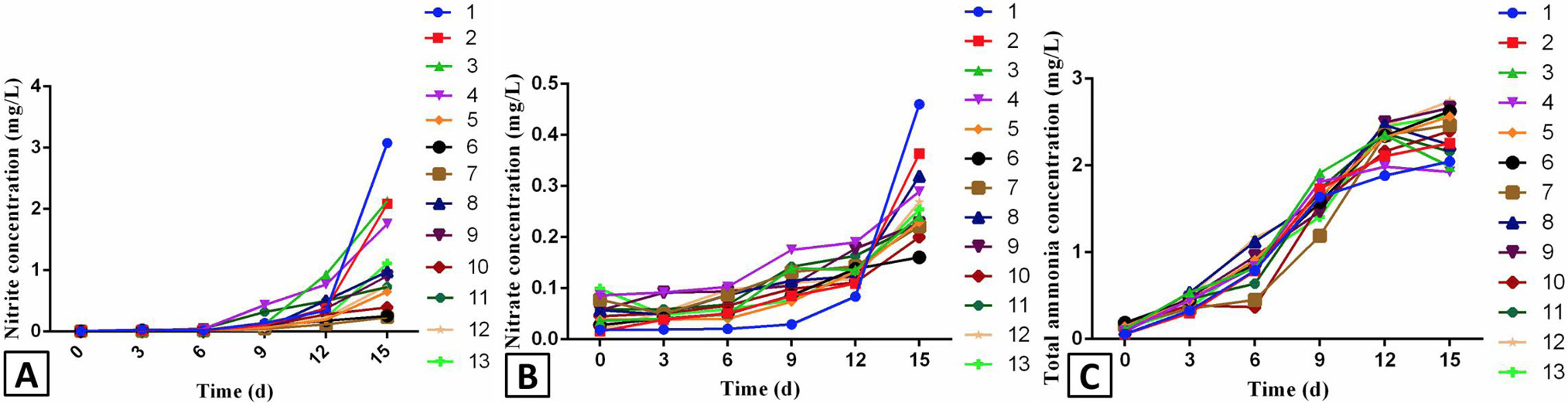
Dynamic change in nitrite concentration (A), nitrate concentration (B) and the total ammonia concentration (C) in ponds 1–13 during Penaeus monodon larva culture.
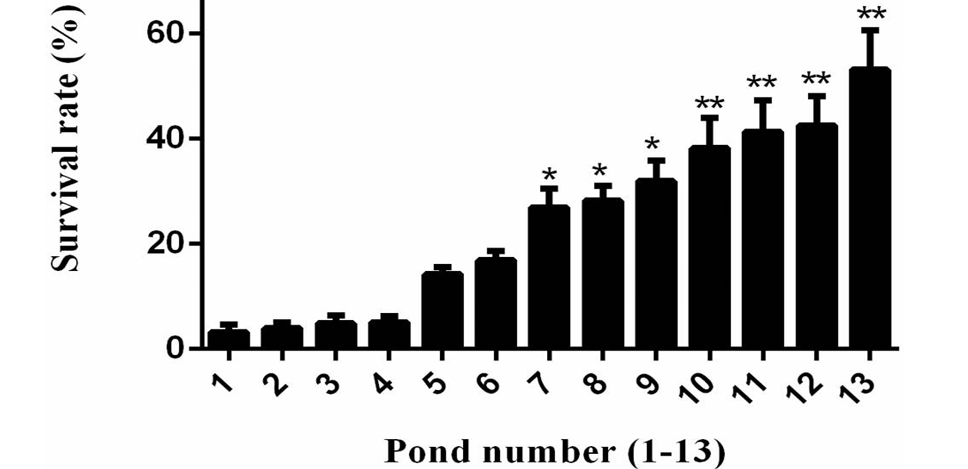
Survival rates of Penaeus monodon in ponds 1–13. Bars represent the mean ± SD (n = 3). * and ** indicate statistically signiï¬cant differences (P < 0.05).
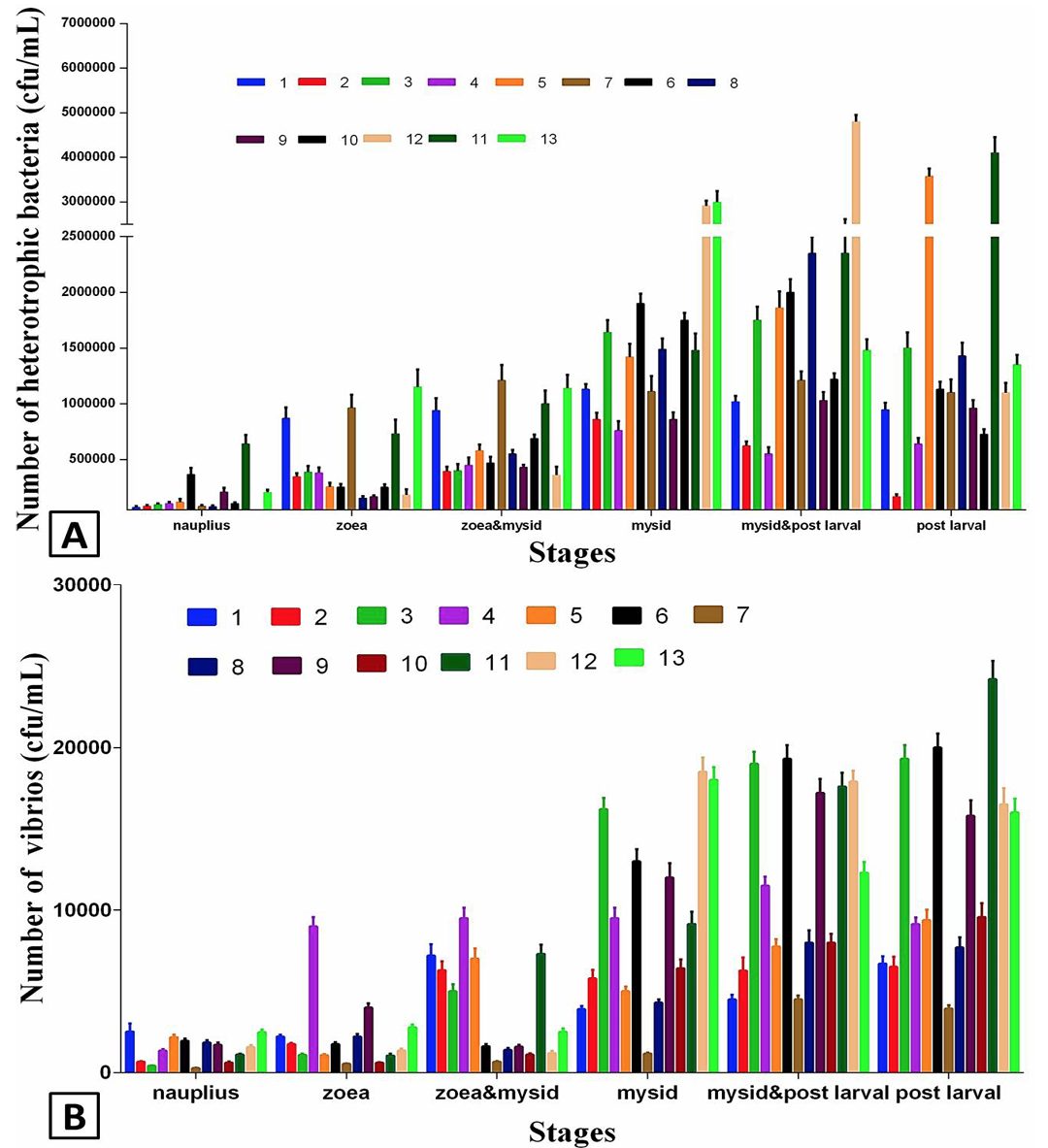
Number of heterotrophic bacteria (A) and vibrios (B) in the different seedling stages of Penaeus monodon. Different colours represent the 13 different ponds. Each bar represents the mean ± SD (n = 3).
References
- Avnimelech, Y., 1999. Aquaculture., 176: 227-235. https://doi.org/10.1016/S0044-8486(99)00085-X[CrossRef]
- Barman, P., Bandyopadhyay, P., Mondal, K.C. and Das Mohapatra, P., 2015. Acta. Biol. Szeged., 59: 169-177.
- Boonthai, T., Vuthiphandchai, V. and Nimrat, S., 2011. Aquacul. Nutr., 17: 634-644. https://doi.org/10.1111/j.1365-2095.2011.00865.x[CrossRef]
- Boyd, C.E. and Tucker, C.S., 1998. Pond aquaculture water quality management. Springer, US. https://doi.org/10.1007/978-1-4615-5407-3[CrossRef]
- Chen, J.C. and Kou, Y.Z., 1992. Comp. Biochem. Physiol. Part C: Comp. Pharmacol. Toxicol., 104: 249-260.
- Chen, J.C. and Lai, S.H., 1992. Comp. Biochem. Physiol. Part C: Comp. Pharmacol. Toxicol., 102: 129-133. https://doi.org/10.1016/0742-8413(92)90054-B[CrossRef]
- Chen, J.C. and Cheng, S.Y., 1993. Comp. Biochem. Physiol. Part C: Comp. Pharmacol. Toxicol., 106: 733-737.
- Chen, J., Zhou, F., Huang, J., Ma, Z., Jiang, S., Qiu, L. and Qin, J.G., 2016. SpringerPlus, 5: 171.
- Ebeling, J.M., Timmons, M.B. and Bisogni, J.J., 2006. Aquaculture, 257: 346-358.
- Irie, T., Watarai, S., Iwasaki, T. and Kodama, H., 2005. Fish Shellf. Immunol., 18: 235-242.
- Jeney, Z. and Jeney, G., 1995. Aquaculture, 129: 397-420. https://doi.org/10.1016/0044-8486(94)00249-N[CrossRef]
- Liao, P.B. and Mayo, R.D., 1974. Aquaculture, 3: 61-85.
- Lightner, D.V. and Redman, R.M., 1998. Aquaculture, 164: 201-220. https://doi.org/10.1016/S0044-8486(98)00187-2[CrossRef]
- Luisvillaseñor, I.E., Castellanoscervantes, T., Gomezgil, B., Carrillogarcía, Á.E., Campacórdova, Á.I. and Ascencio, F., 2013. World J. Microbiol. Biotechnol., 29: 257-265.
- Montoya, R., Lawrence, A., Grant, W. and Velasco, M., 2002. Aquacul. Res., 33: 81-94.
- Prayitno, S.B. and Latchford, J.W., 1995. Aquaculture, 132: 105-112. https://doi.org/10.1016/0044-8486(94)00374-W[CrossRef]
- Sengprasert, P., Amparyup, P., Tassanakajorn, A. and Wongpanya, R., 2015. Develop. Comp. Immunol., 50: 87-97. https://doi.org/10.1016/j.dci.2015.02.003[CrossRef]
- Shen, N.N., Li, C.H., Jia, X.P., Li, Z.J., Yu, M.C., Wang, X.W. and Cao, Y.C., 2007. S. China Fish. Sci., 3: 20-25.
- Vandenberghe, J., Verdonck, L., Roblesarozarena, R., Rivera, G., Bolland, A., Balladares, M., Gomezgil, B., Calderon, J., Sorgeloos, P. and Swings, J., 1999. Appl. environ. Microbiol., 65: 2592.
- Weisse, T. and MacIsaac, E., 2000. Canadian J. Fish. aquat. Sci., 57: 96-105.
- Wickins, J., 1976. Aquaculture, 9: 19-37. https://doi.org/10.1016/0044-8486(76)90045-4[CrossRef]
- Wilson, W., Lowman, D., Antony, S.P., Puthumana, J., Singh, I.B. and Philip, R., 2015. Fish Shellf. Immunol., 43: 346-356.
- Wright, P.A., 1995. J. exp. Biol., 198: 273.
- Xu, W.J., Morris, T.C. and Samocha, T.M., 2016. Aquaculture, 453: 169-175.
- Zokaeifar, H., Babaei, N., Che, R.S., Kamarudin, M.S., Sijam, K. and Balcazar, J.L., 2014. Fish Shellf. Immunol., 36: 68-74.
Cited by 1 article
In journals published by ResearchersLinks.
Services
Article usage statistics
Loading…