
This study examined the effects of UV and formalin treatment on the survival of Penaeus monodon larvae and bacteria communities in the rearing tanks. The survival of P. monodon in the 36 h experimental period was not significantly affected by the water pretreatment (P > 0.05). However, the bacteria communities were significantly affected by water pretreatment (P < 0.05). Heterotrophic bacteria and vibro counts in the formalin treatment were significantly lower than UV treatment and untreated group (P < 0.05). Based on the results obtained in the present study, we suggest that formalin treatment could be a better away to control bacteria in P. monodon larvae culture.
Short Communication · Volume 51, Issue 1, 21 January 2019 · Open Access
Water Pretreatment Affects the Bacteria Communities in Penaeus monodon Larvae Culture
· · · · · ·
Affiliations & Notes ⌄
- 1South China Sea Fisheries Research Institute, Chinese Academy of Fishery Sciences, Guangzhou 510300, P.R. China 2Key Laboratory of South China Sea Fishery Resources Exploitation and Utilization, Ministry of Agriculture, Guangzhou, 510300, P.R. China 3College of Sciences and Engineering, Flinders University, PO Box 2100, Adelaide, SA 5001, Australia , * Corresponding author: qiugroup_bio@outlook.com
Article Info ⌄
- Journal:
- Pakistan Journal of Zoology
- Published:
- 21 January 2019

From the article
- However, upon completion of the experiment, the number of heterothrophic bacteria in the formalin treatment was significantly lower than that in the UV treatment and the control (P < 0.05, Fig. 1A).
- Upon the 36 h experiment period, the survival of P. monodon was not significantly different between treatments (P > 0.05, Fig. 2).
- In the formalin treatment, the percentage of Bacillus sp. was reduced from 63% to 0%, while the percentage of Pseduoalteromon sp. was not significantly different from the control (P > 0.05, Fig. 3).
- In the present study, the final survival of P. monodon was not significantly affected by the water treatment.
Selected from the article's own text.
Abstract
Materials and methods
The healthy nauplii of Penaeus monodon were collected from the same cohort in a commercial hatchery in Shenzhen. The nauplii were stocked at a density of 80 ind. mL-1 in nine 500 L fiberglass tanks at the zoea stage. During the experimental period, no feed was added into the rearing tanks, and the experiment of nauplius culture lasted 36 h. The temperature was maintained at 30°C during the experimental periods.
Two treatments viz., UV and formalin treatment were involved in this study. Treatment 1 used the seawater treated with ultraviolet (The UV light source was caused by a 30 W, 254 nm wavelength UV lamp, and the intensity of the light was not lower than 90μW/cm2 in the present study, which was measured using an ultraviolet radiometer (model UVX-25, UNP, CA)), and treatment 2 used the seawater treated with formalin (12 ppm), while the untreated seawater was used as the control.
During the culture period, the seawater properties (temperature, dissolved oxygen, pH, salinity, ammonia nitrogen, nitro nitrogen, nitroso nitrogen and total phosphorus) were monitored by a multi-parameter water quality instrument (556MPS, YSI Incorporated, Ohio, USA), and the water parameters were within the optimum range for the shrimp nauplii. The numbers of bacteria (heterotrophic bacteria and vibrios) in the seawater in each treatment were counted, and the taxonomy of bacteria were identified using 16s rDNA analysis. Heterotrophic bacteria were investigated with 2216E plate, and vibrios were investigated with TCBS plate. The sampling method and protocol were as follows: the water sample from each treatment was collected in triplicate before nauplii were stocked into the rearing tanks, and after the experiment was completed. Water samples were kept in sterilized flasks and polysorbate was added into each water sample to reach the final concentration of 5 µg/mL, and the each sample was shaken for 30 min. Then use the 4.5 mL sterilized seawater diluted to 10-1, 10-2, 10-3 and 100, 10-1, 10-2 concentrations for 2216E and TCBS plates, respectively. The 0.1 mL seawater sample was coated in two replicates.
The counting for TCBS and 2216E plates was conducted after 2 and 4 days at 28°C, respectively, in order to quantify the concentration of heterotrophic bacteria and vibrio in the seawater. The number of bacterial colonies in each diluted sample was from 30 to 300. Bacterial culture medium was made up of 2216E marine agar, 5 g peptone, 1 g yeast powder, 0.1 g ferric citrate, 15-20 g powdered agar, 1000 mL seawater (pH 7.2-7.5). The bacteria culture medium was sterilized at 121°C for 20 min before being transferred on a plate containing 15-20 mL bacteria culture medium. The water samples were filtered through the 0.45 µm membrane pressured by a vacuum pump. Each water sample was filtered on two membranes and the filtered membrane was folded and stored into a sterilized centrifuge tube.
Data were analyzed using SPSS version 18.0 (SPSS Inc., Chicago, IL, USA). All data were analyzed for normality by probability plots and for homogeneity of variances by Levene’s test. One way analysis of variance (ANOVA) was used to determine the significance of each parameter among different treatments. If the effect was significant, the ANOVA was followed by Tukey’s test. The P-value of < 0.05 was considered statistically significant.
Results and discussion
In this study, the number of heterotrophic bacteria was not significantly different before nauplii were stocked into the rearing tanks (P > 0.05, Fig. 1A). However, upon completion of the experiment, the number of heterothrophic bacteria in the formalin treatment was significantly lower than that in the UV treatment and the control (P < 0.05, Fig. 1A). The number of heterothrophic bacteria was not significantly different between the UV treatment and the control (P > 0.05). In this study, the number of vibro was not significantly different before nauplii were added into the rearing tanks (P > 0.05, Fig. 1B). At the end of the experiment, the number of vibro was significantly affected by the experimental treatment (P < 0.05, Fig. 1B). The lowest number of vibro was observed in the formalin treatment, and the highest number of vibro was observed in UV treatment and untreated seawater (Fig. 1B). The number of vibro was not significantly different between UV treatment and untreated seawater (P > 0.05). Upon the 36 h experiment period, the survival of P. monodon was not significantly different between treatments (P > 0.05, Fig. 2).
The microbial communities in the rearing environment were significantly affected by the experimental treatments (P < 0.05). In the untreated group, the microbial community included 74.2% Bacillus sp., 12.9% Roseobacter sp. and 6.5% Pseduoalteromon sp. (Fig. 3). In contrast, in the UV treatment, Bacillus sp. accounted for 27% and Roseobacter sp. accounted for 10.8% (P < 0.05). While the percentage of Pseduoalteromon sp. increased from 6% to 15% in the UV treatment. In the formalin treatment, the percentage of Bacillus sp. was reduced from 63% to 0%, while the percentage of Pseduoalteromon sp. was not significantly different from the control (P > 0.05, Fig. 3).
Water pretreatment has been considered as an essential procedure in marine aquaculture ; . Evidence has indicated that the formalin treatment can reduce mortality of rainbow trout . Upto present, information on the effects of water pretreatment on the survival of P. monodon and bacteria communities is rare. In the present study, the final survival of P. monodon was not significantly affected by the water treatment. However, the microbial communities in the rearing environment were significantly affected by water pretreatment. Both heterotrophic bacteria and vibro were reduced in the water pretreated with formalin. By comparing bacteria counts, formalin was recommended as an efficient way to control the bacteria in larval P. monodon rearing environment.
Acknowledgement
This study was supported by the Central Public-interest Scientific Institution Basal Research Fund, CAFS (2018HY-ZD0204); the National Natural Science Foundation of China (31741121); The Guangdong Provincial Science and Technology Program (2017A040405001); Natural Science Foundation of Hainan Province, China (2017CXTD021); The Guangdong Provincial Science and Technology Foundation for Marine and Fishery Development (A201601A08).
Statement of conflict of interest
Authors have declared no conflict of interest.
Figures
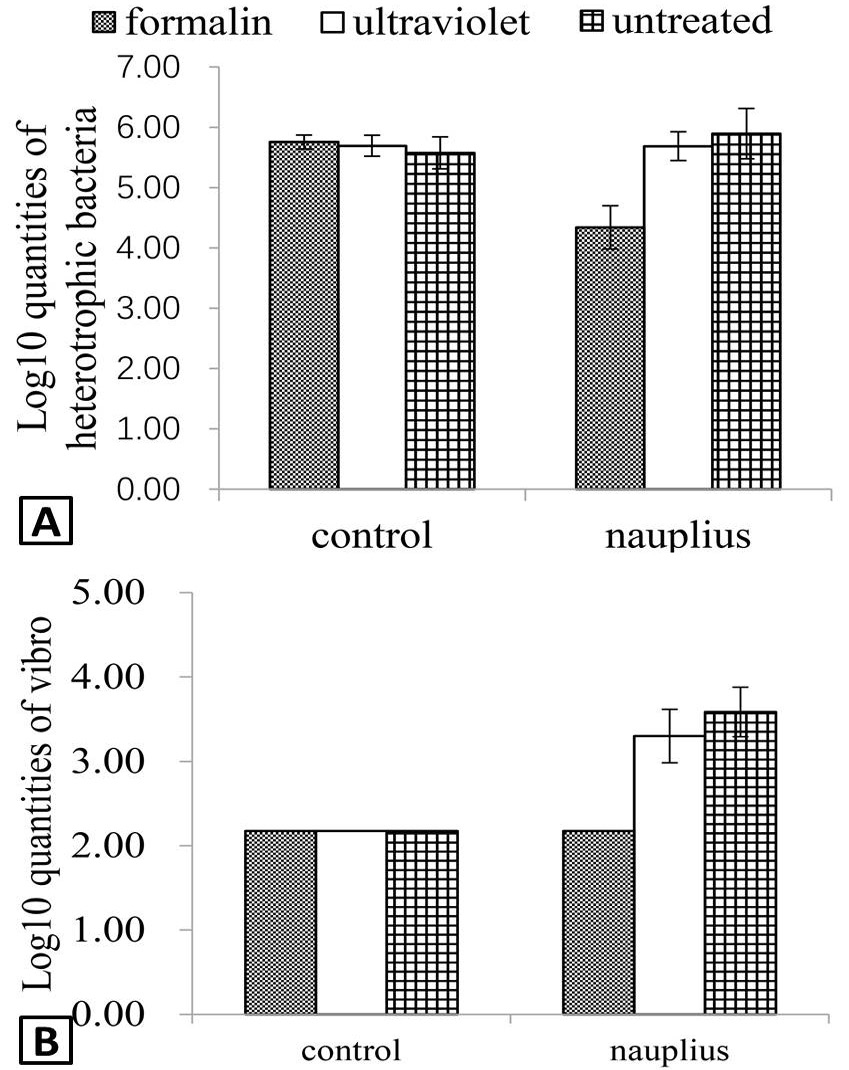
The number of heterothrophic bacteria (A) and vibro bacteria (B) in the seawater treated with formalin or ultraviolet. Control, without rearing nauplii; Nauplius, with nauplii.
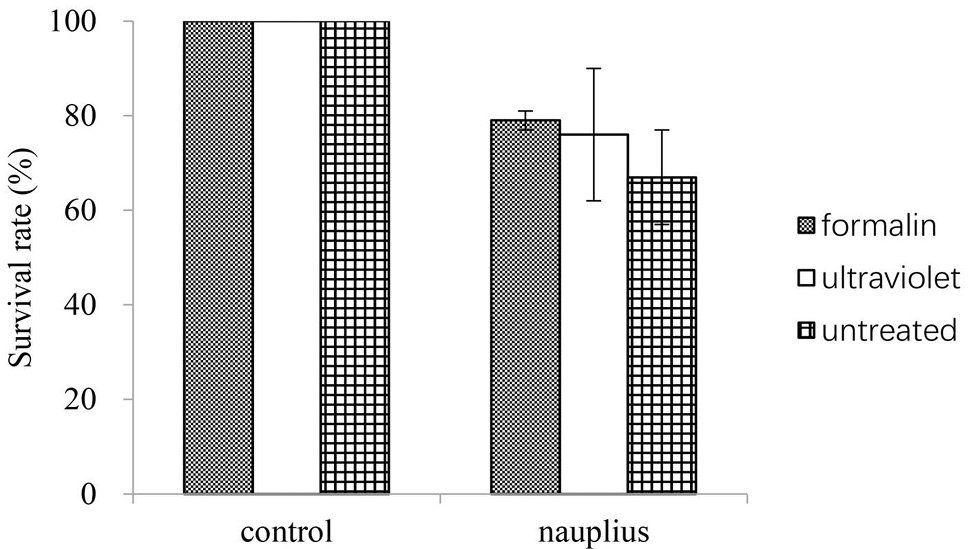
The survival rate of nauplii treated with formalin and ultraviolet. Control: without rearing nauplii, Nauplius: with nauplii.
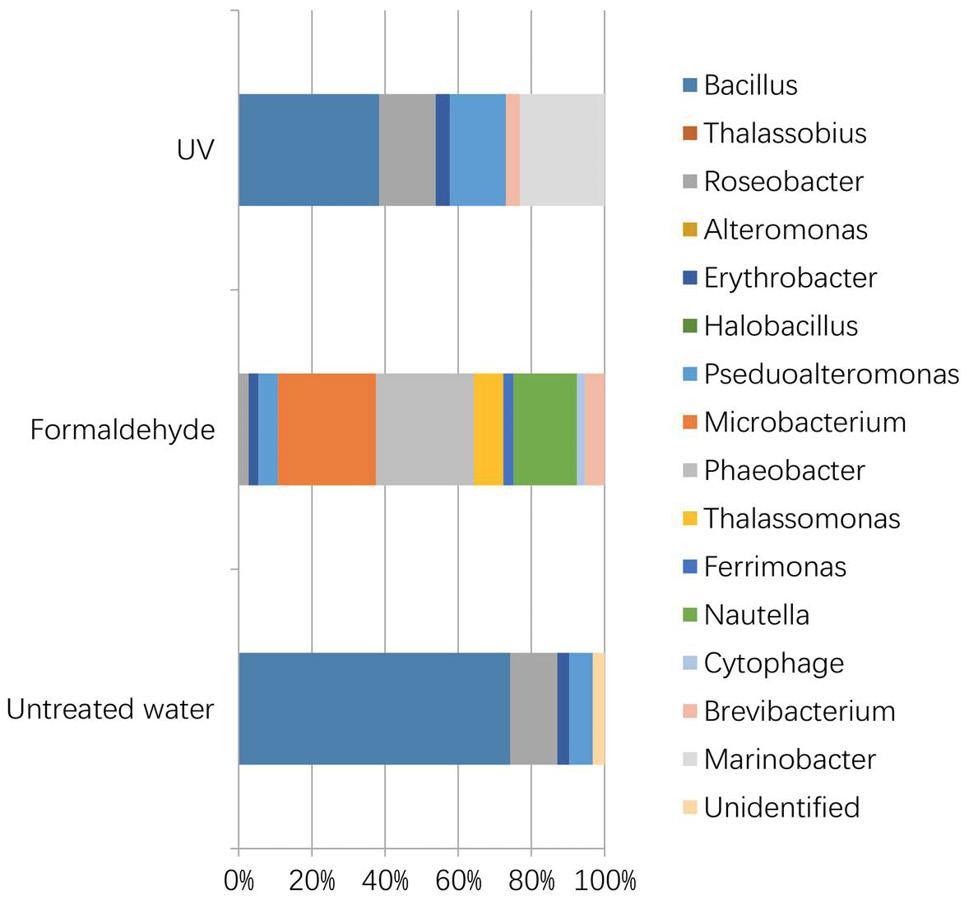
Microbial communities in the rearing environment.
References
- Adams, A., 1991. Fish Shellf. Immunol., 1: 59-70.
- Bly, J.E., Lawson, L.A., Dale, D.J., Szalai, A.J., Durborow, R.M. and Clem, L.W., 1993. J. Fish Dis., 16: 541-549. https://doi.org/10.1111/j.1365-2761.1993.tb00890.x[CrossRef]
- Chen, J., Zhou, F., Huang, J., Ma, Z., Jiang, S., Qiu, L. and Qin, J.G., 2016. Springer Plus, 5: 171-175. https://doi.org/10.1186/s40064-016-3323-x[CrossRef]
- Chaiyapechara, S., Rungrassamme, W., Suriyachay, I., Kuncharin, Y., Klanchui, A., Karoonuthaisiri, N. and Jiravanichpaisal, P., 2012. Microb. Ecol., 63: 938-953. https://doi.org/10.1007/s00248-011-9936-2[CrossRef]
- Duan, Y., Zhang, J., Dong, H., Wang, Y., and Zhang, Z., 2014. J. Fish. China, 38: 1157-1564. https://doi.org/10.3724/SP.J 1231.2014. 49254[CrossRef]
- Defoirdt, T. and Sorgeloos, P., 2012. ISME J., 6: 2314-2319. https://doi.org/10.1038/ismej.2012.58[CrossRef]
- Gieseker, C.M., Serfling, S.G. and Reimschuessel, R., 2006. Aquaculture, 253: 120-129. https://doi.org/10.1016/j.aquaculture.2005.07.039[CrossRef]
- Harlioglu, A.G., 2017. Pakistan J. Zool., 49: 1803-1808. http://dx.doi.org/10.17582/journal.pjz/2017.49.5.1803.1808[CrossRef]
- Jiravanichpaisal, P., Miyazaki, T. and Limsuwan, C., 1994. J. Aquat. Anim. Hlth., 6: 27-35. https://doi.org/10.1577/1548-8667(1994)006<0027:HBAPOV>2.3.CO;2[CrossRef]
- Karunasagar, I., Pai, R., Malathi, G.R. and Karunasagar, I., 1994. Aquaculture, 128: 203-209. https://doi.org/10.1016/0044-8486(94)90309-3[CrossRef]
- Kasai, H., Osawa, S., Kobayashi, T. and Yoshimizu, M., 2002. Fish Pathol., 37: 199-200. https://doi.org/10.3147/jsfp.37.199[CrossRef]
- Lavilla-Pitogo, C.R., Baticados, M.C.L., Cruz-Lacierda, E.R. and de la Pena, L.D., 1990. Aquaculture, 91: 1-13. https://doi.org/10.1016/0044-8486(90)90173-K[CrossRef]
- Lavilla-Pitogo, C.R., Leaño, E.M. and Paner, M.G., 1998. Aquaculture, 164: 337-349. https://doi.org/10.1016/S0044-8486(98)00198-7[CrossRef]
- Leaño, E.M., Lavilla-Pitogo, C.R. and Paner, M.G., 1998. Aquaculture, 164: 367-374. https://doi.org/10.1016/S0044-8486(98)00201-4[CrossRef]
- Wan, S., Li, B., Wang, J. and Xiao, Y., 1991. Fish. Sci. Technol. Inform., 18: 169-172.
- Yu, Z., Lin, F., Yan, Q. and He, J., 1995. A study on relation between heterotrophic bacteria and shrimp disease. Acta Oceanol. Sin., 14: 601-608.
Services
Article usage statistics
Loading…