
The widespread use of glyphosate-based herbicides (GBH) in agricultural practices raises major concerns regarding potential human toxicity. Mounting evidence from prior studies has delineated a direct link between GBH exposure and the development of neurodegenerative disorders. These compounds are also suspected of being involved in the induction of affective disorders. The present study was undertaken to examine the dose-dependent impact of GBH exposure over 8-week period on anxiety- and depression-like behaviors in male Wistar rats, administering daily subcutaneous injections of four different doses 25, 50, 75, and 100 mg/kg of GBH while a control group received 0.9% NaCl. Based on behavioral tests (the open field, elevated cross maze, and forced swim), behavioral alterations were detected, specifically anxiety levels and depressive behavior. Simultaneously, hippocampal oxidative stress markers (catalase, nitric oxide, and lipid peroxidation) were assessed to elucidate the involvement of oxidative stress (OS) in the observed effects. Our results delineate a clear dose-dependent effect of GBH, revealing escalated anxiety and depression-like behaviors at doses of 75 and 100 mg/kg following subchronic GBH exposure. Notably, markers of OS exhibited discernible alterations solely at 75 and 100 mg/kg, with no significant variation observed at lower doses (25 and 50 mg/kg). Our study confirms the dose-dependent effect of subchronic exposure to GBH, implicating markers of OS in the hippocampus as potential contributors to the observed neurobehavioral changes. Thus, our findings underscore OS as a plausible mechanism explaining the underpinnings of the neurotoxic effects observed following exposure to GBH.
Research Article · Volume 12, Issue 6, 16 April 2024 · Open Access
Dose-Dependent Effects of Subchronic Exposure to Glyphosate-Based Herbicide on Behavior and Biochemical Alterations in Adult Rats
· · · · · ·
Affiliations & Notes ⌄
- 1Laboratory of Biology and Health, Department of Biology, Faculty of Sciences, Ibn Tofail University, Kenitra, Morocco. *Correspondence | Abdelghafour El Hamzaoui, Laboratory of Biology and Health, Department of Biology, Faculty of Sciences, Ibn Tofail University, Kenitra, Morocco
- 2Email: elhamzaoui.abdelghafour@uit.ac.ma
Article Info ⌄
- Journal:
- Advances in Animal and Veterinary Sciences
- Published:
- 16 April 2024

From the article
- The current study sheds light on the neurotoxic potential of subcutaneous GBH exposure, providing evidence for dose-dependent neurobehavioral alterations and oxidative stress markers in the hippocampus of rats.
- These findings underscore the need for further exploration into the mechanisms underlying GBH-induced neurotoxicity and reinforce the importance of assessing the long-term effects of low-dose GBH exposure on neurological health.
- Such investigations are vital in understanding and mitigating the potential risks associated with GBH exposure in both environmental and human health contexts.
Selected from the article's own text.
Abstract
INTRODUCTION
The extensive application of pesticides in agriculture poses a growing risk of environmental contamination to water, food, and soil . Among them, glyphosate-based herbicides (GBH) stand as the most frequently applied organophosphate pesticide in the world . GBH’s key action is to inhibit the 5-enolpyruvylshikimate-3-phosphate synthase enzyme pathway, which is present exclusively in plants and absent in vertebrates . Consequently, GBH has been traditionally deemed safe for non-target organisms.
Studies have evidenced that GBH can reach different regions of the body after crossing the mucosa , accumulating notably after chronic exposure even to low doses of this pesticide . GBH residues are detected in the organs and urine samples of farmers and various animal species, according to reports indicating prevalence in 99% of urine samples in France and 60–80% in the USA ; .
This chronic exposure can pose a serious health risk for humans and animals, such as hepatic cancer and endocrine effects ; ; . In addition, GBH’s ability to invade the blood-brain barrier induces neurological diseases , supported by clinical reports linking its increased use to conditions like anxiety, depression, Parkinson’s, autism, and memory impairments ; .
Even though the exact mechanism underlying GBH-induced anxiety and depression behaviors remains poorly understood, it is well established that mood disturbances can occur as a result of intestinal microbial degradation , neuroinflammation , and/or disbalance in neurotransmitter systems provoked by this pesticide ; ; ; . Indeed, oxidative stress (OS) could be a key mechanism behind the neurotoxicity induced by GBH. Moreover, the literature has highlighted the role of OS, such as elevated free radicals as well as oxidant/antioxidant imbalances, in the pathophysiology of mood disturbances like depression and anxiety ; ; ; . In this context, it can be hypothesized that GBH-provoked OS may participate in behavioral changes such as affective disorders.
The long-term effects of low-dose GBH exposure on affective disorders have yet to be fully explored. Moreover, studies on the dermal route of exposure are rare compared with the oral route . In view of the forgoing, this work aims to assess the affective behavior of male rats exposed subchronically to GBH at different doses and to establish the possible implication of OS pathways in the rat hippocampus.
MATERIAL AND METHODS
Pesticide
The herbicide applied in this study is a commercial formulation currently on the Moroccan market, BARBARIAN SUPER 360 (Barclay chemicals manufacturing Ltd).
Animals and study design
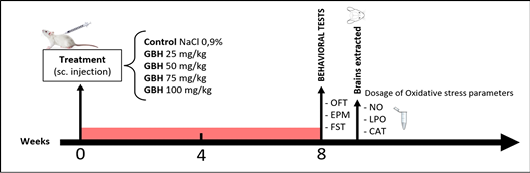
Wistar male rats (120 ± 20 g), offered by the breeding center of Ibn Tofail University. They were maintained in standard conditions of temperature (22 ± 2oC), photoperiod 12h/12h, and they had free access to food and water. Rats were divided into five groups of 6 animals, receiving a daily subcutaneous injection for 8 weeks (subchronique toxicity): (1) control group receiving NaCl 0.9%, (2) GBH groups receiving a commercial glyphosate herbicide diluted in saline solution at different doses (25, 50, 75 and 100 mg/kg/day), basis on the Glyphosate no-observed adverse effect level (NOAEL) for subchronic toxicity . A daily preparation of solutions prevents the risk of degradation of GLY. All experimental procedures are conducted in accordance with the regulations of the guide for the care and use of Laboratory Animals University Ethics Committee guidelines (National Research Council, Revised, 1996) (Figure 1).
Neurobehavioral tests
Open field test
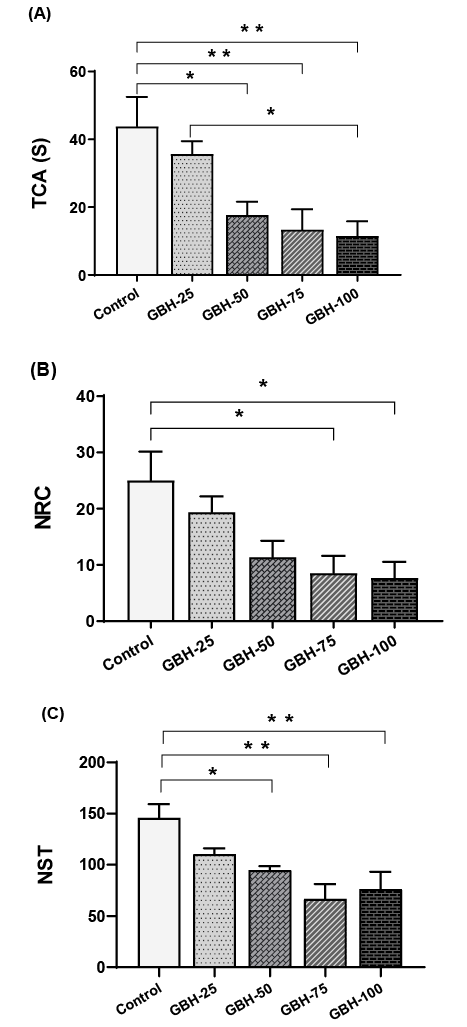
The open field test (OFT) is used to estimate anxiety-like behavior . We consider that the surface of the box (100-L × 100-W × 40-H cm) is divided into central and peripheral regions. Each rat was monitored for 10 minutes to calculate the time spent in the central zone (TCA), the number of visits to the center (NRC), and the total number of squares (NTS). The exploration of the center reflects the level of anxiety, and the number of total squares is an indicator of locomotion. The test box was cleaned using 10% ethanol between animals.
Elevated plus maze
In rodents, the elevated maze plus (EPM) test is frequently used to identify anxiety levels . The apparatus is composed of two opposite open (50 × 10 cm) and closed arms (50 × 10 × 40 cm). Each animal was placed in the intersection of the arms and allowed to explore it for 5 minutes. After analyzing the number of entries (EOA) and the time spent in the open arms (TOA), low exploration of the open arms is an indication of an increase in anxious behavior.
Forced swimming test
The forced swimming test (FST) is designed to assess the state of depressive illness . The animals are placed in a glass cylinder (30-D, 50-H cm). The total duration of immobility (TIM) during the test session was scored; an important level of immobility is a sign of depressive-like behavior .
Oxidative stress indices
After behavioral evaluation, rats were euthanized by decapitation; the hippocampus was collected on ice, homogenized in 0.1M ice-cold phosphate-buffered saline (PBS) pH 7.4, and centrifuged at 1500 rpm for 10 min. The supernatant is preserved at -80°C until use. To examine the antioxidant defense system and any possible oxidative damage in the hippocampus.
Determination of nitric oxide
An excessive amount of nitric oxide (NO) in the hippocampus was tested using the Griess reagent . The mixture of 100 μL of Griess reagent, 300 μl of the sample, and 2.6 mL of distilled water was incubated for 30 min, and the optical density was measured at 548 nm.
Lipid peroxidation assay
Referring to the Draper and Hadley measurement method, the reaction of thiobarbituric acid (TBA) with malondialdehyde (MDA) is used to determine the concentration of thiobarbituric acid reactive substances (TBARS), which is one of the markers of lipid peroxidation (LPO). The reaction product is quantified at 532 nm .
Catalase activity
Catalase activity (CAT) in hippocampal homogenate is evaluated using the method detailed by Aebi (1984). The decrease in H2O2 absorbance at 240 nm was recorded every 30 seconds for 2 minutes. CAT activity was expressed as IU/min/g of tissue.
Statistical analysis
All analyses were conducted by an observer blind to the treatment conditions. Figures were made using GraphPad Prism 8 software (Graph Pad Software Inc., La Jolla, California, United States). Data were represented as mean ± standard error of the mean (SEM) and analyzed using one-way ANOVA followed by Tukey’s post hoc test for multiple comparisons (Version 22 SPSS). A comparison of groups is considered statistically significant if p < 0.05.
RESULTS and Discussion
Effect of repeated GBH exposures on the levels of anxiety-like
The open-field results demonstrate a decrease in the TCA (Figure 2A) in GBH-50, 75, and 100 mg/kg-treated rats with significant decreases (p < 0.05, p < 0.01, and p < 0.01, respectively) compared to the controls. Whereas the GBH-25 mg/kg group showed no variation compared to the control group. Moreover, GBH affects the NRC parameter (Figure 2B) only at 75 and 100 mg/kg, compared with the control group (p < 0.05). On the other hand, GBH administration leads to a decrease in locomotor activity in rats (Figure 2C), with GBH inducing a mean decrease in NTS at doses of 50, 75, and 100 mg/kg.
According to the EPM, Figure 3A shows that GBH administration produces a significant anxiogenic effect, characterized by a significant decrease in TOA at doses of 75 and 100 mg/kg compared with control rats (p < 0.05). Finally, no significant difference in TEA was observed between groups (Figure 3C).
Effect of repeated GBH exposures on the levels of depression-like
Based on the results from the FST presented in Figure 4, analyses revealed that GBH-50, 75, and 100 mg/kg groups presented significantly longer periods of immobility, indicating the development of highly depressive-like behavior compared to saline-treated rats (p < 0.05). In contrast, GBH at the dose of 25 mg/kg did not affect the immobility time (p > 0.05).
Effect of repeated GBH exposures on oxidative stress parameters
Measurement of NO in the hippocampus after GBH treatment showed a pronounced dose-dependent effect (Figure 5A). GBH at doses of 75 and 100 mg/kg produced a significant increase in NO levels compared to the control group (p < 0.05 and p < 0.01, respectively). In addition, GBH at 75 and 100 mg/kg induced a significant increase in NO levels compared with the GBH-25 and GBH-50 groups.
On the other hand, GBH increases LPO levels in the hippocampus in a dose-dependent manner. As observed in Figure 5B, the subchronic administration of GBH at 75 and 100 mg/kg induced a significant increase in TBARS levels in comparison with the control, GBH-25, and GBH-50 groups (p < 0.05).
Also, according to Figure 5C, GBH treatment affected the activity of antioxidant enzymes. A dose-dependent effect was observed at 75 and 100 mg/kg. Treatment with GBH at 75 mg/kg induced a significant increase in CAT activity compared with the control, GBH-25, and GBH-50 mg/kg groups (p < 0.05). Additionally, the GBH at 100 mg/kg induced a considerable increase in CAT activity, and the statistical analysis showed a highly significant increase in comparison with all other groups (p < 0.001).
The present research was conducted to better understand the effects of repeated subcutaneous administration of GBH on affective disorders and OS in the hippocampus of adult rats. The results obtained in our study indicate that subchronic exposure to GBH causes a series of neurotoxic effects, including: (1) increased anxiety- and depression-like behaviors with impaired locomotor activity in rats; (2) increased LPO and NO levels and elevated CAT activity in the hippocampus; (3) GBH induces its effects in a dose-dependent manner.
Regarding the effects on affective disorders, our data clearly show that subchronic administration of GBH induces anxiety and depression behaviors in a dose-dependent manner, as measured in the OFT, EPM, and FST. In agreement with our results, Baier et al. (2017) reported anxiogenic behavior at 50 mg/kg of the GBH in adult mice, administered intranasally for 4 weeks. In addition, subchronic exposure to 1% GBH in drinking water from gestational day 5 up to post-natal day 60 increased immobility time in the forced swimming test . However, Gallegos et al. (2016) demonstrated that rats orally administered 100 or 200 mg/kg of GBH (Glifloglex®) in gestation and lactation had reduced anxiety scores in adulthood in comparison with control rats. These disparities could be attributable to the varying commercial formulations of Gly given, as well as the route and duration of administration .
The precise mechanism behind GBH-provoked anxiety and depression is not fully understood. Interestingly, OS induced by this pesticide may be one of the main mechanisms behind the anxiety- and depressive-like symptoms exhibited by adult rats. In this regard, it is well documented that OS, which results in an overproduction of free radicals and a reduced antioxidant ability to detoxify these reactive products, plays an essential role in the etiology of numerous psychiatric disorders, including depression and anxiety ; ; ; . Accordingly, the OS state in the HPC we observe in GBH-treated rats, accompanied by increased levels of affective disorders, supports this idea. Due to its lipid-rich composition and high oxygen demand, HPC is highly sensitive to oxidative damage . This brain structure is strongly implicated in emotion regulation , and imaging techniques reveal anomalies in the function and structure of the HPC in patients suffering from mood disturbances .
In this experiment, the ability of GBH to cause LPO in the rat HPC via NO generation was confirmed after subchronic administration of this herbicide in a dose-dependent manner. In line with our findings, recent studies in rats have revealed that exposure to GBH induces OS in various tissues, particularly the brain, underscoring the fact that oxidative damage is a key mechanism of neurotoxicity ; ; . Also, Turkmen et al. (2019) observed an increase in LPO levels induced by free radical action in the brain following GBH administration at 375 mg/kg by oral gavage for 8 weeks. In an in vitro study, glyphosate was shown to produce OS, reflected by an increase in NO as well as LPO . Importantly, mitochondria, the main source of free radicals within cells, can be targeted by GBH . In this sense, it has been demonstrated that in vitro exposure to this herbicide causes loss of mitochondrial membrane potential by inhibiting the activity of mitochondrial respiratory chain enzymes and creatine kinase (CK), an enzyme linked to energy metabolism that can generate free radicals’ production, leading to OS state (De Liz Oliveira Cavalli et al., 2013; Neto da Silva et al., 2020). Also, GBH was found to reduce levels of cardiolipin, a phospholipid implicated in the electron transport chain (De Liz Oliveira Cavalli et al., 2013; Neto da Silva et al., 2020). On the other hand, neuroinflammation may be another process that contributes to GBH-induced OS. Through its pro-inflammatory effects, GBH activates microglia and astrocytes, which then release various molecular signals, notably TNF-α, IL-6, and the S100B protein in the mice’s CNS ; . Consequently, by triggering inducible nitric oxide synthase (iNOS), these inflammatory cytokines generate increased NO production, which in turn increases oxidative damage in the brain .
Additionally, GBH-induced oxidative damage was also confirmed in our study by increased CAT enzyme activity in the hippocampus of rats. CAT is one of the most effective antioxidants in the brain, with the ability to defend against oxidative attack, and variations in its activities are used as markers of the antioxidant status of organisms . In parallel with our finding, the study of Gallegos has shown that GBH can affect CAT activity in the brains of adult rats . In this context, it is essential to highlight that any variation in antioxidant enzyme activity, whether decreased or increased, reveals OS . Taken together, the changes in CAT activity and the massive production of NO induced by GBH lead to OS. As a result, oxidative damage occurs to essential biomolecules such as lipids, resulting in cell damage in the hippocampus. These changes could contribute to the neurobehavioral disorders observed in the present study.
CONCLUSIONS AND RECOMMENDATIONS
The current study sheds light on the neurotoxic potential of subcutaneous GBH exposure, providing evidence for dose-dependent neurobehavioral alterations and oxidative stress markers in the hippocampus of rats. These findings underscore the need for further exploration into the mechanisms underlying GBH-induced neurotoxicity and reinforce the importance of assessing the long-term effects of low-dose GBH exposure on neurological health. Such investigations are vital in understanding and mitigating the potential risks associated with GBH exposure in both environmental and human health contexts.
ACKNOWLEDGMENT
We would like to express our gratitude to the members of the Biology Department at Ibn Tofail University for their generous technical support.
NOVELTY STATEMENT
To our knowledge, this study represents the first exploration of the induction of anxiety- and depression-like disorders, as well as OS, following subchronic exposure to GBH via subcutaneous administration in rats.
AUTHORS’ CONTRIBUTION
All authors contributed equally to the manuscript.
Data availability
The datasets generated during and/or analysed during the current study are available from the corresponding author on reasonable request.
Ethical statement
All animal experiments were conducted in accordance with the National Institutes of Health Guide for the Care and Use of Laboratory Animals (National Research Council, revised 1996) and approved by the Animal Ethics Committee (Local Institutional Research Committee).
Conflict of interest
The authors have declared no conflict of interest.
Figures
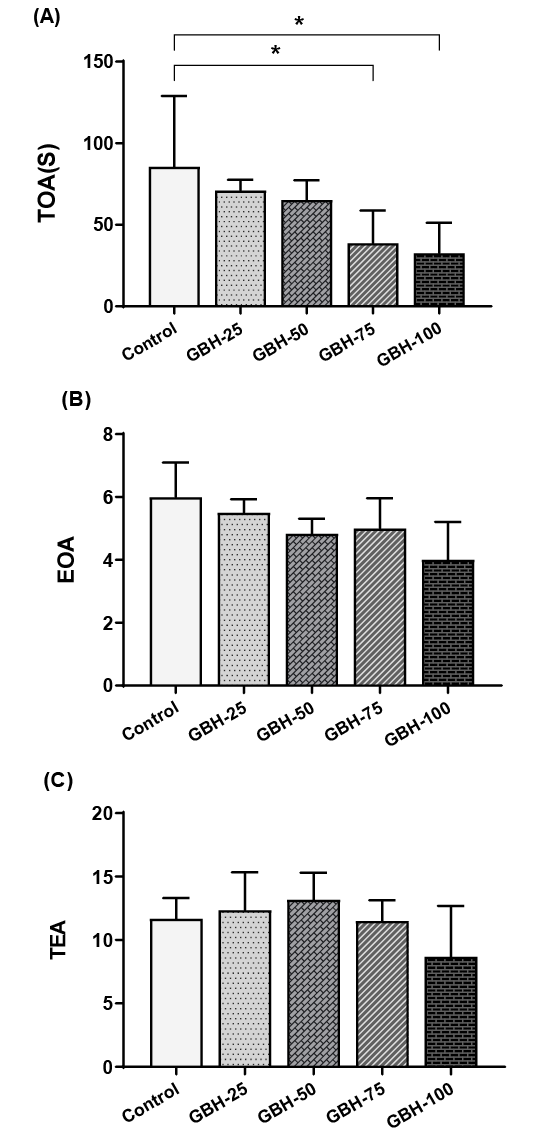
Effects of GBH (25, 50, 75 and 100 mg/kg) administration on anxiety associated behaviors in male rats. (A) Number of entries in exposed arms (EOA); (B) Total amount of time spent in exposed arms (TOA); and (C) Total number of arms entries (TEA) in elevated plus maze. Results are expressed as mean ± SEM. * p < 0.05, ** p < 0.01, *** p < 0.001.
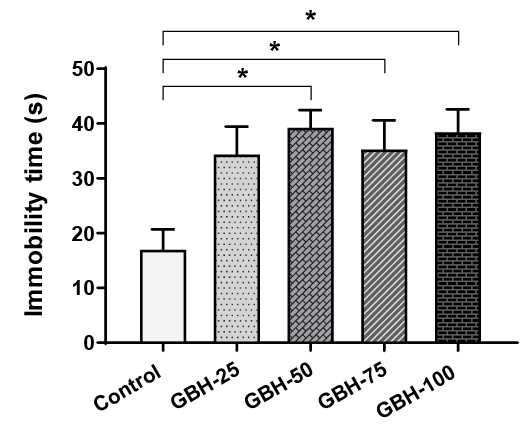
Effects of GBH (25, 50, 75 and 100 mg/kg) administration on depression-related behavior of male rats subjected to the forced swimming test, immobility time expressed in seconds. Results are expressed as mean ± SEM. * p < 0.05, ** p < 0.01, *** p < 0.001.
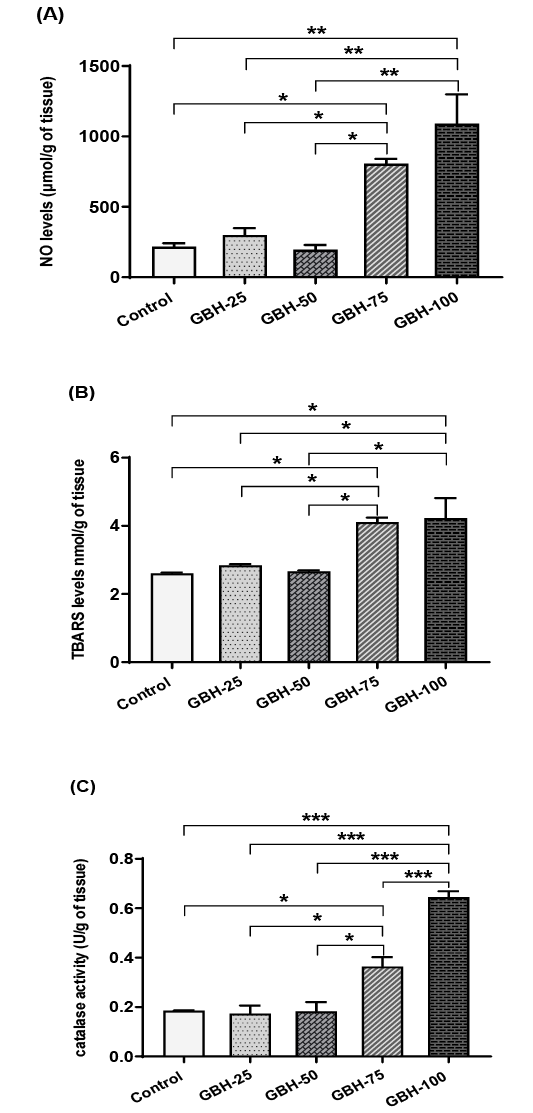
Measurement of oxidative stress parameters in the hippocampus after 2 months of GBH exposure (25, 50, 75 and 100 mg/kg). (A) the nitric oxide (NO) levels, (B) Changes in catalase activity, (C) Determination of the lipid peroxidation levels. Results are represented as mean ± SEM. The significance level is 0.05. *p < 0.05, **p < 0.01, ***p < 0.001.
References
- Aebi H (1984). Catalase in vitro. In: Oxygen radicals in biological systems. Acad. Press, pp. 121–126. https://doi.org/10.1016/S0076-6879(84)05016-3[CrossRef]
- Ait-Bali Y, Ba-M’hamed S, Gambarotta G, Sassoè-Pognetto M, Giustetto M, Bennis M (2020). Pre- and postnatal exposure to glyphosate-based herbicide causes behavioral and cognitive impairments in adult mice: Evidence of cortical ad hippocampal dysfunction. Arch. Toxicol., 94: 1703–1723. https://doi.org/10.1007/s00204-020-02677-7[CrossRef]
- Anadón A, Martínez-Larrañaga MR, Martínez MA, Castellano VJ, Martínez M, Martin MT, Nozal MJ, Bernal JL (2009). Toxicokinetics of glyphosate and its metabolite aminomethyl phosphonic acid in rats. Toxicol. Lett., 190: 91–95. https://doi.org/10.1016/j.toxlet.2009.07.008[CrossRef]
- Astiz M, de Alaniz MJT, Marra CA (2009). Effect of pesticides on cell survival in liver and brain rat tissues. Ecotoxicol. Environ. Saf., 72: 2025–2032. https://doi.org/10.1016/j.ecoenv.2009.05.001[CrossRef]
- Battaglin WA, Meyer MT, Kuivila KM, Dietze JE (2014). Glyphosate and Its Degradation Product AMPA Occur Frequently and Widely in U.S. Soils, Surface Water, Groundwater, and Precipitation. JAWRA. J. Am. Water. Resour. Assoc., 50:275–290. https://doi.org/10.1111/jawr.12159[CrossRef]
- Baier CJ, Gallegos CE, Raisman-Vozari R, Minetti A (2017). Behavioral impairments following repeated intranasal glyphosate-based herbicide administration in mice. Neurotoxicol. Teratol., 64: 63–72. https://doi.org/10.1016/j.ntt.2017.10.004[CrossRef]
- Benachour N, Sipahutar H, Moslemi S, Gasnier C, Travert C, Séralini GE (2007). Time- and dose-dependent effects of roundup on human embryonic and placental cells. Arch. Environ. Contam. Toxicol., 53: 126–133. https://doi.org/10.1007/s00244-006-0154-8[CrossRef]
- Brewster DW, Warren J, Hopkins WE (1991). Metabolism of glyphosate in Sprague-Dawley rats: Tissue distribution, identification, and quantitation of glyphosate-derived materials following a single oral dose. Fundam. Appl. Toxicol. Off. J. Soc. Toxicol., 17: 43–51. https://doi.org/10.1093/toxsci/17.1.43[CrossRef]
- Brikat S, Lamtai M, Chakit M, Ibouzine-Dine L, Fitah I, Abouyaala O, Mesfioui A, El Hessni A (2024). Curcuma longa methanolic extract and losartan improves memory impairment and oxidative stress induced by a high caloric diet in Wistar rats. Adv. Anim. Vet. Sci., 12. https://doi.org/10.17582/journal.aavs/2024/12.4.614.623[Full text][CrossRef]
- Campbell S, Macqueen G (2004). The role of the hippocampus in the pathophysiology of major depression. J Psychiatry. Neurosci., 29: 417–426.
- Carola V, D’Olimpio F, Brunamonti E, Mangia F, Renzi P (2002). Evaluation of the elevated plus-maze and open-field tests for the assessment of anxiety-related behaviour in inbred mice. Behav. Brain. Res., 134: 49–57. https://doi.org/10.1016/S0166-4328(01)00452-1[CrossRef]
- Cattani D, Cesconetto PA, Tavares MK, Parisotto EB, De Oliveira PA, Rieg CEH, Leite MC, Prediger RDS, Wendt NC, Razzera G, Filho DW, Zamoner A (2017). Developmental exposure to glyphosate-based herbicide and depressive-like behavior in adult offspring: Implication of glutamate excitotoxicity and oxidative stress. Toxicology, 387: 67–80. https://doi.org/10.1016/j.tox.2017.06.001[CrossRef]
- Cattani D, De Liz Oliveira Cavalli VL, Heinz Rieg CE, Domingues JT, Dal-Cim T, Tasca CI, Mena Barreto Silva FR, Zamoner A (2014). Mechanisms underlying the neurotoxicity induced by glyphosate-based herbicide in immature rat hippocampus: Involvement of glutamate excitotoxicity. Toxicology, 320: 34–45. https://doi.org/10.1016/j.tox.2014.03.001[CrossRef]
- Chao CC, Hu S, Molitor TW, Shaskan EG, Peterson PK (1992). Activated microglia mediate neuronal cell injury via a nitric oxide mechanism. J Immunol., 149: 2736–2741. https://doi.org/10.4049/jimmunol.149.8.2736[CrossRef]
- Davoren MJ, Schiestl RH (2018). Glyphosate-based herbicides and cancer risk: A post-IARC decision review of potential mechanisms, policy and avenues of research. Carcinogenesis, 39: 1207–1215. https://doi.org/10.1093/carcin/bgy105[CrossRef]
- De Liz Oliveira Cavalli VL, Cattani D, Heinz Rieg CE, Pierozan P, Zanatta L, Benedetti Parisotto E, Wilhelm Filho D, Mena Barreto Silva FR, Pessoa-Pureur R, Zamoner A (2013). Roundup disrupts male reproductive functions by triggering calcium-mediated cell death in rat testis and Sertoli cells. Free. Radic. Biol. Med., 65: 335–346. https://doi.org/10.1016/j.freeradbiomed.2013.06.043[CrossRef]
- Draper HH, Hadley M (1990). 43 Malondialdehyde determination as index of lipid Peroxidation. In: Methods in enzymology. Elsevier, pp. 421–431. https://doi.org/10.1016/0076-6879(90)86135-I[CrossRef]
- Duke SO (2018). The history and current status of glyphosate. Pest. Manage. Sci., 74: 1027–1034. https://doi.org/10.1002/ps.4652[CrossRef]
- El-Brouzi MY, Lamtai M, Zghari O, Ouakki S, Azizoun I, El Hessni A, Mesfioui A, Ouichou A (2021). Intrahippocampal effects of nickel injection on the affective and cognitive response in Wistar rat: Potential role of oxidative stress. Biol. Trace. Elem. Res., 199: 3382–3392. https://doi.org/10.1007/s12011-020-02457-5[CrossRef]
- Etkin A (2010). Functional neuroanatomy of anxiety: A neural circuit perspective. Curr. Top Behav. Neurosci., 2: 251–277. https://doi.org/10.1007/7854_2009_5[CrossRef]
- Faria M, Bedrossiantz J, Ramírez JRR, Mayol M, García GH, Bellot M, Prats E, Garcia-Reyero N, Gómez-Canela C, Gómez-Oliván LM, Raldúa D (2021). Glyphosate targets fish monoaminergic systems leading to oxidative stress and anxiety. Environ. Int., 146: 106253. https://doi.org/10.1016/j.envint.2020.106253[CrossRef]
- Ferreira C, Duarte SC, Costa E, Pereira AMPT, Silva LJG, Almeida A, Lino C, Pena A (2021). Urine biomonitoring of glyphosate in children: Exposure and risk assessment. Environ. Res., 198: 111294. https://doi.org/10.1016/j.envres.2021.111294[CrossRef]
- Gallegos CE, Bartos M, Bras C, Gumilar F, Antonelli MC, Minetti A (2016). Exposure to a glyphosate-based herbicide during pregnancy and lactation induces neurobehavioral alterations in rat offspring. Neurotoxicology, 53: 20–28. https://doi.org/10.1016/j.neuro.2015.11.015[CrossRef]
- Gallegos CE, Bartos M, Gumilar F, Raisman-Vozari R, Minetti A, Baier CJ (2020). Intranasal glyphosate-based herbicide administration alters the redox balance and the cholinergic system in the mouse brain. Neuro Toxicology, 77: 205–215. https://doi.org/10.1016/j.neuro.2020.01.007[CrossRef]
- Grau D, Grau N, Gascuel Q, Paroissin C, Stratonovitch C, Lairon D, Devault DA, Di Cristofaro J (2022). Quantifiable urine glyphosate levels detected in 99% of the French population, with higher values in men, in younger people, and in farmers. Environ. Sci. Pollut. Res., 29: 32882–32893. https://doi.org/10.1007/s11356-021-18110-0[CrossRef]
- Huang T-T, Leu D, Zou Y (2015). Oxidative stress and redox regulation on hippocampal-dependent cognitive functions. Arch. Biochem. Biophys., 576: 2–7. https://doi.org/10.1016/j.abb.2015.03.014[CrossRef]
- Lamtai M, Ouakki S, Zghari O, Hamzaoui AE, Benmhammed H, Azirar S, Hessni AE, Mesfioui A, Ouichou A (2020). Neuroprotective effect of melatonin on nickel-induced affective and cognitive disorders and oxidative damage in rats. Environ. Anal. Health. Toxicol., 35: e2020025. https://doi.org/10.5620/eaht.2020025[CrossRef]
- Lee KH, Cha M, Lee BH (2020). Neuroprotective Effect of Antioxidants in the Brain. Int. J Mol. Sci., 21: 7152. https://doi.org/10.3390/ijms21197152[CrossRef]
- Martínez M-A, Ares I, Rodríguez J-L, Martínez M, Martínez-Larrañaga M-R, Anadón A (2018). Neurotransmitter changes in rat brain regions following glyphosate exposure. Environ. Res., 161: 212–219. https://doi.org/10.1016/j.envres.2017.10.051[CrossRef]
- Martínez M-A, Rodríguez J-L, Lopez-Torres B, Martínez M, Martínez-Larrañaga M-R, Maximiliano J-E, Anadón A, Ares I (2020). Use of human neuroblastoma SH-SY5Y cells to evaluate glyphosate-induced effects on oxidative stress, neuronal development and cell death signaling pathways. Environ. Int., 135: 105414. https://doi.org/10.1016/j.envint.2019.105414[CrossRef]
- Moser VC (2007). Animal models of chronic pesticide neurotoxicity. Hum. Exp. Toxicol., 26: 321–332. https://doi.org/10.1177/0960327106072395[CrossRef]
- Mostafalou S, Abdollahi M (2018). The link of organophosphorus pesticides with neurodegenerative and neurodevelopmental diseases based on evidence and mechanisms. Toxicology, 409: 44–52. https://doi.org/10.1016/j.tox.2018.07.014[CrossRef]
- Myers JP, Antoniou MN, Blumberg B, Carroll L, Colborn T, Everett LG, Hansen M, Landrigan PJ, Lanphear BP, Mesnage R, Vandenberg LN, Vom Saal FS, Welshons WV, Benbrook CM (2016). Concerns over use of glyphosate-based herbicides and risks associated with exposures: A consensus statement. Environ. Health. Glob. Access. Sci. Source, 15: 19. https://doi.org/10.1186/s12940-016-0117-0[CrossRef]
- Naïla N, Makthar W, Lamtai M, Zghari O, Aboubaker EH, Abdelhalem M, Ali O (2021). Effect of intra-hippocampal lead injection on affective and cognitive disorders in male wistar rats: Possible involvement of oxidative stress. E3S. Web. Conf., 319: 02017. https://doi.org/10.1051/e3sconf/202131902017[CrossRef]
- Nassiri A, Lamtai M, Berkiks I, Benmhammed H, Coulibaly SM, Chakit M, Ibouzine-dine L, Mesfioui A, El-Hessni A (2024). Age and sex dependent effects of maternal deprivation on anxiety-like and depressive-like behaviors and oxidative stress in the prefrontal cortex of rats. Adv. Anim. Vet. Sci., 12. https://doi.org/10.17582/journal.aavs/2024/12.3.457.466[Full text][CrossRef]
- Neto da Silva K, Garbin Cappellaro L, Ueda CN, Rodrigues L, Pertile Remor A, Martins R de P, Latini A, Glaser V (2020). Glyphosate-based herbicide impairs energy metabolism and increases autophagy in C6 astroglioma cell line. J. Toxicol. Environ. Health, A 83: 153–167. https://doi.org/10.1080/15287394.2020.1731897[CrossRef]
- Pellow S, Chopin P, File SE, Briley M (1985). Validation of open: Closed arm entries in an elevated plus-maze as a measure of anxiety in the rat. J Neurosci. Methods., 14: 149–167. https://doi.org/10.1016/0165-0270(85)90031-7[CrossRef]
- Peng L (2015). Mice brain tissue injury induced by diisononyl phthalate exposure and the protective application of vitamin E. J. Biochem. Mol. Toxicol., 29: 311–320. https://doi.org/10.1002/jbt.21700[CrossRef]
- Pu Y, Yang J, Chang L, Qu Y, Wang S, Zhang K, Xiong Z, Zhang J, Tan Y, Wang X, Fujita Y, Ishima T, Wan D, Hwang SH, Hammock BD, Hashimoto K (2020). Maternal glyphosate exposure causes autism-like behaviors in offspring through increased expression of soluble epoxide hydrolase. Proc. Natl. Acad. Sci., 117: 11753–11759. https://doi.org/10.1073/pnas.1922287117[CrossRef]
- Rezqaoui A, Boumlah S, El Hessni A, El Brouzi MY, El Hamzaoui A, Ibouzine-dine L, Benkirane S, Adnani M, Mesfioui A (2023). Evaluating the protective effects of melatonin against chronic iron administration in male Wistar rats: A comparative analysis of affective, cognitive, and oxidative stress with EDTA chelator. Biol. Trace. Elem. Res., https://doi.org/10.1007/s12011-023-04006-2[CrossRef]
- Rhaimi S, Brikat S, Lamtai M, Ouhssine M (2023). Acute oral toxicity and neurobehavioral effects of salvia officinalis essential oil in female Wistar rats. Adv. Anim. Vet. Sci., 11. https://doi.org/10.17582/journal.aavs/2023/11.4.654.662[Full text][CrossRef]
- Roger DP (2000). Animal models of depression: Utility for transgenic research. Rev. Neurosci., 11: 53–58. https://doi.org/10.1515/REVNEURO.2000.11.1.53[CrossRef]
- Rueda-Ruzafa L, Cruz F, Roman P, Cardona D (2019). Gut microbiota and neurological effects of glyphosate. Neuro Toxicol., 75: 1–8. https://doi.org/10.1016/j.neuro.2019.08.006[CrossRef]
- Szepanowski F, Szepanowski L-P, Mausberg AK, Albrecht P, Kleinschnitz C, Kieseier BC, Stettner M (2018). Differential impact of pure glyphosate and glyphosate-based herbicide in a model of peripheral nervous system myelination. Acta Neuropathol., (Berl), 136: 979–982. https://doi.org/10.1007/s00401-018-1938-4[CrossRef]
- Turkmen R, Birdane YO, Demirel HH, Kabu M, Ince S (2019). Protective effects of resveratrol on biomarkers of oxidative stress, biochemical and histopathological changes induced by sub-chronic oral glyphosate-based herbicide in rats. Toxicol. Res., 8: 238–245. https://doi.org/10.1039/C8TX00287H[CrossRef]
- Wang G, Fan X-N, Tan Y-Y, Cheng Q, Chen S-D (2011). Parkinsonism after chronic occupational exposure to glyphosate. Parkinsonism. Relat. Disord., 17: 486–487. https://doi.org/10.1016/j.parkreldis.2011.02.003[CrossRef]
- Wang X, Lu Q, Guo J, Ares I, Martínez M, Martínez-Larrañaga M-R, Wang X, Anadón A, Martínez M-A (2022). Oxidative stress and metabolism: A mechanistic insight for glyphosate toxicology. Annu. Rev. Pharmacol. Toxicol., 62: 617–639. https://doi.org/10.1146/annurev-pharmtox-020821-111552[CrossRef]
- Williams GM, Kroes R, Munro IC (2000). Safety evaluation and risk assessment of the herbicide roundup and its active ingredient, glyphosate, for humans. Regul. Toxicol. Pharmacol., 31: 117–165. https://doi.org/10.1006/rtph.1999.1371[CrossRef]
- Winstone JK, Pathak KV, Winslow W, Piras IS, White J, Sharma R, Huentelman MJ, Pirrotte P, Velazquez R (2022). Glyphosate infiltrates the brain and increases pro-inflammatory cytokine TNFα: implications for neurodegenerative disorders. J. Neuroinflamm., 19: 193. https://doi.org/10.1186/s12974-022-02544-5[CrossRef]
- Zghari O, Azirar S, Lamtai M, El Hessni A, Ouichou A, Mesfioui A (2023a). Intrahippocampal dose-dependent effects of aluminum injection on affective and cognitive response in male Wistar rat: Potential role of oxidative stress. Egypt. J. Basic. Appl. Sci., 10: 460–475. https://doi.org/10.1080/2314808X.2023.2229623[CrossRef]
- Zghari O, Lamtai M, Azirar S, El-Brouzi MY, Benmhammed H, El-Hessni A, Ouichou A, Mesfioui A (2023b). Neuroprotective effects of melatonin against neurotoxicity induced by intrahippocampal injection of aluminum in male Wistar rats: Possible involvement of oxidative stress pathway. Adv. Anim. Vet. Sci., 11. https://doi.org/10.17582/journal.aavs/2023/11.5.711.719[Full text][CrossRef]
Cited by 2 articles
In journals published by ResearchersLinks.
- Neonatal Gut Microbiota Disruption Increases Myelin Damage and Neurobehavioral Impairments in Cuprizone-Induced Toxic ModelAdvances in Animal and Veterinary Sciences · 2025
- Neurocognitive and Affective Disorders Induced by Inorganic Mercury Exposure in Male Wistar Rats: Unraveling the Role of Oxidative StressAdvances in Animal and Veterinary Sciences · 2025
Services
Article usage statistics
Loading…