The present study provides a complete checklist of Epinephelus species reported from Indian coastal waters.
However, Fish Base (http://www.fishbase.org/) has shown only 38 species, including E. multinotatus which was not reported in Indian waters.
Hence, the database of FishBase needs to be revised and updated to 47 species.
Despite their importance for commercial fisheries, aquarium trade, aquaculture and coral reefs, these species are highly threatened by overexploitation, bycatch, and habitat loss due to degradation of coral reefs and the possible effects of climate change.
Selected from the article's own text.
Abstract
Darwin Chatla, Padmavathi Pamulapati*
Department of Zoology and Aquaculture, Acharya Nagarjuna University, Nagarjuna Nagar -522510, Andhra Pradesh, India.
Abstract | The grouper fish, Epinephelus Bloch, 1793 represents an iconic genus of the family Serranidae and order Perciformes. They are highly-prized food fishes intended for subsistence, artisanal, recreational and commercial fisheries throughout their geographic range. Despite their economic importance, the status of grouper fishes has been increasingly imperiled through overfishing activities. The conservation efforts have also been constrained with this highly skewed Epinephelus. Hence, in order to save this esteemed resource, effective conservation and rehabilitation strategies need to be planned and implemented in the country. However, it requires the knowledge of the current status of grouper fish diversity which is not yet carried comprehensively. Hence this study was proposed to review the systematic study of the genus Epinephelus to fill the gaps in diversity studies of India. The study also documented the present IUCN status of the listed species of Epinephelus under different categories of conservation status.
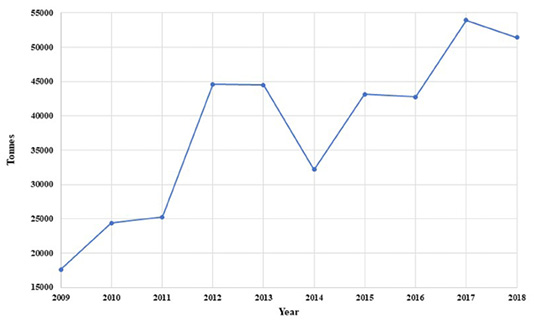
India is one of the twelve megadiverse nations in the world and well known for its biodiversity richness with a distinctive biogeographic marine ecoregion . The Indian coastline (7517 km) with different coastal ecosystems supports rich diverse resources having considerable economic importance. The marine diverse resources represent half of all extant vertebrates with an estimation of 2443 (75.6%) valid species . In recent decades, there has been a massive development of the fisheries sector in the Indian waters. The vessels now extend their trawling operations into deeper waters, catching more varieties of demersal fishes including groupers. Grouper landings have been continuously increasing during the last decade (2009-2018) with an average of 37970 tonnes and are shown in Figure 1. The highest landings of 53924 tonnes in 2017 and the lowest of 17606 tonnes were observed in 2009. In 2018 the landings have been accounted for about 51433 tonnes . However, species-specific landing data were not reported for the grouper species. Because of this low degree of resolution, 61% of grouper landings are reported as “groupers nei” in FAO (2016) database. Concurrent with the increase in landings and production of groupers, there may be a chance of overexploitation and some species on the threat of extinction.
Grouper fishes are cosmopolitan, occurring in tropical and subtropical areas . This highly diverse fish group plays a significant role in the coral reef ecosystem as regulators of the structure and composition of communities and forms an important link in the food chain . The groupers are top predators, sedentary and usually sluggish in movement, slow growing and long-lived . They have white, tender and tasty meat, and commands a high price in the market. Moreover, many species have been prioritized as potential species for aquaculture ; . Small grouper species are highly valued in the aquarium trade and remain as one of the valuable fishery resources along the coasts of India. These features attracted many enthusiastic researchers ; .
Over the past decade, a number of articles published on various aspects of Epinephelus species (Figure 2). In India, only 318 articles are published to an estimated 3386 articles worldwide. Thus, inspite of their commercial importance, the work done so far on Epinephelus species in India is scarce.
A perusal of the literature shows that these fishes are being subjected to intense fishing pressure for food, ornamental display and medicinal purposes globally ; . The loss of groupers can have a serious effect on local ecosystems since these fishes play an important role in the structure of rocky bottom and coral reef communities . In spite of their commercial importance, the status of grouper fishes has been threatened by overexploitation. As a result, certain species of groupers have become a matter of serious concern. Hence, comprehensive information on the current status of grouper diversity is a prerequisite for efficient management and to formulate the steps to be taken to protect these fishes towards sustainable exploitation. Hence the present study was aimed to manifest the diversity and current status of Epinephelus in Indian coastal waters by reviewing the studies carried so far on the diversity and distribution of this fish. The Conservation status of Epinephelus species under different categories was also documented.
Diversity and Distribution of groupers, Epinephelus
Grouper fishes of the Family Serranidae (Order: Perciformes; Class: Actinopterygii) are represented by 16 genera and 163 species with world-wide distribution. According to FishBase, around 54 species of the sub-family, Epinephelinae and 38 species of the genus, Epinephelus have been reported from the Indian waters . Groupers inhabit a wide variety of habitats, mainly coral reefs, rocky areas, seagrass beds, and estuaries ; . They exhibit a wide variety of reproductive and growth strategies . Epinephelus species are regularly landed by subsistence, artisanal, and commercial fisheries throughout their geographic range. A significant number of studies have been carried on the diversity of groupers, Epinephelus in various ecosystems of the Indian coastal waters and are presented in Table 1.
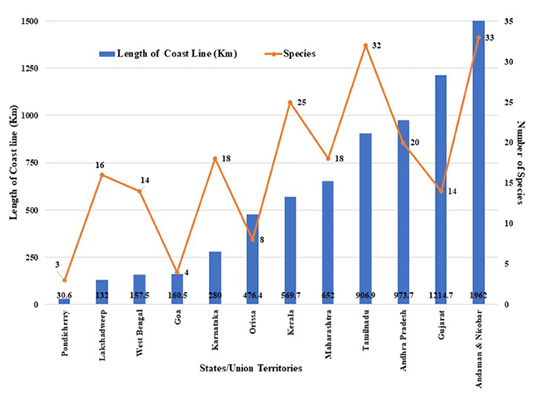
Data on the distribution of Indian groupers were collected from twelve coastal states and union territories of India (Figure 3) which revealed the presence of 47 species of Epinephelus in Indian waters (Table 2). The species richness against the length of the coast of all states and union territories is presented in Figure 3. The east coast represents 76.59% with 36 species, while the west coast
Table 1: Diversity studies on Epinephelus species in Indian coastal waters.
S. No.
State
Location
Reference
1
Gujarat
Location not mentioned
Major coastal states of Gujarat
Gulf of Kachchh
Veraval
;
2
Maharashtra
Location not mentioned
Major fish landing centres of Maharashtra
Sassoon Dock
Mumbai Coast
3
Goa
Grand Island
;
4
Karnataka
Natrani Island
;
Major fish landing centres of Karnataka
Mangalore, Karnataka
5
Kerala
Location not mentioned
Ponnani estuary, Kerala
Neendakara, Sakthikulangara, Munambam, Ponnani, Puthiyappa, and Azheekkal of Kerala
represents 57.44% with 27 species. The Andaman and Nicobar islands represent 70.21% of grouper diversity with a maximum number of 33 species, followed by Tamil Nadu (68.08%) with 32 species, Kerala (53.19%) with 25 species, Andhra Pradesh (42.55%) with 20 species, Karnataka (38.29%) with 18 species, Maharashtra 38.29% with 18 species, Lakshadweep (34.04%) with 16 species, West Bengal (29.78%) 14 species, Gujarat (29.78%) with 14 species, Orissa (17.02%) with 8 species, Goa (8.51%) with 4 species and Puducherry (6.38%) with 3 species.
Regarding species distribution (Table 2), E. coioides was recorded as a dominant species in all coastal states except Puducherry. Similarly, E. malabaricus was identified as the second most widely distributed species in the coastal waters of 10 out of 12 states and union territories in India. Considering the distribution of species from the west coast, E. coioides, E. diacanthus, and E. erythrurus were abundant in all reported stations, while E. areolatus, E. chlorostigma, E. fasciatus, E. fuscoguttatus, E. latifasciatus, and E. malabaricus are dominant in all stations, except Goa. Along the east coast, E. lanceolatus and E. malabaricus were reported in all stations, while E. bleekeri, E. coioides, E. latifasciatus and E. tauvina were found in all stations except Puducherry. The distribution of some rare species was confined to particular regions of the east coast such as E. corallicola (Tamil Nadu), E. fasciatomaculosus (Tamil Nadu), E. hata (Andhra Pradesh), E. magniscuttis (Andhra Pradesh and West Bengal), E. marginatus (Andhra Pradesh), E. melanostigma (Tamil Nadu), E. miliaris (Tamil Nadu), E. poecilonotus (Tamil Nadu), E. retouti (Tamil Nadu), E. rivulatus (Tamil Nadu) and E. sexfasciatus (Tamil Nadu and West Bengal), whereas E. bontoides (Kerala), E. chabaudi (Karnataka and Kerala), E. stoliczkae (Maharastra and Karnataka) and E. Tukula (Goa and Maharastra) were restricted to the west coast of India. In addition to these mainland coastal water species, some species such as E. amblycephalus, E. macrospilos and E. polystigma are reported only from Andaman and Nicobar Islands, while E. ongus and E. spilotoceps were recorded from both Lakshadweep, and Andaman and Nicobar Islands of India.
It is evident that among the 47 Epinephelus species registered in India, 40 are commercial, while the remaining species are used for aquaria, game/sport fishery, subsistence fisheries and aquaculture (Table 2). In India, rearing of groupers in brackish water aquaculture is a relatively new development as a diversification option in pond and cage culture farms and is still in R and D phase. Certain behavioral characteristics with a high degree of territoriality and site specificity are making the groupers at risk and easy targets for fishermen ; ; . In this context, groupers are emerged as a particularly vulnerable group of fishes (Ranjan, 2015). The apparent vulnerability of the giant grouper, E. lanceolatus of Andaman and Nicobar Islands is protected under schedule I of the Wildlife (Protection) Act, 1972.
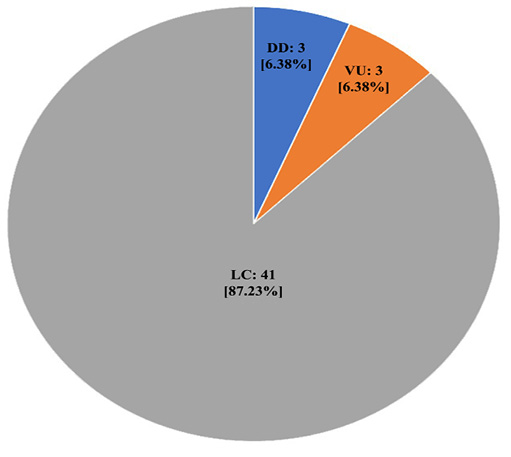
Regarding the conservation status as per the IUCN Red List of Threatened Species, out of 47 Epinephelus species reported from Indian coastal waters, 41 species (87.23%) are marked as Least Concern (LC) and 3 species (6.38%) each as Vulnerable (VU) and Data deficient (DD) (Table 2 and Figure 4).
Table 2: A comprehensive list and distribution status of extant Grouper (Epinephelus spp.) in Indian coastal waters.
S. No.
Species name
Common name
F
States/ Union Territories
IUCN status
Threat to humans
Use/Trade
1
2
3
4
5
6
7
8
9
10
11
12
1
Epinephelus amblycephalus (Bleeker, 1857)
Banded grouper
+
LC
Harmless
Minor commercial
2
E. areolatus (Forsskål, 1775)
Areolate grouper
+
+
+
+
+
+
+
+
+
LC
Harmless
Commercial, aquaculture
3
E. bleekeri (Vaillant, 1878)
Duskytail grouper
+
+
+
+
+
+
+
+
+
+
DD
Harmless
Minor commercial, aquaculture
4
E. bontoides (Bleeker, 1855)
Palemargin grouper
+
LC
Harmless
Of no interest
5
E. chabaudi (Castelnau, 1861)
Moustache grouper
+
+
+
LC
Harmless
commercial
6
E. chlorostigma (Valenciennes, 1828)
Brownspotted grouper
+
+
+
+
+
+
+
+
LC
Harmless
commercial
7
E. coeruleopunctatus (Bloch, 1790)
Whitespotted grouper
+
+
+
+
+
+
+
+
LC
Harmless
Minor commercial
8
E. coioides (Hamilton, 1822)
Orange-spotted grouper
+
+
+
+
+
+
+
+
+
+
+
+
LC
Harmless
Commercial, aquaculture
9
E. corallicola (Valenciennes, 1828)
Coral grouper
+
+
+
+
LC
Harmless
Subsistence fisheries
10
E. diacanthus (Valenciennes, 1828)
Spinycheek grouper
+
+
+
+
+
+
+
+
+
LC
Harmless
commercial
11
E. epistictus (Temminck and Schlegel, 1842)
Dotted grouper
+
+
+
+
+
+
LC
Harmless
Minor commercial
12
E. erythrurus (Valenciennes, 1828)
Cloudy grouper
+
+
+
+
+
+
+
+
+
LC
Harmless
Minor commercial
13
E. fasciatomaculosus (Peters, 1865)
Rock grouper
+
LC
Harmless
commercial
14
E. fasciatus (Forsskål, 1775)
Blacktip grouper
+
+
+
+
+
+
+
+
+
LC
Ciguatera poisoning
Commercial, gamefish,
15
E. faveatus (Valenciennes, 1828)
Barred-chest grouper
+
+
+
+
+
LC
Harmless
commercial
16
E. flavocaeruleus (Lacepède, 1802)
Blue-and-yellow grouper
+
+
+
+
+
LC
Harmless
Commercial, aquarium
17
E. fuscoguttatus (Forsskål, 1775)
Brown-marbled grouper
+
+
+
+
+
+
+
+
VU
Ciguatera poisoning
Minor commercial, gamefish,
18
E. hata (=E.heniochus) Fowler, 1904
Bridled grouper
+
+
LC
Harmless
commercial
19
E. hexagonatus (Forster, 1801)
Starspotted grouper
+
+
+
+
+
+
LC
Harmless
Minor commercial, gamefish
20
E. lanceolatus (Bloch, 1790)
Gaint grouper
+
+
+
+
+
+
+
+
+
+
DD
Traumatogenic
Commercial, aquaculture
21
E. latifasciatus (Temminck and Schlegel, 1842)
Striped grouper
+
+
+
+
+
+
+
+
+
LC
Harmless
commercial
22
E. longispinis (Kner, 1864)
Longspine grouper
+
+
+
+
+
+
+
+
+
LC
Harmless
commercial
23
E. macrospilos (Bleeker, 1855)
Snubnose grouper
+
+
LC
Harmless
Commercial
24
E. maculatus (Bloch, 1790)
Highfin grouper
+
+
+
LC
Ciguatera poisoning
Minor commercial, aquarium
25
E. magniscuttis Postel, Fourmanoir and Guézé, 1963
Speckled grouper
+
+
LC
Harmless
Commercial
26
E. malabaricus (Bloch and Schneider, 1801)
Malabar grouper
+
+
+
+
+
+
+
+
+
+
+
LC
Harmless
Highly commercial, aquaculture
27
E. marginatus (Lowe, 1834)
Dusky grouper
+
+
VU
Harmless
Highly Commercial, gamefish
S. No.
Species name
Common name
F
States/ Union Territories
IUCN status
Threat to humans
Use/Trade
1
2
3
4
5
6
7
8
9
10
11
12
28
E. melanostigma Schultz, 1953
One-blotch grouper
+
+
+
+
LC
Ciguatera poisoning
Subsistence fisheries
29
E. merra Bloch, 1793
Honeycomb grouper
+
+
+
+
+
+
LC
Ciguatera poisoning
Commercial, aquaculture,
30
E. miliaris (Valenciennes, 1830)
Netfin grouper
+
+
LC
Harmless
Minor Commercial
31
E. morrhua (Valenciennes, 1833)
Comet grouper
+
+
+
+
+
+
+
LC
Ciguatera poisoning
Minor commercial, gamefish
32
E. multinotatus (Peters, 1876)
White-blotched grouper
+
LC
Harmless
Commercial
33
E. ongus (summana) (Bloch, 1790)
White-streaked grouper
+
+
+
LC
Harmless
Minor commercial
34
E. poecilonotus (Temminck and Schlegel, 1842)
Dot-dash grouper
+
+
LC
Harmless
Subsistence fisheries
35
E. polylepis Randall and Heemstra, 1991
Smallscaled grouper
+
+
+
+
LC
Harmless
Commercial
36
E. polyphekadion (Bleeker, 1849)
Camouflage grouper
+
+
+
+
VU
Ciguatera poisoning
Commercial, aquaculture
37
E. polystigma (Bleeker, 1853)
White-dotted grouper
+
LC
Harmless
Subsistence fisheries
38
E. quoyanus (Valenciennes, 1830)
Longfin gouper
+
+
+
LC
Ciguatera poisoning
Commercial
39
E. radiatus (Day, 1868)
Oblique-banded grouper
+
+
+
+
+
+
LC
Harmless
Minor commercial
40
E. retouti Bleeker, 1868
Red-tipped grouper
+
LC
Harmless
Subsistence fisheries, gamefish
41
E. rivulatus (Valenciennes, 1830)
Halfmoon grouper
+
+
LC
Harmless
Minor commercial
42
E. sexfasciatus (Valenciennes, 1828)
Sixbar grouper
+
+
+
LC
Harmless
Commercial
43
E. spilotoceps Schultz, 1953
Foursaddle grouper
+
+
+
LC
Harmless
Commercial, gamefish
44
E. stoliczkae (Day, 1875)
Epaulet grouper
+
+
+
LC
Harmless
Minor commercial
45
E. tauvina (Forsskål, 1775)
Greasy grouper
+
+
+
+
+
+
+
+
+
DD
Ciguatera poisoning
Minor commercial, aquaculture
46
E. tukula (Morgans, 1959)
Potato grouper
+
+
+
+
+
LC
Harmless
Subsistence fisheries, gamefish
47
E. undulosus (Quoy and Gaimard, 1824)
Wavy-lined grouper
+
+
+
+
+
+
+
+
LC
Harmless
Minor commercial
*F: FishBase; 1: Gujarat; 2: Maharastra; 3: Goa; 4: Karnataka; 5: Kerala; 6: Tamil Nadu; 7: Puducherry; 8: Andhra Pradesh; 9: Orissa; 10: West Bengal; 11: Lakshadweep and 12: Andaman and Nicobar.
Conclusion and Recommendations
The present study provides a complete checklist of Epinephelus species reported from Indian coastal waters. So far 47 species of Epinephelus have been reported. However, Fish Base (http://www.fishbase.org/) has shown only 38 species, including E. multinotatus which was not reported in Indian waters. Hence, the database of FishBase needs to be revised and updated to 47 species. Despite their importance for commercial fisheries, aquarium trade, aquaculture and coral reefs, these species are highly threatened by overexploitation, bycatch, and habitat loss due to degradation of coral reefs and the possible effects of climate change. These factors are also impacting the species biodiversity. To conserve these species, it is necessary to implement ecosystem-based management practices. Therefore, the following steps could be taken to improve the conservation of Epinephelus species along the coastal waters of India and elsewhere: (i) collection of landing station-wise data from commercial, bycatch, ornamental and recreational catches; (ii) genetic diversity studies to overcome taxonomic ambiguities (iii) identification of the nutrient profile and consideration of the minimum catch size to avoid depletion of the stock in future; (iv) integrated knowledge about the social, biophysical and ecological aspects of Epinephelus in a sustainable way; (v) increase efforts on education and conservation awareness in coastal tourism and communities; and, most importantly, (vi) creation of networks for marine reserves in priority conservation areas, protecting key species and habitats for their survival. This will not only pave the way for better protection of Epinephelus diversity but will also help maintain harmony in the marine community.
AUTHORS CONTRIBUTION
Both the authors contributed equally.
CONFLICT OF INTEREST
The authors have declared no conflict of interest.
References
• Albert Idu KA, Akhilesh KV, Singh VV (2017). Report of potato grouper and Cloudy grouper in fishery landings at Mumbai. Mar. Fish. Inf. Sev. T E Ser., 231: 25-26.
• Anjali KM, Mandal A, Gunalan B, Ruban L, Anandajothi E, Thineshsanthar D, Manojkumar TG, Kandan S (2019). Identification of six grouper species under the genus Epinephelus (Bloch, 1793) from Indian waters using PCR-RFLP of cytochrome c oxidase I (COI) gene fragment. Food Control, 101: 39-44. https://doi.org/10.1016/j.foodcont.2019.02.024[CrossRef]
• Baiju PT, Prabhakaran MP, Benno Pereira FG, Jayaprakas V (2016). Rocky reef-associated fish diversity of South Kerala coast, India. J. Aquat. Biol. Fish., 4: 31-44.
• Barman RP, Kar S, Mukherjee P (2004). Marine and estuarine fishes. In: State Fauna Series 5: Fauna of Andhra Pradesh (Part-2), Mammals and Marine and Estuarine Fishes. Publ. Dir., Zool. Surv. India, Kolkata. pp. 1-311.
• Barman RP, Mishra SS, Kar AS, Mukherjee P, Saren SC (2011). Fauna of Tamil Nadu. In: State Fauna Series, 17 (Part-2). Publ. Dir. Zool. Surv. India, Kolkata. pp. 1-418.
• Barman RP, Mishra SS, Kar AS, Mukherjee P, Saren SC (2012). In: Fauna of Maharashtra, State Fauna Series, 20 (Part-l). Publ. Dir. Zool. Surv. India, Kolkata. pp. 1-480.
• Barman RP, Mishra SS, Kar AS, Saren SC (2013). In: Fauna of Karnataka, State Fauna Series. Publ. Dir. Zool. Surv. India, Kolkata. 21: 1-595. https://doi.org/10.1007/978-3-642-38200-0_31[CrossRef]
• Barman RP, Mishra SS, Kar S, Mukherjee P, Saren SC (2007). Marine and estuarine fish fauna of Orissa. Rec. Zool. Surv. India, Occ. Paper No. 260: 1-186.
• Barman RP, Mukherjee P, Kar S (2000). Marine and estuarine fishes. In: State Fauna Series No. 8, Fauna of Gujarat, Part 1. Publ. Dir. Zool. Surv. India, Kolkata. pp. 1-464.
• Bhendekar SN, Chellappan A, Sonavane AE, Mohanty P, Singh R, Shenoy L (2019). Geo-spatial distribution and faunal diversity in the trawling grounds off Mumbai coast, Maharashtra, India. Indian J. Mar. Sci., 48(9): 1435-1442.
• Bijukumar A, Deepthi GR (2009). Mean trophic index of fish fauna associated with trawl bycatch of Kerala, southwest coast of India. J. Mar. Biol. Assoc. India, 51(2): 145-154.
• Bijukumar A, Raghavan R (2015). A checklist of fishes of Kerala, India. J. Threat. Taxa. 7(13): 8036-8080. https://doi.org/10.11609/jott.2004.7.13.8036-8080[CrossRef]
• Bijukumar A, Sushama S (2000). Ichthyofauna of Ponnani estuary, Kerala. J. Mar. Biol. Ass. India. 42(1-2): 182-189.
• Chandrasekhara Rao G (1991). Lakshadweep: General features. In: State Fauna Series No. 2, Fauna of Lakshadweep. Publ. Dir. Zool. Surv. India, Kolkata. pp. 1-144.
• CMFRI (2019). Annual report, 2018-19. Central Mar. Fish. Res. Inst. Kochi. pp. 320.
• Darwin Ch, Padmavathi P, Srinu G (2018). DNA divergence and genetic relatedness of Epinephelus species (Perciformes:Serranidae) of Indian waters inferred from COI sequence data. In: P. Vijaya Nirmala (ed.). Recent Trends Appl. Biol., (Adikavi Nannaya University, Rajamahendravaram, A.P., India). pp. 3-16.
• Deepti VA, Shrikanya KVL, Sujatha K (2014). Taxonomic studies and phylogenetic relationship of seven spotted groupers species of genus Epinephelus (Pisces: Serranidae) off Visakhapatnam, middle east coast of India. Indian J. Geo-Mar. Sci., 43(12): 2254-2268.
• FAO (Food and Agriculture Organization) (2016). The state of world fisheries and aquaculture-contributing to food security and nutrition for all. Rome. pp. 1-200.
• Froese R, Pauly D (2019). Fish Base. World Wide Web electronic publication. www.fishbase.org, version (12/2019).
• Gibinkumar TR, Sabu S, Pravin P, Boopendranath MR (2012). Bycatch characterization of shrimp trawl landings off southwest coast of India. Fish. Technol., 49: 132-140.
• Gopi KC, Mishra SS (2015). Diversity of marine fish of India. In: K. Venkataraman and C. Sivaperuman (eds). Marine Faunal Diversity in India. Taxonomy, Ecology and Conservation. Acad. Press, Elsevier Inc., USA. pp. 172-191. https://doi.org/10.1016/B978-0-12-801948-1.00012-4[CrossRef]
• Govindan S, Ravichandran R (2016). Fish fauna diversity and conservation status of Pulicat Lagoon in Tamil Nadu. Ann. Aquact. Res., 3(2): 1018.
• Heemstra PC, Randall JE (1993). Groupers of the world. In: FAO species catalogue. Groupers of the world (Family Serranidae, Subfamily Epinephelinae). An annotated and illustrated catalogue of the grouper, rockcod, hind, coral grouper and lyretail species known to date, (Rome: FAO Fisheries Synopsis). pp. 382.
• James PSBR, Lazarus S, Arumugam G (1994). Present status of ‘major perch’ fisheries in India. Bull. Cent. Mar. Fish. Res. Inst., 47: 1-9.
• Jawahar P, Brucelee G, Umamaheswari T (2013). Marine ornamental ichthyofauna of Thoothukudi coast, Gulf of Mannar, India. J. Bombay Nat. Hist. Soc., 110(2): 156-162.
• Jayaprabha N, Purusothaman S, Srinivasan M (2018). Biodiversity of coral reef associated fishes along southeast coast of India. Reg. Stud. Mar. Sci., 18: 97-105. https://doi.org/10.1016/j.rsma.2017.12.010[CrossRef]
• Joshi A, Parmar EAR, Temkar GS, Desai AY, Bhatt AJ (2018). Ichthyofaunal Biodiversity of Kharakuva Fish Market, Veraval, Gujarat, India. Int. J. Bio-resource Stress Manage., 9(5): 596-605. https://doi.org/10.23910/IJBSM/2018.9.5.1902[CrossRef]
• Joshi KK, Sreeram MP, Zacharia PU, Abdussamad EM, Varghese M, Habeeb Mohammed OM, Jayabalan K, Kanthan KP, Kannan K, Sreekumar KM, George G (2016). Check list of fishes of the Gulf of Mannar ecosystem, Tamil Nadu, India. J. Mar. Biol. Ass. India, 58(1): 34-54. https://doi.org/10.6024/jmbai.2016.58.1.1895-05[CrossRef]
• Kar A, Raut SK, Bhattacharya M, Patra S, Das BK, Patra BC (2017). Marine fishes of West Bengal coast, India: Diversity and conservation preclusion. Reg. Stud. Mar. Sci., 1(16): 56-66. https://doi.org/10.1016/j.rsma.2017.08.009[CrossRef]
• Karuppasamy K (2016). Biodiversity of fish species along Wadge Bank, South India. Thesis (M.F.Sc.), Fisheries Training and Research Centre, Parakkai, Tamil Nadu Fisheries University, Tamil Nadu. http://krishikosh.egranth.ac.in/handle/1/5810013496
• Kirubasankar R, Dam Roy S, George G, Sarma K, Krishnan P, Ramkumar S, Kaliyamoorthy M, Goutham Bharathi MP (2013). Fishery and exploitation of Malabar grouper, Epinephelus malabaricus (Bloch and Schneider 1801) from Andaman Islands. Asian Fish. Sci. 26: 167-75.
• Krishnan S, Mishra SS, Prabhakar D (2007). Fishes In: K. Venkataraman. Fauna of Chennai Coast, Marine Ecosystems Series, 1, Publ. Dir. Zool. Surv. India, Kolkata. pp. 1-294.
• Kumar JY, Geetha S, Sornaraj R (2013). Diversity and distribution of reef fishes in Gulf of Mannar islands, India. In: K. Venkataraman, Sivaperuman, C. Raghunathan (eds). Ecol. Conserv. Trop. Mar. Faunal Commun., Springer, Berlin, Heidelberg. pp. 297-310. https://doi.org/10.1007/978-3-642-38200-0_19[CrossRef]
• Kumar TA, Vinoth R, Prakash S, Balasubramanian T (2012). Reef fishes of the Lakshadweep archipelago. Publ. Dir. Zool. Surv. India, Kolkata. pp. 1-180.
• Mahesh V, Benakappa S, Dineshbabu AP, Anjanayappa HN, Kumar Naik AS, Vijaykumar ME, Somasekara SR, Kumar J (2014). Finfish constituents of trawl low value by-catch off Mangalore. J. Exp. Zool. India. 17(2): 479-85.
• Manojkumar PP, Ranjith L, Karuppasamy K, Kanthan KP (2019). Fishery and population dynamics of Epinephelus malabaricus (Bloch and Schneider, 1801) off Tuticorin, southeast coast of India. J. Mar. Biol. Ass. India, 61(1): 26-30. https://doi.org/10.6024/jmbai.2019.61.1.2072-03[CrossRef]
• Mishra SS, Krishnan S (2003). Marine Fishes of Pondichery and Karaikal. Rec. Zool. Surv. India Occ. Pap., 216: 1-52.
• Mogalekar HS, Canciyal J, Jawahar P, Patadiya DS, Sudhan C, Pavinkumar P, Santhoshkumar S, Subburaj A (2017). Estuarine fish diversity of Tamil Nadu, India. Indian J. Mar. Sci. 46(10): 1968-1985.
• Mohanty R, Mohapatra A, Mohanty S, Mishra S, Khan M, Pattnaik A (2015). Ichthyofaunal diversity of Chilika Lake, Odisha, India: An inventory, assessment of biodiversity status and comprehensive systematic checklist (1916-2014). Check List., 11(6): 1817. https://doi.org/10.15560/11.6.1817[CrossRef]
• Morris AV, Roberts CM, Hawkins JP (2000). The threatened status of groupers (Epinephelinae). Biodivers. Conserv., 9(7): 919-942. https://doi.org/10.1023/A:1008996002822[CrossRef]
• Murty VS (2001). Ornamental fish resources of Lakshadweep. Geol. Surv. Ind. Spl. Pub., 56: 103-111.
• Noikotr K, Chaveerach A, Pinthong K, Tanomtong A, Sudmoon R, Tanee T (2013). RAPD and barcode analyses of groupers of the genus Epinephelus. Genet. Mol. Res., 12(4): 5721-5732. https://doi.org/10.4238/2013.November.18.21[CrossRef]
• Ottolenghi F, Silvestri C, Giordano P, Lovatelli A, New MB (2004). The Fattening of Eels, Groupers, Tunas and Yellowtails. Capture-based Aquaculture. Rome, FAO. 308. The fattening of eels, groupers, tunas and yellowtails. Captured-based aquaculture. Rome, FAO. pp. 308. https://doi.org/10.1002/aqc.840[CrossRef]
• Pierre S, Gaillard S, Prévot‐D’Alvise N, Aubert J, Rostaing‐Capaillon O, Leung‐Tack D, Grillasca JP (2008). Grouper aquaculture: Asian success and Mediterranean trials. Aquat. Conserv. Mar. Freshw. Ecosyst., 18(3): 297-308.
• Pokapunt W, Sirimontraporn P, Bussarawit S (1993). Serranid fishes (family Serranidae: subfamily Epinephelinae) from the Andaman Sea. Phuket mar. biol. Cent. Res. Bull., 12: 97-122.
• Rajan PT (2001). A field guide to Grouper and Snapper Fishes of Andaman and Nicobar Islands. Publ. Dir. Zool. Surv. India, Kolkata. pp. 1-103.
• Rajan PT (2015). New Record of Two Species of Epinephelus (Perciformes: Serranidae: Epinephelinae) from Andaman Islands, India. Rec. Zool. Surv. India.115(4): 321-323.
• Rajan PT, Sreeraj CR, Immanuel TI (2013). Fishes of Andaman and Nicobar Islands: A checklist. J. Andaman Sci. Assoc., 18(1): 47-87.
• Ramaiyan V, Purushothaman A, Natarajan R (1987). Check-list of estuarine and marine fishes of Parangipettai (Porto Novo) coastal waters. Matsya. 12: 1-19.
• Ramakrishna, Immanuel T, Sreeraj CR, Raghunathan C, Raghuraman R, Rajan PT, Yogesh Kumar 1S (2010). An account of additions to the Ichthyofauna of Andaman and Nicobar Islands. Rec. Zool. Surv. India, Occ. Paper. Publ. Dir. Zool. Surv. India, Kolkata. 326: 1-140.
• Ramesh R, Nammalwar P, Gowri VS (2008). Database on coastal information of Tamilnadu. Institute for Ocean Management, Anna University, Chennai. ENVIS, Dep. Environ. Gov. Tamilnadu, Chennai. pp. 133.
• Ramu S, Anandaraj T, Elaiyaraja C, Panneerselvam A (2015). Check list of marine fish from Nagapattinam coastal waters, south east coast of India. Int. J. Fish. Aquat. Stud., 2(6): 193-197.
• Rao DV (2009). Checklist of fishes of Andaman and Nicobar Islands, Bay of Bengal. Environ. Ecol., 27(1A): 334-353.
• Ray D, Mohapatra A (2020). First report of ten grouper species (Serranidae: Epinephelinae) from the West Bengal coast, along the east coast of India. Indian J. Mar. Sci., 49(01): 108-117
• Robert DS, Lazarus S (2006). Groupers and Wrasses of Minicoy Island, Lakshadweep, India. Newsl. Groupers Wrasses Spec. Group. 9: 3-6.
• Roy TS, Gopalakrishnan A (2011). Identification of groupers based on pyloric caeca differentiation. J. Fish Biol., 79(5): 1334-1339. https://doi.org/10.1111/j.1095-8649.2011.03089.x[CrossRef]
• Sadovy de Mitcheson Y, Craig MT, Bertoncini AA, Carpenter KE, Cheung WW, Choat JH, Cornish AS, Fennessy ST, Ferreira BP, Heemstra PC, Liu M (2013). Fishing groupers towards extinction: a global assessment of threats and extinction risks in a billion dollar fishery. Fish Fish. 14(2): 119-136. https://doi.org/10.1111/j.1467-2979.2011.00455.x[CrossRef]
• Sambandamoorthy P, Nagamuthu J, Arumugam S, Perumal M (2015). Diversity and trophic level of ichthyofauna associated with the trawl bycatches of Cuddalore and Parangipettai, south-east coast of India. Mar. Biodivers. Rec., pp. 8. https://doi.org/10.1017/S1755267215000159[CrossRef]
• Sen S, Dash G, Bharadiya SA (2019). First record of longspine grouper, Epinephelus longispinis (Kner, 1864) from Gujarat, North-West Coast of India. Thalassas: Int. J. Mar. Sci., 35(1): 287-289. https://doi.org/10.1007/s41208-019-0121-6[CrossRef]
• Serajuddin M, Bano F, Awasthi M, Gupta P, Kumar G (2018). Marine Stock Enhancement in India: Current Status and Future Prospects. Marine Ecology-Biotic and Abiotic Interactions, Intech. Open, 1: 175-195. https://doi.org/10.5772/intechopen.75175[CrossRef]
• Sluka RD (2013). Coastal marine fish biodiversity along the western coast of India. J. Threat. Taxa. 5(1): 3574-3579. https://doi.org/10.11609/JoTT.o3187.118[CrossRef]
• Sluka RD, Lazarus S (2010). Grouper (Pisces: Serranidae) relative abundance and diversity on the west coast of India. Mar. Biodivers. Rec., pp. 3. https://doi.org/10.1017/S1755267210000606[CrossRef]
• Spalding MD, Fox HE, Allen GR, Davidson N, Ferdaña ZA, Finlayson MA, Halpern BS, Jorge MA, Lombana AL, Lourie SA, Martin KD (2007). Marine ecoregions of the world: a bioregionalization of coastal and shelf areas. BioScience, 57(7): 573-583. https://doi.org/10.1641/B570707[CrossRef]
• Sreedhar U, Prakash RR, Rajeswari G (2010). Present scenario of the coastal and deepwater trawl resources of southeast coast of India. In: B. Meenakumari, M.R. Boopendranath, L. Edwin, T.V. Sankar, N. Gopal and G. Ninan (eds), Proceedings of the coastal fishery resources of India: Conservation and sustainable utilisation. Soc. Fish. Technol., India, Cochin. pp. 1-13
• Subba Rao NV, Sastry DRK (2005). Fauna of marine national park, gulf of Kuchchh, Gujarat. Publ. Dir. Zool. Surv. India, Kolkata. pp. 1-79.
• Sujatha K (2004). Groupers off Visakhapatnam, North east coast of India. J. Mar. Biol. Ass. India. 46(1): 87-92.
• Sujatha K, Shrikanya KV, Iswarya Deepti VA (2015). Species diversity and some aspects of reproductive biology and life history of groupers (Pisces: Serranidae: Epinephelinae) off the central eastern coast of India. Mar. Biol. Res., 11(1): 18-33. https://doi.org/10.1080/17451000.2014.949271[CrossRef]
• Varghese M, Gandhi A (2019). Diversity of reef associated fishes in hook and line fishery at Mandapam, Gulf of Mannar, south-east coast of India. Indian J. Fish. 66(2): 49-53. https://doi.org/10.21077/ijf.2019.66.2.82397-07[CrossRef]
• Varghese M, Joshi KK (2017). Reef fish diversity of bottom set gillnet landings at Pamban, Tamil Nadu, India. Mar. Biol. Ass. India. 59(1): 14-18. https://doi.org/10.6024/jmbai.2017.59.1.1958-02[CrossRef]
• Varghese M, Manisseri MK, Ramamoorthy N, Geetha PM, Thomas VJ, Gandhi A (2011). Coral reef fishes of Gulf of Mannar, SE of India. Fish. Chimes., 31(1): 38-40.
• Varghese M, Ranjith L, Joshi KK (2017). Diversity of reef fishes in trap fishery at Keelakarai, Gulf of Mannar, south-east coast of India. Indian J. Fish., 64(1): 23-30. https://doi.org/10.21077/ijf.2017.64.1.53263-04[CrossRef]
• Vincent ACJ (2006). Live food and non-food fisheries on coral reefs, and their potential management. Conserv. Biol., 13: 183. https://doi.org/10.1017/CBO9780511804472.008[CrossRef]
• Yennawar P, Mohapatra A, Ray D, Tudu P (2015). Ichthyofauna of Digha Coast, India. In: K. Venkataraman and C. Sivaperuman (eds), Marine faunal diversity in India: Taxonomy, ecology and conservation, Academic Press, USA. pp. 235. https://doi.org/10.1016/B978-0-12-801948-1.00015-X[CrossRef]
• Yennawar P, Mohapatra A, Tudu PC (2017). An account of ichthyofauna of Digha coast, West Bengal. Rec. Zool. Surv. India, 117(1): 4-21. https://doi.org/10.26515/rzsi/v117/i1/2017/117289[CrossRef]
• Yennawar P, Tudu P, Mohapatra A (2011). Occurrence of three red listed species of Epinephelus (Perciformes: Serranidae) on Digha coast, India. J. Threat. Taxa., 3(10): 2150-2152. https://doi.org/10.11609/JoTT.o2641.2150-2[CrossRef]