
Transovarial transmission of dengue viruses is a crucial phenomenon responsible for persistence of the viruses during inter-epidemic period (s) of the disease. In the present study, distribution and seasonality of horizontally transmitted dengue viruses in Aedes mosquitoes was investigated in the metropolitan city Lahore, Pakistan during 2011, 2012 and 2013. Adult Aedes aegypti, were captured from nine towns and one Cantonment Board of the city using back-pack mechanical aspirator. Female mosquitoes were segregated and were pooled (7-9 individuals/pool) and subjected to NS1 Antigen test (ELISA). To determine infectivity in a mosquito population, detection of the viruses in adult mosquitoes was used to calculate Minimum Infection Rate (MIR). Average MIR was highest being 3.52 and 2.94 in late rainy season in 2011 and 2012, respectively, while it was highest (3.06) in early post rainy season in 2013. Results also revealed significant correlation coefficient ‘r’ and coefficient ofdetermination r2 of MIR with air temperature in all seasons, strongest in early post-rainy season while with humidity and rainfall; these were significant in only early rainy and early post rainy seasons. It was concluded that higher MIR in mosquitoes indicated increased infectivity in them.
Research Article · Volume 51, Issue 1, 16 December 2018 · Open Access
Distribution and Seasonality of Horizontally Transmitted Dengue Viruses in Aedes Mosquitoes in a Metropolitan City Lahore, Pakistan
· · ·
Affiliations & Notes ⌄
- 1Institute of Public Health, Lahore
- 2Sustainable Development Study Centre, GCU, Lahore 3Government Post Graduate College for Women Samanabad, Lahore 4Department of Zoology, GC University, Lahore , * Corresponding author: ejaz_qureshi@hotmail.com
Article Info ⌄
- Journal:
- Pakistan Journal of Zoology
- Published:
- 16 December 2018

Abstract
Introduction
Dengue is an arthropod–borne viral disease transmitted by mosquitoes, Ae. aegypti and Ae. albopictus . It is caused by one of any four dengue virus types but in an individual only one serotype is responsible for causing the disease at a time, whereas more than one serotype may circulate in a community .
The incidence of Dengue Fever (DF) is on the rise in the world as 100 million cases are reported annually and 2.5 billion people are exposed to it (WHO, 2002; . Its incidence is also increasing in Pakistan and is now been considered a public health problem. Ae. aegypti is considered the major source of dengue spread . The first epidemic of dengue in Pakistan was observed in the metropolitan city, Karachi in mid-nineties . Later, in 2011, 20,864 cases of dengue in province Punjab and 17256 in the city Lahore alone, were reported, resulting in death of 323 and 279 patients, respectively .
Current methods of dengue virus detection in mosquitoes collected from field and in human blood require virus isolation using Enzyme Linked Immuno-sorbant assay (ELISA), or viral RNA extraction by RT-PCR . The secreted form of NS1 (amino acid non-structural protein), found at different cellular locations, either membrane-associated in vesicular compartments within the cell or on the cell surface has become a widely used serological biomarker for dengue viral infection both in patients and in dengue mosquitoes in quantities of up to 50 µg/ml ; Wang and Sekaran, 2010a; . Several NS1-based diagnostic assays are currently available commercially, in ELISA formats, for the detection of dengue viruses in human sera (Wang and Sekaran, 2010b; and in field-caught Ae. aegypti mosquitoes. In mosquitoes, NS1 antigen can be detected in pools of trapped mosquitoes with a crude extraction method .
As dengue epidemics are cyclical in nature and the prevalence of viruses fluctuates, it is very important to evaluate the trans-ovarian transmission of dengue viruses. More recently, several workers have reported the trans-ovarian transmission of the dengue virus in both Ae. aegypti and Ae. albopictus experimentally and/or from field-collected mosquito larvae , but little information is available in Pakistan where dengue is a recent introduction and where horizontal as well as vertical trans-ovarian transmission occurs.
Prevalence rate of viral infection is a common surveillance indicator in field-collected mosquitoes . Prevalence of infection in any mosquito population underestimates arboviral infection in them , therefore, it is better to use it in combination with other surveillance indicators like prevailing weather conditions in addition to baseline data.
It is a common observation that in any sample of mosquitoes collected during surveillance, both infectious and non-infectious mosquitoes can be found but ideally infectious mosquitoes should only be used as this method is used for risk assessment of viral transmission in mosquitoes. In addition to this, individual testing of mosquitoes is conducted to find out the viral transmission to salivary gland. Practically it is very difficult due to very large number of mosquitoes collected in a field survey. Due to this reason, the fraction of infected mosquitoes is evaluated .
Large number of mosquitoes must be collected to estimate the proportion of viruses in infected mosquitoes in any population, but due to logistic and financial constraints, only a fraction of field caught mosquitoes are tested. A cost effective method to detect viruses in mosquitoes is to group them in pools . However, it should also be taken into account that environmental variations could also influence the survival of latent mosquitoes, that could become infectious later on .
The information about number of mosquito pools tested positive for virus and the number of mosquitoes in each pool is used for calculation of entomological infection rate (EIR) or infective biting rate (IFR). The two most commonly used methods for determining EIR and IFR are minimum infection rate (MIR) and maximum likelihood estimator (MLE), the latter being the preferred method. It is expressed as the ratio of the number of positive pools tested for viral detection to the total number of mosquito in that sample. It is postulated that only one infected mosquito is present in a positive pool , while MLE represents the proportion of the mosquitoes that are infected in a pool and the greater the proportion, the more the possibility of finding virus positive mosquitoes . MIR is used mostly when infection rate in mosquito is very low, but it underrates mosquito infection when the rate of virus transmission is high.
Materials and methods
Study areas
Lahore, a metropolitan city of Pakistan was selected for this study and comprises residential, semi-commercial and industrial areas with scanty or thin vegetation. Due to highly congested population and lack of appropriate civic amenities, vacant plots with garbage and stagnant water are a common scene in most of the areas. Most of the inhabitants of these areas store water in large number of containers, such as buckets/drums, cement tanks, plastic containers, etc., especially during the summer season. Majority of these containers are used for water storage purposes because of the lack of provision of continuous supply of water, with outage of electric supply as a major issue.
Duration of the study
This study was conducted from July to December during 2011, 2012 and 2013. Each year was further divided into four seasons, early rainy season (Wk: 27-32). Late rainy season (Wk: 33-38), Early post rainy season (Wk: 39-45) and Late post rainy season (Wk: 46-52). The study locations with their prevailing environmental conditions including vegetation and nearby spatial environmental conditions were assessed in a pilot survey prior to commencing the actual study. Meteorological data during the study period were obtained from the local Meteorological Office.
Collection of adult mosquitoes
Adult mosquitoes were collected from inside and from within 200 meter radius of houses in the study sites by using a battery-operated aspirator, operated for of 15 - 30 min at each site. Selection of houses for the study was as carried out by the following procedure:
The City of Lahore is divided into 10 administrative zones [9 Towns and one Cantonment Board (CB)]. Each town is further subdivided into Union Councils (UCs). At present, there are 146 UCs in Lahore and the number of UCs in each town varies from 12-18. From each of the nine towns, 5 UCs and 5 locations in CB were randomly selected and from each UC, ten houses were selected randomly. The selection of houses involved marking any house as a starting point (labeled as House No. 1) and walking for 50 meters in the direction of pointed end of a pencil, thrown in the air, to select second house which was labeled as House No. 2. This process was continued until the required number of ten houses was achieved. In case of non-availability of a house (vacant or locked), the adjacent house to the non-available house was selected.
Estimation of infectivity in adult mosquitoes
After capturing adult mosquitoes, male Ae. aegypti were separated and destroyed, while the females were pooled (8-9 individuals/pool) and anaesthetized at -4°C by keeping them in a refrigerator till further tests involving virus detection. A total of 27207 mosquitoes were collected during 2011, 2012 and 2013. Infectivity in adult mosquitoes was estimated by detecting dengue virus (DENV) in pooled samples of Ae. aegypti mosquitoes to find the horizontal trans-ovarian transmission by NS1 Ag ELISA test. In this study, a commercially available device, the SD BIOLINE Dengue combo (Standard Diagnostic Inc., Korea) was used for the detection of dengue NS1 antigen (Ag) in mosquitoes. Before NS1 Ag detection, pools of the collected mosquitoes were homogenized separately for 2 min in a laboratory scale milling homogenizer that required placing them in 5 ml tubes, each containing two ml of PBS (phosphate buffered saline) and 4 mm diameter glass beads.
In order to determine in a mosquito population, the data collected from detection of virus in field-collected adult female mosquitoes was used to calculate MIR by using the following expression, given by Bustamante and Lord (2010):

Assessment of climatic conditions affecting Aedes aegypti
Weekly atmospheric temperature, relative humidity and rainfall data during the study period were obtained from local Meteorological Office.
Statistical analysis
Collected data were analyzed using SPSS-19 software for data editing, cleaning and analysis which included measurement of MIR. ‘r’ (correlation coefficient) and r2 (coefficient determination) of MIR with climatic variables (air temperature, relative humidity and rainfall) was also established. A p-value (<0.5) was taken as significant statistically.
Ethical consideration
Formal permission for this study was obtained from research committee of Government College University, Lahore. Verbal consent of inhabitants of sampled houses was obtained for indoors capturing of adult mosquitoes. Confidentiality of data was maintained and personal identity of the sampled households was decoded for security purposes.
Results and discussion
Seasonal variation of infectivity of adult mosquitoes
MIR used for estimation of infectivity of adult mosquitoes during 2011, 2012 and 2013 is shown in Figure 1. In 2011, lowest values (0.75 and 0) were observed in early rainy and late post-rainy seasons, respectively, reason being extra precautions including increased cleanliness activities during this period while average MIR was 3.56 in late rainy season and 2.14 in early post-rainy seasons. It was highest (5.1) in Shalamar Town and lowest (2.47) in Data Ghang Bakish Town in late rainy season, while in early post-rainy season; it was highest (4.4) in Shalamar Town and lowest (1.77) in Gulberg Town. In 2012, average MIR in late rainy and early post-rainy seasons was recorded to be 2.97 and 1.53, respectively. Town-wise data showed that in late rainy season, highest MIR (4.1) was observed in Shalamar Town while the lowest (0.37) was in Aziz Bhatti Town. Similar pattern was observed in early post-rainy season. It was highest (4.2) in Shalamar Town and lowest (0) in Aziz Bhatti and CB. In 2013, in late rainy season, highest MIR (4.6) was in CB and lowest in (0.3) in Ravi Town while in early post-rainy season, highest MIR (4.4) was observed in Data Ghang Bakish Town and lowest (1.7) was observed in Ravi Town. However, relatively high values (0.47, 0.66 and 0.3) were also observed in three towns namely, Aziz Bhatti, Data Ghang Bakish and Shalamar, respectively in 2013.
Table I.- Air temperature, relative humidity and rainfall in different seasons during 2011, 2012 and 2013.
| Year / season | Temperature (oC) | Humidity (%) | Rainfall (mm) |
| 2011 Early rainy season (Wk: 27-32) Late rainy season (Wk: 33-38) Early post rainy season (Wk: 39-45) Late post rainy season (Wk: 46-52) | 30.4 29.5 26.7 17.4 | 74.6 77.0 58.7 63.1 | 405.07 27.72 139.59 0.00 |
| 2012 Early rainy season (Wk: 27-32) Late rainy season (Wk: 33-38) Early post rainy season (Wk: 39-45) Late post rainy season (Wk: 46-52) | 32.6 29.7 25.2 15.8 | 64.4 75.8 59.1 66.6 | 190.25 242.81 28.45 71.11 |
| 2013 Early rainy season (Wk: 27-32) Late rainy season (Wk: 33-38) Early post rainy season (Wk: 39-45) Late post rainy season (Wk: 46-52) | 31.3 30.1 25.8 16.1 | 73.1 73.6 68.0 67.5 | 497.29 223.51 345.46 75.18 |
‘r’ (correlation coefficient) and r2 (coefficient determination) of MIR and climatic conditions in different seasons in all towns
Relationship of ‘r’ and r2 of MIR with air temperature was significant in all seasons, strongest in early post rainy season. However, these were negatively correlated in early and late rainy seasons. Relationship with relative humidity was significant in two (early rainy and early post-rainy) seasons, strongest in early post rainy season while relationship with rainfall was also significant in these two seasons strongest being in early rainy season. These relationships in 2011, 2012 and 2013 are shown in Figure 2.
Table I shows that in early rainy season, average air temperature, relative humidity, and rainfall varied from 30.4°C to 32.6°C, 64.4% to 74.6% and 19.25 mm to 497.29 mm, respectively, during 2011, 2012 and 2013. In late rainy season during the same period, air temperature, relative humidity and rainfall ranged from 29.5°C to 30.1°C, 73.6% to 77% and 27.72 mm to 242.81 mm, respectively. In early post-rainy season, these parameters ranged from 25.2°C to 26.7°C, 58.7% to 68% and 28.45 mm to 345.46 mm, respectively, while in late post-rainy season, these ranged from 15.8°C to 7.4°C, 63.1% to 67.5% and 0 mm to 75.18 mm.
MIR is an important parameter and has been reported to be strongly related to severity of dengue . In early rainy season the climatic conditions werenot conducive for development of the adult vector inside residential areas as both water and food was relatively more abundant outside but the situation become reversed in late rainy and early post rainy seasons. During these seasons both water and food was reduced outdoor and mosquitoes tend to shift inside rooms. This trend was visible during 2011 and 2012 but in 2013 PMHD was found to be highest in early post rainy season due to heavy downpour, 345.46 mm (Table I). Furthermore, during this period spraying of insecticides was not carried out and protective measures were not taken by individuals against mosquito bites.
Pinheiro et al. (2005) in Brazil also found high infection rate among wild adult mosquito populations. Infection rates in mosquitoes, collected from field have been reported to fluctuate a in different studies ranging from 8.52-69 in different countries . However, making a comparison of infection rates is very complex because of many different factors influencing, for example pool sizes of sample, number of samples processed and collection period i.e. during epidemic or inter epidemic . It has also been reported that a large samples of mosquitoes should be taken because infection is an uncommon event and a large sample raises the likelihood of collecting an infected mosquito and can improve the accuracy of the estimated infection rate ; .
In addition to this, the type of test (e.g. ELISA vs PCR) and PCR primers used to find DENV may also affect results. So, all these factors in combination with the local epidemiology should be taken into account when analyzing MIR.
Conclusions
It is concluded from this study that infectivity of mosquito, measured by MIR is positivity related with adult mosquito abundance, measured by PMHD, ecological and environmental conditions of the area.
Recommendations and suggestions
Dengue can be effectively controlled by making strategies which control not only the mosquito population but also improve ecological and environmental conditions. One such strategy includes vector surveillance, eradication of potential mosquito breeding places and improvement of ecological and environmental conditions.
Statement of conflict of interest
Authors have declared no conflict of interest.
Figures
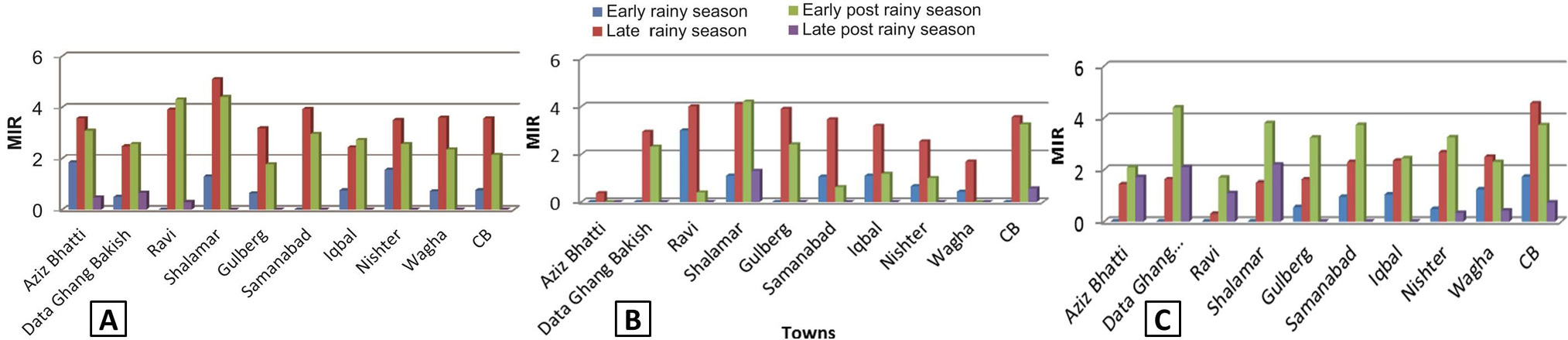
MIR in adult mosquitoes captured from different towns in 2011 (A), 2012 (B) and 2013 (C).
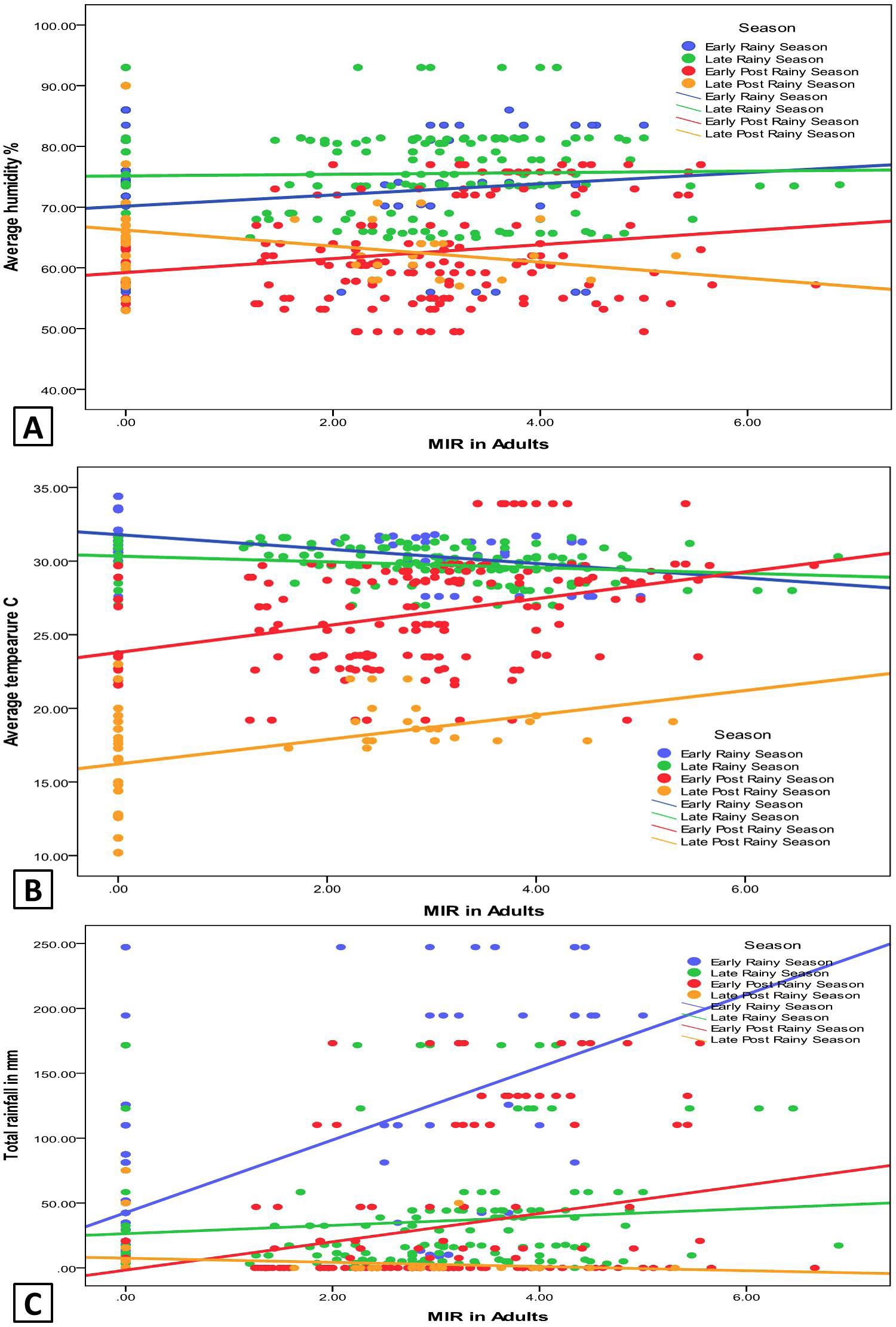
Correlation coefficient (r) and coefficient of determination (r2) of MIR with relative humidity (A), average air temperature (B) and total rainfall (C) in different seasons.
References
- Bustamante, D.M. and Lord, C.C., 2010. Sources of error in the estimation of mosquito infection rates used to assess risk of arbovirus transmission. Am. J. trop. Med. Hyg., 82: 1172-1184. https://doi.org/10.4269/ajtmh.2010.09-0323[CrossRef]
- Cowling, D.W., Gardner, I.A. and Johnson, W.O., 1999. Comparison of methods for estimation of individual-level prevalence based on pooled samples. Prev. Vet. Med., 39: 211-225. https://doi.org/10.1016/S0167-5877(98)00131-7[CrossRef]
- Gibbons, R.V. and Vaughn, D.W., 2002. Dengue: An escalating problem. Br. med. J., 324: 1563. https://doi.org/10.1136/bmj.324.7353.1563[CrossRef]
- Gu, W., Lampman, R. and Novak, R.J., 2003. Problems in estimating mosquito infection rates using MIR. J. med. Ent., 40: 595-596.
- Gu, W., Lampman, R. and Novak, R.J., 2004. Assessment of arbovirus vector infection rates using variable size pooling. Med. Vet. Ent., 18: 200-204. https://doi.org/10.1111/j.0269-283X.2004.00482.x[CrossRef]
- Gu, W. and Novak, R.J., 2004. Detection probability of arbovirus infection in mosquito populations. Am. J. trop. Med. Hyg., 71: 636-638. https://doi.org/10.4269/ajtmh.2004.71.636[CrossRef]
- Guedes, D.R.D., Cordeiro, M.T., Melo-Santos, M.A.V., Magalhaes, T., Marques, E., Regis, L., Furtado, A.F. and Ayres, C.F.J., 2010. Patient-based dengue virus surveillance in Aedes aegypti from recife, Brazil. J. Vector Borne Dis., 47: 67-75.
- Hall-Mendelin, S., Ritchie, S.A., Johansen, C.A., Zborowski, P., Cortis, G., Dandridge, S., Hall, R.A. and van Den Hurk, A.F. 2010. Exploiting mosquito sugar feeding to detect mosquito-borne pathogens. Proc. nat. Acad. Sci. U.S.A., 107: 11255-11259. https://doi.org/10.1073/pnas.1002040107[CrossRef]
- Katholi, C.R. and Unnasch, T.R., 2006. Important experimental parameters for determining infection rates in arthropod vectors using pool screening approaches. Am. J. trop. Med. Hyg., 74: 779-785. https://doi.org/10.4269/ajtmh.2006.74.779[CrossRef]
- Lima, M.D.R.O., Nogueira, R.M.R., Schatzmayr, H.G. and Dos Santos, F.B.D., 2010. Comparison of three commercially available dengue NS1antigen capture assays for acute diagnosis of dengue in Brazil. PLoS Negl. Trop. Dis., 4: e738. https://doi.org/10.1371/journal.pntd.0000738[CrossRef]
- Manzoor, F., Amin, I., Shahid, M., Afzal, S., Ramzan, H., Rehman, T., Samiullah and Idrees, M., 2017. Aedes aegypti is the major vector for transmission of dengue virus in Lahore, Pakistan. Pakistan J. Zool., 49: 1-3. https://doi.org/10.17582/journal.pjz/2017.49.2.sc6[CrossRef]
- Medicalopedia, 2012. Why Pakistan is having the dengue epidemic every summer? Medicalopedia: The Medical Galaxy. Available at: https://www.medicalopedia.org/2581/why-pakistan-is-having-the-dengue-epidemic-every-summer/ (Retrieved 18 November, 2018).
- Moore, C.G., McLean, R.G., Mitchell, C.J., Nasci, R.S., Tsai, T.F., Calisher, C.H., Marfin, A.A., Moore, P.S. and Gubler, D.J., 1993. Guidelines for arbovirus surveillance programs in the United States. Centers for Disease Control and Prevention. Fort Collins, CO.
- Muller, D.A. and Young, P.R., 2011. The many faces of the flavivirus non-structuralglycoprotein NS1. In: Molecular virology and control of flaviviruses (ed. P.Y. Shi). Caister Academic Press, Norfolk, pp. 51-75.
- Pinheiro, V.C., Tadei, W.P., Barros, P.M., Vasconcelos, P.F. and Cruz, A.C., 2005. Detection of dengue virus serotype 3 by reverse transcription-polymerase chain reaction in Aedesaegypti (Diptera, Culicidae) captured in Manaus, Amazonas. Mem. Inst. Oswaldo Cruz., 100: 833-839. https://doi.org/10.1590/S0074-02762005000800003[CrossRef]
- Racloz, V., Ramsey, R., Tong, S. and Hu, W. 2012. Surveillance of dengue fever virus: A review of epidemiological models and early warning systems. PLoS Negl. Trop. Dis., 6: e1648. https://doi.org/10.1371/journal.pntd.0001648[CrossRef]
- Rai, M.A. and Khan, H., 2007. Dengue: Indian subcontinent in the line of fire. 2007. J. clin. Virol., 38: 269-270. https://doi.org/10.1016/j.jcv.2006.12.010[CrossRef]
- Rohani, A., Zamree, I., Lee, H.L., Mustafakamal, I., Norjaiza, M.J. and Kamilan, D., 2007. Detection of transovarial dengue virus in field-collected Aedes aegypti and Aedes albopictus mosquitoes using C6/36 cell culture and reverse transcriptase-polymerase chain reaction (RT-PCR) techniques. Dengue Bull., 31: 47-57.
- Tan, C.H., Wong, P.S., Li, M.Z., Vythilingam, I. and Ng, L.C., 2011. Evaluation of the dengue NS1 Ag Strip (R) for detection of dengue virus antigen in Aedes aegypti (Diptera: Culicidae). Vector-Borne Zoon. Dis., 11: 789-792.
- Wang, W.K., Chao, D.Y., Kao, C.L., Wu, H.C., Liu, Y.C., Li, C.M., Lin, S.C., Ho, S.T., Huang, J.H. and King, C.C., 2003. High levels of plasma dengue viral load during defervescence in patients with dengue hemorrhagic fever: Implications for pathogenesis. Virology, 305: 330-338. https://doi.org/10.1006/viro.2002.1704[CrossRef]
- Wang, S.M. and Sekaran, S.D., 2010a. Evaluation of a commercial SD dengue virus NS1 antigen capture enzyme-linked immunosorbent assay kit for early diagnosis of dengue virus infection. J. clin. Microbiol., 48: 2793-2797. https://doi.org/10.1128/JCM.02142-09[CrossRef]
- Wang, S.M. and Sekaran, S.D., 2010b. Evaluation of a commercial SD dengue virus NS1 antigen capture enzyme-linked immunosorbent assay kit for early diagnosis of dengue virus infection. J. clin. Microbiol., 48: 2793-2797. https://doi.org/10.1128/JCM.02142-09[CrossRef]
- WHO, 2002. Dengue and dengue haemorrhagic fever. Fact Sheet No. 117, World Health Organization, Geneva.
- Wu, P.C., Guo, H.R., Lung, S.C., Lin, C.Y. and Su, H.J., 2007. Weather as an effective predictor for occurrence of dengue fever in Taiwan. Acta Trop., 103: 50-57. https://doi.org/10.1016/j.actatropica.2007.05.014[CrossRef]
- Zainah, S., Wahab, A.H., Mariam, M., Fauziah, M.K., Khairul, A.H., Roslina, I., Sair Ulakhma, A., Kadimon, S.S., Jais, M.S. and Chua, K.B., 2009. Performance of a commercial rapid dengue NS1antigen immunochromatography test with reference to dengue NS1 antigen-capture ELISA. J. Virol. Meth., 155: 157-160. https://doi.org/10.1016/j.jviromet.2008.10.016[CrossRef]
Cited by 1 article
In journals published by ResearchersLinks.
Services
Article usage statistics
Loading…