
The mosquito Aedes aegypti is a serious public health concern since it is the principle vector of several arboviruses. Insecticide application is the most essential component of the present global strategy for the control of mosquito-associated diseases, and vector control is a critical component of that strategy. However, the present study was conducted to evaluate the toxicity of five different insecticides (Spinosad 100%EC, chlorfenapyr 36%SC, pyriproxyfen 10% EC, matrine 0.5 AS and imidacloprid 70% WDG) against Aedes aegypti larval mortality under laboratory conditions. Result indicated that Spinosad (77.32% mortality) and pyriproxyfen (66.28% mortality) are more toxic to A. aegypti larvae as compared to matrine, chlorfenapyr and imidacloprid after 72-h exposure. While minimum mortality was recorded after 24-h exposure of insecticides in all treatments. So, it can be concluded that spinosad was more toxic to kill A. aegypti larvae.
Research Article · Volume 8, Issue 1, 22 June 2022 · Open Access
Toxicity of Different Insecticides against Dengue Vector Aedes aegypti Larvae under Laboratory Conditions
· · · · · · ·
Affiliations & Notes ⌄
- 1Department of Entomology, College of Plant Protection, China Agricultural University, Beijing, China
- 2Department of Entomology, University of Agriculture, Faisalabad, Pakistan. *Correspondence | Ghulam Murtaza, Department of Entomology, College of Plant Protection, China Agricultural University, Beijing, China
- 3Email: murtazabwn54@gmail.com
- 4School of Sciences, Department of Life Sciences, University of Management and Technology, Johar Town Lahore
- 5Department of Zoology, Wildlife and Fisheries, University of Agriculture, Faisalabad, Pakistan
- 6Pest warning and Quality Control of Pesticides Punjab Lahore, Pakistan
- 7Institute of Botany, University of Punjab, Lahore, Pakistan
Article Info ⌄
- Journal:
- Journal of Innovative Sciences
- Published:
- 22 June 2022
From the article
- Result indicated that Spinosad (77.32% mortality) and pyriproxyfen (66.28% mortality) are more toxic to A. aegypti larvae as compared to matrine, chlorfenapyr and imidacloprid after 72-h exposure.
- Our result revealed that non-significant reduction in larval mortality after 24-h in all insecticides except spinosad somehow have more toxic to kill A. aegypti larvae after 24-h of application.
- After 72-h larval exposure to insecticides shows that spinosad and pyriproxyfen were more toxic to cause 77.32% and 66.28 % mortality (Figure 3).
- Generally, it can be concluded that our present findings suggest that spinosad is comparatively a safe alternative to the insecticides in use for the control of A. aegypti larvae.
Selected from the article's own text.
Abstract
1. Introduction
Mosquitoes are a vector for a variety of human diseases such as dengue fever, lymphatic filariasis, yellow fever, and malaria . These diseases wreaked havoc on people’s health in regions with hot and humid climates all across the world . Female mosquitos have an important role in the transmission of illness viruses to humans during blood feeding . Dengue fever (DF) is a viral infection spread by mosquito bites of the Aedes aegypti and Aedes albopictus species (Eggar et al., 2008). Around two-thirds of the world’s population lives in places plagued with Aedes aegypti, the disease’s main vector .
In tropical and subtropical locations of the world, DF is a major cause of illness . Globally, 50–100 million incidence of DF and 250,000–500,000 cases of DHF are anticipated to occur each year . Dengue fever outbreaks were recorded in Pakistan in 2006 and 2007 in Karachi, Islamabad, Mirpur-Khas, Haripur, Hyderabad, Lahore, and Rawalpindi, with 2700 confirmed cases and 24 deaths. In 2008, 1800 instances were reported in Lahore, Punjab province (WHO, 2012; .
Mosquitoes have acquired resistance to chemical insecticides as a result of decades of widespread usage of these pesticides to control mosquito populations . Furthermore, public health concerns have prompted research into alternate insecticides for mosquito vector control . Low mammalian toxicity, low environmental impact, a broad spectrum of activity against all target mosquito species, and a long duration of effect that reduces application frequency are the primary characteristics for an efficient mosquito larvicide. Researchers began looking for new insecticides with novel mechanisms of action in order to prevent or mitigate the effects of pesticide resistance in the previous generation of insecticides ; ; WHO, 2012). Because of their low mammalian toxicity, biological specificity, and environmental safety, insect growth regulators (IGRs) have been advocated as an alternative to synthetic pesticides ; ; ; .
The acceptability of insecticidal compounds used in insect vector control programmes is determined by a number of factors, including their environmental persistence and the behavioral tendencies of insect vectors exposed to the compound. So, the present experiment was conducted to evaluate toxicity of five different insecticides against A. aegypti larval mortality under laboratory conditions.
2. Materials and Methods
2.1 Mosquito rearing
Aedes aegypti was chosen as the investigational insect in this study because it is a key vector for the propagation of dengue fever and one of the most important and irritating. Mosquitoes larvae were gathered using a normal dipper from mosquito breeding places such as pots, tyres, stagnant water reservoirs, and various locations around the University. Mosquito larvae and pupa were collected and identified in the lab based on their larval stage. Adult Aedes aegypti specimens were housed in screened cages until they emerged as adults. Adults were gathered using a mouth aspirator after emergence and placed in rearing cages. Male mosquitoes were fed honey and water solution for raising, whereas female mosquitoes were fed white rat blood. The female lays her eggs on filter paper that is wrapped around the water-filled beaker. Tetraamine, a larval meal comprising 5.0 percent crude fat, 1.3 percent phosphorus, 45.0 percent crude protein, 183 mg vitamin C per kg, and 2.0 percent crude fiber were dissolved in water. The pupae were separated and transferred into the cages for adult emergence after pupation.
2.2 Study layout
The experiment was set up in the form of a Complete Randomized Design (CRD) under laboratory conditions. Five different insecticides (spinosad 100% EC, chlorfenapyr 36% SC, pyriproxyfen 10% EC, matrine 0.5 AS and imidacloprid 70% WDG) were tested for toxicity against Aedes aegypti larvae. All insecticides were used at a normal dose and replicated three times with a control group.
2.3 Bioassay for larvae of mosquito
The bioassays were carried out in accordance with the World Health Organization’s criteria (1981). In the bioassay, Aedes aegypti third and early emerging forth instar larvae were used. Insecticides were sprayed into plastic cups with a capacity of 150 ml. To determine toxicity, cups were filled to the top with water and pesticide stock solution, and 25 larvae were released into the cups. Only distilled water was used as a control, and larvae were released. The mortality rates were measured after 12, 24, and 48 hours of pesticide exposure. Larvae that did not move in response to repeated prodding were assumed to be dead. Daily mortalities of larvae and pupae were recorded, and alive pupae were transferred to untreated water in fresh beakers and allowed until the final mosquito emerged. Dead adults were reported for both partially emerged mosquitoes and those found fully emerged but unable to escape the water surface.
2.4 Statistically analysis
Bioassay data was collected and analyzed using standard Probit analysis , with bioassay results corrected using Abbot’s algorithm . The LC50 results were statistically significant (P≤0.05).
3. Results and Discussion
Result indicated that Spinosad (77.32% mortality) and pyriproxyfen (66.28% mortality) are more toxic to A. aegypti larvae as compared to matrine, chlorfenapyr and imidacloprid after 72-h exposure. While minimum mortality was recorded after 24-h exposure of insecticides in all treatments shown in Figure 1.
The comparative analysis of the spinosad 100EC, chlorfenapyr, pyriproxyfen, matrine, and imidacloprid on larval mortality after 24-h shown in Figure 1. Our result revealed that non-significant reduction in larval mortality after 24-h in all insecticides except spinosad somehow have more toxic to kill A. aegypti larvae after 24-h of application. While after 48-h larval exposure to insecticides indicated that more larval mortality was found in case of spinosad and pyriproxyfen as compared to Matrine, Chlorfenapyr and imidacloprid shown in Figure 2.
After 72-h larval exposure to insecticides shows that spinosad and pyriproxyfen were more toxic to cause 77.32% and 66.28 % mortality (Figure 3). Meanwhile pyriproxyfen is harmful to mosquito larvae after spinosad and can be found in their environments for several months ; . The high efficacy of pyriproxyfen against vulnerable mosquito larvae of A. aegypti has been established in our recent investigation. pyriproxyfen, on the other hand, inhibits adult emergence but does not kill larvae, unlike other chemical larvicides. Even though pyriproxyfen appears to have no cross-resistance with conventional insecticides , its mechanism of action may offer some practical problems, since the prolonged presence of larvae may be perceived as a treatment failure by homeowners.
In contrast, after 72 hours of pesticide treatment, spinosad demonstrated significant toxicity against mosquito larvae shown in Figures 3 and 4. Spinosad have a strong insecticidal action against target pests and minimal danger to people and nontarget animals, it considered as a potential bioinsecticide for public health . It kills a wide spectrum of mosquito species quickly and has no cross-resistance to other insecticides like organophosphates, carbamates, or pyrethroids (Darriet and Corbel, 2005).
Conclusions and Recommendations
Generally, it can be concluded that our present findings suggest that spinosad is comparatively a safe alternative to the insecticides in use for the control of A. aegypti larvae. Spinosad was most toxic among the tested insecticides followed by pyriproxyfen, matrine, chlorfenapyr and imidacloprid against A. aegypti larvae.
Novelty Statement
Mosquito Aedes aegypti is a serious public health concern since it is the principal vector of several arboviruses. Mostly different insecticides are used to control mosquito. So, this study will be help to researcher and scientists to select most suitable insecticides for the control of mosquito.
Author’s Contribution
GM conducted the study and wrote the manuscript, MIF critically reviewed the manuscript and help in data analyzing, NM, MNK, TR helped in data collection and manuscript writing, GEZ, TA MD and helped in data analyzing and critically reviewed the manuscript.
Conflict of interest
The authors have declared no conflict of interest.
Figures
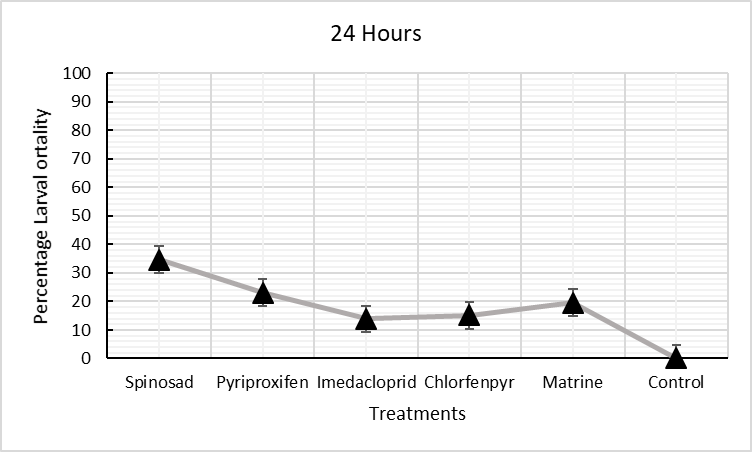
Toxicity of different insecticides to fourth instar larvae of A. aegypti after 24-h exposure.
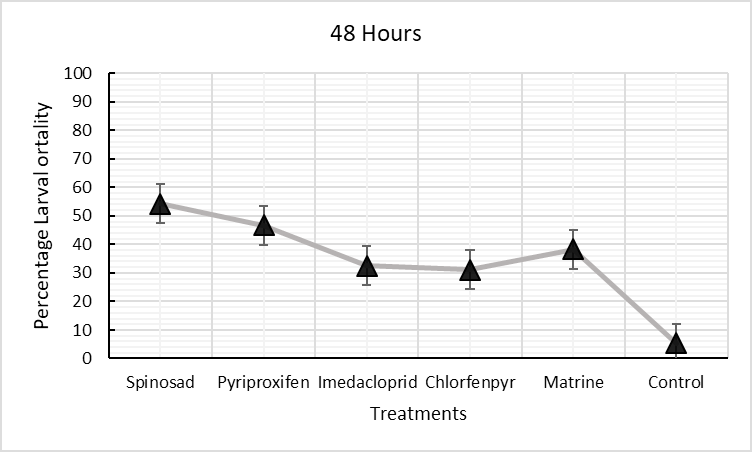
Toxicity of different insecticides to fourth instar larvae of A. aegypti after 48-h exposure.
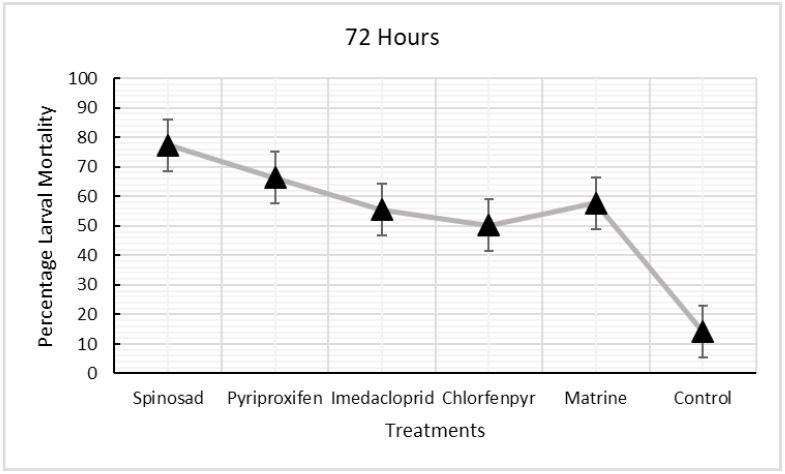
Toxicity of different insecticides to fourth instar larvae of A. aegypti after 72-h exposure.
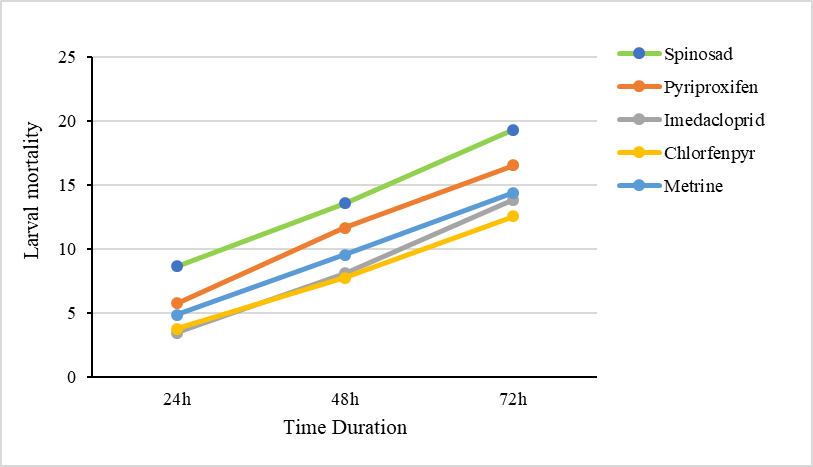
Mean Comparison of toxicity of different insecticides to fourth instar larvae of A. aegypti after 24, 48 and 72-h exposure.
References
- Abbott, W.S., 1925. A method of computing the effectiveness of an insecticide. J. Econ. Entomol., 18: 265-267. https://doi.org/10.1093/jee/18.2.265a[CrossRef]
- Al-Azab, A.M., and Shaalan, E.A., 2018. Efficacy of spinosad and flubex against dengue fever vector Aedes aegypti in Jeddah Governorate, Saudi Arabia. PSM Vet. Res., 3: 15-21.
- Ayudhaya, W.S.N. and Wassanasompong, W., 2017. Insecticide susceptibility of aedes aegypti larvae to bacillus thuringiensis israelensis and juvenile hormone in dengue epidemic areas of samutsongkhram, Thailand. Int. J., 13(40): 107-111. https://doi.org/10.21660/2017.40.86187[CrossRef]
- Claro, L.B., Tomassini, H.C. and Rosa, M.L., 2004. Dengue prevention and control: A review of studies on knowledge, beliefs, and practices. Cadernos de saude publica, 20: 1447-1457. https://doi.org/10.1590/S0102-311X2004000600002[CrossRef]
- Damapong, P., Jumparwai, S. and Kaen, K., 2016. Model development for outbreak of dengue fever. Int. J. Geomate, 11: 2777-2781.
- Darriet, F. and Corbel, V., 2006. Laboratory evaluation of pyriproxyfen and spinosad, alone and in combination, against Aedes aegypti larvae. J. Med. Entomol., 43: 1190–1194. https://doi.org/10.1603/0022-2585(2006)43[1190:LEOPAS]2.0.CO;2[CrossRef]
- Darriet, F., Duchon, S. and Hougard, J.M., 2005. Spinosad: A new larvicide against insecticide resistant mosquito larvae. J. Am. Mosq. Contr. Assoc., 21: 495. https://doi.org/10.2987/8756-971X(2006)21[495:SANLAI]2.0.CO;2[CrossRef]
- Egger J.R., Ooi, E.E., Kelly, D.W., Woolhouse, M.E., Daviesa, C.R. and Colemana, P.G., 2008. Reconstructing historical changes in the force of infection of dengue fever in Singapore: Implications for surveillance and control. Bull. World Health Org., 86: 187-196. https://doi.org/10.2471/BLT.07.040170[CrossRef]
- Endy, T.P., Chunsuttiwat, S., Nisalak, A., Libraty, D.H., Green, S., Rothman, A.L. and Ennis, F.A., 2002. Epidemiology of inapparent and symptomatic acute dengue virus infection: A prospective study of primary school children in Kamphaeng Phet, Thailand. Am. J. Epidemiol., 156(1): 40-51. https://doi.org/10.1093/aje/kwf005[CrossRef]
- Finney, D.J., 1971. Probit analysis. Cambridge University Press, Cambridge, United Kingdom.
- Guzman, M.G., and Kouri, G., 2003. Dengue and dengue hemorrhagic fever in the Americas: Lessons and challenges. J. Clin. Virol., 27: 1-13. https://doi.org/10.1016/S1386-6532(03)00010-6[CrossRef]
- Hemingway, J. and Ranson, H., 2000. Insecticide resistance in insect vectors of human disease. Ann. Rev. Entomol., 45: 371-391. https://doi.org/10.1146/annurev.ento.45.1.371[CrossRef]
- Ishaaya, I., Kontsedalov, S., and Horowitz, A.R., 2005. Biorational insecticides: mechanism and cross-resistance. Arch. Insect Biochem. Physiol., 58: 192-199. https://doi.org/10.1002/arch.20042[CrossRef]
- Jahan, N. and Sarwar, M.S., 2013. Field evaluation of lethal ovitraps for the control of dengue vectors in Lahore, Pakistan. Pak. J. Zool., 45: 305-315.
- Murtaza, G., Ramzan, M., Bilal, H., Ejaz, A., Khan, M.A.A., Riaz, T., and Waqas, M., 2021. Monitoring of fruit fly, Bactrocera zonata (Diptera: Tephritidae) population by installing traps in mango orchard Bahawalnagar, Pakistan. J. Appl. Res. Plant Sci., 2(2): 148-151.
- Perez, C.M., Marina, C.F., Bond, J.G., Rojas, J.C., Valle, J., and Williams, T., 2007. Spinosad, a naturally derived insecticide, for control of Aedes aegypti (Diptera: Culicidae): Efficacy, persistence, and elicited oviposition response. J. Med. Entomol., 44(4): 631-638. https://doi.org/10.1093/jmedent/44.4.631[CrossRef]
- Ramzan, M., Murtaza, G., Javaid, M., Iqbal, N., Raza, T., Arshad, A. and Awais, M., 2019. Comparative efficacy of newer insecticides against Plutella xylostella and Spodoptera litura on cauliflower under laboratory conditions. Ind. J. Pure App. Biosci., 7(5): 1-7. https://doi.org/10.18782/2320-7051.7796[CrossRef]
- Sharma, S.K., Upadhyay, A.K., Haque, M.A., Tyagi, P.K., Raghavendra, K. and Dash, A.P., 2010. Wash-resistance and field evaluation of alphacypermethrin treated long-lasting insecticidal net (Interceptor®) against malaria vectors Anopheles culicifacies and Anopheles fluviatilis in a tribal area of Orissa, India. Acta Trop., 116: 24-30. https://doi.org/10.1016/j.actatropica.2010.05.002[CrossRef]
- Sihuincha, M., Zamora-Perea, E., Orellana-Rios, W., Stancil, J.D., Lopez-Sifuentes, V., Vidal-Ore, C., and Devine, G.J., 2005. Potential use of pyriproxyfen for control of Aedes aegypti (Diptera: Culicidae) in Iquitos, Peru. J. Med. Entomol., 42: 620-630. https://doi.org/10.1093/jmedent/42.4.620[CrossRef]
- Silva, J., Mendes, J. and lomonaco, C., 2009. Effects of sublethal concentrations of diflubnzuron and methoprene on Aedes aegypti (Diptera: Culicidae) fitness. Int. J. Trop. Ins. Sci., 29: 17-23. https://doi.org/10.1017/S1742758409289648[CrossRef]
- Thavara, U., Tawatsin, A., Kong-ngamsuk, W. and Mulla, M.S., 2004. Efficacy and longevity of a new formulation of temephos larvicide tested in village-scale trials against A. aegypti larvae in water-storage containers. J. Am. Mosq. Contr. Assoc., 20: 176-182
- Uragayala, S., Verma, V., Natarajan, I., Sharma, E., Velamuri, P., and Kamaraju, R., 2015. Adulticidal and larvicidal efficacy of three neonicotinoids against insecticide susceptible and resistant mosquito strains. Indian J. Med. Res., 142: 64-70. https://doi.org/10.4103/0971-5916.176624[CrossRef]
- Williams, T., Valle, J., and Vinuela, E., 2003. Is the naturally derived insecticide spinosad compatible with insect natural enemies? Biocontr. Sci. Technol., 13: 459-475. https://doi.org/10.1080/0958315031000140956[CrossRef]
- World Health Organization, 2012. Global plan for insecticide resistance management in malaria vector. WHO Global Malaria Programme. WHO, Geneva.
- Yapabandara, A.M., and Curtis, C.F., 2004. Control of vector and incidence of malaria in an irrigated settlement scheme in Sri Lanka by using the insect growth regulator pyriproxyfen. J. Am. Mosq. Contr. Assoc., 20: 395-400.
Services
Article usage statistics
Loading…