Research Article · Volume 14, Issue 10, 23 September 2026 · Open Access
Dietary Kepayang (Pangium edule) Seed Meal Alters Intestinal Characteristics Without Affecting Growth Performance or Meat Fatty Acid Composition in Broilers
·
Affiliations & Notes ⌄
1Department of Animal Science, Faculty of Animal Science, Universitas Jambi, Jl. Raya Jambi-Muara Bulian Km 15. Mendalo Darat, Jambi, Indonesia. *Correspondence | Wiwaha Anas Sumadja, Department of Animal Science, Faculty of Animal Science, Universitas Jambi, Jl. Raya Jambi-Muara Bulian Km 15. Mendalo Darat, Jambi, Indonesia
Therefore, the present findings indicate that dietary inclusion of processed kepayang seed meal at the levels tested did not produce statistically detectable changes in growth performance.
Dietary inclusion of processed kepayang (Pangium edule) seed meal up to 1.0% had no significant effect on body weight gain, feed intake, feed conversion ratio, or meat fatty acid composition of broiler chickens.
However, supplementation influenced jejunal and ileal lengths, indicating that processed kepayang seed meal may affect intestinal structural characteristics.
Overall, processed kepayang seed meal showed limited effects on production performance and meat lipid composition under the conditions of this study.
Selected from the article's own text.
Abstract
Kepayang (Pangium edule) seed meal is a locally available but rarely utilized tropical feed resource containing phenolic compounds, antioxidants, and unsaturated fatty acids that may exert biological effects in poultry. This study evaluated the effects of dietary kepayang seed meal on growth performance, intestinal characteristics, and meat fatty acid composition in broiler chickens. A total of 200 day-old broiler chicks were randomly assigned to five dietary treatments consisting of a basal diet supplemented with 0, 0.25, 0.50, 0.75, and 1.00% kepayang seed meal in a completely randomized design and four replicates for 35 days. Growth performance, intestinal measurements, and meat fatty acid profiles were determined using standard procedures and gas chromatography analysis. Dietary supplementation with kepayang seed meal did not significantly affect (P > 0.05) body weight gain, feed intake, feed conversion ratio, or meat fatty acid composition. However, birds receiving kepayang seed meal exhibited significantly greater jejunal and ileal lengths compared with the control group. These findings indicate that low dietary inclusion levels of kepayang seed meal was associated with differences in intestinal characteristics without altering growth performance or meat fatty acid deposition. The results provide preliminary evidence supporting further investigation of kepayang seed meal as a locally available functional feed resource in broiler nutrition.
The poultry industry continues to seek locally available feed resources that can support sustainable production while reducing dependence on conventional feed ingredients. In tropical regions, numerous indigenous plant materials remain underutilized despite their potential nutritional and functional value. Consequently, increasing attention has been directed toward evaluating alternative plant-derived feed ingredients for poultry diets.
Kepayang (Pangium edule) is a tropical plant widely distributed in Southeast Asia. Previous studies have reported that kepayang seeds contain various bioactive compounds, including phenolic substances and unsaturated fatty acids, suggesting their potential as functional feed ingredients in animal nutrition ; . However, scientific information regarding the use of kepayang seed meal in broiler diets remains limited. Most available studies have focused primarily on the chemical characteristics and processing of kepayang seeds, whereas information on their biological responses in poultry is scarce.
Previous investigations of plant-derived feed ingredients have shown variable effects on broiler performance. In many cases, supplementation does not necessarily improve body weight gain or feed efficiency, particularly when birds are fed nutritionally adequate diets ; . Nevertheless, dietary interventions may induce changes in intestinal characteristics that are not always reflected in conventional production parameters. Because intestinal structure plays an important role in nutrient digestion and absorption, measurements of intestinal traits can provide additional information regarding physiological responses to dietary treatments.
Another area of interest is the potential influence of plant-derived feed ingredients on meat fatty acid composition. Several studies have demonstrated that dietary lipid sources can modify tissue fatty acid profiles when supplied at sufficient inclusion levels ; . However, the extent to which low dietary inclusion levels of plant seed meals contribute to changes in broiler meat fatty acid composition remains unclear. Since kepayang seeds contain lipid components reported in previous studies, evaluating their potential effects on meat fatty acid deposition is warranted.
Although intestinal characteristics and meat lipid composition have been investigated separately in many feeding studies, reports simultaneously evaluating both responses to dietary kepayang seed meal are currently limited. Such information is needed to determine whether dietary supplementation with low levels of kepayang seed meal influences intestinal characteristics, meat fatty acid composition, or both.
Therefore, the present study was conducted to evaluate the effects of dietary kepayang (Pangium edule) seed meal on growth performance, intestinal characteristics, and meat fatty acid composition in broiler chickens. It was hypothesized that supplementation with kepayang seed meal at levels up to 1.0% would not adversely affect growth performance while potentially influencing intestinal characteristics and/or meat fatty acid composition.
MATERIALS AND METHODS
Experimental design and birds
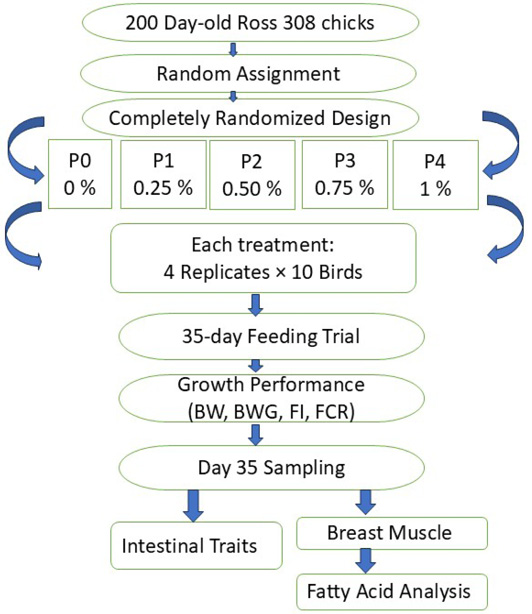
A total of 200 one-day-old male Ross 308 broiler chicks were randomly allocated to five dietary treatments in a completely randomized design with four replicates of 10 birds per replicate. The dietary treatments consisted of a basal diet without kepayang seed meal (control) and basal diets supplemented with 0.25%, 0.50%, 0.75%, and 1.00% kepayang (Pangium edule) seed meal. The feeding trial was conducted for 35 days at the Experimental Farm of the Faculty of Animal Science, Universitas Jambi, Indonesia. Feed and drinking water were provided ad libitum throughout the study. A schematic overview of the experimental design, treatment allocation, and sampling procedures is presented in Figure 1.
Diet preparation
The kepayang (Pangium edule) seeds used in this study were obtained in a traditionally processed form intended for human consumption. Traditional processing methods are known to substantially reduce cyanogenic compounds; therefore, residual hydrogen cyanide (HCN) concentrations in the processed seeds were expected to be minimal. The processed seeds were subsequently cleaned, oven-dried at 60 °C for 24 h, and ground into meal before incorporation into the experimental diets. The processed meal was then mixed thoroughly with the basal diets according to treatment levels. The present study did not include analyses of hydrocyanic acid (HCN) or other anti-nutritional factors in the processed seed meal; therefore, the findings should be interpreted as a preliminary evaluation of biological responses under controlled experimental conditions.
Diet composition
Experimental diets were formulated to meet or exceed the nutrient requirements of broiler chickens according to NRC (1994) recommendations. The starter diet contained approximately 23% crude protein and 3200 kcal/kg metabolizable energy, whereas the finisher diet contained approximately 20% crude protein and 3200 kcal/kg metabolizable energy.
Growth performance measurements
Body weight and feed consumption were recorded on a replicate basis throughout the experimental period. Body weight gain, feed intake, and feed conversion ratio were subsequently calculated using standard procedures.
Intestinal measurements
At 35 days of age, one bird representing the average body weight of each replicate was selected and humanely slaughtered. Following evisceration, the intestinal tract was carefully removed and separated into duodenum, jejunum, and ileum segments according to established anatomical landmarks. The length of each intestinal segment was measured using a flexible measuring tape and recorded in centimeters. Measurements were performed by trained laboratory personnel immediately after dissection to minimize tissue shrinkage. Histological evaluations, including villus height and crypt depth measurements, were not conducted in the present study.
Meat fatty acid analysis
Breast muscle lipids were extracted following the method of Folch et al. (1957). Fatty acid methyl esters (FAME) were prepared by transmethylation and analyzed using a gas chromatograph (Shimadzu GC-2010 Plus, Kyoto, Japan) equipped with a flame ionization detector (FID). Separation was performed using a capillary column (SP-2560, 100 m × 0.25 mm × 0.20 μm; Supelco, USA). Nitrogen was used as the carrier gas at a flow rate of 1.0 mL/min. The injector and detector temperatures were maintained at 250 °C. Fatty acids were identified by comparing retention times with certified FAME standards (Supelco 37 Component FAME Mix, USA) and expressed as a percentage of total identified fatty acids.
Statistical analysis
Data were analyzed using one-way analysis of variance (ANOVA) using SPSS statistical software (Version 26,0 IBM Corp., Armonk, NY, USA). When treatment effects were significant (P < 0.05), means were separated using Duncan’s multiple range test. The replicate pen served as the experimental unit for growth performance variables, whereas individual birds were considered the experimental unit for intestinal and meat fatty acid measurements.
RESULTS AND DISCUSSION
Dietary supplementation with processed kepayang (Pangium edule) seed meal up to 1.0% did not significantly affect (P > 0.05) body weight, body weight gain, feed intake, or feed conversion ratio throughout the experimental period (Table 1). Although some numerical variation was observed among treatments, particularly for feed conversion ratio, no consistent dose-dependent response was evident. The relatively large variation observed within treatments may have reduced the ability to detect modest treatment effects. Therefore, the present findings indicate that dietary inclusion of processed kepayang seed meal at the levels tested did not produce statistically detectable changes in growth performance.
Similar observations have been reported in studies evaluating phytogenic feed ingredients in broiler diets, where supplementation influenced certain physiological responses without consistently affecting growth performance ; ; . However, unlike those studies, the present experiment did not evaluate intestinal histology, immune status, or digestive enzyme activity. Therefore, direct comparisons with studies that measured functional intestinal responses should be made with caution.
Table 2: Effect of dietary kepayang seed meal on intestinal characteristics of broiler chickens.
Parameters
Treatments
P - Value
P0
P1
P2
P3
P4
Duodenum (cm)
31.37±0.75
32.87±1.65
30.87±2.63
32.13±1.31
32.50±0.91
0.891
Jejenum (cm)
77.38±3.25a
83.62±4.51b
83.62±0.63b
79.37±1.55a
82.38±5.34ab
0.046
Ileum (cm)
84.87±0.35ab
83.37±1.41a
80.25±5.65a
84.12±5.65ab
89.62±9.19b
0.035
Notes: Numbers with different superscript letters in the same row indicate significant differences (P<0.05).
Differences in intestinal characteristics were observed among dietary treatments (Table 2). Jejunal length was greater in birds receiving 0.25% and 0.50% kepayang seed meal compared with some other treatments, whereas the longest ileal length was observed in birds receiving 1.0% supplementation. However, these responses did not follow a clear dose-dependent pattern. Statistically significant differences were observed for jejunal (P < 0.05) and ileal length (P < 0.05). Nevertheless, because these responses were not consistently dose-dependent and were not supported by functional intestinal measurements, their biological significance should be interpreted with caution. Structural changes in the intestine do not necessarily correspond to proportional changes in nutrient absorption or animal performance, as intestinal morphology and function are influenced by multiple dietary and physiological factors .
The present study evaluated only gross intestinal measurements and did not include villus height, crypt depth, goblet cell density, nutrient digestibility, microbiota composition, or inflammatory markers. Although intestinal structure is closely associated with digestive function and nutrient utilization, gross intestinal length alone is insufficient to characterize gastrointestinal development or digestive capacity . Consequently, it is not possible to determine whether the observed differences in intestinal length were associated with improved absorptive capacity, altered intestinal function, or other physiological responses. Comprehensive assessment of intestinal health generally requires evaluation of structural, microbial, immunological, and physiological parameters in addition to gross anatomical measurements . Previous studies have shown that phytogenic feed additives may influence intestinal morphology and epithelial characteristics ; ; ; . However, because those studies incorporated histological or functional assessments, their findings should not be considered directly comparable with the present results.
The absence of a significant response in duodenal length further indicates that intestinal responses to dietary kepayang seed meal were not uniform across intestinal segments. The physiological basis of this observation remains unclear and requires further investigation. Additional studies incorporating histological evaluation and nutrient digestibility measurements are needed to clarify whether the observed structural differences have functional consequences.
An additional limitation of the present study is that residual hydrocyanic acid (HCN) concentrations in the processed kepayang seed meal were not determined. Although the experimental material consisted of traditionally processed seeds commonly used for human consumption, which undergo detoxification procedures that substantially reduce cyanogenic compounds , direct quantification of residual HCN would provide stronger evidence regarding the safety of processed kepayang seed meal. Therefore, future studies should include HCN analysis together with biological evaluations to strengthen the safety assessment of this feed ingredient.
The fatty acid composition of broiler breast muscle was not significantly affected by dietary treatment (Table 3). No significant differences were detected in oleic acid, linoleic acid, total saturated fatty acids (∑SFA), monounsaturated fatty acids (∑MUFA), polyunsaturated fatty acids (∑PUFA), or the PUFA/SFA ratio. Although numerical variation was observed among treatments, particularly for oleic and linoleic acids, substantial variability among birds resulted in considerable overlap among treatment means.
The absence of significant differences in fatty acid composition suggests that the inclusion levels of kepayang seed meal used in this experiment contributed insufficient quantities of dietary lipids to produce measurable changes in tissue fatty acid deposition. Similar findings have been reported when lipid-containing plant materials were included at relatively low dietary concentrations ; ; ; . Furthermore, the lack of significant differences in the PUFA/SFA ratio supports the conclusion that dietary supplementation with processed kepayang seed meal up to 1.0% did not substantially alter overall lipid deposition patterns in broiler breast muscle.
Overall, the present findings indicate that dietary supplementation with processed kepayang seed meal up to 1.0% did not significantly affect growth performance or meat fatty acid composition, while modest differences
Table 3: The fatty acid composition of broiler meat from chickens fed diets containing kepayang seed meal.
Parameters
Treatments
P value
P0
P1
P2
P3
P4
Octanoic acid
0.45±0.144
0.26±0.07
0.22±0.054
0.18±0.091
0.12±0.054
0.592
Decanoic acid
0.31±0.054
0.43±0.14
0.27±0.09
0.15±0.04
0.20±0.12
0.444
Lauric acid
3.58±1.18
3.58±2.13
2.23±1.63
1.68±1.22
2.47±1.22
0.279
Tridecanoic acid
0.15±0.04
1.79±2.25
1.24±0.88
2.17±0.93
3.64±1.19
0.277
Myristic acid
0.23±0.09
0.14±0.01
1.49±1.01
0.17±0.09
0.28±0.11
0.681
Myristoleic acid
2.22±0.59
2.46±0.38
1.16±0.89
1.93±0.46
2.02±0.72
0.856
Pentadecanoic acid
0.61±0.68
0.38±0.11
0.25±0.05
0.31±0.09
0.21±0.06
0.274
Palmitoleic acid
22.99±3.38
30.62±6.79
24.87±1.99
22.23±5.04
26.19±2.79
0.903
Oleic acid
7.07±0.88
8.45±2.95
6.30±3.19
6.34±1.87
6.55±0.43
0.779
Linoleic acid
31.93±5.89
26.46±5.11
27.05±9.14
32.68±9.64
36.07±2.77
0.682
Arachidic acid
0.28±0.08
0.61±0.85
0.87±1.10
0.12±0.02
0.35±0.16
0.557
Eicosenoic acid
0.99±0.50
0.91±0.41
0.99±0.51
0.13±0.02
0.29±0.28
0.378
Behenic acid
0.82±0.25
0.70±0.57
1.79±0.48
0.91±0.56
0.69±0.08
0.695
Erucic acid
0.20±0.07
0.50±0.02
0.49±0.23
0.13±0.04
0.14±0.005
0.972
Stearic acid
0.42±0.01
0.54±0.35
0.18±0.03
0.23±0.18
0.16±0.05
0.367
Heptadecanoic acid
0.25±0.07
0.43±0.06
0.18±0.03
0.23±0.07
0.28±0.06
0.660
Palmitic acid
0.58±0.27
0.16±0.02
0.44±0.25
0.11±0.05
0.28±0.06
0.741
∑SFA
7.39±2.15
8.43±4.33
8.34±1.75
6.14±1.07
8.50±0.68
0.830
∑MUFA
34.23±2.75
37.43±14.15
23.74±14.96
23.78±14.07
32.70±7.15
0.900
∑PUFA
31.93±5.89
26.46±5.11
27.05±9.14
32.68±9.64
36.07±2.77
0.682
PUFA/SFA
4.64±1.54
3.83±2.17
3.53±1.88
5.28±1.19
4.21±0.57
0.992
in jejunal and ileal lengths were observed. Because these intestinal responses were not consistently dose-dependent and were not accompanied by functional measurements, further studies are required before definitive conclusions can be drawn regarding their biological significance.
CONCLUSION
Dietary inclusion of processed kepayang (Pangium edule) seed meal up to 1.0% had no significant effect on body weight gain, feed intake, feed conversion ratio, or meat fatty acid composition of broiler chickens. However, supplementation influenced jejunal and ileal lengths, indicating that processed kepayang seed meal may affect intestinal structural characteristics. Overall, processed kepayang seed meal showed limited effects on production performance and meat lipid composition under the conditions of this study.
ACKNOWLEDGEMENTS
The authors would like to express their sincere gratitude to the Rector of Universitas Jambi for financial support through the PNBP Percepatan Guru Besar scheme. Appreciation is also extended to the Dean of the Faculty of Animal Science, Universitas Jambi, for providing research facilities, including poultry housing and laboratory support. The authors further acknowledge all individuals who contributed to the successful completion of this study.
NOVELTY STATEMENTS
Information on the use of processed Pangium edule seed meal in broiler diets is scarce. This study provides baseline data on its effects on growth performance, intestinal characteristics, and meat fatty acid composition, contributing to the limited knowledge available on this underutilized tropical feed resource.
Author’s Contribution
Wiwaha Anas Sumadja: Conceptualization, methodology,
investigation, data collection, data analysis, and
manuscript preparation.
Ucop Haroen: Conceptualization, supervision,
interpretation of results, and manuscript review and
editing.
Both authors approved the final manuscript.
Ethical approval
All experimental procedures involving animals were conducted in accordance with institutional guidelines for animal care and use and were approved by the Ethical Clearance Committee of the Faculty of Animal Science, Universitas Jambi, Indonesia (Approval No. 07/UN21.7/ECC/2025; approved on 15 August 2025).
Generative AI and AI assisted technology statement
The authors declare that no generative AI and AI assisted technology was used in the creation of this manuscript.
Conflict of interest
The authors have declared no conflict of interest.
Figures
Figure 1:.
Schematic diagram of the experimental design.
References
Alagbe EO, Sung JY, Pasternak JA, Adeola O (2026). Postnatal small intestinal morphological development in Cobb 500 broiler chickens. Poult. Sci., 105(4): 106412. https://www.sciencedirect.com/science/article/pii/S0032579126000428 https://doi.org/10.1016/j.psj.2026.106412[CrossRef]
Atoo AF, Perez-Palencia JY, Levesque CL, Underwood K, Koch K, Mueller S, Krishnan HB, Hong, J (2025). Effects of feeding expeller-extruded high oleic soybeans in broiler diets on growth performance, blood profile, and meat quality. Poult. Sci., 104(4): 104960. https://doi.org/10.1016/j.psj.2025.104960[CrossRef]
Ayu DF, Che MY, Rohman A (2017). Chemical properties, fatty acid composition, and lipid profiles of picung (Pangium edule Reinw.) kernel oil from Riau Province. Appl. Sci. Technol. Proc. ICST, 1(1). http://www.estech.org, Available: https://scispace.com/pdf/chemical-properties-fatty-acid-composition-and-lipid-41dn118lcp.pdf
Biswas S, Kim IH (2025). A thorough review of phytogenic feed additives in non-ruminant nutrition: Production, gut health, and environmental concerns. J. Anim. Sci. Technol., 67(3): 497–519. https://doi.org/10.5187/jast.2025.e26[CrossRef]
Ding X, Giannenas I, Skoufos I, Wang J, Zhu W (2023). The effects of plant extracts on lipid metabolism of chickens. A review. Anim. Biosci., 36(5): 679–691. https://doi.org/10.5713/ab.22.0272[CrossRef]
Folch J, Lees M, Stanley GHS (1957). A simple method for the isolation and purification of total lipides from animal tissues. J. Biol. Chem., 226: 497–509. https://doi.org/10.1016/S0021-9258(18)64849-5[CrossRef]
Ghasemi HA, Nahandast H, Hajkhodadadi I, Nari N, Taherpour K (2025). Individual and combined effects of butyric acid glycerides and a multicomponent phytogenic supplement on growth performance, intestinal mucosal health, and immune response of broiler chickens under coccidiosis challenge. Poult. Sci., 104(12): 106046. https://doi.org/10.1016/j.psj.2025.106046[CrossRef]
Ma’rifah B, Suprijatna E, Sunarti D, Mahfudz LD, Kismiati S, Sarjana TA, Muryani R, Shihah HD, Wahyuni NM, Sugiharto S (2025). Effect of encapsulated Averrhoa carambola L. leaf extract on the growth performance, haemato-biochemical parameters, gut health, and antioxidant activity in broiler chickens. Vet. Anim. Sci., 30: 100504. https://doi.org/10.1016/j.vas.2025.100504[CrossRef]
Michalczuk M, Abramowicz-Pindor P, Urban J, Bień D, Ciborowska P, Matuszewski A, Zalewska A, Opacka E, Wojtasik-Kalinowska I (2024). The Effect of phytogenic additive in broiler’s diet on production results, physicochemical parameters, and the composition of volatile organic compounds of broiler meat assessed by an electronic nose system. Anim. Open Access J. MDPI, 14(16): 2428. https://doi.org/10.3390/ani14162428[CrossRef]
Montagne L, Pluske JR, Hampson DJ (2003). A review of interactions between dietary fibre and the intestinal mucosa, and their consequences on digestive health in young non-ruminant animals. Anim. Feed Sci. Technol.,108(1-4): 95–117. https://doi.org/10.1016/S0377-8401(03)00163-9[CrossRef]
Mustaffer N, Ramli, N, Shazini N, Tongkhao K, Vangnai K, Rosni NK, Rukayadi Y (2021). Changes in physicochemical properties and antioxidant activity of fermented kepayang (Pangium edule Reinw.) seeds. Food Res., 5(4): 47-58. http://psasir.upm.edu.my/id/eprint/96335/ https://doi.org/10.26656/fr.2017.5(4).668[CrossRef]
NRC (1994). Nutrient requirements of poultry. 9th Revised Edition. National Academy Press, Washington.
Obianwuna UE, Chang X, Oleforuh-Okoleh VU (2024). Phytobiotics in poultry: Revolutionizing broiler chicken nutrition with plant-derived gut health enhancers. J. Anim. Sci. Biotechnol., 15: 169. https://doi.org/10.1186/s40104-024-01101-9[CrossRef]
Ren J, Ren S, Yang H, Ji P (2025). Effects of phytogenic feed additive on production performance, slaughtering performance, meat quality, and intestinal flora of white-feathered broilers. Vet. Sci., 12(5): 396. https://doi.org/10.3390/vetsci12050396[CrossRef]
Toomer OT, Livingston M, Wall B, Sanders E, Vu T, Malheiros RD, Livingston KA, Carvalho LV, Ferket PR, Dean LL (2020). Feeding high-oleic peanuts to meat-type broiler chickens enhances the fatty acid profile of the meat produced. Poult. Sci., 99(4): 2236-2245. https://doi.org/10.1016/j.psj.2019.11.015[CrossRef]
Untea AE, Turcu RP, Saracila M, Vlaicu PA, Panaite TD, Oancea AG (2022). Broiler meat fatty acids composition, lipid metabolism, and oxidative stability parameters as affected by cranberry leaves and walnut meal supplemented diets. Sci. Rep., 12(1): 21618. https://doi.org/10.1038/s41598-022-25866-z[CrossRef]
Yegani M, Korver DR (2008). Factors affecting intestinal health in poultry. Poult. Sci., 87(10): 2052-2063. https://www.sciencedirect.com/science/article/pii/S0032579119393460 https://doi.org/10.3382/ps.2008-00091[CrossRef]
Zhou H, Yang L, Zou T, Li Q, Qu M, You J, Li G (2023). Regulation of poultry lipid metabolism by dietary fibre: A review. World’s Poult. Sci. J., 79(3): 485–496. https://doi.org/10.1080/00439339.2023.2234337[CrossRef]