
The wood pigeon Columba palumbus is a common bird in Algerian forests. In the near past the species populations have increased significantly in Algeria. In order to better comprehend the ecology and vital needs of the wood pigeon and to help with our results in the process of conservation management of wood pigeon, a study of the diet of this pigeon was undertaken from October 2015 to April 2017 within the Souk Ahras region, in North-eastern Algeria. This work was carried out by using a combination of digestive-contents analysis (86 contents) and field observations (during the breeding season). We identified 16 plant species of which four were recorded through on-site observations and 12 species were collected from bird crops. The biomass contained in the alimentary tract showed that fruits dominated the bird diet but the proportion of food items varied among seasons reflecting their seasonal availability in the study area. The pattern of seasonal variation of the diet was similar to most studies on wood pigeon diet. During the autumn and the winter; significant amounts of fruits of mastic tree Pistacia lentiscus and cork oak Quercus suber were consumed. Spring was characterized by the consumption of fruits of olives Olea europea and Aleppo pine Pinus halepensis. The direct field observations permitted to note that the summer diet was dominated by the cereals.
Research Article · Volume 53, Issue 5, 19 August 2021 · Open Access
Diet of Wood Pigeon (Columba palumbus) in Forest Areas of Souk Ahras Region (North-Eastern Algeria): Management Implications
· · ·
Affiliations & Notes ⌄
- 1LEAT Laboratory, Department of Biology, Faculty of Nature and Life Sciences, University of Souk Ahras, P.O. 1553, Annaba Road, Souk Ahras, Algeria. 2Department of Nature and Life Sciences, Faculty of Sciences, University of Oum El-Bouaghi, P.O. 321, Constantine Road, Oum El Bouaghi, Algeria. , * Corresponding author: m.menaa@univ-soukahras.dz
Article Info ⌄
- Journal:
- Pakistan Journal of Zoology
- Published:
- 19 August 2021

From the article
- We identified the food spectrum of the wood pigeon in Souk Ahras region.
- Overall, the diet of the wood pigeon fitted into the known pattern.
- As in other studies, our preliminary data showed that the tree fruits dominated the diet during all the seasons excepting the summer in which cereals were the most consumed.
- Our data collected from three forest areas suggest that the wood pigeon is a generalist/ opportunistic feeder, feeding on various food items and switching to alternative species when preferred food was not available.
Selected from the article's own text.
Abstract
INTRODUCTION
Determining a bird’s diet is crucial to many aspects of avian ecology . The studies carried on the wild bird’s diet suggested that the food resources play a major role in determining how much to invest in reproduction, and it ultimately affects the population size . Another way in which food can influence the bird population is via its impact on breeding timing ; . Seasonality has a fundamental impact on food availability, which in turn affects abundance, bird distribution, breeding success and the ultimate survival .
Columbidae is one of the most threatened bird families in the world however it has received relatively little conservation attention . The wood pigeon belongs to the family Columbidae. It is a Palearctic species that breeds across the European continent, from Russia and Scandinavia to the Atlantic coasts and Mediterranean peninsulas ; . In North Africa, it is a common resident, passage migrant and widespread breeder .
The wood pigeon is common in Algerian forests and its populations have increased significantly in previous years ; ; ; . In Europe, many studies have investigated the wood pigeon diet. These studies showed that the diet of the wood pigeon is mainly composed of seeds, fruits, and leaves ; ; ; ; ; Jimenez et al., 1994; ; Ó hUallachain and Dunne, 2013; . The main food species consumed by wood pigeons varied in accordance with their abundance in the study areas; for example, ivy Hedera helix and beech Fagus sylvatica are the main plant species exploited by the wood pigeon in the North-east of Ireland (ÓhUallachain and Dunne, 2013). In southern Spain, the acorns of oaks Quercus spp. and fruit of mastic tree dominated the diet of the wood pigeon . In Algeria, Merabet et al. (2014) reported that Oxalis Oxalis pes-caprae and olives are important food items consumed by wood pigeon.
The seasonal variation of the pigeon diet is another story. Many studies highlighted the temporal variation in the consumption of food items by wood pigeon. Seeds and fruits of trees dominate winter and spring diets ; ÓhUallachain and Dunne, 2013; . Gutiérrez-Galán et al. (2016) found that fruits of trees also occurred during autumn in a worthwhile proportion. During summer, the wood pigeon feeds almost on cereals, and many studies agree with the great consumption of this food category ; Jimenez et al., 1994; .
In North Africa, only a few studies document the wood pigeon that were limited to annotated checklists and catalogues of bird species in Algeria , Morocco and Tunisia .
Wood pigeon diet in Algeria has been insufficiently examined, and most of the studies are only descriptive ; . These works showed that the wood pigeon consumes mostly plants with a preference for seeds of Oxalis, barley Hordeum vulgare and wheat Triticum durum in the plain of Mitidja ; . More research on the diet of this species is sorely needed and especially in our study area, where the wood pigeon is still found in forest areas and it rarely spreads over agricultural and urban areas. Besides wood pigeon is a game species that needs better management interventions. In order to redress this lack of information, we have studied the diet composition of this species and its seasonal variation in three forests within the Souk Ahras region, in North-eastern Algeria.
The primary aim is to understand the ecology of the wood pigeon in the region of Souk Ahras and increase the knowledge of the diet of this species. The research objectives were to evaluate the ecological requirements of this game bird and to develop conservation management strategies for this species in forest areas.
MATERIALS AND METHODS
Study area
Data collection
In total, 86 individual wood pigeon (54 males and 32 females) were collected and examined between October 2015 to March 2017. The birds were hunted by local hunters. They were dissected for crop content analysis. All the crops were removed and emptied into Petri dishes and the contents were weighed on a digital scale with an accuracy of 0.0001g. The food items were examined and separated under a binocular microscope LEICA with a magnification of 10 X 40 mm. The sorted items were conserved in ethanol at 70°.
Table I. Summary of description for the sampling sites in the region of Souk Ahras.
| Sites | |||
| Natural forest of Ouled Bechih | Natural forest of Zaarouria | Reforestation of Boussessou | |
| Habitat type | Cork oak stands and zeen oak stands | Aleppo pine stands | Aleppo pine stands |
| Municipality | Mechroha | Zaarouria | M’Daourouch |
| Coordinates | 36° 21′ 26″ N, 7° 50′ 08″ E | 36° 13′ 38″ N, 7° 57′ 28″ E | 36° 04′ 29″ N, 7° 49′ 11″ E |
| Altitude | 790-1050 | 680-717 | 943-1067 |
| Annual pricipitation (mm) | 762 | 687 | 587 |
| Monthly temperature (°C) | 14.0 | 14.5 | 13.8 |
| Climate | Sub-humid | Sub-humid | Semi-arid |
Food items were classed into three categories: cereals: (seeds of barley), fruits: (acorns and other fruits consumed by wood pigeon), grass clover (leaves of clover Trifolium sp.).
Outside the legal hunting season, we observed the feeding sites and recorded the species on which the wood pigeons were feeding. The observations on the feeding sites were not detailed; our results are based on general simple observations and the information given by the local residents.
The body weight of entire birds was measured with an electronic balance (to the nearest 1.0g), distinguishing between sexes and season.
Seasonal changes in diet were evaluated by comparing wood pigeons haunted in autumn (October to November), winter (December to February) and high spring (March to April). The determination of sex was by examination of gonads following dissection.
Statistical analyses
Data on richness and body weight were analyzed for both the overall total and for each season and sex. To analyze differences in diet composition between seasons as well as between sexes, a Permutational Multivariate Analysis of Variance procedure (PERMANOVA) was used with the ADONIS function included in the “vegan” package for R 3.1.0 (R Core Team, 2016) software . This procedure acts as a matrix based non-parametric analysis of variance. PERMANOVA analyzes and segment sums of squares using semi-metric and metric distance matrices using permutation methods .
To analyze seasonal differences in the relative consumption of food categories, overall crop weight and dietary richness, a non-parametric Kruskal-Wallis one-way analysis of variance (ANOVA) test, using the R function, kruskal.test, was used . The test used a single factor with three levels: One for each of the seasons (autumn, winter and high spring). Then Student ‘t’ test analysis was used to test for differences in relative consumption of food categories, overall crop weight and dietary richness between sexes.
RESULTS
Overall, we analyzed 86 crops of wood pigeon; all were hunted in Souk Ahras region between October 2015 and March 2017.
During the study period, 16 species of plant foods were identified. Thirty species were found in the crops and five of them were observed during the fieldwork. Considering all the consumed items in the analyzed crops, the wood pigeon was exclusively herbivorous; no animal species were recorded during this study. Table II summarizes all the plant species consumed by pigeons or recorded during the fieldwork.
The diet composition was examined to see if there was a difference between seasons and sexes. Permanova analysis revealed a clear difference between seasons (Adonis: F2.83=7.9391, p<0.001), but not between sexes (Adonis: F2.83 =1.0719, p˃0.05).
The total weight of consumed items by all studied wood pigeons (86 individuals) was 2276.1g and the average weight of crop contents was 28.45 ± 10.86g.
In comparison between males and females, the average weight (± sd) of the crop content in males (29.42±10.9g) was almost similar to that of females (26.89±10.79g). Statistically, there was no significant difference between males and females (t test: t1.84 = -0.7622, p ˃ 0.05) (Fig. 2A). The variability of the average weight through seasons was significant (Kruskal-Wallis test: χ22.83= 14.8451, p< 0.001) (Fig. 2B).
Table II. Food items consumed by the wood pigeon Columba palumbus in the region of Souk Ahras during the study period 2015-2017.
| S. No. | Food items recorded by examining crop contents | Food items recorded by observing pigeons feeding |
| 01 | Mastic | |
| 02 | Mount Atlas mastic tree | |
| 03 | Cork oak | |
| 04 | Zeen oak | |
| 05 | Evergreen oak | |
| 06 | Aleppo pine | |
| 07 | Common ivy | |
| 08 | Mediterranean hackberry | Mediterranean hackberry |
| 09 | Barley | Barley |
| 10 | Wheat | |
| 11 | Oat | |
| 12 | Mock privet | |
| 13 | Ash | |
| 14 | Olives | |
| 15 | Sensitive plant | |
| 16 | Clover |
1, Food items recorded by examining crop contents; 2, Food items recorded by observing feeding pigeons.
The different food categories consumed by the wood pigeon varied through seasons (Fig. 3). The tree fruits were the best represented food category in the wood pigeon diet. This category accounted (93.25± 17.43%) for the total weight of consumed items. It was present in the diet of 98.83% of the analyzed crops of birds.The main constituents of this food category account for fruits of mastic tree (34.52%) and acorns of cork oak (30.58%). There was a significant seasonal difference in the weight proportion of tree fruits in the diet (Kruskal-Wallis: χ22.83= 15.55, p< 0.01) (Fig. 3A).
The cereals made up 6.00± 17.29% of the bird diet and occurred in 12.79 % of crops. Cereals were exclusively represented by barley. In addition, wood pigeon were observed feeding on wheat and oats Avena sativa during the fieldwork. The items in this category were consumed only in summer and autumn. There was a significant seasonal difference in the weight proportion of consumed cereal grains (Kruskal-Wallis test: χ22.86= 18.9492, p< 0.01) (Fig. 3B).
The clover showed a highly significant difference in term of relative proportion between seasons (Kruskal-Wallis test: χ286. 2= 25.8857, p< 0.01) (Fig. 3C). This food category represented a minor proportion of the diet of wood pigeon (0.76 ±3.74 %). In autumn, the wood pigeon diet was dominated by tree fruits constituting (84.83 ±25.03%) and occurred in 97.05% of crops. Considering the weight proportion, the most important items in this category were mastic tree fruits (48.59 %), followed by Mediterranean hackberry Celtis australis (19.76%), and zeen oak Quercus canariensis (11.26%). The autumn diet included other species recorded in small amounts (Mount Atlas mastic tree Pistacia atlantica, Mock privet Phyllerea angustifolia, Aleppo pine and zeen oak).
Cereals also constituted a large proportion of the autumn diet (17± 25.03%) and were found in 32.35% of the analyzed samples.
The consumption of tree fruits was the most recorded in winter, the diet was exclusively made by tree fruits representing 100% of crop contents mass and being present in all the analyzed crops (100%). Two species were found in major proportions viz., cork oak (46.32%) and mastic tree (33.99%). Mock privet, zeen oak and Sensitive plant Mimosa pudica together represented less than 20% of the consumed materials.
In spring also, the diet analysis revealed that the tree fruits which represented (94.57± 8.97%) of the crop contents, occurred in all the examined crops. The most eaten fruits were cork oak (36.53%), Aleppo pine (30.55%) and olives (30.11%). Berries of Ivy accounted for 2.78% of the spring diet. The clover was found with a low weight proportion (5.43± 8.97%) but was reported in 33.33% of studied crops.
DISCUSSION
Few quantitative data exist on the diet of the wood pigeon in Algeria and North Africa. This study provides a detailed description of the species diet in a Mediterranean forest in North-eastern Algeria.
In our study area, the number of plant species consumed by wood pigeon was smaller than reported in similar studies in Algeria ; and in Europe ; ; ÓhUallachain and Dunne, 2013; . This lower food diversity may be due to the higher availability of a few preferred food items over long periods of the year ; ; . It has already been seen in other studies in the case of acorns ; and olives , a fact also reported in our results. Wood pigeon extensively foraged on the most abundant and available species i.e. acorns of cork oak and fruits of mastic tree.
Animal materials were absent from the wood pigeon diet in our study area. This result is consistent with the findings of other researchers ; ; ; . In this study, the analyzed birds were not hunted during the breeding season when many herbivorous birds take in as many insects as possible . Columbiformes consume additional calcium-rich material during their egg-laying period ; Ó hUallachain and Dunne, 2013).
The basis of the wood pigeon diet is made up of tree fruits. This result is similar to those of Murton (1965), Purroy et al. (1984), ÓhUallachain and Dunne (2013) and Gutiérrez-Galán et al. (2016). Among the most prominent consumed items in this food category, fruits of mastic tree and acorns of cork oak were the most taken species.
Traditionally, the diet varies throughout the day, the year, and between years, sites, sexes, and even between individuals . According to our results, variation in diet composition of the wood pigeon has been significant through the seasons. This variation can be related to the fact that the consumption of food items depends on their availability in the study area ; ; .
During the autumn, wood pigeon fed predominantly on mastic tree fruits. This important use of mastic tree seems to be related to the peak in fruit abundance, which reaches high levels between October and January . It is also coincident with the fruiting season of mastic tree. In addition, it could be related to the digestive physiology of birds and the pulp composition of fruits of the Pistacia genus .
Contrary to our finding, in the plains of Mitidja (Algeria), mastic tree fruits represented a minor item in the wood pigeon diet. However, olives were more preferred . This difference may be due to the fact that the fruits of the mastic tree have less fat value (15.9%) than olives (41.9%) . It may also be linked to difference in the habitat structure between Souk Ahras forests largely dominated by fruit trees and the Mitidja Plain which is mainly an agricultural region.
The wood pigeon completed its autumn diet with other items including acorns of cork oak. Significant consumption of acorns during autumn has been highlighted by many others authors ; ; ; ; .
During the winter, tree fruits dominated the diet; mastic tree and cork oak were the most exploited by wood pigeon. Both species are widely available in the study area. It has been proposed that frugivory can be advantageous because of the low energetic cost involved in fruit-feeding . Many authors reported a preferred consumption of acorns in winter ; ; . The acorns are an important energy source as they contain high levels of fatty acids ; . Additionally, efficient consumption of oak acorns may decrease the time required to fill their stomachs .
The wood pigeon continued feeding on acorns until March. Other studies on wood pigeon diet reported this consumption until high spring (March) ; ; .
In spring, the food spectrum of wood pigeon became more diverse as other food items became available, related to the growth of ground vegetation . The other items included Aleppo pine, olives and clover. It is important to note that the occurrence of Aleppo pine was due to the fact that the wood pigeons were hunted in pine forests.
Although clover constituted a minor percentage of the spring diet, it occurred in 30% of crops. It has been suggested that pigeons feed on foliage to complement the scarcity of fruits ; ; . The green foods are an important source of many essential elements for wood pigeon .
On the other hand, olives were represented in large proportions during high spring. As in other studies ; ; ; , the consumption of olives by wood pigeon reaches considerable values from March on wards when pigeons start to reproduce.
Another study in Algeria found that oxalis substituted acorns and olives as the most prominent food item in the spring diet of wood pigeon. The absence of this species in the crops in our study can be explained by the fact that oxalis is not widely found in the study area.
Our observations on the field work during summer showed that the wood pigeon food depended on cereals. Flocks of wood pigeon were observed in cultivated fields on the edge of forests, feeding mostly on wheat, barley and oats. Similarly, consumption of cereals has been highlighted by several authors ; . Other studies found that cereals dominated the autumn/ late summer diet. This difference could stem from the changes in agricultural practices from winter-sown to spring-sown crops (ÓhUallachain and Dunne, 2013). Some birds were also seen ingesting Mediterranean hackberry during late summer. Merabet et al. (2014) reported a similar result in Algeria.
The pattern of seasonal variation of the diet was similar to most studies on wood pigeon diet (ÓhUallachain and Dunne, 2013; Merabet et al., 2014; .
The consumption level of of some food items does not necessarily reflect strong selection or preference but likely an opportunistic diet . The Absolute preferences can only be inferred outside of the context of fruit abundance .
CONCLUSION
We identified the food spectrum of the wood pigeon in Souk Ahras region. Overall, the diet of the wood pigeon fitted into the known pattern. The temporal variation in the diet was significant. As in other studies, our preliminary data showed that the tree fruits dominated the diet during all the seasons excepting the summer in which cereals were the most consumed. Our data collected from three forest areas suggest that the wood pigeon is a generalist/ opportunistic feeder, feeding on various food items and switching to alternative species when preferred food was not available. Furthermore, we suggest that the relationship between the composition of the diet and the availability of foods still requires clarification. Finally, this study has important implications for the conservation and the management of the wood pigeon in the forests of Souk Ahras and possibly other similar woodland areas.
ACKNOWLEDGEMENTS
We would like to acknowledge the Directorate General for Scientific Research and Technological Development (DGRSDT) for supporting this study. We would like to thank local hunters for their contribution in field work.
Statement of conflict of interest
The Authors have declared no conflict of interest.
Figures
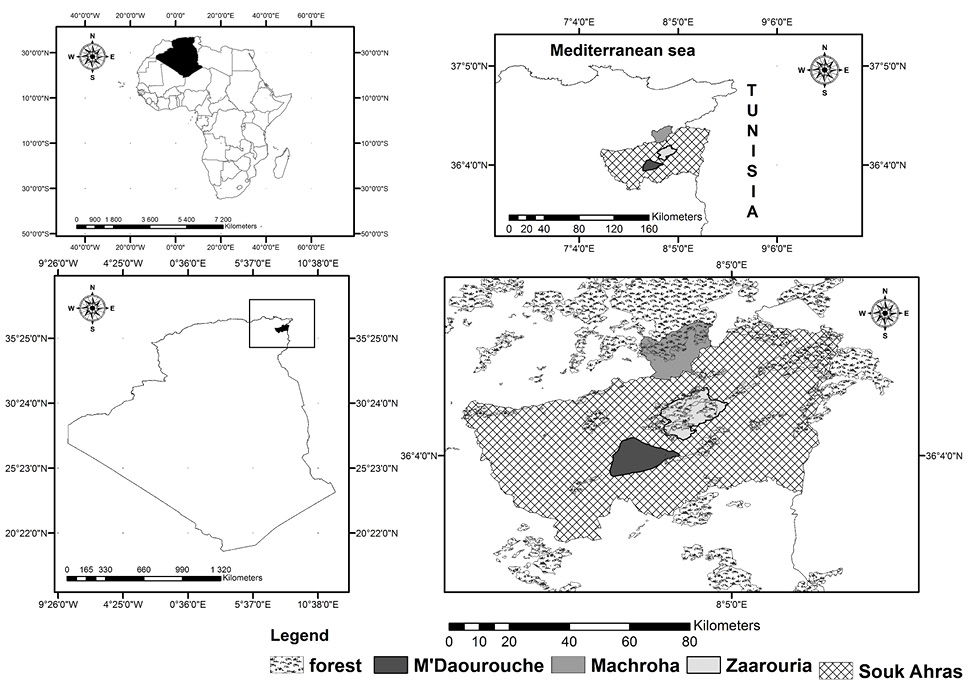
Geographic location of the study area.
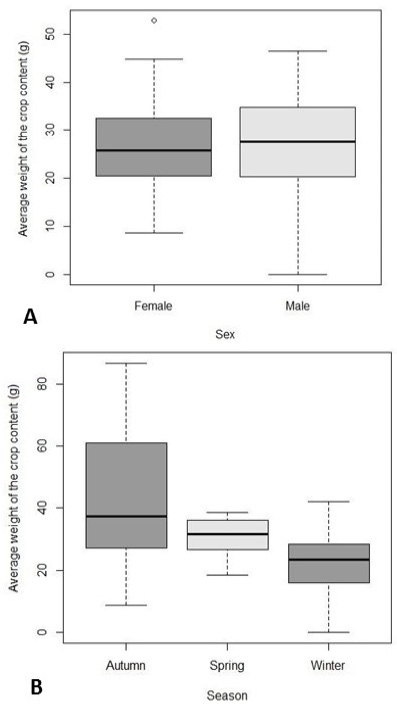
Variation of the average weight of food content in the crops between sexes (A) and seasons (B).
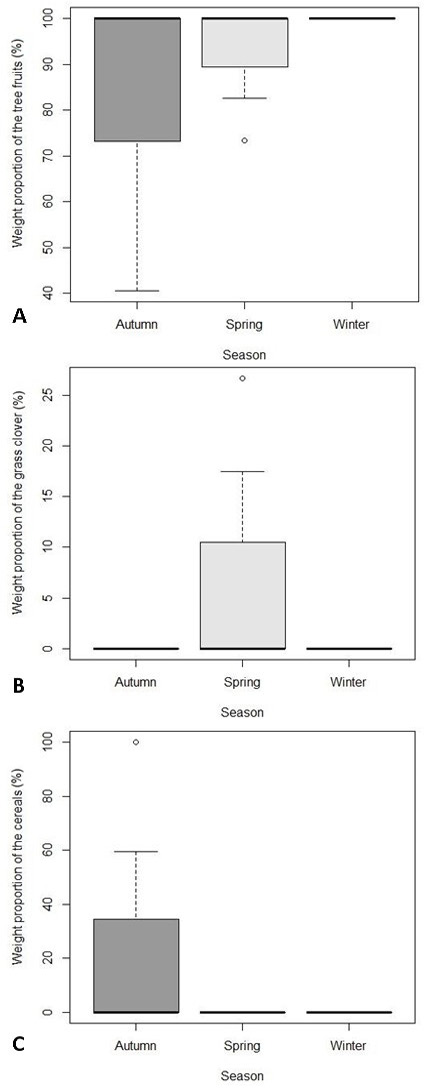
Variation of the average weight of tree fruits (A), clover (B) and cereals (C) consumed by the wood pigeon among seasons.
References
- Anderson, M.J., 2001. A new method for non-parametric multivariate analysis of variance. Aust. Ecol., 26: 32-46. https://doi.org/10.1046/j.1442-9993.2001.01070.x[CrossRef]
- Anderson, M.J., 2005. Permutational multivariate analysis of variance. Department of Statistics, University of Auckland, Auckland.
- Ando, H., Sasaki, T., Horikoshi, K., Suzuki, H., Chiba, H., Yamasaki, M. and Isagi, Y., 2017. Wide-ranging movement and foraging strategy of the critically endangered red-headed wood pigeon (Columba janthina nitens): Findings from a remote uninhabited island. Pac. Sci., 71: 161-171. https://doi.org/10.2984/71.2.5[CrossRef]
- Bea, A., Beitia, R. and Fernández, J.M., 2003. The census and distribution of wintering woodpigeons Columba palumbus in the Iberian Peninsula. Ornis Hung., 12: 157-167.
- Bendjoudi, D., Voisin, J.F., Doumandji, S., Merabet, A., Benyounes, N. and Chenchouni, H., 2015. Rapid increase in numbers and change of land-use in two expanding Columbidae species (Columba palumbus and Streptopelia decaocto) in Algeria. Avian Res., 6: 18. https://doi.org/10.1186/s40657-015-0027-9[CrossRef]
- Colquhoun, M.K., 1951. The woodpigeon in Britain. HMSO, London.
- Cramp, S., 1972. The breeding of urban woodpigeons. IBIS, 114: 163-171. https://doi.org/10.1111/j.1474-919X.1972.tb02601.x[CrossRef]
- Díaz, M. and Martin, P., 1998. Habitat selectivity in wintering wood pigeons (Columba palumbus) in holm oak dehesas of central Spain. Gibier Faune Sauvage, 15: 167-181.
- Ehrlich, P., Dobkin, D.S. and Wheye, D., 1988. Birder’s handbook. Simon and Schuster.
- Folk, C., 1984. The summer diet of the woodpigeon. Folia Zool., 33: 41-47.
- Fuentes, M., 1994. Diets of fruit-eating birds: What are the causes of interspecific differences. Oecologia, 97: 140-142. https://doi.org/10.1007/BF00317917[CrossRef]
- González-Rodríguez, V. and Villar, R., 2012. Post- dispersal seed removal in four Mediterranean oaks: Species and microhabitat selection differ depending on large herbivore activity. Ecol. Res., 27: 587-594. https://doi.org/10.1007/s11284-012-0927-7[CrossRef]
- Guezzoul, O., Doumandji, S., Souttou, K., Baziz, B. and Brahmi, K., 2004. Première mention sur le comportement trophique des adultes du Pigeon ramier Columba palumbus Linné, 1758 et du pigeon biset Columba livia bonnaterre, 1790 dans un milieu sub-urbain près d’el Harrach. Ornith. Algir., 4: 11-16.
- Gutiérrez-Galán, A., González, C.A. and Mercado, J.M. De., 2016. Woodpigeon Columba palumbus diet composition in Mediterranean Southern Spain. Ardeola, 64: 17-30. https://doi.org/10.13157/arla.64.1.2017.ra2[CrossRef]
- Heitmeyer, M.E. and Fredrickson, L.H., 1981. Do wetland conditions in the Mississippi Delta hardwoods influence mallard recruitment? Trans. N. Am. Wildl. Nat. Resour. Conf., 46: 44-57.
- Herrera, C.M., 1984. A study of avian frugivores, birddispersed plants, and their interaction in Mediterranean scrublands. Ecol. Monogr., 54: 1-23. https://doi.org/10.2307/1942454[CrossRef]
- Huysentruyt, F., Baert, K. and Casaer, J., 2013. Onset of common woodpigeon Columba palumbus breeding season in Flanders as based on gonadal development. Ardea, 101: 45-49. https://doi.org/10.5253/078.101.0106[CrossRef]
- Isenmann, P. and Moali, A., 2000. Oiseaux d’Algérie. Société d’Études Ornithologiques de France S.E.D.F., Paris.
- Isenmann, P., Gaultier, T., El Hili, A., Azafzaf, H., Dlensi, H. and Smart, M., 2005. Oiseaux de Tunisie/Birds of Tunisia. SEOF, Paris.
- Jiménez, R., Hodar, J.A. and Camacho, I., 1994. Diet of the woodpigeon (Columba palumbus) in the south of Spain during late summer. Folia Zool., 43: 163-170.
- Jordan, C.F. and Herrera, R., 1981. Tropical rain forests: Are nutrients really critical? Am. Natural., 117: 167-180. https://doi.org/10.1086/283696[CrossRef]
- Kruskal, W.H. and Wallis, W.A., 1952. Use of ranks in one-criterion variance analysis. J. Am. Stat. Assoc., 47: 583-621. https://doi.org/10.1080/01621459.1952.10483441[CrossRef]
- Leiva, M.J. and Fernández-Alés, R., 2003. Post-dispersive losses of acorns from Mediterranean savannah-like forests and shrublands. For. Ecol. Manage., 176: 265-271. https://doi.org/10.1016/S0378-1127(02)00294-3[CrossRef]
- Marrero, P., Oliveira, P. and Nogales, M., 2004. Diet of the endemic Madeira Laurel Pigeon Columba trocaz in agricultural and forest areas: Implications for conservation. Bird Conserv. Int., 14: 165-172. https://doi.org/10.1017/S0959270904000218[CrossRef]
- Menaa, M., 2017. Structure et dynamique de l’avifaune nicheuse de la forêt domaniale de Boumezrane (Ain Zana, Souk-Ahras). Thèse de Doctorat, Université d’Oum El Bouaghi, Oum El Bouaghi, pp. 133.
- Mengesha, G. and Bekele, A., 2008. Diversity and relative abundance of birds of Alatish National Park. Int. J. Ecol. environ. Sci., 34: 215-222.
- Merabet, A., Chebouti-Meziou, N., Chebouti, Y., Bissaad, F.Z. and Doumandji, S., 2014. The diet of the woodpigeon Columba palumbus the edge of the plain of Mitidja (North Algeria). Rev. Écol. (Terre Vie), 69: 3-4.
- Moali, A., Moali-Grine, N., Fellous, A. and Isenmann, P., 2003. Expansion spatiale de la Tourterelle Turque Streptopelia decaocto et présence dans les parcs urbains du Pigeon Ramier Columba palumbus en Algérie. Alauda, 71: 371-374.
- Molokwu, M., N., Nilsson, J. and Olsson, O., 2011. Diet selection in birds: trade-off between energetic content and digestibility of seeds. Behav. Ecol., 22: 639-647. https://doi.org/10.1093/beheco/arr025[CrossRef]
- Murton, R.K., 1965. The wood pigeon. Collins, London, UK.
- Murton, R.K., Isaacson, A.J. and Westwod, N.J., 1963. The food and growth of nestling wood-pigeons in relation to the breeding seasosn. Proc. zool. Soc. Lond., 133: 747-782.
- Murton, R.K., Westwood, N.J. and Isaacson, A.J., 1964. The feeding habits of the woodpigeon Columba palumbus, Stock Dove C. oenas and Turtle Dove Streptopelia turtur. IBIS, 106: 174-188. https://doi.org/10.1111/j.1474-919X.1964.tb03694.x[CrossRef]
- Newton, I., 1980. The role of food in limiting bird numbers. Ardea, 68: 11-30. https://doi.org/10.5253/arde.v68.p11[CrossRef]
- Ó hUallachain, D. and Dunne, J., 2013. Seasonal variation in the diet and food preference of the Woodpigeon Columba palumbus in Ireland. Bird Study, 60: 417-422. https://doi.org/10.1080/00063657.2013.798259[CrossRef]
- O’Donnell, C.F. and Dilks, P.J., 1994. Foods and foraging of forest birds in temperate rainforest, South Westland, New Zealand. N. Z. J. Ecol., 18: 87-107.
- Oksanen, J., Kindt, R., Legendre, P., O’Hara, B., Stevens, M.H.H., Oksanen, M.J. and Suggests, M.A.S.S., 2007. The vegan package. Commun. Ecol. Package, 10: 631-637. https://doi.org/10.1111/j.1654-1103.2003.tb02228.x[CrossRef]
- Oksanen, J., 2013. Vegan ecological diversity-vegan. 2.0-7 in R version 2.15.2 (2013-03-19).
- Oliveira, P., Marrero, P. and Nogales, M., 2002. Diet of the endemic Madeira Laurel Pigeon and fruit resource availability: A study using microhistological analyses. Condor, 104: 811-822. https://doi.org/10.1093/condor/104.4.811[CrossRef]
- Parrish, J.D., 1997. Patterns of frugivory and energetic condition in Nearctic land birds during autumn migration. Condor, 99: 681-697. https://doi.org/10.2307/1370480[CrossRef]
- Perea, R. and Gutiérrez-Galán, A., 2016. Introducing cultivated trees into the wild: Wood pigeons as dispersers of domestic olive seeds. Acta Oecol., 71: 73-79. https://doi.org/10.1016/j.actao.2015.09.005[CrossRef]
- Petty, S.J., 1999. Diet of tawny owls (Strix aluco) in relation to field vole (Microtus agrestis) abundance in a conifer forest in northern England. J. Zool., 248: 451-465. https://doi.org/10.1111/j.1469-7998.1999.tb01045.x[CrossRef]
- Poulin, B., Lefebvre, G. and McNeil, R., 1994. Diets of land birds from northeastern Venezuela. Condor, 96: 354-367. https://doi.org/10.2307/1369320[CrossRef]
- Purroy, F.J., Tomiałojć, L. and Rodero, M., 1984. The Ecology of woodpigeons Columba Palumbus Wintering on the Iberian Penisula. Państwowe Wydawnictwo Naukowe.
- R Development Core Team, 2016. R: A language and environment for statistical computing R Foundation for Statistical Computing. Vienna, Austria. http://www.R-project.org
- Reinecke, L., Aufenanger, S., Beutel, M.E., Dreier, M., Quiring, O., Stark, B. and Müller, K.W., 2017. Digital stress over the life span: The effects of communication load and internet multitasking on perceived stress and psychological health impairments in a German probability sample. Media Psychol., 20: 90-115. https://doi.org/10.1080/15213269.2015.1121832[CrossRef]
- Rouxel, R. and Czajkowski, A., 2004. Le pigeon ramier Columba palumbus L. Ed. OMPO, Société de Presse Adour-Pyrénées, Lourdes, France.
- Ruffino, L., Salo, P., Koivisto, E., Banks, P.B. and Korpimaki, E., 2014. Reproductive responses of birds to experimental food supplementation: A meta-analysis. Front. Zool., 11: 80. https://doi.org/10.1186/s12983-014-0080-y[CrossRef]
- Saari, L., 1997. Woodpigeon. In: Bea, A., Beitia, R. and Fernández, J.M., 2003. The census and distribution of wintering woodpigeons Columba palumbus in the Iberian Peninsula. Ornis Hung., pp. 157-167.
- Sam, K., Koane, B., Jeppy, S., Sykorova, J., and Novotny, V., 2017. Diet of land birds along an elevational gradient in Papua New Guinea. Nature Publishing Group. https://doi.org/10.1038/srep44018[CrossRef]
- Schnock, G. and Seutin, E., 1973. Contribution à l’étude écologique du Pigeon ramier (Columba palumbus) en Belgique. Aves, 10: 182-192.
- Self, A., 2014. The birds of London (Helm County Avifauna).
- Sutherland, W.J., Newton, I. and Green, R.E., 2004. Bird ecology and conservation: A handbook of techniques. Oxford University Press. https://doi.org/10.1093/acprof:oso/9780198520863.001.0001[CrossRef]
- Thévenot, M., Vernon, R. and Bergier, P., 2003. The birds of Morocco: An annotated checklist. British Ornithologists’ Union, Tring, UK. https://doi.org/10.2989/00306520409485437[CrossRef]
- Verdu, J. R., Casas, J. L., Lobo, J. M. and Numa, C., 2010. Dung beetles eat acorns to increase their ovarian development and thermal tolerance. PLoS One, 5 https://doi.org/10.1371/journal.pone.0010114[CrossRef]
- Walker, J.S., 2007. Geographical patterns of threat among pigeons and doves (Columbidae). Oryx, 41: 289-299. https://doi.org/10.1017/S0030605307001016[CrossRef]
- Whelan, C.J. and Brown, J.S., 2005. Optimal foraging and gut constraints: Reconciling two schools of thought. Oikos, 110:481-496. https://doi.org/10.1111/j.0030-1299.2005.13387.x[CrossRef]
- Zimmerman, D.W. and Zumbo, B.N., 1993. Rank transformations and the power of the Student t-test and Welch t′-test for non-normal populations. Can. J. exp. Psychol., 47: 523-539. https://doi.org/10.1037/h0078850[CrossRef]
Services
Article usage statistics
Loading…