
The diet composition of the Desert or Pharaoh Eagle Owl Bubo ascalaphus, was investigated in Eastern Saudi Arabia. 112 regurgitated pellets yielded 203 individual prey items representing at least eleven rodent species, unidentified bird(s), at least one scorpion, and other unidentified insects. Prey items were dominated by rodents (91%) which were found in 96.4% of the pellets. Birds, scorpions, and other insects constituted 2.46, 5.91, and 2.96% of the diet, respectively. Rodents contributed the most in terms of biomass, with the black rat, Rattus rattus, and desert jirds dominating the remains. The results suggested that the Desert Eagle Owl in the arid ecosystem in eastern Saudi Arabia is a highly selective feeder, hunting 1–5 prey items per day (mean±SD 1.77±0.96) mostly from ground-dwelling native and invasive rodents. Prey selection within this human-influenced area likely influenced by the availability and abundance of species and shifting to urban rodents.
Short Communication · Volume 52, Issue 3, 15 March 2020 · Open Access
Diet of the Desert Eagle Owl, Bubo ascalaphus, in Eastern Saudi Arabia
· · ·
Affiliations & Notes ⌄
- 1Faculty of Sciences II, Lebanese University, Al-Fanar, Lebanon and Animal Encounter, Ras Al-Jabal, Aley, Lebanon 2Department of Biology, Faculty of Arts and Sciences, American University of Beirut, Lebanon 3Department of Biology, The University of Jordan, Amman, Jordan 4Department of Biology, Jordan University of Science and Technology, Irbid, Jordan , * Corresponding author: amrz@just.edu.jo
Article Info ⌄
- Journal:
- Pakistan Journal of Zoology
- Published:
- 15 March 2020

From the article
- Pellets with 3, 4, or 5 prey items contained an arthropod and 2 rodents or 3 rodents, an arthropod and 3 rodents or 4 rodents, and an arthropod and 4 rodents, respectively.
- The 11 rodent species included mostly Jaculus jaculus and Meriones crassus at 41% each, followed by Meriones libycus and Rattus rattus at 24% each (Table I).
- Arthropod prey items were represented mainly by scorpions (Table I).
- The Eagle Owl’s diet contained a wide variety of prey items that comprised mainly of small mammals.
Selected from the article's own text.
Abstract
Materials and methods
A large pile of pellets consisting of about 94 intact pellets and 18 fragmented ones were found near a daytime roosting site of Eagle Owl. The site lies in a rocky area in Wadi As Sulai (N 25o 00 11.4 E 46o 37 08.6 altitude 652 m asl) near Riyadh. The area is rocky overlooking a wadi system and with different types of vegetation including gravel plain ecosystems interspersed with seasonal riverbeds (run-off wadis), lowland areas and sand dunes. The majority of the area is barren stone desert rarely covered by vegetation; the wadis provide scattered vegetated bush/shrubby microsystems mainly of Acacia tortilis. Bandan Park and other recreational areas surround the site from the north and west while open desert plains are located in the east.
Pellets were soaked in warm water until disaggregation; bones and other hard remains were removed and placed in separate Petri dishes. Skulls, mandibles, and other easily recognizable elements were selected as the basis for species identification. The total number of prey individuals in a pellet was determined using the total number of mandibles and/or skulls found . Animal identification was based on Osborn and Helmy (1980), Harrison and Bates (1991) and Amr (2012). Rodent body weights were based on Abu Baker and Amr (2003), Osborn and Helmy (1980), and Scott and Dunstone (2000). Diet composition was expressed by the number of individuals, percentage (number of individuals divided by the total number of prey individuals), frequency of occurrence of each prey item in the pellets (number of pellets in which a prey item occurred), and percentage of mass taken.
Results
Pellets were cylindrical in shape with an average length of 52.2 ± 6.8 mm (mean ± standard deviation) and 22.84 ± 3.5 mm in width. The sample of 112 pellets contained prey items that belonged to a total of 203 prey individuals including at least eleven mammal species (Rodentia: Dipodidae, Muridae), and several unidentified species of birds, scorpions, and other insects (Table I).
The pellets contained 1–5 prey items per day (1.77 ± 0.96, average ± standard deviation). Most pellets (79%) contained ≤ 2 prey items; the rest contained 3–5 prey items (Fig. 1). Out of the total 112 pellets, 108 contained rodents, of which 87 contained only rodents, 4 contained remains of a bird and 2-3 rodents and 16 contained remains of an arthropod and 1-4 rodents. Only one pellet contained only remains of insects. Pellets with 3, 4, or 5 prey items contained an arthropod and 2 rodents or 3 rodents, an arthropod and 3 rodents or 4 rodents, and an arthropod and 4 rodents, respectively. The 11 rodent species included mostly Jaculus jaculus and Meriones crassus at 41% each, followed by Meriones libycus and Rattus rattus at 24% each (Table I). Acomys russatus, Sekeetamys calurus, and Mus musculus were the least represented in the diet composition (Table I). However, in terms of body mass intake, R. rattus, M. crassus, M. libycus, and J. jaculus contributed the most at 22.77, 20.96, 20.03, and 19.21%, respectively (Table I). Arthropod prey items were represented mainly by scorpions (Table I).
Discussion
The Eagle Owl’s diet contained a wide variety of prey items that comprised mainly of small mammals. Larger species of rodents made the highest frequencies (11.82-20.20%). The presence of higher frequencies of rodent remains suggests that hunting for food was mostly done at night for species of greater biomass and energetic yield, yet, the presence of Psammomys obesus and Meriones libycus at 5.91 and 11.82%, respectively, suggests crepuscular and/or diurnal hunting activity . Although the largest species in the diet remains, Rattus rattus (average body weight 137.3 g) occurred only at 11.82% in the diet though it contributed the highest in
Table I.- Food composition of the desert eagle owl in Eastern Saudi Arabia.
| Prey item | Total No. | Percentage in diet (%) | Frequency of occurrence | Average body mass (g) | Total mass taken | Percentage mass taken |
| Mammals: Rodents | ||||||
| Jaculus jaculus | 41 | 20.20 | 36 | 67.8 | 2779.8 | 19.21 |
| Gerbillus cheesemani | 7 | 3.45 | 7 | 24 | 168 | 1.16 |
| Gerbilus sp. | 14 | 6.90 | 14 | 21 | 294 | 2.03 |
| Meriones crasus | 41 | 20.20 | 32 | 74 | 3034 | 20.96 |
| Meriones libycus | 24 | 11.82 | 21 | 120.8 | 2899.2 | 20.03 |
| Psammomys obesus | 12 | 5.91 | 11 | 128.7 | 1544.4 | 10.67 |
| Sekeetamys calurus | 3 | 1.48 | 3 | 41.4 | 124.2 | 0.86 |
| Acomys dimidiatus | 6 | 2.96 | 6 | 39.7 | 238.2 | 1.65 |
| Acomys rassatus | 1 | 0.49 | 1 | 50.7 | 50.7 | 0.35 |
| Mus musculus | 3 | 1.48 | 3 | 15 | 45 | 0.31 |
| Rattus rattus | 24 | 11.82 | 16 | 137.3 | 3295.2 | 22.77 |
| Unidentified rodent (fur only) | 4 | 1.97 | 4 | |||
| Unidentified birds | 5 | 2.46 | 5 | |||
| Arthropods | ||||||
| Scorpions | 12 | 5.91 | 12 | |||
| Insects | 6 | 2.96 | 7 | 14472.7 | ||
| Total | 203 | 100 | 174 |
terms of body mass intake (22.77%). It also occurred at frequencies of 1-3 individuals in a single pellet, suggesting their high abundance in the area and/or that the owl may have been taking only the parts with high energy gains such as the heads. Smaller-sized rodents (Gerbillus sp. average body weight 21 g) occurred at 10.35% in the diet and contributed only 3.19% in biomass, however, all occurred as single individuals in the pellets with one or two individuals of the larger species. Similar to previous findings , broken skulls and jaw remains in the pellets suggest that the owl may have torn its prey into small pieces or crushed them before consumption.
Previous studies from arid and semi-arid environments have shown that the diet of the Eagle Owl is dominated by mammalian prey items in terms of frequency and biomass, with rodents (Jaculus jaculus, Meriones sp. and Gerbillus sp.) making up the most of its intake ; ; . However, the present study did not record any insectivores (hedgehogs and shrews) in the diet. Studies from Eastern Saudi Arabia have recorded a diverse mammalian fauna ; . The fauna is associated with diverse habitat types from dry rocky areas with wadi systems, to open hammada habitat type with scarce vegetation cover and sand dune habitats. Feeding and prey selection within this heterogenous human-influenced area was likely influenced by the availability and abundance of prey species .
Our results suggest that Eagle Owl relies on mammalian prey with opportunistic feeding habits. While most higher-energy-yielding prey were nocturnal (e.g. Jaculus jaculus and Meriones crassus), smaller (Gerbillus sp.) and even large diurnal prey (M. libycus and P. obesus) were also hunted. Urban expansion in the area in the form of urban settlements, desert parks, farms and recreational sites may be shifting the Eagle Owl’s diet into urban rodents (Mus musculus and Rattus rattus). Similar observations have been reported for an urban pair of Desert Eagle Owls from Hurghada on the Red Sea coast in Egypt where the diet consisted primarily of the Brown Rat Rattus norvegicus and the House Mouse Mus musculus and Near Azraq Wetland Reserve where Mus musculus dominated the rodent remains ; . It is likely that regional biodiversity in these areas is declining as a result of infrastructure development such as road networks and human settlements . As one of the greatest threats to terrestrial biodiversity, understanding behavioral and ecological responses of organisms to land use changes due to anthropogenic practices is key for wildlife conservation . This knowledge is lacking in arid environments, which occupy approximately one third of the world’s terrestrial area, yet, have been neglected in terms of ecological and conservation studies of land use and its influence on local wildlife . Analysis of owl pellets for prey remains provides a useful tool for gaining insight into the abundance and distribution of small vertebrates as they often contain a high overall richness and provide complementary information for small mammal inventories on a landscape scale ; .
Statement of conflict of interest
Authors have declared no conflict of interest.
Figures
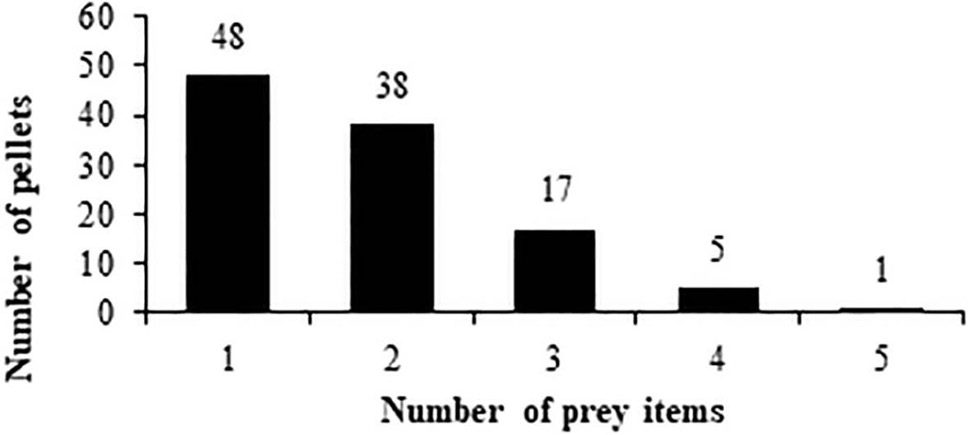
Number of prey items per pellet.
References
- Abu Baker, M. and Amr, Z., 2003. Zool. Abh., 53: 177-204. https://doi.org/10.7601/mez.53.204[CrossRef]
- Amr, Z., 2012. Mammals of Jordan, 2nd edition. Al Rai Press, Amman, pp. 308.
- Amr, Z.S., Al-Melhim, W.N. and Yousef, M.A., 1997. Zool. Middle East, 14: 5-10. https://doi.org/10.1080/09397140.1997.10637698[CrossRef]
- Amr, Z.S., Handal, E.N., Bibi, F., Najajrah, M.H. and Qumsiyeh, M.B., 2016. Slovak Raptor J., 10: 75-79. https://doi.org/10.1515/srj-2016-0002[CrossRef]
- Bates, P.J. and Harrison, D., 1989. Bonn. Zool. Beitr., 40: 223-226.
- Bauer, K., 1988. Ann. Nat. Hist. Mus. Wien Ser. B., 90B: 43-50.
- Cramp, S., 1985. Birds of the Western Palearctic. Oxford University Press, Oxford.
- Cunningham, P.L. and Aspinall, S., 2001. Tribulus, 11: 13–15.
- Didham, R.K., Tylianakis, J.M., Gemmell, N.J., Rand, T.A. and Ewers, R.W., 2007. Trends Ecol. Evol., 22: 489-496. https://doi.org/10.1016/j.tree.2007.07.001[CrossRef]
- Durant, S.M., Wacher, T., Bashir, S., Woodroffe, R., Ornellas, P.D., Ransom, C., Newby, J., Abáigar, T., Abdelgadir, M., El Alqamy, H., Baillie, J., Beddiaf, M., Belbachir, F., Belbachir-Bazi, A., Berbash, A.A., Bemadjim, N.E., Beudels-Jamar, R., Boitani, L., Breitenmoser, C., Cano, M., Chardonnet, P., Collen, B., Cornforth, W.A., Cuzin, F., Gerngross, P., Haddane, B., Hadjeloum, M., Jacobson, A., Jebali, A., Lamarque, F., Mallon, D., Minkowski, K., Monfort, S., Ndoassal, B., Niagate, B., Purchase, G., Samaïla, S, Samna, A.K., Sillero-Zubiri, C., Soultan, A.E., Stanley-Price, M.R. and Pettorelli, N., 2014. Divers Distrib., 20: 114-122. https://doi.org/10.1111/ddi.12157[CrossRef]
- Evans, M. and Bates, P., 1993. Ornithol. Soc. Middle East Bull., 30: 26.
- Goodman, S.M., 1990. J. Arid Environ., 18: 217-220. https://doi.org/10.1016/S0140-1963(18)30855-3[CrossRef]
- Harrison, D.L. and Bates, P.J., 1991. The mammals of Arabia. Harrison Zoological Museum, Kent.
- Heisler, L.M., Somers, C.M. and Poulin, R.G., 2016. Methods Ecol. Evol., 7: 96-103. https://doi.org/10.1111/2041-210X.12454[CrossRef]
- Jennings, M.C., 2010. Fauna of Arabia, 25: 1-772.
- Mohedano, I., Abu Baker, M.A., Hunter, B., Buchan, J., Christopher, J., Michaels, J. and Yamaguchi, N., 2014. Zool. Middle East, 60: 111-119. https://doi.org/10.1080/09397140.2014.914713[CrossRef]
- Moldován, I. and Sándor, A.D., 2009. Sandgrouse, 31: 73-78.
- Osborn, D.J. and Helmy, I., 1980. Fieldiana Zool., 5: 1–579.
- Rifai, L.B., Al-Melhim, W.N., Gharaibeh, B.M. and Amr, Z.S., 2000. J. Arid Environ., 44: 369-372. https://doi.org/10.1006/jare.1999.0601[CrossRef]
- Sándor, A.D. and Orbán, Z., 2008. Zool. Middle East, 44: 107-109. https://doi.org/10.1080/09397140.2008.10638295[CrossRef]
- Scott, D.M. and Dunstone, N., 2000. J. Zool., 251: 481-494. https://doi.org/10.1017/S0952836900008086[CrossRef]
- Shehab, A.H., 2004. Zool. Middle East., 33: 21-26. https://doi.org/10.1080/09397140.2004.10638060[CrossRef]
- Shehab, A.H. and Ciach, M., 2008. Turk. J. Zool., 32: 65-69.
- Torre, I., Arrizabalaga, A. and Flaquer, C., 2004. J. Mammal., 85: 524-530. https://doi.org/10.1644/BJK-112[CrossRef]
- Yalden, D.W. and Morris, P.A., 1990. Occas. Publ. Mammal. Soc., 13: 1-24.
Services
Article usage statistics
Loading…