
Habitat loss and prey species shortages represent serious issues for many wild carnivores. Carnivores may expand their search for prey and suitable habitat to cover a wide area, seeking alternative sources of food at different localities, including human-modified land such as agricultural areas. Agricultural areas in Tabuk Province, north-western kingdom of Saudi Arabia have been expanded substantially over the last three decades. This research studied the potential role of large agricultural areas as supplementary habitats for wild carnivores in a desert ecosystem. Camera traps recorded three mammalian carnivores: golden jackal (Canis aureus), grey wolf (Canis lupus), and red fox (Vulpes vulpes). Although red foxes were highly abundant across the surveyed sites, an analysis showed that they avoided sites near highways. The golden jackal is rarely documented in Saudi Arabia and there is a significant lack of information about this species. All three detected wild carnivores are officially protected species in Saudi Arabia. It can be concluded that agricultural areas represent potential survival sites offering suitable conditions in a harsh desert ecosystem, especially under conditions of prey depletion and native habitat degradation. Further research is required to better understand how agricultural areas can be used to promote conservation actions for wild animals and improve their ecological status.
Research Article · Volume 56, Issue 5, 26 July 2024 · Open Access
Role of Agricultural Areas as Shelters for Carnivores in a Desert Ecosystem in Saudi Arabia
Affiliations & Notes ⌄
- 1Department of Biology, Faculty of Science, University of Tabuk, Tabuk City, 47512, Saudi Arabia. * Corresponding author: abalatawi@ut.edu.sa
Article Info ⌄
- Journal:
- Pakistan Journal of Zoology
- Published:
- 26 July 2024

From the article
- Deployed camera traps detected three wild mammalian carnivores that utilize these agricultural areas: red fox, grey wolf (Canis lupus), and golden jackal (Canis aureus) (Fig. 2).
- The density of red fox was high across the agricultural areas, with 62% of installed camera traps recording their presence (Fig. 3).
- The analysis also indicated that there was no significant difference in red fox detection between farmlands and areas outside of farm boundaries: x2 (1, 45) = 0.11, (p > 0.05).
- Agricultural areas in Tabuk Province appear to provide suitable resources and conditions that can be utilized by local carnivores, including endangered (e.g., grey wolf) and rarely observed near-threatened species (e.g., golden jackal).
Selected from the article's own text.
Abstract
Introduction
Threats to biological diversity vary globally, with some regions being particularly vulnerable to biodiversity loss while others remain relatively secure . Human activities are considered one of the main causes of biodiversity decline ; . The modification of natural areas has greatly reduced the amount of suitable wildlife habitat, which can alter species diversity and distribution, their interactions with surrounding ecosystems, and may cause extinction ; ; ; . The responses of different species to these threats and disturbances may vary according to their abilities to their tolerance . Different forms of interaction between species also exist , which suggests that in some cases such as predator-prey relation the presence of a species can be critical to the survival of another species. Hence, conservation of wildlife and the sustainable use of natural resources are required to ensure the adequate conservation efforts .
Carnivores receive a great deal of research attention since they are among the most threatened species ; . Notably, carnivores are vulnerable to changes in their habitat ; . The global range of carnivores is contracting , mostly due to anthropogenic activities such as habitat destruction and fragmentation, poaching, persecution, hunting, and reduction in prey availability ; , 2017). Since the trophic level of carnivores plays a vital role in food webs, their disappearance might affect ecosystem services ; ; ; . Certain carnivores have large home ranges, which protected areas may not entirely cover. Hence, carnivores may roam far beyond the boundaries of protected areas . For this reason, understanding the distribution of wild animals is required when considering conservation action ; ; .
Habitat loss and prey depletion represent serious issues for many carnivores ; . As a consequence, carnivores may expand their search for suitable habitat and prey to cover a wide area, seeking alternative sources of food at different localities , such as agricultural areas ; . The number of publications regarding the use of agroecosystems by carnivores has expanded considerably ; . Agricultural activities are generally believed to be one of the key drivers of carnivore decline since these activities may directly or indirectly modify carnivores’ natural habitats, and thereby reduce the availability of natural resources ; ; . However, agricultural areas do not inevitably need to be hostile environments since they may hold value for certain carnivore species. Various mammalian carnivores have expanded their home ranges to include human-modified agricultural areas ; ; ; ; , thereby demonstrating that they can survive and obtain benefits from these modified and disturbed habitats , 2016). The availability and variety of food resources and potentially suitable/favorable conditions (e.g., for shelter, reproduction, and habitat connectivity) found in agricultural areas can help carnivores meet their daily demands to ensure survival ; ; .
The increased presence of carnivores near human activities could trigger a human-carnivore conflict that could be fatal for these species ; ; ; . Carnivores might be killed or poisoned if they pose a threat to humans or livestock, which ultimately threatens their conservation status. Therefore, the safety of both humans and carnivores must be prioritized ; .
The considerable expansion of agricultural activities in Tabuk Province, north-western Saudi Arabia has occurred as a result of economic and demographic development ; . Agricultural areas are normally rich habitats that include various resources such as prey species, crops, landfills, and carcasses that may attract local wild carnivores. Therefore, the objective of this study is to explore the distribution of carnivores in agricultural areas and the potential role of these areas as supplementary habitats for local carnivores in Tabuk Province. Overall, understanding how carnivores utilize agricultural areas can help to avoid potential conflicts and inform appropriate protective actions.
Materials and Methods
Study area
The fieldwork was conducted in relatively large agricultural areas within Tabuk Province during the summer and fall of 2022 (June to November) (Fig. 1). Tabuk Province is located in northwestern Saudi Arabia . There has been an important expansion of agriculture-related activities in this province over the last three decades, resulting in large agricultural areas being established near Tabuk city ; . As a result, Tabuk province has become one of the leading food-producing provinces in Saudi Arabia, producing and exporting a wide variety of fruits, vegetables, and other crops to the rest of the country . Many poultry and livestock farms are located in these agricultural areas, with their associated carcass dumps. Additionally, landfills also exist in these areas. These conditions make the agricultural areas suitable candidate habitats for different groups of wild animals, especially carnivores.
Data collection
The presence of wild mammalian carnivores were determined by installing infrared camera traps (HC-802A) at different sites in agricultural areas of Tabuk Province. Camera trap was placed on an iron stand ranging from 50 cm to 60 cm from ground. The camera was programmed to take a photo and a 10 sec video whenever the infrared sensor activated. Camera traps were placed on farmland if permission was granted by the owner, and outside farms if there was no permission or accessibility. All farms on which camera traps were installed were fence-free, and thus accessible to carnivores. The study area is relatively populated, with many private properties hosting various human activities. Hence, the cameras were installed at sites for 24–30 h, then moved to other sites. A total of 45 sites were covered by the camera traps, a camera trap at each site/night. Cooked food such as rice and meat, as well as raw food such as meat, were placed in front of the camera traps. Although providing a sufficient distance between traps was considered in the study design, this was subject to accessibility and other constraints on the ground. Overall, each camera trap received the same treatment and setting to avoid bias in species detection.
Statistical analysis
Only the red fox (Vulpes vulpes) had a sufficient number of detections for a statistical analysis to be performed. Detection data were extracted from each camera trap, and a detection and non-detection history was assigned for the red fox at each visited site. Notably, the agricultural areas are separated by highways (Fig. 1). The distance from each camera to the nearest highway was estimated using the ruler tool in Google Earth (accessed at https://earth.google.com/web/ on December 7, 2022). An independent t-test was used to determine whether the distance to a highway affected red fox occurrence. Additionally, red fox was recorded on farmlands and outside farm boundaries, and the camera traps detected a significant number of stray dogs at the same sites and time slot as red fox. To examine whether there was a difference in red fox detection on farmland or outside farms and whether red fox avoids sites with stray dogs, a chi-square test was used. The data were analyzed using IBM SPSS Statistics (Version 22).
Results
Deployed camera traps detected three wild mammalian carnivores that utilize these agricultural areas: red fox, grey wolf (Canis lupus), and golden jackal (Canis aureus) (Fig. 2). The density of red fox was high across the agricultural areas, with 62% of installed camera traps recording their presence (Fig. 3). Golden jackal was detected at one site and grey wolf was detected at four sites.
The time of day for detection varied among the sites surveyed for the detected species. Although most of the red fox detections occurred at night, this species was also detected in the early morning and late afternoon (Fig. 4). Their earliest appearance on a camera trap was at 7:27 pm, while the latest observation was at 6:48 am in summer season. For golden jackal, most of the activity occurred at night; however, there was also some activity during the morning. The earliest appearance of this species on a camera trap occurred at 8:04 pm, while the latest appearance was at 11:01 am in summer season. Grey wolf activity was observed only at night, with the earliest appearance on a camera trap in fall season occurring at 8:18 pm and the latest appearance occurring at 2:29 am.
The distance from each camera trap to the nearest highway varied. The results of an analysis indicated that the detection of red fox was significantly affected by the distance to a highway (t43 = 1.9, p < 0.05). Also, the statistical result of the chi-square test showed that red fox was significantly affected by the presence of stray dogs: x2 (1, 45) = 9.2, (p < 0.05). The analysis also indicated that there was no significant difference in red fox detection between farmlands and areas outside of farm boundaries: x2 (1, 45) = 0.11, (p > 0.05).
Discussion
Tabuk Province has experienced rapid growth in intensive agricultural activities over the last three decades . In this research, three wild mammalian carnivores were detected in agricultural areas in Tabuk Province: red fox, golden jackal, and grey wolf. To the best of the author’s knowledge, this study represents the first confirmed evidence of the golden jackal inhabiting the north-western area of Saudi Arabia ; . The findings overall support the potentially crucial role of agricultural areas as supplementary habitats for local carnivores.
Studying the presence/absence of a particular species is a key step in appropriate conservation management ; , 2023; . Wild carnivores are vigilant and elusive species that generally avoid contact with humans . Documenting red fox, golden jackal, and grey wolf in agricultural areas within a desert ecosystem is a promising outcome. The presence of different-sized carnivores in agricultural areas has been widely reported by studies of different habitat conditions and characteristics ; . For instance, foxes are commonly reported to use agricultural areas ; ; ; ; ; . For example, Jankowiak et al. (2008) reported on the diet of red fox on farmlands in Poland. Saruhan and Sari (2022) found that the golden jackal was distributed near residential and agricultural areas. Also, Ahmadi et al. (2014) noted that wolves can persist in and adjust to modified agricultural areas. Carnivores listed as species of least concern are more likely to utilize agricultural areas when compared to threatened species ; . The red fox is a widespread species across the deserts of Saudi Arabia and appears to be a non-threatened species with least concern status . In contrast, the golden jackal is a rarely recorded species in Saudi Arabia, and up-to-date information regarding its population size and trend remains incomplete . Therefore, this species is classified regionally as near threatened in the Arabian Peninsula, which includes Saudi Arabia . Additionally, the grey wolf is classified regionally as endangered in the Arabian Peninsula . Notably, all species detected in this study are officially protected in Saudi Arabia, and hunting them can incur a penalty (Ministry of Environment, Water and Agriculture, 2023). The report of a golden jackal in an agricultural area is an important outcome that can inform improvements to its conservation status.
Generalist carnivores are commonly detected in these habitats since they appear to adapt to and benefit from disturbed areas ; ; . In this study, it seems that the detected carnivores make use of the advantages that agricultural areas can offer. Golden jackal and red fox are generalist opportunistic foragers, and their diets include livestock carcasses, small mammals, and other available resources ; ; ; ; ; . The abundance of prey species such as birds, small mammals, and livestock in the studied agricultural areas may attract local carnivores. Additionally, a large number of livestock carcasses were observed to be dumped in the study area; hence, local carnivores may be attracted to these spots. Such conditions may no longer be present in the wild, particularly in light of prey depletion. Furthermore, golden jackal and red fox are known to consume fruit ; ; ; ; , of which there is an abundance in the studied agricultural areas. These factors and conditions, as well as the improperly managed landfills observed, most likely explain the occurrence of the detected carnivores.
The frequency of red fox in the studied agricultural areas was noticeably high. The red fox is a successful adaptive species that can inhabit various habitats, including urban and agricultural areas ; . Stepkovitch et al. (2019) reported that body mass and skeletal size increased in red foxes occupying urbanized areas when compared to natural habitats in Australia. It was also reported that the skull sizes of red foxes in agricultural areas were larger than those in non-agricultural areas in Spain, which could be related to the availability of food from animal husbandry in agricultural areas . In this study, red fox appeared to be affected by highways, which implies that red fox avoids or is less likely to roam near these spots. However, this species was also detected by a camera trap set 284 m from a highway. Notably, the occurrence of red fox seems to be affected by the presence of stray dogs. Red fox was recorded slightly more often on farmlands than outside of farms, regardless of human activities and the presence of stray dogs and guard dogs (Fig. 3). Therefore, it can be concluded that red fox manages to survive in this agricultural system.
Carnivores can provide important benefits to the ecosystems in agricultural areas. Certain carnivores (i.e., scavengers) may profit from livestock mortality while also providing disposal services for organic waste . Carnivores can also contribute to the control of rodent populations, thereby reducing the risk of spreading zoonotic diseases . Additionally, carnivores may help to disperse seeds to new localities . Mohamed and Basuony (2016) reported on the food composition and feeding ecology of red fox from Al-Jouf Province, Northern Saudi Arabia which also included plants. Despite these benefits, carnivores may face serious threats in agricultural areas, especially if they begin to attack humans and livestock or damage crops. Such behavior can trigger possible retaliation, resulting in human-carnivore conflict ; ; ; ; . A farm owner confirmed that in different incidents, he lost several heads of livestock due to predator attacks that he believed to be caused by a wolf. Another farmer complained about red fox because of several attacks on his poultry farm. In addition, agricultural areas in Tabuk province attract hunters that search for native and migratory birds (Fig. 5). Based on existing knowledge of hunters’ attitudes in this region , it is very likely that hunters will also hunt carnivores if they encounter them. Road mortality represents another potential threat to carnivores in agricultural areas. During the fieldwork, two red foxes were observed dead on the road following collisions with vehicles (Fig. 5).
Conclusion
Due to prey depletion and habitat loss, wild carnivores may search for food outside their natural habitat, which can result in them potentially moving closer to areas of human activity. Agricultural areas in Tabuk Province appear to provide suitable resources and conditions that can be utilized by local carnivores, including endangered (e.g., grey wolf) and rarely observed near-threatened species (e.g., golden jackal). Notably, the expansion of agricultural activities is expected to increase. Therefore, additional applied research is required to better understand the associations between local wild carnivores and agricultural areas in desert ecosystems, and how agricultural areas may contribute to the conservation of these wild animals.
Acknowledgments
The author expresses his gratitude to Dr. Ehab Eid and Dr. Abdulhadi Aloufi for the help with species identification, and Dr. Ehab Ahmad for statistical help.
Data availability statement
Data available upon request.
Funding
Self-funding.
Statement of conflict of interest
The author has declared no conflict of interest.
Figures
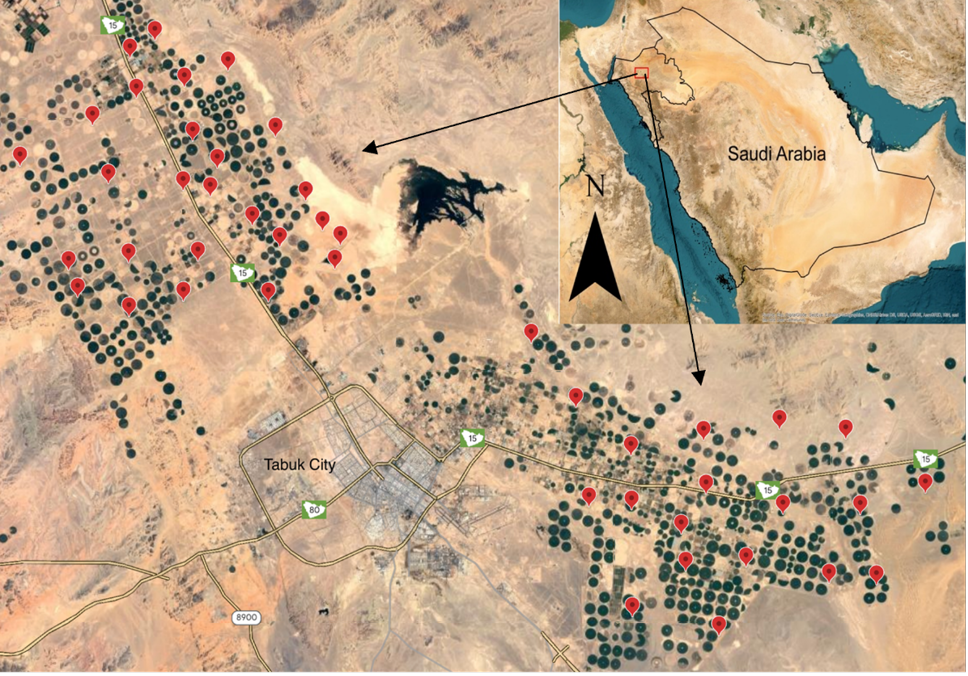
The locations of 45 camera traps installed in agricultural areas near Tabuk city in Tabuk Province during the summer and fall of 2022. The image of the study area was obtained using Google Earth, accessed at https://earth.google.com/web/ on December 7, 2022. Map of Saudi Arabia was obtained using World Imagery in ArcGIS software.
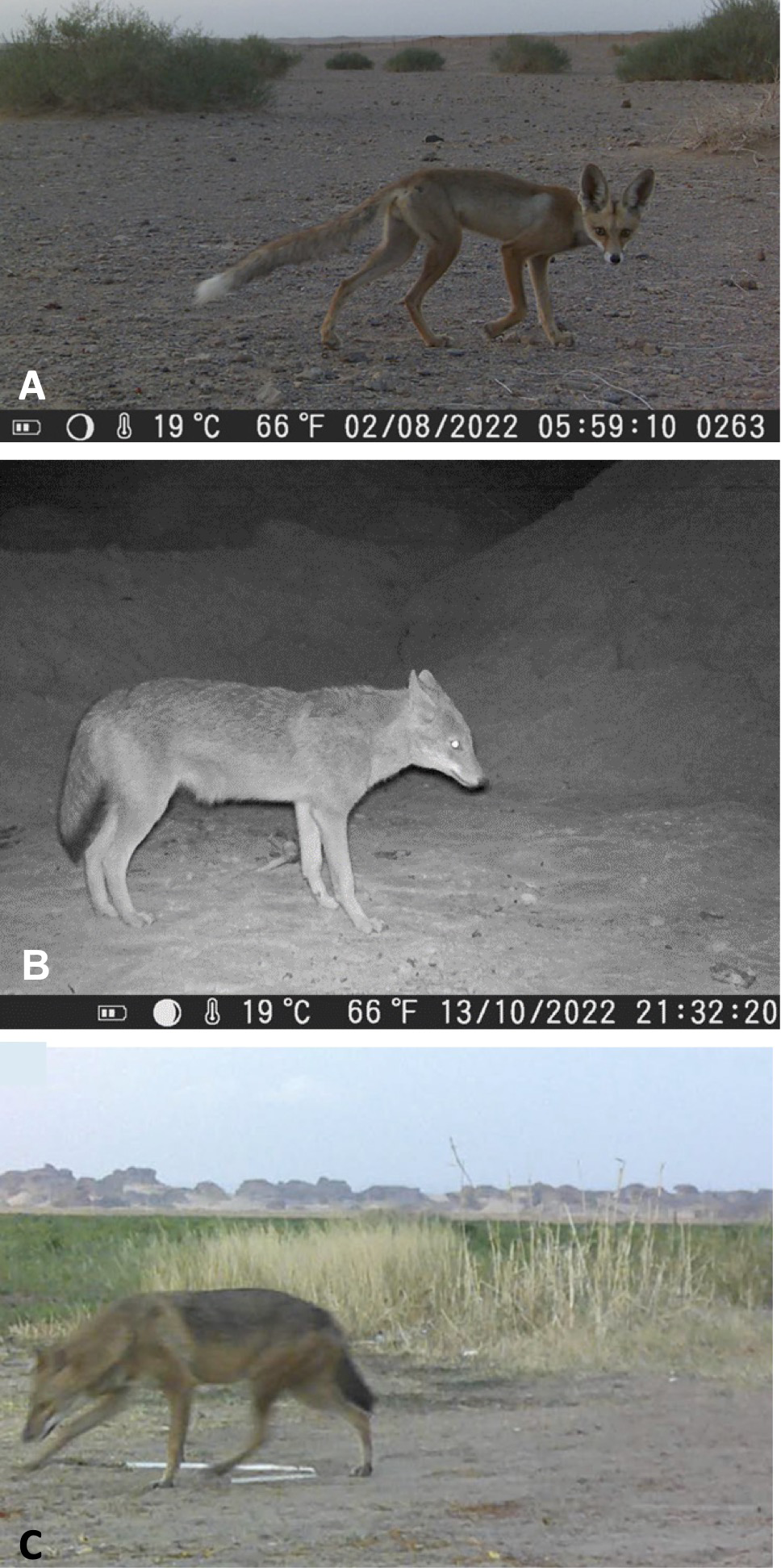
Red fox (A), grey wolf (B), and golden jackal (C)detected by camera traps in agricultural areas of Tabuk province in 2022.
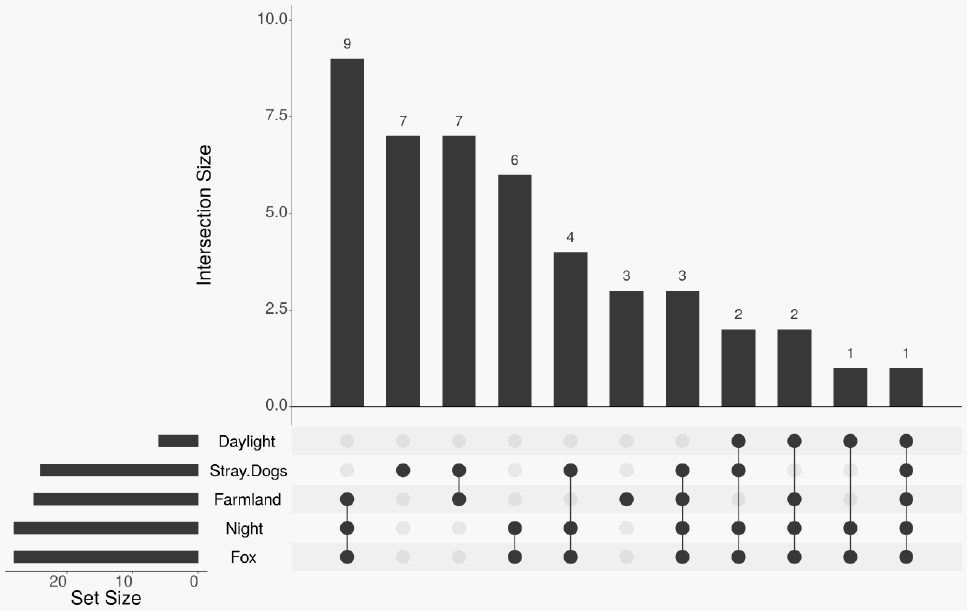
UpSet plot (Lex et al., 2014) of the intersection of red fox dataset collected in the field. The presence of stray dogs was only observed from 7:00 pm to 6:59 am, during the observed period of red fox activity (see Fig. 4).
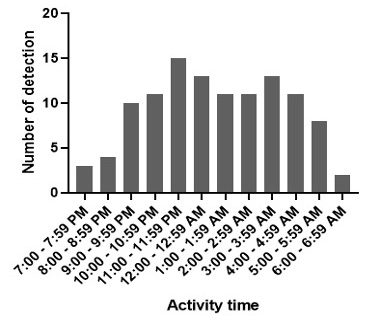
Red fox detection frequency based on camera trap observations across sites in agricultural areas of Tabuk province in 2022.
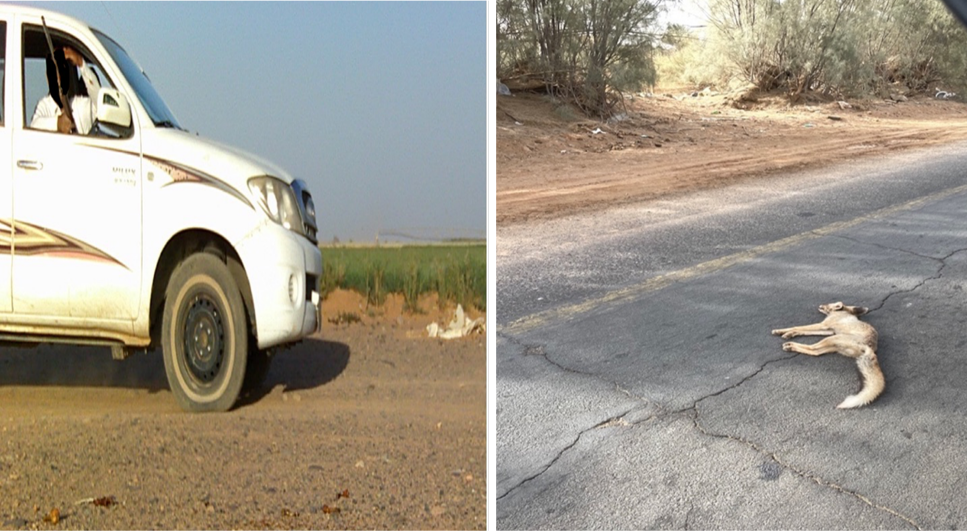
Threats that carnivores might encounter in agricultural areas. Although hunters with guns mostly target birds, they may hunt wild carnivores if encountered (photo from a camera trap). A fox killed in a collision with a car, observed in an agricultural area (photo by Abdulaziz Alatawi).
References
- Abd Rabou, A.N., Elkahlout, K.E., Almabhouh, F.A., Mohamed, W.F., Khalaf, N.A., Al-Sadek, M.A., Alfarra, R.N., Al-Moqayed, L.T., Shafei, A.A., Fayyad, N.A., Adeem, B.S., Dardona, A.W., Awad, A.S., Al-Agha, M.R. and Abd Rabou, M.A., 2021. Occurrence and some ecological aspects of the golden jackal (Canis aureus Linnaeus, 1758) in the Gaza Strip, Palestine. Open J. Ecol., 11: 105-125. https://doi.org/10.4236/oje.2021.112010[CrossRef]
- Ahmadi, M., López-Bao, J.V. and Kaboli, M., 2014. Spatial heterogeneity in human activities favors the persistence of wolves in agroecosystems. PLoS One, 9: e108080. https://doi.org/10.1371/journal.pone.0108080[CrossRef]
- Alatawi, A.S., 2022. Conservation action in Saudi Arabia: Challenges and opportunities. Saudi J. biol. Sci., 29: 3466-3472. https://doi.org/10.1016/j.sjbs.2022.02.031[CrossRef]
- Alatawi, A.S., Gilbert, F. and Reader, T., 2020. Modelling terrestrial reptile species richness, distributions and habitat suitability in Saudi Arabia. J. Arid Environ., 178: 104153. https://doi.org/10.1016/j.jaridenv.2020.104153[CrossRef]
- Albalawi, E., Dewan, A. and Corner, R., 2018. Spatio-temporal analysis of land use and land cover changes in arid region of Saudi Arabia. Int. J. Geomate, 14: 73-81. https://doi.org/10.21660/2018.44.3708[CrossRef]
- Albalawi, E., 2020. Assessing and predicting the impact of land use and land cover change on groundwater using geospatial techniques: A case study of Tabuk, Saudi Arabia. Doctoral dissertation, Curtin University.
- Al-Harbi, K.M., 2010. Monitoring of agricultural area trend in Tabuk region–Saudi Arabia using Landsat TM and SPOT data. Egypt. J. Remote Sens. Space Sci., 13: 37-42. https://doi.org/10.1016/j.ejrs.2010.07.005[CrossRef]
- Aloufi, A.A., and Amr, Z.S., 2018. Carnivores of the Tabuk Province, Saudi Arabia (Carnivora: Canidae, Felidae, Hyaenidae, Mustelidae). Lynx New Ser., 49: 77-90. https://doi.org/10.2478/lynx-2018-0010[CrossRef]
- Ansari, A.A., Siddiqui, Z.H., Alatawi, F.A., Alharbi, B.M. and Alotaibi, A.S., 2022. An assessment of biodiversity in Tabuk Region of Saudi Arabia: A comprehensive review. Sustainability, 14: 10564. https://doi.org/10.3390/su141710564[CrossRef]
- Bino, G., Dolev, A., Yosha, D., Guter, A., King, R., Saltz, D. and Kark, S., 2010. Abrupt spatial and numerical responses of overabundant foxes to a reduction in anthropogenic resources. J. appl. Ecol., 47: 1262-1271. https://doi.org/10.1111/j.1365-2664.2010.01882.x[CrossRef]
- Borchert, M., Davis, F.W. and Kreitler, J., 2008. Carnivore use of an avocado orchard in southern California. Calif. Fish Game, 94: 61-74.
- Curveira-Santos, G., Santos, M.J., Santos-Reis, M. and Rosalino, L.M., 2021. Global patterns of carnivore spatial ecology research in agroecosystems. Biodiv. Conserv., 30: 257-273. https://doi.org/10.1007/s10531-020-02093-4[CrossRef]
- Dobrovolski, R., Loyola, R.D., Guilhaumon, F., Gouveia, S.F. and Diniz-Filho, J.A., 2013. Global agricultural expansion and carnivore conservation biogeography. Biol. Conserv., 165: 162-170. https://doi.org/10.1016/j.biocon.2013.06.004[CrossRef]
- Draper, J.P., Young, J.K., Schupp, E.W., Beckman, N.G. and Atwood, T.B., 2022. Frugivory and seed dispersal by carnivorans. Front. Ecol. Evol., 10: 864864. https://doi.org/10.3389/fevo.2022.864864[CrossRef]
- Faure, J.P.B., Swanepoel, L.H., Cilliers, D., Venter, J.A. and Hill, R.A., 2022. Estimates of carnivore densities in a human-dominated agricultural matrix in South Africa. Oryx, 56: 774-781. https://doi.org/10.1017/S003060532100034X[CrossRef]
- Fernández-Sepúlveda, J. and Martín, C.A., 2022. Conservation status of the world’s carnivorous mammals (order Carnivora). Mammal. Biol., 102: 1911-1925. https://doi.org/10.1007/s42991-022-00305-8[CrossRef]
- Ferreira, A.S., Peres, C.A., Bogoni, J.A. and Cassano, C.R., 2018. Use of agroecosystem matrix habitats by mammalian carnivores (Carnivora): A global-scale analysis. Mamm. Rev., 48: 312-327. https://doi.org/10.1111/mam.12137[CrossRef]
- García, C.B., Svensson, G.L., Bravo, C., Undurraga, M.I., Díaz-Forestier, J., Godoy, K., Neaman, A., Barbosa, O., Abades, S. and Celis-Diez, J.L., 2021. Remnants of native forests support carnivore diversity in the vineyard landscapes of central Chile. Oryx, 55: 227-234. https://doi.org/10.1017/S0030605319000152[CrossRef]
- Giannatos, G., Karypidou, A., Legakis, A. and Polymeni, R., 2010. Golden jackal (Canis aureus L.) diet in Southern Greece. Mammal Biol., 75: 227-232. https://doi.org/10.1016/j.mambio.2009.03.003[CrossRef]
- Jankowiak, L., Antczak, M. and Tryjanowski, P., 2008. Habitat use, food and the importance of poultry in the diet of the red fox Vulpes vulpes in extensive farmland in Poland. World appl. Sci. J., 4: 886-890.
- Jankowiak, L., Malecha, A.W. and Krawczyk, A.J., 2016. Garbage in the diet of carnivores in an agricultural area. Eur. J. Ecol., 2: 81-86. https://doi.org/10.1515/eje-2016-0009[CrossRef]
- Kaky, E., 2020. Potential habitat suitability of Iraqi amphibians under climate change, Biodiversitas, 21: 731-742. https://doi.org/10.13057/biodiv/d210240[CrossRef]
- Kaky, E., Alatawi, A.S., Jaf, A.A. and Gilbert, F., 2022. Predicting current and future habitat refuges for conservation of wild goat (Capra aegagrus Erxleben 1777) under climate change in Iraq. J. Arid Environ., 199: 104699. https://doi.org/10.1016/j.jaridenv.2021.104699[CrossRef]
- Kaky, E., Nolan, V., Alatawi, A. and Gilbert, F., 2020. A comparison between Ensemble and MaxEnt species distribution modelling approaches for conservation: A case study with Egyptian medicinal plants. Ecol. Inf., 60: 101150. https://doi.org/10.1016/j.ecoinf.2020.101150[CrossRef]
- Kaky, E., Nolan, V., Khalil, M.I., Mohammed, A.M.A., Jaf, A.A., Mohammed-Amin, S.M., Mahmood, Y.A. and Gilbert, F., 2023. Conservation of the Goitered gazelle (Gazella subgutturosa) under climate changes in Iraq. Heliyon, 9: e12501. https://doi.org/10.1016/j.heliyon.2022.e12501[CrossRef]
- Lange, P.N., Lelieveld, G. and De Knegt, H.J., 2021. Diet composition of the golden jackal Canis aureus in South-East Europe - a review. Mammal. Rev., 51: 207-213. https://doi.org/10.1111/mam.12235[CrossRef]
- Lex, A., Gehlenborg, N., Strobelt, H., Vuillemot, R. and Pfister, H., 2014. UpSet: Visualization of intersecting sets. IEEE Trans. Visual. Comput. Graphics, (InfoVis’14), 20: 1983-1992. https://doi.org/10.1109/TVCG.2014.2346248[CrossRef]
- Mallon, D. and Budd, K., 2011. Regional red list status of carnivores in the Arabian Peninsula. IUCN Cambridge, UK and Gland Switzerland and Environment and Protected Areas Authority Sharjah, UAE.
- Markov, G. and Lanszki, J., 2012. Diet composition of the golden jackal, Canis aureus in an agricultural environment. Folia Zool., 61: 44-48. https://doi.org/10.25225/fozo.v61.i1.a7.2012[CrossRef]
- Miller, G.T. and Spoolman, S.E., 2009. Essentials of ecology. 5th edition. Brooks/Cole, Belmont. pp. 274.
- Ministry of Environment, Water and Agriculture., 2023. Accessed at https://www.mewa.gov.sa/ar/Pages/default.aspx on 20/01/2023.
- Mohamed, W.F., 2016. On the occurrence of Arabian red fox Vulpes vulpes arabica (Thomas, 1902) in Sakaka, Northern Saudi Arabia. Pakisan J. Zool., 48: 1979-1982. https://doi.org/10.21608/jbaar.2016.109503[CrossRef]
- Mohamed, W.F. and Basuony, M.I., 2016. Food composition and feeding ecology of the Arabian red fox Vulpes vulpes arabica (Thomas, 1902) in Sakaka, northern Saudi Arabia. J. Biosci. appl. Res., 2: 723-728. https://doi.org/10.21608/jbaar.2016.109503[CrossRef]
- Morehouse, A.T. and Boyce, M.S., 2017. Troublemaking carnivores: Conflicts with humans in a diverse assemblage of large carnivores. Ecol. Soc., 22: 1-12. https://doi.org/10.5751/ES-09415-220304[CrossRef]
- Nattrass, N. and Conradie, B., 2018. Predators, livestock losses and poison in the South African Karoo. J. Cleaner Prod., 194: 777-785. https://doi.org/10.1016/j.jclepro.2018.05.169[CrossRef]
- Newbold, T., Hudson, L.N., Hill, S.L., Contu, S., Lysenko, I., Senior, R.A., Börger, L., Bennett, D., Choimes, A., Collen, B., Day, J., De Palma, A., Dıaz, S., Echeverria-Londono, S., Edgar, M., Feldman, A., Garon, M., Harrison, M., Alhusseini, T., Ingram, D., Itescu, Y., Kattge, J., Kemp, V., Kirkpatrick, L., Kleyer, M., Correia, D., Martin, C., Meiri, S., Novosolov, M., Pan, Y., Phillips, H., Purves, D., Robinson, A., Simpson, J., Tuck, S., Weiher, E., White, H., Ewers, R., Mace, G., Scharlemann, J. and Purvis, A., 2015. Global effects of land use on local terrestrial biodiversity. Nature, 520: 45-50. https://doi.org/10.1038/nature14324[CrossRef]
- Nogeire T.M., Davis, F.W., Duggan, J.M., Crooks, K.R. and Boydston, E.E., 2013. Carnivore use of avocado orchards across an agricultural-wildland gradient. PLoS One, 8: e68025. https://doi.org/10.1371/journal.pone.0068025[CrossRef]
- Nolan, V., Kaky, E.D., Alatawi, A.S. and Gilbert, F., 2022. Mapping the Indian crested porcupine across Iraq: The benefits of species distribution modelling when species data are scarce. Mammal. Biol., 102: 1851-1866. https://doi.org/10.1007/s42991-022-00290-y[CrossRef]
- Ordiz, A., Støen, O.G., Delibes, M. and Swenson, J.E., 2011. Predators or prey? spatio-temporal discrimination of human-derived risk by brown bears. Oecologia, 166: 59-67. https://doi.org/10.1007/s00442-011-1920-5[CrossRef]
- Ostfeld, R.S. and Holt, R.D., 2004. Are predators good for your health? Evaluating evidence for top-down regulation of zoonotic disease reservoirs. Front. Ecol. Environ., 2: 13-20. https://doi.org/10.1890/1540-9295(2004)002[0013:APGFYH]2.0.CO;2[CrossRef]
- Pimm, S.L., Jenkins, C.N., Abell, R., Brooks, T.M., Gittleman, J.L., Joppa, L.N., Raven, P.H., Roberts, C.M. and Sexton, J.O., 2014. The biodiversity of species and their rates of extinction, distribution, and protection. Science, 344: 1246752. https://doi.org/10.1126/science.1246752[CrossRef]
- Pita, R., Mira, A., Moreira, F., Morgado, R. and Beja, P., 2009. Influence of landscape characteristics on carnivore diversity and abundance in Mediterranean farmland. Agric. Ecosyst. Environ., 132: 57-65. https://doi.org/10.1016/j.agee.2009.02.008[CrossRef]
- Prakash, S. and Verma, A.K., 2022. Anthropogenic activities and biodiversity threats. Int. J. Biol. Innov., 4: 94-103. https://doi.org/10.46505/IJBI.2022.4110[CrossRef]
- Rico-Guzmán, E., Terrones, B., Cantó, J.L. and Bonet, A., 2012. Frugivore carnivores: Preferences and contribution to seed dispersal of red fox Vulpes vulpes (Linnaeus, 1758) and stone marten Martes foina (Erxleben, 1777) in Carrascal de la Font Roja Natural Park (Alicante, Spain). Galemys, 24: 25-33. https://doi.org/10.7325/Galemys.2012.A03[CrossRef]
- Ripple, W.J. and Beschta, R.L., 2012. Trophic cascades in Yellowstone: The first 15 years after wolf reintroduction. Biol. Conserv., 145: 205-213. https://doi.org/10.1016/j.biocon.2011.11.005[CrossRef]
- Ripple, W.J., Estes, J.A., Beschta, R.L., Wilmers, C.C., Ritchie, E.G., Hebblewhite, M., Berger, J., Elmhagen, B., Letnic, M., Nelson, M.P., Schmitz, O.J., Smith, D.W., Wallach, A.D. and Wirsing, A.J., 2014. Status and ecological effects of the world’s largest carnivores. Science, 343: 1241484. https://doi.org/10.1126/science.1241484[CrossRef]
- Šálek, M., Červinka, J., Pavluvčík, P., Poláková, S. and Tkadlec, E., 2014. Forest-edge utilization by carnivores in relation to local and landscape habitat characteristics in central European farmland. Mammal. Biol., 79: 176-182. https://doi.org/10.1016/j.mambio.2013.08.009[CrossRef]
- Saruhan, T.B. and Sari, A., 2022. Altitudinal distribution and habitat use of the Golden Jackal (Canis aureus Linnaeus, 1758) in Trabzon, Arsin-Yanbolu Valley in Turkey. Pakistan J. Zool., 54: 1521-1529. https://doi.org/10.17582/journal.pjz/20211217111238[Full text][CrossRef]
- Shapira, I., Sultan, H. and Shanas, U., 2008. Agricultural farming alters predator–prey interactions in nearby natural habitats. Anim. Conserv., 11: 1-8. https://doi.org/10.1111/j.1469-1795.2007.00145.x[CrossRef]
- Stepkovitch, B., Martin, J.M., Dickman, C.R. and Welbergen, J.A., 2019. Urban lifestyle supports larger red foxes in Australia: An investigation into the morphology of an invasive predator. J. Zool., 309: 287-294. https://doi.org/10.1111/jzo.12723[CrossRef]
- Suraci, J.P., Clinchy, M., Dill, L.M., Roberts, D. and Zanette, L.Y., 2016. Fear of large carnivores causes a trophic cascade. Nat. Commun., 7: 10698. https://doi.org/10.1038/ncomms10698[CrossRef]
- Takahata, C, Nielsen, S.E., Takii, A. and Izumiyama, S., 2014. Habitat selection of a large carnivore along Human-Wildlife boundaries in a highly modified landscape. PLoS One, 9: e86181. https://doi.org/10.1371/journal.pone.0086181[CrossRef]
- Tilman, D., Clark, M., Williams, D.R., Kimmel, K., Polasky, S. and Packer, C., 2017. Future threats to biodiversity and pathways to their prevention. Nature, 546: 73-81. https://doi.org/10.1038/nature22900[CrossRef]
- Tkachenko, K.N., 2021. Nutrition of the Red Fox (Vulpes vulpes) in Bol’shekhekhtsirskii Nature Reserve and its environs (southern part of the Amur River region). Biol. Bull., 48: 1424-1433. https://doi.org/10.1134/S106235902108029X[CrossRef]
- Warrier, R., Noon, B.R. and Bailey, L., 2020. Agricultural lands offer seasonal habitats to tigers in a human-dominated and fragmented landscape in India. Ecosphere, 11: e03080. https://doi.org/10.1002/ecs2.3080[CrossRef]
- Wolf, C. and Ripple, W.J., 2016. Prey depletion as a threat to the world’s large carnivores. R. Soc. Open Sci., 3: 160252. https://doi.org/10.1098/rsos.160252[CrossRef]
- Wolf, C. and Ripple, W.J., 2017. Range contractions of the world’s large carnivores. R. Soc. Open Sci., 4: 170052. https://doi.org/10.1098/rsos.170052[CrossRef]
- Wolf, C. and Ripple, W.J., 2018. Rewilding the world’s large carnivores. R. Soc. Open Sci., 5: 172235. https://doi.org/10.1098/rsos.172235[CrossRef]
- Yom-Tov, Y., Yom-Tov, S., Barreiro, J. and Blanco, J.C., 2007. Body size of the red fox Vulpes vulpes in Spain: The effect of agriculture. Biol. J. Linn. Soc., 90: 729-734. https://doi.org/10.1111/j.1095-8312.2007.00761.x[CrossRef]
Services
Article usage statistics
Loading…