
African swine fever (ASF) is a highly contagious and economically devastating disease of domestic and wild pigs caused by the African swine fever virus (ASFV), a large DNA virus of the Asfarviridae family. The virus was first reported in Malaysia in 2021 in Sabah and has since been detected in several states, raising concerns over its endemicity. As part of a retrospective biosurveillance program, 38 wild boars (Sus scrofa) were sampled across Peninsular Malaysia between January 2022 and August 2024. Whole blood, spleen tissues and ectoparasites were tested for ASFV using a validated real-time PCR assay. Genotyping was conducted based on the partial B646L gene and the intergenic region (IGR) between the I73R and I329L genes. One adult male wild boar captured at Masjid Tanah, Melaka, tested positive for ASFV, along with a Dermacentor steini tick collected from the same animal. Phylogenetic analysis of the ASFV sequences clustered it with genotype II, while both the blood and tick samples were classified as IGR-II variants, consistent with strains previously reported in Malaysia and other Asian countries. This finding suggests that ASFV is circulating within Peninsular Malaysia’s wild boar population and may be establishing sustained transmission in the country. Continued wildlife surveillance, strict biosecurity at wildlife-livestock interfaces, and One Health coordination through integrated veterinary, wildlife, and environmental health efforts are critical to mitigate further spread.
Short Communication · Volume 58, Issue 4, 25 June 2026 · Open Access
Detection of African Swine Fever Virus Genotype II and IGR-II Variant in Wild Boar (Sus scrofa) and Dermacentor steini Tick from Peninsular Malaysia
· · · · · · · · ·
Affiliations & Notes ⌄
- 1Tropical Infectious Diseases Research & Education Centre, Higher Institution Centre of Excellence, Universiti Malaya, 50603 Kuala Lumpur, Malaysia 2Institute of Biological Sciences, Faculty of Science, Universiti Malaya, 50603 Kuala Lumpur, Malaysia 3Department of Veterinary Clinical Studies, Faculty of Veterinary Medicine, Universiti Putra Malaysia, 43400 UPM Serdang, Malaysia 4Department of Wildlife and National Parks, KM10 Jalan Cheras, 56100 Kuala Lumpur, Malaysia * Corresponding author: zya
Article Info ⌄
- Journal:
- Pakistan Journal of Zoology
- Published:
- 25 June 2026

From the article
- Blood sample from one adult male wild boar captured at Masjid Tanah, Melaka, in May 2022 tested positive for ASFV.
- A Dermacentor steini tick collected from the same ASFV-positive animal also tested positive.
- Sequencing of the partial B646L gene from the wild boar blood (accession no. PX060559) revealed 100% sequence identity, clustering within genotype II and showing complete similarity to ASFV strains previously reported.
- The detection of ASFV DNA in a wild boar and its associated tick provides further evidence of ASFV circulation within Peninsular Malaysia’s wild boar population.
Selected from the article's own text.
Abstract
Materials and methods
This study received approval from the Department of Wildlife and National Parks of Peninsular Malaysia (PERHILITAN) (Permit no. JPHL and TN (IP): 100-34/1.24 Jld. 19 (55), the Universiti Malaya Institutional Animal Care and Use Committee (UM IACUC) (Approval no. T/22052023/13032023-02/R) and the Universiti Malaya Institutional Biosafety and Biosecurity Committee (UM IBBC) (Approval no. UMIBBC/NOI/R/TNCPNI/TIDREC/007-2024-13092024).
Wild boar (Sus scrofa) hunting activities were conducted between January 2022 and August 2024, in collaboration with the Department of Wildlife and National Parks (PERHILITAN), Peninsular Malaysia, in accordance with the Wildlife Conservation Act 2010 [Act 716] and departmental operational guidelines. Hunting was carried out by licensed PERHILITAN personnel using approved firearms and ammunition. Operations were typically conducted during midnight to early morning between 01:00 am and 05:00 am, when wild boar activity is highest. Prior to the operation, the hunting area was surveyed to identify active feeding grounds, tracks, and wallowing sites. Upon sighting, wild boars were culled using precision shooting to ensure humane killing and minimal suffering. All carcasses were handled using biosecurity precautions, including the use of gloves and disinfected tools, to prevent zoonotic pathogen exposure. Carcasses were either disposed of in accordance with PERHILITAN regulations or transported for approved research purposes. All procedures were conducted under direct supervision of PERHILITAN officers to ensure adherence to safety, ethical, and legal requirements.
Animals were categorized by sex and age (adults, sub-adults, juveniles). Whole blood, spleen tissues and ectoparasites were collected post-mortem, transported on dry ice, and stored at −80°C until analysis. DNA was extracted using the GeneJET Genomic DNA Purification Kit (Thermo Scientific, USA). ASFV detection was performed using the VetMAX™ African Swine Fever Virus Detection Kit (Applied Biosystems, USA), validated by the World Organisation for Animal Health (WOAH), following manufacturer instructions. ASFV-positive samples were genotyped by amplifying the partial B646L (p72) gene and the intergenic region (IGR) between the I73R and I329L genes ; . Sequences were aligned with reference ASFV strains from GenBank using MEGA 12, and a neighbor-joining phylogenetic tree was constructed . Tandem repeat sequences (TRS) in the IGR were analyzed for IGR variant classification.
Results and discussion
A total of 38 wild boars of various life stages, consisting of 23 males (10 adults, 9 sub-adults and 4 juveniles) and 15 females (10 adults, 1 sub-adult and 4 juveniles), were captured across 18 sites in five states (Johor, Melaka, Perlis, Selangor, and Terengganu) in Peninsular Malaysia (Fig. 1). Blood sample from one adult male wild boar captured at Masjid Tanah, Melaka, in May 2022 tested positive for ASFV. A Dermacentor steini tick collected from the same ASFV-positive animal also tested positive. Ticks were identified using phenotypic morphological keys . Sequencing of the partial B646L gene from the wild boar blood (accession no. PX060559) revealed 100% sequence identity, clustering within genotype II and showing complete similarity to ASFV strains previously reported
in Malaysia and in neighboring countries, including the Philippines, Singapore and Indonesia (Fig. 2) . The B646L gene however, could not be amplified from the tick. Both samples (wild boar blood and tick) possessed three copies of the TRS (5′-GGAATATATA-3′) in the IGR, between the 173 R and I329L glass, classifying them as IGR-II variants (accession nos. PX060560 and PX060561).
Records from GenBank suggest that a genotype II and IGR-II variant ASFV isolate MVZT3269/MELAKA/2021 (accession nos. OQ680652 and OQ680655) was obtained from the lymph node of a pig sampled in Masjid Tanah, Melaka, on 21 December 2021. Although no published report is available for this isolate, the virus detected in the present study sampled in May 2022 may represent the same or a closely related strain circulating in the area at that time, suggesting possible localized persistence. The subsequent detection of ASFV in commercially farmed pigs in Penang in July 2025 is consistent with the likelihood of an ongoing ASFV circulation in Peninsular Malaysia .
The detection of ASFV DNA in a wild boar and its associated tick provides further evidence of ASFV circulation within Peninsular Malaysia’s wild boar population. The close genetic similarity of the detected strain to other Asian genotype II isolates supports the assertion of a transboundary introduction of the virus into Malaysia, followed by an autochthonous transmission. Illegal movement of contaminated pork products is considered a major transboundary pathway for ASFV introduction into Asia . Spillover between domestic pigs and wild boars may also occur indirectly through human-mediated fomite transmission via contaminated vehicles, equipment, or feed . In areas where domestic and wild pigs share resources or where biosecurity practices are inadequate, improper disposal of infected carcasses or pork waste could provide opportunities for indirect transmission. Although long-distance migration of wild boars between countries is limited, localized movement of wild boar populations along forest corridors may facilitate the spread of ASFV within Malaysia, as observed in other affected regions .
Since only one wild boar tested positive for ASFV in the present study, it may reflect low-level virus circulation among wild boars, with sporadic spillover from domestic pigs rather than endemic transmission in wildlife . The highly lethal nature of ASFV in wild boars further reduces the likelihood of detecting infected individuals, as most animals would succumb rapidly to infection, leaving few survivors available for sampling . Active surveillance through live animal trapping, as employed in this study, generally yields lower detection rates than passive surveillance based on carcass sampling, where mortality events are more likely to reveal infected animals . Furthermore, the relatively small sample size and uneven geographic coverage may have reduced the likelihood of detecting ASFV circulating at low prevalence levels.
The detection of ASFV in a D. steini tick in this study however, highlights the need to further investigate the potential role of hard ticks in the maintenance and transmission of ASFV in tropical ecosystems, as most existing knowledge originates from temperate regions . Including wildlife sampling in routine ASFV surveillance hence, is crucial for effective control of the disease. Enhanced biosurveillance of wild boars, including regular testing of blood, tissues, and ectoparasites, can provide early warning of outbreaks and inform rapid response measures. A One Health approach, integrating wildlife, livestock, and environmental health sectors, will be essential for mitigating ASFV in Malaysia. Cross-border collaborations with neighboring countries such as Thailand and Indonesia are equally important for sharing of genomic data and coordinating regional containment efforts (FAO, 2025).
Conclusion
This study provides evidence of genotype II ASFV circulation in Peninsular Malaysia’s wild boar population and its potential tick host, D. steini, underscoring the potential role of wildlife and ticks in the epidemiology of ASFV.
Declaration
Funding
The study was supported by the Dana Langganan Sukuk Pakej Rangsangan Ekonomi Prihatin Rakyat (SUKUK PRIHATIN)-Fasa 2 under the work package 1 (Project code: MO002A-2021) and partly by the Ministry of Higher Education, Malaysia for niche area research under the Higher Institution Centre of Excellence (HICoE) program (MO002-2019 and TIDREC-2023).
Generative AI and AI-assisted technology statement
The authors declare that no generative AI and AI assisted technology was used in the creation of this manuscript.
Statement of conflict of interest
The authors have declared no conflict of interest.
Figures
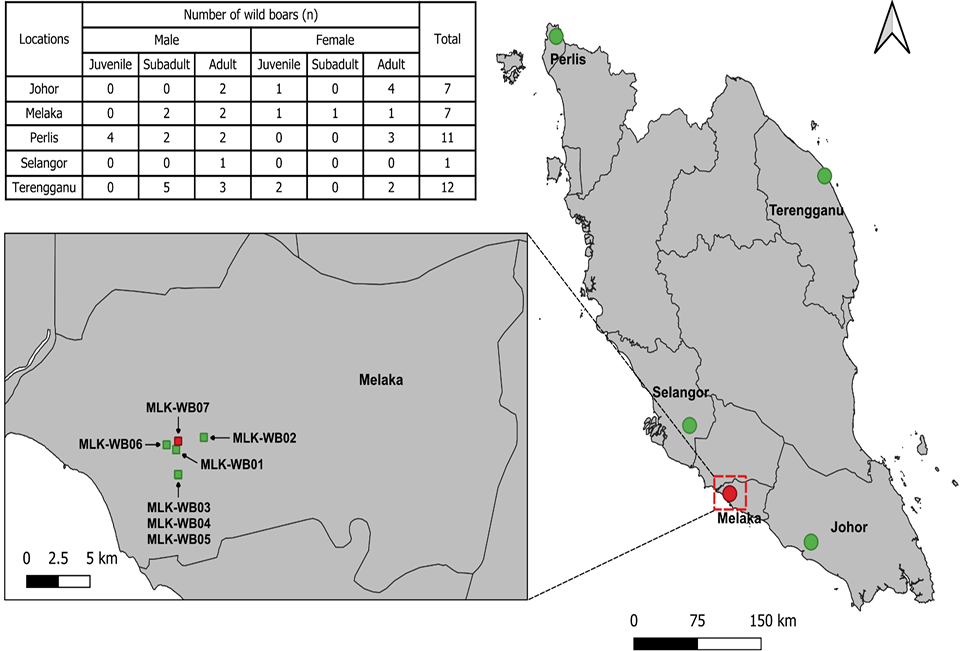
Wild boar sampling locations across five states in Peninsular Malaysia, represented by solid-colored circles. Solid-colored squares indicate the sites for each wild boar collected in Masjid Tanah, Melaka. Colors represent the detection of the ASFV case; red indicates ASFV-positive while green indicates ASFV-negative.
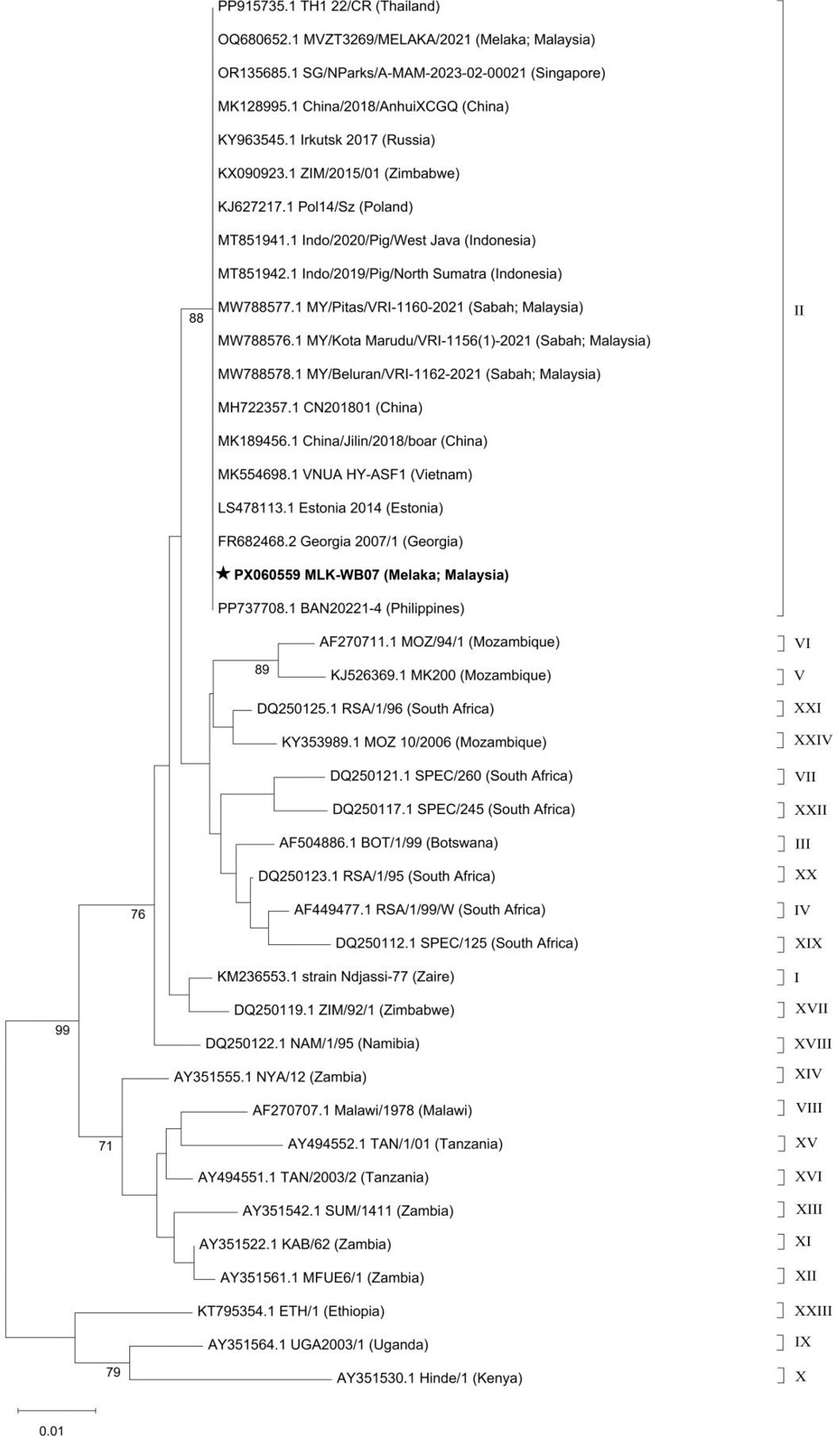
Neighbor-joining phylogenetic analysis of the partial B646L gene of the ASFV-positive sample from Melaka, using the Kimura-2-parameter model in MEGA 12 at 1,000 bootstrap replicates. Only bootstrap values >70% are shown along the branches. The ASFV-positive sample was indicated in bold text and a solid-black star before its name. Roman numerals to the right indicate B646L genotypes. Scale bar indicates nucleotide substitutions per site.
References
- Bastos, A.D.S., Penrith, M.L., Crucière, C., Edrich, J.L., Hutchings, G., Roger, F., Couacy-Hymann, E. and Thomson, G.R., 2003. Arch. Virol., 148: 693–706. https://doi.org/10.1007/s00705-002-0946-8[CrossRef]
- Bernama, 2025. African swine fever confirmed at three Penang pig farms, 50 deaths reported. Available from https://bernama.com/en/news.php?id=2444705 (accessed 12 July 2025).
- Chenais, E., Ståhl, K., Guberti, V. and Depner, K., 2018. Emerg. Infect. Dis., 24: 810–812. https://doi.org/10.3201/eid2404.172127[CrossRef]
- Ernieenor, F.C.L., Apanaskevich, D.A., Ernna, G. and Mariana, A., 2020. Exp. appl. Acarol., 80: 137-149. https://doi.org/10.1007/s10493-019-00439-4[CrossRef]
- Ewers, R.M., Nathan, S.K.S.K. and Lee, P.A.K., 2021. Nature, 593: 37. https://doi.org/10.1038/d41586-021-01189-3[CrossRef]
- FAO, 2025. African swine fever situation update – Asia and the Pacific. Available at https://www.fao.org/animal-health/situation-updates/asf-in-asia-pacific/en (accessed 2 May 2025).
- Gallardo, C., Fernández-Pinero, J., Pelayo, V., Gazaev, I., Markowska-Daniel, I., Pridotkas, G., Nieto, R., Fernández-Pacheco, P., Bokhan, S., Nevolko, O., Drozhzhe, Z., Pérez, C., Soler, A., Kolvasov, D. and Arias, M., 2014. Emerg. Infect. Dis., 20: 1544–1547. https://doi.org/10.3201/eid2009.140554[CrossRef]
- Gaudreault, N.N., Madden, D.W., Wilson, W.C., Trujillo, J.D. and Richt, J.A., 2020. Front. Vet. Sci., 7: 215. https://doi.org/10.3389/fvets.2020.00215[CrossRef]
- Khanna, K., 2022. African swine fever virus: A global concern. Available from https://asm.org/articles/2022/march/african-swine-fever-virus-is-a-global-concern (accessed 2 May 2025).
- Kumar, S., Stecher, G., Suleski, M., Sanderford, M., Sharma, S. and Tamura, K., 2024. Mol. Biol. Evol., 41: msae263. https://doi.org/10.1093/molbev/msae263[CrossRef]
- Montecillo, A.D., Baybay, Z.K., Ferrer, J.B.C., Cariaso, W., Pantua, A., Jose, J.P., Madera, R., Shi, J., Doysabas, K.C., Dargantes, A., Dargantes, K.A.T., Boongaling, A.R.A., Manglicmot, A.P., Villegas, L.C. and Pantua, H.D., 2025. Viruses, 17: 588. https://doi.org/10.3390/v17040588[CrossRef]
- Ngah Hamid, A., Abdullah, S.D. and Ibrahim, S.S., 2023. Control of African swine fever in Malaysia. World Organisation for Animal Health. Available from https://rr-asia.woah.org/app/uploads/2023/11/malaysia-poster-dr-akma_asf.pdf (accessed 2 May 2025).
- Niederwerder, M.C., 2021. Animals, 11: 792. https://doi.org/10.3390/ani11030792[CrossRef]
- Oura, C., 2024. African swine fever. Available from https://www.msdvetmanual.com/generalized-conditions/african-swine-fever/african-swine-fever#Etiology-and-Pathogenesis_v3274838 (accessed 2 May 2025).
- Probst, C., Globig, A., Knoll, B., Conraths, F.J. and Depner, K., 2017. R. Soc. Open Sci., 4: 170054. https://doi.org/10.1098/rsos.170054[CrossRef]
- Sánchez-Cordón, P.J., Montoya, M., Reis, A.L. and Dixon, L.K., 2018. Vet. J., 233: 41–48. https://doi.org/10.1016/j.tvjl.2017.12.025[CrossRef]
Services
Article usage statistics
Loading…