
We evaluated the field efficacy of coumatetralyl maize grain bait (0.0375%) against wild boar population in Fatima Jinnah Park, Islamabad. A total of 1838 kg bait was applied at 32 bait points, out of which 1627 kg was consumed by wild boars during 17 nights. The consumption of bait increased asymptotically and attained peak on the 7th night. The bait in-take, external and internal pathological symptoms were similar as has been described for warfarin and brodifacoum. The bleeding period ranged from 8.06 to 12.94 nights with 13% variation in time. Based upon the total consumption of coumatetralyl bait, 400-450 wild boars were estimated as killed during the operation. The results of the study showed that coumatetralyl is a promising and potential alternate to sodium flouroacetate compound (1080) for managing wild boar populations in diverse environments.
Short Communication · Volume 49, Issue 3, 27 May 2017 · Open Access
Field Evaluation of Coumatetralyl for the Control of Wild Boar, Sus scrofa cristatus
· ·
Affiliations & Notes ⌄
- 1Pakistan Agricultural Research Council, Islamabad, Pakistan 2Vertebrate Pest Management Programme, National Agricultural Research Centre, Park Road, Islamabad, Pakistan , * Corresponding author: pestwatch360@yahoo.com
Article Info ⌄
- Journal:
- Pakistan Journal of Zoology
- Published:
- 27 May 2017

From the article
- During the 17 nights baiting, the observations recorded about the bait intake, external and internal pathological symptoms, indicated that coumatetralyl (0.0375%) maize grain bait was highly effective in reducing wild boar population in different areas of the park.
- A total of 1838 kg bait was applied and out of this 1627 kg bait was consumed by the wild boars.
- The observations on the pattern of bait consumption showed that the natural food was not easily available to wild boars in the park area.
- Also, coumatetralyl proved to be a potential alternate toxicant and replacement to the use of 1080 for wild boar control as problems of bait-shyness, aversion, tolerance, hazards to live-stock, wildlife and humans are not associated with the use of baits formulated from this compound.
Selected from the article's own text.
Abstract
Materials and methods
The study was conducted in Fatima Jinnah Park, F-9 (formerly known as Capital Park), located in the Zone-1 as per Master Plan of the Islamabad territory. It is equivalent to one full sector area (307.3 ha), and was designed by the Japanese architectures in 1970. The park is surrounded on three sides by the residential sectors: F-8 to the east side, E-9 to the north and F-10 to the western boundary. Towards south lies the civic-business-commerce centre of the city known as Jinnah Avenue. It is nearly two kilometers away from the foot hills of Margalla National Park in the north. The topography of the park resembles the overall terrain of the capital city where the land is uneven (rolling) and there is a slope from north to south. The elevation of the park lies between 488-549 m from the sea level. The most predominant feature of the study site is the presence of two nullahs which join each other towards the south of the park. The banks of these nullahs are badly eroded. In the past, the land of this area was used for agriculture till the time it was acquired for urban development.
The land of the park was developed by clearing off thorn scrub vegetation. At the time of this study the vegetation cover of the park comprised of Dalbergia sissoo Roxb, Broussonetia papyrifera (L.) L. Hertit, Acacia modesta (L.) Wall, Pinus roxburghii Sargent, Morus alba L. etc. (trees), and Cynodon dactylon L., Cyperus rotundus L., Sorghum halepense (L.) Pers, Desmostachya bipinnata (L.) Stapf etc. (grasses). Banks of nullahs, having thickest of B. papyrifera and S. halepense provided hide-outs to wild boars, the migrants from the Margallah Hills. The observed wildlife consisted of common foxes and few partridges. The trees provided roosting sites to crows.
Coumatetralyl (Racumin) bait was prepared by mixing molasses with whole maize grain, and racumin master mix (0.75%) in the ratio of 1:18:1 by weight, to give a final concentration of 0.0375% coumatetralyl. Blue dye was incorporated by the manufacturer in the master mix to provide warning that the bait is not human food. Also, birds avoid eating such coloured stuff. Fresh bait was prepared daily and used the same in the late afternoon.
Before the baiting was initiated, the park was thoroughly surveyed for places where wild boar activity was evident i.e., wallows, rooting of grass tubers, tusk or mud marks on tree trunks, numerous foot prints, trails etc. All the active places were flagged with red coloured ribbon. Altogether 32 places were selected as bait points. The baiting was conducted in the late afternoon (1530-1830 h) and the bait consumption was checked in the morning. Starting with an initial placement of 2.5 to 3.5 kg per point and for the following nights the quantity of the bait placed was adjusted according to the previous night’s bait consumption. The baiting at all points continued for 17 nights. Daily records were kept of the bait placed and consumed over night at each bait point.
Results and discussion
During the 17 nights baiting, the observations recorded about the bait intake, external and internal pathological symptoms, indicated that coumatetralyl (0.0375%) maize grain bait was highly effective in reducing wild boar population in different areas of the park. Boars ingesting coumatetralyl showed similar pathological symptoms as described for warfarin and brodifacoum (O’Brien and Lukins, 1990). External evidence of anticoagulant toxicity consisted of bloody rectal or nasal discharge or frank blood in faecal matter. Autopsied animals showed extensive haemorrhages in stomach, small and large intestines. Weight bearing joints also showed bleeding symptoms. Bleeding and nasal discharge was observed at 28 bait points. First bleeding sign was recorded on the 7th day of baiting while it continued to be observed on different days up to 14th day, mean being, 10.5±2.44 nights. Thus, the bleeding period ranged from 8.06 to 12.94 nights with 13% variation in time. During the study it was, also, observed that wild boars having lethal doses of coumatetralyl showed markedly reduced movements and feeding prior to death. Although anticoagulants can pose both a primary and a secondary poisoning hazard to non-target species under certain circumstances, the authors did not record any such case in the present study because coumatetralyl has a much shorter serum half-life and is likely to show persistence (O’Brien and Lukins, 1990).
Thirty two bait points were established in various areas of the park where wild boar activity was evident. After first night’s baiting, bait intake was recorded from 29 bait points and later on all of them became active. Baiting was conducted for 17 nights. A total of 1838 kg bait was applied and out of this 1627 kg bait was consumed by the wild boars. During the 17 nights the maximum bait applied at one bait point was 99 kg while the minimum quantity was 21 kg, average being 56 kg. Similarly, the maximum bait consumed at one bait point was 88.2 kg while the minimum quantity was 19.2 kg, average being 51.8 kg. The consumption of bait increased asymptotically and attained peak on the 7th night and thereafter declined steadily (Fig. 1). The bait applied and consumed by the 17th night declined to 10.26 and 9.14% of the peak, respectively. The quantity of bait applied and consumed varied by 20.99 and 19.20%, respectively which means that the bait applied per night was sufficient for wild boars visiting each bait point. The bait consumption ranged from 1.6-6.52 kg per night with an average of 4.1 kg. The bait consumption data suggest that maize grain bait of coumatetralyl was highly accepted by the wild boars. Although, no comparison was made with any other kind of bait in this study, however, the results of other studies showed that the consumption of grain bait by wild boars was significantly higher than pellet baits (O’Brien et al., 1988). The observation documented revealed that bait type has broader implications for vertebrate pest control. Bait type can be an important determinant of a compound’s toxicity and may be a source of variation in response and also when the natural food is abundant in the operational area. The observations on the pattern of bait consumption showed that the natural food was not easily available to wild boars in the park area.
During this study 1627 kg coumatetralyl (0.0375%) bait was consumed by the wild boars which must have contained 610 g of active ingredient of the compound when it was formulated in the factory. Dobson (1973) conducted pen studies which indicated that coumatetralyl at dosages ranging from 0.1 to 1.0 mg/kg created haemorrhages in majority of pigs and died on the 8th day from consuming 0.25 to 1.0 mg/kg of coumatetralyl for 7 days. He concluded that a total intake of less than 2 mg/kg should be lethal provided this is ingested over a period of seven days. In this study the coumatetralyl master mix (0.75%) was imported in 1975 and may have lost its efficacy by 10-15%, and 1627 kg bait consumed may have contained 549-513g active ingredient. In this study, the first mortality was recorded on the 12 day and followed upto 17th night, which otherwise would have been observed on the 7 or 8 day ; O’Brien and Lukins, 1990). This late mortality indicated the loss of toxicity of the compound. The baiting was terminated on the 17th night. Thereafter, post-treatment bait in-take census was conducted for three nights. On the average, 30 bait points were not visited by the wild boars, indicating 93.75% reduction in wild boar activity in the park. Sixty two dead bodies of wild boar were found in different areas of the park. Based on the total consumption of bait, 400-450 wild boars were estimated as killed during this operation. Saunders (1988) and McIlory et al. (1989) evaluated warfarin as an agent for pig control and obtained 98.9 and 93.7% reduction in pig abundance. Similar results were obtained by Choquenont et al. (1990) with the usage of warfarin bait. The results of the present study and that of earlier preliminary trials suggest that coumatetralyl is a promising and potential alternate to 1080 for managing wild boar infestations in crops, forest plantations, rangelands, parks and protected areas.
Conclusions
The coumatetralyl, an anticoagulant, was highly effective in controlling wild boar population in the park, and that the maize grain as base bait material was palatable and consumed in a relishing way by the wild boars. Also, coumatetralyl proved to be a potential alternate toxicant and replacement to the use of 1080 for wild boar control as problems of bait-shyness, aversion, tolerance, hazards to live-stock, wildlife and humans are not associated with the use of baits formulated from this compound. In view of the findings of this study, for effective management of wild boar populations in crop lands, forest plantations, and protected areas, the use of anticoagulant baits such as coumatetralyl (0.0375%), warfarin (0.025%) and brodifacoum (0.005%) be preferred over the use of sodium flouroacetate (1080) baits for control of wild boar.
Acknowledgements
This publication is dedicated to late Mr. Shakeel Ahmad, our dear colleague and fellow scientist. The financial and labour inputs were provided by the Capital Development Authority (CDA), Islamabad.
Statement of conflict of interest
Authors have no conflict of interest in this study.
Figures
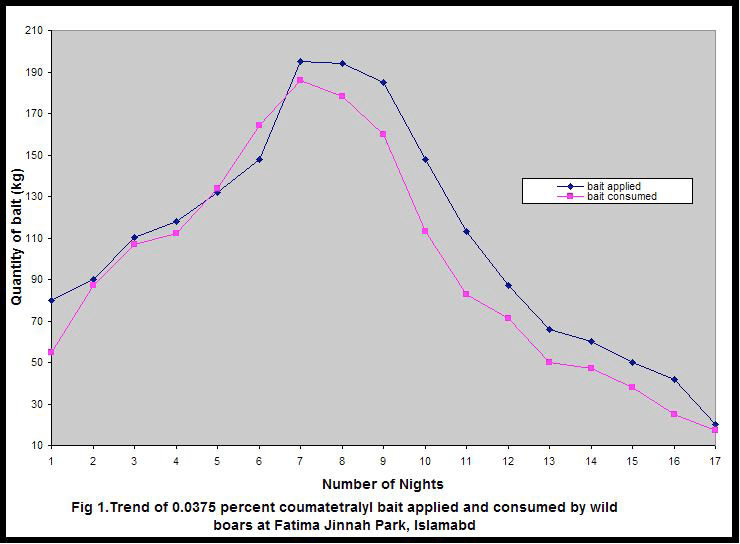
Trend of 0.0375% coumatetralyl bait applied and consumed by wild boars at Fatima Jinnah Park, Islamabad.
References
- Anonymous, 1957. The pastoral review and graziers record, 16 July, 1957.
- Beg, M.A. and Khan, A.A., 1982. J. Anim. Sci. Pakistan, 4: 46-51.
- Brooks, J.E., Ahmad, E. and Hussain, I., 1988. The use of anticoagulants in wild boar control: preliminary field trials. Tech. Rep. (unpublished). GOP/USAID/DWRC Vertebrate Pest Control Project, NARC, Islamabad, pp. 9.
- Brooks, J.E., Ahmad, E., Hussain, I. and Khan, M.H., 1989. Trop. Pest Manage., 35: 278-281. https://doi.org/10.1080/09670878909371380[CrossRef]
- Brooks, J.E. and Ahmad, E., 1993. In: Proc. Feral Swine: A compendium for resource managers (eds. C.W. Hanselka, and J.F. Cadenhead), March 24-25, 1993, Kerrville, Texas, pp. 117-125.
- Choquenont, D., Kay, B. and Lukins, B.S., 1990. J. Wildl. Manage., 54: 353-359. https://doi.org/10.2307/3809054[CrossRef]
- Dobson, K.J., 1973. Aust. Vet. J., 49: 98-100. https://doi.org/10.1111/j.1751-0813.1973.tb09324.x[CrossRef]
- Dunne, H.W., 1970. Disease of swine. 3rd ed., Iowa State University Press, Ames, Iowa.
- Fulton, H. T. 1963. J. Bombay Nat. Hist. Soc., 14: 758.
- Heptner, V.G., Nasimovic, A.A. and Bannikov, A.G., 1966. Die Saugetiere der Sowjetunion Band 1. Paarhufer and unpaarhufer (in German). Jenta, DDR: VEB Gustav Fisher, pp. 839.
- Hone, J. and Atkinson, W., 1983. Aust. Wildl. Res., 10: 499-505. https://doi.org/10.1071/WR9830269[CrossRef]
- Hone, J. and Stone, C.P., 1989. Wildl. Soc. Bull., 17: 419-425.
- Inayatullah, C., 1973. Wild boar in West Pakistan. Forest Institute, Peshawar. Bull No. 1. 17 p.
- Karim, F.C. and Zakria, S.M., 1963. Agric. Pakistan, 13: 86-89.
- Khan, A.A., 1991. Progress of vertebrate pest management in Pakistan. VPCL, PARC, Karachi, pp. 154.
- Khan, M.H., Khan, R.A. and Qayyoom, M.A., 1980. Pakistan Entomol., 2: 45-50.
- McIlroy, J.C., Braysher and Saunders, G.R., 1989. Aust. Wildl. Res., 16: 191-202. https://doi.org/10.1071/WR9890195[CrossRef]
- O’ Brien, P.H., Lukins, B.S. and Beck, J.A., 1988. Aust. Wildl. Res., 15: 451-457. https://doi.org/10.1071/WR9880451[CrossRef]
- O’ Brien, P.H. and Lukins, B.S., 1990. Aust. Wildl. Res., 17: 101-112. https://doi.org/10.1071/WR9900101[CrossRef]
- O’Brien, P.H., 1987. Aust. Rangel. J., 9: 96-101. https://doi.org/10.1071/RJ9870096[CrossRef]
- Pavlov. P.M., 1980. Control methods suitable for the Asiatic wild boar (Sus scrofa cristatus) in Pakistan. FAO Assignment Report, pp. 15.
- Roberts, T. J., 1997. The mammals of Pakistan (revised edn.) Oxford University Press, Karachi, Pakistan, pp. 525.
- Saunders, G.R., 1988. The ecology and management of feral pigs in New South Wales. M.S. thesis, Macquarie Univ., Sydney, pp. 191.
- Shafi, M.M. and Khokhar, A.R., 1986. J. Bombay Nat. Hist. Soc., 83: 63-67.
- Smiet, A.C., Fulk, G.W. and Lathiya, S.B., 1979. Pakistan J. Zool., 11: 295-302.
- Taber, R.D., 1965. Discovery, 18:10.
- Tisdell, C.A., 1982. Wild pigs: Environmental pest or economic resource? Pergamon Press, Sydney, pp. 445.
Services
Article usage statistics
Loading…