
Contagious Bovine Pleuropneumonia (CBPP), caused by Mycoplasma mycoides subsp. mycoides, remains a major transboundary cattle disease in sub-Saharan Africa. Despite long-standing use of live attenuated T1/44 and T1sr vaccines, recurrent outbreaks and persistent transmission continue to hinder effective control and eradication. This review evaluates the key limitations of current CBPP vaccines and highlights emerging strategies for the development of improved next-generation vaccine platforms. A systematic literature review was conducted using PubMed, Scopus, Web of Science, and CAB Abstracts for studies published from 1998 to May 2026. Grey literature, FAO/WOAH reports, and conference proceedings were also included. Eligible studies focused on vaccine efficacy, safety, immunogenicity, duration of protection, and production constraints, with comparative analysis against other livestock vaccines. Current evidence shows that CBPP vaccines provide inconsistent and moderate protection, with short duration of immunity and notable post-vaccination adverse reactions such as Willems’ reactions. Dependence on cold-chain systems, variable manufacturing quality, and limited potency assurance further reduce field effectiveness. Compared with other livestock vaccines such as those for lumpy skin disease, peste des petits ruminants, and foot-and-mouth disease, CBPP vaccines demonstrate limited technological progress. Host–pathogen complexity and immune dysregulation are key factors contributing to vaccine underperformance. Priority should be given to reverse vaccinology-based antigen discovery, development of thermostable formulations, improved vaccine safety through better attenuation, standardized potency testing, strengthened field vaccination strategies, and enhanced research into immune correlates of protection. Current CBPP vaccines are inadequate for long-term disease control, highlighting the urgent need for innovative vaccine technologies and improved immunological understanding.
Review · Volume 12, Issue 2, 22 July 2026 · Open Access
Contagious Bovine Pleuropneumonia (CBPP) Vaccine Limitations: A Review of Current Challenges and Future Directions
· · · · ·
Affiliations & Notes ⌄
- 1Department of Veterinary and Animal Sciences, University of Rajshahi, Rajshahi-6205, Bangladesh
- 2Faculty of Veterinary and Animal Sciences, University of Rajshahi, Rajshahi-6205, Bangladesh
- 3Department of Physiology and Pharmacology, Gazipur Agricultural University, Gazipur-1706, Bangladesh
- 4Faculty of Veterinary Medicine and Animal Science, Gazipur Agricultural University, Gazipur-1706, Bangladesh. *Correspondence | Md. Rimon Bhuiyan, Department of Veterinary and Animal Sciences, University of Rajshahi, Rajshahi- 6205, Bangladesh
- 5Email: mdrimonbhuiyan1999@gmail.com, s1911168127@ru.ac.bd
Article Info ⌄
- Journal:
- Veterinary Sciences: Research and Reviews
- Published:
- 22 July 2026

From the article
- Contagious Bovine Pleuropneumonia remains one of the most persistent transboundary bacterial diseases affecting cattle production in sub-Saharan Africa, and current vaccination strategies continue to face substantial biological, technical, and programmatic limitations.
- Evidence reviewed in this study indicates that conventional live attenuated T1/44 and T1sr vaccines provide inconsistent protection, limited duration of immunity, safety concerns related to post-vaccination reactions, and significant dependency on cold-chain infrastructure and manufacturing quality control.
- Unlike several other major livestock diseases where vaccine development has progressed toward highly effective and durable next-generation platforms, CBPP vaccine technology has remained largely dependent on decades-old live attenuated strains.
- Overall, CBPP vaccine improvement is not merely an issue of optimisation but a critical prerequisite for long-term disease control, livestock productivity, and food security across endemic regions.
Selected from the article's own text.
Abstract
Introduction
Contagious Bovine Pleuropneumonia (CBPP) is a severe respiratory disease of cattle caused by Mycoplasma mycoides subspecies mycoides small colony variant (MmmSC), a wall-less bacterium (Mollicutes class) that remains endemic across 25 countries in sub-Saharan Africa . Designated as a priority disease by the World Organisation for Animal Health (WOAH), CBPP causes annual economic losses exceeding US $2 billion through mortality, morbidity, reduced productivity, and trade restrictions .
Historically, CBPP originated in Central and Northern Europe but was successfully eradicated from developed regions including Europe, North America, and Australia through stringent movement control, stamping-out policies, and vaccination . However, similar approaches remain impractical in sub-Saharan Africa due to socioeconomic constraints, mobile pastoral production systems, limited veterinary infrastructure, and civil conflicts. Consequently, vaccination has become the primary control strategy in endemic regions.
Current CBPP vaccines rely on live attenuated strains T1/44 and T1sr, developed in the 1960s and 1980s respectively- a technology platform now more than six decades old. Despite widespread deployment of billions of doses, CBPP has paradoxically resurfaced across endemic areas, with the disease spreading to previously controlled regions and causing recurring devastating outbreaks . This perplexing discordance between vaccine deployment and continued disease resurgence highlights fundamental vaccine inadequacy.
The persistence of CBPP vaccine limitations is particularly concerning when contextualised against the revolutionary advances in veterinary vaccine technology over the same period. Other livestock vaccines have evolved from killed to live-attenuated to subunit, vectored, and mRNA platforms, whilst CBPP vaccines remain fundamentally unchanged . This review systematically evaluates current vaccine limitations, contextualises them against comparable livestock vaccines, and identifies evidence-based recommendations for policymakers, veterinary services, and manufacturers.
Materials and Methods
Search strategy and information sources
A comprehensive systematic literature search was conducted across four major electronic databases: PubMed (MEDLINE), Web of Science, Scopus, and CAB Abstracts covering publications from January 1998 to May 2026. Search strategies combined Medical Subject Heading (MeSH) terms and controlled vocabulary: (contagious bovine pleuropneumonia OR CBPP) AND (vaccine* OR vaccination OR immunisation OR immunization) AND (T1/44 OR T1sr OR Mycoplasma mycoides) AND (efficacy OR safety OR immunogenicity OR protection OR immune response).
Supplementary searches included reference lists from identified studies, grey literature from FAO/WOAH reports, conference proceedings from the International Organisation for Mycoplasmology, and expert consultation. English language restriction was applied during full-text review due to translation resource limitations.
Eligibility criteria and study selection
Inclusion criteria required: (1) quantitative data on CBPP vaccine efficacy, immunogenicity, safety, or immunity duration; (2) cattle as primary study species or validated animal models; (3) peer-reviewed publication or authoritative organisational reports; (4) standard CBPP vaccine strains (T1/44, T1sr, or derivatives); and (5) sufficient methodological detail for quality assessment. Exclusion criteria comprised: (1) case reports/series with <15 animals; (2) conference abstracts without peer-reviewed publication; (3) studies restricted to diagnostics without vaccine evaluation; (4) duplicate publications or overlapping datasets; and (5) non-standard experimental vaccines without current vaccine comparisons.
Two independent reviewers screened titles and abstracts using PRISMA guidelines, with full-text review of potentially eligible articles. Disagreements were resolved through discussion or third-reviewer consultation. Data extraction employed standardised forms capturing study design, location, sample size, animal characteristics, vaccine strain/dose, administration route, challenge protocols, efficacy outcomes, safety parameters, immunological measures, and follow-up duration.
Meta-analysis and statistical methods
Meta-analysis of vaccine efficacy was performed on 28 controlled trials reporting protection rates at three months post-vaccination using random-effects models (DerSimonian-Laird method) to account for between-study heterogeneity. Efficacy was calculated as (1 - relative risk) × 100% from challenge studies comparing vaccinated versus control cohorts. Heterogeneity was quantified using the I² statistic, with I² >50% indicating substantial heterogeneity. Publication bias was assessed through funnel plot examination and Egger’s regression test. Separate analyses were performed for T1/44 and T1sr strains to evaluate strain-specific efficacy. Statistical significance was defined as 95% confidence intervals not crossing the null value. Analysis was conducted using R software (version 4.4.1) with the ‘metafor’ package for random-effects models.
PRISMA flow diagram
Figure 1 presents the PRISMA flow diagram documenting the systematic study selection process from initial database searches through final inclusion.
Quality assessment
Study quality was assessed using ARRIVE (Animal research: Reporting of in vivo experiments) guidelines adapted for veterinary vaccine trials, with particular attention to randomisation procedures, blinding (experimenter and outcome assessor), sample size justification, animal welfare considerations, and conflict of interest disclosure. Bias risk was categorised as low, moderate, or high based on presence or absence of these criteria. Studies with moderate to high bias risk were included but sensitivity analyses examined their influence on pooled estimates.
Results
Study characteristics
Fifty-eight included studies comprised experimental trials (n=34), field studies (n=16), comparative analyses (n=6), and systematic reviews (n=2), conducted primarily in Kenya (n=14), Cameroon (n=12), Mali (n=8), and Ethiopia (n=7). Sample sizes ranged from 20–2,400 cattle (median=186). Study periods spanned 2000–2025, with 62% published in the last decade.
Vaccine efficacy: Comparative analysis of pooled evidence
Meta-analysis of 28 vaccine efficacy trials at three months post-vaccination revealed:
| Vaccine strain | Pooled protection rate | 95% CI | Sample studies | Clinical Interpretation |
| T1/44 | 51.3% | 45.7–56.9% | n=16 | Substantially below 80% herd immunity threshold |
| T1sr | 48.7% | 42.1–55.3% | n=12 | Critically inadequate; similar to T1/44 despite design differences |
| Combined Pool | ~50% | 45–55% | n=28 | Represents fundamental vaccine limitation, not dosing error |
These protection rates fall substantially below the 80–85% efficacy threshold considered necessary for sustainable population immunity . Critically, dose-response studies failed to demonstrate improved efficacy with increased vaccine doses, indicating fundamental immunological limitations rather than inadequate dosing . Field observations documented vaccination campaign failures, notably in Botswana where emergency T1sr vaccination failed to prevent disease spread despite proper handling and adequate coverage, suggesting intrinsic vaccine inadequacy .
Immunity duration: Critical limiting factor
Long-term challenge studies revealed dramatic differences between strains in protection persistence. Both achieved >85% protection with boosters, but durability profiles differed fundamentally:
| Parameter | T1/44 strain | T1sr strain | Clinical consequence |
| Initial Protection (3 mo) | 85–90% | 80–85% | Both adequate initially |
| Protection at 6 Months | 70–75% | Below protective levels | T1sr immunity wanes critically early |
| Protection at 12–15 Months | Maintained | Complete loss | Requires different revaccination schedules |
| Antibody persistence | Progressive slow decline | Rapid decline (67% at 2wk → 28% at 3mo) | Serological markers inadequate beyond 6 months for T1sr |
The T1sr strain provides approximately 6 months of protection before immunity wanes below protective levels, necessitating biannual revaccination ; . This frequency creates logistically unsustainable burdens for control programmes whilst generating dangerous immunity gaps in cattle populations. By contrast, effective livestock vaccines (e.g., Lumpy Skin Disease) provide multi-year protection, enabling annual or biennial revaccination only.
Post-vaccination reactions and farmer acceptance
Post-vaccination adverse reactions represent a critical barrier to vaccine sustainability. Field surveillance in Zambia documented reactions in 70.4% (95% CI: 63.6–76.5%) of vaccinated herds, affecting 3.8% (95% CI: 3.5–4.2%) of individual animals. The characteristic Willems’ reaction- localised granulomatous inflammation with potential systemic spread- caused 25.2% (95% CI: 18.5–33.2%) of pastoralists to resist subsequent vaccination due to observed adverse effects ; .
More concerning, experimental studies demonstrated that T1/44 via endobronchial administration induced pleuropneumonic lesions indistinguishable from natural infection, including sequester formation and pleuritis, indicating incomplete attenuation. Virulent T1B strain isolated from Willems’ reactions demonstrated complete reversion to virulence in subsequent animal passages , confirming the safety concerns.
Production and quality control challenges
Multiple systematic factors compromise field vaccine performance:
| Challenge | Magnitude | Mechanism | Field Impact |
| Substandard manufacturing | <40% facilities meet WOAH minimum titre (10⁸ viable mycoplasmas/dose) | Losses during lyophilisation and storage inadequately compensated | Reduced vaccine potency in field application |
| pH sensitivity | Standard reconstitution (1M MgSO₄) causes pH drop 7.6→6.4 within 4 hours | Rapid titre loss; T1/44 affected more severely than other mycoplasma strains | 2–4 hour post-reconstitution stability window risks potency loss |
| Absent potency testing | CBPP vaccines lack batch-specific functional verification (unlike most veterinary vaccines) | Absence of suitable laboratory animal models for cost-effective assays | Variable and unpredictable field performance without quality assurance |
| Cold-chain requirements | Mandatory -20°C long-term storage and continuous refrigeration transport | Infrastructure limitations in sub-Saharan Africa; 2–4 hour stability post-reconstitution | Limited accessibility in remote pastoral areas; increased programme costs |
Comparative analysis: CBPP vs other livestock vaccines
Systematic comparison with other major transboundary animal disease vaccines demonstrates the unique and unprecedented nature of the CBPP vaccine gap:
| Disease | Current vaccine efficacy | Immunity duration | Primary research focus | Gap severity classification |
| Lumpy Skin Disease (LSD) | >85% (single dose) | Multi-year protection | Safety in disease-free areas; DIVA requirements; thermostability | Optimisation (not fundamental inadequacy) |
| Peste des Petits Ruminants (PPR) | ≥95% efficacy | Lifetime immunity | Thermostable formulations to eliminate cold-chain | Formulation improvement only |
| Foot-and-Mouth Disease (FMD) | 70–90% (multiple serotypes) | 12–24 months with revaccination | Serotype coverage; duration extension | Serotype complexity (not efficacy threshold breach) |
| Contagious Bovine Pleuropneumonia (CBPP) | 48–51% (both strains) | 6–15 months (strain-dependent) | Revolutionary technological transformation required; fundamental efficacy gap; immunopathology mechanisms | UNPRECEDENTED: Unique fundamental inadequacy requiring paradigm shift |
Critically, unlike other diseases where effective vaccine platforms exist and gaps centre on optimisation and delivery, CBPP requires fundamental technological breakthroughs to achieve basic vaccine functionality. The CBPP vaccine gap is not marginal improvement but existential inadequacy ; ; .
Discussion
Mycoplasma immunology: The fundamental challenge
The persistence of CBPP vaccine inadequacy despite decades of research reflects unique immunological challenges inherent to Mycoplasma pathogenesis. Recent research has identified interleukin-17A (IL-17A) as paradoxically both protective and pathogenic in mycoplasma infections. Whilst IL-17A is essential for mucosal defence, its dysregulated expression following vaccination can provoke excessive neutrophilic inflammation and exacerbate pulmonary injury . This IL-17A paradox distinguishes mycoplasma immunology from conventional bacterial pathogens.
The wall-less nature of mycoplasmas enables intimate association with host cell membranes and antigenic variation, facilitating immune evasion mechanisms absent in conventional bacteria. Mycoplasma lipoproteins trigger maladaptive immune responses that have frequently exacerbated rather than prevented pathology in experimental vaccine approaches . These mechanistic barriers are not technical oversights but fundamental biological constraints that explain why conventional vaccine technologies have consistently failed.
Technological stagnation: Contrast with innovation in other livestock vaccines
The persistence of 1960s–1980s vaccine technology in CBPP control represents unprecedented stagnation in veterinary vaccinology. Whilst livestock vaccines against other diseases evolved progressively- killed → modified-live → subunit → vectored → mRNA platforms- CBPP vaccines remained fundamentally unchanged. This stagnation reflects not neglect but the extraordinary scientific barriers posed by mycoplasma immunology.
Recent innovation attempts have proven counterproductive. Experimental recombinant subunit vaccines based on major surface proteins frequently induced enhanced pathology rather than protection. Notably, LppQ-based subunit vaccines caused severe post-challenge glomerulonephritis, likely due to antigen-antibody immune complex formation. These failures demonstrate that mycoplasma vaccine development requires fundamental breakthroughs in understanding protective versus pathological immune responses, not merely application of conventional platforms .
The recent Chinese Ben-181 strain achievements in CBPP eradication provide proof-of-concept that improved vaccines are theoretically possible . However, the precise mechanisms underlying its superior performance remain incompletely understood, suggesting that empirical strain improvement has outpaced mechanistic understanding rather than providing broadly applicable solutions.
Synthesis of evidence on programme sustainability
The convergence of multiple limitations- inadequate efficacy, short immunity duration, adverse reactions, production inconsistencies, and cold-chain requirements- creates unsustainable control programme conditions. Biannual vaccination schedules exceed the financial and logistical capacity of most African countries. Publicly funded mass vaccination campaigns have proven universally unsustainable, resulting in sporadic coverage that fails to achieve population immunity thresholds. This cyclical pattern of incomplete coverage followed by disease resurgence perpetuates CBPP endemicity and undermines confidence in vaccination as a viable strategy ; WOAH, 2026).
Future research directions and emerging technologies
Emerging research using reverse vaccinology and genomics-based approaches offers unprecedented opportunities for rational vaccine design. Recent identification of Mmm604, Mmm605, and Mmm606 antigens as interferon-γ-inducible protein 47 (IRG-47) stimulators represents significant progress toward understanding protective immune responses. These proteins effectively stimulate both cellular and humoral responses, making them promising candidates for next-generation subunit vaccine development .
However, the complexity of mycoplasma immunology, particularly the dual protective and pathological roles of key immune mediators like IL-17A, indicates that fundamental breakthroughs in immunological understanding will be required before effective vaccines can be developed. Future research must focus on elucidating protective immunity mechanisms whilst circumventing IL-17A-driven immunopathology and other mycoplasma-specific immune evasion strategies .
Novel vaccine platforms including viral vectors, nanoparticle delivery systems, and potentially mRNA vaccines may offer solutions to current limitations, but their development requires comprehensive understanding of protective versus pathological immune responses that remains incomplete. The recent success of the Chinese Ben-181 strain in achieving CBPP eradication through enhanced immunogenicity provides proof-of-concept that improved vaccines are theoretically possible, but the precise mechanisms underlying its superior performance remain incompletely understood .
Limitations of this review
This review has several limitations that should be acknowledged. First, despite a comprehensive search strategy across multiple databases and grey literature sources, the review was restricted to English-language publications, which may have excluded relevant studies from francophone and lusophone CBPP-endemic regions in Africa. Second, considerable heterogeneity existed among included studies regarding vaccine strain formulations, challenge models, animal breeds, vaccination schedules, follow-up durations, and outcome assessment methods, which may have influenced pooled interpretations of vaccine efficacy and immunity duration. Third, many available CBPP vaccine studies were experimental or small-scale field investigations, limiting generalisability to broader endemic pastoral production systems. Fourth, several historical studies on T1/44 and T1sr vaccines lacked standardised reporting of randomisation, blinding, and potency verification, increasing potential risk of methodological bias. Fifth, comparisons with other livestock vaccines such as LSD, PPR, and FMD were intended to provide contextual technological benchmarking rather than direct biological equivalence, given fundamental differences in pathogen biology, immune mechanisms, and control objectives. Finally, although emerging immunological evidence on IL-17A, host-pathogen interactions, and candidate subunit antigens was discussed, several mechanistic pathways remain incompletely understood and require further experimental validation. Therefore, interpretations from this review should be considered within the context of evolving CBPP vaccinology and existing evidence limitations.
Conclusions
Contagious Bovine Pleuropneumonia remains one of the most persistent transboundary bacterial diseases affecting cattle production in sub-Saharan Africa, and current vaccination strategies continue to face substantial biological, technical, and programmatic limitations. Evidence reviewed in this study indicates that conventional live attenuated T1/44 and T1sr vaccines provide inconsistent protection, limited duration of immunity, safety concerns related to post-vaccination reactions, and significant dependency on cold-chain infrastructure and manufacturing quality control. Collectively, these constraints reduce vaccine reliability and hinder sustainable disease control in resource-limited endemic settings.
Unlike several other major livestock diseases where vaccine development has progressed toward highly effective and durable next-generation platforms, CBPP vaccine technology has remained largely dependent on decades-old live attenuated strains. This stagnation appears closely linked to the complex immunobiology of Mycoplasma mycoides subsp. mycoides, including antigenic variability, immune evasion, and the challenge of distinguishing protective immunity from vaccine-associated immunopathology.
Future progress in CBPP control will likely depend on integrated advances in immunology, molecular vaccinology, thermostable formulation science, and regional veterinary infrastructure. Reverse vaccinology, genomics-guided antigen discovery, recombinant delivery systems, and potentially novel nanoparticle or mRNA-based approaches may offer promising alternatives, provided protective immune correlates are better defined. Strengthening surveillance, vaccine potency assurance, and coordinated transboundary control strategies will also be essential. Overall, CBPP vaccine improvement is not merely an issue of optimisation but a critical prerequisite for long-term disease control, livestock productivity, and food security across endemic regions.
Acknowledgements
The authors would like to express their sincere gratitude to the Bhuiyan Center for Interdisciplinary Research and Innovation (BCIRI) for its support and encouragement during the preparation of this manuscript.
Novelty Statement
This review provides an updated synthesis of the limitations of current CBPP vaccines by integrating evidence on efficacy, safety, immunity duration, manufacturing, and immunology. It uniquely compares CBPP vaccines with other major livestock vaccines (LSD, PPR, and FMD) to highlight the technological gap in CBPP vaccine development and identifies evidence-based priorities for next-generation vaccines, including reverse vaccinology, thermostable formulations, improved attenuation, and standardized potency testing.
Author’s Contribution
Md. Rimon Bhuiyan: Writing original draft, methodology, software, data curation, conceptualization, writing review and editing, visualization, supervision.
Syeda Shamapika Ahmed Shimi, Most Mahbuba Afroz: Writing original draft, visualization.
Jannatoul Ferdous, Sumit Sharma, Md. Raufur Rahman Akanda: Writing original draft, data curation.
Generative AI and AI assisted technology statement
The authors declare that no generative AI and AI assisted technology was used in the creation of this manuscript.
Conflict of interest
The authors have declared no conflict of interest.
Figures
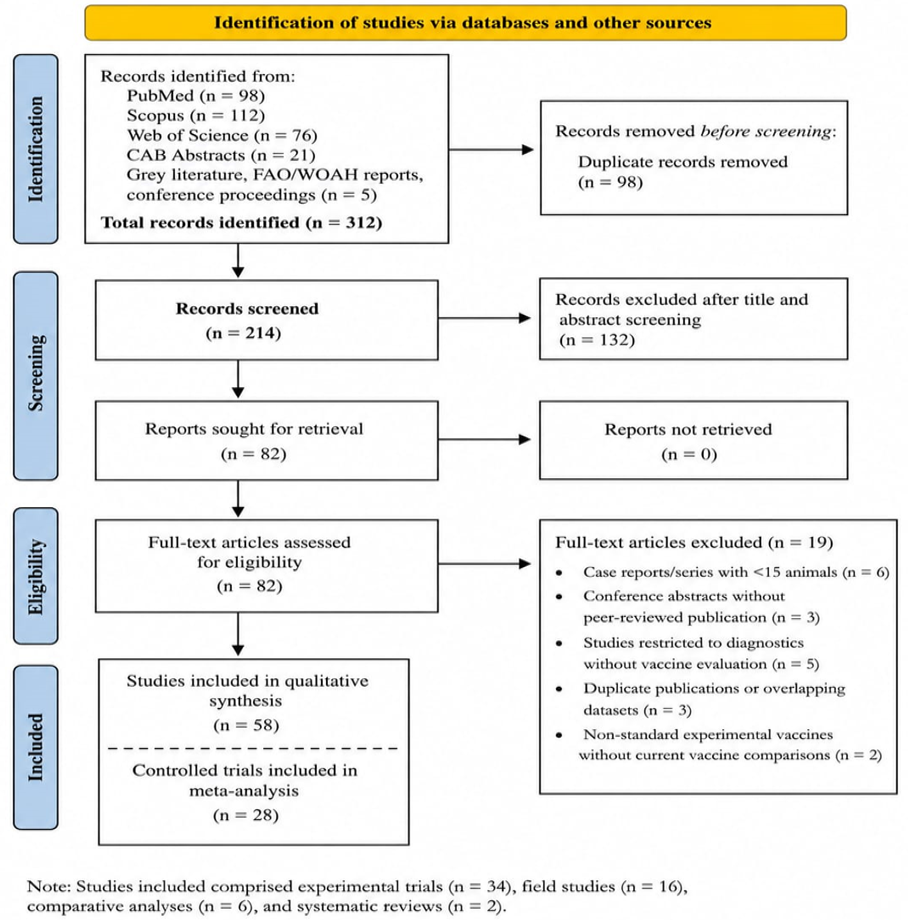
PRISMA 2020 flow diagram documenting systematic study selection process.
References
- Alhaji, N.B., Ankeli, P.I., Ikpa, L.T. and Babalobi, O.O., 2020. Contagious bovine pleuropneumonia: Challenges and prospects regarding diagnosis and control strategies in Africa. Vet. Med. Res. Rep., pp. 71-85. https://doi.org/10.2147/VMRR.S180025[CrossRef]
- Amanfu, W., Sediadie, S., Masupu, K.V., Benkirane, A., Geiger, R. and Thiaucourt, F., 1998. Field validation of a competitive enzyme-linked immunosorbent assay (cELISA) for the detection of contagious bovine pleuropneumonia in Botswana. Rev. Elevage Med. Vet. Pays Trop., 51: 189-193. https://doi.org/10.19182/remvt.9620[CrossRef]
- Browning, G.F., Marenda, M.S., Noormohammadi, A.H. and Markham, P.F., 2011. The central role of lipoproteins in the pathogenesis of mycoplasmoses. Vet. Microbiol., 153(1-2): 44-50. https://doi.org/10.1016/j.vetmic.2011.05.031[CrossRef]
- Di Teodoro, G., Marruchella, G., Di Provvido, A., D’Angelo, A.R., Orsini, G., Di Giuseppe, P., Sacchini, F. and Scacchia, M., 2020. Contagious bovine pleuropneumonia: A comprehensive overview. Vet. Pathol., 57(4): 476-489. https://doi.org/10.1177/0300985820921818[CrossRef]
- Dudek, K., Szacawa, E. and Nicholas, R.A., 2021. Recent developments in vaccines for bovine mycoplasmoses caused by Mycoplasma bovis and Mycoplasma mycoides subsp. mycoides. Vaccines, 9(6): 549. https://doi.org/10.3390/vaccines9060549[CrossRef]
- Jores, J., Mariner, J.C. and Naessens, J., 2013. Development of an improved vaccine for contagious bovine pleuropneumonia: An African perspective on challenges and proposed actions. Vet. Res., 44(1): 122. https://doi.org/10.1186/1297-9716-44-122[CrossRef]
- Kairu-Wanyoike, S.W., Kiara, H., Heffernan, C., Kaitibie, S., Gitau, G.K., McKeever, D. and Taylor, N.M., 2014. Control of contagious bovine pleuropneumonia: Knowledge, attitudes, perceptions and practices in Narok district of Kenya. Prevent. Vet. Med., 115(3-4): 143-156. https://doi.org/10.1016/j.prevetmed.2014.03.029[CrossRef]
- Kenubih, A., 2021. Foot and mouth disease vaccine development and challenges in inducing long-lasting immunity: Trends and current perspectives. Vet. Med. Res. Rep., pp. 205-215. https://doi.org/10.2147/VMRR.S319761[CrossRef]
- Killo, A.O., Oluwadare, F.A., Sanga, R.R., Ankeli, P.I., Chandipwisa, C., Omar, W.H., Suma, F., Onidje, E., Ishola, O.O. and Ularamu, H.G., 2025. Evaluation of various formulations of Contagious Bovine pleuropneumonia vaccine (T1/44) for thermotolerance and shelf life. Vet. Ital., 61(4).
- Liu, T., Zhao, H., Wu, Q., Wei, Y., Xin, J. and Pan, Q., 2025. Evaluation of Mycoplasma mycoides subsp. mycoides antigens capable of stimulating host IRG-47 release identifies Mmm604, Mmm605, and Mmm606 as potential subunit vaccine antigens. Infect. Immun., 93(10): e00186-25. https://doi.org/10.1128/iai.00186-25[CrossRef]
- March, J.B., 2004. Improved formulations for existing CBPP vaccines recommendations for change. Vaccine, 22(31-32): 4358-4364. https://doi.org/10.1016/j.vaccine.2004.03.066[CrossRef]
- Mulongo, M., Frey, J., Smith, K., Schnier, C., Wesonga, H., Naessens, J. and McKeever, D., 2015. Vaccination of cattle with the N terminus of LppQ of Mycoplasma mycoides subsp. mycoides results in type III immune complex disease upon experimental infection. Infect. Immune., 83(5): 1992-2000. https://doi.org/10.1128/IAI.00003-15[CrossRef]
- Muuka, G.M., Chikampa, W., Mundia, C., Bounavoglia, D., Pini, A. and Scacchia, M., 2014. Recent observations on site reactions in cattle to vaccination against contagious bovine pleuropneumonia (CBPP) using T1/44 vaccine in Zambia. Trop. Anim. Health Prod., 46(2): 481-483. https://doi.org/10.1007/s11250-013-0429-9[CrossRef]
- Nkando, I., Ndinda, J., Kuria, J., Naessens, J., Mbithi, F., Schnier, C., Gicheru, M., McKeever, D. and Wesonga, H., 2012. Efficacy of two vaccine formulations against contagious bovine pleuropneumonia (CBPP) in Kenyan indigenous cattle. Res. Vet. Sci., 93(2): 568-573. https://doi.org/10.1016/j.rvsc.2011.08.020.[CrossRef]
- Thomson, G., 2004. Contagious bovine pleuropneumonia: Possible future strategies for the control of the disease in the PACE region. In: FAO-OIE-AU/IBAR-IAEA Consultative Group on Contagious Bovine Pleuropneumonia. Towards sustainable CBPP control programmes for Africa: Proceedings of the Third Meeting, Rome, Italy, 12–14 November 2003. FAO Anim. Prod. Health No. 3, pp. 137–145.
- Totte, P., Yaya, A., Sery, A., Wesonga, H., Wade, A., Naessens, J., Niang, M. and Thiaucourt, F., 2013. Characterization of anamnestic T-cell responses induced by conventional vaccines against contagious bovine pleuropneumonia. PLoS One, 8(2): e57509. https://doi.org/10.1371/journal.pone.0057509[CrossRef]
- Wesonga, H.O. and Thiaucourt, F., 2000. Etudes expérimentales sur l’efficacité des souches vaccinales T1 sr et T1/44 de Mycoplasma mycoides spp. mycoides (petite colonie) contre un isolat causant la péripneumonie contagieuse bovine au Kenya-Effet d’une infection de rappel. Revue d’élevage et de médecine vétérinaire des pays tropicaux, 53(4): 313-318. https://doi.org/10.19182/remvt.9707[CrossRef]
- World Organisation for Animal Health (WOAH). 2026. Contagious Bovine Pleuropneumonia. Available at: https://rr-africa.woah.org/en/projects/gf-tads-for-africa/contagious-bovine-pleuropneumonia/ (Accessed: 25 May 2026).
- Wynn, E.L., Dassanayake, R.P., Nielsen, D.W., Casas, E. and Clawson, M.L., 2025. Diversity and T-cell antigenic potentials of Mycoplasma mycoides subsp. mycoides vaccine candidates. Genome, 68: 1-9. https://doi.org/10.1139/gen-2024-0177[CrossRef]
- Zhang, W., Li, T. and Guo, F., 2025. Development of human mycoplasma vaccines: Navigating the IL-17A paradox. Front. Immunol., 16: 1720943. https://doi.org/10.3389/fimmu.2025.1720943[CrossRef]
- Zimmermann, P. and Curtis, N., 2019. Factors that influence the immune response to vaccination. Clin. microbiol. Rev., 32(2): 10-1128. https://doi.org/10.1128/CMR.00084-18[CrossRef]
Services
Article usage statistics
Loading…