
Vaccination is a cornerstone of animal health, playing a vital role in preventing infectious diseases and safeguarding both livestock and companion animals. By stimulating the immune system to recognize and combat specific pathogens, whether bacterial or viral, without causing disease, vaccines significantly reduce morbidity and mortality rates among animal populations. Moreover, they serve as a crucial tool in public health by mitigating the transmission of zoonotic diseases, such as rabies and avian influenza, which pose risks to human populations. Dual or combination vaccines, designed to provide protection against multiple pathogens within a single formulation, offer numerous advantages, including reduced handling stress for animals, improved compliance, cost-effectiveness, and enhanced disease control strategies. These vaccines are particularly beneficial for both small and large ruminants, where effective disease management is critical for livestock productivity and food security. However, the development of dual vaccines presents unique scientific and logistical challenges, including antigen compatibility, immune interference, and stability concerns. This review explores the significance of vaccination in animal health, with a specific focus on dual vaccines. It examines commonly used dual vaccines for ruminants, the technological and immunological hurdles in their development, and the future prospects of dual vaccine innovation in veterinary medicine. With advancements in vaccine technology, including recombinant and nanoparticle-based platforms, the next generation of dual vaccines holds great promise for more efficient and comprehensive disease prevention in animals.
Review · 14 August 2025 · Open Access
An Overview of Dual Vaccines in Ruminants
· · · · · ·
Affiliations & Notes ⌄
- 1Department of Animal Medicine and Infectious Diseases (Infectious Diseases), Faculty of Veterinary Medicine, University of Sadat City, Egypt. *Correspondence | Shahd Khalid and Mohamed Nayel, Department of Animal Medicine and Infectious Diseases (Infectious Diseases), Faculty of Veterinary Medicine, University of Sadat City, Egypt
- 2Email: mohamed.aboalez@vet.usc.edu.eg
Article Info ⌄
- Journal:
- Journal of Virological Sciences
- Published:
- 14 August 2025
From the article
- While single vaccinations are effective in preventing specific diseases, a dual vaccination strategy provides several distinct advantages, making it a preferable approach in many cases.
- Moreover, dual vaccines contribute significantly to disease control efforts, particularly in preventing co-infections and reducing the spread of zoonotic diseases, which have implications for both animal and human health.
- As research in vaccine technology advances, including the development of recombinant and vector-based vaccines, dual vaccination strategies are expected to become even more effective and widely adopted.
- By addressing logistical and scientific challenges, dual vaccines have the potential to revolutionize veterinary immunization strategies, improving animal health, welfare, and productivity on a global scale.
Selected from the article's own text.
Abstract
Introduction
Creating and implementing health care programs is the base of profitable farms. Prevention of microbial infections using vaccination is an essential part of such a program . Microbial infections are important; therefore, good healthcare practices must be done for adequate management. Vaccination is believed to be the most efficient means of disease prevention . Conventional vaccines, such as killed and live attenuated, contain the entire pathogen in either a killed or attenuated state. On the other hand, vaccines of the new generation are made to trigger an immune response by genetic manipulation of the pathogen’s nucleic acid. These novel therapeutics include chimera, DNA plasmid, mRNA, and recombinant viral vector-based vaccines . Recombinant viral vectors represent an essential avenue for future study in innovative vaccine development since they can provide high immunogenicity and quickly respond to a new pandemic. Also, they are the best vehicles for delivering foreign proteins as they resemble natural infection and trigger an immune response with protective antibody levels . The viral vector has specific characteristics to be considered a vaccination vector: constant insertion of coding sequences into the genome, activation of an immune response that is protective, the potential for enormous production, and a proven safety record, for example, poxvirus and adenovirus . Moreover, lumpy skin disease (LSD), sheep pox (SPP), rift valley fever (RVF), goat pox (GTP), and peste des petits ruminants (PPR) circulate throughout the same African regions, impacting public health and economic activity. Although commercial vaccinations against these viruses exist, most African farmers cannot afford to conduct routine immunization regimens against several diseases. Therefore, African livestock farmers would greatly benefit from a single, affordable multivalent vaccine that concurrently protects against different diseases .
Importance of vaccination
Vaccination is a highly successful and economical method for preventing a wide range of viral infectious diseases in aquatic and terrestrial species, including birds . The major challenge with viral infection pathogens is the lack of antiviral medications that can effectively combat the wide range of viruses responsible for many infectious diseases in industrial animals . Vaccination is among the most popular and efficient interventions in veterinary medicine that aim to reduce fatalities and output losses.
Several platforms have been developed in the last few decades besides conventional live and non-live immunizations. These include viral vectors, RNA and DNA vaccines based on nucleic acids, and particles that resemble viruses. High vaccine stability, long-lasting immune responses, and ease of large-scale production are some of the advantages of employing nucleic acid vaccines . Live vaccines are designed to generate an adequate immune response but not enough to result in noticeable disease . Live attenuated vaccines elicit an immune response similar to the immunological response to an infection with a live virus. This covers both the B cells’ generation of antibodies and the T cells’ initiation of a cellular immune response. Memory cells, which “remember” the infection and enable a speedier and more efficient reaction in the event of subsequent exposure, can develop from both B-cells and T-cells. . Therefore, it minimizes or eliminates clinical symptoms and potentially prevents the generation of disease following infection . Non-live vaccines’ antigenic component has the ability to destroy polysaccharides, recombinant proteins, entire organisms, or purified proteins from the organism .
Protein antigens that trigger immunity and offer defense are a crucial part of the majority of vaccinations . Polysaccharide antigens, on the other hand, are the fundamental components of vaccines that were previously created to avert a number of bacterial diseases and can also elicit protective immune responses . Adjuvants are frequently added to non-live vaccines to increase their immunogenicity or capacity to elicit an immune response . Other ingredients used in vaccines include stabilizers, emulsifiers (like polysorbate 80), and preservatives (such as sorbitol or gelatine) . Theoretically, a number of products used in the production of vaccines, such as antibiotics, egg or yeast proteins, latex, formaldehyde and/or glutaraldehyde, and acidity regulators (like potassium or sodium salts), might also be incorporated as possible trace elements in the vaccine .
Remarkably, a further advantage of vaccinating food-producing animals is that it minimizes the effect of drug residues that the animals receive and then consumed by humans through drinking or eating dairy or meat products, respectively . Also, it should be mentioned that the European Union (EU) has drastically restricted the utilization of antibiotics in food-producing animals (European .
Dual vaccines
Definition
Dual vaccines are known as vaccines intended to confer protection against two distinct diseases or pathogens at the same time. It is also identified as Dual-Antigen Vaccines that target two antigens from multiple pathogens. For example, the dual-antigen vaccine of COVID-19 contains genes for the SARS-CoV-2 virus’s spike and nucleocapsid proteins. This kind of vaccination aims to stimulate a more extensive immune response and improves defense against different viral strains . Additionally, the human coronavirus known as Middle East respiratory syndrome coronavirus (MERS-CoV) is extremely harmful . A glycoprotein called MERS-CoV spike (s) protein is incorporated into the membrane of MERS-CoV virions and plays a part in immune system stimulation. People and animals in locations where MERS-CoV is widespread may benefit from vaccinations using the S1 domain of its s protein, which was produced on the surface of a dead rabies virus and has been shown to elicit strong immune responses against both rabies virus (RABV) and MERS-CoV .
Benefits and examples of dual vaccines
Furthermore, herpesviruses are frequently used as vectors in veterinary medicine because they strengthen potent cell and antibody-mediated immune responses . Because of their long-life latency and numerous unnecessary genes, they have been shown to be the most promising vehicles for developing multivalent vaccinations. These genes include thymidine kinase (TK), protein kinase (PK), glycoprotein E (gE), and glycoprotein I (gI) .
For example, feline herpesvirus-1 (FHV-1) mutant (WH2020-ΔTK/gI/gE), a TK/gI/gE-deleted FHV-1 mutant based on the FHV-1 felid strain WH2020, which effectively protected felines from the FHV-1 infection and was safe for them , expresses the feline parvovirus (FPV) VP2 protein, that can induce the production of a high amount of parvovirus neutralizing antibodies, (WH2020-ΔTK/gI/gE-VP2) seems to be a potentially cost-effective, safe, and efficient dual vaccine against FPV and FHV-1 . Additionally, using FHV-1 as a vector, a recombinant vaccine encoding the FeLV glycoprotein gene was created, and it was demonstrated that the vaccine protected cats against FeLV-induced viremia through oronasal vaccination . In a different investigation, RABV strain BD06 glycoprotein (G) was expressed using an isolate of felid herpesvirus 1 (FHV-1) as a carrier because it is the sole outer membrane protein that can be relied upon to initiate the production of antibodies that neutralize the rabies virus by inserting the glycoprotein (G) of rabies instead of gI/E in the FHV-1 and it has been demonstrated that the dual vaccine FHV-RVG is potent and protects cats from both FHV-1 and RABV infections . Furthermore, recombinant vaccines for the oral rabies vaccination of wildlife have been created using adenovirus as a vector. . Under the influence of internal or external viral promoters, the human adenovirus type 5 produces the rabies virus G gene rather than its deleted E3 transcription unit. Foxes and skunks were protected against rabies virus infection by oral administration of the recombinant rabies adenovirus vaccine .
Moreover, poultry has received dual vaccinations to enhance disease protection. One notable example is the LaSota strain (LS), a low-virulent recombinant Newcastle disease virus (NDV), widely used as a live vaccine to prevent Newcastle disease in poultry worldwide. In a study by Dimitrov et al. (2017), LS was utilized as a vector to deliver the Marek’s disease virus (MDV) gB protein. MDV glycoproteins such as gB, gI, gE, and gC play a crucial role in viral infection, cell-to-cell transmission, and the initiation of host immune responses . The results demonstrated that the recombinant virus (rLS/MDV-gB) effectively protected vaccinated birds from both MDV-induced tumor formation and velogenic NDV infection, making it a promising dual vaccine candidate .
Additionally, a recombinant herpesvirus of turkeys (HVT) vaccine was developed by incorporating the NDV fusion protein gene or haemagglutinin-neuraminidase gene into a non-essential HVT gene. This recombinant vaccine provided partial immunity to NDV without compromising the birds’ immunity against HVT .
In another study, a modified live strain of Salmonella Gallinarum was engineered to express a consensus sequence of the spike protein’s N-terminal domain (S1-NTD) and a conserved immunogenic region of the nucleocapsid protein (N 321–406 aa) from infectious bronchitis virus (IBV) strains . The S1 domain contains multiple epitopes that trigger immune responses, induce neutralizing antibodies, and include the receptor-binding domain . Additionally, the N protein plays a key role in stimulating cell-mediated immunity . The study demonstrated that this vaccine provided protection against both fowl typhoid and IBV, as evidenced by neutralizing antibody levels, gross and histological studies, and reduced viral load .
Dual vaccines in ruminant
Dual vaccines provide protection against two diseases with a single vaccination, simplifying the vaccination program . For instance, a recombinant capripoxvirus vaccine expressing the PPR virus fusion protein can protect goats against PPR and capripox with effective immune responses observed even at low doses . Moreover, the combined vaccines have been evaluated for safety and immunogenicity, showing that the components do not interfere with each other’s effectiveness. This characteristic is vital for ensuring that the vaccine can provide comprehensive protection without adverse effects ; . According to the field application of a combined vaccine against PPR and SPP, the combined PPR/SGP vaccination provides good protection against both PPR and SGP infection, with no discernible difference from monovalent vaccines. . Furthermore, the LSD and dual (bivalent) vaccines for GPV and SPV were more immunogenic than the vaccines for Held goat pox (HGP) and Romanian sheep pox (RSP), and they might be used to vaccinate cattle against LSD safely (A . In addition, the use of dual vaccines can significantly reduce the logistical and financial burdens associated with vaccination campaigns. By providing protection against multiple diseases in a single shot, these vaccines can lower the costs related to vaccine administration and distribution, which is particularly beneficial in resource-limited settings ; . Localized inflammation at the injection site is the most frequent side effect. This reaction frequently indicates an immune response, usually brought on by the vaccine virus’s local replication .
Common dual vaccines in small ruminants
Dual vaccines against PPRV: PPR is a member of the Morbillivirus genus within the family Paramyxoviridae. PPRV infects small ruminants and can cause up to 70–80% of deaths. . A wide range of symptoms, such as fever, ulcers, coughing, diarrhea, ocular and nasal discharge, and abortions, are caused by infection ; . Furthermore, immunosuppression from PPRV infection increases the chance of acquiring infections from other pathogens. . The OIE and FAO have initiated a global eradication effort to eradicate it. The most popular and authorized vaccination currently is the PPR live attenuated vaccine; nevertheless, its usage conflicts with the PPR elimination program’s serological testing and poses a possible safety concern. One of the most promising approaches to resolve this issue is the use of viral vector vaccines. Because of its obvious advantages as a vaccine vector delivery platform, the full-length infectious clone plasmid of the RABV was utilized as the backbone.
First, the Rabies virus can effectively proliferate and transcribe in target cells. Additionally, since few animals have antibodies against the RABV in their serum, the preexisting rabies virus seropositivity rate is low. Thus, it is possible to prevent and control RABV by using the Rabies virus as the foundation for creating a recombinant PPRV vaccine using RABV as a vector. To create infectious clones that express the PPRV F and H genes, the backbone plasmid was modified to incorporate the envelope glycoprotein F (fusion protein) or H (hemagglutinin protein) gene of PPRV as these glycoproteins are the major antigens against which protective immune responses are generated (Choppin andScheid, 1980; and the constructed viruses had good proliferative activity and stability and offered promising bivalent inactivated vaccine candidate strains for the protection against PPR and livestock rabies . Additionally, the bovine Herpesvirus-4 is employed as a vector for transmitting the PPRV-H protein because the recombinant BoHV4-based viral vector is simple to make and manipulate and has a high capacity for accommodating foreign DNA, making it a viable option for gene delivery in vaccinations . Hemagglutinin (H) is a highly immunogenic glycoprotein found in the PPRV envelope exhibiting hemagglutinin and neuraminidase activities. It is essential for the attachment and penetration of viruses , and the vaccinated sheep were protected and did not shed the virus. This indicates that BoHV-4-A-PPRV-H-DTK could be a promising new approach for PPRV eradication programs. Additionally, bivalent vaccines against CPV and other significant ruminant animal viral infections have been created using the attenuated CPV as a vector, including rinderpest ; bluetongue disease (BT) ; and PPR ; . Two recombinant capripoxviruses that express the PPR virus (PPRV) glycoproteins H and F (rCPV-PPRVH and rCPV-PPRVF) were produced, and these vaccines may be a viable option. DIVA vaccination in nations where stamp-out strategies have not yet been implemented or where PPR is a recent occurrence Sero conversion and challenge studies demonstrated that a bivalent vaccine against PPR and GTP was safe and produced a protective immune response in goats, suggesting that component vaccines did not affect one another’s immunogenicity . Additionally, recommended doses of both vaccine viruses were included in a lyophilized form of a combined SPP and PPR vaccine. The viruses did not interact with one another and may be employed in the target population for cost-effective vaccination techniques .
Dual vaccines against FMD and PPR in small ruminants: Goats, sheep, and other small ruminants are at risk from three significant infectious illnesses that fall under WOAH’s category A virulent infectious disease: foot-and-mouth disease (FMD), PPR, and GTP. PPR, GTP, SPP, and FMD are currently prevented mainly by their respective vaccines, and a number of immunization protocols must be developed and implemented. In addition, the expense of vaccination is relatively high, and the effort is also quite heavy. It is crucial to create a vaccination that offers several preventative benefits in a single dose in order to address the aforementioned issues. The GPV genome is genetically stable and roughly 150 kb in size. Since the GPV thymidine kinase gene coding region is not required for replication, it permits a high degree of exogenous gene insertion and expression . One of the primary immunogens that Peste des petits ruminant’s virus (PPRV) uses to trigger the production of neutralizing antibodies is the viral capsule membrane’s fusion protein F ; ; . Furthermore, research on the foot-and-mouth disease virus (FMDV) has demonstrated that P1, which contains VP1, VP2, VP3, VP4, and 2A, makes up the viral capsid. As a result, it can be utilized as an FMDV antigenic gene in associated recombinant vaccination experiments. FMDV’s 3C is in charge of cleaving polyproteins to create the viral capsid ; . A recombinant capripoxvirus efficiently expressed the P12A3C of FMDV and the F protein of PPRV, and the recombinant GPV can significantly raise the antibody levels of FMD, GP and PPR . Additionally, dual live vector vaccines against PPR and FMD that express FMDVP12A3C and PRRV HF proteins have been successfully constructed using the Modified Vaccinia virus Ankara strain (MVA) because of its high immunogenicity, broad host range, excellent safety, and enormous capacity of foreign genes .
Dual vaccines against RVF: Two significant ruminant diseases spread by arthropods are BT and RVF. These pathogens generate severe disease epidemics, especially in sheep, and have a significant impact on trade and agricultural cattle. Due to the significant geographic distribution of both viruses, the bluetongue virus (BTV) is endemic in both Europe and Africa . The three segments that make up the RVFV genome are large (L), medium (M), and small (S). The M segment encodes two auxiliary proteins and the glycoproteins Gc and Gn, which are important for viral cell attachment and cell membrane fusion . As Gn and Gc are the viral membrane’s main antigenic components and the primary catalysts for the production of neutralizing antibodies , They make perfect targets for the creation of vaccines. Together with VP5, the BTV VP2 protein forms the virus particle’s outer capsid and has a role in both virus entry and cell attachment ; . Neutralizing antibodies are primarily directed against this protein . Moreover, BTV-infected cells produce the most viral protein, NS1, contributing to the increase in viral protein synthesis. . The cell-mediated immunity to NS1 or its N-terminal domain (NS1-Nt) has been demonstrated to be protective against heterologous serotypes, and it is significant since the amino acid sequence of the BTV NS1 protein is highly conserved across BTV serotypes ; . A bivalent vaccine that simultaneously produces protective immunity against BTV and RVFV was reported. It was based on modified vaccinia Ankara virus (MVA) expressing BTV proteins VP2, NS1, or a shortened form of NS1 (NS1-Nt), and RVFV Gn and Gc glycoproteins. After being challenged with BTV-4 or RVFV, Vaccinated sheep displayed a marked decrease in viremia and no clinical signs. These findings suggest that the MVA-GnGc-NS1 vaccine protects sheep against BTV and RVFV .
Since RVF virus immunization is not commonly administered unless there is an epidemic that reduces the effectiveness of vaccination, it would be very advantageous to combine RVF vaccination with routine capripoxvirus vaccination (Teffera andBabiuk, 2019). For example, the virulent LSDV Warmbaths (WB) isolate ORF 005 (IL-10 gene) was knocked out to create the field isolate of the Lumpy Skin Disease Virus (LSDV) from Warmbaths (WB), South Africa (LSDV WB005KO), which was effective in preventing sheep and goats from contracting SPP and GTP. used as a vector, and the protective genes for PPR (PPRV-F protein gene) and RVF (RVFV GnGc glycoproteins genes) were inserted. Sheep and goats can be protected against a variety of viral illnesses using this multivalent vaccination candidate . Additionally, by growing the viruses together in Vero cells and using various infectious dosages for animal testing, a live dual vaccine against RVF and PPR was created. For major vaccination campaigns to protect animals from RVFV and PPRV diseases in enzootic regions, this combination live vaccine can be administered safely as a single dose to sheep and goats . Additionally, mice immunized with the inactivated RVF Vaccine Based on Rabies Virus Vector developed humoral and cellular immunity and produced IgG antibodies specific to RVFV. However, no neutralizing antibodies were produced. Because prophylactic therapy trials are scarce, it is impossible to anticipate if this vaccine can prevent RVFV infection with just high titers of IgG antibodies against RVFV and no neutralizing antibodies; therefore, confirmation of protection requires additional testing. Nonetheless, this RVFV vaccine that uses the rabies virus as the vector offers suggestions for creating vaccines that guard against both RABV and RVFV infections .
Common dual vaccines in large ruminants
Dual vaccine against rabies: With a genomic size of roughly 12 kb, the rabies virus is a single-stranded negative-strand RNA virus that codes for five structural proteins: large transcription protein (L), matrix protein (M), glycoprotein (G), phosphoprotein (P), and nucleoprotein (N). Among these, the rabies virus G protein is a trimeric transmembrane protein that the rabies virus expresses on its surface. It has particular B cell and T cell recognition sites that might trigger an immunological response and is a crucial protein that triggers the synthesis of virus-specific neutralizing antibodies (VNA). As a result, recombinant rabies vaccinations frequently contain RABV G protein . Additionally, the double-stranded DNA virus known as Bovine Herpes Virus 1 (BHV-1) is a member of the Herpesviridae family. Envelope glycoproteins comprise ten of the proteins it encodes. Its genome is roughly 138 kb long. Among these, the transmembrane glycoprotein gE is a protein that is not necessary for virus replication. The current BHV-1 live vaccine, which is extensively used in Europe, has gE deleted. Hence, BHV-1 without the gE gene can be used safely as a vector to produce a recombinant rabies vaccine . Moreover, the herpesvirus genome is stable because it is large enough to accept the insertion of important foreign genes. Furthermore, recombinant construction technologies are well established. For instance, recombinant BHV-4 or BHV-1 expressing antigens from various viruses have been used in animals and demonstrated a strong ability to stimulate the immune system ; ; . In intramuscularly immunized mice and cattle, bovine herpes virus type I (BHV-1) that expressed rabies virus glycoprotein (RABVG) instead of its gE glycoprotein produced a protective level of rabies virus-specific neutralizing antibodies (VNA) without causing any clinical symptoms, suggesting that the BHV-1 vector-based rabies vaccine is a promising option for cattle .
Combined LSD and contagious bovine pleuropneumonia (CBPP) live vaccine: The pathogen that causes contagious bovine pleuropneumonia (CBPP), a dangerous and contagious respiratory affection of calves manifested by fever, anorexia, and respiratory symptoms such as coughing, nasal discharge, dyspnea, and polypnea, is Mycoplasma mycoides subspecies mycoides (Mmm) . The virus that causes LSD in cattle is called the lumpy skin disease virus (LSDV). Both CBPP and LSD are transboundary illnesses prevalent in the same parts of Asia and Africa. A combined vaccine for the management of CBPP and LSD provides substantial benefits to small-scale livestock producers with only one injection. A combination of live LSDV/Mmm vaccines elicits a measurable antibody response comparable to monovalent immunizations, with few side effects in the vaccinated animals (Table 1).
A combined vaccine against BT viruses and LSD: BT and LSD are two arthropod-borne viral illnesses of cattle that are reportable to the World Organization for Animal Health . Fever, reduction in both meat and milk production, miscarriage, susceptibility to subsequent bacterial infections, skin nodules, mastitis, peripheral lymphadenopathy, anorexia, nasal discharge, low mortality, and high morbidity are all signs of LSD ; . Vaccination is an efficient technique for the elimination and management of LSD, achievable through a modified live vaccine derived from KSGP or Neethling strains, as well as Heterologous vaccinations derived from the viruses that cause goat or SPP .
BT belongs to the genus Orbivirus in the family Reoviridae . The virulence of the virus strain and the ruminant host’s susceptibility determine how severe BTV infections will be. Compared to cattle and goats, sheep are more susceptible and may have more severe clinical symptoms. Although they rarely show signs of illness, cattle are thought to be a substantial epidemiological reservoir for BTV because they are easily infected. Vaccination remains the recommended strategy for controlling BT. Modified live and killed vaccines exist, but the killed vaccine has fewer serotypes and is expensive .
The killed, oil-adjuvanted bivalent LSDV-BTV4 vaccine, utilizing the LSDV Neethling strain and BTV4, offers an effective means of protecting livestock from the two diseases in a single formulation. The vaccine is completely safe and efficacious for utilization in both endemic and disease-free countries as a potential combination vaccine against both diseases .
Dual vaccines against bovine ephemeral fever (BEF) and LSD: Using the BEF glycoprotein (G) gene, with or without using the BEFV matrix (M) protein gene, incorporated into one of two different LSDV backbones (nLSDV∆SOD-UCT or nLSDVSODis-UCT) dual vaccines targeting both BEF and LSD were generated. The prospective combined vaccines were firstly assessed in a rabbit; Neutralization tests using the South African BEFV vaccine (B-Phemeral) strain revealed that the African consensus (G) protein gene (Gb) offered better neutralization than the Australian (Ga) gene. The two LSDV backbones that express the (Gb) and (M) BEFV genes were evaluated in cattle. They demonstrated the ability to generate neutralizing reactions to both LSD and BEF following two inoculations spaced four weeks apart. In contrast to a group of control naïve animals that displayed clinical LSD, all vaccinated cattle showed resistance against the virulent LSDV challenge, demonstrating the effectiveness of the immunizations. Upon challenge, LSDV produced both neutralizing and T-cell responses. All vaccinated animals developed BEFV-neutralizing antibodies after two doses at a level of ≥ 1/20, deemed protective against BEF .
Dual vaccine against foot and mouth disease virus (FMDV) serotype A24: Foot and mouth disease (FMD) is the most infectious illness affecting cloven-hoofed animals, leading to severe economic repercussions globally (OIE, 2007). A replication-deficient, human adenovirus-vectored FMDV serotype A24 Cruzeiro capsid-based subunit vaccine demonstrated safety, immunogenicity, and consistent protection of cattle at 7 days post-vaccination against direct homologous FMDV challenge. It also facilitated the differentiation of infected from vaccinated cattle before the challenge .
Challenges in developing dual vaccines
Developing dual vaccines presents several significant challenges that can hinder their effectiveness and implementation (Figure 1).
Complex Antigen Selection: Identifying suitable antigens that elicit strong immune responses against both pathogens is complicated. The biological complexity of pathogens, such as their life cycles and genetic variability, makes it challenging to choose conserved antigens that can provide broad protection .
Table 1: Summarizes the different dual vaccines used in veterinary medicine.
| Species | Pathogens targeted | Genes/proteins used | Immune response | Other important information |
| Small ruminants | Foot-and-Mouth Disease Virus (FMDV), Peste des Petits Ruminants Virus (PPRV) | FMDV: P1-2A, 3C proteins. PPRV: Fusion (F) protein. | Induced antibodies against both pathogens' antigens. | Simplifies vaccination for small ruminants; good antibody response observed. |
| Bluetongue Virus (BTV), Rift Valley Fever Virus (RVFV) | BTV: VP2 and NS1 proteins. RVFV: Gc and Gn glycoproteins. | Protection against both viruses, neutralizing antibodies, and T-cell activation. | No significant clinical signs or viremia post-vaccination, safe for sheep. | |
| Sheep Pox Virus (SPPV), Peste des Petits Ruminants Virus (PPRV) | SPPV and PPRV: Virus from live attenuated strains. | Protective immunity against both viruses. | The vaccine viruses did not interfere with each other, ideal for field use in sheep. | |
| Goat Pox Virus (GPV), Peste des Petits Ruminants Virus (PPRV) | PPRV: Glycoproteins F and H. | Strong immune response; neutralizing antibodies observed. | Effective in goats, safe and immunogenic, with no significant side effects. | |
| Foot-and-Mouth Disease Virus (FMDV), Peste des Petits Ruminants Virus (PPRV) | FMDV: P12A3C. PPRV: H and F proteins. | Strong immunogenic response protects against both diseases. | Potential for broad application in small ruminants, stable production system. | |
| Large ruminants | Lumpy Skin Disease Virus (LSDV), Rabies Virus (RABV) | LSDV: vector RABV: Glycoprotein (G). | Induced neutralizing antibodies for both viruses. | Safe for cattle and effective in protecting against both diseases. |
| Mycoplasma mycoides subsp. mycoides (Mmm), Lumpy Skin Disease Virus (LSDV) | Mmm: Respiratory antigens; LSDV: Neethling strain. | Protective antibody response, similar to monovalent vaccines. | Minimal adverse reactions in cattle, suitable for large-scale cattle vaccination. | |
| Bluetongue Virus (BTV), Lumpy Skin Disease Virus (LSDV) | LSDV: Neethling strain. BTV: VP2 | Effective immune response to both diseases. | Suitable for use in both endemic and disease-free areas, safe for cattle. |
Efficacy and immunogenicity: Achieving a balance in immunogenicity for both components of the dual vaccine is challenging. The immune response may differ significantly between the two antigens, leading to suboptimal protection against one or both diseases . Also, there is a possibility of antigenic interference, where the presence of one antigen could potentially affect the immune response to the other. This could lead to a variation in the expected immune response and associated side effects .
Short-lived Immunity: Many vaccines tend to induce waning immunity over time. For dual vaccines, ensuring long-lasting protection for different diseases can be particularly difficult, necessitating the development of novel adjuvants or improved antigen formulations .
Based on the information provided in the search results, it is recommended to use a dual vaccination strategy for ruminants in most cases. Here is why:
Benefits of dual vaccination
- Dual vaccines can provide broader protection by targeting multiple pathogens simultaneously, enhancing immunity against different diseases ; (Figure 1).
- Combination vaccines reduce the number of injections needed, improving convenience for farmers and increasing vaccination compliance ; . They can also minimize stress for ruminants, which is important for their overall well-being and productivity. Stress can negatively affect growth rates and milk production .
- Dual vaccines may be more cost-effective than administering two separate vaccines by lowering production and distribution costs .
- Vaccinating against multiple diseases contributes to better public health outcomes by controlling zoonotic diseases that can affect humans .
- Administering dual vaccines can lead to a stronger and more robust immune response by targeting multiple pathogens at once, enhancing the overall immunological memory of the animals .
- Dual vaccinations enabling the identification of diseased from vaccinated animals (DIVA) are being developed to enhance disease surveillance and control initiatives .
- Dual vaccination strategies can reduce disease incidence and decrease the need for antibiotics and other treatments, promoting more sustainable livestock management practices .
Prospects for developing dual vaccines
The future of developing dual vaccines holds significant promise, particularly in the context of emerging infectious diseases and the need for efficient immunization strategies. Several innovative approaches and technologies are shaping this field:
Types of different vaccine technologies
- Recombinant vaccines: Recombinant vaccine platforms, such as modified BCG (Bacillus Calmette-Guérin) strains, are gaining traction. These can be engineered to express antigens from multiple pathogens, allowing for the development of vaccines simultaneously targeting diseases like COVID-19 and tuberculosis. This approach leverages the immunogenic properties of BCG to enhance the immune response to both pathogens .
- mRNA and DNA vaccines: The adaptability of mRNA and DNA vaccination platforms facilitates the rapid integration of several antigen sequences. These vaccines can be engineered to incorporate conserved epitopes from several diseases, enabling extensive protection. For instance, the development of bivalent mRNA vaccines that encode antigens from both the original SARS-CoV-2 strain and its variants exemplifies this potential .
- Nanoparticle vaccines: Nanoparticle technology enables the presentation of multiple antigens on a single particle, which can enhance the immune response. This method allows for the simultaneous targeting of different pathogens, making it a promising avenue for dual vaccine development .
- Rational vaccine design: Advances in bioinformatics and reverse vaccinology enable the identification of protective epitopes across various pathogens. This rational design approach can lead to the development of multi-epitope vaccines that provide comprehensive protection against multiple diseases ; .
Conclusion
While single vaccinations are effective in preventing specific diseases, a dual vaccination strategy provides several distinct advantages, making it a preferable approach in many cases. By offering broader protection against multiple pathogens, dual vaccines enhance overall immunity, reduce the number of injections required, and improve compliance among farmers and animal caretakers. This not only minimizes handling stress in animals but also optimizes resource utilization, making vaccination programs more efficient and cost-effective.
Moreover, dual vaccines contribute significantly to disease control efforts, particularly in preventing co-infections and reducing the spread of zoonotic diseases, which have implications for both animal and human health. However, the successful implementation of a dual vaccination strategy requires careful planning and adherence to best practices. Key factors such as the appropriate timing of administration, maintaining the cold chain to ensure vaccine potency, and continuous monitoring for efficacy and safety must be considered. Additionally, understanding potential immunological interactions between vaccine components is crucial to avoid interference that may compromise the desired immune response.
As research in vaccine technology advances, including the development of recombinant and vector-based vaccines, dual vaccination strategies are expected to become even more effective and widely adopted. Future innovations in formulation stability, antigen compatibility, and delivery mechanisms will further enhance their role in comprehensive disease management programs. By addressing logistical and scientific challenges, dual vaccines have the potential to revolutionize veterinary immunization strategies, improving animal health, welfare, and productivity on a global scale.
Acknowledgement
The authors want to thank the Animal Medicine and Infectious Diseases Department staff members at the Faculty of Veterinary Medicine, University of Sadat City, Egypt, for their continuous support during this study.
Novelty Statement
This manuscript provides a comprehensive and up-to-date overview of dual vaccines in ruminants, highlighting their strategic importance in modern livestock immunization programs.
Author’s Contribution
Shahd Khalid and Mohamed Nayel: Organized the whole process and drafted the manuscript, performed the data analysis, wrote the work, read and approved the final manuscript.
Walid Mousa: Designed the work, performed the data analysis, wrote the work, read and approved the final manuscript.
Alyaa Elrashedy: Performed the data analysis, read and approved the final manuscript.
Akram Salama, Ahmed Zaghawa and Ahmed Elsify: Designed the work, read and approved the final manuscript.
Conflict of interest
The authors have declared no conflict of interest.
Figures
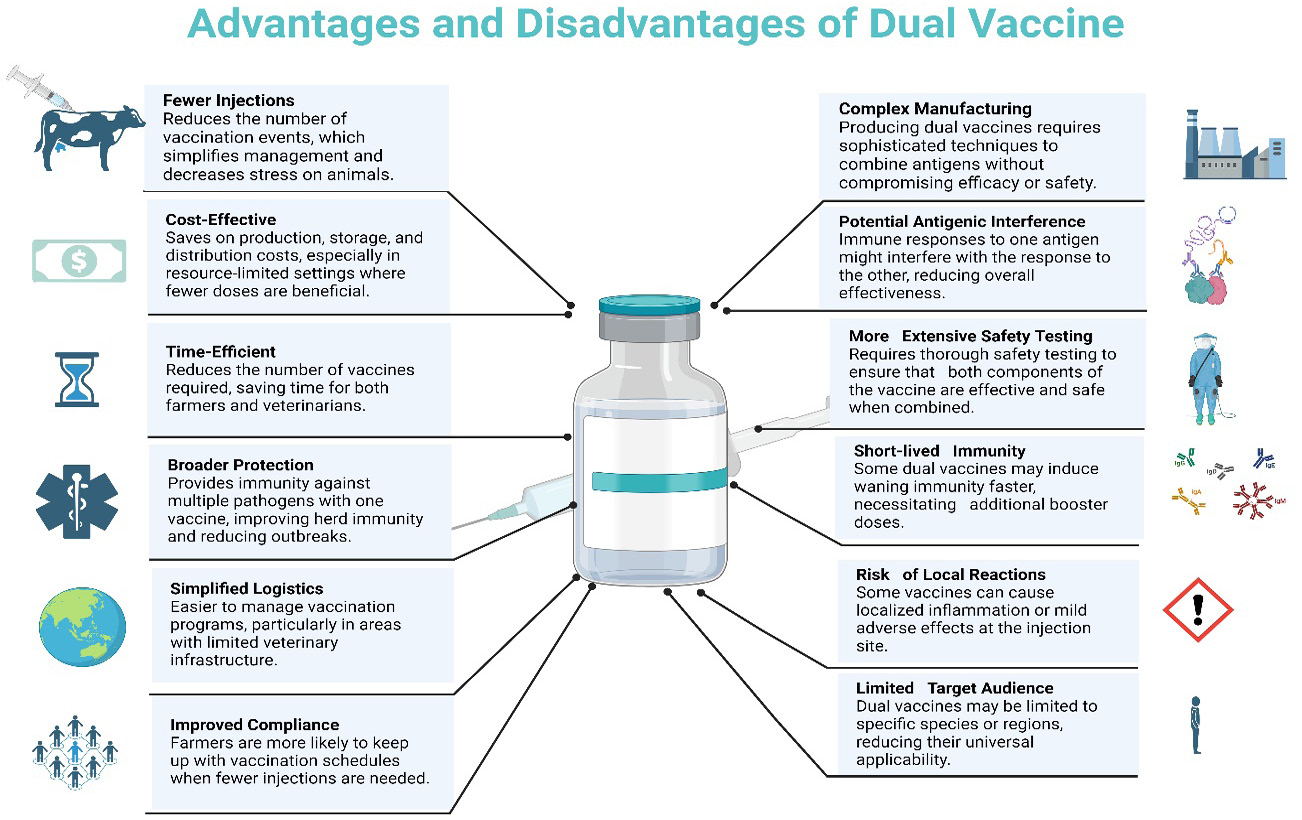
Illustrates the advantages and disadvantages of the dual vaccine.
References
- Akter, F. and Kumar, S., 2023. Glycoconjugate vaccine: An effective way to combat infectious diseases and cancers. https://doi.org/10.5772/intechopen.110281[CrossRef]
- Al-Fattah, Y.A.A., Khalid, K., Lim, H.X. and Poh, C.L., 2023. Development of next generation vaccines against SARS-CoV-2 and variants of concern. Viruses, 15(3). https://doi.org/10.3390/v15030624[CrossRef]
- Bamouh, Z., Hamdi, J., Fellahi, S., Khayi, S., Jazouli, M., Tadlaoui, K.O., Fihri, O.F., Tuppurainen, E. and Elharrak, M., 2021. Investigation of post vaccination reactions of two live attenuated vaccines against lumpy skin disease of cattle. Vaccines (Basel), 9(6). https://doi.org/10.3390/vaccines9060621[CrossRef]
- Benmansour, A., Leblois, H., Coulon, P., Tuffereau, C., Gaudin, Y., Flamand, A. and Lafay, F., 1991. Antigenicity of rabies virus glycoprotein. Virol. J., 65(8): 4198-4203. https://doi.org/10.1128/jvi.65.8.4198-4203.1991[CrossRef]
- Berhe, G., 2006. Development of dual vaccines for the control of peste des petits ruminants and Capripox infections of small ruminants. Online version of PhD thesis.(EMVT, France).
- Berhe, G., Minet, C., Le Goff, C., Barrett, T., Ngangnou, A., Grillet, C., Libeau, G., Fleming, M., Black, D.N., and Diallo, A., 2003. Development of a dual recombinant vaccine to protect small ruminants against peste-des-petits-ruminants virus and capripoxvirus infections. J. Virol., 77(2): 1571-1577. https://doi.org/10.1128/JVI.77.2.1571-1577.2003[CrossRef]
- Besselaar, T. and Blackburn, N., 1992. The synergistic neutralization of Rift Valley fever virus by monoclonal antibodies to the envelope glycoproteins. Arch. Virol., 125: 239-250. https://doi.org/10.1007/BF01309641[CrossRef]
- Boone, J.D., Balasuriya, U.B., Karaca, K., Audonnet, J.C., Yao, J., He, L., Nordgren, R., Monaco, F., Savini, G. and Gardner, I.A., 2007. Recombinant canarypox virus vaccine co-expressing genes encoding the VP2 and VP5 outer capsid proteins of bluetongue virus induces high level protection in sheep. Vaccine, 25(4): 672-678. https://doi.org/10.1016/j.vaccine.2006.08.025[CrossRef]
- Boshra, H., Blyth, G.A.D., Truong, T., Kroeker, A., Kara, P., Mather, A., Wallace, D. and Babiuk, S., 2024. The development of a multivalent capripoxvirus-vectored vaccine candidate to protect against sheeppox, goatpox, peste des petits ruminants, and Rift Valley Fever. Vaccines (Basel), 12(7). https://doi.org/10.3390/vaccines12070805[CrossRef]
- Boshra, H., Truong, T., Nfon, C., Bowden, T.R., Gerdts, V., Tikoo, S., Babiuk, L.A., Kara, P., Mather, A. and Wallace, D.B., 2015. A lumpy skin disease virus deficient of an IL-10 gene homologue provides protective immunity against virulent capripoxvirus challenge in sheep and goats. Antiviral Res., 123: 39-49. https://doi.org/10.1016/j.antiviral.2015.08.016[CrossRef]
- Boshra, H., Truong, T., Nfon, C., Gerdts, V., Tikoo, S., Babiuk, L.A., Kara, P., Mather, A., Wallace, D. and Babiuk, S., 2013. Capripoxvirus-vectored vaccines against livestock diseases in Africa. Antiviral Res., 98(2), 217-227. https://doi.org/10.1016/j.antiviral.2013.02.016[CrossRef]
- Boyce, M., Celma, C.P. and Roy, P., 2012. Bluetongue virus non-structural protein 1 is a positive regulator of viral protein synthesis. Virol. J., 9: 1-11. https://doi.org/10.1186/1743-422X-9-178[CrossRef]
- Brisse, M., Vrba, S.M., Kirk, N., Liang, Y. and Ly, H., 2020. Emerging Concepts and technologies in vaccine development. Front Immunol., 11: 583077. https://doi.org/10.3389/fimmu.2020.583077[CrossRef]
- Brown, L., Rosatte, R., Fehlner-Gardiner, C., Bachmann, P., Ellison, J., Jackson, F., Taylor, J., Davies, C. and Donovan, D., 2014. Oral vaccination and protection of red foxes (Vulpes vulpes) against rabies using ONRAB®, an adenovirus-rabies recombinant vaccine. Vaccine, 32(8): 984-989. https://doi.org/10.1016/j.vaccine.2013.12.015[CrossRef]
- Calvo-Pinilla, E., Marin-Lopez, A., Moreno, S., Lorenzo, G., Utrilla-Trigo, S., Jimenez-Cabello, L., Benavides, J., Nogales, A., Blasco, R., Brun, A. and Ortego, J., 2020. A protective bivalent vaccine against Rift Valley fever and bluetongue. NPJ Vaccines, 5(1): 70. https://doi.org/10.1038/s41541-020-00218-y[CrossRef]
- Cavanagh, D., 2007. Coronavirus avian infectious bronchitis virus. Vet. Res., 38(2): 281-297. https://doi.org/10.1051/vetres:2006055[CrossRef]
- Chalmers, W.S., 2006. Overview of new vaccines and technologies. Vet. Microbiol., 117(1): 25-31. https://doi.org/10.1016/j.vetmic.2006.04.006[CrossRef]
- Chaudhary, S.S., Pandey, K.D., Singh, R.P., Verma, P.C. and Gupta, P.K., 2009. A vero cell derived combined vaccine against sheep pox and Peste des Petits ruminants for sheep. Vaccine, 27(19): 2548-2553. https://doi.org/10.1016/j.vaccine.2009.01.104[CrossRef]
- Chen, T., Zhou, X., Qi, Y., Mi, L., Sun, X., Zhang, S., Liu, Y., Olson, V., Qiu, W., Wu, X. and Hu, R., 2019. Feline herpesvirus vectored-rabies vaccine in cats: A dual protection. Vaccine, 37(16): 2224-2231. https://doi.org/10.1016/j.vaccine.2019.03.008[CrossRef]
- Choppin, P.W. and Scheid, A., 1980. The role of viral glycoproteins in adsorption, penetration, and pathogenicity of viruses. Rev. Infect. Dis., 2(1): 40-61. https://doi.org/10.1093/clinids/2.1.40[CrossRef]
- Chowdhury, S.I., Pannhorst, K., Sangewar, N., Pavulraj, S., Wen, X., Stout, R.W., Mwangi, W. and Paulsen, D.B., 2021. BoHV-1-vectored BVDV-2 subunit vaccine induces BVDV cross-reactive cellular immune responses and protects against BVDV-2 challenge. Vaccines, 9(1): 46. https://doi.org/10.3390/vaccines9010046[CrossRef]
- Cottingham, E., Johnstone, T., Hartley, C.A. and Devlin, J.M., 2021. Use of feline herpesvirus as a vaccine vector offers alternative applications for feline health. Vet. Microbiol., 261: 109210. https://doi.org/10.1016/j.vetmic.2021.109210[CrossRef]
- Das, S.C., Baron, M.D. and Barrett, T., 2000. Recovery and characterization of a chimeric rinderpest virus with the glycoproteins of peste-des-petits-ruminants virus: homologous F and H proteins are required for virus viability. Virol. J., 74(19): 9039-9047. https://doi.org/10.1128/JVI.74.19.9039-9047.2000[CrossRef]
- Demirden, S.F., Kimiz-Gebologlu, I. and Oncel, S.S., 2024. Animal Cell lines as expression platforms in viral vaccine production: A post covid-19 perspective. ACS Omega, 9(15): 16904-16926. https://doi.org/10.1021/acsomega.3c10484[CrossRef]
- Diallo, A., Minet, C., Berhe, G., Le Goff, C., Black, D., Fleming, M., Barrett, T., Grillet, C. and Libeau, G., 2002. Goat immune response to capripox vaccine expressing the hemagglutinin protein of peste des petits ruminants. Ann. N. Y. Acad. Sci., 969(1): 88-91. https://doi.org/10.1111/j.1749-6632.2002.tb04356.x[CrossRef]
- Dimitrov, K.M., Afonso, C.L., Yu, Q. and Miller, P.J., 2017. Newcastle disease vaccines. A solved problem or a continuous challenge? Vet. Microbiol., 206: 126-136. https://doi.org/10.1016/j.vetmic.2016.12.019[CrossRef]
- Domachowske, J., 2021. Vaccine additives and excipients. Vaccines: A clinical overview and practical guide, pp. 49-76. https://doi.org/10.1007/978-3-030-58414-6_4[CrossRef]
- Douglass, N., Omar, R., Munyanduki, H., Suzuki, A., de Moor, W., Mutowembwa, P., Pretorius, A., Nefefe, T., Schalkwyk, A.V., Kara, P., Heath, L. and Williamson, A.L., 2021. The development of dual vaccines against lumpy skin disease (LSD) and bovine ephemeral fever (BEF). Vaccines (Basel), 9(11). https://doi.org/10.3390/vaccines9111215[CrossRef]
- Eloiflin, R.J., Grau-Roma, L., Python, S., Mehinagic, K., Godel, A., Libeau, G., Summerfield, A., Bataille, A. and García-Nicolás, O., 2022. Comparative pathogenesis of peste des petits ruminants virus strains of difference virulence. Vet. Res., 53(1): 57. https://doi.org/10.1186/s13567-022-01073-6[CrossRef]
- Es-Sadeqy, Y., Bamouh, Z., Ennahli, A., Safini, N., El-Mejdoub, S., Omari Tadlaoui, K., Gavrilov, B. and El-Harrak, M., 2021. Development of an inactivated combined vaccine for protection of cattle against lumpy skin disease and bluetongue viruses. Vet. Microbiol., 256: 109046. https://doi.org/10.1016/j.vetmic.2021.109046[CrossRef]
- European Environmental Agency, E.E., 2024. Veterinary antimicrobials in Europe’s environment: A one health perspective.https://www.eea.europa.eu/publications/veterinary-antimicrobials-in-europes-environment
- Fakri, F., Ghzal, F., Daouam, S., Elarkam, A., Douieb, L., Tadlaoui, K., Fassi-Fihri, O. and Elharrak, M., 2015. Field application of a combined vaccine against peste des petits ruminants and sheep pox. J. Vaccines Vaccinat., 6(6). https://doi.org/10.1016/j.trivac.2015.03.004[CrossRef]
- Fan, H., Ooi, A., Tan, Y.W., Wang, S., Fang, S., Liu, D.X. and Lescar, J., 2005. The nucleocapsid protein of coronavirus infectious bronchitis virus: Crystal structure of its N-terminal domain and multimerization properties. Structure, 13(12): 1859-1868. https://doi.org/10.1016/j.str.2005.08.021[CrossRef]
- Fournier, P., Brons, N.H., Berbers, G.A., Wiesmûller, K.H., Fleckenstein, B.T., Schneider, F., Jung, G. and Muller, C.P., 1997. Antibodies to a new linear site at the topographical or functional interface between the haemagglutinin and fusion proteins protect against measles encephalitis. J. Gen. Virol., 78(6): 1295-1302. https://doi.org/10.1099/0022-1317-78-6-1295[CrossRef]
- Francis, M., Oragwa, A., Ankeli, P., Liba, J., Ejeh, E., Raji, M., Ameh, J. and Egwu, G., 2018. Prevalence of contagious bovine pleuropneumonia based on gross lesions in cattle at slaughter in Adamawa State, Nigeria. Sokoto J. Vet. Sci., 16(1): 31-37. https://doi.org/10.4314/sokjvs.v16i1.5[CrossRef]
- Gaafar, B.B., Ali, S.A., Abd-Elrahman, K.A. and Almofti, Y.A., 2019. Immunoinformatics approach for multi-epitope vaccine prediction from H, M, F, and N proteins of Peste des Petits ruminants virus. J. Immunol. Res., 2019(1): 6124030. https://doi.org/10.1155/2019/6124030[CrossRef]
- Gabitzsch, E., Safrit, J.T., Verma, M., Rice, A., Sieling, P., Zakin, L., Shin, A., Morimoto, B., Adisetiyo, H., Wong, R., Bezawada, A., Dinkins, K., Balint, J., Peykov, V., Garban, H., Liu, P., Bacon, A., Bone, P., Drew, J. and Soon-Shiong, P., 2021. Dual-antigen COVID-19 vaccine subcutaneous prime delivery with oral boosts protects NHP against SARS-CoV-2 challenge. Front Immunol., 12: 729837. https://doi.org/10.3389/fimmu.2021.729837[CrossRef]
- Gao, W., Qiu, Y., Zhu, L., Yu, X., Yang, F., Chen, M., He, G., Liu, Y., Cui, L., Liu, F., Zhu, X. and Cao, Y., 2023. A dual-antigen malaria vaccine targeting Pb22 and Pbg37 was able to induce robust transmission-blocking activity. Parasit. Vectors, 16(1): 455. https://doi.org/10.1186/s13071-023-06071-x[CrossRef]
- Gupta, S. and Pellett, S., 2023. Recent developments in vaccine design: From live vaccines to recombinant toxin vaccines. Toxins, 15(9): 563. https://doi.org/10.3390/toxins15090563[CrossRef]
- Guthrie, C.M., Tan, X., Meeker, A.C., Self, A.E., Liu, L. and Cheng, Y., 2023. Engineering a dual vaccine against COVID-19 and tuberculosis. Front. Cell Infect. Microbiol., 13: 1273019. https://doi.org/10.3389/fcimb.2023.1273019[CrossRef]
- Habib, A., Anjum, K.M., Iqbal, R., Jaffar, G., Ashraf, Z., Khalid, M.S., Taj, M.U., Zainab, S.W., Umair, M. and Zohaib, M., 2023. Vaccine adjuvants: Selection criteria, mechanism of action associated with immune responses and future directions. Iran. J. Immunol., 20(1): 1-15.
- Hammouchi, M., Loutfi, C., Sebbar, G., Touil, N., Chaffai, N., Batten, C., Harif, B., Oura, C. and El Harrak, M., 2012. Experimental infection of alpine goats with a Moroccan strain of peste des petits ruminants virus (PPRV). Vet. Microbiol., 160(1-2): 240-244. https://doi.org/10.1016/j.vetmic.2012.04.043[CrossRef]
- He, L., Spatz, S., Dunn, J.R. and Yu, Q., 2023. Newcastle disease virus (NDV) recombinant expressing Marek’s disease virus (MDV) glycoprotein B significantly protects chickens against MDV and NDV challenges. Vaccine, 41(40): 5884-5891. https://doi.org/10.1016/j.vaccine.2023.08.038[CrossRef]
- Heaton, P.M., 2020. Challenges of developing novel vaccines with particular global health importance. Front. Immunol., 11: 517290. https://doi.org/10.3389/fimmu.2020.517290[CrossRef]
- Hewawaduge, C., Kwon, J., Park, J.Y. and Lee, J.H., 2024. A low-endotoxic Salmonella enterica gallinarum serovar delivers infectious bronchitis virus immunogens via a dual-promoter vector system that drives protective immune responses through MHC class-I and-II activation in chickens. Poult. Sci., 103(7): 103844. https://doi.org/10.1016/j.psj.2024.103844[CrossRef]
- Hosamani, M., Singh, S.K., Mondal, B., Sen, A., Bhanuprakash, V., Bandyopadhyay, S.K., Yadav, M.P. and Singh, R.K., 2006. A bivalent vaccine against goat pox and Peste des Petits ruminants induces protective immune response in goats. Vaccine, 24(35-36): 6058-6064. https://doi.org/10.1016/j.vaccine.2006.05.021[CrossRef]
- Huismans, H., Van der Walt, N., Cloete, M. and Erasmus, B., 1987. Isolation of a capsid protein of bluetongue virus that induces a protective immune response in sheep. Virol., 157(1): 172-179. https://doi.org/10.1016/0042-6822(87)90326-6[CrossRef]
- Iqbal, M., 2012. Progress toward the development of polyvalent vaccination strategies against multiple viral infections in chickens using herpesvirus of turkeys as vector. Bioengineered, 3(4): 222-226. https://doi.org/10.4161/bioe.20476[CrossRef]
- Iqbal, T., Altaf, S. and Iftikhar, A., 2023. Overview of vaccination. Biol. Times, 2(5): 21-22.
- Islam, M.S., Mondal, A.K., Auwul, M.R., Islam, T., Islam, O., Yasmin, A., Mahmud, M.A.A., Haque, A., Begum, M., Tipu, J.H., Mojumder, Y., Roy, M. and Islam, M.A., 2024. Assessment of knowledge, attitudes, and practices on vaccine usage among small ruminant farmers in the Northern Region of Bangladesh. Vet. World, 17(7): 1435-1448. https://doi.org/10.14202/vetworld.2024.1435-1448[CrossRef]
- Jogi, H.R., Smaraki, N., Rajak, K.K., Yadav, A.K., Bhatt, M., Einstien, C., Revathi, A., Thakur, R., Kamothi, D. J. and Dedeepya, P., 2024. Revolutionizing veterinary health with viral vector-based vaccines. Indian J. Microbiol., pp. 1-12. https://doi.org/10.1007/s12088-024-01341-3[CrossRef]
- Kamel, M.S., Munds, R.A. and Verma, M.S., 2023. The quest for immunity: Exploring human herpesviruses as vaccine vectors. Int. J. Mol. Sci., 24(22). https://doi.org/10.3390/ijms242216112[CrossRef]
- Kato, H., Takayama-Ito, M., Iizuka-Shiota, I., Fukushi, S., Posadas-Herrera, G., Horiya, M., Satoh, M., Yoshikawa, T., Yamada, S. and Harada, S., 2019. Development of a recombinant replication-deficient rabies virus-based bivalent-vaccine against MERS-CoV and rabies virus and its humoral immunogenicity in mice. PLoS One, 14(10): e0223684. https://doi.org/10.1371/journal.pone.0223684[CrossRef]
- Kausar, S., Said, K.F., Ishaq, M.U.R.M., Akram, M., Riaz, M., Rasool, G., Hamid, K.A., Saleem, I., Shamim, S. and Malik, A., 2021. A review: Mechanism of action of antiviral drugs. Int. J. Immunopathol. Pharmacol., 35: 20587384211002621. https://doi.org/10.1177/20587384211002621[CrossRef]
- Khalifa, H.O., Shikoray, L., Mohamed, M.Y.I., Habib, I. and Matsumoto, T., 2024. Veterinary drug residues in the food chain as an emerging public health threat: Sources, analytical methods, health impacts, and preventive measures. Foods, 13(11): 1629. https://doi.org/10.3390/foods13111629[CrossRef]
- Khan, Y., Maalik, A., Hakeemullah, Sattar, A., Mazhar, D., Hashmi, M.Z., Bibi, M., Aslam, S., Ullah, S.A. and Ahmed, B., 2024. Current trends in the development of vaccines from micro to industrial level. In: Recent advances in industrial biochemistry. Springer. pp. 371-397. https://doi.org/10.1007/978-3-031-50989-6_14[CrossRef]
- Kling, H.M., Nau, G.J., Ross, T.M., Evans, T.G., Chakraborty, K., Empey, K.M. and Flynn, J.L., 2014. Challenges and future in vaccines, drug development, and immunomodulatory therapy. Ann. Am. Thorac. Soc., 11 Suppl 4(Suppl 4): S201-210. https://doi.org/10.1513/AnnalsATS.201401-036PL[CrossRef]
- Kononov, A., Byadovskaya, O., Kononova, S., Yashin, R., Zinyakov, N., Mischenko, V., Perevozchikova, N., and Sprygin, A., 2019. Detection of vaccine-like strains of lumpy skin disease virus in outbreaks in Russia in 2017. Arch. Virol., 164(6): 1575-1585. https://doi.org/10.1007/s00705-019-04229-6[CrossRef]
- Kristensen, T., Newman, J., Guan, S. H., Tuthill, T.J. and Belsham, G.J., 2018. Cleavages at the three junctions within the foot-and-mouth disease virus capsid precursor (P1–2A) by the 3C protease are mutually independent. Virol., 522: 260-270. https://doi.org/10.1016/j.virol.2018.07.010[CrossRef]
- Kumar, N., Barua, S., Riyesh, T. and Tripathi, B.N., 2017. Advances in peste des petits ruminants vaccines. Vet. Microbiol., 206: 91-101. https://doi.org/10.1016/j.vetmic.2017.01.010[CrossRef]
- Kweon, C.H., Kang, S.W., Choi, E.J. and Kang, Y.B., 1999. Bovine herpes virus expressing envelope protein (E2) of bovine viral diarrhea virus as a vaccine candidate. J. Vet. Med. Sci., 61(4): 395-401. https://doi.org/10.1292/jvms.61.395[CrossRef]
- Lacasta, D., Ferrer, L.M., Ramos, J.J., Gonzalez, J.M., Ortin, A. and Fthenakis, G.C., 2015. Vaccination schedules in small ruminant farms. Vet. Microbiol., 181(1-2): 34-46. https://doi.org/10.1016/j.vetmic.2015.07.018[CrossRef]
- Lauer, K.B., Borrow, R. and Blanchard, T.J., 2017. Multivalent and multipathogen viral vector vaccines. Clin. Vaccine Immunol., 24(1). https://doi.org/10.1128/CVI.00298-16[CrossRef]
- Li, J., Liu, Y., Liu, X., Shang, Y., Liu, J., An, F. and Yin, H., 2008. Screening and stability of Madin-Darby bovine kidney cell strain co-expressing the capsid precursor protein P1-2A gene and the protease 3C gene of foot-and-mouth disease virus. Wei Sheng wu xue bao= Acta Microbiol. Sin., 48(11): 1520-1525.
- Li, J., Wang, J., Guo, Y., Gong, Z. and Cai, X., 2023. A recombinant capripoxvirus expressing the F protein of peste des petits ruminants virus and the P12A3C of foot-and-mouth disease virus. BMC Vet. Res., 19(1). https://doi.org/10.1186/s12917-022-03529-5[CrossRef]
- Libeau, G., Sossah, C.C., Caufour, P., Minet, C., Kwiatek, O., Lancelot, R., Servan de Almeida, R., Albina, E. and Lefrançois, T., 2015. Development of vaccines against peste des petits ruminants: CIRAD’s achievements and future challenges. OIE Partn, 2: 72-77.
- Liu, F., Wu, X., Liu, W., Li, L. and Wang, Z., 2014. Current perspectives on conventional and novel vaccines against peste des petits ruminants. Vet. Res. Commun., 38(4): 307-322. https://doi.org/10.1007/s11259-014-9618-x[CrossRef]
- Liu, J., Jaijyan, D.K., Chen, Y., Feng, C., Yang, S., Xu, Z., Zhan, N., Hong, C., Li, S. and Cheng, T., 2023. Cytomegalovirus-vectored COVID-19 vaccines elicit neutralizing antibodies against the SARS-CoV-2 Omicron variant (BA. 2) in mice. Microbiol. Spectr., 11(6): e02463-02423. https://doi.org/10.1128/spectrum.02463-23[CrossRef]
- Macchi, F., Rojas, J.M., Verna, A.E., Sevilla, N., Franceschi, V., Tebaldi, G., Cavirani, S., Martín, V. and Donofrio, G., 2018. Bovine herpesvirus-4-based vector delivering Peste des Petits Ruminants Virus hemagglutinin ORF induces both neutralizing antibodies and cytotoxic T cell responses. Front. Immunol., 9: 421. https://doi.org/10.3389/fimmu.2018.00421[CrossRef]
- Madhavan, A., Venkatesan, G. and Kumar, A., 2016. Capripoxviruses of small ruminants: Current updates and future perspectives. Asian J. Anim. Vet. Adv., 11(12): 757-770. https://doi.org/10.3923/ajava.2016.757.770[CrossRef]
- Marín-López, A., Calvo-Pinilla, E., Barriales, D., Lorenzo, G., Benavente, J., Brun, A., Martínez-Costas, J.M., and Ortego, J., 2017. Microspheres-prime/rMVA-boost vaccination enhances humoral and cellular immune response in IFNAR (−/−) mice conferring protection against serotypes 1 and 4 of bluetongue virus. Antiviral Res., 142: 55-62. https://doi.org/10.1016/j.antiviral.2017.03.010[CrossRef]
- Marín-López, A., Calvo-Pinilla, E., Barriales, D., Lorenzo, G., Brun, A., Anguita, J. and Ortego, J., 2018. CD8 T cell responses to an immunodominant epitope within the nonstructural protein NS1 provide wide immunoprotection against bluetongue virus in IFNAR−/− mice. Virol. J., 92(16). https://doi.org/10.1128/JVI.00938-18[CrossRef]
- McCafferty, S., Haque, A., Vandierendonck, A., Weidensee, B., Plovyt, M., Stuchlikova, M., Francois, N., Valembois, S., Heyndrickx, L., Michiels, J., Arien, K.K., Vandekerckhove, L., Abdelnabi, R., Foo, C.S., Neyts, J., Sahu, I. and Sanders, N.N., 2022. A dual-antigen self-amplifying RNA SARS-CoV-2 vaccine induces potent humoral and cellular immune responses and protects against SARS-CoV-2 variants through T cell-mediated immunity. Mol. Ther., 30(9): 2968-2983. https://doi.org/10.1016/j.ymthe.2022.04.014[CrossRef]
- Mertens, P., Brown, F. and Sangar, D., 1984. Assignment of the genome segments of bluetongue virus type 1 to the proteins which they encode. Virology, 135(1): 207-217. https://doi.org/10.1016/0042-6822(84)90131-4[CrossRef]
- Mertens, P., Pedley, S., Cowley, J., Burroughs, J., Corteyn, A., Jeggo, M., Jennings, D. and Gorman, B., 1989. Analysis of the roles of bluetongue virus outer capsid proteins VP2 and VP5 in determination of virus serotype. Virology, 170(2): 561-565. https://doi.org/10.1016/0042-6822(89)90447-9[CrossRef]
- Mikhael, A.C., Nakhla, E.O. and Mohamed, A.N., 2017. Study on the capability of a dual capripox vaccine in the protection of cattle against LSD infection. J. Vet. Med. Res., 24(1): 61-70. https://doi.org/10.21608/jvmr.2017.43265[CrossRef]
- Milne Price, S., Miazgowicz, K.L. and Munster, V.J., 2014. The emergence of the Middle East respiratory syndrome coronavirus. Pathog. Dis., 71(2): 121-136. https://doi.org/10.1111/2049-632X.12166[CrossRef]
- Morens, D.M., Taubenberger, J.K. and Fauci, A.S., 2023. Rethinking next-generation vaccines for coronaviruses, influenzaviruses, and other respiratory viruses. Cell Host Microbe., 31(1): 146-157. https://doi.org/10.1016/j.chom.2022.11.016[CrossRef]
- Nam, J., Kim, A., Kim, K., Moon, J.H., Baig, J., Phoo, M., Moon, J.J. and Son, S., 2024. Engineered polysaccharides for controlling innate and adaptive immune responses. Nat. Rev. Bioeng., pp. 1-19. https://doi.org/10.1038/s44222-024-00193-2[CrossRef]
- Ngichabe, C., Wamwayi, H., Ndungu, E., Mirangi, P., Bostock, C., Black, D. and Barrett, T., 2002. Long term immunity in African cattle vaccinated with a recombinant capripox-rinderpest virus vaccine. Epidemiol. Infect., 128(2): 343-349. https://doi.org/10.1017/S0950268801006513[CrossRef]
- OIE, 2007. Foot and Mouth Disease http://www.oie.int/fileadmin/Home/eng/Animal_Health_in_the_World/docs/pdf/foot_and_mouth_disease.pdf
- Pedrera, M., Macchi, F., McLean, R.K., Franceschi, V., Thakur, N., Russo, L., Medfai, L., Todd, S., Tchilian, E.Z. and Audonnet, J.C., 2020. Bovine herpesvirus-4-vectored delivery of Nipah virus glycoproteins enhances T cell immunogenicity in pigs. Vaccines, 8(1): 115. https://doi.org/10.3390/vaccines8010115[CrossRef]
- Perrin, A., Albina, E., Breard, E., Sailleau, C., Promé, S., Grillet, C., Kwiatek, O., Russo, P., Thiéry, R. and Zientara, S., 2007. Recombinant capripoxviruses expressing proteins of bluetongue virus: evaluation of immune responses and protection in small ruminants. Vaccine, 25(37-38): 6774-6783. https://doi.org/10.1016/j.vaccine.2007.06.052[CrossRef]
- Petrini, S., Iscaro, C. and Righi, C., 2019. Antibody responses to bovine alphaherpesvirus 1 (BoHV-1) in passively immunized calves. Viruses, 11(1): 23. https://doi.org/10.3390/v11010023[CrossRef]
- Pollard, A.J. and Bijker, E.M., 2021. A guide to vaccinology: From basic principles to new developments. Nat. Rev. Immunol., 21(2): 83-100. https://doi.org/10.1038/s41577-020-00479-7[CrossRef]
- Rajak, K., Sreenivasa, B., Hosamani, M., Singh, R., Singh, S., Singh, R. and Bandyopadhyay, S., 2005. Experimental studies on immunosuppressive effects of peste des petits ruminants (PPR) virus in goats. Comp. Immunol. Microbiol. Infect. Dis., 28(4): 287-296. https://doi.org/10.1016/j.cimid.2005.08.002[CrossRef]
- Rodriguez-Martin, D., Rojas, J.M., Macchi, F., Franceschi, V., Russo, L., Sevilla, N., Donofrio, G. and Martin, V., 2021. Immunization with bovine herpesvirus-4-based vector delivering PPRV-H protein protects sheep from PPRV challenge. Front. Immunol., 12: 705539. https://doi.org/10.3389/fimmu.2021.705539[CrossRef]
- Rojas, J.M., Rodríguez-Martín, D., Martín, V. and Sevilla, N., 2019. Diagnosing bluetongue virus in domestic ruminants: Current perspectives. Vet. Med. Res., pp. 17-27. https://doi.org/10.2147/VMRR.S163804[CrossRef]
- Romero, C., Barrett, T., Evans, S., Kitching, R., Gershon, P., Bostock, C. and Black, D., 1993. Single capripoxvirus recombinant vaccine for the protection of cattle against rinderpest and lumpy skin disease. Vaccine, 11(7): 737-742. https://doi.org/10.1016/0264-410X(93)90258-Y[CrossRef]
- Rweyemamu, M., Paskin, R., Benkirane, A., Martin, V., Roeder, P. and Wojciechowski, K., 2000. Emerging diseases of Africa and the Middle East. Ann. N. Y. Acad. Sci., 916(1): 61-70. https://doi.org/10.1111/j.1749-6632.2000.tb05275.x[CrossRef]
- Safini, N., Elmejdoub, S., Bamouh, Z., Jazouli, M., Hamdi, J., Boumart, Z., Rhazi, H., Tadlaoui, K.O. and El-Harrak, M., 2022. Development and evaluation of a combined contagious bovine Pleuropneumonia (CBPP) and lumpy skin disease (LSD) live vaccine. Viruses, 14(2): 372. https://doi.org/10.3390/v14020372[CrossRef]
- Schutta, C., Barrera, J., Pisano, M., Zsak, L., Grubman, M.J., Mayr, G.A., Moraes, M.P., Kamicker, B.J., Brake, D.A., Ettyreddy, D., Brough, D.E., Butman, B.T. and Neilan, J.G., 2016. Multiple efficacy studies of an adenovirus-vectored foot-and-mouth disease virus serotype A24 subunit vaccine in cattle using homologous challenge. Vaccine, 34(27): 3214-3220. https://doi.org/10.1016/j.vaccine.2015.12.018[CrossRef]
- Sohier, C., Haegeman, A., Mostin, L., De Leeuw, I., Campe, W.V., De Vleeschauwer, A., Tuppurainen, E., Van Den Berg, T., De Regge, N. and De Clercq, K., 2019. Experimental evidence of mechanical lumpy skin disease virus transmission by Stomoxys calcitrans biting flies and Haematopota spp. horseflies. Sci. Rep., 9(1): 20076. https://doi.org/10.1038/s41598-019-56605-6[CrossRef]
- Suzich, J., Kakach, L. and Collett, M., 1990. Expression strategy of a phlebovirus: biogenesis of proteins from the Rift Valley fever virus M segment. Virol. J., 64(4): 1549-1555. https://doi.org/10.1128/jvi.64.4.1549-1555.1990[CrossRef]
- Swayne, D.E., Glisson, J.R., McDougald, L.R., Nolan, L.K., Suarez, D.L. and Nair, V.L., 2013. Diseases of Poultry, 13th Edition. Wiley-Blackwell.
- Teffera, M. and Babiuk, S., 2019. Potential of Using capripoxvirus vectored vaccines against arboviruses in sheep, goats, and cattle. Front. Vet. Sci., 6: 450. https://doi.org/10.3389/fvets.2019.00450[CrossRef]
- Travieso, T., Li, J., Mahesh, S., Mello, J.D.F.R.E. and Blasi, M., 2022. The use of viral vectors in vaccine development. NPJ Vaccines, 7(1): 75. https://doi.org/10.1038/s41541-022-00503-y[CrossRef]
- Van Rijn, P.A., 2019. Prospects of next-generation vaccines for bluetongue. Front. vet. sci., 6: 407. https://doi.org/10.3389/fvets.2019.00407[CrossRef]
- Wang, H., Bi, J., Feng, N., Zhao, Y., Wang, T., Li, Y., Yan, F., Yang, S. and Xia, X., 2022. Construction of recombinant rabies virus vectors expressing H or F protein of peste des petits ruminants virus. Vet. Sci., 9(10). https://doi.org/10.3390/vetsci9100555[CrossRef]
- Wang, Y., Liu, G., Chen, Z., Li, C., Shi, L., Li, W., Huang, H., Tao, C., Cheng, C. and Xu, B., 2013. Recombinant adenovirus expressing F and H fusion proteins of peste des petits ruminants virus induces both humoral and cell-mediated immune responses in goats. Vet. Immunol. Immunopathol., 154(1-2): 1-7. https://doi.org/10.1016/j.vetimm.2013.05.002[CrossRef]
- Wattsb, D., Safinia, N., Bamouha, Z., Hamidiaa, J., Tadlaouia, K. and Harraka, M., 2021. Evaluation of a combined peste des petits ruminants and Rift Valley Fever live vaccine in sheep and goats. J. Vaccines Vaccin, 12: 461.
- WHO, 2020. How do vaccines work? https://www.who.int/news-room/feature-stories/detail/how-do-vaccines-work.
- Willemse, M.J., van Schooneveld, S.H., Chalmers, W.S.K. and Sondermeijer, P.J., 1996. Vaccination against feline leukaemia using a new feline herpesvirus type 1 vector. Vaccine, 14(16): 1511-1516.
- Yamanouchi, K., Barrett, T. and Kai, C., 1998. New approaches to the development of virus vaccines for veterinary use Revue scientifique et technique-Office international des épizooties, 17(3): 641-653. https://doi.org/10.20506/rst.17.3.1125[CrossRef]
- Yang, M., Jiao, Y., Li, L., Yan, Y., Fu, Z., Liu, Z., Hu, X., Li, M., Shi, Y., He, J., Shen, Z. and Peng, G., 2024. A potential dual protection vaccine: Recombinant feline herpesvirus-1 expressing feline parvovirus VP2 antigen. Vet. Microbiol., 290(109978). https://doi.org/10.1016/j.vetmic.2023.109978[CrossRef]
- Yang, M., Jiao, Y., Yan, Y., Li, L., Hu, X., Jiao, Z., Li, M., Chen, Y., Shi, Y. and Shen, Z., 2023. Safety and immunogenicity of a TK/gI/gE gene-deleted feline herpesvirus-1 mutant constructed via CRISPR/Cas9 in feline. Vet. Microbiol., 281: 109728. https://doi.org/10.1016/j.vetmic.2023.109728[CrossRef]
- Zhang, S., Hao, M., Feng, N., Jin, H., Yan, F., Chi, H., Wang, H., Han, Q., Wang, J., Wong, G., Liu, B., Wu, J., Bi, Y., Wang, T., Sun, W., Gao, Y., Yang, S., Zhao, Y. and Xia, X., 2019. Genetically modified rabies virus vector-based Rift Valley fever virus vaccine is safe and induces efficacious immune responses in mice. Viruses, 11(10). https://doi.org/10.3390/v11100919[CrossRef]
- Zhao, C., Gao, J., Wang, Y., Ji, L., Qin, H., Hu, W. and Yang, Y., 2022. A novel rabies vaccine based on a recombinant bovine herpes virus type 1 expressing rabies virus glycoprotein. Front. Microbiol., 13: 931043. https://doi.org/10.3389/fmicb.2022.931043[CrossRef]
- Zhao, H., Njeumi, F., Parida, S. and Benfield, C.T.O., 2021. Progress towards eradication of peste des petits ruminants through vaccination. Viruses, 13(1). https://doi.org/10.3390/v13010059[CrossRef]
- Zhao, Z., Huang, C., Zhu, X., Qi, Z., Cao, Y., Li, P., Bao, H., Sun, P., Bai, X., Fu, Y., Li, K., Zhang, J., Ma, X., Wang, J., Yuan, H., Li, D., Liu, Z., Zhang, Q. and Lu, Z., 2023. Creation of poxvirus expressing foot-and-mouth and peste des petits ruminant disease virus proteins. Appl. Microbiol. Biotechnol., 107(2-3): 639-650. https://doi.org/10.1007/s00253-022-12351-w[CrossRef]
Services
Article usage statistics
Loading…