Research Article · Volume 13, Issue 2, 20 January 2025 · Open Access
Consumer Attitudes, Norms and Willingness to Pay: Exploring the Market Dynamics for Free-Range Eggs in East Java
· · · · ·
Affiliations & Notes ⌄
1Department of Socio-economic, Faculty of Animal Science, Brawijaya University, Malang, Indonesia
2Department of Socio-economic, Faculty of Agriculture, Brawijaya University, Malang, Indonesia. *Correspondence | Budi Hartono, Department of Socio-economic, Faculty of Animal Science, Brawijaya University, Malang, Indonesia
This study explored the influence of demographic variables, attitudinal factors, subjective norms, and perceived behavioral control on consumer purchasing behavior regarding free-range chicken eggs in East Java, Indonesia.
The results demonstrate that WTP is crucial in mediating the relationship between consumer characteristics and purchasing outcomes, encompassing product stability, habitual purchasing, recommendations, and intentions repurchase.
WTP’s positive and significant effects suggest understanding and enhancing consumers’ willingness to pay is vital for encouraging continued support for free-range eggs.
Moreover, providing consumers on the benefits of free-range eggs could positively influence their willingness to pay and improve perceptions of the product, leading to more sustainable consumer behavior.
Selected from the article's own text.
Abstract
This study examines the influence of various factors on consumer behavior, focusing on demographics, attitudes, subjective norms, perceived behavioral control, and willingness to pay (WTP). The purchase decision is analyzed through product stability, habitual buying, recommendations, and repurchase intention. Utilizing cross-sectional data from 510 respondents who are purchasing free-range eggs, structural equation modeling is employed to address the research questions. The results reveal that consumer demographics, product attitude, subjective norms, and perceived behavioral control positively and significantly impact willingness to pay (WTP), which is a mediating variable. Additionally, WTP, and these factors, significantly influence key outcomes like product stability, habitual buying, recommendations, and repurchase intention. Notably, the study underscores the mediating role of WTP, highlighting its importance in bridging the effects of consumer characteristics on purchase intentions. Based on these findings, the study suggests several practical implications and business policy recommendations . Programs such as loyalty cards or discounts can encourage repeat purchases, while educating consumers about the benefits of free-range eggs may enhance their willingness to pay and positively influence their attitudes toward the product.
Food insecurity, defined as the inability to access adequate nutritious sustenance due to resource limitations, continues to pose significant global challenges ; . This phenomenon, and various forms of malnutrition, represents a substantial threat to human health and well-being . Recognizing of these issues, the United Nations has incorporated them into its Sustainable Development Goals (SDGs), specifically SDGs 1, 2, and 3, which aim to eradicate poverty, eliminate hunger, and promote good health by 2030 . These targets underscore the relationship between food security, nutrition, and overall societal development. However, achieving these objectives has proven particularly challenging for developing countries such as Indonesia, where progress remains notably slow ; WHO, 2022). This disparity highlights the need for targeted interventions and comprehensive strategies to address the multifaceted nature of food insecurity and its associated health implications in resource-constrained settings. In this context, eggs emerge as a potential solution, given their status as a globally significant and widely consumed staple food. Lesnierowski and Stangierski (2018) highlight the egg’s importance, noting its high protein content. Moreover, eggs possess notable antioxidant properties, containing a spectrum of beneficial compounds, including carotenoids, vitamins E and A, and essential minerals such as selenium and iodine . These nutritional attributes position eggs as a valuable resource in addressing malnutrition and food insecurity, particularly in developing regions where diverse nutrient sources may be scarce.
Concurrently, a growing global awareness of health-conscious and environmentally friendly food products, including free-range eggs. This trend is particularly evident among Taiwanese consumers, reflecting a broader international shift in consumer preferences. Several interrelated factors are significantly studying the evolving of global egg market. Cao et al. (2021) and Rondoni et al. (2020) highlight the increasing consumer awareness and concerns regarding animal welfare as a primary driver pushing the industry towards more hen-friendly production methods. Additionally, according to Legendre and Coderre (2018) the growing consumer demand for transparency in production processes reflects a desire for greater understanding and control over food sources. Furthermore, Żakowska-Biemans and Tekień (2017) note a marked increase in consumer preference for free-range eggs, indicating a substantial shift in market dynamics. While the motivations for purchasing free-range eggs are multifaceted, Situmorang et al. (2022) identify four key aspects driving consumer behavior in this domain: health consciousness, food safety concerns, animal welfare considerations, and price sensitivity. This evolving consumer landscape underscores the complex interplay between nutritional value, ethical considerations, and economic factors in food choice decisions.
Consumer preferences for egg types are undergoing shifts in various countries. In Australia, for instance, the egg industry has witnessed a substantial increase in free-range egg sales, rising from 37.3% to 59.0% of supermarket grocery chains’ market sales value. Concurrently, there has been a notable decline in the sales value of caged hen eggs, dropping from 49.5% to 36.0% ; . This trend reflects a growing consumer preference for more ethically produced eggs in developed markets.
In Indonesia, a different dynamic is observed. According to data from the Ministry of Agriculture (2023), the production trend of free-range eggs has shown a consistent increase from 2019 to 2023, with an average growth rate of 41.14%. However, the consumption of free-range eggs has been fluctuating, with a decrease of 0.52% recorded in 2023. This discrepancy underscores the need to investigate strategies for stimulating consumer demand in Indonesia, and such research should focus on examining consumer attitudes and perceptions towards free-range egg products, with the ultimate goal of enhancing interest and stimulating purchase behavior among consumers.
However, international studies prioritize production aspects and animal welfare in the egg industry. Studies have explored the relationship between animal welfare and egg production, which was conducted in China and Chile. The researcher found that welfare indicators and income (per 10,000 hens) were generally better on free-range farms in China compared to cage farms. Improved parasite control and lower stocking densities could enhance hen welfare and profitability. Moreover, strong preference for products from animal production systems that prioritize animal welfare, which is important for the sustainability of egg production in Chile ; .
Additionally, research has examined the connection between animal welfare and premium egg pricing . The findings indicate that the premium for pure cage-free eggs is 1.5 cents per egg or about 7.8%. This is lower than in similar studies, likely due to limited awareness of animal welfare in Croatia and the use of enriched colony cage eggs as the baseline, which already meet higher welfare standards than conventional cage eggs.
Furthermore, multiple studies have investigated egg production aspects and livestock welfare (Bennett et al. (2016); ; ; ; ; . The result indicated that free-range use benefits bone health in pullets and hens, helps reduce keel deviations, and supports natural behaviors. It also improves hen’s production, promoting overall well-being. However, there is a potential risk of infection from bacteria, viruses, and parasites. Preventive strategies include implementing biosecurity measures and boosting animals’ defenses through proper nutrition.
Rahmani et al. (2019) evaluated Spanish consumers’ preferences and willingness to pay for fresh hens’ eggs from various production systems (caged, barn, free-range, or organic). Moreover, another study focuses on the factors free-range egg consumers believe are important for hen welfare. The result found that consumers chose free-range eggs, believing that happier and healthier hens produce better-tasting eggs . In Kenya, research has focused on consumer willingness to pay for improved chicken welfare . The researcher stated that consumer preferences revealed strong support for ethical chicken production practices, with consumers willing to pay significant premiums for various welfare measures: 30% more for certified transport, 72% extra for welfare-labeled products, 135% more for humane slaughter methods, and a substantial 236% premium for hormone-free chicken.
Several previous studies have extensively discussed the production of commercial and native chicken and their relation to animal welfare. However, despite the abundance of international research, studies focusing on consumer perception, consumer behavior, subjective norms, and willingness to pay for free-range eggs in Indonesia remain scarce. In this study, the willingness-to-pay (WTP) estimates indicate the price premium or the maximum amount that existing or prospective consumers are prepared to pay for free-range eggs. Insight into consumers’ WTP can enable policymakers and various stakeholders to develop and implement more socially acceptable policy measures that support sustainable food production. This statement is supported by , who stated that willingness to pay is a useful way to understand consumers’ views and preferences for sustainable features in food products. On the other hand, subjective norm-focused expectations pertain to an individual’s perceptions of how they should regard significant others and their motivation to conform to these perceived expectations. Here, family, friends, and peers serve as influential relationships that shape an individual’s behavior. Research further suggests that subjective norms arise from beliefs about the importance of key referents and the drive to align with their expectations. These relationships have been substantiated by various studies in consumer behavior and social psychology ; ; .
Moreover, consumer behaviors involve examining how individuals select, use, and dispose of products, services, ideas, or experiences to fulfill their desires and needs . For instance, this study could explore consumers’ motivations and obstacles to buy free-range eggs, the influence of labeling and certification on purchasing decisions, and the effect of ethical or environmental considerations on consumer preferences.
In line with the statement, this investigation seeks to address this gap by exploring the influence of consumer perception, including demographic factors, attitudes, subjective norms, and perceived behavioral control, on consumers’ purchasing behavior regarding free-range chicken eggs in East Java. The study aims to provide novel and comprehensive insights into how these various antecedents affect the purchasing behavior of free-range chicken eggs, thereby contributing valuable information to producers in this sector. Specifically, this research examines the impact of demographic factors, attitudes, subjective norms, and perceived behavioral control on consumers’ willingness to pay, and purchasing decisions. The researchers hypothesize that these factors, along with consumers’ willingness to pay, will show significant positive effects on buying decisions for free-range eggs. This targeted focus on East Java’s market will not only contribute to academic literature but also provide valuable practical insights for local egg producers seeking to better understand their consumers’ behavior.
MATERIALS AND METHODS
Research Location, Respondent and Data Collection
A purposive sampling method was employed to select locations for data collection , targeting consumers from five cities and regencies in East Java including Surabaya, Malang, Batu, Blitar, and Kediri. These areas were chosen as they represent the largest regions within the province. Moreover, East Java is the third-highest- ranked region in Indonesia in terms of egg production and consumption. Specifically, Surabaya, Malang, Batu, Blitar, and Kediri are the areas with the highest free-range egg production in East Java, with annual outputs of 7,106.99 kg, 1,456,662.73 kg, 20,418.00 kg, 1,573,290.9 kg, and 784,806.96 kg, respectively, in 2022 (BPS, 2023).
This research utilized a non-probability sampling method, specifically convenience sampling, also known as accidental sampling. In this approach, the researcher selects samples based on their accessibility and availability. Convenience sampling was chosen to streamline the research process, considering the wide and diverse population of free-range egg consumers across different age groups and genders. The choice of this method is based on the ease of accessing participants and the simplicity of data collection. A total of 510 respondents participated in this study. While convenience sampling offers practical advantages, it has limitations, such as potential bias and limited generalizability. To mitigate these concerns, purposive sampling was used to select locations, and convenience sampling to gather data from consumers within those chosen areas. This approach ensures more focused data collection while maintaining efficiency. The final step involved selecting specific respondents, namely consumers of free-range eggs.
The research design incorporated both primary and secondary data sources. Primary data were gathered from March to August 2024 by face-to-face interviews with respondents, employing a questionnaire as the data collection instruments to ensure uniformity and comprehensiveness. The survey questionnaire encompasses various aspects, including consumer demographics, consumers’ attitudes, subjective norms, perceived behavioral control, willingness to pay, product stability, habitual buying, people recommendation, and repurchase intention. Before distributing the questionnaires, this study tested their validity and reliability to ensure they adequately represented the model were using. Additionally, before the enumerators conducted interviews with the respondents, each enumerator performed a trial interview to confirm their understanding, ensure clarity, and anticipate any potential issues. Moreover, Secondary data were obtained from literature, including journals, documents, and books pertaining to consumer attitudes and willingness to pay for free-range eggs.
Data Analysis
Descriptive analysis: This study employed descriptive analysis, a methodological approach designed to ascertain the value of independent variables, whether singular or multiple, without establishing comparisons, correlations, or inter-variable associations. The descriptive analytical framework primarily utilized measures such as mean values and frequency distributions expressed as percentages. These mean values are subsequently categorized into interval scales, as presented in Table 1.
Table 1: Categories of respondent answer scores.
No
Answer Score Range
Category
1
1.00 - 1.80
Very Low
2
1.81 - 2.60
Low
3
2.61 - 3.40
Moderate
4
3.41 - 4.20
High
5
4.21 - 5.00
Very High
Statistical data analysis: To assess the influence of demographic factors, attitudes, subjective norms, and perceived behavioral control on consumers’ purchasing behaviors for free-range eggs, structural equation modeling was conducted using SmartPLS 4.0. The analysis aim is to determine which constructs have a significant impact on consumers’ purchasing behavior concerning free-range eggs. This analytical framework allows for a comprehensive examination of the interrelationships among the study’s key constructs. PLS-SEM is particularly appropriate for this research, given its ability to handle complex models with multiple latent variables and its robustness in exploratory research contexts.
This study utilized Partial Least Square (PLS) analysis. PLS is effective for measuring latent variables, which cannot be directly observed, through their associated indicators (manifest variables) while accounting for measurement error. This method enables a more detailed and comprehensive analysis of the indicators associated with latent variables, identifying the strength of their relationships, from the most to the least influential, while considering the level of error involved. According Hair et al. (2017) PLS-SEM offers advantages for handling complex models, smaller sample sizes, non-normal data distributions and is predictive or exploratory research in nature. This method has been extensively used in social science research to illustrate relationships among multiple variables ; ; . Although PLS-SEM has gained increasing popularity in the research literature, certain academics criticize the method for its perceived lack of rigor and question its appropriateness for analyzing relationships between latent variables .
Research focus and operational definition of variables: The variables employed in this study comprise consumer demographics, attitudes, subjective norms, perceived behavioral control, willingness to pay (WTP), purchase intention, and purchase decision. Consumer demographics are subdivided into several aspects: gender, age, income, educational level, and ethnicity. Considering the importance of understanding how socio-demographic factors influence individual decision-making, this study assesses the role of these characteristics in determining consumer behavior regarding the purchase of free-range eggs. Evolutionary psychology suggests that females and males differ in their decision-making processes due to the different ways they approach social interactions . Additionally, age has become an increasingly important socio-demographic characteristic to consider as the buying power of millennials grows and the senior market expands .
Furthermore, the attitude variable consisted of cognitive, affective, and conative components. Subjective norms are divided into two aspects: normative beliefs and motivation to comply. Moreover, the perceived behavioral control variable was divided into two parts: control beliefs and power of factors. Consumers’ willingness to pay (WTP) was also measured as a research variable. Willingness to pay (WTP) acted as a mediating variable, moderating the effect of demographic factors, attitudes, subjective norms, and perceived behavioral control on consumers’ purchasing behavior. Also, the purchase decision was identified through several indicators, such as product stability, people recommendations, repurchase intention, habitual buying. Table 2 presents detailed descriptions of the indicators for each latent variable, which are evaluated using a Likert scale from 1 to 5.
RESULTS AND DISCUSSION
Measurement Model Evaluation
Composite validity test: The measurement scales employed in this study were adapted from established instruments in the relevant literature. These scales underwent
Table 2: Description indicator of each construct in structural equation modeling (SEM).
Construct
Indicator
Measure
Consumer’s Demographic (X1)
Gender is an aspect I consider when purchasing and consuming free-range chicken eggs (X1.1)
Likert Scale 1-5
Age is a factor I consider when purchasing and consuming free-range eggs (X1.2)
Income is a factor I consider when purchasing and consuming free-range chicken eggs (X1.3)
The level of education I have influenced my decision to purchase and consume free-range chicken eggs (X1.4).
Ethnicity is an aspect I consider when purchasing and consuming free-range chicken eggs (X1.5).
Consumers’ attitude (X2)
I am confident in the quality of free-range chicken eggs (X2.1)
I believe that the quality of free-range chicken eggs is different from other types of eggs (X2.2)
I feel proud to purchase and consume free-range chicken eggs (X2.3)
I experience benefits from consuming free-range chicken eggs (X2.4)
I will continue to purchase and consume free-range chicken eggs even when other types of eggs are available (X2.5)
I continue to purchase and consume free-range chicken eggs because of their high quality (X2.6)
I choose free-range chicken eggs because they are affordable (X2.7)
I choose free-range chicken eggs because they come in a variety of brands and packaging options (X2.8)
Subjective Norm (X3)
My family considers free-range chicken eggs to be a high-quality product when I purchase and consume them (X3.1)
Friends and close relatives influence me to view free-range chicken eggs as a quality product when I purchase and consume them (X3.2)
Business colleagues agree with my decision to purchase and consume free-range chicken eggs (X3.3)
Influential people around me believe that I should purchase free-range chicken eggs (X3.4)
My family, friends, and relatives purchase and consume free-range chicken eggs (X3.5)
Perceived Behavioral Control (X4)
I do not rely on anyone when purchasing free-range chicken eggs at any given time in the future (X4.1)
I do not limit my purchase of free-range chicken eggs to at least once a season (X4.2)
I will buy free-range chicken eggs whenever I wish (X4.3)
I do not face any obstacles or barriers when purchasing free-range chicken eggs (X4.4)
Willingness to Pay (Y)
Free-range chicken eggs are suitable to be used as a daily food ingredient (Y1.2)
Free-range chicken eggs are products that can compete in terms of price and quality (Y1.3)
I will meet my needs by purchasing free-range chicken eggs (Y1.4)
I always purchase free-range chicken eggs using an online shopping application (Y1.5)
I always purchase free-range chicken eggs at modern markets (Y1.6)
I always purchase free-range chicken eggs at traditional markets (Y1.7)
I feel that free-range chicken eggs sold at prices of Rp. 2,800 - Rp. 3,000 per egg are reasonable for the quality and benefits they provide (Y1.8)
I purchase free-range chicken eggs in quantities of more than 1 kilogram per month (Y1.10).
Product Stability (Z1)
I purchase free-range chicken eggs because they align with the price and quality I expect (Z1.1)
I like free-range chicken eggs because they meet my desires and needs (Z1.2)
I purchased free-range chicken eggs because they offer the best quality and health benefits compared to other types of eggs (Z1.3)
I am confident that purchasing free-range chicken eggs is the right decision (Z1.4)
I evaluate other types of eggs besides free-range chicken eggs (Z1.5)
Habitual Buying (Z2)
I always seek information before deciding to purchase eggs (Z2.1)
I purchase free-range chicken eggs after obtaining information about the product that matches its description (Z2.2)
I am interested in buying free-range chicken eggs after learning that many other consumers purchase and consume them (Z2.3)
Free-range chicken eggs are my first choice in meeting my needs (Z2.4)
I decide to purchase free-range chicken eggs after evaluating several alternative options (Z2.5)
People Recommendation (Z3)
I purchase free-range chicken eggs based on recommendations and suggestions from others (Z3.1)
I recommend free-range chicken eggs to my family, relatives, and others (Z3.2)
I purchase free-range chicken eggs based on the experiences of others (Z3.3)
I buy free-range chicken eggs because I am following the current trend of healthy living (Z3.4)
Repurchase Intention (Z4)
My demand for free-range chicken eggs is high (Z4.1)
I find that free-range chicken eggs are easily available and sold in the market (Z4.2)
I feel that free-range chicken eggs are sold in various packaging options, making them easy to carry (Z4.3)
I am satisfied after purchasing and consuming free-range chicken eggs (Z4.3)
I am always loyal and continue to purchase free-range chicken eggs (Z4.4)
I purchase free-range chicken eggs in quantities that are relatively consistent with my previous purchases (Y4.5)
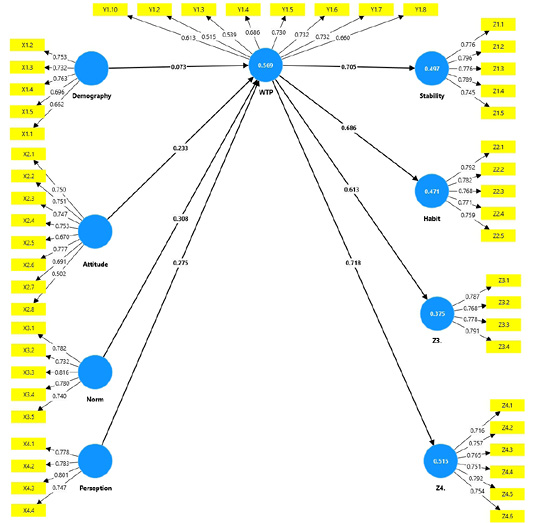
modifications to align with the study’s objectives, pilot results, and expert recommendations, ensuring content validity. The indicators for a latent variable are considered acceptable if their factor loadings exceed 0.5. The reliability of individual items was assessed, meeting the > 0.5 threshold as recommended by Hair Jr et al. (2021) and Wong (2013). Ideally, a factor loading > 0.7 indicates that an indicator is valid in measuring its construct. However, in empirical research, factor loadings > 0.5 are still considered acceptable. Recent studies in the field of social sciences continue to use indicators with factor loadings > 0.5 ; ; ; . The findings, based on Figure 1, demonstrate that the factor loadings for all constructs exceed the threshold of 0.5. This suggests a statistically significant relationship between individual items and their respective constructs. Such results indicate that each item serves as a reliable indicator of its associated construct, providing strong evidence for the measurement model’s validity.
Discriminant validity and convergent validity: Table 3 explains the result of Cronbach’s Alpha coefficients range from 0.773 to 0.856, with the values surpassing the standard threshold of 0.7. Importantly, Composite Reliability (CR) values exceed 0.7 for all constructs, signifying strong internal consistency . Although Cronbach’s Alpha values below 0.7 may be deemed acceptable in some contexts , the CR values further support convergent validity. CR assesses the overall reliability of a set of items within a construct or latent variable.
Table 3: The result of discriminant validity and convergent validity test.
Variables
Cronbach's alpha
Composite reliability
Average variance extracted
Demography (X1)
0,773
0,779
0,522
Attitude (X2)
0,856
0,863
0,504
Subjective Norm (X3)
0,829
0,831
0,594
Perceived behavioral control (X4)
0,782
0,783
0,604
WTP (Y)
0,807
0,819
0,531
Product Stability (Z1)
0,835
0,835
0,603
Habitual buying (Z2)
0,833
0,834
0,600
People Recommendation (Z3)
0,789
0,792
0,610
Repurchase (Z4)
0,850
0,851
0,572
Furthermore, Average Variance Extracted (AVE) values meet the minimum criterion of 0.5 for all constructs, reinforcing convergent validity ; . Discriminant validity is confirmed using the Fornell-Larcker criterion, as the square root of each construct’s AVE exceeds its correlations with other latent constructs (Table 4) . The multicollinearity check via Variance Inflation Factor (VIF) reveals values < 5 range from 1.247- 1954 for all indicators across the constructs (consumer demography, attitude, subjective norm, perceived behavioral control,
Table 4: Discriminant validity result.
Attitude
Demo-graphy
Habit
Norm
Perse-ption
Stability
WTP
Recom-mendation
Repur-chase
Attitude
0,845
Demography
0,526
0,560
Habit
0,665
0,491
0,906
Norm
0,843
0,548
0,739
0,855
Perception
0,833
0,348
0,561
0,755
0,820
Stability
0,830
0,465
0,811
0,744
0,801
0,921
WTP
0,795
0,488
0,833
0,814
0,795
0,844
0,865
Recommendation
0,555
0,466
0,801
0,677
0,484
0,645
0,765
0,802
Repurchase
0,780
0,491
0,825
0,666
0,698
0,851
0,859
0,722
0,665
willingness to pay (WTP), product stability, habitual buying, recommendation, repurchase), adhering to the recommended threshold ; Vörösmarty and Do- bos, 2020). The AVE indicates the proportion of variance a construct captures in relation to measurement error.
The Goodness of fit (GOF): The model’s goodness of fit is evaluated using three indicators: standardized root means square residual (SRMR), chi-square, and Normed-fit index (NFI), as presented in Table 5. These indicators collectively suggest that the model employed in this study demonstrates adequate fit. The NFI, introduced by Bentler and Bonett (1980) as one of the earliest fit measures in structural equation modeling (SEM), ranges from 0 to 1, with values closer to 1 indicating superior fit. Generally, NFI values exceeding 0.9 are considered acceptable ; .
Table 5: The result of goodness of fit test.
Saturated Model
Estimated Model
Note
SRMR
0.061
<0.100
Fit
Chi-Square
3812.121, P< 0.05
Higher is better, P<0.05
Fit
NFI
0.773
Closer to 1.00
Fit
Source: This study, 2024.
Researchers have proposed various thresholds for the Standardized Root Mean Square Residual (SRMR) to assess model fit in structural equation modeling. Hu and Bentler (1999) suggest that an SRMR value under 0.10 indicates a good fit in covariance structure analysis. For partial least squares SEM (PLS-SEM), Henseler et al. (2014) recommend using SRMR to detect model misspecification. Generally, lower SRMR values signify better model fit. Many researchers consider a value of 0.05 or less to be ideal ; , while values up to 0.08 are often deemed acceptable . Furthermore, a chi-square test coefficient with a p-value below 0.05 provides additional support for the model’s fit . Therefore, based on these results, the model represents the observed data well.
Structural Model Evaluation
R-square (R2): In the context of structural equation modeling utilizing partial least squares (PLS-SEM), coefficient of determination (R2) values of 0.67 (substantial), 0.33 (moderate), and 0.19 (weak) are interpreted as substantial, moderate, and weak, respectively . In this study, the coefficient of determination (R2) for the latent variable product stability, habit, purchasing habits, people recommendation, and repurchase product are 0.471, 0,497, 0.569, 0.375, and 0.515, respectively, which represents a moderate explanatory power. Specifically, the R² value of 0.471 for product stability signifies that 47.1% of its variance is explained by the independent variables, which include consumer attitude, consumer demographics, subjective norm, perception, and willingness to pay. Similarly, the R² value of 0.497 for habit shows that 49.7% of its variance is accounted for by the same set of predictors. The purchasing habits latent variable has an R² value of 0.569, meaning that 56.9% of its variance is explained by these independent variables, reflecting a moderate to strong explanatory capacity.
Furthermore, the R² value for people recommendation is 0.375, indicating that 37.5% of the variance is explained by consumer attitude, demographics, subjective norms, perception, and willingness to pay, which still aligns with the moderate range. Lastly, the R² value for repurchase products is 0.515, suggesting that 51.5% of its variance is explained by the independent variables. These findings collectively confirm that the model provides a moderate degree of explanatory power for the studied latent variables, demonstrating its effectiveness in capturing the relationships among the factors considered.
Hypothesis test: The interrelationships among various factors influencing consumer purchasing decisions are elucidated in Table 6. The analysis reveals that attitude exerts
Table 6: Hypothesis test.
Original sample (O)
Sample mean (M)
Standard deviation
T statistics
P values
Attitude -> Habit
0,160
0,164
0,044
3,638
0,000***
Attitude -> Stability
0,164
0,169
0,046
3,586
0,000***
Attitude -> WTP
0,233
0,238
0,061
3,807
0,000***
Attitude -> Recommendation
0,143
0,146
0,038
3,729
0,000***
Attitude -> Repurchase
0,167
0,171
0,045
3,718
0,000***
Demography -> Habit
0,050
0,052
0,025
2,001
0,045**
Demography -> Stability
0,051
0,053
0,025
2,077
0,038**
Demography -> WTP
0,073
0,075
0,035
2,066
0,039**
Demography -> Recommendation
0,045
0,046
0,022
2,010
0,044**
Demography -> Repurchase
0,052
0,054
0,026
2,026
0,043**
Norm -> Habit
0,211
0,209
0,039
5,431
0,000***
Norm -> Stability
0,217
0,214
0,036
5,975
0,000***
Norm -> WTP
0,308
0,303
0,053
5,769
0,000***
Norm -> Recommendation
0,189
0,186
0,035
5,320
0,000***
Norm -> Repurchase
0,221
0,218
0,039
5,613
0,000***
Perception -> Habit
0,189
0,188
0,033
5,673
0,000***
Perception -> Stability
0,194
0,194
0,037
5,219
0,000***
Perception -> WTP
0,275
0,274
0,049
5,626
0,000***
Perception -> Recommendation
0,168
0,168
0,031
5,493
0,000***
Perception -> Repurchase
0,197
0,197
0,036
5,522
0,000***
WTP -> Habit
0,686
0,687
0,036
19,320
0,000***
WTP -> Stability
0,705
0,706
0,030
23,115
0,000***
WTP -> Recommendation
0,613
0,613
0,032
19,009
0,000***
WTP -> Repurchase
0,718
0,718
0,027
26,494
0,000***
Note: **significant at 5%; ***significant at 1%.
significant positive effects on all examined constructs, including purchasing habit, product stability, willingness to pay (WTP), people recommendation, and repurchase intention, with notably high T-statistics and P-values below 0.001, underscoring its strong influence. In contrast, consumer demography demonstrates weaker but still statistically significant positive effects on the same constructs, with P-values less than 0.05. Furthermore, both subjective norm and consumer perception exhibit robust positive effects across all constructs, with P-values consistently below 0.001, indicating their substantial roles. Among all predictors, WTP emerges as the most influential factor, showing the strongest positive effects on purchasing habits, product stability, people recommendation, and repurchase intention, supported by exceptionally high T-statistics and significance levels. A detailed explanation of each construct’s influence and its implications will be provided in the following paragraphs.
The initial analysis reveals a statistically significant positive correlation between attitude and purchasing habits, as evidenced by a t-statistic of 3.638 (p < 0.01). This finding suggests that consumers exhibiting more favorable attitudes are more likely to develop consistent purchasing habits. This result confirms the correlation between customer attitudes and purchase behaviors. This result aligns with the arguments of Amoako et al. (2020) and Zaremohzzabieh et al. (2021) who assert that youth purchasing behavior is shaped by their attitudes.
Additionally, the data indicate a positive relationship between attitude and product stability, with a t-statistic of 3.586 (p < 0.01). This statistically significant result implies that consumer attitudes exert a positive influence on their confidence in the product. Furthermore, the path from attitude to willingness to pay, serving as a mediating variable, demonstrates a positive coefficient with a t-statistic of approximately 3.807, also significant at the p < 0.01 level. This result indicates that attitude has a substantial and positive effect on consumers’ willingness to pay. The findings imply that consumers who maintain positive attitudes toward a product exhibit a greater propensity to express willingness to pay for the product. Consumers perceive free-range eggs as healthier, more nutritious, and tastier compared to regular eggs, which drives their willingness to purchase them .
Furthermore, the analysis reveals a positive relationship between attitude and product repurchase intention, significant at the p < 0.01 level. This indicates that consumers with favorable sentiments towards a product are more likely to make repeat purchases. In this case, consumer satisfaction with the product experience has been shown to significantly influence repurchase decisions . Then, the attitude has a significantly positive effect on people’s recommendations, with a coefficient of 3.729 and a 1% significance level. This result indicates that individuals with favorable attitudes are significantly more likely to recommend the product to others. Consumers who express satisfaction with the perceived benefits and quality of free-range chicken products are more inclined to disseminate positive recommendations. These endorsements are communicated through various channels, including word-of-mouth interactions with friends and relatives, as well as broader dissemination to the general public via both interpersonal communication and mass media platforms .
Consumer demographics also play a significant role in various aspects of consumer behavior. Demographic factors positively influence purchasing habits (t = 2.001, p < 0.05) and product stability (t = 2.007, p < 0.05) . Demographic factors, including age, education, and income, significantly influence determinants of food selection and individual preferences. As individuals age, their dietary choices increasingly prioritize the nutritional value and overall quality of food products . Moreover, sufficient income is crucial, as exemplified by the higher cost of free-range eggs compared to conventional eggs. Additionally, educational attainment plays a pivotal role in shaping nutritional knowledge and subsequent dietary behaviors. Research indicates a positive correlation between higher education levels and a greater propensity to select high-quality eggs for consumption ; .
Demographic factors demonstrate a significant positive correlation with consumers’ willingness to pay. Specifically, educational attainment and income levels substantially influence dietary preferences . As individuals age, they become more aware of food safety and its health implications, which drives a higher willingness to pay for health-enhancing and wellness-oriented food products ; . Additionally, the data indicate that demographic factors positively and significantly affect both product recommendations (t = 2.010) and purchasing habits (t = 2.026). Researchers posit that ethnicity serves as a critical determinant influencing purchasing habits through consumer perceptions of distinct cultural values associated with rural or urban environments . The consumption of free-range eggs, whether raw or cooked, is believed to contribute to the development and maintenance of bodily health, as well as aid in illness prevention and recovery ; . Consequently, consumers may develop habitual consumption patterns of free-range eggs, potentially leading to established purchasing habits. Additionally, this may encourage consumers to recommend free-range eggs to their social networks.
The next analysis reveals that subjective norms exert a statistically significant positive influence on multiple aspects of consumer behavior. Specifically, subjective norms demonstrate a positive effect on purchasing habits (t = 5.431, p < 0.01), product stability (t = 5.975, p < 0.01), willingness to pay (t = 5.769, p < 0.01), product recommendation (t = 5.320, p < 0.01), and repurchase intention (t = 5.613, p < 0.01). The strong positive relationship between subjective norms and purchasing habits suggests that consumers’ buying patterns are significantly influenced by perceived social pressures and expectations . Similarly, the impact on product stability implies that social norms play a crucial role in shaping consumers’ trust and belief in products . The significant effect on willingness to pay indicates that subjective norms may influence consumers’ perceived value of products, potentially affecting price sensitivity ; . The positive relationship with product recommendation behavior suggests that social norms not only influence individual purchasing decisions but also play a role in word-of-mouth marketing and social influence processes. Finally, the significant impact on repurchase intention underscores the long-term effects of subjective norms on consumer loyalty and repeat business .
Furthermore, the study reveals compelling insights into the influence of perceived behavioral control on consumer behavior regarding free-range egg products. Notably, perceived behavioral control demonstrates a positive and statistically significant impact across several key aspects of consumer engagement. Firstly, it strongly affects consumer’s product stability, with a substantial effect size of 5.673. This suggests that as individuals feel more in control of their purchasing decisions, they are more likely to maintain consistent buying patterns for free-range eggs. Secondly, perceived behavioral control significantly influences consumers’ willingness to pay for free-range egg products, as evidenced by an effect size of 5.219. This indicates that consumers who perceive greater control over their choices are more inclined to invest in these premium products, possibly reflecting a stronger commitment to ethical or quality-focused consumption ; ; . Thirdly, the study found that perceived behavioral control has a marked impact on consumer recommendations, with an effect size of 5.626. This implies that individuals who feel more in control are more likely to endorse free-range egg products to others, potentially serving as influential advocates within their social networks .
Finally, perceived behavioral control demonstrates a significant positive effect on consumers repurchase intentions, with an effect size of 5.493. This indicates that consumers with higher perceived control are more likely to exhibit loyalty by repeatedly choosing free-range egg products . Importantly, all these effects were statistically significant at the 5% level, underscoring the reliability of these findings. Collectively, these results highlight the critical role of perceived behavioral control in shaping various aspects of consumer behavior in the context of free-range egg products, from initial purchase decisions to long-term loyalty and advocacy.
As conclusion the study reveals compelling insights into the impact of consumers’ willingness to pay on various aspects of consumer behavior in relation to a specific product or service. The findings demonstrate that consumers’ willingness to pay has a positive and highly significant impact across multiple dimensions of consumer engagement and loyalty. The effect is particularly significant on people’s repurchase intentions, with a remarkable coefficient of 26.494. This suggests that as consumers’ willingness to pay increases, they are substantially more likely to make repeat purchases, indicating a strong link between perceived value and customer retention. Consumers who show a willingness to pay for free-range eggs demonstrate satisfaction with the perceived benefits derived from consuming these products, encompassing both quality attributes and functional advantages. This satisfaction engenders product trust, subsequently influencing consumers’ decision-making processes and culminating in repurchase intentions for free-range eggs ; ; .
The strongest effect is observed on product stability, with a coefficient of 23.115, implying that consumers willing to pay more tend to maintain more consistent purchasing patterns and brand loyalty. The desire to purchase prompts individuals to actively seek information about the product, including aspects such as price and quality, as observed in the case of free-range eggs. This information is typically gathered from close acquaintances or through social media platforms. Consequently, this acquired knowledge contributes to increased confidence and certainty in the product .
Habitual buying behavior is also significantly influenced, with a coefficient of 19.320, suggesting that a higher willingness to pay is associated with the formation of strong purchasing habits. Similarly, people’s likelihood to recommend the product or service is positively affected, as evidenced by a coefficient of 19.009, indicating that those willing to pay more are more inclined to become brand advocates. Consumers who are willing to pay higher prices for free-range eggs are more likely to repurchase these products and recommend to others . Importantly, all these effects were statistically significant at the 1% level, underscoring the robustness and reliability of these findings. Collectively, these results highlight the critical role of consumers’ willingness to pay in shaping various facets of consumer behavior, from habitual purchasing and product stability to recommendation and repurchase intentions, providing valuable insights for marketing strategies and product pricing decisions.
CONCLUSIONS AND RECOMMNDATIONS
This study explored the influence of demographic variables, attitudinal factors, subjective norms, and perceived behavioral control on consumer purchasing behavior regarding free-range chicken eggs in East Java, Indonesia. By utilizing a sample of 510 respondents and employing structural equation modeling via the Partial Least Square (PLS) technique, the research demonstrated that consumer demographics, attitudes, subjective norms, and perceived behavioral control significantly affect willingness to pay (WTP), which, in turn, serves as a crucial mediating factor in shaping purchasing decisions.
The results demonstrate that WTP is crucial in mediating the relationship between consumer characteristics and purchasing outcomes, encompassing product stability, habitual purchasing, recommendations, and intentions repurchase. WTP’s positive and significant effects suggest understanding and enhancing consumers’ willingness to pay is vital for encouraging continued support for free-range eggs.
Based on these insights, the research recommends that industry stakeholders consider strategies to bolster consumer loyalty, such as loyalty programs or discounts that foster repeat purchases. Moreover, providing consumers on the benefits of free-range eggs could positively influence their willingness to pay and improve perceptions of the product, leading to more sustainable consumer behavior. These recommendations are essential for shaping marketing strategies and fostering long-term consumer engagement with free-range products.
This study faces several limitations. First, the cross-sectional design restricts the ability to observe changes in consumer behavior over time, limiting the understanding of evolving patterns. To address this, future research should employ longitudinal designs to track behavioral shifts more effectively. Additionally, integrating qualitative methodologies such as interviews or focus groups may provide deeper insights into the underlying motivations of consumers. These methods would deepen the study of factors influencing free-range egg purchasing behavior, offering a more thorough view of consumer preferences and decision-making processes in this context.
ACKNOWLEDGMENTS
Authors acknowledge the Department of Socio-economic, Faculty of Animal Science, Brawijaya University, Malang, Indonesia.
NOVELTY STATEMENTS
This study provides a combination of demographic factors, attitudes, subjective norms, and perceived behavioral control, alongside willingness to pay, creating a multifaceted understanding of the factors influencing purchasing behavior. In Addition, by concentrating on free-range chicken eggs, the research targets a niche product category, addressing a specific gap in consumer behavior studies related to ethical and sustainable food choices.
The authors have declared no conflict of interest.
Figures
Figure 1:.
The result of structural equation model.
References
Abumalloh RA, Ibrahim O, Nilashi M (2020). Loyalty of young female Arabic customers towards recommendation agents: A new model for B2C E-commerce. Technol.in Soc., 61: 101253. https://doi.org/10.1016/j.techsoc.2020.101253[CrossRef]
Ab Hamid, M., Sami, W., & Sidek, M. M. (2017). Discriminant validity assessment: Use of Fornell & Larcker criterion versus HTMT criterion. Journal of Physics, Conference Series, 890, 012163. https://doi.org/10.1088/1742-6596/890/1/012163[CrossRef]
Al-Swidi A, Mohammed RHS, Haroon HM, Noor MSM (2014). The role of subjective norms in theory of planned behavior in the context of organic food consumption. Br. Food J., 116(10): 1561-1580. https://doi.org/10.1108/BFJ-05-2013-0105[CrossRef]
Al Mamun A, Fazal SA, Ahmad GB, Yaacob MRB, Mohamad MR (2018). Willingness to pay for environmentally friendly products among low-income households along coastal peninsular Malaysia. Sustainability, 10(5): 1316. https://doi.org/10.3390/su10051316[CrossRef]
Ali T, Ali J (2020). Factors affecting the consumers’ willingness to pay for health and wellness food products. J. Agric. Food Res., 2: 100076. https://doi.org/10.1016/j.jafr.2020.100076[CrossRef]
Amoako GK, Dzogbenuku RK, Abubakari A (2020). Do green knowledge and attitude influence the youth’s green purchasing? Theory of planned behavior. Int. J. Productivity Perform. Manage., 69(8): 1609-1626. https://doi.org/10.1108/IJPPM-12-2019-0595[CrossRef]
Amudjie J, Agyekum K, Adinyira E, Amos-Abanyie S, Botchway EA (2023). Implementing the principles of circular economy in the construction industry: exploratory and confirmatory factor analyses of strategies. Constr. Innov., https://doi.org/10.1108/CI-10-2022-0270[CrossRef]
Atemoagbo OP (2024). Confirmatory Factor Analysis on Climate Change Impact on Human Migration Patterns and Social Vulnerability. Val. Int. J. Digit. Libr., 26057-26068. https://doi.org/10.18535/ijecs/v13i02.4782[CrossRef]
Babu S, Gajanan S, Sanyal P (2014). Food security, poverty and nutrition policy analysis: statistical methods and applications. Academic Press. https://doi.org/10.1016/B978-0-12-405864-4.00038-7[CrossRef]
Bahn RA, Hwalla N, El Labban S (2021). Leveraging nutrition for food security: The integration of nutrition in the four pillars of food security. In Food Security and nutrition (pp. 1-32). Elsevier. https://doi.org/10.1016/B978-0-12-820521-1.00001-0[CrossRef]
Bai L, Wang M, Gong S (2019). Understanding the antecedents of organic food purchases: The important roles of beliefs, subjective norms, and identity expressiveness. Sustainability, 11(11): 3045. https://doi.org/10.3390/su11113045[CrossRef]
Bennett RM, Jones PJ, Nicol CJ, Tranter RB, Weeks CA (2016). Consumer attitudes to injurious pecking in free-range egg production. Animal Welfare, 25(1): 91-100. https://doi.org/10.7120/09627286.25.1.091[CrossRef]
Bentler PM, Bonett DG (1980). Significance tests and goodness of fit in the analysis of covariance structures. Psychol. Bull., 88(3): 588. https://doi.org/10.1037//0033-2909.88.3.588[CrossRef]
Bo L, Yang X (2022). Is consumers’ willingness to pay premium for agricultural brand labels sustainable?: evidence from Chinese consumers’ random n-price auction experiment. Br. Food J., 124(13): 359-374. https://doi.org/10.1108/BFJ-01-2022-0077[CrossRef]
Bonnefous C, Collin A, Guilloteau LA, Guesdon V, Filliat C, Réhault-Godbert S, Rodenburg TB, Tuyttens, FA, Warin L, Steenfeldt S (2022). Welfare issues and potential solutions for laying hens in free range and organic production systems: A review based on literature and interviews. Front. Vet. Sci., 9: 952922. https://doi.org/10.3389/fvets.2022.952922[CrossRef]
BPS (2023). Data on Free-Range Chicken Egg Production in East Java Province.
Campbell D, Bari M, Rault JL (2020). Free-range egg production: its implications for hen welfare. Anim. Prod. Sci., 61(10): 848-855. https://doi.org/10.1071/AN19576[CrossRef]
Cao YJ, Cranfield J, Chen C, Widowski T (2021). Heterogeneous informational and attitudinal impacts on consumer preferences for eggs from welfare enhanced cage systems. Food Policy, 99: 101979. https://doi.org/10.1016/j.foodpol.2020.101979[CrossRef]
Chi CG (2011). Destination loyalty formation and travelers’ demographic characteristics: A multiple group analysis approach. J. Hospitality Touris. Res., 35(2): 191-212. https://doi.org/10.1177/1096348010382233[CrossRef]
Child S, Stewart S, Moore S (2017). Perceived control moderates the relationship between social capital and binge drinking: longitudinal findings from the Montreal Neighborhood Networks and Health Aging (MoNNET-HA) panel. Ann. Epidemiol., 27(2): 128-134. https://doi.org/10.1016/j.annepidem.2016.11.010[CrossRef]
Chin WW (1998). The partial least squares approach to structural equation modeling. Modern Methods for Business Research/Lawrence Erlbaum Associates.
Dikmen BY, Ipek A, Şahan Ü, Petek M, Sözcü A (2016). Egg production and welfare of laying hens kept in different housing systems (conventional, enriched cage, and free range). Poult. Sci., 95(7): 1564-1572. https://doi.org/10.3382/ps/pew082[CrossRef]
Egg A (2021). Annual report 2021. https://www.australianeggs.org.au/who-we-are/annual-reports
Güney OI, Giraldo L (2020). Consumers’ attitudes and willingness to pay for organic eggs: A discrete choice experiment study in Turkey. Br. Food J., 122(2): 678-692. https://doi.org/10.1108/BFJ-04-2019-0297[CrossRef]
Hair J, Hollingsworth CL, Randolph AB, Chong AYL (2017). An updated and expanded assessment of PLS-SEM in information systems research. Ind. Manage. Data Syst., 117(3): 442-458. https://doi.org/10.1108/IMDS-04-2016-0130[CrossRef]
Hair JF, Ringle CM, Sarstedt M (2011). PLS-SEM: Indeed a silver bullet. J. Mark. Theory Pract., 19(2): 139-152. https://doi.org/10.2753/MTP1069-6679190202[CrossRef]
Hair JJF, Hult GTM, Ringle CM, Sarstedt M, Danks NP, Ray S (2021). Partial least squares structural equation modeling (PLS-SEM) using R: A workbook. Springer Nature. https://doi.org/10.1007/978-3-030-80519-7[CrossRef]
Hau YS, Kim YG (2011). Why would online gamers share their innovation-conducive knowledge in the online game user community? Integrating individual motivations and social capital perspectives. Comput. Hum. Behav., 27(2): 956-970. https://doi.org/10.1016/j.chb.2010.11.022[CrossRef]
He S, Lin J, Jin Q, Ma X, Liu Z, Chen H, Ma J, Zhang H, Descovich K, Phillips CJ (2022). The relationship between animal welfare and farm profitability in cage and free-range housing systems for laying hens in China. Animals, 12(16): 2090. https://doi.org/10.3390/ani12162090[CrossRef]
Henseler J, Dijkstra TK, Sarstedt M, Ringle CM, Diamantopoulos A, Straub DW, Ketchen JDJ, Hair JF, Hult GTM, Calantone RJ (2014). Common beliefs and reality about PLS: Comments on Rönkkö and Evermann (2013). Organ. Res. Methods, 17(2): 182-209. https://doi.org/10.1177/1094428114526928[CrossRef]
Hu L, Bentler PM (1999). Cutoff criteria for fit indexes in covariance structure analysis: Conventional criteria versus new alternatives. Structural equation modeling: A Multi. J., 6(1): 1-55. https://doi.org/10.1080/10705519909540118[CrossRef]
Hwalla N, El Labban S, Bahn RA (2016). Nutrition security is an integral component of food security. Front. Life Sci., 9(3): 167-172. https://doi.org/10.1080/21553769.2016.1209133[CrossRef]
Jain S (2020). Assessing the moderating effect of subjective norm on luxury purchase intention: A study of Gen Y consumers in India. Int. J. Retail Distrib. Manage., 48(5): 517-536. https://doi.org/10.1108/IJRDM-02-2019-0042[CrossRef]
Jumani ZA, Sukhabot S (2021). Identifying the important attitude of Islamic brands and its effect on buying behavioural intentions among Malaysian Muslims: A quantitative study using smart-PLS. J. Islamic Mark., 12(2): 408-426. https://doi.org/10.1108/JIMA-09-2019-0196[CrossRef]
Keller K (2009). Marketing Management (13td ed.). (In Prentice Hall)
Larcker, D. F. (1981). Evaluating structural equation models with unobservable variables and measurement error. Journal of Marketing Research, 18(1), 39-50.
Legendre S, Coderre F (2018). The impact of altruistic attribution and brand equity in food label campaigns. J. Prod. Brand Manage., 27(6): 634-646. https://doi.org/10.1108/JPBM-12-2016-1381[CrossRef]
Lesnierowski G, Stangierski J (2018). What’s new in chicken egg research and technology for human health promotion?-A review. Trends Food Sci. Technol., 71: 46-51. https://doi.org/10.1016/j.tifs.2017.10.022[CrossRef]
Li S, Kallas Z (2021). Meta-analysis of consumers’ willingness to pay for sustainable food products. Appetite, 163: 105239. https://doi.org/10.1016/j.appet.2021.105239[CrossRef]
Loh Z, Hassan SH (2022). Consumers’ attitudes, perceived risks and perceived benefits towards repurchase intention of food truck products. Br. Food J., 124(4): 1314-1332. https://doi.org/10.1108/BFJ-03-2021-0216[CrossRef]
MOA (2023). Statistics of Food Consumption 2023. https://satudata.pertanian.go.id/assets/docs/publikasi/Buku_Statsitik_Konsumsi_Pangan_2023.pdf
Mahadin B, Akroush MN, Bata H (2020). The effects of tourism websites’ attributes on e-satisfaction and e-loyalty: a case of American travellers’ to Jordan. Int. J. Web Based Communities, 16(1): 4-33. https://doi.org/10.1504/IJWBC.2020.105124[CrossRef]
Maydeu-Olivares A, Shi D, Rosseel Y (2018). Assessing fit in structural equation models: A Monte-Carlo evaluation of RMSEA versus SRMR confidence intervals and tests of close fit. Structural equation modeling: A Multi. J., 25(3): 389-402. https://doi.org/10.1080/10705511.2017.1389611[CrossRef]
Miao M, Jalees T, Zaman SI, Khan S, Hanif NA, Javed MK (2022). The influence of e-customer satisfaction, e-trust and perceived value on consumer’s repurchase intention in B2C e-commerce segment. Asia Pac. J. Mark. Logist., 34(10): 2184-2206. https://doi.org/10.1108/APJML-03-2021-0221[CrossRef]
Minh NN, Tien NH (2024). Factors affecting career opportunities abroad for students of the faculty of Business Administration of the HCMC University of Food Industry. Int. J. Multi. Res. Growth Eval., 5(1): 556-565.
Morales N, Ugaz C, Cañon-Jones H (2020). Perception of animal welfare in laying hens and willingness-to-pay of eggs of consumers in Santiago, Chile. Proc., https://doi.org/10.3390/IECA2020-08836[CrossRef]
Ngah AH, Gabarre S, Eneizan B, Asri N (2021). Mediated and moderated model of the willingness to pay for halal transportation. J. Islamic Mark., 12(8): 1425-1445. https://doi.org/10.1108/JIMA-10-2019-0199[CrossRef]
Ngah AH, Jeevan J, Salleh NHM, Lee TTH, Mhd Ruslan S (2020). Willingness to pay for halal transportation cost: The moderating effect of knowledge on the theory of planned behavior. J. Environ. Treat. Tech., 8(1): 13-22.
Nimalaratne C, WJ (2015). Hen egg as an antioxidant food commodity: A review. Nutrients, 7(10): 8274-8293. https://doi.org/10.3390/nu7105394[CrossRef]
Ogundijo DA, Tas AA, Onarinde BA (2021). Exploring the impact of COVID-19 pandemic on eating and purchasing behaviours of people living in England. Nutrients, 13(5): 1499. https://doi.org/10.3390/nu13051499[CrossRef]
Ogundijo DA, Tas AA, Onarinde BA (2022). Age, an important sociodemographic determinant of factors influencing consumers’ food choices and purchasing habits: an English university setting. Front. Nutr., 9: 858593. https://doi.org/10.3389/fnut.2022.858593[CrossRef]
Otieno DJ, Ogutu SO (2020). Consumer willingness to pay for chicken welfare attributes in Kenya. J. Int. Food Agribusiness Mark., 32(4): 379-402. https://doi.org/10.1080/08974438.2019.1673275[CrossRef]
Pettersson IC, Weeks CA, Wilson LRM, Nicol CJ (2016). Consumer perceptions of free-range laying hen welfare. Br. Food J., 118(8): 1999-2013. https://doi.org/10.1108/BFJ-02-2016-0065[CrossRef]
Purwanti TS, Syafrial S, Huang WC, Hartono B, Rahman MS, Putritamara JA (2023). Understanding farmers’ adaptation to climate change: A protection motivation theory application. Cogent Soc. Sci., 9(2): 2282210. https://doi.org/10.1080/23311886.2023.2282210[CrossRef]
Rahmani D, Kallas Z, Pappa M, Gil JM (2019). Are consumers’ egg preferences influenced by animal-welfare conditions and environmental impacts? Sustainability, 11(22): 6218. https://doi.org/10.3390/su11226218[CrossRef]
Rhee CE, Choi J (2020). Effects of personalization and social role in voice shopping: An experimental study on product recommendation by a conversational voice agent. Computers in Human Behavior, 109: 106359. https://doi.org/10.1016/j.chb.2020.106359[CrossRef]
Rondoni A, Asioli D, Millan E (2020). Consumer behaviour, perceptions, and preferences towards eggs: A review of the literature and discussion of industry implications. Trends in Food Sci. Technol., 106: 391-401. https://doi.org/10.1016/j.tifs.2020.10.038[CrossRef]
Ryan MJ (1982). Behavioral intention formation: The interdependency of attitudinal and social influence variables. J. Consum. Res., 9(3): 263-278. https://doi.org/10.1086/208922[CrossRef]
Saad G, Gill T (2000). Applications of evolutionary psychology in marketing. Psychol. Mark., 17(12): 1005-1034. https://doi.org/10.1002/1520-6793(200012)17:12<1005::AID-MAR1>3.0.CO;2-H[CrossRef]
Sang P, Yao H, Zhang L, Wang S, Wang Y, Liu J (2020). Influencing factors of consumers’ willingness to purchase green housing: A survey from Shandong Province, China. Environment, Dev. Sustainability, 22: 4267-4287. https://doi.org/10.1007/s10668-019-00383-8[CrossRef]
Scarpato D, Rotondo G, Simeone M, Gómez A, Gutiérrez P (2017). How can food companies attract the consumer concerned about food safety? A logit model analysis in Spain. Br. Food J., 119(8): 1705-1717. https://doi.org/10.1108/BFJ-12-2016-0616[CrossRef]
Schniederjans DG, Starkey CM (2014). Intention and willingness to pay for green freight transportation: An empirical examination. Transportation Research Part D: Transp. Environ., 31: 116-125. https://doi.org/10.1016/j.trd.2014.05.024[CrossRef]
Shan G, Yee CL, Ji G (2020). Effects of attitude, subjective norm, perceived behavioral control, customer value and accessibility on intention to visit Haizhou Gulf in China. J. Mark. Adv. Pract., 2(1): 26-37.
Sheppard BH, Hartwick J, Warshaw PR (1988). The theory of reasoned action: A meta-analysis of past research with recommendations for modifications and future research. J. Consum. Res., 15(3): 325-343. https://doi.org/10.1086/209170[CrossRef]
Shi D, Maydeu-Olivares A (2020). The effect of estimation methods on SEM fit indices. Educ. Psychol. Meas., 80(3): 421-445. https://doi.org/10.1177/0013164419885164[CrossRef]
Situmorang ROP, Tang MC, Chang SC (2022). Purchase intention on sustainable products: A case study on free-range eggs in Taiwan. Appl. Econ., 54(32): 3751-3761. https://doi.org/10.1080/00036846.2021.2001423[CrossRef]
Slack N, Singh G, Sharma S (2020). The effect of supermarket service quality dimensions and customer satisfaction on customer loyalty and disloyalty dimensions. Int. J. Qual. Serv. Sci., 12(3): 297-318. https://doi.org/10.1108/IJQSS-10-2019-0114[CrossRef]
Sohail MT (2023). A PLS-SEM approach to determine farmers’ awareness about climate change mitigation and adaptation strategies: pathway toward sustainable environment and agricultural productivity. Environ. Sci. Pollut. Res., 30(7): 18199-18212. https://doi.org/10.1007/s11356-022-23471-1[CrossRef]
Triwidyati, H. and Tentama, F., (2020). Reliability and Validity of Subjective Well-Being Scale Construct. International Journal of Sciences: Basic and Applied Research, 51 (2), pp.191-200
UNICEF (2021). The state of food security and nutrition in the world 2021.
Vörösmarty, G., Dobos, I. (2020). A literature review of sustainable supplier evaluation with Data Envelopment Analysis. Journal of Cleaner Production, 264, 121672
Vukina T, Nestic D (2020). Paying for animal welfare? A hedonic analysis of egg prices. Agribusiness, 36(4): 613-630. https://doi.org/10.1002/agr.21658[CrossRef]
Wang C, Ma L, Zhang Y, Chen N, Wang W (2022). Spatiotemporal dynamics of wetlands and their driving factors based on PLS-SEM: A case study in Wuhan. Science of the total environment, 806, 151310. https://doi.org/10.1016/j.scitotenv.2021.151310[CrossRef]
Wang R, Liaukonyte J, Kaiser HM (2018). Does advertising content matter? Impacts of healthy eating and anti-obesity advertising on willingness to pay by consumer body mass index. Agric. Resour. Econ. Rev., 47(1): 1-31. https://doi.org/10.1017/age.2018.1[CrossRef]
Wardle J, Haase AM, Steptoe A, Nillapun M, Jonwutiwes K, Bellisie F (2004). Gender differences in food choice: the contribution of health beliefs and dieting. Ann. Behav. Med., 27: 107-116. https://doi.org/10.1207/s15324796abm2702_5[CrossRef]
Wertenbroch K, Skiera B (2002). Measuring consumers’ willingness to pay at the point of purchase. J. Mark. Res., 39(2): 228-241. https://doi.org/10.1509/jmkr.39.2.228.19086[CrossRef]
WHO (2022). The state of food security and nutrition in the world 2022: Repurposing food and agricultural policies to make healthy diets more affordable (Vol. 2022). Food Agric. Org.,
Wong KKK (2013). Partial least squares structural equation modeling (PLS-SEM) techniques using SmartPLS. Mark. Bull., 24(1): 1-32.
Wongprawmas R, Mora C, Pellegrini N, Guiné RP, Carini E, Sogari G, Vittadini E (2021). Food choice determinants and perceptions of a healthy diet among Italian consumers. Foods, 10(2): 318. https://doi.org/10.3390/foods10020318[CrossRef]
Yang Q, Dwyer CM, Vigors B, Zhao R, Langford FM (2024). Animal welfare with Chinese characteristics: Chinese poultry producers’ perceptions of, and attitudes towards, animal welfare. Plos one, 19(7): e0307061. https://doi.org/10.1371/journal.pone.0307061[CrossRef]
Yuan KH, Chan W, Marcoulides GA, Bentler PM (2016). Assessing structural equation models by equivalence testing with adjusted fit indexes. Structural equation modeling: A Multi. J., 23(3): 319-330. https://doi.org/10.1080/10705511.2015.1065414[CrossRef]
Żakowska-Biemans S, Tekień A (2017). Free range, organic? Polish consumers preferences regarding information on farming system and nutritional enhancement of eggs: A discrete choice based experiment. Sustainability, 9(11): 1999. https://doi.org/10.3390/su9111999[CrossRef]
Zaremohzzabieh Z, Ismail N, Ahrari S, Samah AA (2021). The effects of consumer attitude on green purchase intention: A meta-analytic path analysis. J. Bus. Res., 132: 732-743. https://doi.org/10.1016/j.jbusres.2020.10.053[CrossRef]