
Mitochondrial DNA is the most reliable tool in species classification, genetic diversity, and phylogeny of fish studies. In this study, two new mitochondrial genomes in the genus Corydoras (Callichthyidae) were determined, specifically C. hastatus and C. cruziensis. Comparative and phylogenetic analyses were conducted using our data and those of 12 other mitochondrial genomes from Corydoras. The nucleotide diversity and genetic distance among the protein-coding genes of the Corydoras mitochondrial genomes showed that the most conserved gene was COII. Analysis of the selection pressures on each gene showed that COI was associated with the strongest purifying selection. The Corydoras mitochondrial genomes had similar AT and GC contents, AT and GC skew, genetic distances, nucleotide diversity, number of codons, and Ka/Ks values, supporting concerted evolution within this genus. The resulting phylogenetic relationship supports a sister-group relationship between C. hastatus and C. pygmaeus and between C. cruziensis and (C. rabauti + C. aeneus). The complete mitochondrial genomes of C. hastatus and C. cruziensis provide valuable resources for future studies on the molecular phylogeny and population genetics of Callichthyidae.
Research Article · Volume 57, Issue 2, 29 March 2025 · Open Access
Complete Mitochondrial Genomes of Two Corydoras (Siluriformes, Callichthyidae) and their Phylogenetic Implications
· · · ·
Affiliations & Notes ⌄
- 1College of Life Science and Technology, Mudanjiang Normal University, Mudanjiang 157012, China * Corresponding author: qzlqzqjr@126.com
Article Info ⌄
- Journal:
- Pakistan Journal of Zoology
- Published:
- 29 March 2025

From the article
- In this study, the mitochondrial genomes of two Corydoras species were sequenced and assembled.
- The results showed that the sequenced gene arrangements were consistent with the putative ancestral fish mitochondrial genomes, as understood today.
- Comprehensive analysis of the two new and 12 published Corydoras mitochondrial genomes showed that the 14 mitochondrial genomes had similar AT and GC content, AT and GC skew, genetic distances, nucleotide diversity, number of codons, and Ka/Ks values.
- The nucleotide diversity and genetic distance of PCGs in the Corydoras mitochondrial genomes showed that ND2 and ND4 were the most variable genes, whereas COII was the most conserved gene.
Selected from the article's own text.
Abstract
Introduction
Fish comprise the most primitive and dominant group of vertebrates in terms of the number of species and genera ; . They include a wide range of species with widespread distribution and a complex origin. Studying their genetic differentiation and clarifying their evolutionary paths have always been interesting topics . In recent years, with the widespread adoption of molecular biology technology in various research fields, studying the genetics and evolution of fish at the molecular level has become increasingly attractive ; . At the molecular level, it is important to select appropriate molecular markers when studying the genetics and evolution of fish. DNA molecules contain a large amount of information on genetic variation, from which we can obtain a more objective understanding of the evolution of organisms. The biological characteristics of mitochondrial DNA render its haplotype tree more consistent than nuclear autosomal gene and species trees, and mitochondrial DNA is often used to estimate the evolutionary history of biological groups ; . Fish mitochondrial DNA, similar to that of many other vertebrates, comprises covalently closed, circular, and double-stranded molecules that are closely arranged ; ; ; . The mitochondrial DNA of fish is generally 15–20 kb in size. Mitochondrial genomes vary considerably among different species. Tandem repeats and a few scattered repeats are present in their sequences, similar to those in other vertebrates . The mitochondrial genome of fish is composed of 13 protein-coding genes (PCGs), two ribosomal RNA genes (rRNAs), and 22 transfer RNA genes (tRNAs), as well as the control region (D-loop) and light chain replication initiation region related to the non-coding region of heavy chain replication initiation. With the gradual maturation of DNA sequencing technology, fish mitochondrial genomes have been widely used as molecular markers for fish germplasm resource protection, population polymorphism analysis, and phylogenetic development ; ; .
Corydoras are members of the genera Aspidoras Ihering, 1907, Brochis Cope, 1871, and Corydoras Lacépède, 1803 in the subfamily Corydoradinae . Owing to two small barbells on the sides of their mouths, the fish resemble mice swimming in water, hence the name Corydoras. The dwarf species Corydoras hastatus Eigenmann and Eigenmann, 1888 has a silvery white body and a black tail handle with a white frame, which is of great ornamental value ; . The fish are mostly located in the Mato Grosso Plateau in Brazil. Corydoras hastatus is not a benthic fish. It is characterized by an obvious cross-shaped black spot on its tail handle, and it often swims in groups of other fish species with a very similar appearance, such as Serrapinnus kriegi , in native waters, forming a symbiotic relationship. It is as small as a lampfish and the least hungry species of Corydoras (max length: 2.4 cm). Corydoras cruziensis is characterized by a bright orange head and back, metallic green body, short snout, and a round figure .
Building upon the study on C. aeneus and C. paleatus ; , we sequenced, assembled, and annotated the complete mitochondrial genomes of C. hastatus and C. cruziensis. Using the newly sequenced genomes and 12 complete mitochondrial genomes of the genus Corydoras available in the NCBI database, we aimed to conduct a comprehensive analysis that will provide a reference for the taxonomy, evolutionary genetics, and interspecific identification of the genus Corydoras.
Materials and Methods
Fish collection, identification, and DNA extraction
Single fresh specimens of the two target species were collected from a wholesale flower, bird, and fish market in Mudanjiang City, Heilongjiang Province (44°35′20.08″N, 129°36′31.87″E), in January 2022. After euthanization, specimens were immersed in absolute ethanol and stored in a freezer at −80 °C until use. Total DNA was extracted from muscle tissue using a Magen Hi Pure Inspect DNA Micro Kit following the manufacturer’s instructions. The quality and purity of the extracted DNA were tested using agarose gel electrophoresis and a NanoDrop 2000 spectrophotometer (NanoDrop Technologies, Wilmington, DE, USA). Species identification was verified using morphological characteristics ; , Cytb , and the 16S rRNA gene combined. The animal study protocol was approved by the Ethics Committee of Mudanjiang Normal University (Jan 12, 2022).
Genome sequencing, assembly, and annotation
The qualifying total genomic DNA was sent to Wuhan Benagen Biotechnology Co., Ltd., where the whole-genome shotgun method was used to build the library and next-generation sequencing technology was used to conduct high-throughput sequencing on the Illumina NovaSeq 6000 sequencing platform. SPAdes v3.11.1 was used to assemble high-quality second-generation sequencing data from scratch. Contigs and scaffolds were constructed using the default parameters. Using C. aeneus MZ571336 as the reference sequence, we conducted the collinearity analysis, determined the positional relationship between segment overlapping groups, and filled in the missing sequences between the overlapping groups in MUMmer v3.1 . Pilon v1.18 was used to correct the results and obtain the final mitochondrial sequence. The complete mitochondrial genome sequence obtained through splicing was functionally annotated using the MITOS web server (http://mitos.bioinf.uni-leipzig.de/) . The genetic code was set to vertebrate, and other settings followed the default parameters of MITOS. The annotation results were further verified after manual correction and using MitoFish (http://mitofish.aori.u-tokyo.ac.jp/), online tools, and tRNAscan-SE v1.3.1 . Circular mitochondrial genome maps were generated in MitoFish .
Genome analysis
The two newly obtained mitochondrial genomes were combined with 12 published mitochondrial genomes from the genus Corydoras for genome analysis. Base compositions and genetic distances were determined using MEGA v7.0 . PhyloSuite v1.2.2 was used to calculate the number of codons, AT and GC content, AT skew [AT skew = (A – T)/(A + T)], and GC skew [GC skew = (G – C)/(G + C)] in the mitochondrial genome . The Ka/Ks ratio and nucleotide diversity for the 14 Corydoras species were calculated using DNAsp v5.1 . These results were plotted in origin v2018 .
Phylogenetic analysis
For the analysis, we created a dataset of 14 Callichthyidae mitochondrial genomes (12 Corydoras, one Brochis, and one Hoplosternum available in the NCBI database) and the two newly sequenced genomes; Hyphessobrycon amandae MT484069 in the Characidae family was selected as an outgroup (Table I). IQ-TREE v1.6.8 integrated in PhyloSuite was used to build a maximum likelihood (ML) phylogenetic tree based on 13 PCGs and two rRNAs. The best partition model was screened using ModelFinder . Branch confidence was assessed by 200,000 ultrafast bootstrap replicates and the Shimodaira–Hasegawa-like approximate likelihood-ratio test . Mbayes v3.2.6 was used to construct a Bayesian inference (BI) phylogenetic tree under the partition model (two parallel runs of 20,000,000 generations each), in which the initial 25% of sampled data was discarded as burn-in. The optimal partition models for ML and BI are listed in Table II. iTOL was used to visualize the resulting phylogenetic trees.
Table I. Complete mitogenomes used in this study.
| Family/ Taxa | Length | AT % | GenBank accession No. |
| Callichthyidae | |||
| Brochis multiradiatus | 16916 | 58 | MN641874 |
| Corydoras aeneus | 16604 | 58.5 | NC_063780 |
| Corydoras agassizii | 16562 | 58.4 | MN641875 |
| Corydoras arcuatus | 16822 | 58.5 | NC_049096 |
| Corydoras cruziensis | 16531 | 59.5 | OP562096 |
| Corydoras duplicareus | 16667 | 59.4 | NC_049095 |
| Corydoras hastatus | 16518 | 58.6 | OP562095 |
| Corydoras nattereri | 16557 | 57.9 | KT239009 |
| Corydoras paleatus | 16593 | 58.2 | NC_063781 |
| Corydoras panda | 16611 | 58.8 | NC_049097 |
| Corydoras pygmaeus | 16840 | 60.3 | ON729306 |
| Corydoras rabauti | 16831 | 58.6 | NC_004698 |
| Corydoras schwartzi | 16632 | 58.3 | KT239007 |
| Corydoras sterbai | 16636 | 59 | NC_048967 |
| Corydoras trilineatus | 16526 | 58.9 | NC_049098 |
| Hoplosternum littorale | 16597 | 61 | KX087170 |
| Characidae | |||
| Hyphessobrycon amandae | 16701 | 57.2 | MT484069 |
Results and Discussion
Two new mitochondrial genomes
The total lengths of the mitochondrial genomes of C. hastatus and C. cruziensis were 16,518 bp (GenBank accession number: OP562095) and 16,531 bp (GenBank accession number: OP562096), respectively. Complete mitochondrial genomes are double-chained rings consisting of a heavy chain (J strand) and a light chain (N strand) (Fig. 1). Both mitochondrial genomes contained 37 genes (13 PCGs, 22 tRNAs, and two rRNAs) and one D-loop
Table II. Best substitution models for Bayesian inference (BI) and maximum likelihood (ML) analyses.
| Gene | BI | ML |
| 12S rRNA | GTR+F+I+G4 | TIM2+F+I+G4 |
| 16S rRNA | GTR+F+I+G4 | TIM2+F+I+G4 |
| ND1 | GTR+F+I+G4 | GTR+F+I+G4 |
| ND2 | HKY+F+G4 | TPM3u+F+G4 |
| COI | GTR+F+I+G4 | GTR+F+I+G4 |
| COII | GTR+F+I+G4 | GTR+F+I+G4 |
| ATPase 8 | HKY+F+G4 | TPM3u+F+G4 |
| ATPase 6 | GTR+F+I+G4 | GTR+F+I+G4 |
| COIII | GTR+F+I+G4 | GTR+F+I+G4 |
| ND3 | HKY+F+I+G4 | K3Pu+F+I+G4 |
| ND4L | GTR+F+I+G4 | GTR+F+I+G4 |
| ND4 | GTR+F+I+G4 | GTR+F+I+G4 |
| ND5 | GTR+F+I+G4 | GTR+F+I+G4 |
| ND6 | HKY+F+I+G4 | HKY+F+I+G4 |
| Cyt b | GTR+F+I+G4 | GTR+F+I+G4 |
non-coding control region (Table III). There were nine genes on the N chain, namely tRNA-Gln, tRNA-Ala, tRNA-Asn, tRNA-Cys, tRNA-Tyr, tRNA-Ser, tRNA-Glu, tRNA-Pro, and ND6, and the remaining 28 genes were on the J chain. The length of most of the gene sequences and the interval repeats were identical between C. hastatus and C. cruziensis (Table III). There were 11 spacer regions in the mitochondrial genomes of C. hastatus and C. cruziensis, with spacer lengths of 69 and 70 bp, respectively. The largest spacers were between tRNA-Asn and tRNA-Asn, comprising 31 and 30 bp in the genomes of C. hastatus and C. cruziensis, respectively. Eight adjacent genes in the two genomes overlapped. The maximum overlap of 13 bp was between COI and tRNA-Ser, and the minimum overlap of 1 bp was between tRNA-Gln and tRNA-Met and between
Table III. Characteristic features of Corydoras hastatus (left) and Corydoras cruziensis (right) mitochondrial genomes.
| Gene | Strand | Position | Intergenic nucleotides | Length (bp) | Start codons | Stop codons | Anticodon | |
| From | To | |||||||
| tRNA-Phe | J | 1/1 | 68/68 | 0/0 | 68/68 | GAA | ||
| 12S rRNA | J | 69/69 | 1013/1013 | 0/0 | 945/945 | |||
| tRNA-Val | J | 1014/1014 | 1085/1085 | 0/0 | 72/72 | TAC | ||
| 16S rRNA | J | 1086/1086 | 2759/2758 | 0/0 | 1674/1673 | |||
| tRNA-Leu | J | 2760/2759 | 2834/2833 | 0/0 | 75/75 | TAA | ||
| ND1 | J | 2835/2834 | 3806/3805 | 8/8 | 972/972 | ATG/ATG | TAG/TAG | |
| tRNA-Ile | J | 3815/3814 | 3886/3885 | -2/-2 | 72/72 | GAT | ||
| tRNA-Gln | N | 3885/3884 | 3955/3954 | -1/-1 | 71/71 | TTG | ||
| tRNA-Met | J | 3955/3954 | 4024/4023 | 0/0 | 70/70 | CAT | ||
| ND2 | J | 4025/4024 | 5069/5068 | 0/0 | 1045/1045 | ATG/ATG | T/T | |
| tRNA-Trp | J | 5070/5069 | 5140/5140 | 1/1 | 71/72 | TCA | ||
| tRNA-Ala | N | 5142/5142 | 5210/5210 | 1/1 | 69/69 | TGC | ||
| tRNA-Asn | N | 5212/5212 | 5284/5284 | 31/30 | 73/73 | GTT | ||
| tRNA-Cys | N | 5316/5315 | 5381/5381 | -1/-1 | 66/67 | GCA | ||
| tRNA-Tyr | N | 5381/5381 | 5450/5450 | 1/1 | 70/70 | GTA | ||
| COI | J | 5452/5452 | 7011/7011 | -13/-13 | 1560/1560 | GTG/GTG | AGG/AGG | |
| tRNA-Ser | N | 6999/6999 | 7069/7069 | 4/4 | 71/71 | TGA | ||
| tRNA-Asp | J | 7074/7074 | 7142/7142 | 4/4 | 69/69 | GTC | ||
| COII | J | 7147/7147 | 7837/7837 | 0/0 | 691/691 | ATG/ATG | T/T | |
| tRNA-Lys | J | 7838/7838 | 7911/7911 | 1/1 | 74/74 | TTT | ||
| ATPase 8 | J | 7913/7913 | 8080/8080 | -10/-10 | 168/168 | ATG/ATG | TAA/TAA | |
| ATPase 6 | J | 8071/8071 | 8754/8754 | 15/17 | 684/684 | ATG/ATG | TAA/TAA | |
| COIII | J | 8770/8772 | 9553/9555 | 0/0 | 784/784 | ATG/ATG | T/T | |
| tRNA-Gly | J | 9554/9556 | 9624/9627 | 0/0 | 71/72 | TCC | ||
| ND3 | J | 9625/9628 | 9973/9976 | 0/0 | 349/349 | ATG/ATG | T/T | |
| tRNA-Arg | J | 9974/9977 | 10043/10046 | 0/0 | 70/70 | TCG | ||
| ND4L | J | 10044/10047 | 10340/10343 | -7/-7 | 297/297 | ATG/ATG | TAA/TAA | |
| ND4 | J | 10334/10337 | 11714/11717 | 0/0 | 1381/1381 | ATG/ATG | T/T | |
| tRNA-His | J | 11715/11718 | 11784/11787 | 0/0 | 70/70 | GTG | ||
| tRNA-Ser | J | 11785/11788 | 11851/11854 | 1/1 | 67/67 | GCT | ||
| tRNA-Leu | J | 11853/11856 | 11925/11928 | 0/0 | 73/73 | TAG | ||
| ND5 | J | 11926/11929 | 13752/13755 | -4/-4 | 1827/1827 | ATG/ATG | TAG/TAA | |
| ND6 | N | 13749/13752 | 14264/14267 | 0/0 | 516/516 | ATG/ATG | TAG/TAA | |
| tRNA-Glu | N | 14265/14268 | 14333/14336 | 2/2 | 69/69 | TTC | ||
| Cyt b | J | 14336/14339 | 15473/15476 | 0/0 | 1138/1138 | ATG/ATG | T/T | |
| tRNA-Thr | J | 15474/15477 | 15546/15549 | -2/-2 | 73/73 | TGT | ||
| tRNA-Pro | N | 15545/15548 | 15614/15617 | 0/0 | 70/70 | TGG | ||
| D-loop | 15615/15618 | 16518/16531 | 0/0 | 904/914 | ||||
tRNA-Cys and tRNA-Tyr. The start and stop codons of the PCGs in C. hastatus and C. cruziensis were identical and similar to other Corydoras species. The start codons were ATG and GTG, and the stop codons were TAG, TAA, and the incomplete stop codon T-.
Comprehensive analysis of 14 Corydoras mitochondrial genomes
The two mitochondrial genomes obtained in this study were combined with 12 published mitochondrial genomes for a comprehensive analysis that included the base composition, base bias, paired genetic distance, nucleotide diversity, Ka/Ks ratio, and number of codons. The mitochondrial genomes with the 13 PCGs and two rRNAs of the 14 Corydoras species showed a positive AT skew but a negative GC skew, except for ND6 (Fig. 2), which has also been reported in a mitochondrial genome study on other fish species . Among the 13 PCGs and two rRNAs, the AT content of ATP8 and ATP6 was the highest, and that of ND4L was the lowest (Fig. 3). The GT content exhibited the opposite trend. Except for ND4 of C. agassizii and C. schwartzi, the AT content of all other genes was greater than the GC content, which coincided with the fact that the mitochondrial base composition of teleost fish exhibits a preference for A and T ; .
To estimate the average divergence among the mitochondrial genomes of Corydoras, the overall mean K2P genetic distances were analyzed based on 13 PCGs (Fig. 4). Congruent results showed that both COII (0.073) and COIII (0.097) had the smallest genetic distance, whereas ND4 (0.136) had the largest, thereby representing the most conserved and the most variable genes, respectively. The results of the nucleotide diversity analysis (Fig. 4) were consistent with those of genetic distance.
To evaluate selection pressure ; on the mitochondrial genome of Corydoras fish, the Ka/Ks values of 13 PCGs in the mitochondrial genome were estimated, and a histogram of this ratio was constructed (Fig. 5). The Ka/Ks values of the 13 PCGs ranged from 0.006 to 0.072 and were less than one, indicating strong purification selection. The Ka/Ks values of COI (0.006) were the lowest, suggesting that this gene was under the greatest purifying selection pressure during evolution.
The PCGs of the 14 mitochondrial genomes of Corydoras were translated into 3,785–3,797 codons. Ile (307.35 ± 9.60 codons), Thr (312.58 ± 2.45 codons), Ala (312.52 ± 5.80 codons), and Leu1 (470.88 ± 14.61 codons) were the four predominant codon families (Fig. 5) and might be associated with the coding function of the chondriosome . In contrast, Cys (25.12 ± 0.83 codons) and Ser1 (52.82 ± 2.57 codons) were with the smallest number of codons.
Phylogenetic analysis
The phylogenetic tree of C. hastatus, C. cruziensis, and 14 species of the family Callichthyidae, based on the tandem sequences of 13 PCGs and two rRNAs in the mitochondrial genome, was constructed using the ML and BI methods (Fig. 6). Consistent with previous studies ; ; , the ML and BI tree topologies were congruent, confirming the monophyly of the genus Corydoras; however, Brochis multiradiatus was clustered within this genus. Corydoras hastatus and C. pygmaeus formed a highly supported clade (BI potential probabilities, PP = 1; ML bootstrap, BS = 89), which is consistent with the results reported by Alexandrou et al. (2011). Corydoras cruziensis clustered with (Corydoras rabauti + Corydoras aeneus) in a highly supported clade (PP = 1; BS = 100). Fourteen species of the genus Corydoras clustered together quite well. Similar to Sun et al. (2022), we believe that the clustering of C. trilineatus and C. sterbai is attributable to identification errors, introgressive hybridization, or that the two names are homonyms.
Conclusions
In this study, the mitochondrial genomes of two Corydoras species were sequenced and assembled. The results showed that the sequenced gene arrangements were consistent with the putative ancestral fish mitochondrial genomes, as understood today. Comprehensive analysis of the two new and 12 published Corydoras mitochondrial genomes showed that the 14 mitochondrial genomes had similar AT and GC content, AT and GC skew, genetic distances, nucleotide diversity, number of codons, and Ka/Ks values.
The nucleotide diversity and genetic distance of PCGs in the Corydoras mitochondrial genomes showed that ND2 and ND4 were the most variable genes, whereas COII was the most conserved gene. An analysis of the selection pressures on each gene showed that COI was associated with the strongest purifying selection.
Phylogenetic analyses based on PCGs and rRNAs from the mitochondrial genomes of 17 species have thus clarified the phylogenetic relationships of Corydoras. The sister-group relationships between C. hastatus and C. pygmaeus and between C. cruziensis and (C. rabauti + C. aeneus) were well supported at the mitogenome level. Our findings also suggest that mitogenome sequences are effective molecular markers to study the phylogenetic relationships within Corydoras and Callichthyidae.
Funding
This research was funded by the Doctoral Research Fund of Mudanjiang Normal University [grant number 1002319042].
Ethics statement
The animal study protocol was approved by the Ethics Committee of Mudanjiang Normal University.
Data availability statement
The original contributions presented in this study are publicly available. This data can be found in the GenBank repository under accession numbers OP562095 and OP562096.
Statement of conflict of interest
The authors declare that they have no known competing financial interests or personal relationships that could have appeared to influence the work reported in this paper.
Figures
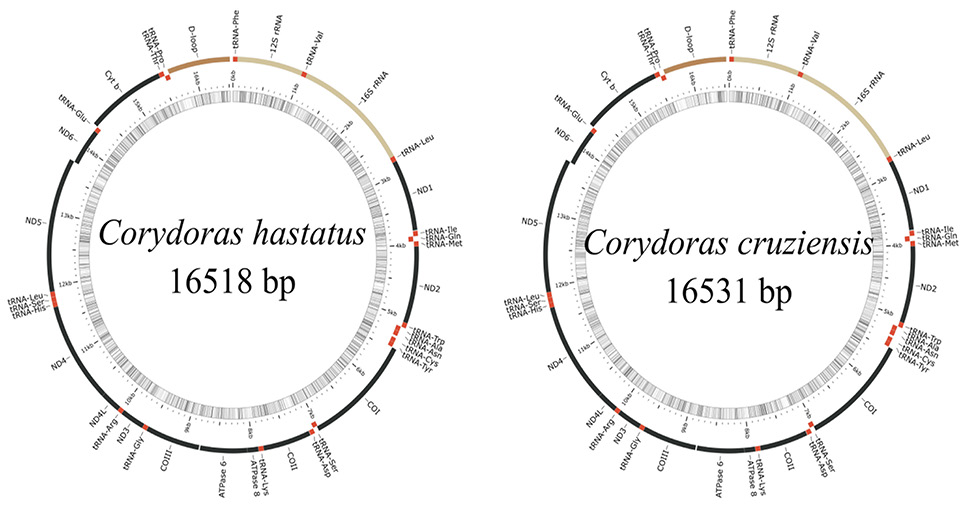
Circular maps of Corydoras hastatus (left) and Corydoras cruziensis (right) mitochondrial genomes.
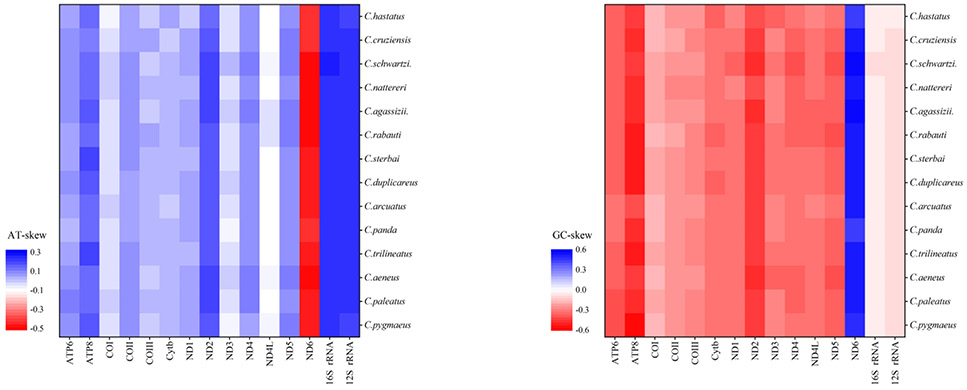
AT and GC skews for protein-coding genes and ribosomal RNA genes of 14 Corydoras mitochondrial genomes.
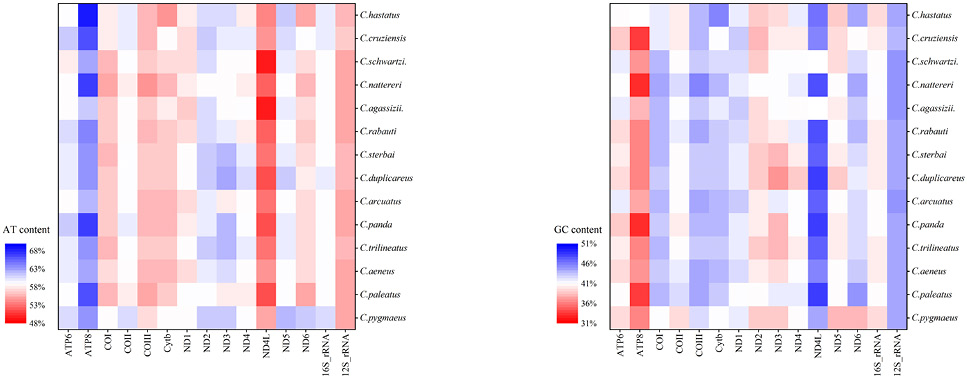
AT and GC contents of protein-coding genes and ribosomal RNA genes in 14 Corydoras mitochondrial genomes.
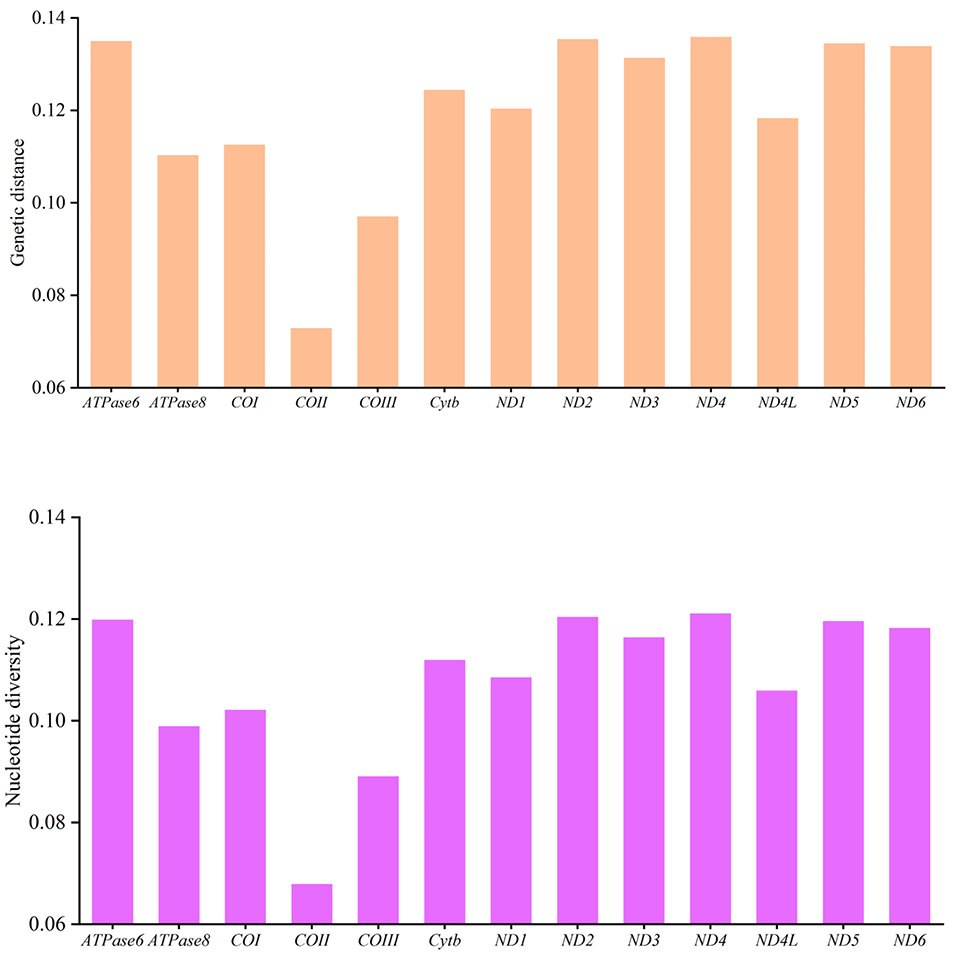
Genetic distances and nucleotide diversity of protein-coding genes in 14 Corydoras mitochondrial genomes.
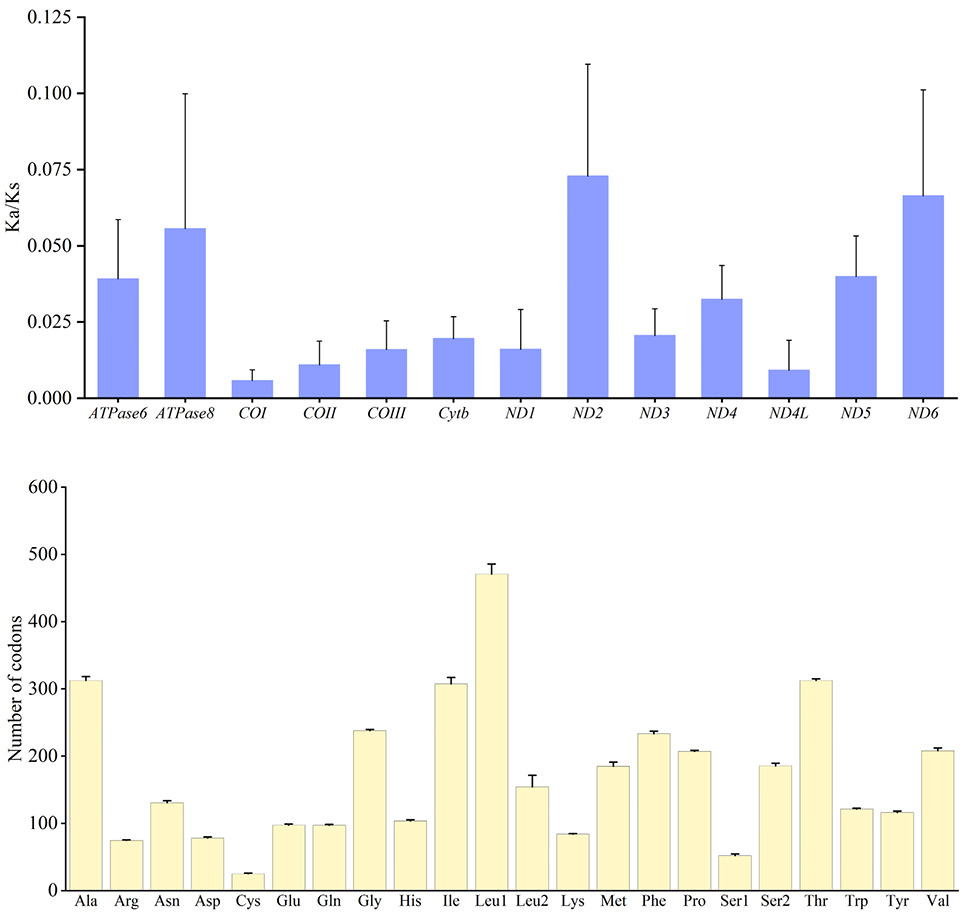
Ka/Ks ratios and number of codons in protein-coding genes of 14 Corydoras mitochondrial genomes.
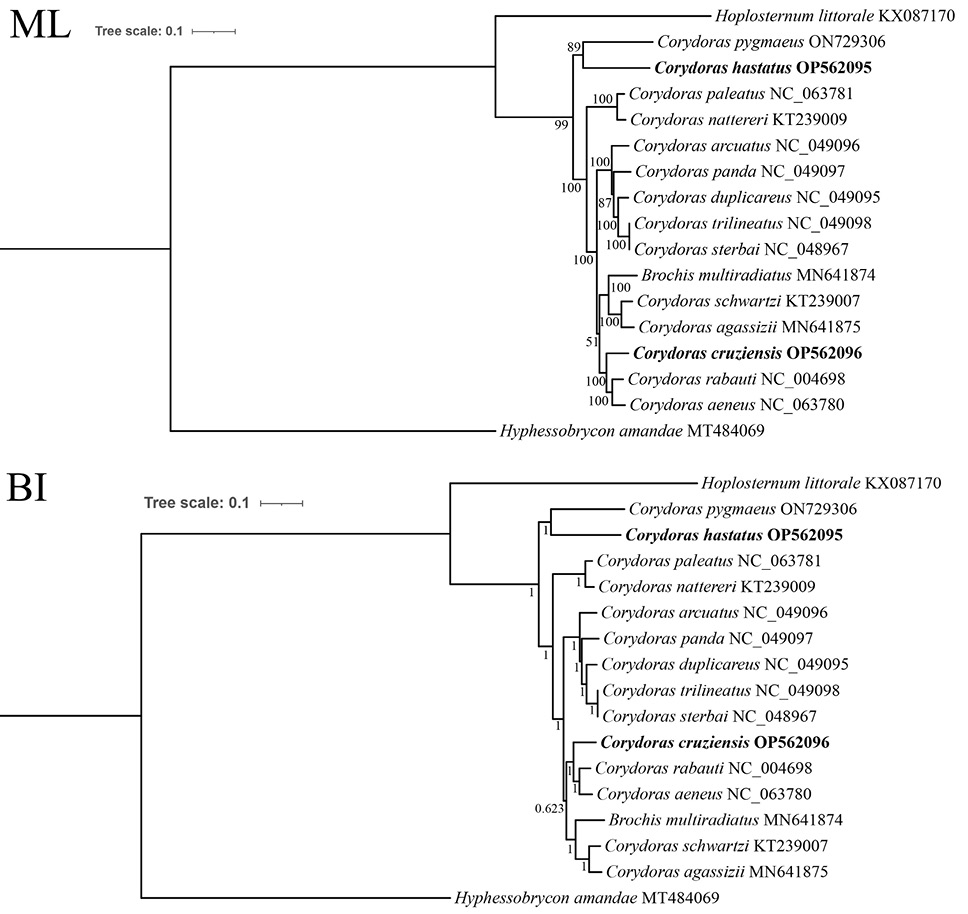
Phylogenetic relationships of Corydoras based on complete mitochondrial genomes inferred using maximum likelihood (ML) and Bayesian inference (BI) analyses.
References
- Alexandrou, M.A., Oliveira, C., Maillard, M., McGill, R.A., Newton, J., Creer, S. and Taylor, M.I., 2011. Competition and phylogeny determine community structure in Müllerian co-mimics. Nature, 469: 84–88. https://doi.org/10.1038/nature09660[CrossRef]
- Avise, J.C., 2009. Phylogeography: Retrospect and prospect. J. Biogeogr., 36: 3–15. https://doi.org/10.1111/j.1365-2699.2008.02032.x[CrossRef]
- Bankevich, A., Nurk, S., Antipov, D., Gurevich, A.A., Dvorkin, M., Kulikov, A.S., Lesin, V. M., Nikolenko, S.I., Pham, S., Prjibelski, A.D., Pyshkin, A.V., Sirotkin, A.V., Vyahhi, N., Tesler, G., Alekseyev, M.A. and Pevzner, P.A., 2012. SPAdes: A new genome assembly algorithm and its applications to single-cell sequencing. J. Comput. Biol., 19: 455–477. https://doi.org/10.1089/cmb.2012.0021[CrossRef]
- Bernt, M., Donath, A., Jühling, F., Externbrink, F., Florentz, C., Fritzsch, G., Pütz, J., Middendorf, M. and Stadler, P.F., 2013. MITOS: Improved de novo metazoan mitochondrial genome annotation. Mol. Phylogenet. Evol. 69: 313–319. https://doi.org/10.1016/j.ympev.2012.08.023[CrossRef]
- Boore, J.L., 1999. Animal mitochondrial genomes. Nucl. Acids Res., 27: 1767–1780. https://doi.org/10.1093/nar/27.8.1767[CrossRef]
- Britto, M.R., 2003. Phylogeny of the subfamily Corydoradinae Hoedeman, 1952 (Siluriformes: Callichthyidae), with a definition of its genera. Proc. Acad. Nat. Sci. Phila., 153: 119–154. https://doi.org/10.1635/0097-3157(2003)153[0119:POTSCH]2.0.CO;2[CrossRef]
- Broughton, R.E., Milam, J.E. and Roe, B.A., 2001. The complete sequence of the zebrafish (Danio rerio) mitochondrial genome and evolutionary patterns in vertebrate mitochondrial DNA. Genome Res., 11: 1958–1967. https://doi.org/10.1101/gr.156801[CrossRef]
- Burgess, W., 1992. Colored atlas of miniature catfish. T.F.H. Publications, United States.
- Compagno, L.J.V., 1990. Alternative life-history styles of cartilaginous fishes in time and space. Environ. Biol. Fish., 28: 33–75. https://doi.org/10.1007/978-94-009-2065-1_3[CrossRef]
- Glasauer, S.M.K. and Neuhauss, S.C.F., 2014. Whole-genome duplication in teleost fishes and its evolutionary consequences. Mol. Genet. Genom., 289: 1045–1060. https://doi.org/10.1007/s00438-014-0889-2[CrossRef]
- Gu, Y.L., Sun, C.H., Liu, P., Zhang, X., Sinev, A.Y., Dumont, H.J. and Han, B.P., 2022. Complete mitochondrial genome of Ovalona pulchella (Branchiopoda, Cladocera) as the first representative in the family Chydoridae: Gene rearrangements and phylogenetic analysis of Cladocera. Gene, 818: 146230. https://doi.org/10.1016/j.gene.2022.146230[CrossRef]
- Guindon, S., Dufayard, J.F., Lefort, V., Anisimova, M., Hordijk, W. and Gascuel, O., 2010. New algorithms and methods to estimate maximum-likelihood phylogenies: Assessing the performance of PhyML 3.0. Syst. Biol., 59: 307–321. https://doi.org/10.1093/sysbio/syq010[CrossRef]
- Hauser, L. and Carvalho, G.R., 2008. Paradigm shifts in marine fisheries genetics: Ugly hypotheses slain by beautiful facts. Fish Fisheries, 9: 333–362. https://doi.org/10.1111/j.1467-2979.2008.00299.x[CrossRef]
- Huelsenbeck, J.P. and Ronquist, F., 2001. MrBayes: Bayesian inference of phylogenetic trees. Bioinformatics, 17: 754–755. https://doi.org/10.1093/bioinformatics/17.8.754[CrossRef]
- Hurst, C.D., Bartlett, S.E., Davidson, W.S. and Bruce, I.J., 1999. The complete mitochondrial DNA sequence of the Atlantic salmon, Salmo salar. Gene, 239: 237–242. https://doi.org/10.1016/S0378-1119(99)00425-4[CrossRef]
- Iwasaki, W., Fukunaga, T., Isagozawa, R., Yamada, K., Maeda, Y. and Satoh, T.P., 2013. MitoFish and MitoAnnotator: A mitochondrial genome database of fish with an accurate and automatic annotation pipeline. Mol. Biol. Evol., 30: 2531–2540. https://doi.org/10.1093/molbev/mst141[CrossRef]
- Jia, C., Zhang, X., Xu, S., Yang, T., Yanagimoto, T. and Gao, T., 2020. Comparative analysis of the complete mitochondrial genomes of three rockfishes (Scorpaeniformes, Sebastiscus) and insights into the phylogenetic relationships of Sebastidae. Biosci. Rep., 40. https://doi.org/10.1042/BSR20203379[CrossRef]
- Kalyaanamoorthy, S., Minh, B.Q., Wong, T.K.F., von Haeseler, A. and Jermiin, L.S., 2017. Model finder: Fast model selection for accurate phylogenetic estimates. Nat. Methods, 14: 587–589. https://doi.org/10.1038/nmeth.4285[CrossRef]
- Kelsh, R.N., 2004. Genetics and evolution of pigment patterns in fish. Pigment Cell Res., 17: 326–336. https://doi.org/10.1111/j.1600-0749.2004.00174.x[CrossRef]
- Knaack, J., 2002. Ein weiterer Neuer Panzerwels aus Bolivien: Corydoras cruziensis n. sp. (Pisces, Siluriformes, Callichthyidae). VDA-aktuell, 3: 60–69.
- Kumar, S., Tamura, K. and Nei, M., 1994. MEGA: Molecular evolutionary genetics analysis software for microcomputers. Comput. appl. Biosci., 10: 189–191. https://doi.org/10.1093/bioinformatics/10.2.189[CrossRef]
- Kurtz, S., Phillippy, A., Delcher, A.L., Smoot, M., Shumway, M., Antonescu, C. and Salzberg, S.L., 2004. Versatile and open software for comparing large genomes. Genome Biol., 5: R12. https://doi.org/10.1186/gb-2004-5-2-r12[CrossRef]
- Lemos, B., Meiklejohn, C.D., Cáceres, M. and Hartl, D.L., 2005. Rates of divergence in gene expression profiles of primates, mice, and flies: Stabilizing selection and variability among functional categories. Evolution, 59: 126–137. https://doi.org/10.1111/j.0014-3820.2005.tb00900.x[CrossRef]
- Letunic, I. and Bork, P., 2016. Interactive tree of life (iTOL) v3: An online tool for the display and annotation of phylogenetic and other trees. Nucl. Acids Res., 44: W242–W245. https://doi.org/10.1093/nar/gkw290[CrossRef]
- Lévêque, C., Oberdorff, T., Paugy, D., Stiassny, M.L.J. and Tedesco, P.A., 2008. Global diversity of fish (Pisces) in freshwater. Hydrobiologia, 595: 545–567. https://doi.org/10.1007/s10750-007-9034-0[CrossRef]
- Librado, P. and Rozas, J., 2009. DnaSP v5: A software for comprehensive analysis of DNA polymorphism data. Bioinformatics, 25: 1451–1452. https://doi.org/10.1093/bioinformatics/btp187[CrossRef]
- Liu, G.H., Shao, R., Cai, X.Q., Li, W.W. and Zhu, X.Q., 2015. Gnathostoma spinigerum mitochondrial genome sequence: A novel gene arrangement and its phylogenetic position within the class Chromadorea. Sci. Rep., 5: 12691. https://doi.org/10.1038/srep12691[CrossRef]
- Lowe, T.M. and Eddy, S.R., 1997. TRNAscan-SE: A program for improved detection of transfer RNA genes in genomic sequence. Nucl. Acids Res., 25: 955–964. https://doi.org/10.1093/nar/25.5.955[CrossRef]
- Menni, R.C., Miquelarena, A.M., Lopez, H.L., Casciotta, J.R., Almiron, A.E. and Protogino, L.C., 1992. Fish fauna and environments of the pilcomayo-paraguay basins in formosa, argentina. Hydrobiologia, 245: 129–146. https://doi.org/10.1007/BF00006154[CrossRef]
- Minh, B.Q., Nguyen, M.A.T. and von Haeseler, A., 2013. Ultrafast approximation for phylogenetic bootstrap. Mol. Biol. Evol., 30: 1188–1195. https://doi.org/10.1093/molbev/mst024[CrossRef]
- Moberly, J.G., Bernards, M.T. and Waynant, K.V., 2018. Key features and updates for Origin 2018. J. Cheminform., 10: 5. https://doi.org/10.1186/s13321-018-0259-x[CrossRef]
- Moore, W.S., 1995. Inferring phylogenies from mtDNA variation: Mitochondrial-gene trees versus nuclear-gene trees. Evolution, 49: 718–726. https://doi.org/10.1111/j.1558-5646.1995.tb02308.x[CrossRef]
- Nguyen, L.T., Schmidt, H.A., von Haeseler, A. and Minh, B.Q., 2015. IQ-TREE: A fast and effective stochastic algorithm for estimating maximum-likelihood phylogenies. Mol. Biol. Evol., 32: 268–274. https://doi.org/10.1093/molbev/msu300[CrossRef]
- Perna, N.T. and Kocher, T.D., 1995. Patterns of nucleotide composition at fourfold degenerate sites of animal mitochondrial genomes. J. mol. Evol., 41: 353–358. https://doi.org/10.1007/BF01215182[CrossRef]
- Roxo, F.F., Ochoa, L.E., Sabaj, M.H., Lujan, N.K., Covain, R., Silva, G.S.C., Melo, B.F., Albert, J.S., Chang, J., Foresti, F., Alfaro, M.E. and Oliveira, C., 2019. Phylogenomic reappraisal of the Neotropical catfish family Loricariidae (Teleostei: Siluriformes) using ultraconserved elements. Mol. Phylogenet. Evol., 135: 148–165. https://doi.org/10.1016/j.ympev.2019.02.017[CrossRef]
- Ruan, H., Li, M., Li, Z., Huang, J., Chen, W., Sun, J.J., Liu, L. and Zou, K.S., 2020. Comparative analysis of complete mitochondrial genomes of three Gerres fishes (Perciformes: Gerreidae) and primary exploration of their evolution history. Int. J. mol. Sci., 21: 1874. https://doi.org/10.3390/ijms21051874[CrossRef]
- Saha, S., Song, N., Baki, M.A., Yang, T. and Gao, T., 2021. Characterization and phylogenetic analyses of the complete mitochondrial genome of Sillaginopsis panijus (Perciformes: Sillaginidae). Mitochondrial DNA B Resour., 6: 3202–3203. https://doi.org/10.1080/23802359.2021.1989339[CrossRef]
- Serra, W.S., Scarabino, F. and Paullier, S., 2018. First record of Serrapinnus kriegi (Schindler, 1937) and confirmed presence of S. calliurus (Boulenger, 1900) for Uruguay (Characiformes: Characidae). Ichthyol. Contrib. Peces Criollos., 59: 1–6.
- Sevilla, R.G., Diez, A., Norén, M., Mouchel, O., Jérôme, M., Verrez-Bagnis, V., van Pelt, H., Favre-Krey, L., Krey, G. and Bautista, J.M., 2007. Primers and polymerase chain reaction conditions for DNA barcoding teleost fish based on the mitochondrial cytochrome b and nuclear rhodopsin genes. Mol. Ecol. Notes, 7: 730–734. https://doi.org/10.1111/j.1471-8286.2007.01863.x[CrossRef]
- Sun, C.H., Huang, Q., Zeng, X.S., Li, S., Zhang, X.L., Zhang, Y.N., Liao, J., Lu, C.H., Han, B.P. and Zhang, Q., 2022. Comparative analysis of the mitogenomes of two Corydoras (Siluriformes, Loricarioidei) with nine known Corydoras, and a phylogenetic analysis of Loricarioidei. ZooKeys, 1083: 89–107. https://doi.org/10.3897/zookeys.1083.76887[CrossRef]
- Sun, C.H., Liu, H.Y. and Lu, C.H., 2020. Five new mitogenomes of Phylloscopus (Passeriformes, Phylloscopidae): Sequence, structure, and phylogenetic analyses. Int. J. Biol. Macromol., 146: 638–647. https://doi.org/10.1016/j.ijbiomac.2019.12.253[CrossRef]
- Sun, C.H., Liu, H.Y., Xu, N., Zhang, X.L., Zhang, Q. and Han, B.P., 2021. Mitochondrial genome structures and phylogenetic analyses of two tropical Characidae fishes. Front. Genet., 12: 627402. https://doi.org/10.3389/fgene.2021.627402[CrossRef]
- Walker, B.J., Abeel, T., Shea, T., Priest, M., Abouelliel, A., Sakthikumar, S., Cuomo, C.A., Zeng, Q.D., Wortman, J., Young, S.K. and Earl, A.M., 2014. Pilon: An integrated tool for comprehensive microbial variant detection and genome assembly improvement. PLoS One, 9: e112963. https://doi.org/10.1371/journal.pone.0112963[CrossRef]
- Zhang, D., Gao, F., Jakovlić, I., Zou, H., Zhang, J., Li, W.X. and Wang, G.T., 2020. PhyloSuite: An integrated and scalable desktop platform for streamlined molecular sequence data management and evolutionary phylogenetics studies. Mol. Ecol. Resour., 20: 348–355. https://doi.org/10.1111/1755-0998.13096[CrossRef]
- Zheng, J., Chen, B., Gao, T. and Song, N., 2021. The mitochondrial genome of Chaeturichthys stigmatias provides novel insight into the interspecific difference with Amblychaeturichthys hexanema. Acta Oceanol. Sin., 40: 74–81. https://doi.org/10.1007/s13131-021-1787-1[CrossRef]
Services
Article usage statistics
Loading…